Author: Ann Bauer

  • A Declining Week in Wine

    pl.jpg

    I have a wicked wanderlust. This is one of the reasons I ride a motorcycle: because on any given Saturday I’m willing to take off and hit a small town in South Dakota — as long as it’s one I’ve never seen before. I’ll also seize whatever random opportunity comes my way to get on a plane and BE somewhere else for a while. This week, I went out to New York City in order to give a 20-minutes speech at the New York Academy of Medicine. At least, that was the plan.

    On the panel were one of the world’s top research psychiatrists, a doc from Johns Hopkins, a graduate of Harvard Medical School and, uh. . . .me. No pressure there.

    I was last on the agenda, going immediately after the woman from Hopkins who’d single-handedly set up a peds unit for critically ill children while raising two kids of her own and no doubt darning her husband’s silk socks. But after hours worth of PowerPoint presentations, each of which had multiple technical difficulties, the moderator looked at me and said in a genuinely gloomy tone, “I’m so sorry, our program has gone over time, you’ll have to keep your comments to five minutes. Seven at most.”

    There was wine at my left hand: a glass of Beaulieu Vineyards Chardonnay, which is the Skippy peanut butter of white wines. It’s cheap and if not high-brow, perfectly fine — even marginally satisfying — once you get a few swallows in. Well, ordinarily, I don’t drink before speaking (which is why the full glass was sitting there, untouched). But in this case, I made an exception and downed about a third in what I hope was a ladylike motion, rose and said, “Well, I’m a writer, I’m used to being edited,” then gave my 20-minute talk in 6 minutes flat.

    It was a lovely trip, really. The Academy people couldn’t have been nicer. No, that’s not true. They could have been the guy with dreads and a grease-stained jacket at Grand Central who swiped his very own Metro card for me and whispered, “Go,” when I was ineptly trying to rush the turnstile and catch the Lexington Avenue train.

    I had lunch with my agent at the Blue Water Grill, a terrific, casual publishing hang-out on Union Square. (And yes, for those of you — thank you — who are reading closely: the agent responded, the book is being tweaked and readied for editors’ eyes. My neurosis about it grinds endlessly on.) We ate some great spicy tuna rolls and assorted other sushi, but we didn’t have wine over lunch, which is a shame, really, because it probably would have been the only decent glass of my week.

    As it was, things went downhill from the Skippy-level Chardonnay.

    I went to the airport yesterday afternoon, dashed in feeling late, in fact, for what was to have been a 6:30 flight. After I stood in line and got my e-ticket, however, I noticed the time had been changed to 6 o’clock. “How odd,” I thought. “They rarely move the flight times back.” That, of course, is when I realized that not only had the time been changed, the date had as well. This morning, six a.m., and I had no place to spend the night.

    The woman behind the American Airlines counter was on the phone, speaking Italian. She hung up, turned to the couple at my side, and had a rapid conversation in Spanish. By the time she turned to me, I’d put her right up next to the doctor with the seven or eight Ivy League M.D.’s. (People who speak multiple languages always intimidate me in a biblical, highly evolved sort of way.) I showed her my ticket and she punched something into her computer. “Northwest at 10:45,” she said in a gruffly lilting Puerto Rican accent. “The weather is bad. They might let you on, might not.”

    Which is how I ended up, elbow-to-elbow with a furniture salesman from Detroit, at the bar in the Delta terminal at La Guardia, asking for a wine list. To which the bartender scoffed. “We got red,” he said, holding up a crusty bottle of Kendall-Jackson Merlot. This is one of those wines I’ll drink at a pub, if I absolutely must. If it’s that or, say, Schlitz. So I said, “Sure,” and he tipped the bottle, but what came out was more the consistency of slurry than wine. The only taste I took was thick and scorched, like the stuff that dribs onto the bottom of the oven when you bake a blueberry pie. I switched to soda water, which the furniture salesman insisted on putting on his tab, and waited among thousands of hot, stranded bodies for my plane to land.

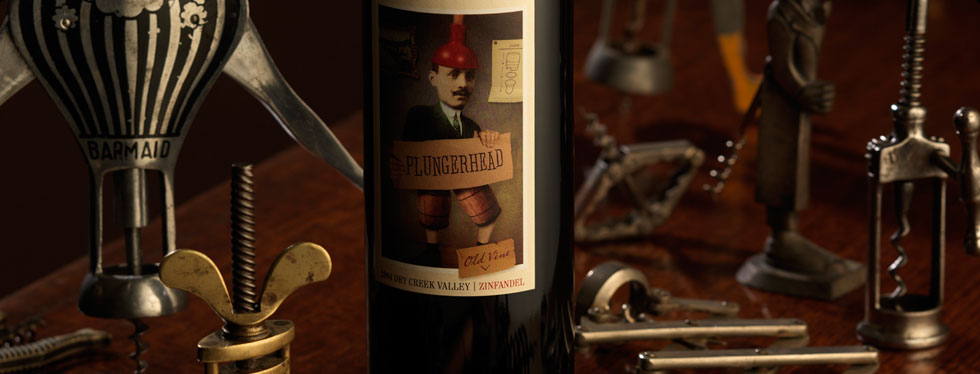
    They let me on the plane. I nearly wept. My husband picked me up from the nearly deserted nighttime airport on the other side. We came home and despite the late hour, opened a bottle of wine. It was corked. So we opened another — the only one we had. It happened to be an odd vintage with a demented Robert Crumb-ish label called Plungerhead Old Vine Zinfandel 2005, which someone had given me insisting it was good. It’s made by The Other Guys, a whimsical little division of the mega-corporate Don Sebastiani & Sons.

    This wine is called Plungerhead, apparently, because it’s sealed with a “zork” — a rubbery little mushroom top cap that’s been wrapped with a spiral of plastic you have to unzip. It’s supposed to keep the wine good. Well guess what? It isn’t good to begin with. At least this bottle — at 1:30 a.m. on a Friday morning, after a total of 12 hours spent sitting on airplanes and in airports over the space of only 24 — didn’t seem so to me. It has a nose of cranberry and cough syrup, and a flavor to match, only the taste fades quickly in a sour way. And I expect more from a basic $12-14 bottle of Zin.

    The only good part: Plungerhead has a whopping 14.8% alcohol, which made it better than Nyquil for knocking me out.

    I can’t say I’m sorry for the way of the week. Typically, my days are full of sameness and routine, interrupted from time to time with a really fine glass of wine. This was a whirlwind of activity, new experience, and truly putrid drinking. Life is meant to be lived, after all, and an adventurer is bound to run into a few snags (seen Into the Wild, anyone?). As trade-offs go, this one — compared to killing a moose, eating poison and dying a lonely death — wasn’t so bad. But I’m looking forward to something far better when I tilt my glass tonight.
  • The Staff of Life. . . .Shouldn't it be free?

    bread.jpeg

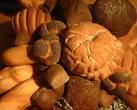
    A reader e-mailed this morning to tell us about a South Minneapolis bistro (I won’t say which one. . . .because this is a common practice) where she and a friend enjoyed their entrées but were completely put off after being charged separately for the bread — a couple paltry, obviously store-bought slices of baguette served with two foil packs of butter.

    “Our meal, with wine but no desserts, came to more than $60 for two,” she wrote. “I can understand a restaurant trying to save money by not automatically setting out a bread basket. But once you’ve ordered — at that price — shouldn’t bread be part of the deal?”

    As one of those people who rarely eats bread, I’m sometimes surprised by the number of restaurants that still do set down a bulging basket at the outset of every meal. My husband might take a slice or two, but we’ll typically send back half a loaf to be discarded (I hope!) in the kitchen.

    Personally, I agree with our reader: the best solution is for patrons who want bread to request it, so entire baskets don’t go to waste; but at a certain price point — say, $20 a head — it really should come gratis. Manna from. . . .well, you get the idea.

    Dissenters?

  • Fin: An End to the Reverie at Dusk

    118383.jpg

    I drink at dusk in autumn.

    This is dangerous, as dusk comes a little earlier every day, cutting my afternoon off at 6:30, then 6, and then, suddenly, this past weekend, around half past 5.

    I can almost feel the lonely, lavender air come down like a curtain, or a veil. The world dims in quick shutter stages, the leaves in the driveway swirl and scratch, and I love all this in the same way I enjoy sad movies. Throat aching, I sit looking out the window. I might as well drink; it’s not as if I’m going to get anything done.

    This time of year always reminds me of when I lived in Duluth, fall of 1990. Dusk was later up north, but it came down like a sheet of dark water. The wind in the maples made an eerie whistle and on murky evenings we could hear the foghorn blowing across the lake.

    I was 24 and in love, but anxious too. About my husband’s addiction, the future for my two young sons, the rent and oil bills and groceries we couldn’t afford. Dusk came and I remember, I always felt a slice of fear.

    I still do. I think there’s a moment — you can miss it if you’re working or inside a bright kitchen or talking on the phone — when the world goes from light to dark and crosses something empty. It’s that moment when I always realize that we’re actually, each of us, simply stranded in a little sphere of gravity, exhaling useless carbon dioxide, unnecessary, really. And completely alone.

    Nothing matters in that moment: even for me, a mother who loves her three with a wild, irrational force, there is no real purpose in putting children forth. They’re only walking out into a world with random car crashes and weak blood vessels, after all. And money — what IS money, anyway? — which will govern their lives but ultimately come to nothing. Paper, like leaves. . . .

    And no news, whether of despots or ecologists, really matters either. Claim a country, for what? And sustainability? It’s a pipe dream. Everything is temporary, just a flash of activity occurring in a particular time. There is nothing to sustain because in the end it’s only earth and water and sky.

    It is at this point, that crevice of early evening when I begin thinking pleasantly maudlin thoughts, that I pour a half glass of wine. I drink for a moment or two — just a bit, that’s all it takes; the habit as helpful, I think, as the alcohol itself — and suddenly, I’ve bridged the empty place, reached the other side, reattached myself to things, to people, to the dollar bills in my wallet. It’s an easy ritual, effective, benign, and warm.

    For my former husband, however, the cure never did take. I understand now, in ways I didn’t before, that he felt constantly, as many addicts do, that gap between light and dark. He once told me, after we’d been married for about ten years, that he was alone, always. And I became furious. Was I not a good wife? A constant presence? A comfort?

    The answer is no — to the last, at least. I live today with wry teenagers and a wonderful, new husband, happy in most things and tethered to ordinary events roughly 23 hours a day; yet I often feel that dusky, wise melancholy creep in. And make no mistake. Though I treat it, as do many people I know, with only moderate amounts of good wine, I share something with the man I knew back in Duluth, father to sweet babies and a genuinely lost soul, who kept trying to fill the empty space with tokes and lines, Jack Daniels and Miller Lite.

    Saturday, probably the last good riding day of the year, my husband and I were on our motorcycle headed west into a sky like dark felt cracked with fiery gold. We cornered sharply, taking the ramp onto 394, and I thought, as I do so often, “We could die,” then immediately, “But, of course, it would matter so little and to so few.” And this was, in the molten light of the setting sun, somehow comforting.

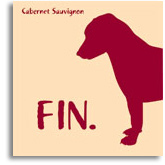
    We came home then, quiet, both of us, and opened a strange screwcap wine called Fin., a fruity, currant and cherry-filled Cabernet Sauvignon from 2005.

    I sat at the table with my glass. It took only a few ounces, a quiet space in time filled with the smell of fresh, chopped garlic, and there was that sudden lifting of my disbelief. I stood to help my husband with dinner. Once again, I’d crossed the gap. Dusk was gone.

  • Mea Culpa: I Forgot Zander

    When A Rebours closed earlier this fall, I — and just about every other food writer in the Twin Cities — bemoaned the dearth of fine dining in St. Paul.

    “I don’t know what’s happened,” I wrote on September 20. “There’s practically nowhere left in St. Paul to get a decent upscale meal. The only exceptions are Heartland and I Nonni.”

    But how could I have forgotten Zander Cafe, which has been serving terrific, reasonably-priced and very fine food and wine in Cathedral Hill for nearly ten years? I just don’t know. Perhaps it’s because this modest little brick building on Selby Avenue has a polka-dot sign in kitchen appliance blue that reminds me of the early 1970’s and my mother in stirrup pants doing exercises in front of the TV with Jack La Lanne. Or it could be because Zander closed for three months this summer for a renovation that was completed in the long, slow days of late July.

    In any case, consider the omission corrected.

    I went to Zander for drinks on Friday, ended up staying for a bite to eat, and was utterly charmed. First, there was the wine list — note, this is where wine mogul Sam Haislet of Sam’s Wine Shop got his start as a server and ad hoc sommelier — which included a Domaine de Piaugier Rhone wine by the glass. It was smooth, full of cranberry and raisin, with a nice, hot finish, for only $8.25. And the full wine list offered some incredible values, such as a Foris Pinot Noir for $25 (I pay about $17 retail) and an entire section devoted to Chateauneuf-du-Pape.

    I shared an order of Pappardelle Monte Cristo, a mosaic of noodles, fresh basil, pan-fried eggplant, goat cheese, and roasted red pepper tapenade, which was chewy and crisp, earthy with herbs and cheese, smoky and thick and warm. But best? I talked to Alexander Dixon, the eponymous chef “Zander” who — if you don’t mind my saying (Who else will, after all? Jeremy?) — is one of the cutest, most unassuming chef/owners in town.

    He’s a hirsute and rather rumpled fellow, with owlish eyes behind heavy horn-rimmed specs. And he slinks through the restaurant like some random guy who was sent to check the heating ducts. In fact, Dixon stopped by, even before introductions were made, to talk about the strange, aching gospel-ish music (Nina Simone) that was playing in the bar.

    And about his renovation — a clean bit of sprucing with terra cotta walls in butter and moss, tatami carpet, and desert photos in frames — Dixon said, simply, “It was time.” The man who created what he called a “crude, urban bistro” in 1998 was ready to dress things up.

    His customers, apparently, are not. There were diners in jeans and terry cloth sweatsuits, scruffy in that unmistakable St. Paul style, supping on Three-Soup Mosaic, Salmon en Papillote, and Moroccan Lamb Kabob. Afterward, dressed down as they were, these same patrons might have stepped into Zander’s piano bar — Ferdinand’s, according to the retro sign outside — to listen to a group called the Tributary Jazz Ensemble.

    The Dakota this is not. There were no sleek suited men or women carrying lizard bags or people taking money at the door. The piano had worn keys and the menus were paper, not leather-bound. But I’d put Dixon’s cuisine up against any in town. And there are few places I’d rather hang out than at his little 7-seat bar. Drinking Rhone wine and listening to the throaty grace of Nina Simone.

    In St. Paul. Now, isn’t that a wonder?

  • Stock Your Cellar

    cellar.jpeg

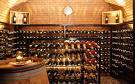
    Today is the last day of Surdyk’s Annual Fall Wine Sale, with 20-35% off bottles throughout the store. So if you’re into the old-style guys-in-ties-and-striped-aprons ambiance of the place — or in the mood for some extraordinary cave-aged Cheddar cheese, also on sale in The Cheese Shop next door — you have until 10 p.m. to make it there.

    Should you be out of town, however, touring the north country and looking at leaves on this exquisite autumn day, try Haskell’s — any one of their 8 Twin Cities stores — where Mr. Farrell and the boys are running their own Fall Wine Sale, ’til Saturday the 27th, with discounts of 30-70%. One of the largest wine purveyors in the country, Haskell’s carries bottles ranging from $6 to $160 right on the floor. You’ll have to ask if you want a Chateau Lafite-Rothschild, however; they keep it in back.

  • Semen Sent Same-Day Mail

    Winner of the best opening line of the day: On Labor Day weekend, a midwife’s favorite holiday, Louise Sloan, a 41-year-old lesbian, had semen Fed Exed to her mother’s summer place in Kennebunkport, Maine. Read the rest of the article here.

  • This Year's Hottest Gifts: Goats, Guinea Pigs, and Water Buffalo

    0710newimagebb.jpg

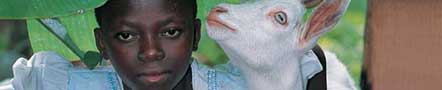
    At first, I thought it was a joke. Heifer International just sent me a holiday catalog offering me the opportunity to buy a water buffalo for $250 and ship it to Cambodia. I could also buy a share of a buffalo, for just $25. And this is serious.

    Heifer International is a private nonprofit agency that sends animals — chickens, pigs, rabbits, even llamas — to impoverished communities around the world. Their mission is to promote sustainable food production and end hunger, and they do this by donating both “edible” creatures (including guinea pigs — a major source of protein in Ecuador) and working animals, such as donkeys, camels and bees.

    I don’t know what the ecological cost is to mail a goat to Haiti, or an ox to Uganda, and this was the one question I couldn’t answer by visiting the Heifer site. But everything else this organization is doing seems spot-on.

    Heifer International:

    Provides farm materials and training in sustainable agriculture methods.
    Helps disaster victims rebuild their towns and agrarian communities.
    Encourages recipients to “pass on” the offspring their animals produce.

    Plus, they have a bunch of shiny, sexy people involved: Susan Sarandon, Ted Danson, and the mother from a television show called Malcolm in the Middle, whose name I didn’t recognize. The organization also has testimonials from Bill Clinton and Jane Goodall, which was far more convincing to me. Enough so I’m now signed up to sponsor a part of a Russian cow.

    “If an economically poor country is to conserve its wildlife heritage, this means additional hardships for the peasants, in many cases,” said Dr. Goodall. “Thus it is necessary to build conservation into a package — money for rural development programs, agroforestry, medical help, controlled tourism, etc. Heifer International fits absolutely right in with this overall plan.”

    But I’m afraid Heifer is going to have to reach for some new spokespeople if they want to entice the next generation. My 13-year-old daughter (the one who explained to me about Malcolm) paged through the catalog and said, “Wow, this is cool. If they got that guy from Las Vegas, I would TOTALLY buy a whole buffalo.”

    If you’d like more information about Heifer International, visit their website or call 1-800-422-0755.

  • A cigar, a long tunnel, and King Triton's castle. . . .

    100_35291.JPG

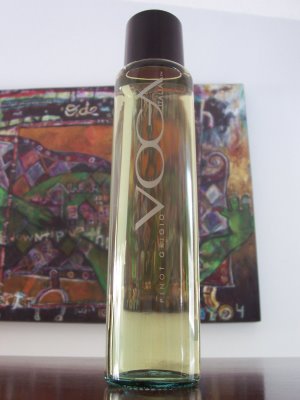
    Now this. My good friend and loyal reader, Schneider, sent the photo above in response to my October 11 Jug O’ Wine entry about unexpected bottle shapes.

    Hmmmmmmm.

    Now, maybe I’ve just taken too many film theory classes (Am I, by the way, the only person in America who believes Die Hard was a romance between Bruce Willis and Reginald VelJohnson that climaxed — so to speak — when their hands met in front of a towering skyscraper that rose to pierce the clouds?), but it seems to me the Voga Italia bottle may have been designed to be. . . .um. . . .multi-purpose.

    I haven’t tried the Pinot Grigio. To tell the truth, I don’t want to — I prefer a more traditional, less organic shape in my wine containers. But you can read Schneider’s far less Freudian analysis here.

  • Stage Mother

    Patricia Olive has no children. So you’d think she’d be spared that dinnertime nightmare: This one hates vegetables, this one eats only bologna sandwiches with ketchup, this one weeps about dead animals every time you serve beef. But when the Guthrie Theater staged Six Degrees of Separation in 2003, the veteran props manager got a taste of what it’s like.

    “In the play, a young con artist makes pasta for a huge party,” Olive says. “It had to be real because there’s a long scene where the actors are eating it. But one was allergic to wheat products and another one refused to eat anything with tomatoes, green peppers, or onions.” Ultimately, a compromise was concocted: rice pasta topped with blackberry applesauce that had been blended with a drop of yellow food coloring, making it a deep orange. “We spent a long time experimenting to come up with that.”

    But even with Olive’s hard work and careful planning, a new problem emerged: permanently stained napkins that had to be thrown away after each show.

    “We discovered the actors were pretending to eat this vile pasta, then spitting it into their napkins,” Olive laughs. “So over the course of the run, the portions got smaller and smaller.”

    Olive grew up in Detroit. She earned a degree from Western Michigan University in industrial education, and started her career in 1976 as a shop teacher in the Kalamazoo public schools. But she was always involved in theater: community, summer stock, experimental.

    After nine years as a teacher, she took a job as the production manager for a small theater company in Florida. And she’s been in theater full time ever since. She worked in New Jersey, Tennessee, and Colorado before a friend mentioned in 2002 that the Guthrie Theater needed an experienced prop manager.

    “I’d only ever driven through Minnesota,” Olive says. “But the Guthrie has such a wonderful reputation. Then I met with [artistic director] Joe Dowling. And that was it.”

    In addition to consulting on sets and costumes, Olive oversees every single item actors use on stage: stuffed animals, bells, power tools. She has an associate manager, Sarah Gullickson, and a staff of six, plus a sewing area, a prop room in the theater, a warehouse on East Hennepin Avenue, and an on-site kitchen for preparing food that will be consumed during performances.

    She had to fight for that last amenity.

    “When the architects sent over the plans for the new theater, the prop kitchen they gave us was only six feet wide,” she recalls. “That wasn’t even enough room to open a dishwasher or oven door.” After some negotiating, Olive got a real working kitchen, about the size you’d find in an efficiency apartment.

    Still, much of the food that appears on stage is fake. The seedcake served by Miss Temple in the current production of Jane Eyre, for instance, is made of painted upholstery foam, joint compound, and Flex glue; the “seeds” actually are pockmarks made with the end of a black Sharpie pen. Nevertheless, Olive and her crew did bake an authentic cake to use as a model.

    In another currently running play, The Home Place, the actors eat shortbread and cold beef sandwiches—which are real, prepared by a prop liaison during each performance—and drink “Irish whiskey”—actually watered-down, unsweetened, decaffeinated instant iced tea.

    “Often we need to provide something that looks like alcohol,” says Olive. “Juicy Juice is our wine of choice—we’ve found if it’s spilled on a costume it will wash out.”

    Some plays call for a combination of real and fake food. In the recent production of Private Lives, for instance, the actors both ate and threw brioche. Rather than waste dozens of rolls a day—and deal with the inevitable crumbs that would be left all over the stage floor—Olive bought a couple fresh-baked brioches from Rustica, the bakery in South Minneapolis, and made up a basket of fakes. The biggest challenge, she said, was marking them so actors could tell the difference.

    Over the years, one of the oddest things she’s run into, again and again, is an actor who will smoke for a part but refuses to eat meat. (Theaters are a rare exception to the statewide smoking ban in public places, which went into effect October 1; for the sake of art, you can still light up onstage.)

    “Often we’ll make steaks out of bread sprayed with Kitchen Bouquet, this brown spray-on coloring that’s supposed to make food look pretty,” Olive says. “My job is to make the food look good to the audience, and I try not to make it repulsive. But it doesn’t have to be great cuisine. That’s the actors’ job: to look like they’re loving every bit of what they’re eating.”

  • Bev's Wine Bar: Haven by the Highway

    skyline2.jpeg

    Back in the late 1990’s, I lived for a year in a house that felt completely wrong. Liminal, oddly oriented. It was set sideways — or rather, along a street that somehow struck me as sideways — on a hill, facing the back parking lot of a school that ran perpendicular. What’s more, the main floor was interrupted by a built-in garage, so it didn’t form a circle or a horse-shoe shape or even an arc. It was an “L” with a little lip where the kitchen had been extended in back.

    Other people thought my home was just fine; they’d comment on the lovely cabinets, the prime location, and the spacious upstairs. But I didn’t trust it, and I spent not one minute in that house that I didn’t feel off. It was as if I were facing the wrong direction or buttoned backward into my clothes.

    Strange, perhaps. But all I’m trying to say is that I notice — unusually so — the way the buildings I occupy are oriented in space.

    Certain places feel right — the bar at jP American Bistro, for instance, which has a calming, nearly reverent sense of balance — whereas others strike me as precarious. While I love the food and admire the décor, 20.21 falls into the latter category. Upon entering its cubic dining area, I always have the tilted sense one gets while standing on one foot.

    Bev’s Wine Bar, unlike my former house, exists in a strangely perfect sideways pocket of space. Tucked behind J.D. Hoyt’s, next to the Washington Avenue on-ramp to I-394, Bev’s is a block of a building with its name painted on the stone exterior and as stark a decorating scheme as I’ve ever seen. When I first walked in last week, I assumed the proprietors were just moving in. . . .or out. . . .The walls are a soft peach verging to pumpkin, half-etched with a leafy stencil of some sort, but otherwise bare. The furnishings are blond wood, the shelves behind the bar mostly empty. I sat in a corner, wondering if there was any wine left or if, perhaps, it had all been drunk except for a bottle of something leftover and sticky, like port.

    Yet, I was quite happy sitting there, looking out oversize windows at the Minneapolis skyline and rush hour traffic bumping like little train cars onto the freeway ramp. And when the waiter came, I discovered Bev’s did still have wines after all — not so many as you might expect at a wine bar, but I’ve decided over the years that this is fine. Sometimes it’s better. A shorter wine list, carefully assembled, can be a soothing thing, and it was. I tried the “Bev’s Red,” a Protocolo Vino La Tierra de Castilla 2005, which sold for $5.95 a glass. It was like a dry cigar on the tongue, full of cardboard, tobacco, and crumbly soil, then fruit. Mostly dark cherry.

    On a whim, then, because it’s very easy to feel whimsical while sitting in a small, well-slanted place with great music (the soundtrack from Once happened to be playing, which made me quite happy), I switched to white. First, I had a taste of the Amano Fiano Greco 2006, which has a nose of pure banana, then a fruity apricot flavor and a finish that vanishes like a poof of dust. I’m not wild about bananas, so I passed on this one. However, the second white I tried, a Farnese Trebbiano d’Abruzzo 2006 from Tuscany was exactly to my taste: as clean as wind, smooth but flinty, with a crisp ascending pear-to-melon flavor that I found nearly musical. Trebbiano typically is a very ordinary grape — and it’s not held in high regard by most connoisseurs — but the Farnese is a perennial award-winner, and for good reason. At $7.50 a glass, it’s quite a deal.

    It turned out the young-looking guy wearing a faded t-shirt and standing behind the bar was the owner of Bev’s, Peter Karihara. And he is neither moving in nor moving out, he just likes to keep the place Spartan. In fact, Bev’s has been there, in that smoky little nick of downtown, serving a short list of wines, beers, and baguettes with Brie, for the past 13 years. Karihara also owns Moose & Sadie’s and Jetset, a gay dance club and bar on North First. “There is no Bev, not really,” Karihara told me. He named the place after the mother of a friend of his, a woman who liked wine. “It just sounded so cool: Bev’s Wine Bar. Don’t you think?” Then he grinned.

    I can’t tell you why one slanty, sideways place will make me feel queasy while another seems utterly grounded, as organic as if it had sprung from the concrete whole. All I know is that as Bev’s filled on a Friday evening in fall, it felt warm and safe. A strangely simple little haven off the highway, set apart from the chaos outside.