Simply the best, most entertaining food site I know: check out Eat Drink One Woman. It’s the project of a young New Yorker named Ganda (rhymes with Wanda), who polls random people on what they eat, provides knock-out recipes, and makes touching, honest, memoir-ish entries that make me feel more human. Also hungry.
Author: Ann Bauer
-
Peace (Coffee) Be With You

October is Fair Trade Month (in addition to being Breast Cancer Awareness Month and, strangely, National Popcorn Month) and in observance of this, Peace Coffee will host an appearance by Monika Firl, Coffee Farming & Production Liaison of Cooperative Coffees, and Teresa Ortiz — a local activist, organizer, immigration expert and former Director of el Centro de Derechos Laborales (Immigrant Workers Rights Center) at the Resource Center of the Americas — this Thursday at Common Roots Cafe.
Common Roots is, of course, the restaurant and bagel bakery that went into the old Soba’s location, at 2558 Lyndale Avenue South, and uses organic, locally-sourced ingredients. Peace Coffee actually is the for-profit arm of the Institute for Agriculture and Trade Policy (IATP), a tax-exempt, nonprofit organization devoted to promoting and supporting sustainability, family farming, and fair trade.
“Back in 1995, we were working with some Mexican coffee farmers who were getting screwed,” says Jim Harkness, president of the IATP. “We decided if we’re telling the world to trade fairly, we should put our money where our mouth is and show that it can work. So one day a container load of coffee beans showed up and we had to figure out a way to sell it.”
Unlike a lot of do-gooder coffee projects, however, Peace Coffee is premium stuff. Rich, soily, nutty arabica beans. It consistently wins taste tests. Peace Coffee defines fair trade this way: No one human becomes obscenely rich by making another human disgracefully poor. Here’s proof that the world can operate with dignity and produce high-quality products, if everyone is operating above board.
Monika Firl and Teresa Ortiz at Common Roots Cafe
Date: October 18th
Time: 7:30 p.m.Call 612-871-2360 for more information.
-
Minnesota's Fatal Flaw: Politeness?
Verlyn Klinkenborg of the New York Times comments here on our state’s pathology of politeness and the tentative nature of most female writers. As a Minnesota writer and a woman who tends to err on the side of brashness, I’m curious what others think. . . .
-
Fetal Drinking: I'm Against

The National Institute for Health and Clinical Excellence (NICE) in the United Kingdom came out this week with an astonishing pronouncement that pregnant women past their 12th week can safely drink “1.5 units” of alcohol per day — the equivalent of a single, small glass of wine.
This, in my opinion, is bullshit.
No one loves wine more than I. And I’m a great promoter — as many of you know — of moderate drinking for one’s health. Yet, there are two groups of people to whom I would never advocate a drop: alcoholics and pregnant women. So far as I’m concerned, it’s a simple matter of the risk/benefit ratio. For someone with a drinking problem, the antioxidant benefit isn’t worth the risk of ending up on a highway overpass, holding a sign that says “God bless.”
And for pregnant women? Consider this: The single only way to produce a baby with Fetal Alcohol Syndrome (FAS) — a constellation of disorders that includes mental retardation and various birth defects — is to drink while pregnant. So as far as I’m concerned, in this case the risks outweigh the potential benefits by about a million percent.
I have a son, now 19, with profound autism. I didn’t drink while pregnant; I was, in fact, barely of legal drinking age. But I did consume fish and tap water, take Tylenol for headaches, and live downwind of a plastics plant. If someone were to tell me that avoiding salmon, bathing in pure Evian, suffering through killer migraines, moving to another state, or — for that matter — having every hair on my body singed off with a Zippo lighter would prevent my son’s having to go through the muddy chaos that is his life today. . . .I would do it in a second. Give up alcohol in order to save a kid even the off chance of impairment? I can’t conceive why any woman would do anything but.
But in this case, it’s the scientists I just don’t understand.
The NICE announcement seems like an unnecessary invitation for trouble and heartbreak. Pregnant women are routinely under stress. They’re sick, breathless, exhausted, worried, and often in conflict with their partners. One glass of wine may or may not be safe, but take a woman who’s under severe stress, lower her inhibitions with a little bit of alcohol, and what are the chances when someone refills her glass, she’ll drink that, too?
For what it’s worth, the UK Department of Health agrees with me. They came out against the NICE recommendation, saying it is unsafe for pregnant women to consume alcohol. Their advice remains what is has been for years, that women abstain completely from beer, spirits, and wine for the duration of their pregnancies. And take it from this mother of three: nine months may seem like a long dry spell. But there will be many years ahead for drinking — and many opportunities. When you’re waiting up for a 17-year-old to come home from a late-night party, for instance. Around two a.m., that’s a perfect time.
-
Nick and Eddie: Sounds great

I strolled across Loring Park last night and popped into Nick and Eddie simply because I saw activity through the windows there. Turns out it’s not technically open to the public yet. They were having a “friends and family” night, and I’m neither. But the practicing staff were nice enough to let me have a look around. It’s a stark black & white space with weird bulbs on stems that protrude from the walls and poke out every which way. The tables are pressed against the walls, so there’s a wide open area in the middle — big enough for people to dance. And what luck. . .I can’t speak for the food just yet, but the sound system in this place is incredible!
It’s called High Emotion Audio, it’s sound science engineered by a couple of Nashville, TN, audiophiles, and Nick and Eddie non-owner Doug Anderson (his wife, Jessica, along with chef Steve Vranian, are the official principals) explained that the music at their restaurant offers “sound that travels at a different rate” from any other place in town. All that black décor? It’s really yards and yards of speakers: 120 mid-range, 120, tweeters, and 24 sub-woofers. This means the music has a rich, ribbony quality; it travels above and below the buzz of conversation. But it never, somehow, interferes with the frequency our voices occupy.
To me, a meal is about so much more than food. I’m auditory and olfactory: sounds and smells affect my restaurant experiences, perhaps as much as the taste of what’s on my plate. Give me a crisp fall night and a woodfire grill, an open kitchen issuing plumes of garlic, olive oil, and white wine. Give me the high emotion sound of 24 sub-woofers putting out music you can hear in your blood and your chest, along with easy, intimate conversation in a crowded room. Give me that any day.
Nick and Eddie, 1614 Harmon Place in Minneapolis, will be open to the public October 19.
-
A Damn Good Jug o' Wine
I was in Rhinelander, WI, giving a reading last week and someone in the audience, hearing I was a wine critic, raised her hand and said, “You have to go to House of the Spirits before you leave!” I nodded and said I’d try, but she insisted, “NO, I mean it. It’s this weird little wine store where you walk in and something completely different and perfect just appears. Like that magic shop in Harry Potter.”
Well, who could resist?
So the next morning, on my way out of this two-block town, I stopped at the combination gift store/real estate office/coffeehouse for some espresso and went into House of the Spirits, a place that was last decorated (and dusted) in 1962.
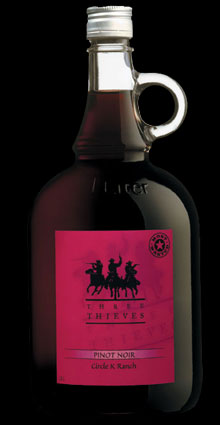
Two steps in the door, and what should I run into (as if Dumbledore himself had planted it there) but a clear glass jug of Three Thieves Circle K Ranch Pinot Noir 2004, with a silver screwcap and one of those little monocle-like loops for you to hook your finger through.
Three Thieves actually is made from about 75% Pinot Noir grapes and a quarter Syrah. Grapey, fruity, red, and juicy, this is a full-on, in-your-face John Wayne and Dean Martin, shoot-em-up kind of wine. Take it along in your saddlebags when you ride a horse along the Rio Grande. Swig it by a campfire. Guzzle it before getting the bullet dug out of your side.
With an alcohol content of 13% it’s right in the mid-range of California reds these days. But here’s the surprise: at $11.99, it’s a steal. The jug is a full liter, so you get 6-8 glasses for your 12 bucks, instead of 5. And besides, it’s somehow great fun to pour from a jug. Even if you’re using Riedel.
-
Red Stag: Wonder Women Rule

Imagine my surprise when I found out that the contractor who worked on my own tiny St. Louis Park house — doing everything from renovating the kitchen to replacing the automatic garage door when my teenage son backed the car through it — is also the person who’s helping Kim Bartmann — the innovative, blur-the-lines founder of Barbette and Bryant Lake Bowl — create Red Stag, soon to become the only LEED-certified restaurant in town.
Her name is Lori Reese, and she runs a funky, homegrown company called Wonderwoman Construction that specializes in flexible design and salvage. She also, I’ve recently learned, used to play rugby with Bartmann at the U of M. And let me tell you, if I saw these two women coming at me with bloodthirst in their eyes, I’d be scared. Of course, I’m about five-foot-four in heels. . . .
But I digress. LEED stands for Leadership in Energy and Environmental Design, and it’s the benchmark for the building and operation of “green” buildings. Restaurants are notorious energy hogs and wasters of everything from water to electricity to food. Red Stag is being built with features such as dual-flush toilets, LED lighting, and stove hoods that turn on only when their “sensors” detect a build-up of smoke and/or heat. They’re installing post-consumer recycled carpet that doesn’t off-gas and water heaters without tanks. Food will be locally sourced — reducing travel miles — and the plate scrapings composted.
Bartmann says she loves the contrast of opening a traditional supper club with progressive values. Also, she points out, “Supper clubs are popular in rural places where people actually do care about the environment.”
She’s been scouting a location for a third restaurant for a couple years now. Bartmann almost bought Bobino, then thought about the former Boom space (now the Bulldog-NE), but when she saw this old mechanical shop at 509 1st Avenue NE, she fell in love. “It was affordable, it had parking, and it’s a really solid-ass old building,” she says.
Reese predicts Bartmann will spend a little over 10 percent more on construction than if she were using conventional materials and methods to build Red Stag. But the cost, Reese says, may be recouped in as little as 18 months, given the savings on utility bills. “It’s a longer curve for residential,” she says. “You don’t make back your investment so fast because you’re not using so much energy. But in a restaurant, the energy bills tend to be 30 to 40 percent of your overall operating costs. So everything we’re doing should make a huge difference.”
But what about the food? The actual restaurant part of things? That’s where chef Bill Baskin, formerly of the spaceship-stylish Cosmos, comes in. Here, he’s planning a menu of “contemporized comfort food:” veal casserole, chicken and dumplings, a meat plate with game cooked three different ways (e.g. fried, braised, and smoked). The bar will be all about pickles, including pickled pigs feet, which Baskin, who’s originally from Texas, says they’re going to “give a go and see what Minnesota says.”
Lunch will include a lot of quick pick-up sandwiches and salads, for the downtown working crowd. One recipe Baskin was willing to share was a “deconstructed” Waldorf salad (entirely vegan) with celeriac, julienned apples, walnuts, smoked raisins, and fried mushroom chips. He’ll be serving a brunch on Sunday that’s a bit more conventional: French toast, chicken fried steak, “and maybe” — he flashes a grin “green eggs and ham.”
Right now, the 100-seat restaurant is only a frame. But assuming Reese and Bartmann keep moving — and don’t take a break to rough it up on the rugby field — Red Stag will open to the public in early November. And I have no doubt it will happen. These wonder women seem to be able to get anything done.
-
The wine-soaked writing life

(Pulitzer prize-winning author,
William Styron)I finished another novel last week. But this means little.
It means I awakened at 6:30 a.m. for two years or so — on holidays, my birthday, every morning but the one my husband and I camped on our honeymoon — went immediately to the computer while my saturated dream state remained, and wrote for an hour and a half before starting my day. It means when I found myself sitting with 450 double-spaced pages of a story that crystallized in surprising ways, I shipped it off to my agent — a New Yorker whom I’ve met only three times — and now I’m waiting for his response. Waiting.
Experience with my first novel taught me that even if someone does pick up your book, some caring editor who shepherds it through the cut-throat global publishing scene and commissions beautiful cover art and publicizes it even though you, its author, are a complete unknown from the Midwest, it doesn’t mean you will become famous or wealthy. It only means there exists this knowledge that such a thing can happen. You can dream up characters and fall in love with them, put them into strange, wonderful, and unlikely situations, draw them out on paper in arbitrary symbols, sending them forth to touch people you’ll never meet. It’s pretty cool.
It’s also hell. Did I mention I’m waiting. . . .? Waiting, waiting. Oh, and waiting. Which is excruciating, by the way. But apparently, this writing life is hard no matter who — or how great — you are.
Recently, when someone close to me was being treated for depression, I re-read William Styron’s memoir Darkness Visible, in an attempt to understand what my friend was going through. The first time I encountered this book, it made an impression on me because it described with such visceral power the dark hole of depression. One almost enters the illness while reading Styron and wonders if, simply by putting the book down, it will be possible to emerge. It’s a terrifying experience, which I had on the second reading as well.
But this time, another thread in the book caught me: Styron’s nearly Gothic description of the relationship between wine, aging, depression and art. This passage, for instance —
The storm which swept me into a hospital in December began as a cloud no bigger than a wine goblet the previous June. And the cloud — the manifest crisis — involved alcohol, a substance I had been abusing for forty years. Like a great many American writers, whose sometimes lethal addiction to alcohol has become so legendary as to provide in itself a stream of studies and books, I used alcohol as the magical conduit to fantasy and euphoria, and to the enhancement of my imagination. There is no need to either rue or apologize for my use of this soothing, often sublime agent, which had contributed greatly to my writing; although I never set down a line while under its influence, I did use it — often in conjunction with music — as a means to let my mind conceive visions that the unaltered, sober brain has no access to. Alcohol was an invaluable senior partner of my intellect, besides being a friend whose ministrations I sought daily — sought also, I now see, as a means to calm the anxiety and incipient dread that I had hidden away for so long somewhere in the dungeons of my spirit.
The trouble was, at the beginning of this particular summer, that I was betrayed. It struck me quite suddenly, almost overnight: I could no longer drink.
That there is a connection between my wine drinking and my writing seemed likely, though it was not until I read Styron’s words that I truly understood what it might be. He goes on, in Darkness Visible, to plot out what happens once he is — for whatever reason — sickened by alcohol. A fog seizes his mind. A malaise settles over his soul. He cannot think, he cannot write. He becomes remote and suicidal. He loses all hope.
I cannot say what the moral of this story might be. Styron recovered from the depression he wrote about so starkly but fell into another, even more profound, later in life and had to be treated with electro-convulsive therapy (ECT). He died of pneumonia, at the age of 81, in November of last year.
“The good writing of any age has always been the product of someone’s neurosis,” Styron once said. And he lived it as well.
I take some small comfort in the fact that I’m doing my part. Drinking my wine. Writing my stories. Letting neurosis dance freely across the surface of my sober morning brain. And waiting. . . .
-
Jeremy's Cake: Fit even for his palate

It must be nerve-wracking to provide a birthday cake for one of the area’s top food critics. But some mysterious baker’s wife did a bang-up job.
At my esteemed co-blogger’s party the other night, we were served a towering creation from A Baker’s Wife Pastry Shop. Now, I’m not a dessert person. Fine wine, five-dollar-a-cup shade-grown coffee, and savory, spicy snacks? Bring ’em on. But I eat sweets perhaps once a month. For October, this was it.
Jeremy’s birthday cake was a mosaic — it went from white to dark chocolate and contained an array of hues in between, cream, walnut, and tan. As inexperienced as I am with pastry, I cannot do the taste justice. But I can say this was a more complex eating experience than one usually has when handed a slice of cake on a plate. There was a toffee flavor, something mocha, and chocolate, of course. The icing was sweet but not overly so.
This wife can bake for me any time. And if you have a yen to indulge, I’d highly recommend your visiting her, too. And for more on Jeremy Iggers’ birthday celebration, click here.
A Baker’s Wife, 4200 28th Avenue South, Minneapolis 612-729-6898.
-
Bull's Blood: For The Man Who Has Everything
And I do mean everything. My friend and colleague, Jeremy Iggers, is successful, well-traveled, profoundly ethical, and endlessly curious about food, culture, and life. He has a lovely house, a huge following, and an absolutely beautiful wife, Carol, who’s wickedly smart to boot. So what does one get a fortunate man like this on the event of his 56th birthday?
Why, a bottle of Hungarian Bull’s Blood, of course!
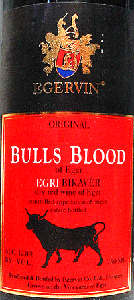
He said no gifts. But this is hardly a gift, more like a portent. First of all, it comes from “Eger,” which I — and many others — translate to be an early form of “Iggers.” After all, Jeremy has a robust, Hungarian look. But also, I like the story behind this wine. Actually, there are a few versions, but my favorite goes like this:
In 1552, a fortress in the ancient Eger was under attack and its defenders were outnumbered. To give themselves courage, they drank this thick, locally-made red wine and spilled it on their chests. When the enemy approached, they saw these warriors with what they thought was bull’s blood dripping from their mouths and coats. And they turned and fled before the battle could even begin.
Bull’s Blood isn’t a wine to savor. It’s a haphazard blend of, well, whatever grapes happen to be cropping up in Hungary during any given year: Kadarka, Kekfrankos, Cabernet Sauvignon, Merlot, and Kekoporto. The 2003, which we drank last night, had a metallic, slightly sour grape foretaste, then a strange, empty pause, and a finish that was pure funk and barnyard. The first sip was hard to take, but I swear, it got more and more drinkable as the night went on.
By the time Carol served the cake, we all felt fully fortified. Capable of turning back a horde of thieving Turks. Luckily, none appeared under the arbor at Jeremy and Carol’s Minneapolis home, and we ended the night invigorated but peaceable, full of warriors’ wine and an exquisite chocolate cream.