Author: Ann Bauer

  • Eat a duck, save a doberman

    babyducks.jpeg

    Ah, the dilemma of being an upright mammal. Each of us — excepting strict vegans, of course — must make peace with his or her spot on the food chain. Are we carnivores, herbivores, or pesci-vegetarians? Do we eat fowl but not red meat, because cows have sad eyes while chickens are mostly irritating? Is it enough simply to eat only humanely-killed beasts?

    If you are an animal lover, the questions are particularly thorny. . . .or so it would seem. Yet, I know plenty of devoted horse people who like their steaks bloody. Cat ladies who wouldn’t dream of giving up their Easter lamb.

    Which brings me to this year’s Chefs, Cats & Canines Fall Wine Dinner, a benefit for the Animal Humane Society, which will be held at the St. Paul Hotel on Friday, November 2nd. For $225 a head, luminary locals such as Scott Pampuch and Vincent Francoual will put together a six-course meal. The Humane Society promises $125 of each ticket is tax-deductible (which means these hard-working chefs are certainly donating their time and food products at cost), and proceeds will help care for more than 35,000 homeless animals.

    The menu:

    Scott Pampuch, Corner Table
    Fall vegetable tasting – pumpkin, squash, turnip, parsnip, carrot, and beets

    Vincent Francoual, Vincent A Restaurant
    Pan seared scallops, leeks, fingerling potatoes, and orange sauce

    Lance Kapps, St. Paul Hotel
    Duck strudel with baby greens and ver jus vinaigrette

    Mike Phillips, The Craftsman
    Braised 1000 Hills beef shanks with a potato shallot gratin and smoky tomato chutney

    Russell Klein, Meritage
    Artisan cheeses from around the world with seasonal accompaniments

    Sandra Sherva, Birchwood Cafe
    Chocolate pear tart with ginger crème anglaise

    Each course will be paired with a wine by The Cellars Wines & Spirits.

    No question, these are amazingly talented chefs and the evening promises to be spectacular. Each and every course sounds exquisite to me. But I find it curious — don’t you? — that there isn’t an all-vegetarian option for dog people who also happen to be fond of ducks.

  • Sup like a steelworker

    bullHead.gif

    The latest Parasole restaurant opened for dinner last night in Maple Grove. It’s called Pittsburgh Blue, named for the way he-men in the Rust Belt eat their steak: charred on the exterior, cold and bloody inside.

    Why, you may ask, is a restaurant geared toward steelworkers located in the pink collar capital of the Midwest? Will the mega-cineplex and Olive Garden set suddenly grow incisors? All I know is, Phil Roberts (the man behind the curtain at Parasole) measures the market and gets things right. He brought Salut to Edina, Oceanaire to the downtown Hyatt, and Buca di Beppo to the world. If he says northwest metro residents are ready for viscera, I believe him.

    Also, the menu is vast. Oysters Rockefeller, Spinach and Applewood Bacon Salad, Corn-Crusted Halibut, Spinach and Mushroom Gratin. That and lots and lots of beef. Prices are at the tipping point: $27.95 for that halibut, $17.95 for a dry-aged sirloin steak sandwich. Sides are shared, as at Oceanaire and Manny’s: monster portions of onion rings and asparagus with hollandaise. A root beer float goes for eight bucks.

    But if in this era of sustain-the-earth speak the mighty Roberts predicts Twin Citians will get into their cars and drive miles on I-94 to a stylish supper club with a “very, very mean-looking bust of a bull” (according to the restaurant’s ad hoc press release) hanging over the hearth, in order to eat as carnivorously as the men who do back-breaking work in fiery foundries, 12 hours at a shift, pouring molten pig iron into ingots. . . .they will. Bank on it.

  • Once, full of light

    gallery25.jpg

    Oddly, the last two movies I’ve seen have had more or less the same storyline: impoverished street musician suddenly finds success but suffers many personal losses along the way.

    The first was La Vie en Rose, a biopic about the French singer Edith Piaf. It was long — 140 minutes — and as violent a film as I’ve seen in years. I don’t mean there was a lot of shooting or blood (though there was some of both), but it was relentlessly loud and dark and hopeless. There was tons of screaming, drinking, fighting, and hysterical weeping. The only peaceful scenes were of a jaundiced, dying Piaf and even those included shattering glasses and angry words.

    There’s no denying, Marion Cotillard did a spectacular job playing the blighted French singer. And La Vie en Rose was told in a layered mosaic style that worked beautifully, evoking life as we tend to remember it: random memories, tenuously connected, that aggregate over time to form a history.

    One might argue that it’s “truer” than the second movie I saw: a sweet, short Irish Sundance winner called Once. And technically, it is. But I take another point of view, that what’s important is a lucid view into the making of great music. And in that sense, Once is the far better film.

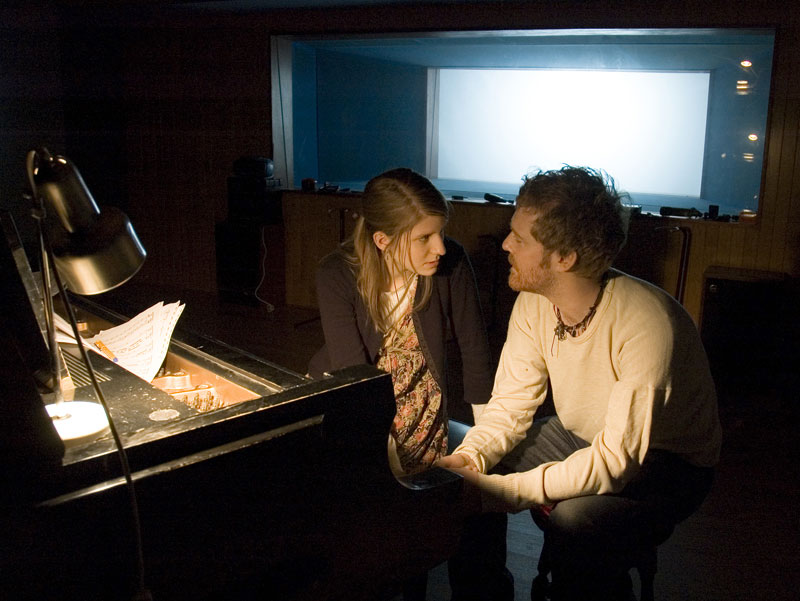
    Granted, this is a fairytale of a movie. There’s actually a scene in which the street busker and his rag-tag band are cutting a demo album while a two-year-old runs gleefully around the sound studio. I’ve had two-year-olds [three of them] and you can barely make toast when they’re around and upright.

    Nevertheless, this film is wonderful. It’s quirky and sad and nearly prayerful: everyone in it is visibly lifted, exalted, made more whole by the music. And, yes, the music is that good.

    On a strictly emotional level, Once is real. Its stars, playing simply “the guy” and “the girl” according to a script by director John Carney, are an Irish and a Czech musician (Glen Hansard and Marketa Irglova, respectively) whose voices simply light up our world. In the story, they sing together for the first time in an empty music shop and everyone — from the clerk, who is leaning on the counter eating a sandwich, to members of the theater audience — goes still. Listening.

    There are those, I’m sure, who prefer the music of Edith Piaf to that of Hansard (lead singer of The Frames, one of the most popular bands in Dublin). She was an undisputedly great artist and an important figure in French cultural history. Given this, however, there’s a falseness to La Vie en Rose that bothers me. Piaf did have a stunning voice, and this comes through in spades. But the rest of her life was, according to the film, nothing but ugliness: poverty, degradation, betrayal, abuse, and addiction.

    I’ve no doubt all these things happened. But I also suspect there were moments of lightness in her life — the ones that allowed her to sing as she did. Only at the very end of the film, around minute 118, was there even a glimmer of humanity and by that time, it was too late. When Cotillard as the beleaguered and weary Piaf got up and sang “Non, je ne regrette rien” (translated: No, I regret nothing), I didn’t believe it: she should have been regretful if this account was accurate. She had used, cheated, laid waste, and destroyed. I left the theater bleak despite Piaf’s glorious voice, vaguely angry that so much bitterness had been stuffed inside me.

    Where Once may err on the other side, portraying life as twinkling and hopeful even in the grayest of circumstances, it does music justice. Watch the scene in which a jaded studio technician, stuck working with a no-name band, listens to them for the first time, his face washed with a craggy wonder at the sound coming from the motley group. Or the one in which the working-class father grins after he listens to his son’s completed album, full of a quiet, aching pride. These alone are worth your $8.25.

  • White on a whim

    bottle-fume-blanc.png

    Perversely, after a summer of drinking meaty, dry red wines, when the cool weather set in this week, I suddenly got a hankering for white.

    A woman’s body is fickle, as I tell my husband often. One day, you slip into your size-7 jeans and run around the world bending every which way like an Olympic gymnast; the next day, though it’s impossible that you have gained 50 pounds, you awaken feeling like some huge, galumphing creature who is in danger of crushing household animals under her swollen feet. That’s just how it is.

    Now, my hormonal fluctuations aside, about that wine:

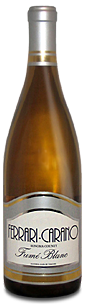
    In deference to my mood, my husband opened a bottle of Ferrari-Carano Fumé Blanc — an easy task, as it’s a screwcap. (He picked up this wine, he said, because it’s made by the same winery that produces Siena, a blend of Sangiovese, Malbec, and Zinfandel, that we dearly love.) The color is lovely, clear and oystery-yellow. The nose is interesting, too: far spicier than you might expect of a wine made of 100% Sauvignon Blanc, with notes of cucumber, lime, pineapple, and some sort of redolent dusty-smelling flower, such as zinnia or marigold.

    The flavor follows the same pattern — lots of tropical fruit and grass and floral elements — plus it’s full-bodied and finishes with a little green apple and a long-lasting zing in the corners of the mouth. This likely is due to the fact that about 65% of the grapes that go into this Fumé Blanc are aged in stainless steel casks, while the other 35% are aged in French oak. By selecting and putting the lots together, vintners at Ferrari-Carano create a taste at once earthy and sharp.

    The Ferrari Carano Fumé Blanc contains 13.9% alcohol; it retails for around $15. And maybe my biological clock isn’t so far off after all. The crisp, apple-ish snap of this wine even reminds me of fall. So there.

  • For news junkies with spatial skills

    Lists bore you? Don’t bother. You can get breaking news in a colorful, jagged puzzle format at newsmap. Even if you don’t find anything interesting, it’s a great screen to stare at. Kind of like an Escher.

  • A little Jersey armpit

    Bio-Pic.jpg

    So I’m talking to my friend Schneider today and he asks, “Are you watching Wine Library TV?”

    “Damn,” I think to myself. “I guess it’s time to bite the bullet and get cable.”

    First I find out there’s this show on HBO featuring dysfunctional couples having real sex; not good sex, mind you, and never the complete sex act, but real, graphic scenes of unsatisfying attenuated sex. Not that I think I’d want to see that. But if everyone else has the option of watching crabby, unhappy people having bad sex, I think I might want to have the option, too. And now Schneider, former blog master of Wine Commando and a man I trust on the topic of wine like no other, seemed to be telling me there was an entire station devoted to wine TV.

    This was, however, a misunderstanding.

    In fact, Wine Library TV is on the web, free for everyone with a broadband connection to watch. Each 15-minute “show” features a ferrety young New Jersey guy named Gary Vaynerchuk (pictured above) who appears to be broadcasting out of his parents’ basement rec room. Think of this as the Wayne’s World of wine media. Vaynerchuk uses words like “poopy” and “Jersey armpit” to describe what he smells and/or tastes. When a wine starts well but has a disappointing finish, he dubs it a “Netflix” — good until the last few scenes.

    This man uses a Jets beer bucket to spit, has toy figures strewn around his decanting space, and draws little cartoons on the green board behind his head — Blue’s Clues-style — to illustrate the theme of the day. What’s more, he is weirdly addictive.

    The best part? The segment I watched today was #308, so I’m betting there are 307 others I can watch back-to-back — say — over the weekend. And I don’t even have to get cable TV, unless I want to see that bad, bad sex.

  • Twitch your nose and a sandwich will appear

    bew.jpeg

    It’s funny. Not too long ago, I was with a group of people who were bemoaning the lack of “real” delis in the Twin Cities. Then, as if magically, two contenders appeared.

    First, the New York Deli & Bar opened in June on the south side of downtown Minneapolis. And on Monday, September 10, former Solera chef Matthew Bickford and Michael Ryan, former chef de cuisine from Restaurant Alma, will launch a New York-style deli called Be’wiched in the old C. McGee spot at 800 Washington Avenue North (612.767.4330).

    OK, so Matthew and Michael aren’t exactly Sol and Abe. But they’re planning to brine and smoke all their own deli meats — pastrami, turkey, roast beef — and serve them on homemade bread. They’ll pile the sandwiches high with cheese, tomato, lettuce, and plenty of spicy mustard. Also, Bickford and Ryan have acquired a strong beer and wine license, which they promise to use for “eclectic and approachable” brews and blends.

    “Independently, Mike and I were both working on deli concepts,” said Bickford. “Even though we come from fine dining, both of us felt the pendulum was swinging toward simpler food and lower guest checks. Then we got together and came up with Be’wiched.”

    The name is a play on the national trend to abbreviate “sandwich,” Bickford told me, as well as a nod to the current craze for everything occult.

    So if you’re in the area, stop by for lunch on Monday to see how the boys are doing. Shout Mazel Tov. . . .or wave a pentacle in their direction. Then order a pastrami on rye.

  • Grade A Cotes-du-Rhone

    andezon257.jpg

    The name Côtes du Rhône is a regional appellation for wines coming out of France’s Southern Rhone Valley. The area is huge: about 171 villages, with more than 100,000 acres of vineyards in a space 60 miles long and 30 miles wide. What’s more, there are a number of varietals grown in the Côtes du Rhône region, including Grenache, Mourvèdre, Carignan, and Syrah. (These are the red grapes most often associated with Côtes du Rhône; there are also white varietals such as Clairette, Marsanne, and Roussanne.)

    Due to the wide variation in the region, not to mention the sheer number of different winemakers, each employing his or her own techniques, Côtes du Rhônes differ greatly in terms of quality, flavor, and character. One may be light or thin, while another with the same appellation is meaty and rich. The blends are based on a myriad of factors, ranging from the winemaker’s personal taste to how growing conditions affected individual crops. And price matters: cheap Côtes du Rhônes tend to be constructed like cheap Chiantis — a passable concoction of mediocre grapes, macerated and left to ferment into something wine-like.

    Don’t get me wrong. They’re often good. Given the passage of a little time, Rhone grapes soften and become more than drinkable. But go up a notch, say from $10 a bottle to $18, and magical things can happen.

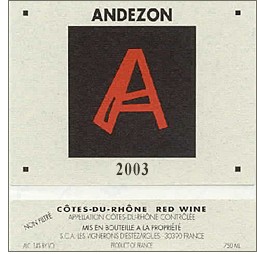
    For instance, we picked up the Andezon Côtes-du-Rhône 2003 at a little wine shop on Canal Park in Duluth. It cost roughly $17 and said only “Red Wine” on the label. But when we opened it, the bouquet was clear and consistent: raspberry, blueberry, and a little leather. It tasted, strangely, like a Pinot Noir, in that it was cool and not too sweet, solid but almost entirely without tannins.

    This wine, it turns out, was made entirely of Syrah grapes — a decision that likely was based upon its vintage. The summer of 2003 was torrid in the Rhone region and many crops were heat-damaged: cooked, as it were, so the wines they produced were off-balance and jammy. Many people avoid the Côtes du Rhône of 2003, simply because it’s easier — a better bet to pick up a 2004.

    But vintners at Domaine d’Andezon, a 25-acre property in a village on the west side of the Rhone, were wise. They banked on the fact that Syrah grapes love sun and can withstand higher temperatures — also that their proximity to the sea would infuse the wine with a rich, balanced flavor.

    They were right. This was one of my favorite wines of the past, oh, six months or so. My husband and I split the bottle over an anniversary meal of spinach salad and take-out from Pizza Lucé. French wine meets Italian sausage — now, this is our idea of great fusion food.

    Here in town, this terrific mid-priced wine can be found at France 44 for a mere $15.99. May I suggest a garlic mashed potato pizza to go with it?

  • Ashland, WI: City of lungs

    nosm.jpg

    Traveling by motorcycle has many advantages: open air, engagement with the environment, and gas mileage about one-third that of most mid-size cars. There is one downside, though. You’re at the mercy of small towns when it comes to things like coffee, wine, and food. My husband and I have toured most of the Midwest, and our biggest problem historically has been Wisconsin.

    First, everything you order is likely to come beer-battered and smothered in cheese. (I once ordered what I thought was plain, broiled whitefish, only to be served something entirely covered in cheddar.) Second, the wine selection often is edged out by library-like shelves of Blatz. But most critical is the fact that most of the “non-smoking sections” — an antiquated concept, which I never remember until I step out of the Twin Cities — are tiny annexes stuck on rooms full of acrid smoke.

    Many’s the time we’ve scoured a town for up to an hour, looking for one enlightened coffeeshop or an outdoor cafe, only to end up eating yogurt while leaning on the Triumph in the parking lot of a monster grocery mart. But today, we discovered something wonderful.

    Ashland, Wisconsin, an industrial port town of approximately 8,600 people, has gone smoke-free! We were informed by Paul Levelius — owner of the 2nd Street Bistro — who told us Ashland was the third city in the state, after Madison and Appleton, to ban smoking in restaurants.

    Levelius’s restaurant was terrific, by the way: a BLT with smoked pepper bacon, fresh arugula, and avocado mayo on Texas toast; bouillabaisse in a saffron orange broth; house salad made of organic greens, red peppers, scallions, and a tangy homemade rice wine vinaigrette. 2nd Street also features live music on Wednesdays and weekends; and half-priced bottles of wine on Monday and Tuesday nights.

    But better even than finding fresh vegetables in Wisconsin (not drenched in cheese sauce!) was leaving the restaurant without a headache, our clothes free of the lingering stench of old tobacco, our lungs clean rather than lined with other people’s breathed-out cigarette fur.

    And according to the website Smoke Free Wisconsin, many other cities are considering following suit.

  • Hair of the Hound Dog

    8EPZLANYPTRH6M2J8WWG_L.jpg

    So, we’re riding through the Upper Peninsula last night and decided to stop in Hancock, Michigan. Walked into a little mom-and-pop liquor store called The Shottle Bop — I’m not kidding — and right up to a shelf with The King Cabernet Sauvignon 2003, third edition. The bottle features a photo of Elvis from his glory years: white suit and lariat-style belt, microphone in hand, bulges in all the right places. (Note: the label pictured above is different, without the enviable groin, but I was unable to find the one we purchased on the Graceland Cellars site, so maybe it’s a very rare collector’s item. . . .)

    In any case, we had to buy it. Wouldn’t you? We took it back to our Holiday Inn Express (damn, don’t we travel in style), uncorked it and breathed in the plummy, purple essence of The King. This is not a subtle wine — I mean, not even for a Cab. It doesn’t just sit on the tongue, it puddles there: rich, dark fruit, anise, and chocolate flavors, like a Hershey-covered black cherry soaked in some kind of syrupy, blackberry hooch. Not that it was bad. In fact, I kind of liked it in an against-my-better-judgment Hunk of Burning Love sort of way.

    I probably won’t be drinking The King on a regular basis, however. Because I awoke this morning with a not-hungover (I had less than a glass and a half) but racy feeling — likely more from the sulfites and sugars than the alcohol content (12.9%). But still, there’s that bottle. . .