Author: Ann Bauer

  • A smoky, cerebral wine

    fleurplaisance.jpeg

    With most wines, I know right away: I like it or I don’t; it enhances the meal I’m eating or it doesn’t; it’s full or light or insipidly thin. But this one I had to taste for most of an evening — slowly, letting it breathe and change — with food between glass one and glass two. Still, its profile was very difficult to parse.

    A blend of Merlot (80%) and Cabernet Sauvignon (20%), the Château La Fleur Plaisance is paint-strippingly tannic and ultra-rich. It has notes of chewy dark fruit — blackberry, raisin, and plum — but the most prominent flavor is wet wood, like an oak tree that’s been sliced open and rained on for a couple days. The nose is full of cigar. . . .not cigar box, which is refined, but actual cigar: tobacco and fire and smoke. (Alcohol 12.5%)

    I found this $11 Bordeaux by chance while walking through Hennepin-Lake Liquor Store, an odd little wedge-shaped shop at 1200 W. Lake Street in Minneapolis that operates as if it were 1972. They don’t take credit cards, have no website, and keep their reserve wines in precariously tilted wall bins and haphazard stacks. Searching through the selections at Henn-Lake Liquors is like visiting a musty old bookstore, picking through the bins, and running across a discounted first edition of The Sound and the Fury.

    I didn’t enjoy drinking the Château La Fleur Plaisance, the way I would a smoother, more comforting wine. But I delighted in the fact that it was dark, complicated, and interesting — challenging in a way that made me both perplexed and entertained. Much like reading Faulkner. . . .

    So while I wouldn’t choose Château La Fleur Plaisance every day, it’s a nice departure from predictable pinot noirs and simple Spanish table wines. Occasionally, I like to exercise different sensibilities and bend my palate a bit. This is the perfect vehicle.

  • Lemon or sugar in your Zin?

    I ran across this refreshingly blasphemous article in Denver’s Rocky Mountain News, titled Putting a Cork in Wine Snobs. It’s a good read and underscores a few of the points I’ve been making. Among them:

    The phrase room temperature refers to the cool interior of a drawing room in the French Alps, not a 90-degree kitchen in the muggy Midwest.

    Screwcaps are all the rage — even among some fine winemakers — and tend to keep the product pure. Also, aseptic packaging of less expensive wines (think juice boxes, only bigger) is an up-and-coming trend.

    Glassware isn’t all that. Sure, there’s a certain aesthetic to Riedel that many people find appealing. But the complicated parade of different sizes and shapes isn’t necessary. Just make sure your glass is GLASS (not plastic, styrofoam, or waxed, all of which leach flavor), cool to the touch and clean.

    Keep in mind, I don’t endorse every fragment of this wine columnist’s irreverent, myth-busting advice. For example, she recommends sweetening wine to taste, with sugar — or sharpening it up with a squeeze of lemon juice. Also zapping reds in the microwave to “round out” their fruit.

    I’m all for making wine more approachable. But personally, I think I’ll reserve my tea service for Earl Grey and my microwave for thawing big hunks of frozen meat.

    However, I just may get a box of wine and a fancy glass straw and take them along to the fireworks tonight.

  • Table for one

    A reader contacted me this morning to ask if I had any restaurants to recommend for solo diners. A single woman who loves good food, she said she often feels self-conscious when seated at a table by herself. It doesn’t help, she added, when the server asks, “Will anyone be joining you tonight?”

    Longfellow Grill is one of the only places I can come up with that has a really singles-friendly vibe,” she wrote. “And there’s Town Talk, where the bartenders will take a snit of whatever you’re drinking when they refill your glass. But can you think of any others?”

    Well, I’m a wine columnist, so my mind immediately goes to places such as Lucia’s and the now [sadly] defunct Auriga, as well as those coffehouse/wine bars like Wilde Roast and Zeno that provide wireless and great pastry, but less in the way of entrées and “haute cuisine” ambiance.

    So I’m putting the question out there. Singles, do you have any favorite fine dining haunts you’re willing to share? Send them in! And if enough of you congregate in one place, who knows? A couple of those tables for one may be pushed together before evening’s end.

  • Cheap and easy

    2004_redcms.jpgIt has a refreshingly prosaic name — CMS Red — and a label that reminds me somehow of industrial equipment, with a stamp certifying it’s been approved by the Washington Wine Quality Alliance. But this wine is, in fact, a canny blend produced by Hedges Cellars, a mom-and-pop shop located on Red Mountain in Washington’s Yakima Valley, that sells locally for $9-12 a bottle. CMS stands for Cabernet (39%), Merlot (57%), and Syrah (4%) — an acronym of an appellation. And there’s an equally basic white version, as well (CMS White, what else?) that’s made from Chardonnay (44%), Marsanne (2%), and Sauvignon Blanc (54%).

    I haven’t tried the white, but CMS Red is one of those wines I keep on hand as back-up. It’s big and fruity, full of blackberry and cherry, vanilla, clove, caramel and cassis. The quality of the flavor is very young: there’s no mysterious alchemy of dusty cigar box and oak here. But the finish is respectable, leaving a hint of anise in its wake. I wouldn’t serve CMS at a formal dinner party, but it’s perfect for a 4th of July barbecue. And if you have a few bottles left over, stow them for a year or so. Peter Hedges’ notes claim this blend was specially formulated to age well. Given his track record with finer wines, I believe it.

  • Heartland goes on holiday

    It is a sad fact that every year Heartland, the restaurant and wine bar on St. Clair Avenue, closes its doors for two weeks in summer. This is because owner Lenny Russo (formerly the executive chef at Cue) and his wife, Mega Hoehn (the wine maven), work non-stop the other 50 weeks a year — also, because there’s a death-like lull in our region’s food service industry during cabin season.

    What it comes down to is this: you have only two more days to get into the Heartland Wine Bar — arguably the best little boîte in St. Paul — for a glass of something truly unique and great. Along with your wine, you’ll enjoy the eclectic musical selections of manager Christa Robinson (from The Floaters to Brenda Starr), and the evening’s amuse bouche: a tiny ramekin containing chilled carrot mousse with fresh dill or duck confit and grilled ramps on a homemade wheat cracker.

    Then, on July 1, Heartland will close for two weeks, reopening at 5:30 on July 17. So if you have time this warm, sunny, summer weekend, I heartily suggest you stop by to try one of Mega Hoehn’s hand-picked whites:

    Von Schleinitz “Slatestone” Riesling 2004 (Mosel, Germany) — Sweet on the middle of the tongue but tart around the edges, this wine is full of honey and orange zest; it’s also thicker than you might expect a Riesling to be, filled with wild flowers and the taste of warm sunshine. I recommend this wine with light food such as pasta, risotto, or broiled whitefish. (10% alcohol)

    Domaine de la Racauderie Demi-Sec Vouvray 2004 (Loire Valley) — This buttery golden wine has an astonishing bite that’s all sweet onion and chive; but its lingering flavor is slightly citrusy, grassy with a hint of marigold, and very sturdy. The extra-long finish makes this Vouvray a red drinker’s white. Drink it with shellfish or salmon, paella or pork. (12% alcohol)

    Marqués de Cáceres Rioja 2005 (Rioja) — Who knew a Rioja could be so white? This wine is a confetti of lemon and musk and a weirdly satisfying hint of roquefort cheese. Crisp, smooth, and very dry, with firm fruit and a lingering finish on the back of the tongue. A white that can stand up to pork, lean meat such as bison, or cave-aged cheese. (12.5% alcohol)

  • Dinner at Brasa tonight?

    Alex Roberts’ much-awaited new restaurant, Brasa Rotisserie, opened today at 11 o’clock in the former Betty’s Bikes and Buns location, at 600 E. Hennepin in northeast Minneapolis. The food is locally sourced and organic, as it is at Brasa’s high-class sister restaurant Alma. But here you will find a mix of Latin American, Peruvian, and Creole cuisines, served cafeteria-style and priced accordingly. And while fans of Betty’s may flock to taste the slow-roasted pork, rotisserie chicken, grits, rice, beans, and sweet potatoes, even old regulars won’t recognized the space. Roberts worked with perennial restaurant design company Shea, Inc., to convert the former service station into a faux-Caribbean shanty with a large, shaded patio. Roberts must have called in powers even greater than David Shea to order today’s weather. Dinner service begins at 5.

  • Chef Maccaroni takes the helm

    Partners in the Sample Room announced today that they have promoted Peter Macaroni to executive chef. Macaroni worked at La Bec Fin in Philadelphia and Barlays in Atlanta, before coming west to serve as executive chef at Tiburon. He’s been sous chef at the Sample Room for a few months now — which, so far as I’m concerned, is the most important squib on Macaroni’s CV. I happen to have taken a group of people there on Father’s Day: bottles of wine were half-price (as they are every Sunday and Monday night), the service was spot-on, and our food was fantastic. I had a roasted vegetable salad with Stickney Hill goat cheese that managed to be simultaneously light, earthy, and filling. And I recall that night commmenting to my friends that the Sample Room — long one of my favorite spots in the Twin Cities — just keeps getting better. Maybe that’s Macaroni’s influence and the upswing will only continue. . . .Boaters should know that the restaurant is opening the Rockway Docks in mid-July. Forget Highway 94. Soon, you’ll be able to ride the Mississippi directly to the Sample Room, walk up the bluff, and claim your table.

  • Class in a Glass

    ImgFetcher.gif

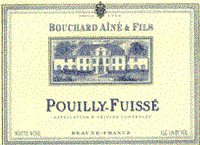
    I attended a wedding over the weekend — one of the loveliest I’ve ever seen, with a rose petal-strewn Japanese garden and a chuppa-like arbor under which the couple was joined. Topping off this perfect event was an exquisite wine: a delicate, slightly dry Pouilly-Fuissé from the house of Bouchard Aînés & Fils. If you think of Chardonnay as a bland, butter-colored liquid that went out of style in the ’90’s, give this a try. Pouilly-Fuissé is made from 100% Chardonnay grapes but takes its name from the Burgundy region in which they are grown. The Bouchard Aînés & Fils 2003 is a balance of gentle fruit — apricot, apple, and lemon — and mineral qualities, plus just a touch of honey. It was an ideal summer wedding wine: refined, light, and, from what I heard, universally liked. Also, it received 90 points from Wine News. I’ve searched the big wine vendors in town and found few that carry it, but it is available at Lakeside Fine Wines & Spirits, in Long Lake; and according to the distributor’s website, it can be sourced through Paustis & Sons in Plymouth. (13% alcohol)

  • Master of the Restaurant Riff

    Tim Alevizos is a man who lives his art.

    Show up at his posh Uptown condo on a Saturday morning around 10. He will open the front door and take your coat. Then, if you’re someone he likes (and believe me, if you weren’t, you wouldn’t be here) he’ll usher you into the “owner’s suite” of his 8-foot Italian couch and bring you a cup of coffee so strong it’ll make your nasal hairs sing.

    There are surgical photos lining the walls, all viscera and blue-veined hearts. A statue of a naked Roman, one hand cupping his genitals, in the corner. Raise your mug and you’ll see that it’s printed with an advertisement: a beautiful blonde gazing into middle distance, looking healthy and satisfied. And underneath the words, “For her, it’s Maximum Strength Pubicort.” Alevizos will chuckle and stroke his chin and show you his own cup, the one that features a photo of him, five years younger and beardless, with his arm around the same woman, and the words “Clitrosyn Vagitabs.”

    These were Alevizos’ Christmas gifts one year: he posed for the photo with his friend, Jennifer Roberts; dreamed up the names of the drugs; and had the cups screen printed for $35 each at a Kodak photo lab in New Hope.

    “The best part,” he’ll tell you, flopping back against the far end of the couch, “was when I went to pick them up and there was this big guy at the register, yelling into the back ‘Hey, George, do we got any more of the Clitrosyn mugs back there?’ And I was just delighted. I made the big man say my made-up dirty words!”

    After a cup of the tannic coffee, you’ll ask for a glass of water (sparkling, of course), and then you’ll need to urinate. Lucky you.

    “Use the toilet in back,” Alevizos will advise, his eyes sparkling behind thick glasses. “That’s the best one.”

    So you’ll go all the way back, through the man’s personal lair with its unmade bed and books strewn all over. Enter the bathroom, a cavernous cube of tile, and face the Toto Neorest, a porcelain fixture like a throne that will yawn open as you approach. Sit on the heated seat, settle in, do your business. Then pick up the remote that hangs to the left of you on the wall.

    Hit the button that says “Front,” and feel the warm spray, which you can adjust — farther forward, if you happen to be a small sort of person who perches toward the front of the rim; or back, if you are, unlike this reporter, a person who covers the entire area of the lid — then the one that says “Back,” even though there is no compelling hygiene reason for doing so. (Notice, ladies, that there is a ‘pulse’ feature, as well; you decide what to do with this particular bit of information.) Finally, press the button labeled “Dry,” and let the air move gently across your bottom while you imagine the horn-shaped blowers of a drive-through car wash, only smaller and down below.

    “I was in Japan in 2002 when I first encountered these toilets,” Alevizos will say when you return, a full 20 minutes after excusing yourself. “I was lusting after one. Then I got this really sweet freelance job that turned out to be really easy and incredibly lucrative. Out of nowhere, there was just enough money to order a Neorest, and I’m really glad I did. That purchase has been nothing but pleasure for me. The remote, the technology, and the pride of ownership. People are always begging me to let them come over and poop in my toilet.”


    So what does all this have to do with food? Only that Tim Alevizos is the author of roughly 90 percent of the edgiest, most scatological, profane, and impolitic restaurant advertisements in town.

    His billboards for Chino Latino were among the most famous, sparking, among other things protests from the parents at a local elementary school when “Aw, Phuket, Let’s get takeout” was posted directly across the street from their playground; and outrage from All in the Family fans from coast to coast when he penned the wickedly cruel “Third World Prices, Sally Struthers Portions.”

    All in all, the Chino campaign hit national news some half a dozen times. Not bad for a guy who started his career as an intern for the U.S. Senate.

    “My first restaurant writing job was back in 1988,” says Alevizos. “I’d just graduated from Northwestern and moved to Washington. I always thought I wanted to work on Capitol Hill, but when I got there, I discovered the only things I liked about it were the crazy letters from constituents and these fabulous corporate gift packs that would open up like a Louis Vuitton steamer trunk. When it came to having laws passed, I really didn’t care.”

    That’s when he got a call from Phil Roberts, co-founder (with Peter Mihajlov) of Parasole Restaurant Holdings, and the father of his childhood friends, Steve and Jennifer.

    Roberts had just opened Blue Point, a rustic little seafood restaurant in Wayzata, and he wanted to produce a faux-tabloid ad. Alevizos responded with about a dozen headlines, including: “After having 3 bouncing baby boys, Wayzata woman gives birth to 18-inch prawn; Dad loves the little shrimp.”

    Still in Washington, now working as an information officer for PBS, Alevizos continued writing restaurant jingles and ads on a freelance basis. When Parasole launched Buca di Beppo in 1993, he traded on the over-the-top kitschiness of the décor, scripting radio spots that promised an atmosphere perfect for anniversaries, birthdays, and bowling banquets, as well as “recorded music in every room, thermostatic heating and cooling, and sanitary bathrooms.”

  • David Fhima at A Rebours

    There’s something about talking over a meal that makes people loosen up. It’s the proximity of your knees under the table, the intimacy of sharing food, the lubrication of a little wine. This is not a set-up for drunken confessions. It is a method for coaxing the truth out of public figures used to communicating mostly in talking points. Ultimately, I want On The Table to show my guests the way they really are.

    But I may have set myself up by asking David Fhima — the smooth, accented restaurateur whose empire crumbled last year amid rumors he was roughly a million dollars in debt — to be my first.

    The truth is that I’ve known David for more than four years: I’ve interviewed him twice before and talked with him personally more than a dozen times. But even after sitting down to a meal with him recently, I still have no idea who he really is.

    Ask around town and you’ll hear that David is a master chef, a hack, a thrill seeker, and a dreamer. You’ll learn he grew up in Morocco, London, or maybe Provence. He had as many as 17 siblings and got kicked out of two or four or possibly seven different boarding schools. He was once a minority partner in L’Orangerie in Los Angeles, or, more likely, one of their top maitre d’s. He’s a good guy who got in over his head, or a con man who’s been running a shell game, transporting unpaid liquor from one restaurant to another in the back seat of his car.

    In "Without Reservations" — a terrific profile by Steve Marsh that appeared in the September 2004 edition of Minneapolis/St. Paul magazine — Fhima admitted to being a “bullshitter” and a control freak. He skewered local food critics for panning Louis XIII, talked about opening versions of his eponymous Fhima’s restaurant in Chicago and Wayzata, raved about the imminent opening of Lo-To, and claimed to be in negotiations to host a show on the Food Network.

    Two years later, there was neither a Food Network show, nor a Fhima’s in Chicago. Lo-To had launched but then closed its doors for a short time, due to unpaid utility bills. Louis XIII was shuttered so quietly, Edina socialites kept showing up for lunches and finding the doors locked. News of his financial troubles was far more widespread, however. In June 2006, the St. Paul Pioneer Press reported that Fhima owed more than $900,000, including $39,000 to his fish vendor, and at least $180,000 to the IRS.

    Over the intervening year, there have been rumblings of continuing problems, such as bounced paychecks at Fhima’s.

    But the people who’ve worked with him — even the ones who’ve been burned — tend to be forgiving. Scott Mayer, local public relations legend and the founder of the Ivey Awards, worked with Fhima until near the end.

    “The thing about David is, no matter what happens, you just can’t get mad,” Mayer says. “Because at the heart of things, he’s just a genuinely nice person.”

    And I have to admit that despite everything I know, I feel the same way. Having lunch with David Fhima is restorative in a strange way. However vain and quixotic he may be, he’s also authentically kind and interested in the people around him. He reminds me, in this way, of a very smart and naughty nine-year-old who dreams of being king.

    Perhaps this is why people keep throwing money at him.


    We meet in May at A Rebours, the bistro that shares a block with Fhima’s. David arrives precisely at noon, dressed all in black, wearing dark glasses and carrying nothing but a small European satchel.

    “This is the earliest lunch I’ve had in years,” he announces as he sits. “At my age [46], I’ve tried to change. But no way. I’m a night person, and I’ll always be a night person. I think my DNA is made up for the restaurant business.”

    He has just returned from three days in North Carolina, where he was doing business for Bahram Akradi, founder of Life Time Fitness and Fhima’s new employer-slash-savior.
    In the aftermath of his financial woes, Fhima tells me, Akradi — a longtime acquaintance — stepped in to propose a deal: He would take over LoTo and rebrand it LoTo Life Cafe, then turn around and use the concept in Life Time facilities throughout the country. Fhima would join Life Time as executive chef in charge of more than 50 cafés around the country, and develop a fine dining concept for the higher end clubs.

    Fhima is understandably grateful. “Life Time is a company that if you walk into any club, no matter how incredible they are, it doesn’t do justice to Rahm’s vision,” he raves.
    He’s landed on his feet, yes. But when we begin talking about Louis XIII, Fhima’s mood becomes more sober. And he is ardently philosophical when he describes the past year: “Whether or not it’s true, I’ll always believe that challenges are like magnets. I think they’re like these little animals that walk and pick a place where they can’t knock people down. There’s so much to be learned from a failed dish, a failed relationship, a failed financial experience. More than to be learned from success. If you keep getting up and getting up and getting up, challenges become fun.”

    Say what you will about David Fhima, he does keep getting up.

    After giving me many of the same quotes he’s given other reporters about the closure of Louis XIII — including that it was misunderstood; that it was too good for the Southdale mall; and that it suffered from his being split between kitchen and front of the house — he hunkers down abruptly and looks me straight in the eyes.

    “Looking back, I don’t have any regrets except for one. When I knew it wasn’t working, I should have cut my losses. And I knew within three to four months. I should have cut my losses and owed ten times less than I do now.” He shrugs then, and his face changes, becoming tough again.

    “But I was trying to stick by my concept and make it work, employing people, and staying true to what I believed. What sends me is that some people try to put my financial failure on the same level with my talent as a chef. I know a lot of very talented chefs who have not been able to make a go of it. But there are a lot of successful ones I wouldn’t trust to butter my bread.”


    Wait for the long pause at the beginning.