Here’s hoping the Thursday evening Mill City Farmers Market picks up steam over the summer. It’s a great concept — limiting entrants to local growers and regional businesses — and I hear the Saturday sessions are packed. But last Thursday at 5 there were only a handful of stands operating, most of them selling pricey soaps and textiles. There was, however, an interesting vendor, Azariah Acres Farm, offering lamb, wool products, and ground yak. I’ve never tried yak, so I bought a pound for a little over $5. It’s a beautifully lean meat — that’s the upside — with virtually NO flavor. Like tofu, ground yak picks up whatever taste you add (cayenne, onion, etc.), and it leaves your grill nearly grease-free. . . .But I’m thinking there may be something mindful and zen about eating yak — the opposite of filling your body with, say, grizzly bear. Azariah Acres farmer Sue Peterson says yaks are supremely docile and very easy to raise. Plus, their ancestors hung out and grazed near the Dalai Lama.
Author: Ann Bauer
-
Spill the Wine. . . .please
It’s time for us to have a little talk about the appropriate temperature for serving wine.
A delicate white, such as a Riesling, should be served downright cold: 45-46 degrees. A heartier white, a Chardonnay or Sauterne, may benefit from a 48- to 52-degree environment in which it can mellow a bit. Lighter reds (Beaujolais, for instance) are best when served on the chilly side, around 55 degrees. And finally, rich reds — everything from Zinfandel to Shiraz to Bordeaux — are at their best when between 59 and 65 degrees.
But under no circumstances should an open bottle of, say, Cabernet Sauvignon, be stored near a sizzling kitchen in an 85-degree room, then served in a glass still warm from the dishwasher. And I wish someone would run right now and tell the entire staff at Minneapolis’s newest trendy wine bar, Spill the Wine.
I went there tonight, not intending to write about the place. It was simply an evening out with my husband — and a preview for me. But the experience was so abysmal, I decided I owe it to every patron in the Cities who cares one whit about whether their wine is oxidized, watery, sharp-tasting, or brown, to say something now.
First off, if you’re going to enter the oenophilic field in the Twin Cities, competing with wine bars such as Lucia’s, Heartland, and even Cafe Barbette, you should hire people who know a little something about, um, wine. . . .We asked our server two questions about the offerings, which was enough to know she had no idea what she was talking about. I ordered the White Knight Viognier (a wine I’d never heard of) and found that though it had a nice, bright opening flavor, the finish was dull and slightly bitter.
I switched to red even though it was 90 degrees outside (and not much cooler at our table): first, a glass of the Estancia Cabernet. I’ve drunk this several times — it’s a not-spectacular but perfectly serviceable dinner wine. The glass that arrived, however, was warm to the touch. And what was inside simply wasn’t drinkable. It was roughly the temperature of the inside of someone’s mouth and had the distinct off-taste that occurs only when a bottle is poorly handled: thrown into the trunk of a car on a summer afternoon, stored next to an oven, or left uncorked for a day and a half.
I rarely do this, but I sent the Cab back and asked once again for a recommendation. The polite but clueless young woman shrugged. So I went with the Parker Station Pinot Noir, another lackluster wine but one, frankly, that’s hard to screw up. This pinot is simple and its flavors quite pliable. The glass, when it arrived (about ten minutes later) was barely passable: lukewarm and thin-tasting, but forgiving in its sweet berry qualities, as I’d hoped.
My husband drank a glass of the Trivento Malbec, a thick Argentinian wine, which he deemed mediocre and. . . .it was the theme of the evening where reds were concerned. . . .far, far too warm.
We ordered a light dinner — the Waldorf salad for him and a Cobb for me — and though neither was bad, each was so uninteresting, we easily could have made a comparable meal at home by opening a package of Dole pre-washed lettuce and squeezing the dressing that came with it out of a little plastic tube.
Our bill for this underwhelming adventure: $43.
I worry about places like Spill the Wine. I worry about the fact that an artsy little location — just east and south of the Guthrie, and only blocks from the West Bank — tin ceilings, black napkins, and an assortment of funky glassware, will convince some people they’re getting their money’s worth and experiencing fine wine the way it was meant to be consumed.
Not so. Someday, this could be a nice place: it has the cool old building, just-outside-downtown vibe, and proximity to the river road, where we enjoyed a nice walk after our meal. But I respectfully suggest that the managers of Spill the Wine should call up someone like Mitch Spencer at Haskell’s, or Bill Summerville at La Belle Vie, and ask for a few basic lessons.
You? Right now, you’re better off buying some nice salads at D’Amico & Sons, stopping at the liquor store for an $11 bottle of McManus Viognier or Bogle Old Vine Zin, and having a casual dinner in the comfort of your own home. Serve the wine at the right temperature and it doesn’t really matter if you don’t have a set of matched goblets. Jelly glasses will do.
-
Death to Fhima's
David Fhima announced today that he will be closing Fhima’s on Saturday, June 16. “It’s been a great five-year run,” says the restaurateur — currently executive chef for Life Time Fitness — who closed the opulent Louis XIII last year amid rumors that his debts were nearing the $1 million mark. “We introduced Moroccan food to people who had no idea where Morocco is. And this will always be a happy memory for me.” Fhima says the restaurant will serve until the regular time (1 a.m.) Saturday night/Sunday morning and he will be on hand to talk with regular patrons. He has given no official reason for the closure, saying only that it was business decision and “it’s time.”
-
Sticky Fingers and sticky buns
Doug and Jessica Anderson (formerly of Bakery on Grand, currently proprietors of A Rebours in St. Paul) plan to open Nick and Eddie on Loring Park later this summer. A combination breakfast spot, singles hangout, and rock ‘n roll bar, Doug promises this place will have the “right” music — including plenty of old Rolling Stones — as well as great food, a full bar, and picnic deals for people who’d rather eat in the park. “I want every freak and every queen, plus the young families to use this place,” he says. “We’re going to be very democratic.”
-
Spanish Soul
First there was Alma: Spanish for “soul.” Now, Chef Alex Roberts is opening Brasa (which means “hot coal”) at 600 E. Hennepin on the site formerly occupied by Betty’s Bikes and Buns. At Brasa, Roberts will serve soul food from Latin America, Peru, and the Caribbean — sweet potatoes, rice, beans, pork shoulder, and rotisserie chicken — only the majority of the ingredients will be Midwestern, organic and locally sourced. “I’m devoted to fine dining and that’s my training,” Roberts says. “But I also really love good wholesome everyday food.” Expect the 45-seat Brasa to open the last week of June, with a full takeout menu and prices in the $12-20 range.
-
Take Flight

My last experience with the Riverview Theater was when my mother took my sister and me to see a movie called The Other Side of the Mountain. It was the true story of a skier who plunged off a cliff while training for the Olympics and was paralyzed from the chest down. She rode around in a motorized wheelchair, learned to paint, and fell in love with a downhill medalist named Mad Dog, played by Beau Bridges.
So it’s a cool, windy June evening nearly 30 years later and I’m sitting in the Riverview Wine Bar, staring at the theater marquee and remembering the scene where she sobs and tells him she’s never had sex. He pulls out a handkerchief, wipes her nose for her, and says something like, “Don’t worry about it. Sex isn’t all it’s cracked up to be,” then strides off and promptly dies in an airplane accident (isn’t that how all 70’s love stories end?).
My mother and sister were weepy for days. I was unnerved. Imagine my relief, years later, when I discovered Beau was only being kind. . . .
I have plenty of time to muse about this, because I’m waiting for Johnny Hodges — the manager, a spiky-haired musician in skin-tight striped pants who could be Billy Idol’s little brother — to create a flight for me. It’s a wonderful thing, this service: you go into the Riverview wine bar, tell Johnny what you like, and he’ll dream up a tasting for you. Four two-ounce pours that match your yearnings. Nine and a half bucks. What a deal.
I’m a woman who loves a big red, on the dry-ish side with tons of fruit and a very long finish — particularly on an unseasonably chilly night in June. So after working the room and making recommendations all around, Johnny pulls out a card and makes some cryptic notes. Then he pours my four miniature glasses.
The first one is a big miss. Johnny describes Villa Carafa Sannio Aglianico D.O.C. 2001 (Italy — 13% alcohol) as “like a Chianti that has all the things I love and none of the ones I hate. . . .plummy and raisiny with a nice, tart finish.” I, however, find this wine bitter, shrewish, and empty, with no finish but for a lingering tongue-curling taste. And at $40 a bottle and $10.25 a glass, it’s on the pricey side — especially as I drink only a couple sips, leaving a good ounce and a half to be poured down the sink.
But Johnny’s second selection, Chateau Couronneau Bordeaux Superieur 2004 (France — 13.5% alcohol), is a great antidote. Smooth and round and big, tart around the edges of the tongue with a body of oak and wild strawberry, this wine is drinkable and versatile. It’s great alone, but I can easily imagine having it with cheese, artichokes, or the crisp, fragrant Margarita pizza that’s being enjoyed by the people at the next table. A full bottle of the Chateau Couronneau will set you back $34, but a glass is only $8.75.
The third, Sobon Estate Fiddletown Zinfandel 2005 (California — 15.1% alcohol), is “hot”: the vapors coming off it as boozy as rum. This wine is big, too — full of flavor that marches through the mouth, blackberry, cherry, a little butter, licorice, pepper, and meat. I will rarely say this, but the Fiddletown is so weighty, it’s not for drinking solo. This Zin requires food to balance it out, some chewy bread soaked in olive oil or an antipasto platter with plenty of peppers and smoked meats. It’s $39 a bottle and $10 per glass, but given the alcohol content, you can’t drink much.
Finally, there is the Mas de Gourgonnier 2004 (Provence — 12.5% alcohol), a lush red that takes my breath away. “So earthy, you could stick a pitchfork in it,” Johnny tells me. And he’s right. This wine is warm and soft and jammy, with a hint of mushroom and peat. Drinking it makes me think of fresh rain in the morning; the rhythm of horse hooves at a canter; black soil and yellow sun and blue sky. Plus, it’s a bargain! The Mas de Gourgonnier sells for just $28 a bottle and $7.25 a glass. I could drink this one all evening and, in fact, I do, sipping slowly, gazing at the marquee across the street, thinking of movies, mountains, and the well-intentioned lies men may tell.
-
Live Long
Speaking of inexpensive road trip wines: We stopped in Chamberlain, SD, last night and went to Casey’s — a quirky little hybrid diner/drugstore/wine shop on the banks of the Missouri River — where we picked up a bottle of Prosperity Red – Cabernet Sauvignon for $10.99. This is *not* a complex wine. But it’s big and fruity and cheerful, full of cherry and youthfully sweet for a Cab. Utterly drinkable, it rounds out with air and has a poignant, Steinbeckian label, featuring a farmer who looks like Tom Joad might have if the Dust Bowl hadn’t rolled in. Take a look, at the Prosperity Wines website. 13% alcohol
-
Screw It
Don’t get me wrong. I’m as caught up in the romantic rituals of wine drinking as anyone: the instruments, shining and nearly surgical; the bottle long stored at a tilt; the small effort required to remove the cork; the serious sniff, the careful pour, the sip. But there are times I’m just not in the mood for the whole production. It seems there’s always a bottle of corked wine sitting on my countertop, waiting to be taken back. And I’m tired of my corkscrews being confiscated at the airport.
The solution to all this: screwcap closure. Good for the industry, which loses a substantial amount of cash on the roughly 7 percent of wine bottles (according to a recent Wine Spectator study) containing TCA — a bacteria whose scientific name is 2,4,6-trichloroanisole — that are returned after purchase. Cork taint causes a wine to smell musty, like wet dog, and taste both rancid and "flat." The incidence of corkedness may be on the rise because some pollutants catalyze TCA. Also, in my opinion, we’re getting more discriminating about wine, rejecting the ever-so-slightly tainted bottles our parents might have drunk.
We’re also an active generation, drinking wine wherever we go. My husband and I, for instance, are bikers who take long road trips by motorcycle, stopping along the way in inexpensive roadside motels, buying a bottle to share in our room after the day’s riding is done. At least one trip in three, we forget to pack the corkscrew, which means either buying one or picking up a screwcap wine. In a lot of small towns, this limits us to a couple sweet, dull, bottled-yesterday varieties. But happily, better wine stores now carry a range of no-cork wines from reputable vintners including Beringer, Hogue Cellars, and Beam Wine Estates.
Haskell’s, the largest purveyor of fine wines in the five-state area, carries dozens of screwcap options. Today, Mitch Spencer, wine director for Haskell’s, says most of the screwcap wines he sells go for less than $15. But that’s changing. "Two years from now, I’ll have a full line of more expensive wines under screwcap," Spencer predicts. "The winemakers in Oregon, California, and Washington are all going in that direction."
Luckily, though, the affordable screwcap wines he has available right now run the gamut from adequate to amazingly tasty. Here are some you might want to try:
Gazela Vinho Verde 2006 (Portugal) — this is a sweet, frothy, nearly sparkling white with a melony aroma, effervescent mouth feel, and a clean, complete, finish; a beautiful label (which I’m told is important to the majority of female buyers) featuring artistic renderings of flowers and rain, 9% alcohol
d’Arenberg Stump Jump White 2006 (Australia) — conjured out of Riesling, Sauvignon Blanc, Russanne, and Marsanne grapes, this blend is lemon-yellow and clear; mildly citrusy with a little chalk; and mellow but with a surprisingly musky finish; simply nice and a great accompaniment for a meal of pasta or white fish, 13% alcohol
Domaine de Pouy 2005 (Cotes de Gascogne) — a clear, sun-filled white so clean it tastes diamond-cut; an aroma of wet rocks, hay, and field, with a full, assertive grassy flavor that lingers on the back of the tongue; excellent for drinking alone, 11.5% alcohol
Bonterra Sauvignon Blanc 2006 (Mendocino and Lake counties) — so startlingly redolent of cantaloupe, drinking this wine is like eating a slice of fresh fruit; secondary notes of wildflowers and tart fruit; a full-bodied wine that can be paired with everything from shellfish to pork, 13.3% alcohol
Newhaven Sauvignon Blanc 2006 (New Zealand) — a bewildering blend of sharp green pepper and pink grapefruit, this is an aggressive wine with complex layers of flavor and a full, flinty finish; a big taste that may not be for everyone but will provide ballast for a hearty vegetarian meal, 13.5% alcohol
Le Grand Pinot Noir 2006 (Southern France, vineyard not specified) — truth, I detested this wine, but it’s one of Haskell’s top sellers, so others must disagree; flavors include soft plum, licorice, and — to my palate — a stale bit of shoe leather; light with no finish to speak of, 13% alcohol
Laurel Glen Reds 2005 (Lodi, CA) — a blend of Zinfandel, Carignane, and Petite Sirah, this is a big, nearly heavy table wine with plenty of fruit; nice, if slightly off balance, it tastes of oak, cherry, and cassis; best served with burgers or brats, 14.5% alcohol
d’Arenberg Stump Jump Red 2005 (Australia) — the first cousin of Stump Jump White is equally as drinkable, with an ultra-smooth blend of Grenache, Shiraz, and Mourvedre; woody, with notes of perfume and black cherry; big flavor with a dazzling finish; a great choice for a picnic: bread, cheese, fruit and wine, 14.5% alcohol
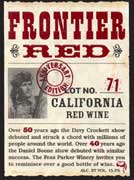
Fess Parker Lot 71 Frontier Red (California) — this is a brand-new wine from a new vintner, and it’s phenomenal; earthy and ever-so-slightly meaty with generous touches of blackberry, cherry, violet, sandalwood, cinnamon and cassis; it’s a colossal taste that’s overtly sexy; drink this alone or with food, just drink it, 15.5% alcohol