Author: Ann Bauer

  • Don't Have Sex to Sousa

    If only I’d known when I posted my last entry about White Burgundy and Fall Out Boy!

    Suddenly, everyone in the wine world seems to be talking about Clark Smith who — along with his wife, Dr. Susan Mayer-Smith — has been conducting "research" into the relationship between wine and music. The owners of GrapeCraft Wines, she (Susan) holds a PhD in clinical psychology while he (Clark) states on their website that his "claim to fame" is having been fired by Alice Waters, then goes on to talk about his own "Svengali-like charisma."

    I want to make it clear right up front: I have not tasted the wines from GrapeCraft. For all I know, they may be nigh to ambrosia. But come on. . . .This musicology thing — on which they presented a paper at the 13th annual Australian Wine Industry Technical Conference, and about which Clark was interviewed by the host of Day to Day on NPR — seems to me to be based more on savvy marketing principles than real science.

    Smith’s thesis is that a wine’s flavor will be "dramatically affected" by the music a drinker listens to as he or she sips. Cabernet Sauvignon, he says, requires "music of darkness," but might be ruined by a light chamber quartet. Pinot Noir calls for Mozart, while white Zinfandel will be improved (you’re not going to believe this one. . . .) by a good polka. Sweet Chardonnay must be served to the Beach Boys. Yeah, well, I wish we all could be California Girls.

    Back when I was in graduate school, I once ran into a woman at a party who had recently received a $150,000 grant from the NEA to study The Sopranos and measure the show’s impact on society as well as evaluate its relationship to George Eliot’s Middlemarch. (I’m 100% serious about this.) I remember being torn between envy and derision. My husband at the time, a carpenter, was simply admiring. "What a scam," he crowed. Indeed.

    That there is a relationship between music and wine is all but indisputable. Also between music and food, music and learning, music and sex.In fact, I’ve long contended that people eat more (and taste less) in cacaphonous environments, which is why I wouldn’t consume a morsel in a shopping mall — not even if Julia Child herself rose from the dead and appeared at Eden Prairie Center to prepare Coq Au Vin.

    We play Mozart to children because it is complex and mathematically structured, so it helps the brain develop connections in a similarly synthesized way. And we don’t make love to marching band music (please keep it to yourself if you do), but rather to Marvin Gaye, k.d. lang, Leonard Cohen, and Sting.

    In other words, I’m not saying the Clarks are wrong — they’re only pointing out what musicians have known since they worked for emperors and kings.

    Earlier this month, I wrote about the M. Chapoutier Belleruche Côtes-Du-Rhône 2005 and said it was "as balanced as Beethoven’s Sixth Symphony," with a nearly metrical composition of sugar, acid, and fruit. I’m sure the description occurred to me because of the inherent shared qualities of great music and fine wine. But the fact that someone is making a name by pointing out the obvious strikes me as ridiculous — the sort of whimsy only the NEA should support.

    As for that concert I attended, I’m quite regretful now. It occurs to me that Fall Out Boy’s The Carpal Tunnel of Love was literally screaming out for a good Shiraz.
  • The Mysterious Male Id

    I’ve fallen in love with plenty of imperfect movies. There was Donnie Darko, a film whose haphazard, cross-genre narrative I forgave because it cut right to the core of how weird and perilous it feels to be a depressed teenager. And Benny & Joon, a sweet, just-shy-of-precious story that was redeemed by genuine filial warmth and Johnny Depp’s knockout Charlie Chaplin impersonation — good enough (I like to imagine) that the Little Tramp was probably up in heaven cheering wildly as they filmed.

    John Turturro’s Romance & Cigarettes is just such a flawed but decent flick. Set in working-class Queens, it’s that age-old tale about midlife misbehavior and its resounding effects. John Updike’s Rabbit series, American Beauty, Married With Children — the zeitgeist is replete with examples. But there’s reason to make room for one more. Because Turturro’s Nick Murder (played by James Gandolfini) bares his soul in a way other anti-heros have not.

    What’s his beef? Not entrapment or tedium or the chains binding him to a dead-end job. No, Murder is simply LONELY. Or more precisely — and in a human way, I think — he’s afraid of being alone. And in a scene very near the beginning of this odd music-smattered film, the stubbly bridge worker lets himself out of his squalorous, smoke fume-filled house to serenade the neighborhood with his sorry state: "Lonely is a man without love."

    Of course, he isn’t without love. He’s merely stuck in the thirty-year slump of a long and encumbered marriage. And his wife, Kitty — Susan Sarandon, who is as lovely and foul-mouthed as she was 16 years ago in Thelma and Louise — is onto him. She’s a devout Catholic who uses the word "twat" as easily as she says the rosary. She knows her husband is fooling around. And chances are, she also knows why.

    Egged on by his know-it-all friend, played by Steve Buscemi, Murder not only has an affair with a trampy, British lingerie saleswoman (Kate Winslet) who eats chicken in bed and invites him to "open her back door," he gets circumcised for her. And this is where the magic of Turturro comes in. Because he alone has put forth one fact of life that at least fifty percent of the population never understood: Grown men in long-term relationships still obsess over their oddly-shaped penises. . . .the same way women fret over their flappy post-pregnancy stomachs and widening hips.

    Romance & Cigarettes is one extended explication of the male mind: Murder imagines his girlfriend dressed in red and shimmying through a burning house while firemen below wield their out-of-control "hose" like a powerful snaky phallus. He leaves the raising of his three daughters — creatures around the same age as his mistress who clearly bewilder him — to his wife. And he cowers in the presence of his mother, whose dominance is so emasculating it makes circumcision entirely beside the point.

    The movie is very uneven. Its plot takes turns that are not only unexpected, they don’t, in truth, make much sense. This, likely, is why Romance & Cigarettes bounced around Hollywood for two years after MGM was bought out by Sony and wrote the film off.

    I sympathize with the naysayers. This movie is raggedly written and refuses to stay put in one category: drama, comedy, muscial, or indie-style slice-of-life. Yet it’s saved not only by Turturro’s brash revelations about the male psyche, but also by a supporting cast that includes Mary Louise Parker, Christopher Walken, and the superb dowager Elaine Stritch.

    In perhaps the most inconceivable "twist" on the story of this film, Adam Sandler intervened with studio executives and asked that his friend Turturro’s film be given a limited distribution. Thus, on the power of the mighty Wedding Singer, it was.

    And I’m glad for that. Because thanks to Romance & Cigarettes, I may finally understand what’s going on in men’s heads.

    Opening December 7th at the Landmark Edina Cinema.

  • White Burgundy: Smooth Sunlit Chardonnay

    You would think — would you not? — that having been rendered temporarily, partially deaf would improve one’s ability to evaluate wine. Blindness, after all, makes the other senses more acute. Why not a faint pain and constant ringing of the ears.

    I had occasion to ponder this on Thanksgiving, after attending the Young Wild Things concert with my daughter in Cedar Rapids, Iowa, the night before. They, the wild things, were Cute Is What We Aim For, Plain White T’s, Gym Class Heroes (whom I adore), and the smashingly loud yet strangely dirge-ish Fall Out Boy. The last, headline band was accompanied by popping bursts of fire, a la Whitesnake, which amused most of the 40- and 50-something parents in the audience — and there were, by the way, A LOT: so many that Travy from GCH dedicated one entire song to us.

    Four hours. That’s how long we sat in the auditorium in C.R.

    But it was all worth it when, as we drove away through a sprinkling of midnight snow, my daughter turned to me, huge brown eyes shining, and said, "It feels like something’s missing now that I don’t have that thumping in my chest."

    The following day, Thanksgiving, I uncorked a Domaine de la Bongran Grand Vin de Borgogne, a white Burgundy from Clessé, France, 2002. I’d been saving the bottle, because it was expensive, highly-rated, and promised to be excellent. This, I decided, would be the perfect opportunity: my ears were wrecked, so surely my nose and tongue would be in top condition.

    Not so. Perhaps because I’m a bit of a synesthete — all my senses intertwined like tentacles of computer wire — I was in my echoey state also olfactorily confused. I smelled lime at the outset, and that was right. But after that, I got a whiff of green onion that no one else at the table (and luckily, I’d invited some excellent tasters) could detect.

    "You cut onions for the salad earlier," said one friend, tactfully. "Could that be it?" Indeed. It probably was.

    Everyone agreed that the wine was smooth and dry and delicious in a not-quite-crisp sort of way. The first taste seemed whole, as solid and neatly planed as a jewel. But as this Burgundy warmed and softened and unfolded, it became more complex, with a warm, sunny apricot flavor that filled the mouth and a finish that contained a bit of flint.

    Gradually, I figured out how to taste in my impaired state. This required intense concentration, and a palm pressed to my right ear in order to mute the dull throb inside. I got the spoke-like qualities of the Grand Vin de Borgogne, even if I couldn’t make the connection (as I might, under normal circumstances) between its flavor profile and a summer sunshower or a Sheryl Crow song.

    I have it on good authority — both Robert Parker’s and my Thanksgiving guests’ — that the Bongran Grand Vin de Borgogne (a Chardonnay wine with 14% alcohol) is well worth all the accolades it’s received. But I probably need a couple more days, preferably in a stark, white room with Crosby, Stills, Nash, and Young playing in a continuous loop and at low volume, before I’ll be recovered enough to tell you on my own.

  • My Last Supper: What's Yours?

    It’s #128 on Amazon, so I’m guessing this book will appear under many tinsel-frocked Christmas trees — My Last Supper: 50 Great Chefs and Their Final Meals, by Melanie Dunea — a thick, lush photo, interview, recipe volume that’s been described as Annie Liebowitz meets Heat.

    The conceit here is that 50 chefs, ranging from Jaques Pépin to Gary Danko to Nobu himself, were asked to imagine they would die the following morning and instructed to plot out their final fantasy meal.

    Here’s a portion of the publisher’s description:

    Chefs have been playing the “My Last Supper” game among themselves for
    decades, if not centuries, but it had always been kept within the
    profession until now. Melanie Dunea came up with the ingenious idea to
    ask fifty of the world’s famous chefs to let her in on this insider’s
    game and tell her what their final meals would be.
    My Last Supper showcases their fascinating answers alongside stunning Vanity Fair–style
    portraits. Their responses are surprising, refreshing, and as distinct
    from each other as the chefs themselves. The portraits — gorgeous,
    intimate, and playful — are informed by their answers and reveal the
    passions and personalities of the most respected names in the business.
    Lastly, one recipe from each landmark meal is included in the back of
    the book. With
    My Last Supper, Dunea found a way into the
    typically harried, hidden minds of the people who have turned preparing
    food into an art. Who wouldn’t want to know where Alain Ducasse would
    like his supper to be? And who would prepare Daniel Boulud’s final
    meal? What would Anthony Bourdain’s guest list look like? As the clock
    ticked, what album would Gordon Ramsay be listening to? And just what
    would Mario Batali eat for the last time?

    Curious, I looked up the menu for the actual last supper — which was, of course, a Passover seder meal. No one knows for sure, but it probably included unleavened bread, lamb with bitter herbs, saltwater, and wine. This was a supper at which the shared cup symbolized a "new and eternal covenant," an era in which everyone would be redeemed, heart, mind, and soul.

    Now, this sounds far loftier to me than the truffles, foie gras, blowfish, and (believe it or not) hotdogs the celebrity chefs of Dunea’s book listed among their desires. But in the absence of bread and wine consecrated by a prophet, I think I’d have to go with either the Salade Chinoise from Vincent A Restaurant followed by Alex Roberts‘ roasted duck with Brussels sprouts, or carryout from Pizza Lucé with a really nice Côtes du Rhône.

    Anyone else care to contribute a recommendation for last-day-of-life dining in the Twin Cities metro?

  • Pizza Via Text Message and U.S. Mail

    I recall sitting in a long, dull editorial meeting one Monday afternoon. It was around 4:30; a dozen writerly types, all disengaged. Our eyes were darting between our watches and the door. Then, the editor gave us the topic for our annual food issue: Best Pizza. Suddenly, everyone in the room perked up and had something to say.

    What is it about pizza? Not only is it a strikingly perfect meal: if you assemble it correctly, all five food groups are represented in more or less the right ratio. But it seems to strike an emotional chord with just about everyone in the free world.

    That it is the preferred late-night nosh of college students seems right to me, too. These are kids — really — away from home for the first time. There could be nothing more comforting than a warm slice, bubbling with cheese, to take the edge off worry about exams and dating and that touch of homesickness to which none of them want to admit.

    I saw this demonstrated just last week, when I mentioned to my creative writing class at Macalester that Papa John’s has now made it possible to order a pizza by text message. Half the students in my class rose off their chairs, as if they couldn’t possibly make it through the next hour of lecture; they simply had to leave and code in an order for a large pepperoni with onion and green pepper.

    Talk about your savvy marketing campaigns! Papa John’s not only has the most active Internet ordering system of any pizza purveyor (it’s advertised during Heroes — how much more exposure can you get — and statistics show one in five PJ pizzas is now ordered online), the company has hooked into the Millennium Generation‘s favorite method of communication.

    There is nothing new about any of this. Pizza has long been unique among restaurant food offerings: it’s the only item available for delivery to your hotel room, dormitory, house or apartment door in nearly every city, township, and village in the United States. And certain beloved pizzamakers are willing to go to great lengths to ship their product directly to you.

    How do I know this? Because I have a personal pizza story of my own:

    Back in April, I was on a college fact-finding trip with my younger
    son, who was then a junior in high school. It had been a tough year.
    Max was a varsity football player who got laid up with a nearly fatal
    staph infection, missed the final game of the season, and confessed to
    us that he’d always hated football and he was just as glad. . . .This
    explained a lot: the moodiness and testosterone bursts and mediocre
    grades we’d been seeing out of this heretofore model kid.

    Things
    were still a little tense, even when we left for our trek through
    Wisconsin, Michigan, and Illinois. This was supposed to be our chance
    to bond — mother and son — getting back to where we were before the
    fall from hell. We drove to Madison and had a fine time. Then we went
    to Ann Arbor, and it was as if the heavens opened up and angel trumpets
    began to blare. Max was entranced. He met with professors and took
    every tour and dragged me to a falafel place on the far side of town.

    "This is where I want to go," he told me that night over dinner. "There’s no need to visit Northwestern; let’s just go to
    Gino’s instead."

    He’d been talking about Gino’s since we planned
    the trip. "It’s the best pizza in Chicago, probably in the country,
    maybe in the world." But I — the responsible mother — was having none of this. "We came to visit colleges," I told him, "not eat pizza."

    We
    set off the next day for Northwestern. I’d programmed it into the GPS
    and allotted just enough to get there for our scheduled tour at noon.
    But as we drew closer to Chicago, something clearly went wrong. The GPS
    kept directing me toward downtown, though I knew the university was in
    a place called Evanston. Finally, around 11:30, I pulled over and asked
    someone.

    "You’re a good hour and a half from Northwestern," she told me. "There’s no way you’re getting there by noon."

    I
    was furious — at myself. I told Max I was going to find a coffeeshop
    where I could call the admissions office to get good directions and see
    if I could postpone our tour. I turned left, then right, then left
    again, and then I heard Max shout, "There it is! I don’t believe it. .
    . .you got us to Gino’s! See? It was meant to happen."

    Well, there it was. Indeed. And I had to make a split-second decision. Should I stick to my guns and drag the kid to Northwestern, risking our fragile new relationship; or should I go with the flow and share in his sense of divine guidance?

    Let’s just say: The pizza was really, really good. The lightest upside-down deep-dish I’ve ever eaten, it had a savory cornmeal crust and lots of tangy tomato sauce. And the best part is, you can have it shipped to you anywhere in the country.

    My son wears his Michigan sweatshirt proudly, but his other memento from that trip is the black marker I bought him to sign Gino’s wall.

  • Long Day's Journey

    I’m an unreliable narrator. You should know this.

    Here are my flaws: I’m alternately delighted and devastated by other people (there is, for me, little middle ground); I look for meaning in everything I see, whether or not it exists; and I believe too fervently in my own ability to change circumstances, no matter what the odds.

    So it was with my older son, who came back to us from the Mayo Clinic in June, like a whiteboard wiped clean. We’d spent years treating him for autism — OT, PT, kinesthetic exercises, biofeedback, social skills programs, and DMG. He made remarkable progress until the age of 17, when, after treatment for depression he began to slide back and then went into a near-vegetative state. Eighteen months later, we took him to Rochester nearly dead and they returned him to us (for which I am profoundly grateful) exactly the child he’d been at five: mute, ritualistic, lost . . . .

    The thing about my son — about so many people with autism — is that he was very able to do things. Play chess, navigate the city, balance my checkbook, or bake a cake. Most of his brain was functioning just fine, but the area controlling his ability to communicate had been shuttered down or roped off.

    For the past three months, he’s been in a transitional post-high school program where one of his main activities seems to be riding the bus from class to the shopping mall, three miles away. The goal, I guess, is to teach independence. But the tedium of his days, frankly, drives me insane.

    "We could drop him off in St. Paul on a Sunday," I told my husband. "Give him 20 bucks, tell him to buy himself lunch, and I’ll bet you anything he could find his way back."

    "How sure are you?" my husband asked. At which point, I went to an ATM and withdrew a $20 bill.

    Last Sunday, on the first chilly day of winter, we took our nearly-20-year-old autistic son to Highland Park mid-morning and left him with instructions to find buses that would lead him home and call us if something went wrong. Then we waited. . . .and I spent the afternoon pacing, wondering how crazed and wrong and stupidly hopeful a mother can be.

    Around 5, about an hour after a wet snow had begun to fall, my phone rang. I was certain it was he, calling to say he was cold and ask me to pick him up in some remote and unkown locale.

    It was my son, but he was calling only to ask if I was ready to see him at home. He’d had a pleasant time wandering through the shops in Highland Park then found a bus bound for Minneapolis, transferred twice, treated himself to a calzone at Old Chicago in Uptown around 3:30 and had been killing time ever since.

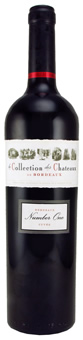
    He arrived a short time later. And all this is true: He speaks little, and only haltingly, but there was a broad smile on his face as he took 20 minutes to describe his day. I tried not to cry and opened a Collection des Chateaux de Bordeaux.

    I’d love to draw a parallel here; the essayist in me is dying to tell you I chose this wine because it, too, is put together in an utterly unconventional way, mixing the best Bordeauxs of any one year to come up with a blend of Merlot and Cab that’s instantly drinkable but also ages well. That would, however, be a lie: I had none of this in mind when I uncorked the bottle and took the first sip. I really only wanted something to do as I waited through the pauses in my son’s story, never mind the dry, oaky flavor and piano notes of pepper, tannins, and plum.

    There is no real moral to this story. My husband drove my son home to the place where he lives with his father, then returned and gently took my glass away. The bottle was nearly empty and I was bleary, limp with wine and relief. I still believe I can change the world if I just wish hard enough. Sometimes it is that glass at the end of the day which comforts me after I find out the world is not this way — none of us is so powerful.

    And other times, it’s the glass I drink in wonder because, after all, it’s just possible we are.

  • None Of Us Is There

    There is a peculiar poignancy in watching I’m Not There, Todd Haynes’ film based upon the life of Bob Dylan, in Minnesota. This is the home Dylan repudiated, along with his name, his family, and his faith. It’s long been a sore point for many here: that one of the greatest songwriters of our era has shrugged off this place, making it nothing but a minor footnote in his life. Perhaps now, the wound will close. Because I’m Not There makes the argument that Dylan belongs nowhere and to no people or religion. He is anchored neither to place nor time.

    Haynes accomplishes this by using six different actors, ranging from a young African-American boy (Marcus Carl Franklin) to a woman (Cate Blanchett) to a virile, robust young man (Heath Ledger), in the role of the film’s central figure. [The other Dylan avatars: Ben Winshaw, Christian Bale, and Richard Gere.] None but Blanchett — ironically, the most convincing — makes an effort to look or speak like Dylan. And each has a different name in the film, as if they are splintered personalities whose ownership of one musician’s body overlap. In a way, they are.

    These characters appear in merry-go-round fashion, representing the apprentice, the poet, the philosopher, the activist, the family man, the star, the preacher, and the wanderer. Some events from Dylan’s life, such as his offensive speech to the National Emergency Civil Liberties Committee in 1963, are enacted authentically. Others, such as the visit he actually made to a dying Woody Guthrie as an adult, which is depicted in the film as a fleeting, traumatic childhood event, clearly have been revised. And his stint as a born-again Christian becomes here the end of one alter’s story, rather than one more rock in the bumpy road of an erratic life.

    This is not an easy movie to watch. Just as the magic realism of Gabriel Garcia Marquez or Laura Equivel demands of the reader both absolute trust and hard work, I’m Not There asks viewers to suspend all expectations about linear narrative coherence. "Let it wash over you," producer Christine Vachon (of Killer Films) instructed the audience — utterly without irony — at the Walker Art Center’s premiere in early November.

    That Vachon was paraphrasing William Hurt’s drug-addled character in The Big Chill seemed unintentional. The advice is pretty good: you must relax and give in if you are to understand how sturdy little Marcus Carl Franklin, the boy told to "sing about [his] own time" becomes, ultimately, the wifty, slender, long-nailed and alabster white Cate Blanchett, railing against the fans storming her/his car and smoking with a mad, suckling greed.

    It is interesting, however, that for all his experimental strategies, Haynes begins and ends I’m Not There in the most traditional of American ways — with the hero riding on a train, pondering first his future and then his past. And each thread of the film is rendered startlingly in the style of a great director: Federico Fellini, Jean-Luc Godard, Sam Peckinpah (for whose Pat Garrett and Billy the Kid Dylan actually wrote "Knockin’ on Heaven’s Door.") Some are more successful than others: the Godard sequence in particular, saturated with color and starring a brilliant, luminous Charlotte Gainsbourg, is a joy to watch. There is logic in this chaotic swirl of scenes and the way to find it probably, perversely, is to be both relaxed and alert — accepting and ready to reach for connections that aren’t in evidence. The film is a kaleidoscope that likely speaks to each of us in a different way.

    Ultimately, it seems to me, I’m Not There isn’t about Bob Dylan at all. He appears, in person, only in one brief, closeup harmonica sequence at the very end. Rather, this is a film about reinvention and resurrection, about disillusionment with one’s own choices, about looking for answers and finding they are always just around the next bend. Nothing new here — it’s all just that messy business of being human. But Haynes has given us a unique lens through which to view the experience. And he’s chosen one man — one of us, in fact — to be the literal emblem of this odd, swiftly changing life that’s sometimes so difficult to understand.

    “Yesterday, today, and tomorrow are all in one room,” says Richard Gere playing Billy, the sixth and final Dylan alter-ego to appear on screen. And for a moment, in that darkened theater, they are.

    I’m Not There opens at the Uptown Theater on November 21.

  • A Perfect Holiday Pinot Noir

    I spend more time in the Byerly’s wine store than you might think. No, it doesn’t have the shop-on-the-corner charm of Hennepin-Lake or Solo Vino or Sam’s. It
    doesn’t have the breadth of Haskell’s or Surdyk’s. It isn’t dirt cheap
    like Costco, World Market, or Trader Joe’s. What it is is easy.

    It’s
    close to home, there’s never a line. Plus I can do my banking, my grocery
    shopping, send a few packages and buy a few bottles all in one trip.
    Call it environmental awareness, call it laziness, call it what you will. The surprise — for me, at least — is that Byerly’s stocks some
    excellent, affordable wines.

    Granted, you may have to look to find them. Last time I was at there, they had a great pyramid of Castle Rock Pinot Noir right up front. This wine is syrupy and foul. I’d far rather decant a bottle of Benadryl with my evening meal. And yet. . . .I discovered one of my favorites of the last year at Byerly’s: the Abbaye de Tholomies Minervois.

    While shopping over the weekend, I ran into Bill Belkin, the category manager of wines & spirits at Lund Food Holdings, Inc. (owner of Byerly’s, as of the acquisition ten years ago) and a rather garrulous guy. Within moments he had waxed on about the new Coen brothers film (he’s a BIG fan), my husband’s resemblance to Josh Brolin, and an FM-107 Lori & Julia segment he’d participated in on MILFs (which I would rather not define here — if you don’t know what they are, please Google; you’ll get an eyeful).

    Then he recommended the Bouchard Aînés & Fils Bourgogne Pinot Noir 2005, calling it a "really great turkey day wine."

    Now, a man that forthcoming, you assume he’s either totally honest or off his meds. I opted to trust Belkin, and I’m very glad I did. This pinot noir is pretty perfect for a holiday celebration involving several generations and levels of wine-drinking zeal. It has a bright fruit flavor with just a tiny bit of eucalyptus (a combination of oak and mint), a light mouthfeel, and a kirsch-soaked finish that stops short and relatively clean.

    Not only is it a good match for turkey — hearty enough to stand up to the stuffing and dark meat, but delicate enough to complement the white — it’s that grape that everyone in America has loved since Paul Giamatti‘s swooning ode to it in Sideways:

    "It’s a hard grape to grow, as you know. Right? It’s uh, it’s
    thin-skinned, temperamental, ripens early. It’s, you know, it’s not a
    survivor like Cabernet, which can just grow anywhere and uh, thrive
    even when it’s neglected. No, Pinot needs constant care and attention.
    You know? And in fact it can only grow in these really specific,
    little, tucked away corners of the world. And, and only the most
    patient and nurturing of growers can do it, really. Only somebody who
    really takes the time to understand Pinot’s potential can then coax it
    into its fullest expression. Then, I mean, oh its flavors, they’re just
    the most haunting and brilliant and thrilling and subtle and… ancient
    on the planet."

    I’m not telling you the Bouchard Aînés & Fils is the "fullest expression" of a pinot noir. But for $13 a bottle (and a rather meaty alcohol content of 12.5%), what can you expect? This is a very drinkable, universally appealing, and versatile wine. And you don’t have to take my word for it. Mr. Belkin of Byerly’s — fan of independent film and MILFs everywhere — says so.

    For the record, this winemaker also produces a masterful Pouilly-Fuissé that’s quite a bit pricier and much harder to find. . . .but it’s well worth the effort if you also want to offer a white at your table as well.

  • The Devil Knows About These People

    WARNING: Plot points revealed below–

    *****************************************************************

    Don’t shoot heroin.
    Don’t screw your brother’s wife.
    Don’t steal from your parents.
    If you do, make sure they won’t be there.


    Don’t embezzle from your company.
    Don’t squander your child support on cheap booze.
    Don’t whine, especially if you’re a guy.
    Pay some attention to the company you keep.


    Have great sex in Rio, but remember it’s just vacation.
    Don’t expect it to last forever.
    Don’t kill your mother, your brother’s friend’s brother-in-law, or your heroin dealer when you get back.


    Remember the IRS is watching.
    Don’t pay former employees and pocket their checks.
    Never trust your brother.
    Watch out when your father has a pillow in his hands.


    These are just a few of the lessons I learned watching Sidney Lumet’s Before the Devil Knows You’re Dead, in which a shallow, fucked-up, heroin-and-cocaine addicated real estate accountant (Philip Seymour Hoffman) hatches a plot with his spectacularly dumb little brother (played to a T by Ethan Hawke) to rob their parents’ suburan jewelry store.

    Why? Well, there are drugs to buy. Lots of them — dispensed by a gender-indeterminate waif in an apartment with modern furnishings and a view of the Empire State Building. Also, the accountant has a hot wife — Marisa Tomei, who spends a good half the movie topless and jiggling with a pertness that belies her age. Their last great sex was in a hotel room in Rio de Janeiro and he’s got it in his head that all he needs to do in order to repeat the doggie-style feat of manliness is return.

    The cypher, on the other hand, begins boffing his brother’s wife once everyone’s reassembled in New York — though what she sees in him is anyone’s guess. He also has a jaggedly bitchy ex-wife to serve and a spoiled daughter who wants to see The Lion King on Broadway, but tickets are $130 a pop.

    Everyone needs money. No one seems to want to work.

    This is not simply a dysfunctional family, it’s one in which blood flows like a rancorous, rotting, murderous stream. The mother is killed; her husband, the always fantastic Albert Finney, finds out. The brothers disintegrate in predictably biblical style. And justice is meted out: from the hands of the father, a punishment worthy of the crime.

    Sidney Lumet has made some startling, wonderful, tense films in his time, and this one is no exception. It is, however, lacking the fundamental humanity of a movie like Dog Day Afternoon. The latest Lumet begins with an epigraph: "May you be in heaven a half hour before the devil knows you’re dead." In the case of these people, however, I’m sure the devil won’t be fooled when they die. He’s been waiting.

    Before the Devil Knows You’re Dead is playing at the Edina Cinema.

  • Trash Can Turkey With White Wine

    It’s been my experience that people under stress generally respond in one of two ways: they either shut down, sleep more, become lethargic and gain weight; or they become frantic, insomniac, impossible to calm and they lose.

    I’m a loser.

    When my first husband left our family — out of frustration and addiction and through little fault of his own — I was in my last year of grad school and I found myself, suddenly, the single, unemployed mother of three. Nights were particularly scary; I lay awake and panicked. Mealtimes made my stomach clench. So I paced and pushed the food around on my plate and ran miles each day in an attempt to burn away the fear.

    I dropped 20 pounds in less than 8 weeks. About half my hair fell out, I failed a bone scan, there was a long sore on my back from where my bones poked through my skin. It pains me to tell you that women would stop me on the street to tell me I looked fabulous and ask me how I’d managed to lose the weight. The men I knew, by and large, asked if I was OK and plied me with food. I suspect it is no coincidence that my son, Maxwell — a caretaker even at 10 — became a great cook that year.

    On Sunday mornings, he made authentic Irish scones, which he served with tea and cream. Evenings, it was vegetarian Thai curry, pasta stuffed with pumpkin, and once, an authentic Cuban meal of black beans, peppers, hot sausage, and rice. Max got so good, friends of mine would hire him to make appetizers or desserts for their dinner parties. He watched the Food Network and talked about his plan to attend either Johnson & Wales or the CIA.

    At Thanksgiving that year, it was just the four of us. I had no idea how to roast a turkey — this had always been my husband’s area of expertise — and it really wasn’t in me even to try. But before I could even investigate alternatives, Max announced he was planning to brine a 20-pound bird. He had me buy him a brand-new 5-gallon trash can, then filled it with sugar, salt, peppercorns, red wine vinegar and water, and slipped the turkey in. He set his alarm and at 4 a.m., he got up briefly to stir.

    "Because it’s an aqueous environment, the vinegar and salt get into the pores of the turkey," Max told me. "It helps moisten the meat." I have no idea where he learned to speak this way. . . .

    The meat was, indeed, excellent, as I recall. Though I’m pretty sure anything this stoic little boy had put on the table would have filled me with pride. And I remembered that November of seven years ago today, when I ran across a recipe for Brined Roasted Turkey Breast with White Wine Sauce from Chef Ethan McKee of Rock Creek at Mazza, in Washington D.C.

    For me, life got better. I found a job, bought a house, got my kids into a great school system, started dating again, and published a book. Thanks in large part to Max, I put the 20 pounds back on (plus a couple more); my hair grew back, my skin healed, and my bones somehow survived. More important, I watched my kids pull together and I learned that a brave ten-year-old who’s just lost his father can find the wherewithal to make a holiday turkey in a can meant for trash.

    Over time, Max’s plans have changed. When he leaves for college next fall, he’ll be pre-med rather than a student at a culinary school. But I’m struck by how similar theses courses are: he’ll be taking care of people one way or another — feeding them or healing them. It’s very much the same.