Author: Ann Klefstad

  • Frida Kahlo

    On the centenary of Frida Kahlo’s birth, a comprehensiveretrospective can go a long way to rescue this tough, rich artist from her ArtHeroine Poster Grrrl status. She deserves more. Kahlo was full ofcontradictions and had moments of heroism and weakness; she had blindness,insight, and a gift for telling a story with pictures. She also hadtalent-maybe not quite enough for her desire, but that’s true of manydeservedly beloved artists: Edward Hopper and Paul Cézanne, for instance, weregiven deeper insight into the nature of the world by their own clumsiness atlevering it into paint. Kahlo shares this divine thumbiness; it helps hercreate the new and make it accessible to her fellow mortals.

    Walker Art Center, 612-375-7600.

  • Alec Soth: Dog Days, Bogotá

    One of these photos—a scruffy dog isolated in the center of theframe—appeared in passing on a web page and immediately snagged my eye.There was no attribution provided but I thought, that’s got to be Soth.And it was. Why was this goofy, tragic dog as good as a signature? Fora young guy, Soth seems to have an old guy’s emotional chops—and notjust any old guy. If you want to see Lear as a dog, or Cordelia as aghetto kid, then go see this show. You’ll be so happy you’ll cry youreyes out and go home confused—the best possible outcome for an artshow.

    Weinstein Gallery, 908 W. 46th St., Minneapolis; 612-822-1722.

  • Art Market: Buying Futures

    Graduates from the Minneapolis College of Art and Design
    have been changing the world you see since 1886. Names from its lengthy roster
    of notable alums include Wanda Gag, the brilliant children’s book illustrator
    who graduated in 1917, when the institution was known as the Minneapolis School
    of Fine Arts; the New York School painter George Morrison (class of 1943); Rob
    Roy Kelly (1952), who designed the Guthrie logo; Rob Fischer (1993), currently
    showing at prestigious New York venues like PS 1 and the Whitney
    Museum of American Art; and Ben Conrad and Alexei Tylevich (1994 and 1996,
    respectively), whose studio, Logan, designs ads for the iPod Shuffle. And, of
    course, the school is currently incubating talent you haven’t heard of-yet.

    But you can buy work from tomorrow’s stars at the MCAD
    Annual Art Sale. With many pieces under $100 and nothing more than a thousand,
    the price is certainly right. And if you trust your good eye, you might acquire
    something whose maker is on a fast track to fame. November 30 and December 1 at
    MCAD, 2501 Stevens Avenue South, Minneapolis; (612) 874-3700. For more images and info, see here.

  • Window on the World

    Brave New Worlds, up through February 17 at the Walker Art
    Center, considers "the present state of political consciousness, expressed
    through the questions of how to live, experience, and dream." The seventy works
    by twenty-four artists from seventeen countries were organized by Walker
    curators Doryun Chong and Yasmil Raymond; 10,000 arts spoke to Chong about the
    exhibition:

    How did the idea for this show come about?

    Almost all of us in the field are feeling a certain kind of
    urgency. Exhibitions dealing with the topic of wars, the topic of America, are
    turning up in Europe. We wanted to blow it up into something more encompassing
    … this work seems different in how it strives to be responsible to the world.

    With such a broad topic, relatively speaking, how did you
    narrow the field to just two dozen artists?

    We didn’t "discover" these artists. We’re looking at a range
    of practices to see what’s out there. We went to places like Poland or Romania,
    where there isn’t really an arts infrastructure, but many of the artists were
    very savvy anyway. The most interesting ideas are from these kinds of places,
    because you have to know the "First World" but also deal with your own world.

    For instance, Artur Zmijewski, a Polish artist, followed
    three working-class women around for twenty-four hours to show a portrait of
    life, of labor in Warsaw at this moment. Cao Fei, a Chinese artist, did a
    project with workers in a German-owned lightbulb factory in southern China,
    about their dreams and aspirations. They go from this assembly-line documentary
    to full-blown fantasy sequences with music and costumes.

    What was important to us was that all these artists are
    anchored in specific locations and specific locales.

    There’s also a lot of sculpture in the show that has specific
    concrete relations to place, is made of substances specific to place. So the
    show is a map of current art practices but not a totalizing map; it shows
    important threads of what artists in the world are doing.

  • Point of Entry


    All artists come from a foreign country, in some sense.
    Where “originality” is essential, each artist becomes a world in him- or
    herself, with zealously guarded borders. But what’s it like to be an artist who
    makes a home in a distant land? The answers to this and a thousand other
    questions are different for each of the artists interviewed below. It turns out
    that “émigré artist” is not a category, only a door into a very large world.


    Manjunan Gnanaratnam

    Sri Lanka’s civil war drove Manjunan from home at
    twenty-one, in 1983. He arrived in New York to study music, saw Merce
    Cunningham perform, and found his calling as a composer for dance. His current
    projects include plans for a 2008 performance that includes dance projected on
    the walls at the Weisman Art Museum; he’s also recreating composer Karlheinz
    Stockhausen’s work Ceylon.

    Manjunan never spoke publicly about leaving Sri Lanka until
    recently: “I couldn’t talk about the effects of war until war came here—you
    can see wounded young people in the airports now. I can speak now about the
    innocence that was lost and people will understand.” He feared that if people
    knew of his exile, it would overshadow his work—which is not about exile
    or nationality, but the relation of human bodies and sound.

    “In some ways,”
    remarked Manjunan, “I’m more at home musically here than in Sri Lanka; the
    avant-garde music community here understands what I do. I have a home inside my
    music, inside my relationship to dance, to the optimal performance environment
    … that is, in some ways, my true home.”

    However, on returning to his home country after twenty
    years, he realized he had missed “the vibrations of the society that produced
    me. Sri Lanka has five hundred years of colonization, by India, England,
    Holland. The music contains all these traditions, church music, Hindu music,
    Buddhist, rock ’n’ roll—and so in some sense everything’s allowed. My
    physical home is in Minnesota, but my emotional home will always be Sri Lanka.”

    “My work as a composer for modern and postmodern dance and
    performance art is easily accepted in the East and West coasts and
    internationally,” he noted; “however, I would say Minnesota lags on this.”

    So when asked what he feels he brings to the mix of the arts
    in Minnesota, Manjunan responded with a smile and another question:
    “Adventure?”


    Gladys Beltran

    A painter who arrived here in 1993 from Colombia, Beltran
    has a BFA from the University of Antioquia in Medellín, and won a McKnight
    Fellowship in 2006. It took her several years to learn English and feel at
    home, but now, she says, “the process of growing old and the hope of growing in
    the spirit through my work is taking place here.” But she misses her sisters,
    her parents—their faces, how they change over time, their jokes and
    laughter. “The absence of our loved ones is a temporal death. It is horrible
    when you can’t hug them.”

    But there is freedom even in this sorrow. “As a painter it
    is liberating not to be with some members of my family who love me, I know, but
    who cannot understand why I have to paint. Being away, I do not have to explain
    over and over why: I have to paint if I want to breathe in peace. I have to
    paint because I do love to exist.” She says it’s too soon to know people’s
    reactions to her work: “My work is like a baby, and people always like babies.
    I haven’t done 1/30th of my project.”

    Artists, she believes, are similar everywhere. “I brought my
    hungry soul. I can say it is more what I took from you than what I brought,
    because I am taking your cities to paint them, I am taking your spaces to
    navigate in them with my paintbrushes over the canvas. In other words I will be
    taking over your country to paint it, to love it.”

  • Another Green World: New Landscape Art in Minnesota

    Landscape has always been one of the strongest currents in the Minnesota art world. Now, new ways of perceiving and portraying landscape tie artists here to a global groundswell of art about the complex relationship of nature and culture. Recently, I sat down with a group of artists from around the state to discuss their work: photographer Chris Faust, painter Theresa Handy, sculptor Karl Unnasch, multimedia artist Margaret Pezalla-Granlund, and painter/sculptor Gregory Euclide (our cover artist); plus curator Theresa Downing, whose fascinating show, Environments of Invention at the Minnesota Museum of American Art this spring (see “In Review,” p. 18), was the opening topic. As Downing said, “The theme of the show was looking at the difference between raw experience of the natural world and our perception of it through the screen of our eyes, our minds, our emotions.”

    Each artist had a different tale of the origins of their insight into the natural world. Euclide’s involved saturating himself in it. “Being a kid wandering through fields was important … experiences like falling in the snow and staying there for three hours and letting snow fall on you and just looking at the sky … Here I am thirteen years old and laying down in a river and letting the water flow over me for hours—if anyone saw me they’d think, you know … ” and he casts his eyes up.

    When Faust was young, “the outdoors was where your real life was,” he said. He loved maps, and was fascinated by the split between their flat symbols and the look and feel of the places they represented.

    Unnasch spoke of how and why he came to use landscape in his sculptures: “I’m interested in, for lack of a better term, I’ll say ‘innocence’—the thirteen-year-old’s stigmata. For myself, growing up in the country, being out in nature was the basis of that transition; it wasn’t smoking my first cigarette, it was catching my first trout.”

    It became clear that the losses, memories, and entropy associated with the natural world all played a major role in most of these artists’ work. As Euclide described his childhood experiments, he spoke of a longing for an experience that would not fade, a desire for presence: “The growth and decay that I saw in the landscape was mirrored in my mind as experience and memory.”

    Faust remarked, “Nature is continually trying to increase entropy, and humans are trying to decrease it. That’s why we paint the house, right? Nature is trying to erode the house, we’re trying to scrape and prime … Nature will always win.”
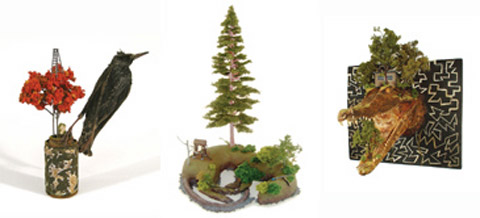
    Starling, The Long and the Short of It, and Whudda Croc by Karl Unnasch

    New Landscape for Old?

    How do these artists view their relation to the traditions of landscape painting and photography? Is this relation ironic, transformed? Euclide noted, “I don’t consider myself a ‘landscape painter,’ even though that’s what I do.” For him, work becomes experience. “I’ll pile up sheets of paper, do a painting on one, then spray water on it. I think of it as a natural process, a temporal image, the landscape washed away by water; I’ll start painting on the next piece, these planes of paper mimic planes of experience in time, they get painted on the front and on the back to mimic the experience of walking through landscape. For myself, it’s a kind of longing, because I’m not in nature anymore, I’m in the city.”

    Most of these artists are urbanites, though they may have memories of idyllic days in nature. Though Handy didn’t grow up in the country, “maybe my work talks about that sort of longing [for it],” she said. “And my work is a metaphor as well. Lately I’ve been making small works fastened together. They’re photographs that I paint on, editing out a lot of things in the photo. They feel like flashes of a memory of a place, a happening, a time … that editing mimics our inability to remember all the details.”

    Of course, it is possible to see the urban environment as simply another sort of landscape. This became clear to Pezalla-Granlund when she was living in Los Angeles, which “was very different from the landscape I grew up in, but it was also similar, quite flat. I guess when I got addicted to landscape was in parking ramps, and also on L.A. freeways, because you’re up above.”

    As the discussion stretched over a range of themes and topics, an undercurrent emerged: landscape as something we want to see but which is difficult to grasp. Faust talked about a rural ecology project he’s part of, which is trying to devise ways of easing the relationship between farmland and wild land. “We’re looking at this point where farmland and nature meet, looking at what farmers would call ‘chaos.’ The natural landscape looks messy to them. The Conservation District is trying to convince farmers to do different landscape practices. They’ll be asked to put in a buffer zone to filter field chemicals, but we have to order it somehow. You can’t just plant a bunch of stuff, there has to be some rhyme or reason to it—otherwise the farmers won’t do it.” Even for him, shooting pictures of these junctures isn’t easy: “It’s very odd-looking, I really have to sit down and look at it for a while. Jill Nassau, the project landscape architect, talks about this messiness, and how it’s innate in every human to try to order landscape. I find that when I’m out in natural landscape, I need to find some sort of thing that compositionally ties it all together.”
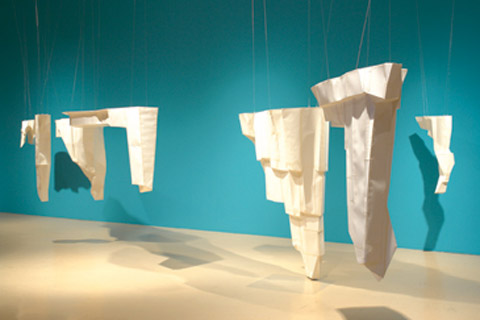

    Missing Part (Iceberg Models) by Margaret Pezalla-Granlund


    Unnasch agreed with this compulsion to order the world, noting, “I bet it’s hard to find a piece of ground that’s unaffected, that’s not somehow urbanized.” Euclide dreamily added, “You know what the most beautiful spaces I find are? Freeway ramps. I think that those are so beautiful, because they’re left alone.”

    In response, Faust reported a comment he heard while driving along a highway, that “MNDoT oughta come in here and clear some of this stuff out!” Faust disagreed—it was nature working. Unnasch laughed. “People feel safer when all those trees are doing exactly what’s expected”—ensuring, in other words, that there’s no room for weeds. He added, “Now there’s another conceptual word—what’s a weed and what’s not? There are no weeds in nature, just like there’s no ‘natural disaster,’ only human disasters.” Faust answered himself, “Nature doesn’t care.”
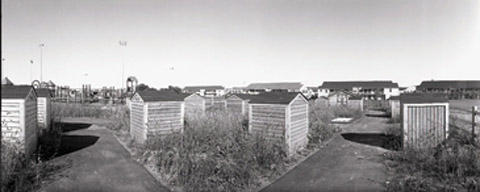

    Safetyland by Chris Faust


    But is there always a distinction between the human and the natural?

    Handy points out the possibility that human alteration of the world is as natural as any other part of it. Her work is becoming more urban; she’s looking more at her immediate surroundings—skies, birds, telephone wires. Euclide told this story: “About six months ago I buried some paper. Later I used that paper covered with dirt, sprayed it with water, made shelves on the torn paper that caught the dirt and water, which became a three-dimensional construction that came out over the floor. I was interested in making the process mimic what the work represented, so the process and content were the same. There was decay on the paper, and where it came out from the wall I planted seeds that grew. The aesthetic parts were not my doing but created by growth and decay.”

    The need to understand the disorderly order of nature, to gain a viewpoint beyond the human, is familiar to these artists. Downing described Google Earth, the online database of satellite images of the whole globe, as tremendously influential:

    “I often sit and think about how I look to someone outside our atmosphere. For me it was hypnotic to go on Google Earth the first time and think about how we see ourselves and how others see us. It’s changing so rapidly.”

    For her, landscape art is this kind of mediation, and both meaning and chance—which can include random techniques like tearing, seized compositions, as well as accident and decay—inform the work of the artists present.

    Unnasch’s tableaus often include road-killed animals and found artifacts; the bases of his landscapes are “actual animals, not taxidermied … because I’m not interested in taxidermy, the craft of it. I want to know just enough to bring it off, to keep innocence, openness.” His work is formed half by himself and half by the ravages of time and decay on the animal corpses and the reclaimed objects that make up his sculptures.

    That willingness to both see and to un-see—that is, to erase assumptions—is part of this new genre as well. “I’m interested in a continuum of landscape,” Faust said. “I want to draw a line on a map and shoot photos along that line, to unlearn assumptions about the land, to find out what it really is.”

    But there’s an equal desire not to represent landscape but to become it, to have art be the processes that create the natural world. “I couldn’t just depict the experience of being in nature,” said Euclide. “I had to redo the process of growth and decay. The process of viewing it, then, becomes the equal of making the piece.” Two-dimensional painting that only depicts the world comes up short for him.

    For all their innovative ideas, these landscape artists still owe much to the past, of course: a yearning for communion with the natural world, respect for perception, commitment to the wisdom of the senses. But there’s much that’s new here too. The landscape in these artworks is cut across by human markings, literally broken into pieces, or torn, or part of a body that was once living. Their works convey difficult beauties and tough-minded pleasure; romantic and scientific, earthy and philosophical, these artists are giving us the world that we need as well as the one we deserve.
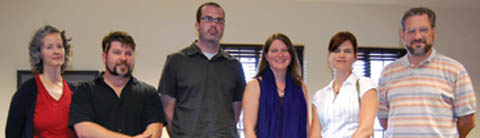

    The participants: Margaret Pezalla-Granlund, Karl Unnasch, Gregory Euclide, Theresa Downing, Theresa Handy, Chris Faust.
     

  • Bruce Tapola: Paintings for Germans, Sculpture for Snobs

    If you’re going to be in Rochester for your annual colonoscopy, brighten the occasion with a trip to the Rochester Art Center to see the always interesting work of Bruce Tapola, Minnesota’s most famous somewhat-obscure artist. Venues ranging from esteemed institutes of art (in Milwaukee and Minneapolis) to a rented U-Haul parked in front of the Walker Art Center have spread his fame. Recent outings in Miami and Minneapolis, and a collaborative installation with his wife and daughter called I’m With Stupid, have enabled Tapola to further develop his broad range of media-inflected moody imagery. Here he again hammers on the closed gates of American culture, with his ambivalent cry: “I love you! I hate you! I love you!” 40 Civic Center Dr. S.E., Rochester; 507-282-8629; www.rochesterartcenter.org

  • Bird x Bird

    More fun than a flock of starlings! This improbably cool event is a snowballing phenomenon. Artists passionate about something besides art. A show that’s rife with feeling. The only unusual thing is—jeez, Minnesota!—the dearth of collectors in the mix. For God’s sake, people, this show brings together some wonderfully skilled artists. And it doubles as an auction to support bird-related causes (it’s organized by a nonprofit that “links the collective action of artists to organizations dedicated to the stewardship of avian species”). So show up already, get bargains, and meet a lot of interesting-looking folk. 1500 Jackson St. N.E., #322; Minneapolis; 952-994-0914; www.birdxbird.org

  • Daniel Mason: New Paintings

    By now, most of us have read Harry Potter. And there are differences between that parallel world and those of yore. Namely, in the ’60s, the parallel world was real, created through individual skill and grace. It was J. D. Salinger’s Upper West Side; or it was on the roads and streets of Kerouac and Ginsberg, the address of people with greater reserves of appetite and heedlessness. Readers could enter if they learned the skills, took the leap. But there’s no way to become a wizard. Dan Mason’s paintings present a parallel world, too, but it’s one that’s findable somewhere on this globe. His blocky cities and landscapes shimmer in colors that can be sought, through travel or the pharmacopoeia, in real time. 530 N. Third St., B10, Minneapolis; 612-338-3656; www.thomasbarry.com

  • Host

    This somewhat mysterious exhibition, curated by Elizabeth Grady of the Whitney Museum, seeks to use the Soap Factory itself as subject and object. The grandeur and melancholy of the Factory, not to mention the deeply ingrained scent of soap and labor with which the place is imbued, have long been the best aspect of shows here; in fact, sometimes the art suffers next to the rich, dark aura of this venue. But Grady intends to use these charms in putting together this exhibition. There are other purposes stated in the prospectus (interactivity, thoughts about the power of spaces to foster interaction), but the bulk of the show, it seems, will be an improvisation with the space. 518 2nd St. S.E., Minneapolis; 612-623-9176; www.soapfactory.org