Author: Brian Lambert

  • Weekly Standard Week on The Daily Show

    When I saw the front page flag on yesterday’s Wall Street Journal — the one that said, “Why We Need More Dick Cheney” — I thought my favorite WSJ contrarian troll was at it again. If you follow the Journal’s Op-Ed page, you know it is populated — exclusively — by some of the eeriest, most in-bred cultural reactionaries American journalism has ever produced. And that is saying something.

    But among them, deputy editor Dan Henninger is my hands-down favorite. The guy had to be last picked at kick-ball. My list of all time favorite Henninger syllogisms would have to include the time he dared gay-marriage advocates to prove that what they wanted wouldn’t lead to people, (most likely gay liberal Democrats) to eventually demand to be allowed to marry snakes … like a woman in India did. (Link is here, scroll to the bottom.)

    Anyway, sorry to ramble, but it turns out Henninger was NOT the author of the “Damn, That Dick Cheney is a Smart Guy” Op-Ed. No, the piece was written by Cheney’s approved biographer, Stephen Hayes, who, just like Lindsay Lohan on Leno, has something new to sell, in this case his latest book, “Cheney: The Untold Story of America’s Most Powerful and Controversial Vice-President”. Hayes writes for the ultra-conservative Weekly Standard and Cheney himself has referred to his previous work asserting the ties between Al Qaeda and Saddam Hussein several times as proof enough that … Cheney’s … epic fiasco in the Middle East isn’t rooted in either fraud or incompetence. (Here’s the counter-point to Hayes’ assertions.)

    Here’s a bit more on Stephen Hayes.

    So … imagine my surprise when Hayes turns up on Jon Stewart’s show last night … only a couple days after his boss, Weekly Standard editor and uber-neo-con, William Kristol, had been on.

    My point — and don’t you wish I’d get to it? — was the demeanor and tenor Stewart displayed in the presence of both men, neither of whom would ever be considered fellow-travelers. Here is Stewart with Hayes, and here is Stewart with Kristol.

    In the context of … the myriad problems with mainstream media … it by now a cliche to point to Stewart and say, “Look, damn it. This isn’t so tough. Ask these questions in this way.” Point being that Stewart understands that O’Reilly-style head-knocking offends the sensibilities of his audience. Bellicose name-calling and boorish grandstanding not only is off-putting to anyone with an adult brain, but it is utterly valueless in terms of asserting or ascertaining any truth.

    In fairness to Kristol and Hayes, both understand, like a liberal tip-toeing on to O’Reilly’s set, that they are probably not going to have the last word in this fight. But, unlike the usual “adversarial” pin-cushions on O’Reilly-like acts, both also knew that Stewart, despite profound disagreement, was going treat them with civility befitting … a guest.

    I was thinking of this because there has been some talk around town of trying to set up a liberal/conservative face-off website for the Twin Cities, where readers/viewers could, you know, maybe get a better idea of who is dealing with reality and who isn’t? As in: An actual honest debate. This strikes some lefties as a complete sell-out. After seven years of Rove-Cheney (abetted by the Kristols and Hayes of the world), they have no tolerance at all for collegial civility. Not right now, anyway.

    “First, rip their gizzards out, spread them out in the sun, cover them with lime and salt … THEN we’ll consider civility.”

    (And that’s a sample from usually squishy-huggy liberals.)

    Accepting that the right-wing attack and echo machine invented the game of mass/pop media demonization-for-profit, lefties are justifiably worried that engaging in human-level interaction with characters so notoriously, and unapologetically wrong-headed as Bill Kristol risks playing into another diabolical trap.

    But the Stewart model seems to be working pretty damned well. And in the context of so-called “objective” journalism, particularly as the mainstream shifts on-line and must re-visit a few of the hoarier standards of “fair” questioning, the ability to pose tough — but demonstrably fair questions … revealing personal viewpoints … is a place journalism is going to have dare to go if it has any hope at all of holding both demanding, long-time news consumers AND attracting younger news seekers.
  • Does It Have to be News OR Analysis?

    The extraordinarily anachronistic Tim Rutten of the Los Angeles Times — a guy writing about media, newspapers even, while on the staff of a daily newspaper — has a particularly interesting piece up today. It’s about several things all adding up to what news consumers really want out of an on-line newspaper, supposedly the creature evolving to either hammer the last nail in the coffin of print or to offer print a last chance for survival.

    Rutten gets off several good lines, like the one where, in trying to describe the specific type of anger that drives CNN Headline’s Nancy Grace, he comes up with, “crypto-fascist anger”. (Shades of Gore Vidal v. William Buckley). And by the way, what was Grace ranting on last night? Some derelict mother who fed cocaine to her toddler? Why is that ever a national news story? Rutten’s point is that cable TV’s strategy for driving viewership is based on a wretch-inducing combination of near lunatic anger, junk news and hype, not exactly a recipe for journalistic credibility.

    He also notes a Pew study on the matter of “media bias” that 71% of Republicans who rely on Fox News as their main news source — and damn, aren’t they a fun crowd? — “hold an unfavorable opinion of major national newspapers”, as opposed to 52% of Republicans who get news from somewhere else and only (?) 33% of non-Republicans. In other words the more you turn your brain over to Fox News the angrier you get with the New York Times and the Washington Post for not reporting the good news from Iraq, the hoax of global warming, the in-depth, investigated truth about John Edwards $400 haircut and how the Clintons murdered Vince Foster.

    Point being, screw ’em. You pander to that fringe at your own peril.

    But eventually Rutten gets around to wondering what news consumers want, (as opposed to what embittered ideologues need).

    If an on-line newspaper is going to be different than its shriveling, compromised dead tree cousin, how different and in what ways?

    “The honest answer,” Rutten writes, “is that nobody knows for certain, but the odds are it will be a hybrid publication in which an online edition that’s focused mainly on breaking news and service works in tandem with a print edition whose staples are analysis, context and opinion. The former almost surely will have a lot more video and interactivity than it does today; the latter will have to be much more thoughtful and far more intensely and carefully edited.”

    Rutten, like other veteran newspaper types seems to believe that news consumers will demand some kind of continuation of a print edition well into the future. I’m not so sure at all.

    Last Friday night former Strib food and ethics writer turned Rake blogger and TC Daily Planet guiding force, Jeremy Iggers, invited me down to a class he’s teaching at the new Minneapolis Central Library. I was flattered he had an interest in my deep thoughts on what is happening to daily papers, and arrived full of half-prepared bloviation and bogus factoids. I was going to wow ’em, I tell ya’. Then the Strib’s Mike Meyers showed up. Mike is a smart and funny guy, and, well hell, why lie? He big-footed all over me. Not that I put up much of a fight. Who could? When Mike gets on a roll he is damned entertaining, and Iggers’ class ate it up. Besides Meyers and I pretty much agree. Pretty much. So what’s to fight?

    Meyers, who takes a kind of pragmatic capitalist view of things up to the point of condoning rampant, short-sighted stupidity, such as he sees going down at the Star Tribune and elsewhere in the newspaper biz, also believes the dead tree version will linger. I don’t. I think five years from now the thing they’re leveling forests and burning boat loads of gas to truck to your door every morning will be a quaint memory.

    In my scenario, the greed of the Avista Capital Partners private equity/hedge fund crowd now gobbling up every molecule of value at the Star Tribune will soon give way to them blowing out of town and leaving behind the journalistic equivalent of a fake Hollywood stage set standing at 425 Portland. The Strib will be a fraction of a fraction of its former size and by that time everything the Strib, and other major papers, used to provide, will be available, albeit scattered in a thousand different places on the web. But also by that time … advertisers will have grown comfortable enough with the best of local news/analysis sites to have begun moving money toward them. Then, I say, all that’s left to spike consumer interest and appeal is an ergonomically comfortable device that allows avid information consumers to replicate their favorite habit of reading the “paper” anywhere they want with a cup of coffee and a delicious custard-filled bismark. (Oh wait, that wasn’t supposed to be in my out-loud voice.)

    A device based on technology from something like this would pretty much fill the bill.

    I mention the ergonomics because I hear that a lot, especially from older readers, the crowd Strib research famously referred to as being so loyal, “we couldn’t beat them off with a stick.” People like holding a newspaper. They don’t like hunching over a computer. Everyone understands that. This ergonomic issue came up again at Iggers’ class.

    I tried to explain the dawn of gizmos that will radically shift the thinking of long time newspaper reading adults. But that f**king Meyers was being so amusing and on-point all I got were a lot of glazey-eyed stares. (Meyers nodded when I repeated the market assumption that the purchase price of a personal, fold-away, eminently portable computer screen would probably be heavily underwritten by on-line content purveyors, much like cellphone companies who more or less give the phones away and then stab you with monthly fees.)

    But back to Rutten’s concern over the proper separation of classical news reporting and analysis. Frankly, I don’t see why the two can’t co-exist on the same web-site. Anything you can do in print you do more of and better on line. In something like the I-35W bridge collapse what staff there was, and presumably an established collection of stringers/community journalists, most with cameras, would rush down and do what reporters always do. But then, as the search for explanations expanded, reporting, by professionals, could mix with analysis in ways that would not set off bias sirens in anyone other than the most hardened Fox News-o-holic, not many of whom I’m betting will have much interest in news from any source other than Sean Hannity’s butt.

    I mean, read a newsweekly and tell me where the “straight” news ends and analysis kicks in? Smart readers — the only folks who’ll BUY into an on-line paper — know bias when they read it. Bias is when the facts don’t match the reality.

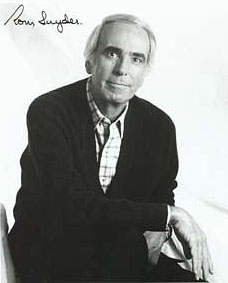
  • Before It's too Late: Tom Snyder

    tom-snyder.jpg

    The bridge disaster put a hit on my carefully planned blog schedule. (I’ve been reading through the local papers from the first days after — I was out of town when it happened — and will offer deep thoughts in the not too distant future. I know, hearts be still.)

    But I gotta say something about Tom Snyder, whose death was obscured, not just by the bridge over I-35W, but by the simultaneous passings of film legends Ingmar Bergman (somebody … please … another full-scale retrospective … fresh prints … especially Wild Strawberries and Persona), Michelangelo Antonioni (ditto, La Notte), and Bill Walsh. (Do you really think Brad Childress has read ANY of Walsh’s stuff?)

    I was a Snyder fan. The guy was the perfect night-capper: curious, smart enough, inclined to be goofy but not a comic, flappable, affable, approachable and occasionally maudlin. The kind of guy you figured spent the previous night out on the town chatting up cabbies and players, and was perfectly comfortable telling stories about the boss(es) with a cocktail in his hand — i.e. an evolved, easy to be around human being. For God’s sake, the man even SMOKED on camera. (It was relaxing watching him smoke. The cigarette was a prop he used well. It conveyed relaxation.) And he admitted smoking pot to Barbara Walters. And he managed — more or less — to get The Clash to sit still for an interview, (during their legendary Bonds’ concerts in Times Square in 1981).

    I met Snyder only once, in L.A. maybe 10 years ago, during his brief come-back. By that point the game had shifted and he was doing kind of a caricature of himself, almost as though that’s what the suits expected. But in his prime Snyder possessed — and was allowed to express — a quality largely missing from television today, despite the fact there are roughly 150 more functioning channels than when he was doing his thing.

    What gives? Why can’t a character who isn’t as self-involved and self-serious as Charlie Rose, or as embalmed and … incurious … as Larry King, interview people from the entire range of modern culture — novelists, government leaders, rockers, athletes, firebrand politicos, other media egos? My understanding has always been that in the fragmented media game of 2007, every niche has its go-to interview guy/gal and the rules more or less require them to play within their demographic zone. That is to say, if on MTV, stick to pop foo-foo. If on ESPN, don’t wander far from sports. Stick with the games and the careers, and obviously don’t even try to trot say, Jonathan Franzen onto MTV, or Win Butler from Arcade Fire onto The Best Damn Sports Show.

    The lack of a character like Snyder, or hell, even like Dick Cavett, bothers me. Although Cavett, who I also enjoyed and appreciated, had a lot more of that Upper East Side ‘tude going for him than Snyder. (Never mind that Cavett was born in Nebraska and Snyder in Milwaukee. Both are also the same age, interestingly enough.) Their act — Snyder’s in particular — shouldn’t be that tough to replicate. But I don’t have the feeling anyone is even trying.

    PBS should be able to pull off something like this. But somehow everything that goes through the PBS de-flavorizer, (TM — Neal Karlen), ends up too self-consciously proper and measured, with no room for a prankish stupid question or two. And God knows you couldn’t smoke.

    I really have nothing more to say on the subject, other than it strikes me as odd that Snyder’s shtick, and it was pretty natural as shticks go — isn’t playing anywhere, nationally or locally.

    If any of you think of someone who meets the criteria, remind me.

    Here is a collection of Snyder’s “classic bits”. Steven Spielberg, Alfred Hitchcock. a very young Bono, Charlie Manson, Johnny Rotten.

    Nice range, dude.

    I looked for Dan Aykroyd’s impersonation of Snyder and couldn’t find it.

  • Why Are These People So Happy?

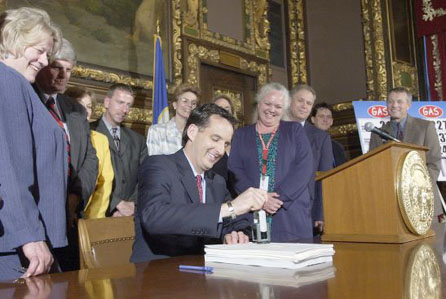
    This photo was passed along to me without any idea who the photographer was. If anyone knows, I’ll happily credit them for what I think captures an iconic moment in Minnesota government, namely Gov. Pawlenty and his, uh, anti-government, “No New Taxes,” transportation advisers, (note Lt. Gov. Carol Molnau beaming at left), vetoing last year’s pittance of a gas tax increase.

    I am prepared to host a pool on when Pawlenty throws Molnau under the bus to protect himself from direct criticism for going to the Taxpayers’ League well one time too often. The Governor has other places to go, if you know what I mean, and is far too adroit a politician to allow himself to be tarred with accusations of gross short-sightedness or errors of judgment in relation to the collapse. So I say sometime around Thanksgiving Molnau will suddenly feel the urge to, A. “Spend more time with my family,” and/or B. “Explore new opportunities.”

    Meanwhile, for a taste of the new, post-collapse Taxpayers League talking point meme, where the real issue is proper allocation of existing resources, (i.e. wasteful education and social spending can always take another hit), you owe it to yourself to catch former State Rep. now Taxpayers League President Phil Krinkie in action on Gary Eichten’s show this morning.

    Also, Mr. Krinkie, please, do you really think it is necessary for the entire state and every media and government agency to avoid discussion of the hows and whys of this tragedy and instead remain in a state of prolonged respectful sorrow for the dead and their families? Most of us can multi-task. We can show respect for the dead and injured AND demand that the people most responsible for the policies that guaranteed inadequate maintenance maintain a high public profile.

    I think I’ve already said that the best time to engage the public in the musty but critical business of state budgets is when people have an acute focus on an issue.

    Veto gas tax.jpg

  • Inside the Latest Radio Ratings

    First, a word of apology for a glitched-out post that hung out here for a while last night and this morning. There are reasons why I’ve never been asked to program the space shuttle.

    The collapse of the I-35W bridge last week pushed a lot of beat coverage off the table for a while. In between boogie boarding and cocktails, (neither a pretty sight), I had been fishing for the Arbitron radio ratings for the spring/second quarter of this year. I now have them.

    You may have seen the overall ratings, the so-called 12-plus. While a reasonable enough gauge of station popularity, that category, including both kiddies and geezers, is of almost no value to the stations’ primary customers. (That’d be their advertisers, not you, you silly listener.) But under the rules of Arbitron they are allowed only to publicly share that broad, vague figure, while zealously guarding information that has actual sales validity and impact.

    But as in all things media (and life) there are ways to get your gloms on the darker secrets.

    Here then is a look at the ratings and station rankings for the Twin Cities top stations among adults 25-54. First number is spring ’07, second is spring ’06.

    Station ’07 / ’06

    KQRS 12.2 / 11.4
    K102 7.2 / 7.3
    KS95 5.6 / 5.9
    Cities 97 5.1 / 5.6
    93X 4.9 / 3.6
    WLTE 4.6 / 4.8
    KDWB 4.6 / 3.1
    Jack-FM 4.3 / 4.3
    AM 1500 4.1 / 2.7
    The Beat 3.7 / 1.9
    WCCO 3.3 / 3.7
    KFAN 3.0 / 3.9
    KOOL 108 2.6 / 5.0
    KTLK 2.1 / 1.5
    FM 107.1 1.8 / 1.6
    LOVE (3) 1.1 / 1.1
    Air America 0.9 / 1.1

    Further down the list, deep wing nut radio, WWTC AM 1280, aka, “Patriot” lost about half its adult audience from last year. Dipping to an 0.6 from a 1.1.

    Digging around a little further I find the evening ratings for AM 1500 up from a 1.7 in ’06 to a 12.4 in ’07, almost certainly due to the Twins games now playing over there. But note that this extraordinary leap, (for which AM 1500 draws very little revenue as a result of their deal with the Twins), has translated to only a modest increase across AM 1500’s entire schedule.

    In general, what with lower ratings for WCCO, KFAN, The Patriot, Air America and a negligible increase for heavily-promoted KTLK, it doesn’t appear Twin Cities audiences were in much of a mood for talk this past spring.

    In that context I really shouldn’t, but can’t help checking on the afternoon drive, or the 3pm to 7 pm day-part of KTLK, where a year ago Sarah Janecek of Politics in Minnesota and I were gleefully hurling chairs at each other five days a week.

    I’m not going to call ours’ a polished act. But damn, we were working cheap. The old saying goes, “If you don’t stand up for yourself, no one else will.” Which is why I have less shame than I should in noting that we were thrown out of the station while performing for a modest but growing 3.7 rating, while today, the same four-hour slot, occupied by the far, far better compensated Jason Lewis, (doing three hours), is playing in front of a 2.8 share of the local radio audience.

    Did I mention how much more Clear Channel is paying him than us AND our long-suffering producer, Rob Pendleton?

    Anyway, enough of that. I’m only capable of being so tacky. (Until next time.)

    The cratering of ratings for KOOL108, which re-transformed itself with more ’80s and less ’50s and ’60s music, is one reason why the station’s Program Director, Travis Moon, recently departed for a new gig in Cincinnati. Internally at Clear Channel, fear and rumor-mongering says changes may soon be afoot at both KOOL 108 and KTLK in the wake of continued low audience levels and the recent whacking of long-time boss, Mick Anselmo.

    I’m not able to offer 25-54 adult ratings that include any MPR station. But I can include MPR in among the 12+ rankings.

    STATION ’07 / ’06

    KQRS 9.1 / 7.8
    K102 6.9 / 9.0
    WCCO 6.6 / 9.0
    KDWB 5.6 / 4.4
    93X 5.0 / 4.9
    WLTE 5.0 / 4.6
    KS95 4.7 / 4.6
    KNOW * 4.6 / 4.6
    AM 1500 4.6 / 3.2
    Cities 97 3.9 / 3.3
    The Beat 3.8 / 3.7
    Jack-FM 3.3 / 3.4
    KSJN * 3.0 / 3.6
    KOOL 108 2.7 / 3.7
    KFAN 2.2 / 2.5
    KTLK 2.1 / 2.0
    89.3 The Current * 1.8 / 2.6
    FM 107.1 1.3 / 1.2
    The Patriot 1.1 / 1.4

    * Minnesota Public Radio stations.

  • KSTP-TV Fires News Director

    Fresh from critical acclaim for its around-the-clock coverage of the I-35W bridge disaster, KSTP-TV fired news director Chris Berg today. Berg’s departure had been predicted , and several insiders believe he was scheduled for termination August 2, but was kept on an additional few days as his staff stayed on the bridge story.(August 1 was the official end of the July ratings period.)

    Berg had been with KSTP for just over four years. In that time the station’s news ratings had continued a decade-or-longer downward slide, but a consensus of his staff seems to be that he did a solid, professional job with too little imaginative support from upper management.

    No replacement has been named.

  • I-35W: Blame-Placing IS Part of the Solution

    Unlike a psychopath shooting up a campus, or even a drunk killing six or ten people in a fiery crash, the reasons for the collapse of a major freeway bridge are almost certainly knowable. That means there is significant value in a full, public assessment of those reasons. This tragedy was preventable, and understanding how the critical problem was left unresolved could help prevent another disaster.

    With that in mind, here’s a reminder: It is an essential responsibility of journalism to demand answers to events like the collapse of I-35W, particularly when there is an extraordinarily high probability that all-too-ordinary human error, most likely a series of human errors, contributed to this calamity. If that means placing blame on policies directly related to the proper inspection of that bridge, then so be it. That doesn’t make it “advocacy journalism.” Demanding answers — i.e. discerning the full truth to a relevant story — is so basic a tenet of journalism it shouldn’t even qualify as “courageous.”

    But in a moment when so much journalistic energy is being put into reiterating how much … the reporting journalists … care about families of the deceased and survivors, and how much they admire “heroes” like the first responders, it takes a certain amount of courage to play off the nurturing beat and repeatedly draw public attention to the series of dots connecting policies of naked self-interest and tragedy.

    Good journalism, as practiced collectively by reporters, photographers, editors, and executives at newspapers and TV stations, requires a full range of coverage of an event like we’ve experienced this week. No one can dispute the all-hands-on-deck response by every such entity in town, and there has been plenty to admire. (KSTP-TV is still getting the bulk of the critical acclaim for its work, particularly its non-stop coverage the day and night of the collapse, not that the ratings have matched their effort. But it goes to show that sometimes there is an enormous advantage in NOT having to get permission from absentee ownership in New York or DC to blow out your schedule and provide full community service … as required by your license.)

    While Reporting 101 dictates steady coverage of search operations — the recovery of survivors, stories of good Samaritans, and official speculation on the structural issues in the collapse — it is also entirely appropriate — make that, “vitally necessary” — to be peeling back the complex systemic reasons most likely behind the collapse, and to be doing it NOW, when public attention is focused on seeking explanations and solutions and emotions are high enough to demand the kind of action that might prevent another infrastructure disaster.

    Unfortunately, at this moment in a situation like this, when a specific type of utterly routine political ideology appears so ripe a suspect for goring, the general media attitude is still to play back on blame-placing, as though harsh, indignant tones are “disrespectful” to the deceased or something. (To repeat, unlike Columbine or Virginia Tech, where debates on solutions spiral off into theories of psychology, sociology, etc., the solution here appears to be as basic as adequately maintaining — or replacing — steel and concrete.)

    The standard media strategy in an assailant-free tragedy like this is to apportion roughly 50% of coverage to search and recovery logistics, 30% to feature-ish stories of valor and survival, 18% to straight stenography of political posturing, and 2% or less to what I’ll call informed indignation. This situation needs more of the latter.

    Which more or less gets me back to Nick Coleman. Nick, who I consider a friend, continues to draw heat from his usual adversaries as well as this tragedy’s “This is No Time for Finger-Pointing” crowd, namely the various “No New Taxes!!!!” interest groups and the politicians who were cowed by them. (This same group will very soon morph into the, “Let’s Move On” crowd. That is their well-practiced scenario for distracting the public enough to skitter past the role their influence played in a disaster and make a seamless return to business as usual, ASAP.)

    I mentioned Coleman’s Thursday column, which was kicked over to me by another friend, (but which never made the Strib’s dead tree edition, a decision in which Coleman says he had a choice). Today’s column continues along the same theme, as does his appearance on MSNBC yesterday. (Link provided — ironically enough — by Michael Brodkorb’s Minnesota Democrats Exposed. Thanks, Michael. And all of you reading here, by all means do scroll on down through the 10-watt thinking of MDE’s “No Time for Finger-Pointing” commenters.)

    This is the appropriate time for indignation and demanding accountability from those whose job it is to prevent things as catastrophic and fully-preventable as this from happening.

    Coleman, as we all know, takes regular rippings for being “just an angry guy.” That is so obviously short-sighted it isn’t worth a response. Unlike other metro columnists who settle into a cozy rhythm croaking about silly do-gooders or spooling out numbing, predictable pablum about injustice, Coleman sees the value in laying a two by four across a glossy head from time to time.

    Personally, I admire his willingness to get in anybody’s face — Republicans, fat-ass Democrats, and even his bosses. There are a few strands of pugnacious Irish DNA in the boy. But it isn’t like he’s writing to stay on secret handshake terms with the big boys at the country club. That sort of thing doesn’t take any balls at all.

    OK, so maybe he spikes his blood pressure over things you, and even I, think beneath our concern, like downtown condo towers and baseball stadiums. But his argument against public funding of the Twins’ stadium (which I admit I eventually caved on) was always within the context of misplaced priorities, and the line you can draw between misplaced priorities and that heap of concrete and steel laying in the Mississippi is direct and bold.

    So say it out loud: “Coleman, the bastard, was right.”

    Just like he is right now to continue hammering in to his readers’ brains the notion that some otherwise popular politicians — people who should have known better but were cowed by “taxpayer advocates” into asserting the preposterous and childish notion that you can run a 21st century government for five million people “on the cheap” — have earned a fair share of the blame for this disaster. That is an entirely valid and highly relevant point.

    What’s more, I would find it refreshing to hear other high-profile local journalists, preferably a few of the “Please, please love us” TV persuasion, demand the same kind of accountability.

    Don Shelby is the first to come to mind because his stature as a journalist, as opposed to mere anchor personality, is leagues beyond anyone else’s in town. But if Mike Pomeranz or Julie Nelson or Leah McLean or Jeff Passolt or Robyne Robinson want to take this opportunity to spend a little of their “celebrity” capital, go right ahead.

    On a side note, a couple commenters here at The Slaughter, have misunderstood, intentionally or otherwise, my point on taxation. While , as I said, I feel a wave of nausea every time some liberal/progressive politician weasels away from talking about tax increases — primarily and largely on the 1% reaping the vast share of the benefits of the so-called “low tax” ethos — the greater weight of the blame has to fall on people like Tim Pawlenty who so flagrantly capitulated to The Taxpayers’ League “No New Taxes” pledge in order to guarantee himself both their support as well as freedom from attack by their noise machine of fellow travelers.

    I can’t imagine Pawlenty ever imagined a consequence of “small government” as nightmarish as this, but now that it has happened he has taken less than 72 hours to reverse field (i.e. concede a grave mistake) and declare himself in favor of the long-overdue hike in the gas tax he politicked away so successfully last spring. (A gas tax increase will obviously impact every economic strata while having only negligible impact on Minnesota’s 1%-ers. That’s why re-writing the state income tax is a fairer, more far-reaching solution. But a few more cents a gallon — like 20 to 25 (7.5 does nothing) — at least allows for forward progress on basic maintenance.)

    Blame-placing in the early hours of a tragedy becomes a virtue when the tragedy was avoidable and the processes that caused it are still in effect.

  • Damn Right, Nick.

    When he’s right he’s right, and Nick Coleman makes a spot-on point in this morning’s column. Minnesota, like much of the rest of the country, is digging itself deeper and deeper into a very serious infra-structure repair deficit, in no small part due to fear of so-called “taxpayer advocacy” groups who force/blackmail cowardly and cynical politicians into signing “no new taxes pledges” and avoiding the basic responsibilities of governance.

    When the final report is in, the collapse of the 35-W bridge may be tagged to something no one has yet imagined. Maybe Osama bin Laden did order a hit on Minneapolis. But all early signs point to garden variety, duly noted age and inadequate maintenance, both of which, you can argue are a consequence of, as Nick says, politicians’ on-going, craven attempts to govern “on the cheap.” As though the world we live in getting less and less expensive — rather than the reality that confronts the rest of us every day.

    Few reactions are more unappealing than your average “progressive” candidate tucking his tail between his legs at the thought of taking heat for making a stand for adequate funding — i.e. new taxes. Never mind it may be for some indisputably vital, relevant cause — like major infrastructure repair — which, by the way, can’t be out-sourced to China, and rattles nicely around the local, middle-class economy.

    Who and what are they afraid of, largely? Op-ed pieces in either paper? Give me a break. What they fear are the knee-jerk acolytes of mass media demagogues, people who will camp out at their intellectual masters’ microphones for hours every day and robotically fire off angry letters denouncing every peril — mostly imagined and mostly paranoid — of “big government,” the first among them being any kind of taxation (usually because of the way liberals waste money on lesser classes of citizens).

    Maybe it takes something as enormous and grotesque as the collapse of a major freeway bridge to remind this stunningly self-absorbed crowd that even their lives are imperiled by the steady rot of arteries we all depend upon, and that the last time I checked, “private initiative” has re-built very few freeways in this country.

    Anyway, nice job, Nicky Boy. Not badly written either. Although, a la any New York Times piece the Strib handles, another half-dozen editors might have tightened it up here and there.

  • Bad News Travels Fast

    My ingestion of Hurricane Charleys (vodka, mint leaves, some blue stuff, some green stuff) was rudely interrupted around 7:30 EDT last night by the first phone calls from home bringing news of the 35W bridge collapse.

    Within the first hour of coverage the familiar patterns of tragedy-reporting, both good and bad, were playing … incessantly.

    The good:

    The pictures. Chopper coverage via Twin Cities affiliates on CNN, MSNBC, and CNN Headline provided the visual basics, which pretty much amounted to one extended, “Holy shit!” This is the essential value of TV news. As in, “Let me see what has happened and I’ll figure out half the story all by myself.”

    But within the first hour the repetition — always necessary for viewers tuning in late — produced the usual unintentionally iconic images — like the big, bald, shirtless guy with a bandaged abdomen being led — apparently back and forth by first responders. Footage of the guy ran so often on cable you’d be forgiven for thinking he was the single most important survivor. (A corollary was footage of a very beefy Virginia cop running across a lawn after the Virginia Tech shootings. It ran every three minutes for hours in the early reporting.)

    With all the footage pouring in from their local “partners” you wonder why the cable channels re-re-re-run loops of the same rather more mundane stuff?

    More to that point, with CNN’s Wolf Blitzer and MSNBC’s Keith Olbermann and Dan Abrams, anchoring non-stop coverage, the cable news bible says the anchors must maintain high levels of screen time, even if, in the interest of getting a fuller first impression of the event they might be better off parceling more time to the affiliates.

    The bad:

    The inability of phone-in witnesses and experts to answer a basic question. Never mind the mistake of saying the bridge “Connects Minneapolis to St. Paul,” which CNN had up way past the point somebody could have told them otherwise. How about local news types’ inability to even offer a reasonable guesstimate of the river’s depth, a question likely on every viewer’s mind. My guess was 25-30 feet. I’ve since read a 9′ minimum channel is maintained. But when asked on CNN, one local news man instead wandered off into the design of the damn thing, about which he also knew nothing.

    Blitzer, who can flail to fill as badly as anyone, also allowed himself to be held captive by a caller who admitted he had driven over the thing 10 MINUTES before it collapsed and was buying a sandwich when it actually dropped. Who vets those calls? Why was he even on the air? Didn’t WCCO or KARE have anything fresher than that?

    One shining light of news basics was my good buddy, Jim Leinfelder, an MSNBC freelancer working the story. Jim maintained enough presence of mind to give Olbermann direct, succinct answers to questions. Thank you, my man.

    Being out of town I can’t say much about local coverage, although early e-mail and phone flow this morning is giving KSTP, Channel 5, the nod for best coverage, never mind being largely shut out from the CNN-MSNBC coverage. (KSTP’s ratings problems have never had much to do with their reporting performance.)

    Despite attempts by the usual nutballs to insinuate some kind of terror meme, the cable(rs) accepted the word of local officials that it was what it appeared to be, a structural failure. (My curiosity: What has been the effect of 40 years of de-icing chemicals on the support girders?)

  • Aschburner on Garnett

    Even from the coast of SW Florida I get the feeling of KG overkill in Twin Cities media. Nothing like a blockbuster sports deal in the dog days.

    I count myself among the “fans” who pretty much ignored the Timberwolves start to finish last season. I don’t recall (TM … Albert Gonzales, Dick Cheney) listening to one turn-over of a Woofies game on radio and caught only fractions of TV games. Boredom. Ennui. Fatigue. Indifference. It’s all kind of the same thing. Even with Garnett the team wasn’t doing anything but taking a steady drift downward, and worse, they we’re taking that downward drift with what seemed to a part-time fan like me to be minimum intensity.

    I did, however, read a lot of Steve Aschburner’s stuff as the Strib’s pro basketball guy. Tight, punchy, well-sourced. Aschburner’s copy was better than any Woofies offense.

    As some of you may know Aschburner accepted a Strib buy-out offer while on a Woofes roadtrip in early March, then quickly pulled it back, only to have Strib management insist on “honoring” his original request.

    Aschburner, who was President of the Pro Basketball Writers Association when the Strib made sure he left the paper, has a piece on the Garnett deal up on sportsillustrated.cnn.co. . And this morning, another on AOL Sports.

    Says Aschburner of KG: “He was the pearl among swine, so goes the popular perception, a silk purse among sows’ ears (and other butcher cuts)… .”

    That’s about right.

    Keep it coming, Steve.