These trash shadows, inspired hybrids of sculpture and shadow puppets made from various household refuse, caught our attention this week. Prude that I am, I don’t much care for the whizzing-themed installation. Other than that: What a great way to recycle!
Author: Christy DeSmith
-
Design Review: Adidas's crotchless running tights
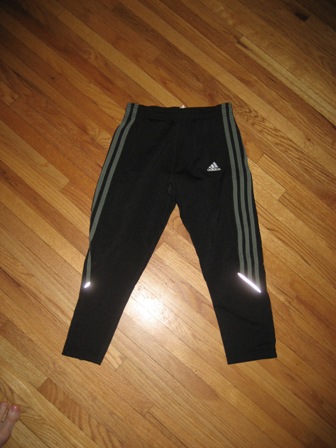 They might look innocent (and stylish) enough. But hear ye the simple story of how I came to know – the hard way – of my new running tights‘ nasty, little secret. (The culprit is as right.) Upon first inspection, the Adidas Response running Capri had all the features I sought of my autumn running gear: coverage, Coolmax, and spiff – thanks to Adidas’s fashionable triple racing stripes. Without second thought (and without trying them on, as a matter of fact) I tossed off my credit card and walked away happy with my purchase. It wasn’t until after that first run in my new pants, when I was doing butterfly stretches along with other members of my running group, that I noticed the “anatomical mesh insert” at the crotch. Come to think of it, I had caught a spectacular wind around Lake Harriet that day.
 Here, I demonstrate the see-through crotch by holding the pants to a red lamp in my living room:
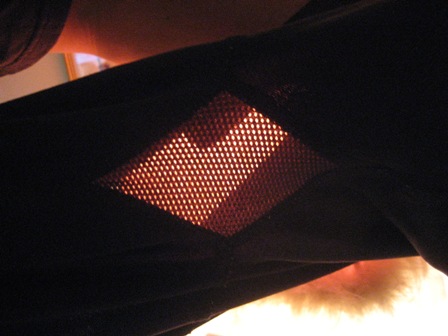
It’s nothing that can’t be solved by black undies. But I couldn’t help but wonder: How far will the establishment will go in keeping women’s thighs locked together. I mean, skirts and dresses are one thing. But must our exercise apparel, too, be so precarious?
-
Who wears these clothes?
Last minute alert for your social calendars: The third annual Sashion Flow (get it, ha-ha) event is happening tomorrow, September 8 at Soo Visual Arts Center. What a great way to combine clothes- and art-making, as I know you Minneapolitans so love to do. The featured designers include Annie Larson and, one of my new faves, House of Henry. You can spy the HoH fall line here. But I’m telling you, it pales in comparison to the upcoming Spring ’08 collection, for which I received a “look book” earlier this week. If I had the scan skilz, I’d be sharing, I promise. But alas, ineptitude has caused my being barred from the office Epson. However, I will now demonstrate my dazzling powers in describing, with words, my two favorite outfits: 1) Red dress of stretchy cotton with Donna Karan-style cutout from the cleavage to, oh, the bottom of the sternum. 2) Unforgiving, ultra-short yellow romper with “trouser” detailing and a sweetheart neckline that’s gathered by three white buttons. Of course, this means I’ll be spending my winter on weight watchers.
In fact, much as I love these clothes, they call to memory a lyric that was once sung by my best friend Andrea (a singer and cabaret artist) who unearthed this chestnut while preparing an entire clothes-themed cabaret.
Who Wears These Clothes
from The Times, music by Brad Ross, lyrics by Joe KeenanWho wears these clothes
And in that size
I mean, who’s got the dash
Or the cash
Or the thighs…
Who wears these clothes
And where can I find them in
Large -
Flu-inducted stupor or fall/spring fashions?
Sorry to have disappeared for the past several days. I’ve been nursing some frightful, flu-like symptoms that, sadly, have kept me off my game. But I would like to acknowledge that, yes, I’m aware that New York Fashion Week is in swing. No, I am not among the attendees … But from what I’ve seen so far, here’s my unasked for, half-informed assessment of the collections: Yawn! I’d sooner stay in to watch movies than wear a humdrum tailored suit or bidness dress to Saturday’s rockin’ cocktail party. And this other thing: Hold it with the talk of fashion’s “return to feminism,” already! Fashion is, like a lot of art, driven by commerce, you see. It can do nothing so radical as, say, a unison of women demanding that their male friends stop using feminine nouns and adjectives to degrade one another. (Trust me, it’s not so bad being a pussy.) When did covering the female form become akin to feminism, anyhow? Me, I like to call that prudishness, but then again, I didn’t mind showing a mile of leg in this summer’s micro babydoll dress, either. And if I’m going to wear neutral tones, they better damn well be see-through. (I layer.) Have I mentioned that I might have the flu? Carry on, then.
-
Legislating Fashion
You know, my disdain for droopy drawers is well documented, but I wouldn’t go so far as to say they ought to be outlawed.
-
Old Style, New Standards
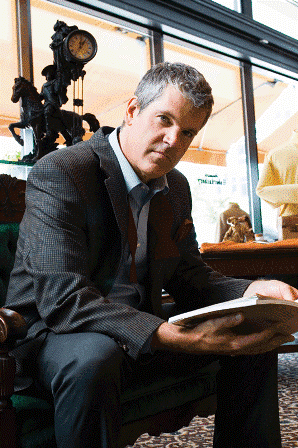 If you haven’t already, check the photo shoot we did with members of the New Standards for our September issue. Not only does it provide a rare glimpse of the musicians’ doll-faced (and successful!) wives. But it’s also a hosanna, of sorts–our tribute to the gentlemen of yesteryear who, you know, wore fedoras and went through all that trouble of polishing their shoes.
 -
Plays on Location
“Edifice complex.” That’s the diagnosis playwright Edward Albee gave to American arts organizations—more specifically, it seemed, to nonprofit regional theaters—when he spoke at the Westminster Town Hall forum in 2005. Though the pun drew laughs, Albee followed with a hard, damning statistic. “Ninety-five percent of the money we give as a country does not go to creative artists; it goes into buildings and organizations,” he pointed out. “But great music, great art, great theater can be performed on the streets. It does not need a fancy theater to occur.”
At the time of Albee’s talk, lovely new facilities for a number of local arts organizations were in the works, with designs by pedigreed architects (Guthrie Theater, Walker Art Center, MacPhail Center for the Arts), or plans to rehabilitate historic quarters (Ritz Theater Foundation, Minnesota Shubert Performing Arts & Education Center). Other historic theaters renovated in earlier years include a “building preservation fee” in the price of most tickets (Southern Theater, Theatre de la Jeune Lune).
For many theater artists (or almost anyone lacking a development staff, really), the costs of renting one of these facilities are prohibitive. One way around that, though, is to get creative about where and how to stage work—to find a site that’s not devoted exclusively to performance. The origins of site-specific theater are often traced to the now-disbanded New York troupe En Garde Arts. For a time during the mid-’80s and through the ’90s, this company was staging work in such unconventional settings as the Chelsea Hotel and a pier on the Hudson River. Other companies followed suit, expanding on the Shakespeare-in-the-park tradition and looking to public spaces, cultural landmarks, and art galleries as performance venues—places that are far less expensive than theaters, and sometimes free.
An upcoming site-specific production is Cityceased, a theatrical walking tour of South Minneapolis’s Lakewood Cemetery that opens September 1. Four actors and a musician will enact an ethereal piece of fiction that considers the histories of both the cemetery and the people buried there (which includes many notable figures, although this play won’t call attention to any particular graves). It’s a novel idea, but Kristopher Lencowski, the show’s director, acknowledges that economics had much to do with spawning his unusual show. “I’ll be totally honest—the cemetery isn’t charging us anything,” said Lencowski, an approachable twenty-seven-year-old with wide, fiery blue eyes. “I’m a young director, and it’s expensive to get a theater. As a point of comparison, my friend rented the Ritz [the rehabbed theater that reopened in Northeast Minneapolis last year] and it cost her $3,500 for one weekend. I’m running four weekends and it cost me nothing.”
At the same time, from the perspective of Lakewood Cemetery, Cityceased might add up to something of a public relations opportunity. Not only is it good form to support the arts, but hosting this show could also serve to demystify the cemetery for the public, and even enhance appreciation for its acreage. In fact, the press release for Cityceased includes an enthusiastic quote from Lakewood’s president, Ron Gjerde, Jr.: “It is our hope that these performances encourage thinking and conversations about the significance of remembering those we’ve lost. We think the beauty and peacefulness of Lakewood will provide the perfect backdrop for such a conversation.”
-
Frank with Relish
The regional premiere of The Pillowman, a recent hit on Broadway, is shaping up as one of most highly anticipated productions of the Twin Cities fall theater season. A psychological thriller about a mystery writer whose stories uncannily resemble real-life horrors, the play—like so many other productions by Frank Theatre—takes place in a totalitarian state.
Frank Theatre founder Wendy Knox is an unpretentious St. Cloud native who has spent nearly two decades producing work by some of the twentieth century’s more provocative playwrights. Frank has also been noted for creating theater in such rough-hewn venues as the abandoned Pillsbury A Mill. Perhaps it’s a measure of Pillowman’s popularity, but this time out the onstage action will unfold at the Guthrie’s sparkling Dowling Studio (September 20– October 14).
You founded Frank Theatre almost twenty years ago now, in 1989. Is the name a reference to being frank, or upfront?
A lot of people seem to think so. But, no. … I started the theater with Bernadette Sullivan, an actress. We had had way too much coffee, and I had seen a film that day … there were sixteen characters and they were all named Frank.How would you describe your company to someone who knows nothing about theater?
Politically and artistically edgy.Does that explain your affinity for dark, political playwrights such as Brecht?
Oh, I’m a big ol’ Brecht fan. And as I get older I try to use him a little more. I also love Caryl Churchill and Suzan-Lori Parks—love her! And no one else will touch Parks’s work. I’m interested in plays that tackle tough issues, and do it in a really smart way. I’m also interested in plays that have language you have to wrestle with.What does The Pillowman playwright Martin McDonagh have in common with these more established scribes?
Again, he’s got great language, great storytelling … there’s this whole thing about rewriting and revising the story. Suzan-Lori Parks does that, too—the repeating and revising also leads to the idea of the power of the narrative, and how whoever tells the story shapes the experience.You must have seen The Pillowman in London or New York. What drew you in?
The play itself was such a delight. You think you’ve figured it out and then something new happens; and so right up until the end there are these constant surprises. And, it’s also just raw; it’s black humor. I saw it at a matinée with a bunch of blue-hairs and I’m in the second row howling at all the wrong things in the play.But the plot involves the murders of children. Isn’t that going to be touchy?
When I Googled the press on this play I just howled because it’s in keeping with Frank’s reputation. Most often with paired adjectives, [critics] say this is the most disturbing yet funniest play they’ve seen in a long time.So with regard to your own work: Why do some audience members say they feel like they’re getting yelled at during Frank performances?
I don’t want to feel that we lecture or yell at people but also I don’t shy away from the fact that our work scratches around and raises questions … we do that while realizing fully that we’re preaching to the choir. Most people who come to Frank shows are going to be sympathetic. But even those in the choir like to go to church.Since your company is Frank, tell us what you think is wrong with the local theater scene.
I’m not cynical about theater, but I think good theater is hard to find. My friends say I don’t like anything. But it’s not that; it’s just that I think there’s a greater potential. And it’s important to talk about what you don’t like in a play or a production and why you don’t like it. I think it’s important for the theater community to have that discussion because that’s how you get better.So is the Twin Cities theater community perhaps too supportive of each other?
Yeah. You don’t get to talk with the reviewers back and forth, and also within the theater community.Do the Twin Cities deserve a reputation as a theater hotbed?
Yes, I do think there’s a lot going on here, a lot at all levels. … Right now we’re at a really interesting moment: What is the impact of the Guthrie—and also all the big Broadway shows—going to be on the rest of the community? It seems like the mega stars here are getting more mega, whereas on the smaller end it’s always scrappy; you have to be scrappy to survive.In recent years, several mid-sized local companies have complained about shrinking audiences. Are you feeling that?
There is a battle. There are so many theaters! I’m kind of a hag for saying that, but do we really need this many theaters? Twenty years ago in grad school Lee Breuer [founder of the New York avant-garde company Mabou Mines] came and talked to us and he was smoking his Camel straights and he said: “What ya gotta do is ya gotta find a theater that you sort of believe in. And you just hang around and hang around. And then you hang around some more. And you hang around, and pretty soon you’re working and making yourself indispensable so they’ve got to hire you.” That’s the sort of sane advice I pass along.But how sane? Obviously, few in town are getting rich by working in theater. How do you fare?
I feel really lucky, as cynical as I am. I get to work with really good people. I have a house. I drive a twenty-year-old Volvo, but I get to do work that I really believe in, and that’s something that a lot of people—and a lot of artists—don’t have.Which local theater-makers excite you?
It’s funny as you get older, you slow down. I used to go out a lot, but I still try to keep tabs on what is going on. I would hope I see thirty-five, forty shows a year. Michael Sommers [of Open Eye Figure Theatre], who is also a good friend of mine; we’ve been collaborators for twenty years. I also like seeing what’s going on with Bedlam, at Mixed Blood, Jeune Lune. Joel Sass, who’s designing Pillowman—he’s got a very distinct aesthetic and he’s really smart about theater. A lot of directors in town don’t have a distinctive mark, don’t have an aesthetic; they don’t have a point of view.Which recent productions stick out in your memory?
I Am My Own Wife at the Jungle Theater [summer 2006]—loved that! I was so proud of Bradley [Greenwald, the solo performer], so proud of Joel [Sass, the director]. That was the year that I also saw Pillowman and Knock! After a long, dry period I was just tickled to see three shows within a couple of months that thrilled me.Do you have any guilty pleasures?
Law & Order, I confess to you. My dad in the nursing home called the other night and I said: “Dad, I’m watching Law & Order!”Who’s the funniest performer in town?
That’s tough. Jim Lichtscheidl and Luverne Seifert are both so goddammed funny. They’re really wrestling for the crown of comedy whore.The sexiest?
Bradley Greenwald has done some very sexy things in his funny little goofy way. Luverne can be totally sexy onstage. He hasn’t done it for a while, but when he played Macbeth fifteen years ago, it was something; everyone thought he was totally hot. Oh, here! Michael Sommers in his fur pants for The Holiday Pageant -
Idigaragua
The always irreverent and ever-theatrical indie-rock band Fort Wilson Riot created this five-part “indie-rock opera” (and album) about a nameless American journalist and his adventures in a mysterious foreign land. Enlisting the help of Jeremey Catterton, a stage director and friend from the University of Minnesota who now resides in London, the band has cobbled together a fictional travelogue based on the writings of Paul Bowles, the ex-pat author best known for The Sheltering Sky. Given the scarcity of collaborations between theater-makers and rockers, this won’t be your typical night at the theater—plus this production incorporates puppets, dancers, and video. As for the score for Idigaragua, one local music critic compared it to Sondheim and Beethoven—but these ears detect more the influence of Queen. Bedlam Theatre, 1501 S. Sixth St., Minneapolis; 612-341-1038.
-
Fashion 47
Though she loves classics, Diane Paulus has a penchant for finding inspiration in the more theatrical aspects of pop culture. The New York City-based director recently staged Turandot in a professional wrestling ring, but she’s better known for her production of The Donkey Show, a disco adaptation of A Midsummer Night’s Dream. So it’s not surprising that fashion shows, what with all the elaborate costumes, makeup, and entrances and exits, became a recent and ripe subject for Paulus’s picking. By transplanting an ancient Japanese samurai narrative called Ronin 47 to the dog-eat-dog world of high fashion, Paulus has created a surprisingly family-friendly work in the style of Project Runway. Here’s an amusing tidbit from a production in which characters set out to out-design and out-strut one another: Instead of switching off their cell phones, theatergoers will use them, à la American Idol, to vote. Childrens Theatre, 612-874-0400.