Author: Christy DeSmith

  • Sweeney Todd: Compare and Contrast

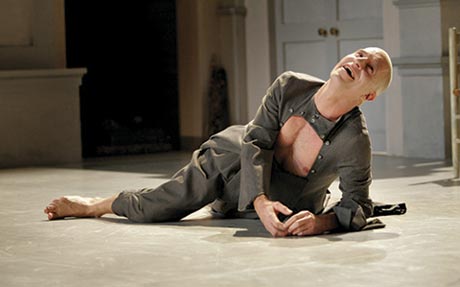
    At last night’s opening of Sweeney Todd, at the State
    Theatre
    , I couldn’t help but make comparisons to the recent film version. This
    is what theatergoers do at revivals, right? They consider the present viewing
    experience in relation to all previous encounters with a favorite play or musical. And to
    be clear: Sweeney is, by far, one of my favorites.

    The first thing that struck me last night was that the
    performers not only sang; they orchestrated. Johanna played the cello, Tobias the violin. They took turns at the piano. Mrs. Lovett played the freakin’ triangle. I was glad it wasn’t
    another of those overblown, over-produced Broadway productions with all manner
    of mechanical, remote-controled set elements. You see, when I go to the theater, I don’t want a stage production with an inferiority complex, something that really
    wants to be a film. As it turned out, this was a fairly simple, hand-made interpretation reliant only on instruments, a few set pieces, and, most of
    all, these actors’ ability to conjure alternate reality.

    What’s more, a lot of Sweeney stage adaptations are very
    vertical in design; most of the ones I’ve seen have employed some sort of chute
    (just like the movie) with which the barber can cleanly dispose of his victims.
    This production, on the other hand, was more abstract in its handling of the murders–as well as the disposal of the corpses.
    I won’t spoil it by giving anything away, but will say that the stage version
    comes off as much, much funnier–much thanks to the fact that it doesn’t resemble
    a slasher flick.

    On the play’s youngest characters, Johanna and Tobias: Here’s an instance where I
    preferred the actors/singers in the
    film version. The actress who played Johanna, in particular, had a very pretty but nonetheless
    unsophisticated voice that sounded almost white in tone. The stage version, of
    course, employs adult actors who, great as are (with plenty of color to their voices),
    aren’t quite so fresh-faced–and therefore aren’t as forceful–in their youthful parts.
    As for the character of Anthony (played last night by Benjamin Magnuson), he
    looked more the part of a brute sailor; whereas in the movie he was a mop-haired,
    Victorian-era metrosexual. In other words, in the movie, he looked a lot like an ex-boyfriend, which I didn’t care for.

    But the stage version’s most important distinction is that
    it doesn’t allow for such moping, brooding portraits of these characters. Sweeney et al. can’t be so internalized in a 2,000-seat house. David Hess, who plays
    Sweeney, interprets the barber as more enraged than sociopathic. Mr. Todd therefore appears less the self-pitying, self-isolating freak than, in fact, a blood-thirsty
    demon dead set on exacting revenge.

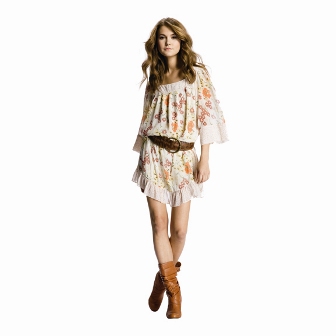
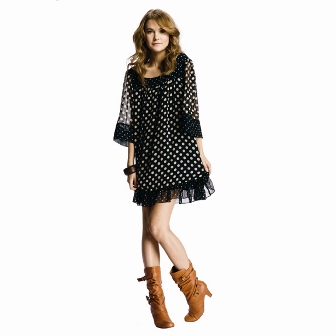
  • Jovovich-Hawk for Target

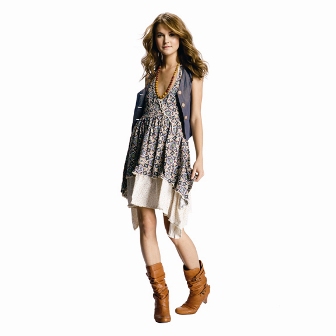
    p.s. I heart these looks from the latest Go International
    designer, Jovovich-Hawk. These will hit Target stores on March 2 or thereabouts.


  • Why It Took Me 'Til Now To Post on NY Fashion Week

    1. d’Uh. I’m
    not even there.

    2. By
    now, I’ve had my fill of black, gray, and wool–even though I am somewhat pleased
    by the, uh, "bold prints" that will purportedly appear on racks everywhere
    next fall. My original point being: right now I’m looking forward to spring,
    not fall.

    (2.5 A
    parenthetic thought: In theory, graphic prints are fine. But have you noticed
    how revolting they are in the real world–on curvy, non-coat hanger
    bods?)

    3. While
    we’re on the topic of fall ’08 top trends, let’s talk shoulder pads. Don’t
    get me wrong: linebackers are sexy ‘n all (or so I hear).
    However, I, myself, do not care to emulate the look since, as I recall, shoulder pads make me feel fat.

    (3.5. I’m too busy scrutinizing Hillary’s wardrobe.)

    4. Frankly, there’s a strong current of maternity-esque
    fashions (much of which look eerily similar to that shapeless
    sheath
    Angelina Jolie recently wore; see the Halston
    runway shots for examples). I must admit: for whatever reason (biological clock?), I’m drawn to
    such free-flowing, waist-less frocks. But I–and other women like me–have taken some heat for dressing this way. Guys don’t much like it, you see. So,
    I was hoping to avoid the look from hereon out. However, I do wonder if this means my beloved
    babydoll will resurrect. Thank God for pregnant superstars!

    5. Have
    you heard about the recession? I don’t mean to be a downer; however, I do
    feel recession and fashion are strongly correlated. Personally, my
    consumer confidence is in nosedive. I’m terrified of
    finding more fleeting fashions at which to toss my dough. For example, I covet those adorable scrunchy boots (see Jill Stuart‘s collection), but how long can
    that last?

  • Ad Man

    Not long ago, Colle+McVoy, the second-oldest ad agency in Minnesota, was thought to be a stodgy place; mostly it created ads for agricultural products, a decidedly un-sexy category. But last fall, observers got to scratching their heads when the agency won top honors at “The Show,” an annual awards ceremony from the Advertising Federation of Minnesota, for its work for the Erbert & Gerbert’s chain of sub shops. Colle+McVoy also walked away with the most awards, sixty-nine in all. As it turns out, a coup took place a couple years earlier, when Mike Fetrow, formerly an award-winning art director at Fallon, Minnesota’s most famous agency, signed on as Colle+McVoy’s executive creative director. Now the agency has won a host of hip clients (including August Schell Brewing Company, Aveda, and Wolfgang Puck Catering and 20.21), and recently relocated from a Bloomington office park to a fashionable address in Minneapolis’s warehouse district. We recently sat down to shoot the breeze with Fetrow, a forty-two-year-old father of two, about the tumultuous industry in which he works.


    The Super Bowl is coming up on February 3. Are the ads still a big deal?

    I don’t think so. Going back ten, fifteen years, they were the thing. From a client standpoint, it was the place to be. And from a creative standpoint, it was a career-maker; you were on the big stage. Now advertising has changed and clients have changed their vision of how to use advertising. It’s hard to justify the one-time appearance on a Super Bowl spot when you can use other media and have a consistent presence.

    So it’s not a bad sign that no Minneapolis agency has a Super Bowl ad this year?

    I think it’s reflective not only of the state of advertising but also of some of the transitions Minneapolis is going through.

    Is it safe to say Minneapolis is still an advertising town?

    I think so. The city is and always has been a really artistic place. But I think the sands are shifting, and it’s natural that cities and agencies should go through that … the advertising agencies we’re going to be hearing about will have different names.

    What kinds of advertising or marketing strategies actually work in today’s media-saturated environment?

    We’ve had success with ideas that exist in a lot of different media at the same time. We create an idea that is a print ad and a poster and sometimes an event and a website. So if we create an event where people get a poster or a T-shirt, the event might happen just one day but the T-shirt will be around for months. It continues to be active, versus a one-time ad in the Star Tribune.

    With Erbert & Gerbert’s, for example, we cut up a coupon for a free sub into four different ads in the newspaper. One quarter of a coupon really didn’t make any sense. But four or five pages later, you’d see another quarter of the coupon, and another. If you were curious enough and cut them all out and taped them together, you’d find a coupon for a free sub. It’s something that people can interact with.

    Who has time for that? Personally, I find it irritating that advertisers should want me to do all that work.

    If ads make the assumption that people care, you’re right, people are offended. They know the brand is trying to get them to do something, and it’s sort of insulting. You have to make sure that if it’s going to take time, it’s something people want to find. It’s something people want to pass to their friends.

    What ads out there right now do you find remarkable?

    There was a viral thing for a show about a serial killer [Showtime’s Dexter]. You [go to a website and] type in the name of a friend and a little fact, and the friend ends up getting [an email about] a news report that says “Serial Killer At Large, He Always Leaves Clues To His Next Victim.” It’s absolutely brilliant. As the person getting the email, you’re totally convinced you’re the next one to die. It’s so entertaining and so engaging you can’t help but participate.

    OK, we’ve all heard about “viral” this and “viral” that. Can you define “viral” in this context?

    “Viral” has become an easy-seller catchphrase, because in truth you can’t make something viral; it either becomes viral or not. But the definition is something that kind of catches on with consumers and gets passed around and starts to spread out.

    Do you have to do anything in your work that’s really awful—things in total opposition to your tastes and values, just because they work for the client?

    Not anymore. There is that in advertising; sometimes you’re selling a product that you know is not as good as you’re trying to get people to believe. But we find a way to love our clients’ products—people around here wear Red Wing shoes. And we just started working with a hip-hop record label, a local, small one called Rhymesayers. That was just a passion we have. So sometimes we try to follow our passions and let success come as a second. But when it’s the client who comes to us first, we try to find a passion within them.

    To what do you credit Colle+McVoy’s recent achievements?

    Well, few agencies value personality as much as talent. I didn’t really come in to change the work we were doing; I came in to change the personality of the agency.

    What was its personality before you arrived?

    It was a confident, professionally strong agency—but it was just quiet. For the first few hires I purposefully chose people who were really passionate and loud. Ramon Nuñez [a broadcast producer] was one of the first and he’s really big-chested, loud, listens to Cher.

    How important is the physical environment at an ad agency?

    It’s huge. Advertising is sort of messy; anything creative should be. So our new space is open. You can’t hide. And I don’t think people want to hide, because it’s more fun.

    How do you feel about the cubicles?

    It was funny coming to this new space; everyone had offices out in Bloomington and was really worried about cubes. We went so far as to not say the word “cube”; we said “personal workspace.” And in truth, they’re cubes. They’re fine. Nobody complained.

    Do you think ad agencies ever over-romanticize their creative cultures? Can there be too much foosball?

    I guess there’s a point where it could go too far. But as much as we are a business, we’re on the play-fringe of business. People expect us to bring that excitement. For a lot of clients, this is their exciting appointment of the week; they get to come in and it’s kind of crazy.

    The ad industry is famous for how many ways it awards itself. What’s the purpose of so many little trophies?

    The main one nowadays is to attract talent. I don’t know whether we’re in the same sort of environment that Fallon grew up in. Fallon was able to use awards to really show clients they were doing breakthrough work. It was a new message at the time. But now there’s so many award shows, and clients have gotten hip to it. It doesn’t have the same sort of punch.

    What would you be doing for a living if you weren’t doing this?

    I feel like I’m the luckiest person alive. I stumbled into advertising and I don’t think I would’ve been good at anything else.

    I understand you love graffiti art.

    Yeah, that’s a huge passion. I do some things in my basement on plywood boards and stuff.

    Were you a tagger as a kid?

    Unfortunately, I found graffiti when I was a little too old. And I think I’d embarrass my kids if I got caught.

  • The Changing Tides of Calhoun

    So, as I’m sure lots of you’ve heard, another makeover to Calhoun Square is
    in the works. The press release came across our desk just yesterday, along with
    the artist rendering above. Frankly, I can’t pretend like I care much
    about it today …

    But here’s something I do find interesting: A few months back, while reading about the anniversary of Southdale’s opening (it’s the nation’s oldest mall, which
    you probs already knew), I was reminded that the place was built by a total commie, Victor
    Gruen, who so loathed the social isolation of suburbs, such as Edina, that he
    sought to fix ‘em a proper town square. Of course, the reality is that these
    shopping centers are too cold (as in: beige) and too manufactured to ever
    achieve the organic, hand-made feel of a public meeting spot, such as our downtowns. Turns out, sunshine and fresh air are more important
    ingredients than first imagined.

    Which is precisely why I live in Uptown. Of course, the neighborhood
    has plenty of haters, but it’s still the most walkable in all the T.C.
    I’ve got three grocery stores within a quarter mile (which is, perchance, the "walkability"
    threshold). I’ve got the lakes. I’ve got some of the best clothing boutiques
    (Ivy and Local Motion) within three blocks, an upstanding new shoe shop (Luna Soles) around
    the corner. We’ve got decent restaurants. One of them happens to be Chang Mai
    Thai
    , and that joint is on the biggest eyesore of a street (Girard) I’ve ever seen. So, I’m happy to see Girard will get a boost, in any case. I’m also happy to see an attempt will be made to make the mall better "integrated
    to the Hennepin Avenue
    streetscape." But still, I’m skeptical. The best neighborhoods aren’t
    created by real-estate developers; they’re made by people. As I see it, it’s an
    ugly, vicious circle we’re now operating in: the homogenizing influence of corporate
    culture has infiltrated our homiest, most historic neighborhoods while, some time later, they started making facsimiles of the best ‘hoods (only with plenty
    of parking). Bah!

  • In a Word, Slutty

    A word regarding this month’s fashion feature and the related
    discussion: Jason DeRusha did not, in fact, call his wife slutty. He was simply
    being witty about the fact that 1) he is, in fact, male and 2) he therefore prefers that his
    beautiful wife wear form-flattering clothes. And yes, friends, in the minds of
    men, I’m afraid "attractive" has often been conflated with "slutty."


    So, is this one of those quotes that should’ve fallen to the
    cutting-room floor? Perhaps. But, in my mind, it was just too specific/amusing to pass
    over. And you know what? If it was my boyfriend who had gone shopping for me, I
    can almost guarantee that, knowing him and the way he talks, he would’ve used a
    different, even more incriminating word as he picked out one of those uninspired,
    almost ass-baring sundresses to which he’s partial: "whorish." Of course, in reality, I’m not really a whore. In fact, I’m pretty much a prude.

  • Theater in Motion

    In accordance with standards for staging cosmic spectacles, (however low-budget), the cast of A Gift for Planet BX63 (above photo) appeared in glittering, metallic costume. But Off-Leash Area, an inventive, burgeoning troupe based in Minneapolis, had injected its intergalactic show—think The Little Prince—with another, rather unexpected feature: zero gravity. Rendered as a six-foot cube, simply constructed from plywood, mirrors, and Plexiglas, this tiny onstage world was a place in which the performer, Jennifer Ilse, could wall-dance. By balancing on her hands and kicking off the cube’s various surfaces—even its ceiling—Ilse created the illusion of floating in space.

    Her performance mixed dance, mime, and traditional text-based theater, not to mention gymnastics and contortionism. In all, it was an extraordinary demonstration of “movement theater,” a performance genre increasingly popular in the Twin Cities. It is, in essence, an approach that requires a heightened use of gesture and body language, as well as an awareness of the spatial relationships among the actors, the audience, and the performance space. In simple terms, it’s theater that has been choreographed. And as a matter of fact, there’s a permeable boundary between “movement theater” (or “physical theater,” as it’s often called) and “dance theater.” Both communicate with motion more than words. The difference between them lies in the varying measure of each ingredient.

    When it comes to distinguishing theater from other entertainments, especially film, immediacy and common experience are, perhaps, its supreme virtues. Theater is unique in the way it unfolds in real time at a common point shared between artists and audience, thus imbuing the live performances with a sense of connectedness that film and literature simply cannot possess. But there’s another distinction less often discussed: A theater audience observes the action through a window more sweeping and panoramic in scope than that offered by film.

    Exposure to cinema has caused many theatergoers, including this one, to tire of dialogue-heavy theatrical realism. Filmmakers have the luxury of using close-up shots when they wish to emulate the intimacy of real life, person-to-person conversation. In a playhouse (or for that matter, an ancient amphitheater) it’s difficult for the audience to see the teardrop streaking an actor’s cheek—that tear is simply too remote. Theater must provide something altogether different. Since the scale is so much larger, a performer’s broad, gestural movements will register far better than, say, the nuance of his facial expressions, especially in larger venues. The performer better communicates with thrashes and wails—and, come to think of it, the Greek chorus often functioned in this style, too.

    Theatre de la Jeune Lune’s Tartuffe


    In short, with movement theater, character is rendered physically, not emotionally. Locally, well-known examples include Steven Epp’s portrayal of Tartuffe in Theatre de la Jeune Lune’s now-classic production of Molière’s play: Epp crouched in the shadows as would a predator, before leaping forth to center stage. He didn’t walk so much as slither. On the other hand, in Or The White Whale, last spring’s adaptation of Moby Dick, director Jon Ferguson called for a lack of movement—stillness in an otherwise kinetic universe—to illustrate the alienation of Ishmael. In both instances, actors and directors worked to distill from complex characters their most basic, core elements. But, in translating those elements into evocative physical presences onstage, they offered more powerful understandings of these characters.

    What’s more, movement theater tends not to be burdened by the formalities some folks perceive in much of the performing arts. Chalk it up to the pervasive influence of clowning and circus arts, but movement theater practitioners, to their credit, do not shy away from silliness, even if their subject matter is solemn, be it war (Please Don’t Blow Up Mr. Boban, Live Action Set, 2005), the great American novel (Or The White Whale), or feigned piety (Tartuffe). That may be, in part, because the practice of such intense, often athletic physicality requires of the actors a certain youthful vigor. The resulting aesthetic is light and playful; it has a hand-made quality; it’s full of action, and a pleasure to behold.
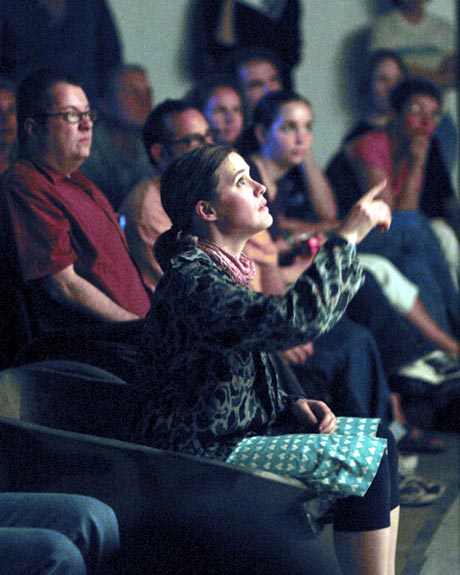
    Live Action Set’s Please Don’t Blow Up Mr. Boban

    Many of the Twin Cities’ current crop of movement theater practitioners are linked, in some way, to Theatre de la Jeune Lune. It was this company that, in 1979, imported a European style of theatrical clowning to our city. These were the very methods that the founding artistic directors—Barbra Berlovitz, Vincent Gracieux, Robert Rosen, and Dominique Serrand—learned from their Parisian teacher, the legendary Jacques Lecoq. (The most famous graduates of the École internationale de théâtre Jacques Lecoq are the founders of the enormously popular Cirque du Soleil.) The curriculum includes work in miming, masks, improvisation, studying the dynamics between performer and stage, and something called “finding your inner clown.”

    Lecoq’s teaching also emphasized a collaborative approach to creating new theatrical works, a tradition still deeply rooted in the movement theater community. This is, perhaps, the most important factor in the recent explosion of the form. From the very start, a student or apprentice of movement theater functions as an integral part of his or her ensemble. At the time of graduation, the student has already helped write, choreograph, and perform several original works. In other words, this newly minted performer is no stranger to the entire artistic process, and is therefore better prepared to strike out on his own, and, along the way, to pass these traditions along to other collaborators.

    In 1985, Theatre de la Jeune Lune settled permanently in Minneapolis. As the company grew, so, too, did an inner circle of artists who studied and subscribed to this form of theater. Local clown Luverne Seifert was a company member between 1994 and ’99. (These days, Seifert regularly appears with Ten Thousand Things and Frank Theaters.) Joel Sass, the Jungle Theater’s associate artistic director, was a Jeune Lune company member during the early ’90s. Puppeteer Michael Sommers (who founded Open Eye Figure Theatre in 2000) has been a frequent collaborator. Emerging performers like
    Lisa Rafaela Clair (who studied clowning with the esteemed Pierre Byland at the Burlesk Center in Switzerland) and Katie Kauffman (a graduate of the California-based Dell’Arte International School of Physical Theatre) came to Minneapolis to study and intern with Jeune Lune. Capping off this by no means exhaustive list is freelance director Jon Ferguson—in my opinion, the most exciting movement theater artist in town. And he has said he was drawn to Minneapolis, at least in part, because of the mood set by Jeune Lune. (Full disclosure: I worked for several years at Jeune Lune in an administrative capacity.)

    Over the years, other movement theater companies have sprung up. Outstanding midsized companies like Ten Thousand Things and Frank Theaters frequently incorporate movement theater. Bedlam Theatre, founded in 1993, practices its own homegrown approach to creating playful, collaboratively created spectacles, relying heavily on the tenets of movement theater. Paul Herwig, who is the co-artistic director of the nine-year-old Off-Leash Area, is also a graduate of Lecoq’s school; his wife and co-director, the aforementioned Jennifer Ilse, is a veteran of ballet and contemporary dance. Like Off-Leash, the delightful Live Action Set, founded in 2003, is peopled by both dancers and movement theater artists. And with any luck, a tiny troupe called 3 Sticks will soon rise to prominence as well. Founded in 2005 by students from the London International School of Performing Arts (a two-year program based on the teachings of Lecoq), 3 Sticks already has two outstanding Minnesota Fringe shows to its credit (2005’s Mythed and 2006’s Borderlines). Artistic director Jason Bohon recently announced a slate of upcoming shows; look for their take on Alfred Hitchcock’s The Birds later this year. And, of course, as these artists continue to practice their craft, thereby hooking a new generation of performers, the list of must-see movement theater will continue to grow.
  • Claude Wampler: What Just Happened?

    There’s some interesting discussion over at the Walker blogs concerning the
    performance career ender that was staged, just this past weekend, by
    Claude Wampler. I saw the show on Friday but, sadly, didn’t stick around for
    the Q&A, which sounds to have been very tense. Truth be told, my date was
    so angry as to be agitated; after the show, he wanted a drink in his hands, stat!
    So did I, of course, except I found myself more amused by the thing … But I’d been lucky
    enough to notice, as we waited for the house to open, that there were likely "plants"
    among the audience members. How and why? Because there were too many folks with
    asymmetrical haircuts, and too many wearing shiny fabrics–that’s why. The "real"
    audience members were swathed in wool and down parkas. (It was freakin’ cold
    outside.)

    According to some of the folks posting at the Walker
    blogs, Wampler made a [condescending?] statement at the Q&A regarding the
    difference between NYC and Minneapolis
    audiences. Well, we’re quieter, for one. But we probably don’t dress as
    often in metallics, either. By show’s end, some of the plants were up and
    dancing in the aisles. Others were tossing light-up toys onstage. My suspicions
    were confirmed.

    In case you missed it, Wampler basically staged a band
    practice. From beginning to end, the frontman had to communicate his vision for a
    song to his bandmates. But a visual trick was employed: images of the trio were projected onstage. The lead singer’s image fell onto a screen, so his remained crisp. But in the cases of the keyboardist
    and drummer, smoke was occasionally pumped into the vicinities of their
    instruments–and so, their ghost-like images would materialize, every now and
    again, on the canvas of that haze.

    But, going back to my original point: the real story is that the audience was "seeded," or full of planted performers. These folks
    hooted and, in some cases, heckled and behaved all-around badly, which inspired
    imitative behaviors from others. For example, when the lead-singer character
    made a funny comment about how the band must "finesse" its way out of his song (presumably by playing fancily),
    my date shouted (seemingly with glee): "Sure do!"

    And that, friends, made the whole thing worth it–the fact
    that my well-behaved friend felt compelled to act in such a dramatic way, and the
    fact that he felt SAFE enough to do so. In other words, Wampler tinkered with
    the audience/performer dynamic to great success. Sure, her show was repetitive,
    perhaps even boring (although I must admit to being amused by the rock-n-roll clichés). But I appreciated being jolted out of my expectations
    and, for once, at a theater, having absolutely no fucking idea what was going
    on. Sweet chaos. As I exited the theater that night, I turned to an usher
    and asked (also with glee): "What just happened?" Then I went to the bar with my friend and
    enjoyed one of the most spirited conversations I’ve had about art in a long, long while.


  • The Royal Robes (A Retake)


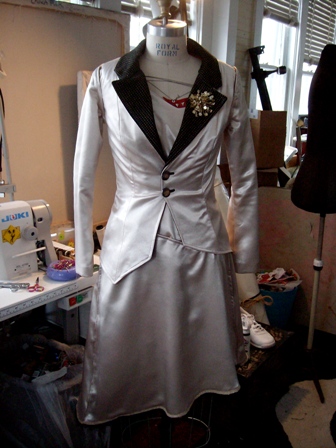
    The above outfit is worn by the title character in the
    just-opened play, God Save Gertrude, a punk rock-meets-theater riff that was
    penned by a local ‘wright and is, in fact, loosely inspired by Hamlet’s mother (cuz
    Ophelia is played out, donchyaknow). I suspect the character, a singer, has
    something in common with Patti Smith, too, although that’s just an educated
    guess based off the press release. I haven’t yet seen the play, but plan to
    next weekend.


    In any case, Laura Fulk, a local fashion designer with, what
    I would call, an avant-and/or-punk rock aesthetic, designed the getup. Now, because
    we have this so-called thriving theater scene, the Twin Cities are full of great
    professional costume designers. (For example: Sonya Berlovitz, whom I used to
    know at Theatre de la Jeune Lune, is just scary brilliant.) But I, for one,
    appreciate that, in this instance, the playwright, Deborah Stein, reached out
    to a fashion designer. I like to see artists venturing from their silos. And
    this play–a fashion meets theater meets punk rock mash-up–seems to spread across many forms.

  • Dress Up to Get Down

    The directive was simple: Pick an outfit for your sweetheart to wear to a hypothetical romantic dinner-on Valentine’s Day, or any other occasion, for that matter. We proposed this to three reasonably fashionable folks, all with different ideas about what flatters the female form. Our guys-an intrepid television reporter and the owner of a women’s boutique in Minneapolis’s Wedge neighborhood-ventured to shops new to them, whereas our lady, a noted restaurateur, had her own suggestion (naturally): Could she visit a socially responsible eco-retailer? No problem! Their picks, not surprisingly, were wildly divergent. The assembled outfits range from tailored-yet-skimpy to a modest bomber-meets-Flashdance look to, finally, a vintage ensemble brilliantly characterized as "Golden Girls fabulous."

    Kim Bartmann

    Restaurateur, Bryant-Lake Bowl, Café Barbette, and the new
    Red Stag Supper Club

    Shopping at:
    Key North
    , a Northeast eco-boutique; 515 First Ave. N.E., Minneapolis; 612-455-6666.
    Melrose Antiques, vintage décor, fashion, and accessories; 13 Fifth St.
    N.E., Minneapolis; 612-362-8480.
    Surdyk’s Liquor & Cheese Shop; 303 Hennepin Ave. E., Minneapolis;
    612-379-3232.

    Shopping for: Her girlfriend of seven years, a modern dancer.

    Why Key North? "I believe people should spend money in accordance with their values."

    Disposition:
    Flummoxed. Standing at the center of the jam-packed store, Bartmann darted her eyes about helplessly. "I never do this sort of thing. I mean, who shops for other people?"

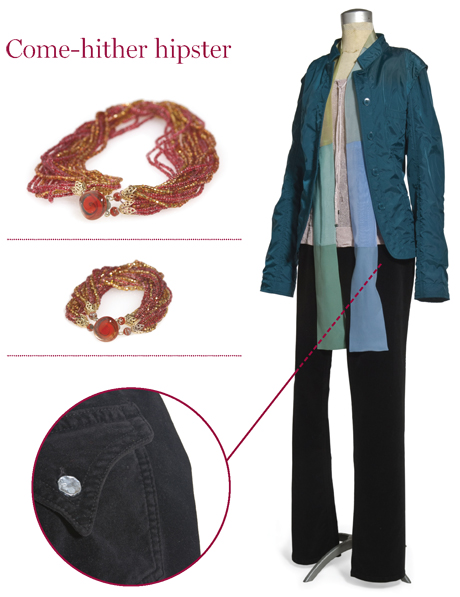
    What she’s after: "Hip-casual! She would totally wear jeans to La Belle Vie, but with something nice on top."

    Settled on:
    Velour slacks by Pure Color Jeans ($182), mostly because of the
    sexy cut of the back pockets; and by Bernadette Conte, a teal nylon jacket ($337) and shimmering, translucent pink shirt with a draw-string collar ($203.70, on clearance). All at Key North. Accessories: a matching Murano glass necklace and bracelet ($85, including earrings) from Melrose Antiques.