Author: Jeremy Iggers

  • The Original All-American

    ED_reviewDetail.jpg

     
    There is nothing wrong with talented chefs like J.P. Samuelson at jP American Bistro turning out dishes like roast chicken breast with fermented black bean sauce and mango salad and calling it American cuisine. And Doug Flicker has every right to offer duck breast with prune ravioli, asparagus, and portobello mushrooms at Mission American Kitchen. But if you want to taste American cooking the way it was B.C., you have to go to a diner.

    B.C. means Before Child, as in Julia. She swept across the American landscape like a gastronomic tornado, starting in the early ’60s, and almost completely wiped out a venerable dining tradition. Nowadays it’s hard to find a menu that doesn’t offer deep-fried calamari or seared ahi tuna with ginger wasabi dipping sauce, but you’ll have to search far and wide to find a good old-fashioned chicken salad sandwich or Midwestern hotdish.

    Though there are some things that good diners have always done well, like hash browns and pancakes, there is no need to get too nostalgic about this bygone era—the truth is, most American food B.C. wasn’t very good. We were at the height of a convenience-foods craze when Julia burst on the scene, and the signature dish of the American diner in those days was a can of Campbell’s chicken noodle soup. Now the best of the new generation of diners offers an expanded repertoire, often using local ingredients, as well as more imaginative preparations—all without losing sight of the core value of traditional diners: unfussy fare at reasonable prices.

    You can break the contemporary American diner scene down into three basic categories: the true classics, like Mickey’s Diner, the Band Box, Our Kitchen, and the Ideal Diner, which continue to serve exactly the same grub they did two generations ago; the updated diners, like the Modern Café, the Colossal Café, and the Town Talk Diner, where new owners have preserved the historic décor, but offer updated menus (as well as wine and beer, or even a full bar); and, finally, the new retro diners, like the Edina/Longfellow/Highland Grills, which pay homage to the diner tradition with menus that combine old and new.

    The original diners were inspired by railroad dining cars, with a long counter and booth seating, but the concept, and the design, have evolved over the years. The early diners were America’s first fast food restaurants, decades before the Golden Arches arrived on the scene in 1955. With limited seating and tiny kitchens, the short-order cook had to get the food out, well, in short order—and the customers, too. In the ’80s, the Frogtown Diner in St. Paul captured the hurry-up attitude with the motto “Eat It, Then Beat It!”

    If you stretch the definition of a diner a bit, you can include landmarks like Peter’s Grill, which opened in 1914 and is the oldest restaurant still operating in Minneapolis. It has a long curved counter and plenty of booths, but a more extensive menu than the typical diner. Among its specialties are American classics that have largely disappeared, such as the Tuesday specials: a chicken patty with cream sauce and fresh peas, or grilled beef liver with bacon.

    The ultimate classic diner is Mickey’s in downtown St. Paul, built in a factory in New Jersey and shipped by rail to Minnesota. The first Mickey’s Diner opened in 1939 and is listed on the National Register of Historic Places. (There are two other locations in St. Paul, although they have different owners.) You’ll walk out of Mickey’s smelling like a hamburger and French fries, but it’s worth it—this is traditional diner cooking at its best. Their basic cheese omelet is almost as light and airy as a soufflé—maybe because they whip the eggs in a malt blender, and fry them up in what looks like about half a cup of butter. And the hash browns, fried on the griddle, combine crisp and tender in savory perfection.
    BandBoxPic1.jpg

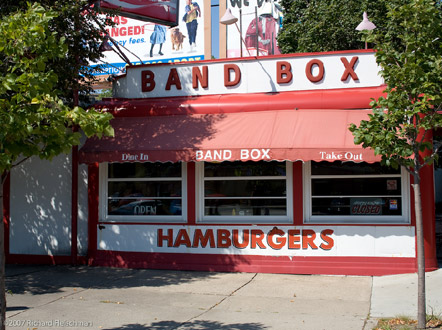
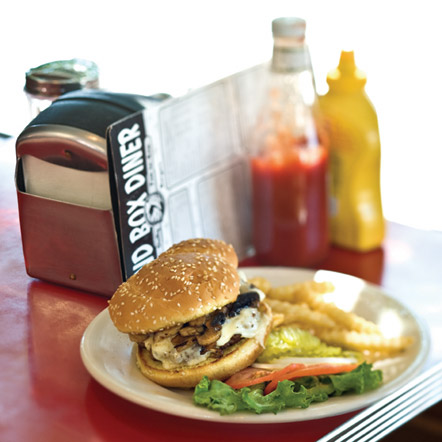
    The Band Box opened that same year just outside downtown Minneapolis, and is enough of a neighborhood institution—and landmark—that its 2003 renovation was supported by Elliot Park neighborhood revitalization funds. It’s got a classic red-and-white color scheme, a standard eggs-pancakes-and-sandwiches menu, and a friendly neighborhood vibe. Although the Band Box Diner’s motto is “Turning Grease Into a Feast For Over 60 Years!” neither my juicy mushroom Swiss burger nor my side of fries was actually very greasy.
    BandBoxPIC3.jpg

    Something about the Ideal Diner brings Lake Wobegon to mind. It’s a place that, to paraphrase Garrison Keillor, “time forgot and the decades cannot improve.” That could almost be its motto, except it already has a better one: “Where Regular People Feel Special, and Special People Feel Regular.” My deep-fried pork tenderloin sandwich was more regular than special, but the accompanying hash browns were terrific. And the daily special, billed as goulash, turned out to be classic Minnesota hotdish: elbow macaroni, ground beef, and tomato sauce, untainted by any detectable spice or seasoning.


  • Midwestern Beats Italian in 6th Round TKO

    boxers.jpeg

    Italian cuisine is scheduled for a six-round culinary bout against Midwestern newcomer Canyon Grille October 4 in Eden Prairie, in what is billed as an Italian Wine Dinner, and we are predicting a knockout. After the Champagne reception and passed tapas (Round 1), and a salad course of haricots verts and tomato tartare (Round 2), the Italian culinary tradition will face a heavy pounding in Round 3, when the Canyon Grille will dish up a course of pork tenderloin stuffed with sweet basil, smoked ham, aged Swiss cheese and asparagus, wrapped in apple-smoked bacon and served with pancetta pasta.

    I don’t think Italian cucina has ever met an opponent like this before – back in Italy, fine dining usually proceeds in small courses from antipasti to pasta, with perhaps a small fish course and a small meat course, salad and dolci – dessert.

    Next comes cheese tortellini tossed with pork osso bucco. The little Italian guy won’t even know what hit him – in Italy, osso bucco is a veal shank, prized for its marrow. Pork instead? Okay, but if they toss tortellini with a pork shank, somebody could get hurt.
    If the scrappy Italian answers the bell for Round 5, he’ll be facing a Tuscan fennel crusted ribeye steak, served with “mascarpone mashed” (potatoes?) and eggplant Parmesan. If that isn’t enough to drop him to the canvas, you can expect the Berry-misu dessert to deliver the coup de grace. Or maybe that will arrive with the bill – $85 per person, plus tax and 17 percent tip – adding up to over $100. That does include wine with every course – and there should be enough leftovers to fill a good-sized doggy bag.

    For reservations, call 952-767-4000.

  • The Fon of Bafut Visits Minneapolis

    907Font.jpg

    Where does royalty dine when they visit our fair metropolis?

    When His Royal Majesty King Abumbi II, the Fon of Bafut visited Minneapolis last month, he stopped and his entourage attended a breakfast organized in his honor at the Sunnyside Deli & Coffee Cafe, 1825 Glenwood Ave. N. in Minneapolis. Actually, the Fon, hereditary ruler of Bafut, in northwestern Cameroon, does not eat in public, so chef-owner James Baker prepared a sandwich for the king to eat later.

    The visit got front page coverage in a recent issue of the Insight newspaper – in a story headlined “King, elders connect in Royal visit to community.” (Insight editor Al McFarlane holds informal Editor’s Roundtable meetings at the Cafe on Friday mornings.)

    I learned all this recently when I stopped in to sample the Sunday soul food buffet at the Sunnyside. Chef Baker turns out to be a terrific storyteller, with funny stories to tell about his old friends Jim Marshall and Carl Eller, two of the legendary Purple People Eaters of the 70s-era Minnesota Vikings.

    The Sunday brunch buffet served from noon on ($11.95) is a pretty impressive spread – corn bread, potato salad, red beans and rice, a hot pasta entree, bread pudding, macaroni and cheese, roast and barbecued chicken, baked beans, collard greens, sweet potatoes, peach cobbler and much more. This is soul food with a health food twist – a nice selection of salads and vegetables, and no pork or lard in the collard greens or red beans and rice. My companion opted for the specialite de la maison, an eight egg Basquais omelet $8.95), stuffed with tomatoes, a colorful medley of peppers, onions, spinach, mushrooms and grated carrots, plus a big bowl of grits on the side. That’s the vegetarian version – the meat eaters’ version also includes ham or bacon. A breakfast buffet ($8.95) is also offered, from 7 a.m. to noon on Saturday, and 8 a.m. to noon on Sunday.

    Chef Baker’s main business is Elite Catering, Inc., so the cafe is only open on weekends – Friday and Saturday from 7 a.m. to 5 p.m., and Sunday from 8 a.m. to 5 p.m.

    Sunnyside Coffee & Cafe, 1825 Glenwood Ave., Minneapolis,.

  • The Week in Eating

    Monday, September 17, the Campus Club at the University of Minnesota will host Jazz88 FM’s monthly RestauranTour benefit dinner. It’s a winning combination – a talented chef, Mary Cashman (formerly of the No Wake Cafe), an interesting menu: heirloom tomato salad, fig-stuffed chicken roulade, and apple galette with thyme whipped cream, a reasonable price ($50 per person, including accompanying wines), and a worthy cause: public radio. And since KBEM-FM is a jazz radio station, there will be piano accompaniment by jazz pianist Alissa Wendelshafer of the U of M school of music.
    I attended the last Jazz 88 Restaurant Tour, a Peruvian dinner prepared by chef Rachel Rubin at the LeDuc mansion in Hastings, and had a terrific time. For reservations or more information, contact Kevin Barnes at, or visit the KBEM website and click on Restaurantour.

    Why didn’t we think of that? The Sample Circuit organizes Happy Hour expeditions to a different restaurant every week. You get to nibble and nosh your way through a sampling of the restaurant’s menu offerings, and taste some featured wines and spirits, all for $38. This Tuesday, September 18, they’ll visit Azia, the Asian fusion restaurant on Eat Street. To sign up, go to the Sample Circuit website.

  • Steven Brown to Ivy? "No Comment"

    The rumor is floating around restaurant kitchens – or at least one restaurant kitchen – that the talented Steven Brown is leaving Harry’s Food and Cocktails to become executive chef for the new upscale restaurant at the Ivy Hotel, a Starwood Hotels luxury property scheduled to open later this year at 1115 2nd Ave. S. in downtown Minneapolis. Harry’s opened in early July in the former Nochee’s site at 500 S. Washington. Contacted for a response, Brown offered a succinct “no comment,” but he did volunteer that the long-awaited poutine will be on Harry’s menu by Wednesday. “It features amongst other things, pickles and green peppercorns and it is, imho of course, better than sex…even for those under 30!”

  • Sanctuary Has Arrived

    We spotted Michael Kutscheid the other night in the dining room of his new restaurant, Sanctuary, looking proud as a peacock – and even more dapper than usual. The elegant new dining room and lounge, which Kutscheid owns with partners Roger Kubicki and Naomi Williamson, opened quietly last week on the ground level at of the Stonebridge Bank Building at 903 Washington Ave. S. (below Wasabi),a few blocks from the Metrodome. Kutscheid is a familiar face on the local dining scene – back in the the mid-90s, he was the owner and driving force behind Kapoochis, one of the most creative restaurants of its time, until a dishonest bookkeeper drove the business into bankruptcy. In the years that followed, he worked his way back, working as a manager at restaurants ranging from Oceanaire to Martini Blu and Babalu .

    On the Sanctuary website, Kutscheid boasts that “If Charlie Trotter and Bobby Flay met Morimoto in Spain, that would begin to describe Sanctuary’s menu!” Charlie Trotter and Bobby Flay are familiar names, but who’s Morimoto? Turns out he was the last of the Iron Chefs Japan on the Iron Chef TV show, and now owns his own Japanese restaurant in New York City. There isn’t much on chef Gary Stenberg’s menu that sounds Japanese – except for a yellow fin tempura entree with seafood salad an wasabi horseradish cream, but Kutscheid does have a bit of Iron Chef host Takeshi Kaga‘s flair for the dramatic – back in his Kapoochi days, he greeted guests in borrowed stage costumes from the Guthrie. (This time around, he greeted guests in more subdued black formalwear, complete with black vest and wing collar tuxedo shirt.)

    Kutscheid also has a flair for the visual – the romantic interior of stone walls and old massive wood beams is gorgeously executed.
    There’s plenty to explore on the menu – from starters ($5-$12)such as calamari stuffed with rock shrimp, or crab-stuffed risotto cakes with risotto cream, to entrees ($13-$29)of beef tenderloin stuffed with Maine lobster, and wanton-wrapped shrimp with polenta fries and avocado chimichuri.

    903 Washington Ave. S., Minneapolis,. www.sanctuaryminneapolis.com

  • One Big Night Out to Sustain Sustainable Famers

    Flooding in southeastern Minnesota last month caused heavy losses to some of the small farms that practice sustainable farming. Now some of the Twin Cities restaurants that serve locally and sustainably grown foods are lending a helping hand. Dine at any of the participating restaurants next Saturday, September 8, for their One Big Night Out, and they’ll donate a portion of their profits to the relief effort. Participating restaurants include the Birchwood Cafe, Cafe Brenda, Corner Table, The Craftsman, Heartland, Jay’s Cafe, Lucia’s Restaurant, Muffuletta, the Nicollet Island Inn, the Signature Cafe, and Spoonriver.

    For an updated list, and information about an upcoming online benefit auction, visit the Slow Food Minnesota website.

    You can also make donations directly to the Red Cross Winona chapter, 1660 Kramer Dr.; Winona, MN 55987;; or online to the Sow the Seeds Fund, www.sowtheseedsfund.org.

  • A Norwegian Cabernet, perhaps?

    My very talented co-blogger Ann Bauer is much too modest and self-effacing to mention this herself, but she just published another terrific piece in Salon.com, on the impact that global warming is having on the world’s top wine-growing regions. You can read it here.

  • You're invited: Szechuan Dinner With An Expert

    When Jim Harkness, the new executive director of the Institute for Agriculture and Trade Policy, dines at Little Szechuan in Saint Paul, he orders in Mandarin, and sometimes he throws in a Szechuan accent, just to mess with the waiters’ head. My Rake co-blogger and I will be having dinner with Jim this Sunday, September 2 at 7 p.m., and we would like to invite some Rake readers to join us. It’ll be a chance to learn more about the cuisine of Szechuan, and the work that Jim is doing with IATP. We’ll split the bill – we’ll try to keep in under $20 per person – – and you have to pay for your own wine and beer. Probably about half the dishes will be vegetarian or seafood. If you would like to join us, please email me at iggers@rakemag.com, no later than this Friday at noon.

  • Make Your Own Seltzer, Save the Planet

    machine-E1.gif

    If you drink a lot of pop or bottled water, then recent news reports have given you one more thing to feel guilty about. You have probably read about how producing all those plastic bottles requires millions of gallons of oil every year and that most of those plastic bottles wind up as landfill.

    And you probably already know that a lot of those best-selling brands of bottled water, like Aquafina and Dasani, are really just glorified tap water, and you also know that Minneapolis tap water has beaten the bottled waters in blind taste tests.

    So giving up plain old bottled water shouldn’t be too hard.
    But if you are hooked on sparkling water, like I am, it’s a little harder to give up that habit. In hot weather, I drag home a six-pack or two of Mendota Springs every week, held together by those plastic carrier thingies that kill turtles and sea birds.

    Or rather, I used to, until I discovered Soda Club, a seltzer and soda pop-making gadget. (Yes, folks, you read this far only to discover that this post is actually an unpaid, unsolicited info-mercial for sodaclubusa.com, which sells these gadgets.) I ordered the Fountain Jet Value Kit ($129 including free shipping) which includes a tabletop soda maker, two cannisters of compressed CO2 that screw into the soda maker, and four reusable one-liter plastic bottles, plus 18 different soda pop flavor bases, regular and diet. (It’s easy to make sparkling water or pop – watch the video on their website for details.)

    The CO2 cannisters each make about 110 liters of sparkling water, so, if you figure that a six-pack of Mendota Springs is equal to three liters, then each cannister is equal to about 36 sixpacks, which run about $2 a piece. So, by the time you use up both cannisters, the kit has more than paid for itself. (You exchange the empty cannisters for full ones for $20).

    I haven’t figured out yet how to make flavored seltzers, like Mendota Springs’ lemon and lime flavored varieties, but otherwise I am pretty satisfied. I don’t drink a lot of pop, but the homemade cola and root beer flavored pops I tried are actually pretty good, and I haven’t bought a six-pack of Mendota Springs since I got my my soda maker.

    I did have a momentary panic when I thought I remembered reading something about cows contributing to greenhouse gases by belching CO2 into the atmosphere. Is my sparkling water habit creating similar harm? I’m still not sure, but it turns out that the real bovine emissions problem is not carbon dioxide but methane. I’ll save the problem of human methane emissions for another column.