Author: Jeremy Iggers

  • Sushi a la Francaise, Chinese-Style

    We stopped in last night at Musashi, the new Japanese
    restaurant in the former Olive Garden space at 6th and Hennepin,
    downtown, and took a seat at the sushi bar.

    When I asked for omakase, the sushi chef who greeted us gave
    me a puzzled look.

    "Teppanyaki?," he
    asked – or something that sounded like that.

    "No, "I said, "omakase."

    "We don’t have that."

    Just then, a second sushi chef, Noua, overheard our
    conversation, and stepped in: "I can do that. How many courses do you want? How
    much do you want to spend? Four courses? Five?

    Omakase means, roughly, "chef’s choice," and when I have
    tried this gambit before, the results have ranged from spectacular (Fuji-ya in
    Saint Paul,) to the same stuff we could have ordered from the menu.

    We never did agree on a price, but a series of off the menu
    dishes started to arrive, starting with a pair of martini glasses, filled with
    chunks of raw tuna and salmon with thin slices of cucumber in a soy marinade .
    The novelty of this dish was the fake ice cube at the bottom of each glass,
    each with a little blinking light that changed colors from to blue to green.
    (Actually, mine was stuck on blue.)

    Round two was four pieces of raw salmon wrapped around
    spears of fresh mango, served over leaves of aromatic Japanese chrysanthemum.
    partially cooked with a blow torch by the first sushi chef, presented with a
    mound of shredded daikon at the center, topped with a little dollop of lumpfish
    caviar. Buried beneath the daikon was
    another light cube, again flashing red, blue and green. A little less novel
    this time, but still an attractive presentation.

    Then came a third course – a sort of seafood medley covered
    in a spicy mayonnaise the color of Thousand Island dressing, dappled with
    orange flying fish row. Actually quite tasty.

    And for the grand finale, four little rice balls wrapped in
    eel and white tuna, again presented with a flashing litecube by chef #1. This
    was, he informed us, "French-style sushi."

    I have never seen anything like it in France, but the
    phrase, French-style sushi rang a bell. The last place I went that offered
    "French-style sushi" was the Mt. Fuji in Maple Grove, which serves up neon
    day-glo fantasies on the theme of sushi far more elaborate than anything
    dreamed of in the land of the rising sun. The chefs at Mt. Fuji are Chinese, as
    are the owners of Musashi, and Wasabi, which opened last year near the
    Metrodome.

    It turns out that Minneapolis may be prt of a global trend. According to a December 2006 report from Agence France-Presse, an estimated 90 percent of all the Japanese-style restaurants in France are Chinese-owned.

    So I asked sushi chef #1 where he was from, and he said,
    China. "Are you all from China?" I asked. "We’re from Asia," sushi chef #3
    offered, helpfully. "Not me, " shouted out Noua, in perfect English " I’m from Saint
    Paul."

    Overall, some of the off-the-menu omakase dishes were pretty good, some of it was just okay, and mostly it was kind of weird. It certainly didn’t seem very Japanese, but maybe that’s okay. Neither is teppanyaki, really, nor California rolls. I did see a lot of "normal" sushi come out of the sushi bar while we were dining, and it looked the same as it does everywhere else.

    Bottom line: dinner
    with the four omakase dishes and a spicy tuna roll, plus tax, tip, and a couple
    of drinks apiece came to just under $120.

  • Cue's Second Act

    Remember Cue at the Guthrie?

    The press release from the Guthrie Theater touting a January
    three-course prix fixe menu for $29.95 took me by surprise. This isn’t just a
    prix-theater early bird special – it’s available any time, and includes a free
    self-guided iPod tour of the theater and complimentary glass of wine or cup of coffee after dinner.

    Back when Cue opened in the summer of 2006, a table at the
    new Guthrie Theater’s sleek dining room was the hottest ticket in town. Cue had
    snagged a local celebrity chef, Lenny Russo, and all the buzz that came with
    the opening of a major new landmark, designed by superstar architect Jean
    Nouvel.

    Russo’s opening menu, assembled with the help of a network
    of Midwestern producers made the concept of Midwestern haute cuisine seem like
    more than an oxymoron: Rick Nelson’s review in the Star Tribune praised the
    wild boar pate with pickled vegetables; sliced elk with wild rice and
    blueberries; and a salad of grilled quail with summer squash and poached
    tomatoes, among other dishes.

    Russo left about a year ago, to return to his own Midwestern
    haute cuisine restaurant, Heartland, and I hadn’t been back since. The buzz and the crowds
    have evidently died down – when we visited at 8:30 on a Saturday night, the
    dining room was about three-quarters empty. The theaters were empty last night,
    which may explain the sparse crowd, but Cue had ambitions to be a top
    destination restaurant.

    The new Cue menu is still very stylish, but not nearly as
    inventive or adventurous as it was in Russo’s day. The elk, quail and wild boar
    are gone, though the menu does offer a cassoulet made with pheasant confit. (I
    was puzzled enough by this description to ask the chef: duck confit is duck
    cooked in its own abundant fat. How do you confit a bird as lean as pheasant?
    Turns out, you cook the pheasant in duck fat. Which makes sense, but must make
    the pheasant taste like duck.) A lot of the usual suspects show up, including
    artic char, ahi tuna, mussels, filet of beef with wild mushroom sauce;
    free-range chicken breast with whipped potatoes.

    The prix fixe menu varies a bit from day to day, but the
    basic format seems to include a choice of soup or salad; a choice of fish,
    chicken or pork chop, and a choice of desserts from a list. In strictly
    economic terms, the $29.95 special is a good deal: the pork chop costs $29.00 a
    la carte, and if you add the cost of soup or salad (8-$9) and dessert ($8),
    plus the price of the audio tour (5), and the complimentary glass of Pinot Noir
    or Chardonnay (or coffee) that accompanies the audio tour, the savings are
    substantial. But this still isn’t bargain dining: with tax, tip, and
    three glasses of wine between the two of us, our tab still came to $115.

    We had a pleasant dining experience in striking
    surroundings, with friendly and attentive service and food that was
    well-prepared but not exactly exciting. My winter squash soup was a low-calorie
    puree with diced cubes of roasted potato and just a hint of sweetness (pear, as
    I recall), and my grilled pork chop was thick and juicy, nicely complemented by
    whipped sweet potatoes, roasted golden beets and a chutney of walnuts and
    raisins. Carol’s menu started with a rather bland fennel salad, followed by
    grilled coho salmon served over Israeli couscous and baby zucchini with a hint
    of a citrus sauce. I thought the salmon was a bit dry; Carol didn’t. Neither of
    us was very impressed by our desserts – a cranberry upside down cake with a
    citrus sorbet, and an almond, apple, and crystallized ginger cake with almond cream and cream cheese ice cream.

    Bottom line: an enjoyable evening, and the self-guided iPod audio tour, narrated by director Joe
    Dowling and several Guthrie actors, was a fun little bonus at the end. But I am
    glad I didn’t pay full a la carte prices. When it opened, Cue was vying for a spot on the short list of top
    Twin Cities destination restaurants. Now it seems more like a convenient but
    pricy place to dine before the show.

  • Grassfed buffalo: something to chew on

    I had a lovely dinner last night at the Grand Café:
    cauliflower soup with a fig gastrique; pan-seared scallops with porcini-potato
    pave, and lean slices of medium rare bison (buffalo) top sirloin with lentils, bathed in a fig and port wine
    demi-glace. Then this morning, I happened to see the full-page ad in the New
    York Times for Michael Pollan’s new book, In Defense of Food: An Eater’s
    Manifesto
    . Pollan wrote the best-selling Omnivore’s Dilemma, which takes a
    critical look at our overly industrialized food system.

    The new book is billed as The Omnivore’s Solution, and the
    dozen recommendations in the ad start with

    1. Don’t
      eat anything that your grandmother wouldn’t recognize as food,

    and ends with

    12. Eat deliberately, with other
    people whenever possible, and always with pleasure.

    But it was recommendation #9 that caught my eye:

    9. Eat food
    from animals that eat grass.

    I’d read the literature about this before: meat from
    grass-fed is lower in calories and higher in healthy omega-3 fatty acids and conjugated linoleic acid, which is supposed to reduce your
    risk of cancer. And grass-fed animals have a much smaller environmental impact that animals raised on corn.

    That made me curious about last
    night’s bison: was it grass-fed or grain-fed? Ordinarily, I would have simply
    assumed that buffalo are raised on grass, but a recent letter to the editor of
    the New York Review of Books claimed otherwise: the writer had done a little
    research and discovered that a lot of buffalo sold in supermarkets (including
    Trader Joe’s) is actually raised on corn. Apparently, a lot of consumers like
    the idea of buffalo, but like the flavor of corn-fed meat.

    Our hostess, Mary Hunter, who owns the café with her husband Dan,
    had told me that the bison came from Venison America, a family-owned business
    in Hudson, WI. According to their
    website, their bison comes is raised in Minnesota by a supplier who "feeds
    the bison grains and grasses but also supplements this with a weekly ration of
    whey from their cheese factory." The website does claim that their bison is
    still a lot leaner than beef:

    " Bison has per 3.5 ounce serving: 143 calories and 2.42
    grams of fat.
    Choice Beef has per 3.5 ounce serving: 211 calories and 9.28 grams of fat."

    There aren’t a lot of buffalo producers in Minnesota, and
    even fewer who own cheese factories, so the producer in question had to be
    Eichten’s Hidden Acres, which raises buffalo and produces cheese. Steve Loppnow, the owner
    of Venison America confirmed that Eichten’s is the supplier, and said that
    while the buffalo spend most of their lives eating grass, in the last 30 days
    before slaughter, they are fed a diet of oat silage, alfalfa, and "a little bit
    of corn, not a huge amount because corn is really expensive."

    Loppnow said that if restaurants want bison that is purely
    grass-fed, he can supply it, from an organic producer in Rice Lake, WI, but
    it’s more expensive – and he added that the fat from grass-fed beef is not as
    palatable as the fat from animals that have had some corn in their diet.

    Bottom line: that bison sirloin at the Grand Cafe was from an animal who consumed some corn, but a lot less than the typical feedlot steer.


  • Highlights of a Year of Eating

    I don’t do ten best lists, but looking back over the last
    year, I can recall some memorable dining experiences. For now, at least, I am going to limit myself to the new places – the
    list will just get too long if I try to work in more than just a mention of old
    favorites like the Grand Café Vincent, and Atlas Grill.

    My nominee for best new restaurant of 2007 is Saffron, where
    chef Sameh Wadi brings together the flavors of the Middle East and North Africa
    with the techniques and presentation of contemporary haute cuisine in very stylish
    surroundings. Highlights of my visits included an entrée of fork-tender lamb
    shoulder, over a savory bed of chick peas and a tagine of salmon and clams with
    roasted peppers, olives, fennel and saffron.

    Other favorite new places:

    Heidi’s Café: The
    same talent that the husband and wife team of Stewart and Heidi Woodman
    demonstrated at Restaurant Levain and Five (both now defunct) is again on
    display at Heidi’s, but this time at much more affordable prices: poached
    pheasant breast with cauliflower arugela salad for $19; a vegetarian entrée of
    pappardelle Bolognese for $12 .

    Meritage: Chef
    Russell Klein, cooked Regional American at W.A. Frost, but as chef-owner at
    Meritage, (in the former A Rebours space in downtown Saint Paul) he is free to
    return to his first love, French cuisine – which he delivers up with some
    playful and creative twists (like a Nutella and matzo sandwich for dessert.)

    Rotisserie Brasa, which Alex Roberts opened this summer in a
    former gas station on E. Hennepin remodeled to look like a Caribbean chicken
    shack. Roberts, known for much pricier and refined cuisine at Restaurant Alma,
    sets out at Brasa to show that local and sustainable can also be affordable.
    Only two meats are offered – rotisserie chicken and a terrific roast pork shoulder,
    along with a bunch of classic southern sides like cheese grits and collard
    greens.

    Keefer Court Bakery & Café. This funky little Chinese
    bakery at Cedar and Riverside recently hired Jack Ma, one of the most talented
    Cantonese chefs in the Twin Cities, to run their kitchen, and now serve a menu
    of traditional rice plates, noodle soups and stir-fries, at bargain prices.

    Pagoda in Dinkytown: The décor is much trendier than the
    usual noodle house, but the menu here, too, is traditional Cantonese street
    food plus a smattering of Japanese, Thai and Korean dishes in very stylish
    surroundings, at student-budget prices.

    Shiraz Fireroasted Cuisine: The chicken and lamb koubidehs
    (ground meat kabobs) at this new Persian restaurant at 61st and
    Nicollet tasted so authentic to me that I assumed that the chef must be from
    Iran, but it turns out it’s the same Mexican chef who ran the kitchen when the
    place was called Cintia’s of Mexico.

    Little Szechuan: The best Sichuan cuisine in the Twin
    Cities, plus some amenities you won’t find at many other Chinese restaurants in
    the Twin Cities, like a small but decent selection of wines. Try the fish
    fillet and tofu with spicy tasty broth.

    Café Ena: I live a few blocks from El Meson, and I have been
    a fan of chef-owner Hector Ruiz for years. His new Latin American fusion
    restaurant at 46th and Lyndale is just a tick more upscale, but the
    cuisine is just as lively and imaginative.

    Ngon Vietnamese Bistro: A lot of the restaurants that attempt East-West fusion wind up with the worst of both worlds, but this stylish storefront in Saint Paul’s Frogtown neighborhood is an exception: smart combinations of Asian and Western flavors in dishes such as Vietnamese beef over pappardelle noodles, ahi-tuna mango
    salad, and a succulent lamb shank with pho spices, served over
    lemongrass rice.

    Well, that’s about as many highlights as I can think of at the moment, but check back – I’ll probably add a few more to the list.

  • A Bone to Pick with Andrew Zimmern

    I was going to tell you about my most memorable dining
    experiences of this past year, but that will have to wait until tomorrow. There is more pressing business at hand: Andrew Zimmern’s recent blog post.

    I have only met Andrew – who writes about restaurants for
    Mpls-St.Paul magazine – a couple of times, but he seems like a nice guy. Once,
    when we happened to be dining at the same restaurant, he sent a couple of
    glasses of champagne over to our table
    – a classy gesture. But in a
    recent blog post, Zimmern says some things about my colleague, Ann Bauer, and
    me, that kind of hurt my feelings.

    I don’t mean the
    part where he says that I have a "workmanlike style honed over many years
    churning copy at the Star Tribune." I’m not sure how to return that compliment,
    except to say that Andrew is the perfect restaurant critic for a magazine like
    Mpls-St. Paul.

    No, the part that bothered me is when Andrew wrote that Ann
    needs to get out more, and that The Rake should send us to the restaurants that
    are "really making some noise," like La
    Belle Vie
    and Heartland, which have both been around for years. And then
    he suggests that Ann and I need to be "more conversant with the local dining
    scene."

    That’s an interesting suggestion, coming from a guy who
    seems to spend a lot of his time out of town, eating sheep eyeballs on camera.
    I’m a little curious as to how Andrew finds time to check in on "two dozen
    other restaurants in town that are kicking ass every meal period." I’m in town most of the time, eating out
    about five nights a week, – looking for good restaurants that don’t make a lot
    of noise – and I can’t name that many places that are that consistently
    excellent.

    He did confess that he still hasn’t made it yet to Heidi’s,
    Meritage or Nick & Eddie, but I would be curious to know whether he has
    made it to very many of other new restaurants that we have written about in the
    past year: including Saffron (my nominee for the best new restaurant in the
    Twin Cities), the Blackbird Café, the Chindian Café, Pagoda, Keefer Court, Ngon
    Vietnamese Bistro
    , Shiraz, Café BonXai, Mysore, the Hyderabad House, and Vinh
    Loi. Some of these have been reviewed by Andrew’s colleagues, but it looks like
    Mr. Zimmern himself isn’t getting out as much as he should. Or maybe he is
    spending too much time at the usual suspects. He did make it to Cafe Ena but wasn’t impressed – I suggest he give it another try.

    I made it to a lot of other very worthwhile restaurants this past
    year: Peninsula, Brasa, the Grand Café, Cosmos, Relax (the former Yummy), Yum!,
    Tanpopo Noodle Shop, Obento-ya, Cave Vin, Tam-Tam’s African Restaurant, Wolfgang Puck’s 20.21,
    First Course, Little Szechuan, Hoa Bien, Evergreen, Vincent, the Colossal Café, North
    Coast
    , Kum Gang San, Victor’s 1959 Café, Sapor, Babalu , Cheng Heng and the
    Namaste Café – and I am sure I am forgetting a few.

    I don’t spend a lot of time going back to places like La
    Belle Vie and Heartland, because they have been around for years. And besides,
    I have had some wonderful meals at La Belle Vie, but I have also had moments
    where I have found myself wondering just exactly what the point is. Tim McKee
    and Josh Thoma are very talented chefs, but their menu, with its truffles and
    porcini and Barkham blue and branzino (sea bass, flown in fresh from the
    Mediterranean), doesn’t exactly engage the place where they are. It’s a cuisine
    they could create anywhere, as long as their customers have enough money – but
    maybe that is the point.

    I’m more inclined to restaurants like Heartland, at least in
    theory. I like and admire Lenny Russo, who is a very engaging guy, and has done
    heroic work to support local farmers and promote local and sustainable eating.
    His menus always sound wonderful – how can you resist a dish like Minnesota elk tartare with preserved tomato
    jam, Wisconsin turnip slaw and rosemary-shallot dressing?
    In my limited experience, it’s always good,
    but it doesn’t always taste as exquisite as it sounds. Maybe it’s time for another visit, but I
    wish he used more garlic. Or something.

    Zen philosopher Alan
    Watts
    warned against eating the menu instead of the meal. That’s good advice.
    Charlie the Tuna had something similar in mind when he made the distinction
    between "good taste" and "tastes good." Lucky for us, our readers just want to know what tastes good.

    Tomorrow: my favorite tastes and restaurants of 2007. I
    promise.


  • Where to Dine on New Year's Eve – Part II

    Still haven’t decided where to go for New Years Eve? Besides
    the usual suspects, and the places I wrote about last week in Part I the options range from free champagne and hors d’oeuvres at
    midnight at the new Driftwood Char Bar, three- and five-course options at First Course, and a seven-course gastronomic blowout
    at North Coast in Wayzata.

    The Driftwood
    recently opened in the former Westrum’s Tavern space at 44th and
    Nicollet Ave. S., Minneapolis, which closed last spring after the city pulled its liquor license.
    The new joint seemed to have some of the same spirit and clientele, but a
    mellower mood. Flyers at the Driftwood promise complimentary champagne and hors d’oeuvres at midnight, but if you want something more substantial, you can order ff the menu, which sticks to basic tavern fare: burgers, sandwiches, chicken wings, home-cut
    French fries, and a first-rate homemade macaroni and cheese ($5.25, with a side of steamed broccoli). Driftwood Char Bar, 612-354-3402.

    The menu at North Coast starts with five courses for $55,
    including poached cold water lobster tail, with braised artichoke and rapini
    ratatouille; mushroom and fresh ricotta "cheesecake;" Thai curry glazed king
    salmon with coconut seared spaghetti squash; prime Angus filet mignon, and a dark
    chocolate crème brulee, but if you really want to put on the dog, you can add
    the flight of five selected wines for $25, and optional courses of American
    Sevruga caviar and Schramsberg blanc de noir champagne ($35), and an intermezzo
    of French foie gras medallion with pear
    flambé and ice wine reduction ($20). If that’s a little too rich for your
    blood, a limited selection from the North Coast’s regular menu will be
    available a la carte (entrees $16-$34).
    North Coast, 294 E. Grove Lane, Wayzata, 952-475-4960.

    The three course prix-fixe at First Course starts with Norwegian smoked salmon wih frisee and salmon roe; followed by Thousand Hills short ribs with tallegio potato gratin, and a chocolate trio of raspberry terrine, fallen cake and truffle for dessert – all for $40, plus $20 if you select the accompanying flight of three wine and glass of champagne. The five-course version, which costs $60, adds a carpaccio of foie gras with miso and Japanese truffle sauce, and braised pork belly with herbed polenta; add $30 more if you want the flight of five wines and champagne. Reservations recommended.
    First Course, 5607 Chicago Ave., Minneapolis, 612-825-6900.

  • The Best Place to Hide A Wine Bar

    If you really wanted to hide a sophisticated little wine bar
    where nobody would find it, where would you put it? Eden Prairie? Hilltop?

    How about, in the back room The Newsroom on the
    Nicollet Mall?

    You could easily walk into The Newsroom., a high-decibel
    newspaper-themed restaurant plastered with newspaper headlines and packed with
    video monitors,  spend the evening
    dining on deep-fried Brie curds, chicken Caesar salad and coconut shrimp, and
    never have an inkling that  there’s a terrific
    little wine bar called Taste in the back, with a completely different
    menu and wine selection. You could even search the Newsroom web site and not
    find a single mention of it. And if you came on a Monday or Tuesday, all you
    would find is a darkened room.

    On a Wednesday night when we visited, there was one lonely
    soul at the bar, and nobody in the little mezzanine hideaway where we settled
    in on a couch. Is it always this empty, I asked our server. Yes, she said.
    Nobody knows about it. We could have canoodled all evening with anyone – except
    our server – intruding on our privacy.

    The list of wines by the glass – actually small carafes –
    includes a few familiar names: a J. Lohr Chardonnay ($13.50/$25), a Rodney
    Strong Cabernet ($14/$26), but most are more obscure: a Quinto dos Grillos from
    Portugal ($13.50/$25), a Salneval Albarino ($11/$20) from Spain, a really
    delightful Ruche di Castagnole from Italy, (imported by Bonny Doon, ($8.75/
    $15.50). The prices seem a bit high, until you notice the size: the smaller pour
    is eight ounces, and the larger is 16 ounces – the equivalent of three glasses
    at most places.

    The menu is built around tastes -bite-sized portions of
    cheeses, hot and cold appetizers and sweets priced from $1.95 to $3.95 The
    cheeses ($1.95-$2.25) are well-chosen – a nicely ripened wedge of Humboldt Fog
    goat cheese, a creamy blue Fourme D’Ambert, an Italian truffled goat cheese and
    several more. The only big blunder is the bread, ($1.95 for a quarter baguette,
    $3.50 for a half) with no crust, and the soft, cottony texture that comes from
    being stored in plastic. 

    The cold starters run the gamut from a tuna ceviche, (four
    tasting spoons for $3.95), coarsely chopped chunks marinated in a habanero
    cilantro vinaigrette to a beet salad with micro greens and a sherry Roquefort
    dressing ($2.55), while the hot starters range from asparagus risotto croquettes with grilled tomato sauce ($2.65)  to a sake-infused
    scallop served with green tea soba noodles ($2.95). Some items were memorable (like the pear carpaccio with blue cheese crisp ($2.95), and others were not – like the cross-cut
    coriander cumin fries with a gorgonzola cream sauce ($3.95), but the pricing is very reasonable and the overall batting average is pretty high. Weekdays, the happy hour specials (offered till 6:30), include a featured wine and a selection of draft beers for $3 a glass, plus mini-sandwicbes and appetizers for $2-4. 

    We passed on the desserts, but the options include a
    chocolate wafer with chai ice cream, blueberry blini with lemon crème fraiche,
    and a blue cheese and port mousse with pear (all $2.95).

    Taste Wine Bar, in The Newsroom, 990 Nicollet Mall, Minneapolis, 612-343-0073.

  • Where to Dine on New Year's Eve – Part I

    Monday night is cheap date night at the Bryant Lake Bowl
    two soups or salads, two entrees, a bottle of wine, and two lines of bowling
    for $28. And since New Years Eve happens to fall on a Monday, they are offering
    a Not So Cheap Date Night – the same deal for $32, but with better than usual
    entrees and wine, and tablecloths on the table. They don’t take reservations
    for dinner, but you can guarantee yourself a seat if you reserve tickets for
    the Scrimshaw New Years Eve Spectacular, performed at 7 and 10:30 at the BLB
    Theater. The show, by perennial Fringe Festival favorites the Scrimshaw
    Brothers
    , is billed as "comedy,
    music, dance, special surprise guests, and more broken resolutions than you can
    shake a Scrimshaw at!" The full BLB menu is available in the theater.
    There are some risks attached to sitting in the dark in a theater full of
    people who are eating and laughing at the same time, but heck, New Years Eve is
    the night to live on the edge. Showtimes are 7 p.m. and 10:30 p.m., and tickets
    are $20, or $15 with a Fringe Festival button. You can reserve tickets online by going to the BLB website, or by calling 612-825-8949.

    Bryant Lake Bowl, 810 W. Lake St., Minneapolis, 612-825-3737.

    At BLB’s sister restaurant, Barbette, new executive chef
    Sarah Master is raising the gastronomic level a notch or two with a selection
    of a la carte New Years Eve specials such as bison carpaccio with arugela and shaved pecorino ($9), red deer with cherry-vanilla demi-glace, glazed vegetables
    and mustard spaetzle ($27), and
    butter-poached lobster with asparagus, tarragon potato cakes and caviar crème
    fraiche ($35).

    Barbette, 1600 W. Lake St., Minneapolis, 612-827-5710.

    The very romantic Grand Café is offering a six-course prix
    fixe menu for $65, and a modified version for vegetarians for $10 less. The
    structure of the menus is the same, but the vegetarian agnolotti are stuffed
    with celeriac, while the carnivores get foie gras; the seafood course of diver
    scallops with lobster sauce is replaced by polenta with sweet carrot sauce, and
    while the meat eaters get with a potato and cepe pave, the vegetarians get the
    potato and cepe pave without accompanying animal flesh.

    Grand Cafe Minneapolis, 3804 Grand Ave. S., Minneapolis, 612-822-8260.

    Creating a menu that combines the spirit of a Northeast
    tavern with the structure of a five-course $65 French prix fixe menu isn’t easy, but the chef
    at the Sample Room has risen to the challenge: the first course offers choices
    such as country pate en croute with Cumberland sauce, (in lieu of meatloaf),
    and performing the role of bratwurst, a house-made maple chicken sausage.
    Entrees choices include a beef tenderloin, chicken breast stuffed with
    prosciutto, and striped sea bass with sautéed spinach and walnut butter sauce,
    but also a tavern classic – roast breast of turkey with brown gravy and butternut
    squash puree.

    The Sample Room, 2124 Marshall St. N.E., Minneapolis, 612-789-0333.

  • Take the Chill Off

    It’s winter. You’re cold, you’re broke, and you spent the entire month of December eating too much. You made a few New Year’s resolutions, and you want to keep them. You don’t need a bunch of fine dining recommendations.

    You need soup: warm, filling, and cheap, it’s the perfect antidote to cold, fat, and broke.

    I’m not talking about those red and white cans of Campbell’s that have impoverished the very concept of soup for so many, or even that little cup of tomato basil that comes with the soup-and-sandwich special. I’m talking about a meal in a bowl, from one of the many cultures around the world where soup is celebrated.

    Take China. Odds are when you think of Chinese soups you think wonton, and the typical wonton soup at Chinese restaurant these days is a disgrace—thin broth and soggy pasta dumplings with a tiny bit of minced meat at the center.

    The real wonton soup is a whole different kettle of dumplings. It has a rich homemade stock and fat pouches filled with minced pork, mushrooms, and more; and it’s cooked to order, so the wontons are firm, not mushy.

    But wonton soups are just the beginning. My favorite Chinese noodle soup is beef brisket, typically made with big chunks of stewed meat and tendon in an aromatic broth scented with star anise. As you eat, you slurp, and the hot, aromatic steam rises into your nostrils.
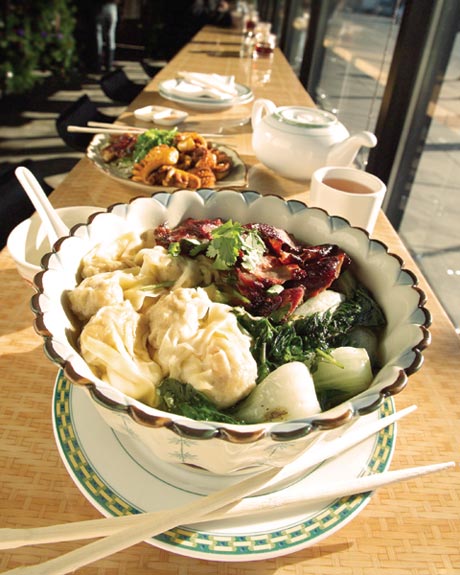
    The newest and most stylish of the restaurants that serve Chinese meal-in-a-bowl soups is Pagoda in Dinkytown. They let you design your own soup: You select a broth (chicken or pork), a noodle (the four options include Japanese udon), and as many fillings as you want from a list that includes beef brisket, curried squid, beef balls, fish balls, and more. It costs $3.95 for noodles and broth, plus a dollar more per ingredient.

    Pagoda also offers several kinds of congee, the savory rice porridge that is the ultimate comfort food. Some people find it bland, but at its best, it’s deceptively simple and wonderfully nuanced, studded with chewy shreds of pork and slippery morsels of gelatinous preserved egg, and scented with slivered ginger, chopped green onions, and aromatic fresh coriander. Other top spots for traditional Chinese noodle soups and congees include Hong Kong Noodle, Keefer Court, Shuang Cheng, Village Wok, Relax (the former Yummy), and Mandarin Kitchen.

    By now most American gastronomic adventurers are familiar with at least one or two soups from the Vietnamese repertoire: pho, the beef noodle soup from the north; and hu tieu, made with roast pork, shrimp, and squid (originally from Cambodia). The many variations of pho range from a simple rare sliced beef with rice noodles to a combination of sliced beef, brisket, tripe, tendons, and meatballs. Regardless of type, it should be served with fresh chopped coriander on top and a side dish of basil and other fresh herbs, bean sprouts, and lime wedges.

    Moving beyond pho and hu tieu, many better Vietnamese restaurants also offer bun bo hue, a hot and spicy noodle soup from central Vietnam; and bo kho, an intensely flavorful beef stew (misleadingly described as curry), which can be ordered with rice noodles, egg noodles, or a French baguette. For the truly adventuresome, Quang serves chao long, a rice porridge made with pork intestines and other innards, on weekends. My other favorite spots for Vietnamese soups include Pho Tau Bay and K-Wok in Minneapolis, and Ngon Bistro, Trieu Chau, and Hoa Bien in St. Paul.

    If you like it spicy, it’s hard to beat the selection at Peninsula, the Malaysian restaurant just up the street from Quang. Their beef curry soup with egg noodles is intensely flavorful without being overpoweringly spicy, but my favorite is the nyonya laksa, a curried coconut-milk soup brimming with tofu, chicken, shrimp, bean sprouts, and rice noodles. You can also find a decent version of curry laksa soup, along with a few other Malaysian dishes, at K-Wok, the Vietnamese/Chinese restaurant at Cedar and Riverside. And for a terrific selection of hearty Cambodian noodle soups, both spicy and mild, visit Cheng Heng, on University Avenue in St. Paul, where you’ll find distinctively Khmer versions of Vietnamese pho and Thailand’s hot-and-sour tom yum.

    Japan gave us ramen, the instant noodle soup packets that are a mainstay of college dorms and employee lunchrooms. You can find a more refined version of ramen, topped with roast pork, bamboo shoots, and fish cake on the lunch menu at Origami, but most other local Japanese restaurants base their soup repertoires on two other traditional noodles: fat wheat udon, and chewy brown buckwheat soba.

    My two favorite spots for Japanese noodle soups are Midori’s Floating World Café in Minneapolis, and Tanpopo Noodle Shop in St. Paul’s Lowertown. Tanpopo’s nabeyaki udon is a composition with the elegant simplicity of a haiku: noodles, shrimp tempura, sliced chicken, fish cake, Japanese omelet, and seaweed, presented steaming hot in a pottery bowl.

    Korea has very cold winters, and the best of the Korean restaurants around town, like King’s Korean, Mirror of Korea, Kum Gang San, and Hoban, all offer soups to warm your innards. Mandoo kook is Korea’s answer to wonton soup—dumplings filled with beef, cabbage, and tofu (ingredients vary) served in a clear flavorful broth. My favorite, cham pong, is made with spaghetti-like noodles and mixed seafood (typically, shrimp, octopus, and mussels), as well as napa cabbage, green onions, onions, and carrots. Adventuresome eaters will want to try kimchi chigae, a very spicy stew of fermented cabbage, tofu, green onions, and pork in a hot pepper broth.

    Asian cuisines, of course, don’t have the lock on great soup. The most famous Mexican soup is probably menudo, the spicy tripe and hominy soup traditionally served as a hangover cure. (A word to the squeamish: Even though I shy away from liver, kidneys, and most other organ meats, I actually like tripe, which has a mild flavor and a pleasantly chewy texture.) Many restaurants serve menudo only on weekends, but Pancho Villa and Tacos Morelos make it every day. Beyond menudo, Pancho Villa offers a traditional caldo de res and caldo de pollo (stewed beef or chicken in broth with big chunks of vegetables), and a spectacular caldo 7 mares (“Seven Seas”), full of shrimp, octopus, mussels, squid, and crab legs, swimming in a spicy red broth. I also enjoyed their pozole, a traditional soup made with pork and hominy that dates to pre-Columbian times. Order it rojo—red—for the extra kick of chili peppers.

    Kramarczuk’s Deli on East Hennepin in Minneapolis usually has about half a dozen soups on hand, including the classic Eastern European winter-beater, a beet and cabbage broth. This hearty version also has lots of chunks of stewed beef. It’s a bright rose color when served, and changes to a lascivious shade of pink when you stir in sour cream, as is the custom. A bowl of this borscht, with a few slices of rye bread and butter, and you are ready to face a Ukrainian winter, or a Minneapolis snowstorm. For variety, try the sweet and sour version at the Brothers Deli in downtown Minneapolis, where you can also find pretty good chicken noodle and matzo ball soups.
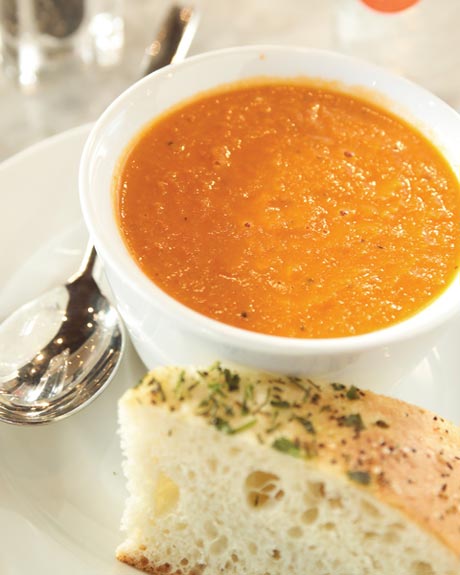
    Speaking of which, for first-rate chicken noodle soup, head to Yum! Kitchen & Bakery in St. Louis Park, where you can add matzo balls à la carte. Yum! also offers a delicious creamy, chunky tomato basil soup and a hearty gumbo, served over rice and brimming with andouille sausage, chicken, shrimp, and okra.

    One more favorite spot for soups is the Fireroast Mountain Café. Owner Lisa Piper makes two a day, at least one vegetaria
    n, ranging from smoked beef with roasted poblano to apple-parsnip, potato-leek, and chicken-and-veggies-with-rice varieties. Combine that with one of Lisa’s terrific homemade desserts, like the signature Mexican chocolate cake, or apple spice cake with walnut topping, and you’ve got a hearty lunch—plus change from a ten-dollar bill. (Full disclosure: Lisa and her husband/co-owner Dave Clark are friends.)

    If you work your way around the Cities to all of these restaurants, that should be enough soups to keep you going ’til spring, but it’s hardly a complete list. If you have favorites to add, drop me a line at iggers@rakemag.com, and I will add them to my Breaking Bread blog.

  • Cave Vin: Moules Frites and Mellow Jazz

    So, the first thing Carol says when we are seated at our
    table at Cave Vin, is, "why would anybody want to eat at Salut, when they could
    dine here?"

    Of course, this was before we had ordered any food, so it
    was based entirely on appearances, but it seemed like a good question. Cave
    Vin, with its pale dappled walls and soft lighting, just seemed so much more
    romantic and inviting than Parasole’s high-decibel parody of a French
    restaurant, a few blocks away at 50th and France. Evidently, a lot
    of shrewd market research led to the conclusion that what Ediners want when
    they dine at a French restaurant is a French Onion Soup burger. On this
    Wednesday night, Cave Vin was mostly empty, while Salut always seems to be
    crowded.

     Adding to Cave Vin’s
    charm was a trio, featuring chanteuse Rhonda Laurie, who has performed around
    town at the Dakota, Rossi’s and elsewhere, backed by bass and guitar, playing
    old jazz standards, softly. They’re at Cave Vin every Wednesday night from 6:30
    to 9:30.

    We weren’t really hungry, so we ordered light – we split a
    delightful beet and roasted fennel salad, served in a subtle Dijon vinaigrette
    ($7.50), and then Carol ordered the mussels in shallots, white wine and garlic
    ($9.50 / $13 with frites) and I opted for the steak tartare ($8.75), a dish
    that has virtually disappeared from American menus because of fears of food
    poisoning (and law suits.) This was a classic rendition, topped with a raw egg
    and accompanied by chopped onions and capers, and toasted croutons – an
    elemental pleasure for carnivores.

    Carol’s mussels were tender and flavorful, and the
    accompanying side of thinly sliced salted frites was big enough to share. We
    hesitated about dessert, tempted by the likes of crème brulee and chocolate pot
    de crème, and then decided that we were quite satisfied without. Total tab for
    two, with tax, tip, and a couple of glasses of wine was $55.

    There is lots more on the menu that I would like to try,
    ranging from the crab cakes ($10) and the frog legs ($7.95) to the braised lamb
    shank ($18) and cornmeal crusted sea scallops ($24), so I will probably be back
    soon – either on a Wednesday, to hear Rhonda Laurie again, or on a Monday or
    Tuesday, when bottles of wine are half-price.

    Cave Vin, 5555 Xerxes Ave. S., Minneapolis, 612-922-0100. Open nightly at 5 p.m.