Author: Michael Fallon

  • "We Choose to Go to the Moon"

    “Many years ago the great British explorer George Mallory, who was to die on Mount Everest, was asked why did he want to climb it. He said, ‘Because it is there.’ Well, space is there, and we’re going to climb it, and the moon and the planets are there, and new hopes for knowledge and peace are there. And, therefore, as we set sail we ask God’s blessing on the most hazardous and dangerous and greatest adventure on which man has ever embarked.”

    -John F. Kennedy, Rice University, Sept. 12, 1962


    ONE INTRIGUING OCCASIONAL AFTER-EFFECT OF ART is that it can, when conditions are right, be a means to break through the time-space continuum. Case in point: I was recently, upon seeing a recent work of local public art, transported back in time to the year 1962.

    1962, at its lowest, was tense, tumultuous, and treacherous. It was, of course, a year of near nuclear oblivion, but it was also a year of massive military movements across the globe in places like Burma, the Dominican Republic, the Congo, and Indonesia; military buildups in East Germany and Vietnam; a military conflict between China and India; and violent civil conflicts in the South.

    Despite this atmosphere of warfare, terror, murder, and bloodshed, or perhaps because of it, 1962 was also a year of great cultural highs. The Beatles released their first single in 1962. Andy Warhol painted his first Marilyn Monroes, Elvises, Campbell soup cans, and Coca Cola bottles, and the Sidney Janis Gallery mounted the first group exhibition of Pop artists (“The New Realists”). The Rolling Stones, James Bond, Andrei Tarkovsky (perhaps the best filmmaker no one’s ever heard of) all made their first appearance in 1962, and Lawrence of Arabia, To Kill a Mockingbird, and The Manchurian Candidate became instant film classics — notable each for the innovative story-telling risks they took. And among the great and innovative books published in 1962 were A Clockwork Orange, The Man in the High Castle, One Flew Over the Cuckoo’s Nest, A Wrinkle in Time, The Golden Notebook, One Day in the Life of Ivan Denisovich, Pale Fire, Silent Spring, and Travels with Charley.
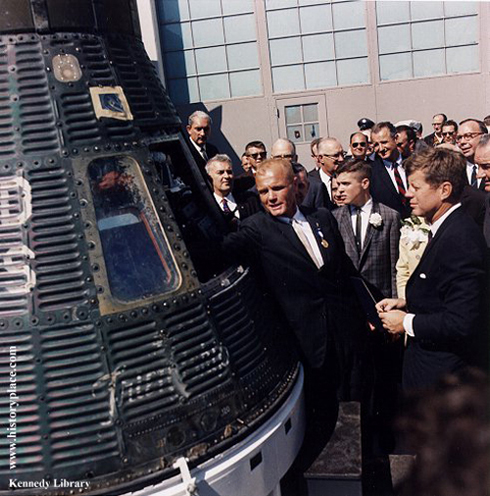


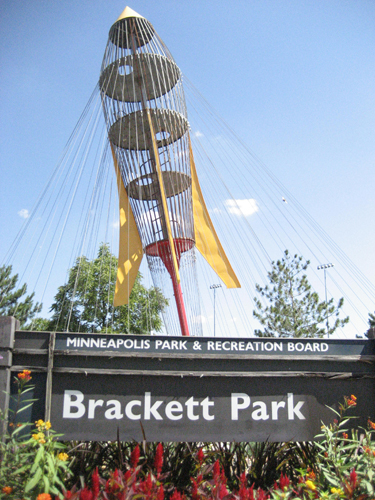
    Two events in particular in 1962 had arguably the deepest, most lasting impact on the culture — at least for the decade or two that followed. This was when John Glenn and Scott Carpenter risked all to be the first Americans to orbit the earth. A resulting national frenzy for all things space culminated in September of 1962, when the president uttered his immortal pledge — “We choose to go to the Moon” — in a speech in Houston. Suddenly, kids of all ages were learning how to make junior cadet space helmets, buying Marx mystery space ships and toy rocket launchers, and, if they lived anywhere near Brackett Park in Minneapolis, climbing up a newly installed 30-foot rocket to take imaginary trips to the stars.
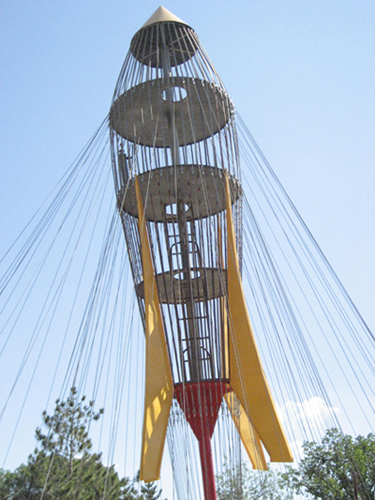
     

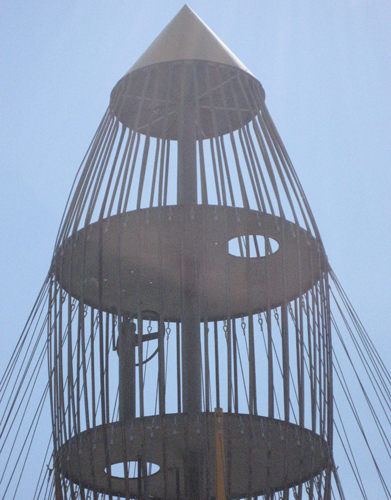
    Thanks to art, the Brackett Rocket survives to this day — nearly a half-century later — reminding us of what 1962 was about. Though I’d seen last summer’s reports about the installation of the above work of public sculpture, called “Return Journey” and fabricated in 2007 by Randy Walker, it wasn’t until I saw it recently — passing by on my way to lunch at the Birchwood Café — that I realized the old rocket that once stood in Brackett Park, and that now survived thanks to Forecast Public Art, was similar to the one I had climbed on in the 1960s and 70s as a kid growing up in California. Originally installed in 1962, according to the Minneapolis Parks website, the Brackett Rocket was “a children’s climbing structure symbolic of the entrance of the United States into the ‘space race.’” The rocket was basically a semi-enclosed, upwardly built clubhouse-like structure, with a exterior comprised of a series of metal slats that bowed out gracefully with a kind of classic raygun-like convexity. This allowed children to frolic inside the rocket while still remaining visible to parents. Entry to the rocket was gained by climbing a ladder through a hole cut into a bottom circle of rigidized (RSS.3) sheet-metal. Once inside, a child could decide how much further to climb: into a second, even larger, stage; then into a third stage, wherein lay the rocket’s steering apparatus; and finally into the final stage, the rocket’s claustrophobic, but lofty, nose cone.

    The joy of this particular piece of playground equipment — as I remember it from my own childhood playing at Victory Park in Pasadena, California — came not only because it allowed for imaginary star roaming, but because entering, and climbing, the rocket was, at least superficially, a risky act — much like the ones embraced by people like Glenn, Carpenter, Mallory, and Kennedy. You wanted to climb the rocket, because it was there, and it was the tallest thing you’d ever seen on any playground. There was particularly something frightening, exhilarating, perhaps even breathtaking, about attempting to visit the nose cone, mostly because of the height of the ascent, but also because of the likelihood that you’d bump into a kid much bigger and meaner than yourself who wanted the highest spot for himself. And there was also the fact that the thing was damn rickety. The see-through walls, the narrow ladders, the rough metal, the vertigo-inducing open walls — all implied an enter-at-your-own-risk kind of ethos that was a larger part of American life in the 1960s and 1970s.


    "Please, dear God, don’t let me fuck up."

    –Words spoken by Alan Shepard just before launch of the world’s second manned spaceflight mission; this has become known among aviators as “Shepard’s Prayer”


    OVER TIME, THE EUPHORIC FRENZY of the 1962 American race-to-space subsided. Some space missions succeeded, and other space missions failed (some spectacularly), as did other missions. Perhaps affected by these failures, the culture grew, over time, subtly more risk-averse. In the late 1990s, safety concerns shuttered, at least partially, the rocket in Brackett Park. Stories circulated at the time that an influential local parent watched in terror as her daughter lodged her head in the rocket’s slat sidewalls. “I cringe when she goes in it,” another parent was quoted in 2004, regarding her own two-year-old daughter. “Aesthetically, it’s nice, but it’s not a safe piece of equipment.” Still, k
    ids have a natural curiosity about danger that will ever go against parental risk-aversion — perhaps, in a vicious cycle, leading to ever more parental protectionism. As this story described, local kids loved the Brackett rocket up until the end despite parental fears: “Even on a chilly afternoon, it was worth the trip. From [a local boy’s] perch high above the park, the 10-year-old could grab a makeshift steering wheel and imagine soaring above the clouds… he had few complaints about the 42-year-old rocket.” But no matter; in 2004, the Brackett rocket was completely removed as part of park renovation efforts.

    The Brackett rocket, having been built before an age of seatbelts, bike helmets, child safety seats, anti-bacterial soap, children-at-play signs, toy recalls, and anything else we can think to do to protect our children (short of locking them in a padded room), was doomed. Its age was one of risk-taking of the sort that won us the space race but that took a toll on the physical body. Back then, playgrounds looked like they’d been fabricated out of the spare parts of WW II battle cruisers, and they were nearly as dangerous to youthful fingers, knees, elbows, and wrists. The Brackett rocket eventually became victim to changing cultural values that worked to remove the danger, and fun, from the nation’s playgrounds.

    The downward slide in playground design, which began in the 1980s, came about specifically from concerns about child fragility that had begun to affect trends in parenting and education. According to a 1989 story in the New York Times, parents were fixated that year on Consumer Safety Commission stats citing 15 deaths and 185,000 serious injuries on playgrounds across the U.S. With such parental watchdogs on the prowl, not only were Brackett-style rockets being examined as unsafe by well-meaning local park boards, but so were old-style jungle gyms and other climbing equipment, traditional monkey bar arrangements, swings, playground surfaces, merry-go-rounds, and any number of playground toys that had served several generations of happily banged-up kids. (Victory Park removed its rocket some time in the 1990s, while parks in other towns, such as Scott Carpenter’s home town of Boulder and the rough western outpost of Dallas, have been taking down their rockets in more recent years). Compounding the situation, playground equipment designers, concerned about increasing ligitiousness in the late 1980s, grew increasingly wary of innovating and exploring new ideas about play. Parents, perhaps due to overstressed, overscheduled lives — and worry about losing control over their children’s safety — began taking kids less often to playgrounds (even as they worked to diminish creative design of playgrounds), and schools began limiting playground time, even to the extreme of canceling recess altogether in some areas.

    What’s most ironic, of course — and somewhat depressing — about this playgound protectionism and irrational fear is it occurred just as child-development experts were becoming, according the Times article, “increasingly vocal about the importance of imaginative outdoor play for children.” The playground, explained the experts, was an “arena for physical, mental and social challenge,” a place vital to children’s development. And, according to experts, the new safe and “uninspiring” play spaces were exactly what kids needed least. “Playgrounds,” said David Belfield, a playground design expert, “by their very nature need to be challenging and risky in order to attract children to go back again and keep trying. It is fine for kids to fall over! Government intervention and our nanny state is damaging our children’s development. This will have a lasting impact as they go through life. If we are not careful, we will become a completely risk averse country to the detriment of our growth and prosperity.”

    Danger and risk-taking — especially in the relatively controlled, but unsupervised, atmosphere of the playground — is a crucial teacher of children. Putting oneself in (reasonable) harm’s way imparts to a child the importance of approaching risky problems with creativity and chutzpah and style. Again, according to the experts, “… today’s children are missing out on unsupervised play, a critical part of their mental and physical development. Incorporating risk is an important aspect of growing up. We develop from learning by our mistakes and pushing our boundaries and this has to start in childhood.” The fact is a few banged knees, twisted ankles, and split nails or jammed fingers may be among the best teachers we can have in life.

    It is all too telling — and in many ways tragic — that, today, playgrounds look less like dangerous, war-surplus scrap metal than something from the back warehouses of IKEA: all designer polyvinyl and off-centric, trapezoidal, globalist shapes meant to nestle perfectly atop a polyfill, low-impact, modern play surfaces. These plastic pre-fab products of the Euro-designer’s imagination offer about as much opportunity for real imaginative play — and real danger — as, well, spending an afternoon stuck in IKEA.
     

    Certainly, the Brackett rocket offered an important object-lesson to any kid who managed to mount the exalted, rarified nose cone: If you overcame your fears and dared to make the climb, then you were rewarded — especially if you lived to tell the tale without too much personal damage. I wonder if the same could be said today about a country too long pampered and protected, about privileged citizens living ever-cushier lifestyles, about politicians who fear administering any sort of necessary, but vote-draining, pills — have we simply grown afraid to face the numerous challenges of the future? Does anyone other than me wonder how John F. Kennedy might have suggested we deal with any of our sundry contemporary dilemmas: Unaffordable housing and health-care, a devaluing currency and ever-ballooning trade deficit, a looming energy crisis, rising ocean levels and increasing environmental stress, loss of industry and job, growing inflation, a widening divide between haves and have-nots, and on and on?

    What’s great about this new incarnation of the Brackett rocket is that the sculpture has the power to evoke the spirit of a bygone era and point out every important difference between then and now. It hints at a better version of ourselves — the nation of risk-takers and achievers who made, despite the great dangers surrounding the country, “know how” and “can do” everyday expressions, and an everyday approach to living life.

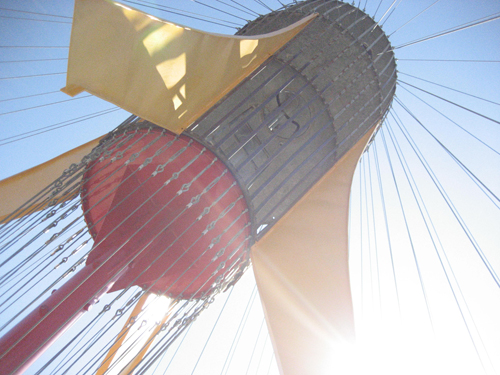
    Still, at the same time, “Return Journey” only hints at the former glory of the year it was erected. Mounted on a pole now, removed from its launch position on the ground, it does not allow us truly to go back to that time, just as it blocks any curious child from entering it. Today, outlined against the sky, frozen in mid-act of an impossible lift off, tethered with dozens of guy-wires — the sculpture is a tribute to a million risks taken by a hundred million kids through the years (who once climbed the rocket), but it’s also a mockery of our raging cultural trepidation and
    mutual risk-avoidance. Thanks to artist’s anchoring of the structure — whether intentional or not — the Brackett rocket has become nothing more than an outdoor museum piece, removed from its past energy and potential and a sad commentary on our own contemporary cultural ineffectuality.
    In the end, we can only marvel that in the much more dangerous year of 1962 the country’s citizens became united in ways that seem impossible now — its creativity focused on one project, its inspiration whetted by one young president enough to make the sacrifices (to the tune of between $20 and $25.4 billion in 1969 dollars in sum for the Apollo project, which amounts to approximately $135 billion in 2005 dollars) necessary to get the job done.

    If only we could choose to go to the moon all over again…
     

  • ArtofPolitics.com

    One common blogging convention, that our Vicious Circle of intrepid arts writers has yet to employ, is what I am going to hereby dub the "Cavalcade of Links" (also sometimes called, by those who follow such things more closely, a "Blog Carnival"). For our purposes, a Cavalcade of Links is a posting wherein a lazy or overwrought (or too clever) blogger, in an effort to give the appearance of having thought an issue through, picks a topic and offers up a mass of live links to topic-related sites. All I can say at this point is, enjoy the first Cavalcade of Links!


    IN THIS RAPIDLY UP-RAMPING POLITICAL SEASON, the time seems right, on our little visual arts blog, to offer up a "Cavalcade of Links" on the expanding intersection, of late, between local art and national politics. That is, I would like to point out how artists in our Minnesotan voting districts and precincts will be attempting, over the next couple of months, to position themselves to garner attention, usurp power and influence, or simply quibble and complain over the ongoing political process to anyone at all willing to listen.

    Based on preliminary investigations, my working hypothesis is that Minnesota will, this year, be witness to a veritable explosion of art-meets-politics positioning, caviling, and attention-seeking (and this is true even considering that it’s a national election year). This uptick could be because of local excitement/agitation about a particular candidate. Or it could also be agitation/excitement over the looming Republican National Convention, although the growing cynic in me has another theory. That is, it’s possible this may also be a desperate attempt by a lost and distant generation, fast growing increasingly frustrated with their several layers of electronic separation from the real world, to connect with anyone on the outside willing to listen and take a looksee at their art. But that’s just the personal theory of a rapidly aging ex-radical critic…

    Whatever the reasons, what’s on offer here is a helpful guide for wading through all this local political artsmanship. To assist in such an effort, I have attempted to break down the various activities — either commenced or announced — into three main areas: (A) Come Together, Over Me: Broad calls, mostly web-based, to motivate artists to join together to work on some sort of upcoming artistically political group activity; (B) Hey, Look at Me!: Politics-related exhibitions being currently planned or mounted by artists, galleries, and museums seeking to insert themselves in the thick of the ongoing buzz/activities; and (C) Me Me Me Me Me: A catch-all category for any and all aristic public rants, arguments, and kerfuffles in advance of the looming grand ol’ gathering and election.

    (If you have additional links to upcoming local arts-political activities of any sort — in any of these areas — please add them to the comments section at the bottom of this post.)

    Without further ado, shall we start the Cavalcade?

    A) Come Together, Over Me

    • The UnConvention is the granddaddy of all assemblies of artists looking to dip a toe in the pool of politics this election season. Citing as its main mission — "To umbrella the myriad artistic and educational activities (exhibitions, lectures, performances, etc.) that will take place in the Twin Cities during the lead-up and staging of the 2008 Republican National Convention in St. Paul, Minnesota" — the UnConvention’s list of planned projects is pretty extensive. It includes: a variety of public art projects — sculpture, performance art, and an artist-made lawn sign competition very similar to one that was mounted in 2004; opportunities for civic dialogue and speechifying; a parade culminating in a gathering in Loring Park; an art car powered by humans; a skywriting project; an interactive peace-themed picnic complete (I’m guessing) with hootenanny-style sing-alongs; a round-the-clock gathering place for alt-media and others; and much more. In the end, so vast are the UnConvention’s planned efforts that it ends up as partner/umbrella to many of the projects listed below. The whole shmear is sponsored by, who else?, the Walker Art Center.

    • One notable sub-project to the UnConvention that’s worth pointing out separately is a competition called I Approve This Message. In this project, artists are invited to create a video in response to questions surrounding the scripted nature of presidential nominations and democracy in general. In addition to being shown online, the best works submitted will be screened at the Walker and other venues.


    • Vote YES Minnesota is the public advocacy campaign associated with the dryly-titled Clean Water, Land and Legacy Amendment that will be on the ballot this November. (This amendment, if passed, will increase our state sales tax by three-eighths of one percent through the year 2034 to dedicate funding to protect drinking water sources, wetlands, prairies, forests, and wildlife habitat, to preserve our arts and cultural heritage, and to support our parks and trails.) Interestingly, one of the key features of the Vote YES MN campaign is (as with the UnConvention’s "I Approve.."), a video contest, in which filmmakers "of all skill levels" are encouraged to tell why Minnesota is "such a special place to live."


    • Spark 24, an offshoot of the UnConvention, is a non-stop marathon of free entertainment that will kick off at 5 p.m. on Saturday, August 30, 2008 and continue until 5 p.m. on Sunday, August 31 (the days just prior to the start of the Republican National Convention). Free events of all sorts –music, theater, dance, etc — will be scattered around Minneapolis, mostly downtown in and around Peavey Plaza and Orchestra Hall, but also in over 60 nearby restaurants, bars, hotels, and retail stores. Unfortunately, there doesn’t appear to be video contest involved with this project.


    • But not to worry. Though it’s not a strictly local effort, YouTube is sponsoring yet another politics-based video contest. Actually, it’s two contests — one for each side of the political fence. All you have to do is answer (in your video) the question "Why are you a Democrat/Republican in 2008?" and you can win a day in the campaign press pool and a trip to either of the 2008 political conventions.


    • And, True Blue Minnesota, an honest-to-goodness 527 non-profit corporation formed to act as a counter-balance to the Republican National Convention, is also planning to present videos to the world during the convention (will we ever tire of political videos?!). They have rented two "JumboTron" televisions on which they’ll show a wide variety of imagery, ranging f
      rom single words, short phrases, and famous quotes to full-length motion pictures, artist videos, comic bits,visual art, photographs, comics, and animation. One television, 17 feet high and 23 feet across, will be located in Triangle Park, across from the Minnesota History Center, and the other in a Harriet Island parking lot. Meanwhile, if you’re getting tired, like me, of all the videos, True Blue MN is also sponsoring a competition for artists to redesign the RNC logo.


    B) Hey, Look at Me!

    • The Weisman Art Museum, that oft-overlooked third wheel of the local museogarchy, is running a vast number of politics-oriented exhibitions and programs in coming weeks and months. "Who is a Citizen? What is Citizenship?" is the first of a series of exhibits and programs examining the role of art and artists in a democracy. It draws from the museum’s collection in exploring the stated theme. Meanwhile, "Hindsight is Always 20/20" is a solo exhibition featuring prints — based on U.S. presidential State of the Union addresses — by R. Luke DuBois, a New York-based composer, performer, video artist, and programmer. Meanwhile, the museum has planned a nearly non-stop slate of political-themed events, lectures, exhibitions, performances, and dialogues for the next three months, including, on September 4, an event called "American Politics Sideshow," that will "mimic a three-ring circus, [with] speakers, tours, films, and performers from late morning ‘til nightfall."


    • The Saint Paul Public Library is hosting a series of poltical-oriented events — both civic and artistic — cleverly called "Saint Paulitics." Among the wide range of stuff taking place during August in downtown St. Paul are: "Political Scenes" — free screenings of politics-themed movies in the Central Library Courtyard; lectures by various experts on politics, including Mark Halperin of Time Magazine, Susan Estrich of Fox News, and Bill Arnold (writer of Triple Espresso); and "Moving Lives Artists" — a series of lectures, held in conjunction with Intermedia Arts, by artists whose work focuses on social change.


    • Speaking of Intermedia Arts, as of August 30, this community arts center will be no longer (at least through Nov. 8 — election day). As stated on its website, in advance of the RNC, Intermedia Arts "will transform into "The UnConventional Gathering Place," a place to "hang out with artists, community leaders, educators, alternative journalists and socially engaged citizens" in a "digital information playground of new media installations by national and local artists, online reportage by community and youth journalists, political karaoke evenings, one-mile radius UHF TV station, art exhibits of the people, by the people, for the people and more."

    • While we’re back on the subject of the ubiquitous UnConvention, the Form + Content gallery too will give itself over to the cause for the duration with an exhibition called, uh, "Party Party in a Tweety Land b/w This Republic of Suffering." Apparently inspired by old 45 records (thus the tricky title), this barrel-full-of-fun exhibition will contemplate the "tensions between suffering and denial, grief and self-absorption, and the real cultural losses buried under the flotsam of a consumer and celebrity obsessed culture."


    • Not to be outdone, the Altered Esthetics gallery is mounting, in August, "The Revolution Will Not Be Televised." This show will be comprised of over 100 works made in response to global and socio-political topics by 50 local and international artists working in sculpture, installation, performance art, painting, and photography.


    • The Northrup King Building will present "Translating Politics," a response to the looming RNC by 13 local artists working in painting, photography, sculpture, mixed media, and (of course!) digital video. This show is being sponsored by the Northeast Minneapolis Artists Association (NEMAA) and (you guessed it!) the UnConvention.


    • And finally, students and graduates of the McNally Smith College of Music in downtown St. Paul have announced they will perform at six outdoor locations (an activity known, in the parlance, as "busking") during the RNC. According to college vice president, and occasional public performer, Chris Osgood, the idea originated after discussions between the school and city officials about how to energize downtown during the convention. You may also want to take note: McNally Smith will host "The Daily Show with Jon Stewart" for the duration of the convention.

    C) Me Me Me Me Me


    • Ironically enough, when the Southern Theater announced just about the same time as the MAEP that it was placing its longtime veteran artistic director on "administrative leave," local dance artists reacted with much the same public fervor. In response, the Southern’s board mounted, just as the MIA did, a press blitz and a public forum to discuss the situation. I don’t know if the dance artists remained as un
      happy as the visual ones after all the furor died down, but I haven’t yet seen issued any local dance manifestos. (And there’s no word yet on whether the artist-reaction to the recent news about the shut-down of the Minnesota Center for Photography will be anywhere near as passionate.)


    OF COURSE, IT’S ALL UP TO YOU — each individual voter — to decide how much of this hoohah to participate in. While it’s quite likely that Minnesotan art lovers will never again see quite the convergence of this stuff in their lifetimes, it’s also just as likely that a good percentage of us will be as far away from the goings-on as we can get (and so will miss it in the first place).

    In the end, if politics is, as Bismarck said, "the art of the possible," well then in Minnesota this year politics is, thanks to local artists and organizers, everything that’s possible in art.

    (Again, submit arts-political links you’d like to see added to this list to the comments section below.)


  • Eric Inkala's "Overflow: A Pleasure Trip"

    Eric Inkala‘s no fool. After a good run of years of painting his coloristic, hazy-dazy, arabesque, Little-Engine-that-Could-meets-Pacman murals (this guy is a tagger of the most whimsical sort) on walls around town, Inkala’s finally been hit by the legitimacy bug. That is, in the manner of graffiti artists gone legit–like Keith Haring in the 1980s and, more recently, Barry McGee, whose work was a highlight of the recent Carnegie International–Inkala’s bringing his particular brand of graffiti stylings indoors to show at The Gallery @ Fox Tax. (Note: Fox Tax is a tax and financial services company that also has an art gallery.) Called "Overflow: A Pleasure Trip" and curated by Emma Berg of mplsart.com, this is being billed as Inkala’s first local solo gallery exhibition. How exactly he manages the transition (from outdoors to in-; from renegade to law-abider) remains to be seen, but press materials promise there will be "smoothly cut whales hanging from the ceiling," "bulbous characters" flowing in and out of the background, "walking creations of his recurring character," and the sum of these parts will form an "abstract diary that represents everything from the day-to-day mundane to his travel experiences…"

    "Overflow: A Pleasure Trip" runs August 8 – September 6. The opening reception is on August 8, 6 – 11 pm. The Gallery @ Fox Tax is located at 503 1st Ave NE, Minneapolis.

  • The New Dada

    Part the first — History Is the Past


    History is something that happens to other people. -Anonymous


    WELCOME STUDENTS. I’d like to begin today’s seminar with a pop quiz. (No groaning, people!) Please take out your Bluebooks and answer the following two-part question:

    1. Identify the following historical era: In the early years of a century, at the end of a long era of prosperity, there occurred a contentious generational baton-pass between an older, tradition-minded generation (often called the "Civic Generation," but also sometimes the "Greatest Generation"), to a younger generation noted for being insecure, disillusioned, and "lost." That new century’s dreams for continued prosperity and peace had been ended by a brutal war that, while at first very popular, was later deemed the deceitful, wool-pulling act of a reactionary leadership bent on preserving a dying world order. The resulting atmosphere of destruction, death, disappointment, and demoralization defined the history of an entire generation.

    2. Identify the movement that was birthed of this era, and describe its location and surrounding circumstances: Out of the era’s despair and dismay, a group of young artists and writers gathered in a place of refuge and began venting their anger at the times in the best way they knew how: through art. Making use of new communications technologies (which often became a subject of the work), the loosely linked group took to questioning the meaning, and subverting the value, of what had been held sacred by the generations previous. The resulting art was often obtuse and insensible, but it also captured the underground anger of an age and shocked an otherwise apathetic public.

    Everyone got your answers? Good, let’s check em.

    Question 1: This era occurred circa 1916-1923, and is sometimes dubbed the years of the "Lost Generation." The war was World War I — a.k.a., the Great War — and the reactionary leaders were the last, blind rulers of the old Empires of the 19th century.

    Question 2: The place of artistic refuge was Zurich, Switzerland; the recent communications breakthrough was the rapid expansion of cheap printing methods on newsprint, and the art movement came to be called dada.


    (A little bit of dada from back in the doo-dah…)


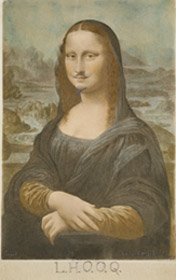
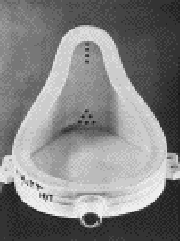
    Dada, the 20th century’s greatest and perhaps earliest art movement primarily intended to shock the established order, was birthed of war and its aftermath. Dadaist artists and poets, who comprised a wide range of styles and approaches — such that it’s difficult to identify any single dada style — were connected via a sense of protest and discontent and by their use of mild obscenities, scatological humor, obscure visual puns, nonsensical language experiments and imagery, and blasé gestures. (Think Marcel Duchamp’s Mona Lisa moustache, called properly "L.H.O.O.Q." (1919), or his flat-footedly presented urinal called "Fountain"). (Note: The title "L.H.O.O.Q." is a wry and baudy pun in French, because read aloud it makes a sentence, "Elle a chaud au cul," which, translated, means, "She has heat in the arse." )


    The group’s primary goal, then, embraced by young artists around the world and across the ages, was to outrage and repel the public (read: the established elders of the time). Today, history suggests the dada movement is key to understanding the sense of meaninglessness of the post-War era.


    Part the second — History Is the Present


    History is the present. That’s why every generation writes it anew. But what most people think of as history is its end product, myth. -E.L. Doctorow


    OF COURSE, AS WITH ALL GOOD HISTORY LESSONS, I suggest there’s also a second, alternate, partial-credit answer possible to today’s pop-quiz.

    That is, the advanced students among you might have noticed that another era also fits the historical description above. Just substitute, for instance, in your answer to question 1: the Iraq War for World War I; the Bushies for the great old oligarchs; the malaise of now and the current generation for that of the early 20th century’s "lost generation" — et viola, what’s old is new again! (The only question that remains is with the impending death of older, newsprint-based information systems where can one find a movement of artists seeking a place of refuge from all the turmoil today and a method to express their discontent?)

    But you don’t have to take my word alone on this connection between then and now. Other commenters have suggested that the current conditions are similar to what created dada. Tyler Green, for example, reviewed a retrospective of dada at the National Gallery in 2006, and wrote: "[Dada] is a celebration of the power artists have to portray horrors, as well as a celebration of the voice they have in condemning the circumstances that produced those horrors. On view in Washington at a time when our nation is questioning the Bush administration’s conduct before and during war in Iraq, it is a rare — very rare — instance of an exhibition at our National Gallery of Art bumping up against the news of the day."

    Certainly, there has been lively activity among political-minded artists in recent years. The 2006 Whitney Biennial was filled with young artists venting a variety of grievances through artistic gesture. (It’s a personal hypothesis of mine that this show’s curators — Philippe Vergne and Chrissy Iles — had hoped to evoke the energy and subversive qualities of dada in their curatorial choices; as to whether they succeeded in any way, well, I’ll discuss that in a moment…) Even well-established artists — such as Mel Chin (in recent sculptural objects suggest makeshift humvee armor, for instance), Jenny Holzer (in recent paintings based on declassified government documents related to the Iraq War), and Siah Armajani (in a recent public monument that conflated Fallujah with Guernica) — have gotten the political bug of late.

    As Enrique Chagoya said in a recent issue of Art in America dedicated to political art, "I have noticed many more artists dealing with political content since 9/11. The world changed after that ominous day, and the topics are more urgent and global than ever. Just look at how many issues are making us anxious in our country and in the world: political and economic corruption, global warming and our dependency on fossil fuels, the rise of xenophobia, ethic cleansing wars, discrimination toward women and minorities, etc. — the list could be really long."


    (Recent image of the Bush administration by Enique Chagoya)


    Still, the current generation’s political art up till now has been greatly lacking in something, some je ne sais quoi, or magic if you will, to capture a wider audience. Mostly it’s been dull and dry and deadpan and rote, lacking spark and inspiration — or the power to spark imagination in others (and thus win them to a cause). In my view, it’s
    a great disappointment that in this day and age of so much to protest and rail against, there appears to be no movement among artists that has any of the depth and quality to upset, confuse, question, and subvert like the dada movement of old.

    So where, I ask you students of history, is the New Dada?


    Part the third — Nothing Is More Delightful Than to Confuse and Upset People


    Nothing is more delightful than to confuse and upset people. People one doesn’t like. What’s the use of giving them explanations that are merely food for curiosity? The truth is that people love nothing but themselves and their little possessions, their income, their dog. -Tristan Tzara

    SO, THUS BEMUSED AND DISTRACTED by my own ideas and preoccupations about the current times and its art, a few weeks ago I received a cryptic, and unsolicited, email from a sender I did not know — a guy named Alex, who apparently is a regular a reader of some of my more obscure web-based arts writing. The email included only a weblink, and no other explanation; no text, no greeting, nothing at all of an explicatory nature. Of course, being an incurably curious sort — especially when it comes to online offers and links of uncertain provenance — despite my better judgment I clicked through the message to the other side. And what I found was an inscrutably low-tech-looking, clunkily typographed webpage with, again, no explanation beyond another link, this time to a pdf file of a document written by one Alexander Lane — thus solving one mystery (who this "Alex" was), but leading to another (what did this guy want?).

    The essay, which, frankly, could have been written by a failing high school sophomore English student (who had never learned how not to use passive voice), was a rundown of a recent panel discussion at the New Museum in New York, "Net Aesthetics 2.0," which examined the phenomenon of something called "Internet art."

    Now, I consider myself a fairly open-minded guy, and somewhat youthful and accepting despite my advancing years. But like any busy contributor to the national economy, between you and me, I was getting peeved by all of Alex’s obfuscation and crypticism. Still, against my better nature, I dug in and tried to make sense of this essay, painfully as it was written (and painfully as it was presented), and as a result I learned the following nugget of gold: Apparently, a lot of artists are using the Internet to make art these days.

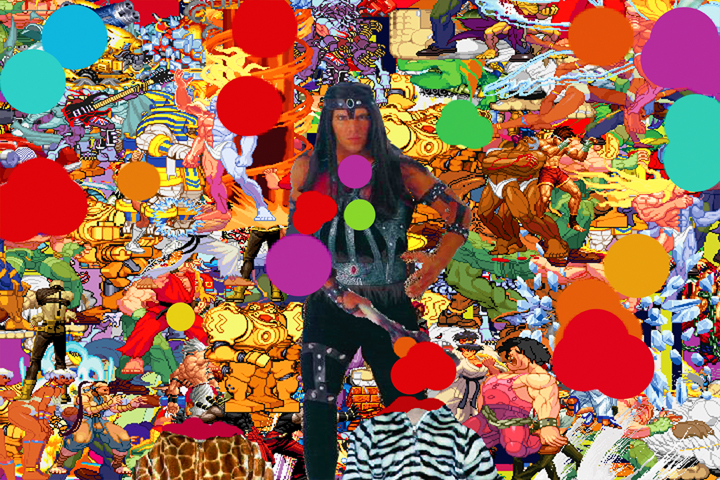
    Also, I learned, many of these artists often participate in something called "surfing clubs." I had never heard of such, but, according to another essay I dug up (via a couple of testy email exchanges with Cryptic Alex), a surfing club, as defined by Marcin Ramocki, is, apparently, a communal blog, usually run by artists, that may have several characteristics. These characteristics include: an internal dialectical and syntactical logic and narrative flow; a disregard for audience expectations in favor of its own infrastructure; a tendency toward semiotic and conceptual "games"; a connection to the act of "surfing" the Internet to find random materials and referents; a self-awareness of certain cultural codes inherent to the internet (among the most common being "Minimalism," "slacker art," "rock music," "youth culture," "programming language," "cute, extremely ugly eighties colors," "beauty for beauty’s sake," "porn,"and "video games"); and a tendency to evolve and change quickly (as per the culture of the Internet).

    The art done on these blogs is, I learned, at first glance rather off-putting and inaccessible, perhaps much in the same way Dadaist art and poetry must have been for the older generation of the time. It is raw, blatantly youthful, full of noisy, and seemingly random, disjointed imagery and gestures. The work denies any clear interpretation, and it is often repulsive and off-putting, confusing, upsetting, and resistant to clear explanation — just as Tristan Tzara may have preferred.

    In fact, it seems, the extra-credit answer to question 2 could be that the Internet is both the place of artistic refuge and the recent communications breakthrough for artists seeking to vent their frustrated modern spleen. And, it seems possible, that in this Internet Art movement we may well have the perfect analogue to the greatest protest art movement of the last century. That is, this cadre of young, disparate, unaffiliated, and angry online artists, who have found on the Internet a place to voice their underground discontent, may be the earliest wave of the New Dada.

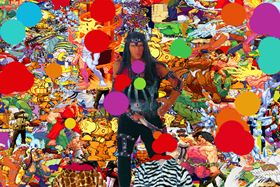
    (Sample of art from a "surfing club" weblog based in Minnesota)


    The part in which I AM conclusory (or, at best, partially conclusive) — CHoosing Instead to Provide Links (with explanation) to Samples of This Internet Art Phenomenon (both local and national), So You Can Judge for Yourself

    WITHOUT FURTHER FUSS, below I present some practitioners of the obscure art of the Internet — from "surfing clubs" both national and local — for you to make your own call (as to whether these measure up to dada, or else seem something altogether different).


    National Surfing Clubs/Internet Art Groups

    (Art by Tom Moody, from Nasty Nets)


    Nasty Nets — Apparently this group began posting in 2006, and is credited with being first to coalesce a growing movement of artists interested in online blog art. The community is relatively small, comprised of artists, curators, and activists/bloggers pushing boundaries (in the manner of Dadaists of old), and in fact questioning whether what they’re doing is art at all.

    Loshadka — has existed since May 2007. The first post on the site, extant during that first month, says everything about the site’s aesthetic and m. o.:


    PWN

    everything

    billy you’re gay right?
    admin;

    2 Comments »

    1.
    yesyesyesyesyes
    Comment by billy — June 22, 2007 @ 7:41 am

    2.
    gives me a pwnr thinkin about it
    Comment by prawnstar — June 28, 2007 @ 5:08 am


    Spirit Surfers — A much more clean, graphic-designy, and less frenetic site than some of its competitors, Spirit Surfers is no less obscure and obtuse – nor biting and incisive — for all the cleanliness. One of my favorite posts on this site is Tim Skirvin’s documentation of the building and destruction of a scale lego model of a Star Destroyer (from Star Wars). It’s particularly poignant that the Star Destroyer was destroyed by a cat named Tulip.

    Double Happiness — Click on this site, and you get a frenetic soundtrack mixture of sounds from 1980s uber-soundtrack of Top Gun, hip hop music, and a 1-800 infomercial. Plus, chocolate chip cookies with bacon
    , Google maps to pizza places in Poughkeepsie, and an image of the Hulk having standing sex with Wonder Woman.


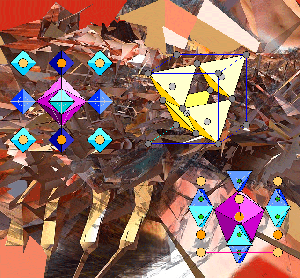
    (Another sample of Internet Art)

    Heck, with Internet Art, you just never know what sort of visions you’ll see — nor how obscure and obtuse they will be.


    Minnesota-based Surfing Clubs/Internet Art Groups

    Here are some locally-based attempts at Internet Art, though (*please note) it is often difficult to know precisely where such "surfing clubs" are located. This is because the artists often eschew their very identity, including their names, locus, origins, and so on, when they get involved with such sites.

    The Shitizens — A mishmash of local artists hip to national Internet Art trends, this site also seems to be one of several efforts by a local artist/blogger named Hollingsworth J. McTubbins. Check out the silly whip fetishism in this fun post.

    Hardland/Heartland — A group of artists who seem to do a bit of everything (including old analogue art exhibitions, online stuff, zines, happenings, poetry, manifesta — and everything in between); you probably shouldn’t miss whatever they’ve got hidden up their proverbials.

    Hooliganship — These guys really seem to love, for whatever reason, the whole "cute, extremely ugly eighties colors" thing. The organization of the site is a bit tighter, and less fluid, than some of the others of their ilk, but still the artists involved seem just as dedicated to the eccentrically obtuse aesthetic as any of them.

    Lords of Apathy — These guys seem particularly sex-deprived, but then what do I know about modern art anyway?

    And, well, you get the picture. I’d love to hear if you come across any more of these artistic endeavors — both national and local — or if you have any opinions about this art. Submit any thoughts, comments, suggestions (as long as they’re not cryptic) to the comment section at the end of this post.

  • Dried Blood and Dandelion Wine

    (Header image credit: "Conversation with Death" by Gabriel Combs)

    In an effort to seek out and engage multiple voices and viewpoints from the local arts community, I will present in my space on The Thousandth Word occasional postings by “Vicious Guests” — that is, writings by various artists, curators, guest critics, journalists, art experts, art lovers, and other essential members of the arts community who have a story to tell. The first such story, by 36-year-old local artist Gabriel Combs, is presented here. If you would like to propose a future “Vicious Guest” post, please contact me (Michael Fallon) at: thousandthword(at)gmail(dot)com.


    Dried Blood and Dandelion Wine

    By Gabriel Combs, a "Vicious Guest" (edited by Michael Fallon)

    I GOT THIS IDEA THE OTHER DAY to do dandelion paintings.

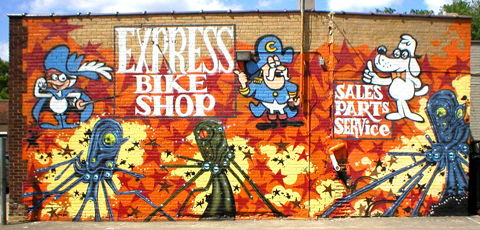
    I was waiting for the 21 bus to go from the K-Mart on Lake Street to Selby and Dale in Saint Paul, where I was supposed to pick up a check for a recently completed mural for a bike shop. Before leaving the studio, and probably because I’d been overly stressed of late about having no actual living space, I’d smoked a couple of onies of low-grade pot I’d found on the street (stuffed in the celophane of a cigarette pack). It had been raining while the sun was shining when I found the pot, and I witnessed a rainbow that day that no one else seemed to notice. The pot helps push back most things – other than art ideas, that is. It’s better medicine than most prescriptions.

    On the 21 bus, freshly high and scrubbed clean (as clean as one can get from a bucket; I hadn’t had a shower or bath in two months), I felt I was trapped in a video game, grabbing the subconscious shade of green through plastic. I pushed the bar on the back door of the bus and heard a Nintendo sound effect of achievement. The dandelion is a common wildflower that goes through an easily recognized metamorphosis. It’s often called a weed, though not by the National Audubon Society. It came to mind that I could do a mural-sized aerosol painting of a dandelion after it had turned white and was about to blow away in the wind so it could start its cycle over again. I’d find a decaying area of our lofted city and do several aerosol paintings on the big vertical walls of some urban squat or another. It would be a good job for me and would add something to the landscape.


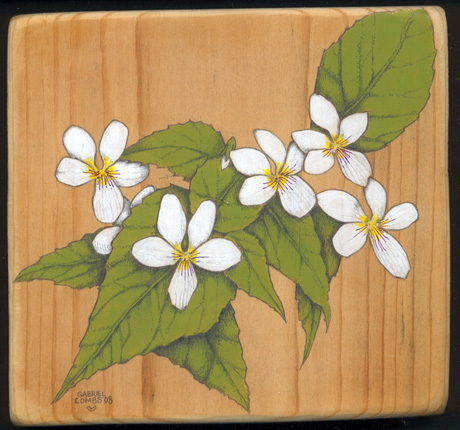
    ("Canada Violets" by Gabriel Combs)


    In early June, I was sitting in the downtown Minneapolis jail for getting drunk and making a fool out of myself. I was being a little too honest and a little too much of an ass – probably from all of my recent despair and loneliness – so I ended up in a cell upstairs at the jail. I’d chosen isolation away from the general population of the jail, a choice that gave me only an hour of cell-free time a day. The cell hadn’t been cleaned, and some other man’s "possessions" were still there on the eating table, caked with his dried blood. I started sporadically reading a book of Sherlock Holmes stories and taking in my surroundings. In one spot there were some clumps of human hair. In another, there were some letters and jail papers. The last man appeared to have been reading and writing in Spanish, but he was listed as African-American on the papers. He was a couple years younger than I.

    I was wearing orange jail clothes. Since I didn’t know how long I’d be stuck in jail, I stashed two stub pencils in the only place they weren’t likely to look for them – in a space between a bar and the round seat at the table. This was the only design flaw in the cell, from a security standpoint. Everything else was simple geometrical shapes with no lips, overhangs, or ledges that could conceal as much as a cigarette. Nothing could conceal my mind and ideas, however. I had been analyzing the psychology of the cops – which was the good one, which was the bad – just from their passing words of weather small talk. Saving the pencils meant I could draw if I ended up in jail very long. I was interested in reading though, and I wished they’d switch the library cart. I must’ve seen three or four other carts on the handcuffed walk to this room. Last time, they had To Kill A Mockingbird, and I would’ve liked to read that.


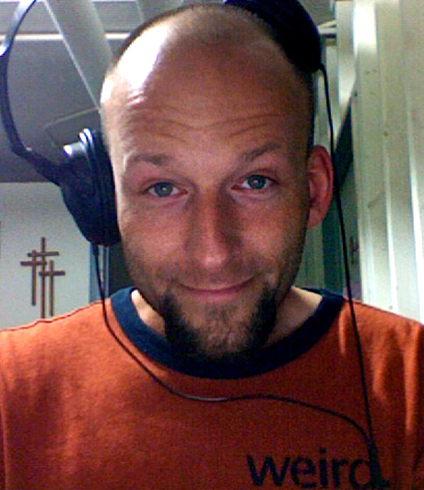
    (Photo of Gabriel Combs taken on the night of one of his recent arrests.)


    Two baloney sandwiches and an apple came in a brown paper sack, but I couldn’t eat them because my jaw was fucked up from the night I mouthed back to three guys. They beat me up and then called the cops on me, probably because I got back on my feet and produced a pair of bolt cutters to chase them off. They left out the fact that they’d beaten me up to the cops. On my first day out of jail, I didn’t get my studio keys or wallet back for four days. They blamed a computer problem for this. The internal affairs forms were useless when they had a faulty machine. I also had a sketchbook that was in police custody from when I got arrested in May. They were throwing the book at me, I guess, ignoring their profit margin on crack dealers, because the sketchbook was supposedly a graffiti book. It isn’t graffiti, of course, but there was no arguing.

    On the outside, pressed to figure out how to get back to making art, I thought fast and remembered the owners were remodeling an apartment in the building where I rented my basement studio, so I could ask them for a key to copy. I then went to the hardware store to get keys remade. The guy looked pretty sideways at me, and I couldn’t blame him. I was unshaven and full of anxiety about the repercussions of going to jail twice within a few weeks. I was fortunate to find this place and rent it for just $190 a month, considering I had an eviction on my record. I’d found the space on Craigslist, and the owners seemed OK with the idea of my using it as a painting studio. I sometimes slept in the studio when I couldn’t find a friend’s couch to sleep on. It was pretty clean for a basement, though there were plenty of spiders, silverfish, and common house centipedes.

    I had a $30.25 check that the jail gave me, which their bank wouldn’t cash because I didn’t have an ID (it was in the wallet they couldn’t give back to me). Luckily, my regular bank is downtown, and they know me, so, despite my embarrassment, I went there to get my money. All was well now, because I had enough paint and art supplies for the time being – plus, some food, my phone, a toilet, and time to think.

    I stayed sober through most of June just because I couldn’t deal with the panic attacks. On the Internet at the library, with new keys in my pocket but still no identity, I saw a friend who was driving by, and I had a coke with him and talked about my situation. As an artist, he’d been close to the same situation on occasion. I told him I was feeling scarred and rejected by society, especially since I’d spent my entire life trying to make things better in the world by making art.

    A week later, I was back drinking, fighti
    ng the sense of impending doom because of the upcoming court date. I was probably facing further incarceration for long enough that I’d lose my studio, humble as it was. The studio isn’t a home, but it’s a place to make art and to keep my art stuff and slight private personal possessions safe. I’m burning the candle at both ends now – at least until I say to hell with it and throw the every damned thing in the fire.

    I sometimes can’t take the worrying about it all. So what, I think, if I lose two drawing tables, an easel, and various stashes of oil and latex paint? So what if I lose some sentimental objects I’ve kept safe from harm for thirty years? I’ve always lived just as chaotic a life as this, but it’s been securely enveloped in a series of locked doors. I’ve always had an official address, and I’ve embraced the trappings of society – a job, a social life, and a bank account that was refreshed every two weeks but always remained a few dollars short at month’s end. There were no frills, just a one-room efficiency, a bike for transport (until it got totaled), no cell phone but a stripped down landline, a little net access, and a bit of liquor every now and then.

    It wasn’t much, but it was more than I have now. Still, I make more art now.

    When I lost my last job two-and-a-half years ago and I was facing financial desolation despite a frugal lifestyle, to make ends meet I copied an idea from printmaking. I would make a complete series of paintings – each similar to, but different from, each other – whenever I had squeezed some paint and the colors and ideas were out and fresh. I’ve sold over 400 pieces of art since – for prices ranging from 99 cents up to, recently, just over four hundred dollars (my all-time record). I take endless dumpster-diving missions, and I pick up any scraps of real wood I can find, along with scrap-metal from discarded appliances. The tools for getting this metal – including the bolt cutters that maybe saved my life – resulted in a charge of "intent to commit a crime." One of my favorite things to find is dresser drawers, the dove-tailed kind especially — although they usually need to be sanded first. I make my paintings ready-to-hang by stringing them with copper wire from dead appliance motors and screws from everything I find. Masonite scraps, familiar to many artists, are another valuble find.

    Two-and-a-half years ago I simply decided to make a run at this artist thing, and I’ve been inventing it – rather than just talking about it – ever since. My old friends see me coming and treat me like I’m homeless, which I am, but at least I am fulfilling my dream. They’ve got the same old complaints, and I have as much apprehension about coming into contact with them as they do me. I also have callouses turned to blisters and back again from the struggle to make art, which they don’t.

    They’ll go back to their homes, partners, and steady incomes. They’ll drive to a nice vacation spot this summer, while either I sit in jail or I toil away at my art, working toward selling my one thousandth piece.

    (Bike shop mural by Gabriel Combs)

    At the bike shop on Selby and Dale in Saint Paul, the shop owner paid me more than the price we agreed upon, saying "I can’t possibly pay you enough for your time." The bike shop folk loved the mural, and so did the area residents, which is a confidence builder for someone who, despite the shit he talks, basically feels like everything he paints is shit.

    If I lose the last few items I own and my studio, I’ll remain as vital as before – if not more so – as that’s what this thing is. Being an artist is not a fashion statement that passes with the season; it’s not something that hinges on gas prices. Art is something that combines with the culture to establish roots that intertwine with and break up the cement of society so the wildflowers can grow.

    Art breaks up a false foundation and replaces it with dirt. I wonder if it’s really possible to make dandelion wine…


    Editor’s note, 7/12 — Gabriel Combs posted this message on a community forum board (in regards to his court hearing on 7/10):
    evidence proved sufficent for the
    judge. free, no fine, but if i get in trouble again i’ll go down for
    *all three* arrests. thanks for all the good energy i received going
    through this. i still have to do some work with the restoritive justice
    center, and get my black book out of jail along with some other
    possessions. the turtle thats in that book must be really pissed by
    now, wondering how come i have’nt busted him out yet.

  • Serious Art

    Here’s a truism of modern art: Every new generation of emerging young artists is convinced it will reinvent the culture. And, strangely enough, they all go about this reinvention pretty much in the same way: By making a bunch of meaningless noise. Think of Tristan Tzara here, and his poems that go nowhere. Think of Jackson Pollock’s random splotches and drips. Think of the long and ambling filmic experiments of Warhol’s Factory. It’s not surprising, then, that the upcoming show “Serious Art” at First Amendment Arts of work by young artists Michael Gaughan and the group that calls itself Hardland/Heartland traffics in the realm of the bizarre and incongruous. Even the PR material are in on the act, abecedarianally describing the show as, “absurd, barbaric, concerning, despicable, entertaining, flippant, gregarious, half-baked, intellectual, jarring, knowledgeable, ludicrous, mellifluous, non-sensical, outlandish, perplexing, quadrangular, ridiculous, subversive, typical, urban, verbose, whimsical, xeroxed, yawn, zzzzzzzzzzzzzzzzzzzzzzzzzzz boring.” What this means, likely, is a colorful and head-scratching aggregation of colorful drawings, collages, paintings, installations, hand-made books, music, and fashions.

    The Serious Art opening party, which includes musical performances by Gaughan and members of Hardland/Heartland, takes place on Saturday, July 12, 7 – 10 pm. Admission is free. First Amendment Art is at 1101 Stinson Blvd (in basement rooms A & B) in Northeast Minneapolis.

  • The Man Who Fell to Pittsburgh

    I recently sat down to speak with Douglas Fogle–the curator of the 2008 Carnegie International–in his office at the Carnegie Museum of Art. It was a fine, bright spring day about one month into the run of the latest version of the great survey exhibition of international artists that was first mounted in 1896, and Fogle, who left the Walker Art Center in 2005 after eleven years to take this job, looked relaxed–if somewhat more internally care-worn than the last time I’d seen him at the beginning of his stint in Pittsburgh. (Full disclosure: I worked in 2006 for a brief time as a part-time media relations person at the Carnegie Museum of Art, where the Carnegie International takes place every three or four years.)

    You can also, if you’re so inclined, read "Oh Man, Look at Those Cavemen Go!"–my expansive review of this sizeable exhibition.

    Michael Fallon: The first question I wanted to ask is about the show’s title, "Life on Mars." I read that it came from the David Bowie song, and I’m curious if the first line of the song–"It’s a god-awful small affair"–was in your mind as you were organizing the exhibition, which is obviously a huge affair.

    Douglas Fogle: It wasn’t the first line. I was a huge David Bowie fan as a kid, when I was in high school. Actually I came to a lot of art and cultural stuff through music–not just David Bowie, but other bands. Living in the suburbs of Chicago, that was kind of how I got my cultural fix. I learned a lot through music about film and art and other things.

    I was well into working on the show before I titled it. The exhibition has never had a title for the show in 112 years. That was sort of the radical gesture, according to Pittsburgh, which asked "you’re having a title?" To give something a title rather than just saying this is the Carnegie International, that was just the way I wanted to do it. The idea was really to have the exhibition start before you walked in the door, for a question to be asked. At the Walker Art Center, titling your exhibitions was always a contact sport. In the curatorial department, we liked to compete with each other in coming up with good titles that were evocative without dominating the artists. And "Life on Mars" really came out of the idea of the kind of humanity that is discussed in that song. It’s a very human song, about a world spinning out of control, and are we looking for another world to go to, or is this world itself an alien place? It really made sense to me to give it something that was open-ended, and you could read many things into it.

    The way I read it now is it tends to refer to the different worlds that many contemporary artists will take you to. Each of them will take you to some other world, which is often–or usually–our world slightly put askew, so you can look back at it from a different angle.

    Michael: The "god-awful small affair" sort of speaks to that, which is interesting. The song starts out as a domestic moment, then opens up to a lot of the more outward-focused imagery in the lyrics. And there’s a lot of work in the show that’s very intimate, domestic, personal that then opens up to something larger.

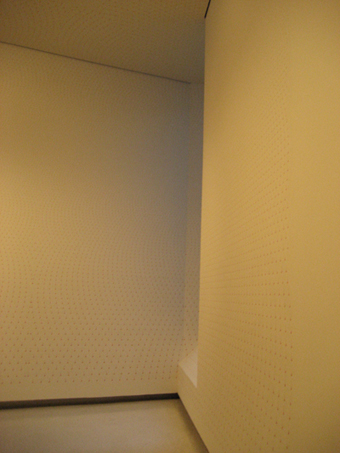
    Douglas: The idea of intimacy and immensity, which in my essay for the exhibition catalogue I talk about a quote by the French philosopher Gaston Bachelard, who wrote a book called The Poetics of Space. He talks about oceans that are both intimate and immense at the same time. Outer space is the same thing, in a way. And that idea–of the one individual grain of sand in the millions of grains of sand in a pile of sand, where you see the pile of sand but you also see the individual grain–that was something that a lot of the artists I was interested in were doing in a metaphorical, or even in a real way. In Richard Wright’s painting on the wall in gouache, there are thousands of little triangles that he’s painted on the wall. It’s a very intimate and a very ephemeral thing too. That painting gets painted out at the end of the show, it’s over.


    So as for the song, it’s funny. You choose artists and you put them together, and all of a sudden you start seeing connections that you never saw before. You choose a title and you don’t think about all of the implications, and then it becomes more and more interesting as you put the work together and you start to think about how you can interpret different works in different ways. One thing I always wanted to stress before the show opened was it’s not a show about science fiction. It’s not a show about space, even if that’s a great metaphor. But who knows–now we have Mars in Pittsburgh…

    Michael: Well, and the Bowie song is not really about science fiction either. I promise I’ll get off "Life on Mars," but I wanted to ask one more question about it. The first line of the second verse was very interesting as well. It was, "It’s on America’s tortured brow/that Mickey Mouse has grown up a cow…," which sort of takes the personal moment in the song and begins to politicize it a little bit. Was that also an influence on the show?

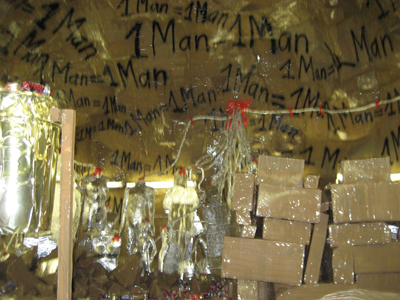
    Douglas: No, I would hate to push the show towards any sort of a political thing, because it’s not. There are individual artists who have a different take on things. The most so-called political artist in the show would be Thomas Hirschhorn. But he would say, "I’m not a political artist, I make work politically." It’s for him the formal stuff–using duct tape, packaging tape, cardboard, tinfoil, photocopies, everyday materials, very democratic materials–that’s really important. His piece "Cavemanman"–which has been seen in Minneapolis at the Walker Art Center a year or two ago so some of your readers might remember it–has a cave in the back, of the many caves that make up this 2,100-square-foot installation, that has scrawled words "1 Man = 1 Man." And that’s about as political as it gets, which is one person should never equal less or more than another person. It’s a very democratic ideal, and very much this sort of universal equation of ethics, I think, the bottom line that if you reduce ethics to an equation that’s what it is.


    So it’s not really a show about America, especially since only eight of the forty artists are American. It’s a show about the world and about a relationship to, I hate to say it, the human condition. That just sounds so pretentious, but it’s not about Hannah Arendt writing about the human condition. I think about authors who write very much about what it means to be a human. It could be a novelist too. I think a lot of these artists take this on in different ways. It might just be they’re using their hands a lot in the work, such as in the ceramics that Rosemarie Trockel makes, which refer to this domestic 50s furniture in a very modern, yet all-ceramic and hand-made way. They have that push-pull between the mass produced and the handmade, between the absent body and the body that’s supposed to sit on a sofa. Yet, you can’t sit on these things because they’re made of 200-pound ceramic objects.

    So, in the end, I think there are different worlds being evoked. You could make a case for Mario Merz’s work being political, and about the times. One of the last works he made is in the show, from 2003. It’s a set of newspaper stacks, and he took the newspapers that were just from the days around which he made the work, which happened to be right when the U.S. was going to war in Iraq. On top of that, it is a neon French phrase which says, "A roll
    of the dice will never abolish chance," which is the title of a Stéphane Mallarmé poem from 1896 or so–around the time, actually, that the International was founded. It’s a paradox, a symbolist poem that was also graphically designed across the page so that you would read it in multiple ways. You could read it very different ways depending on how you started reading it. It’s a paradox: A roll of the dice is supposed to eliminate chance, because that is chance. You roll the dice and then, boom, you get your, you know… Marcel Duchamp appropriated the phrase for a work he did as well. I think it’s very interesting and so open to interpretation: What does that mean on top of these newspapers stacks that happen to be newspapers covering the beginning of the Iraq War? I didn’t know the newspapers were from the beginning of the Iraq War when I asked to borrow the piece. I knew there were newspapers, I just didn’t know from when. These are all chance things that you can think about and keep yourself updated with, in an interesting way.

    Michael: A friend of mine saw the show and he actually used the word "apolitical," though I don’t think the show’s really apolitical since there are politics and social concerns in there. Did you consciously think you wanted to stay away from politics with the artists that you chose?

    Douglas: No, I studied international relations and political philosophy. The first section I turn to in the newspaper is the op-ed page every day after the front page. So, no, there are artists who make very didactic work. I’m not so interested in didactic work. I would say that Thomas’s work is the closest to that in the entire show, and it’s not that at all, in my mind. It’s so much not about that, it’s about the formal questions that come up in Hirschhorn very much translated to content in a very particular way. And so no.

    Actually, I think it’s very political, strangely enough, to do a show about the human condition. I think that if you want to do a show about issues, that’s a different thing, and I think kind of boring, quite honestly. The artists that I’m most interested in are the ones that are much more open-ended in their questioning, rather than didactic.

    No, I didn’t think "I’m not going to do a political show." In fact, the first essay after mine in the catalogue is Jonathan Swift’s "A Modest Proposal," which is a total satirical and political indictment of the English in 1727 of their occupation of Ireland. It’s a piece of satire and that’s where I think it becomes very interesting. When you have people writing things like that, which are humorous but also completely devastatingly political.

    Michael: And your essay also mentions Goya and [filmmaker] George Romero in a political-social context, which is interesting because those are quite stark, quite dramatic instances of very in-your-face politics that didn’t really appear in this exhibition…

    Douglas: Well, except so few people would read George Romero that way.

    Michael: Still, it’s a very stark and dramatic, black-and-white Zombie movie. There’s really nothing like that in this show.

    Douglas: And Goya’s work, his "The Disasters of War," was very political, but it was also dark and modern in its own weird way that was not didactic. The "Disasters of War" by Goya were very much political, because they done as prints and they could be distributed, but those black paintings they talk about–"Saturn Devouring His Children" and whatnot–those were never even meant for public consumption, yet they share the very same kind of dark look at the world as the "Disasters of War" did. I think that the essay is one more aspect of the exhibition, as is the catalogue, that is a separate thing, but it’s very much a parallel project. I don’t know–you look at Thomas Schutte’s work and you look at zombies, I don’t know that I would call that political, but I have to say Thomas is the one whose work I wrote about last year and talked about Jonathan Swift and he said "I love that essay." A lot of Thomas’ work is about taking apart the idea of monumentality. When you talk about the monument, he’s thinking of the political monument, the artistic monument, all these different ideas of the monument. And those zombie sculptures are taking apart his own work, his earlier works–the big ghosts. Except he is taking those apart and reconfiguring them.

    So, no, we’re not talking about John Heartfield anti-Nazi collages, but I think there is politics if you look at Phil Collins’ film. I think it depends on how you define politics. It’s an incredibly beautiful, incredibly human, incredibly heart-breaking film, really really beautiful, and probably the most sophisticated thing he’s done as a filmmaker, but it’s very ambiguous. In its cinematic qualities–the light, the camera, the way he directs the cameraman–in its content, in its stance, you know. This is a Serbian family living in Kosova, and they are seen now as the "bad people," but they were kicked out. So Phil didn’t want to go for the easy thing and just talk to the Albanians about the Serbian language. He went and talked to other people from there and about what happens with a language when it’s the official language and yet there’s another language spoken by the majority. What happens? Before he made the piece, the questions he wanted to ask people were, "Do you often accidentally reach for a word in Serbo-Croat, instead of Albanian? Do you accidentally dream in Serbo-Croat, because you grew up speaking it in school? Do you think of a folk song or start humming a folk song that was actually Serbo-Croat, even though you’re an Albanian and aren’t really supposed to speak it anymore?" It was a really difficult project for him to do, and I have to say that’s the kind of political inquiry I’m interested in, in terms of the art world–the investigating of those ambiguities. As Collins put it, someone told him, "What you’re asking people to talk about is very difficult. It’s like going to Israel after the War and asking people to speak in German. People who escaped." He said you’re asking Albanians to speak in Serbo-Croat, and we don’t speak it anymore. That’s a real brave act as an artist to go and take that kind of thing on. It’s a very textured piece, it’s a really beautiful film. If that’s not political in an interesting way, then I don’t what is. I think that relates directly to the kind of things I talk about in my essay in a very different way, because I hadn’t seen the film yet.

    I think there are lots of other things like that–from the Hirschhorn, to Mario Merz’s work, to Phil Collins’ work, to Mark Bradford’s abstract paintings that are political in a very different way. You could talk about it in very different ways depending on your point of view. Sometimes though there’s a lot of different work in the show. Sometimes, as Paul Thek said in the 70s, why can’t I just make a pretty, beautiful picture? There’s a level of engagement with the hand and the naïve sort of expression, child-like sensibility in his work. You could say that’s political. Peter Fischli and David Weiss recapturing the essence of what it means to be a kid, and the idea of play. That’s a radical gesture too in it’s own way. It’s not "we hate Clinton," or "we like whatever." It’s not didactic. I think contemporary art that’s didactic fails. I think it’s not interesting.

    Michael: One of my takes on the International is I found it much more interesting and affecting on a human, social, political level than the 2006 Whitney Biennial, which was filled with a lot of work that was very overly political, very angry, and, maybe, didactic. I wondered if that show was in your mind when you were putting this together.

    Douglas: Well, two of my friends curated that show, but the Whitney is its own animal. It’s all American, for the most part. It’s every tw
    o years; it’s one hundred artists, instead of thirty-five or forty. It’s a very different project. I’m actually one of the few people who liked that show. It got criticism I think for how dense it was, but I thought it was really interesting.

    The Whitney and the Carnegie are two of the oldest shows in America. The Carnegie is a really different animal. It’s international. It’s an older show. It’s also museum based, which is interesting because they’re very comparable that way, but historically the Carnegie always had about 35-40 artists, which is all you can really accommodate in any kind of serious way giving people enough space. I probably could have had 35 instead of 40 artists and given everybody a little bit more room, but when you put together a show you’re never quite sure how it’s going to fit together and you keep wanting more and you have to temper yourself.

    I think it’s just a different take on the world. I’m a different person. This is the show that I felt I needed to make, a different take about where we are now in the world. I do think, honestly, the choices I made were very political in their own way. I just would not call it didactic, I guess.

    Michael: I wanted to ask about the fact that a lot of critics of record have written in the last ten years of so about the declining influence of international survey shows like the Carnegie and the Whitney, in the face of the rise of art fairs like the Armory Show and Art Basel. How do you feel about this now that you’ve curated this show?

    Douglas: I think the Carnegie International is a very different show. It is its own animal. It’s the oldest international exhibition in the world, except for the Venice Biennale–by six months only. The way my methodology and thinking worked was, when I got the job, I thought how do you approach it? Are you going to do a survey show with one from column A, one from column B? I’m going to go to 500 countries and blah blah blah. Or do you think, OK, I’m going to have a spine and I’m going to try to build around it, because it’s just one show? I’m going to do other shows in the future, so this is not the be-all end-all. It has to be a show, so that’s why I gave it a title and had a certain idea about what I wanted to do.

    But, I don’t know, I think Venice will continue to be Venice. I think this show will continue on. I think the Whitney will continue on. Some of the small biennials might drop off. I think it really depends on who’s doing them. You know, I have no problem with art fairs. I learn a lot at art fairs, they’re great. I don’t want to go to all of them. The Basel Art Fair is happening this week and I’m not going because we have a board meeting, and it’s the first time in probably in eight years that I’ve not gone, and I’m kind of happy about it, it’s fine. I think the art fairs are a different venue. I do bemoan sometimes the overheated market for art, only in the sense–I mean I’m really happy that artists are able to make their living–but museums start to not be competitive. We can’t buy art. All these collectors, the François Pinaults of the world, are hoovering everything up before we can get to it, or we can’t afford it as a museum. That’s how I see these things in this market affecting public institutions, and all of these people wanting to start their own private museums. Of course this, I have to say, is what happened with the Walker Art Center and the Whitney. The Walker began as a private collection, and lots of other museums have as well. My hope for these institutions–these one-person museums–is that they do merge into or morph with other institutions. I just think that all of the institutions that we work in and the museums just need more help. It’s sad that people are founding their own museums when there are plenty of museums to help shape with your collections and your resources.

    Is the biennial going to die? I don’t think it’s even an interesting question. They seem to keep going, and Documenta is still happening, and Venice is still happening. The Tehrani Biennial and some of these other smaller biennials around the world, maybe they’re not happening as much. And people talk about "festivalism" and all this stuff, but the art world goes in cycles. I do think there is a place for these exhibitions. I don’t know that I want to do another one right away–a big group show. I’d like to do a nice monographic exhibition now.

    In the end, the art fairs serve their purpose, and as the market changes some of it might dry up. It happens, there are cycles. I’ve been in the business slightly long enough to see a couple of cycles. I started at the beginning of the 90s after the crash of 89-90, so things we really different then and I’ve seen the escalation of the art market and the biennials and all that. I think the Carnegie International will go on, I think the Whitney Biennial will go on. And I really don’t think those art fair are the proper way to see work. The bottom line is they’re fun to go to and look at new work, and sometimes you see things you hadn’t seen before, but it’s not the proper way to see work. I think there will always be a place for museums and these big exhibitions, especially the classic ones: Sao Paolo, Documenta, Carnegie, Venice.

    Michael: A question for folks back home, how do you think the Walker prepared you for this big grueling experience, and how do you compare your experiences here in Pittsburgh to your experiences in Minnesota?

    Douglas: First of all, the Walker prepared me better than any experience I could have had. I worked over eleven years there with other curators on shows, and then my own shows, which were smaller versions of this kind of a big group show. "Painting at the Edge of the World," "How Latitudes Become Forms," all these shows I worked on with my colleagues were smaller models of an international-type exhibition. Then, I worked with some of the greatest colleagues in the world there, in all different departments. It really let me figure out what I wanted to do. The catalogue for this show is a real testament to the Walker and the type of catalogues that I did there. We [the Carnegie Museum] don’t have an in-house design team, so I chose a designer recommended by the Walker design director. I really wanted to do a book very much like the ones I had done for "The Last Picture Show" and the "Edge of the World" that became a reader as much as anything else.

    Pittsburgh and Minneapolis are very similar. They’re very similar communities. They’re around the same size. They’ve had the same sort of economic reinvention in different ways over the years. They’re also both, pound for pound, incredibly acculturated cities. In terms of per capita, there’s way more culture here than there should be. It’s a testament to the two cities’ great level of patronage over a hundred years or more–from your T.B. Walkers and Pillsburys in Minneapolis, to your Carnegies and Mellons and Fricks here. Both of them are similar, nineteenth-century, philanthropy-based cities. I miss Minneapolis and a lot of things about Minneapolis, but I don’t miss the dead of winter, I have to admit. It’s really horrible to say. But I love Minneapolis. I try to go back a couple of times a year to visit, and I will always have a real soft spot for it.

    These are very similar cities, but this institution is very different from the Walker. This is closer to the MIA, because it has a department of fine arts before 1945, a department of contemporary art from 1945 and up, and also a great decorative arts collection and great architecture program, and we’re part of the larger Carnegie Institute, where we’ve got the Warhol Museum, the Natural History Museum, and the Science Center. So it’s a very different kind of structure from being in a completely contemporary institution, and there’s no performing arts department here or film department here like at the Walker, though there are lots of colleagues in town in those fields that I
    work with. The institutions are very different, but I feel as comfortable here as I did there. Having a director who is a contemporary curator and had done the International certainly helps a lot, because I feel like I have colleagues to talk–whereas I had six or seven to talk to talk to at the Walker. You have your run in a place like the Walker, and we did great stuff for eleven years. And during Kathy Halbriech’s time, her leadership there was amazing. I credit Kathy and Richard Flood for keeping me interested in being in the art world and eventually coming to this. They were really instrumental in my early career, and I thank Minneapolis for that. People in Minneapolis are as great as people are here. I felt comfortable the minute I stepped off the plane. It felt like a similar city.

    Michael: Do you know what’s next for you?

    Douglas:
    Well, this is next. I’m not going anywhere at the moment. I’m working on the reinstallation of the permanent collection. When the exhibition comes down, half of the galleries that we use for the International are actually our collection galleries from 1945 on–the contemporary galleries. So, maybe later this month or July I’m going to start planning for next spring, to reinstall the collection. We’re working on keeping the show going. I’m giving tours every other day still. I’m doing a lot of programs in the fall. There’ll be a lot more programming. I’m working on acquiring some of the works from the show for the collection. The reason the show was started in the first place, in 1895, was to build a collection of contemporary work from this exhibition. So, I’m busy right now. There are a lot of other things to do. I’m thinking of other projects we could do here in the future, and starting to get the schedule ready so we see when the next Carnegie International will be. It looks about 2012 right now.

    Michael: Thanks for your time.

    Douglas: You’re very welcome. Thank you for coming.


  • Oh Man, Look at Those Cavemen Go!

    On my first pass through the 2008 Carnegie International, the massive, just-mounted edition of the 112-year-old international art survey that runs through next January at the Carnegie Museum of Art in Pittsburgh, I eighty-percent hated the show. It started with the forced theme, "Life on Mars"–the first time ever that the show has had a separate title and theme–which seemed just a tad mundane for this event. Then it went to the somewhat annoying tagline questions listed on the marketing materials associated with the exhibition: Are we alone in the universe? Do aliens exist? Or are we, ourselves, the strangers in our own world? Is there life on other planets? (What’s this got to do with art?) And finally it passed to the bulk of the art itself–works by 40 artists from 17 countries–which had little to do with any of the upfront hoohah.

    But the hate pretty much stayed upfront. Some time before I finished my first walk-through two hours before it’d begun, I realized my initial impression was misguided. Beyond the buzz and spin, I came to appreciate that there were some eccentrically personal, intriguingly revealing, and beautifully intimate moments in this show. And so, once I much more slowly and purposefully passed through the exhibition a second time, I ended up eighty-percent loving the work in it. Having come to understand what these artists were quietly attempting to do–and not what the curator wanted us to think they were doing–I was occasionally enraptured and captivated by these artists’ eccentric visions and their personal and intimate practices.

    It’s tough to pinpoint a single moment or work of art that changed my outlook on the International, my response being more of a dawning revelation than anything else, but there’s no better artist in the show that I can think to mention than Los Angeles-based photographer/filmmaker Sharon Lockhart. Her work, a series of revealing, full-length portraits of children, each between 8 and perhaps 12 years of age, was tucked in a narrow hallway back behind an elevator and near the Carnegie Museum’s film auditorium. These were titled as a composite body of work Pine Flat Portrait Studio (2005), after the community where the kids lived and which the artist had visited to make the work. The setting for each photo was spare–black backdrop, gray concrete floor–but something about the positioning of the subject–pictorially, emotionally, and narratively–lent volumes of meaning to each image. These kids were rich characters, worldly wise and emotionally mature far beyond what they should have been. Their expressions, so raw and open, unguarded and direct in confronting our gaze, not only nearly leapt from the picture plane to grab the viewer but revealed personality types that reflected our adult awareness of the world back on us. Each of these images is much the same in presentation, yet each is wholly unique. Just to describe three examples, in one a Tom-boyish dark-haired girl stands, mouth set firm, hands folded onto her hips as if she’s just finished washing the dishes, in a slightly amused, just-show-me-the-money sort of pose. It’s the look of the girlfriend you’ve just disappointed for the umpteenth time. Another boy stands with a worried look, one uncertain hand resting on hip like a college professor’s, and one leg forward and slightly twisted in the eternally ennui-laden pose of the artist (the paint stains on his baggy jeans are a give-away). Still another, smaller boy with short hair and gritted lips, his wiry muscles showing through his tank top, has mounted his hands defiantly on his hips as if to dare you to knock him off. Something you said must have really pissed this guy off.


    Lockhart’s images are all fascinating character studies, but the value of this work is not in seeing kids reflect the souls of troubled adults. Rather, it is in several secondary realizations. The fact that these are kids is always, meaningfully apparent beyond their surface poses. One of the tough boxer kid’s high top sneakers are untied, for example, revealing the childlike vulnerability and innocence beyond his defiance in an almost heartbreaking way. The cynical girl–hard-set as her look is–still walks in summertime bare feet and wears a shirt with a sparkly butterfly embroidered on front. These sweet, sometimes sad, always intimate portraits reveal worlds to us about the spirit of our times–the ways a troubled culture can affect even the youngest among us–and give us pause to think about our own lives. (Other portraits include a tense young blonde girl in a "Freedom" t-shirt, a precocious boy with a fake tattoo on his art that someone drew in ballpoint pen, and another boy in camo-shorts with a toy rifle hoisted over his head). We end up questioning, while looking at these kids, and because these are kids, in a deep way something about our own vulnerabilities and susceptibilities in a world gone slightly mad. This is like finding catharsis from the Depression-era Little Rascals, if those kids had been, in keeping with our own modern depression, slightly bipolar rather than full of madcap mischief.

    The best work in the 2008 Carnegie International reflects intimate, eccentric, often uncertain moments even as it hints at deeper and vast problems in the society. This is art of the resigned, pitiful shoulder-shrug variety, not of the noisy (and perhaps useless) hammer-thud variety–such as what was on display in such blustery recent shows as, say, the 2006 Whitney Biennial. Many of the personal and intimate gestures of these artists are designed, in fact, to spill out over from the private mind into a public realm, perhaps like pond ripples or a zen butterfly’s wings flapping or other suitable metaphor. Rivane Neuenschwander’s "I Wish Your Wish" (2003), for instance, is a mass of brightly colored, foot-long ribbons stuffed into rows of holes that have been drilled into the gallery wall. On each ribbon is printed a wish, such as, "I WISH I COULD CHANGE SOMETHING." Visitors are invited to take a ribbon and asked to wear the ribbon on a wrist until the object falls apart, at which point (according to a Brazilian tradition) the wish will come true. Visitors are also asked to write down a new wish on a slip of paper and push it into the vacated hole that held the ribbon. The new suggestions will be printed on future ribbons. In this way, via a perfect circle of wistfulness and want, the people will speak their concerns, and then other people will make the sacrifice necessary to make those wishes come true. There’s something sadly beautiful about such a self-feeding circle of wish, even though, of course, it’s an entirely useless gesture in practical terms. Still, futile as it likely is, it seems just as good as any other system anyone’s ever devised to change the world. Same goes with Mark Bradford’s act, in a seeming homage to the futile efforts of New Orleans flood victims to find assistance from someone, anyone willing to help, of placing the words "HELP US" on the roof of the Carnegie Museum–presumably so the Martians can send us succor.


    That’s the thing about "Life on Mars." The work in it tends toward the useless, beaten up, or pathetic, and it is beautiful because of these aspects. Rosemarie Trockel makes useless, mock sleek-modernist furniture out of ceramic materials that, while inviting in look, is in reality hard and heavy and unpractical–a mockery of a person’s desire for comfort. Manfred Pernice creates a half-finished public works presentation of a mock highway br
    idge project, replete with half-painted vitrines, a highway diorama strewn with empty coke cans, pathetic photocopies haphazardly tacked to the wall, and a video monitor that is stuck on the start screen. Marisa Merz has made a lumbering, duct-system gone-awry, hanging sculpture out of pieces of old aluminum. It nearly fills a gallery space with a rough, hard-worn, and utterly useless beauty, looking like something pulled from the rubble of a collapsed modern high-rise. And Thomas Hirschhorn presents a survivalists’ grotto that has been created out of cardboard, packing tape, aluminum foil, and spraypaint seemingly by a group of twelve-year-olds.

    All of these things revel in their failed attempts to make something meaningful, useful, and helpful. Indeed, their very poignancy comes from the very failure of the human hand to make something worthwhile.


    There’s much more work in this show that, while not perfectly in keeping with my this theme of pathetic-but-beautiful human imperfection, is touching just for being somewhere between the small scale of human failure and the vast scale of preternaturally perfect. Vija Celmins’ small Night Sky paintings walk a line between uncomfortable human obsessiveness, and an absolute representation of the sublime abyss. Up close, the small touches and daubs of gray and off-gray paint on a blackish background fall apart into a tense battle with compulsion (each of these small works take multiple years to complete), while just a step or two away they seem perfectly realized visions of the ultimate beyond. Ranjani Shettar’s "Just a Bit More" (2006), meanwhile, is just as obsessive. Comprised of five net-like sheets of what look like green and blue beads connected by thread, on closer inspection these turn out to be hand-rolled and dyed daubs of beeswax the artist has fashioned herself. The surface effect is akin to seeing sea spray from a crashing ocean wave suspended in mid-air, but a viewer’s realization of the work the artist put into this evokes the harder, more humble notion of the common labors of humans to survive by hand fashioning tools like fishing nets. There are other instances of a human push-pull in this show: Haegue Yang’s beautiful geometric origami figures animated on a high-tech high-def computer screen to morph and merge into each other; Richard Wright’s massive gouache wall mural of a thousand directional triangle shapes spanning in curved grids from floor and onto ceiling; Richard Hughes’ strange wall painting of colors on top of each other that are then pulled back like torn wallpaper to reveal layers of color underneath in random patterns.


    The only down-note for me in the Carnegie International was the quality of the painters included in the show. Most of these five or six artists seemed, likely in keeping with the pathetic human quality of the rest of the show, to be very unsuccessful at their medium. Their painting in general lacked any real expressive craft, approached in a senselessly slapdash way–like a candy-color Francis Bacon, or a less self-aware Richard Pettibon, or a glorified children’s book painter. And, of these, only Paul Thek’s work was variously poetic and rigorous enough to overcome its lack of technical skill. Still, in the end, loving eighty percent of any show is certainly about as much as you can expect, especially when it’s a show as varied, as heavily marketed, and as highly anticipated as the Carnegie International.


    To learn more about what the curator for the Carnegie International was thinking as he organized the show, follow this link to "The Man Who Fell to Pittsburgh," a Q&A discussion between Douglas Fogle and Michael Fallon.


  • Come Join the Vicious Circle

    "That would be a good thing for them to cut on my tombstone: Wherever she went, including here, it was against her better judgment."
    -Dorothy Parker

    Over ten long, occasionally checkered, years as an art critic here in Minnesota, here’s one thing I’ve learned: Making your way in the world today, as a visual artist anyway, takes everything you’ve got. Upfront there are studio costs, exhibition costs, materials costs, opportunity costs, and the constant expense of keeping in coffee, cigarettes, and alcohol (although this last is probably true for most of us). And the money you get back from what you pour your heart and soul into creating is scant, at best. Mere pennies on the investment. And you know how valuable is a penny today, right?

    I don’t even begin to know how a person in this day and age sustains an artistic practice.

    Here’s another thing I’ve learned: The life of the art critic is no quiet afternoon at the corner bar either. You’re often up all night writing, even when you can’t pay your light bill. And your editor keeps telling you the check is in the mail; that is, when there still is an editor to report to, because you can no longer count the number of publications you’ve written for that have unceremoniously shit-canned the entire staff when you weren’t looking or else closed their doors altogether.

    Sometimes I wonder how in hell I’ve lasted so long doing this crazy thing called arts writing.

    And here’s another thing I have long wondered about: If we assume for a moment that we’re all–artists and arts writers–compatriots in the struggle to keep alive the dying, flickering light of artistic goodness in our culture, why, then, don’t we artists and critics get along better? Why aren’t we, at least metaphorically, raising beers to each other in the spirit of collaboration and mutual support for the cause? After all, we all have the same goals at heart, right? We all seek to advance the cause of art in Minnesota and to ensure the survival of ancient and honorable traditions that are much bigger than any single one of us? Right?

    Or, are we all, like everyone else, just in it for ourselves, and ourselves alone?

    Here’s what I know: I list these questions and postulations not to keep you up at night (as often happens to me), but rather to explain something about how we formulated our name for ourselves for this new visual arts blog, "The Thousandth Word," which you happen to have stumbled upon.

    We are six arts writers and critics (some of us also–as explained below in our brief bios–artists and art lovers, friends and neighbors). And we’re calling ourselves "the Vicious Circle," mostly because we acknowledge that the art world itself is just that: a Vicious Circle. No one is getting rich. No one is getting along much. No one seems particularly happy. And yet, our troubles are all the same. We’re caught up in this circle together, against our better judgment. And we all love it despite ourselves in much the same way.

    "The Vicious Circle" works as a name for another reason, because it acknowledges that sometimes, in the service to art, the critical person has to write somewhat negative reactions to what he or she has seen. A good critic simply, from time to time, has to be vicious. It’s part of the secret initiation to the club. Or as Groucho Marx put it, in regards to membership in the original "Vicious Circle" (which is how the Algonquin Round Table referred to themselves back in the 1920s): "The price of admission is a serpent’s tongue and a half-concealed stiletto."

    We are not in this to be mean-spirited, though; we’re art critics, not Sicilian knife fighters. Our goal is to address the art we see with only the utmost lucidity and honesty. And if anything we write lifts your neck feathers, you can always throw a few sharp comments right back at us. It will show you care!

    We hope, then, that you’ll come back often to read and engage with "The Thousandth Word." In the meantime, here are bios for the six writers of the Vicious Circle.


    Rich Barlow: Rich Barlow has an MFA in visual arts from the University of Minnesota. He works as an artist, arts educator, musician, curator, and fringe theater and music producer. He is a founding member of Flaneur Productions.

    Michael Fallon: Michael Fallon is an arts writer and arts administrator who’s written for more publications than he can count, really. But he’s proud that he’s been a member of the International Art Critic’s Association since 2000, and that he founded a local arts writers association, the Visual Art Critics Union of Minnesota (VACUM), in 2002. His other blog blatherings, and more about what he’s up to in his copious spare time, can be found at Art Happy Hour and the Chronicle of Artistic Failure in America.

    Glenn Gordon: Glenn Gordon is a writer, sculptor, and photographer. He was born in the Bronx, grew up in L.A., spent the sixties in Berkeley, lived for many years in Chicago, and moved to the Twin Cities about twenty years ago, working at many biographically colorful jobs all along the way. He’s written widely on architecture, sculpture, photography, woodworking, furniture, craft, and industrial design for national magazines and art journals, and locally for The Rake, Architecture Minnesota, Rain Taxi, and mnartists.org.

    Christina Schmid:
    Christina Schmid’s writing on the visual arts is informed by the years she spent at universities but seeks to go beyond the narrow confines of academic discourse. Her aim is to chronicle her encounters and experiences with contemporary art in order to render the process of meaning-making that art demands of its viewers both more accessible and transparent. She holds advanced degrees in contemporary literature, philosophy, visual and cultural studies from the Karl Franzens University in Graz, Austria and the University of Minnesota in Minneapolis.

    Andy Sturdevant: Andy Sturdevant is a Minneapolis-based artist, curator and writer whose work has appeared in ARP!, The Rake, and Bejeezus magazines, and on mnartists.org. He curated the History Room: 20 Years of No Name and the Soap Factory exhibition at the Soap Factory this year, and is currently working on an accompanying book about the gallery’s history. Andy is also a contributor to the Electric Arc Radio Show music and performance series, which is beginning a new season at the Ritz Theater in Minneapolis this fall.

    Collier White: Collier White is a writer and filmmaker who lives and works in North Minneapolis. He attended the University of Minnesota where he edited the newspaper’s film coverage. After freelancing for several print and online arts journals, he co-founded Object, an online pop-culture journal that garnered much acclaim before dissolving when he left for film school in Denmark. Since returning to Minneapolis, he has written for Ruminator magazine, City Pages and mplsart.com whil
    e continuing to write and direct short films.

  • A Picture is Worth 5,000 Years

    “A photo is all I have left of her,” Chris Lang, the boyfriend of murdered college student Dru Sjodin, told a Judiciary Policy and Finance Committee at the Minnesota House of Representatives. His testimony culminated with a heated statement about Level Three sex offenders: “They’re not like normal people. I think they’re wired wrong. They’re like animals. They need to be treated like animals, and animals are kept in cages.” The committee, including freshman legislator Cy Thao, remained impassive. Lang stepped down, and discussion moved on to child abuse, crystal-meth addiction, and other problems.

    “We don’t have time to do all the emotional stuff,” said Thao later that day, by way of explaining how legislators can seem inured to the personal horrors their legislation is meant to address. Capitol business is often conducted at a safe remove from emotional issues at hand, but that doesn’t mean Thao, who was elected to office in 2002, sometimes finds the impersonal nature of policy and politics hard to take. A thirty-one-year-old Hmong-American whose round face is accentuated by a close-cropped haircut, Thao came to politics by an unusual route, as a painter and former arts organizer in St. Paul’s Frogtown district. “Artists have to be passionate and emotional,” he believes. “When I’m painting, I put my emotions into it. That’s what drives me. But as a legislator, you’ve got to contain your emotion and turn it into strategies. You just have to focus on the policy.”

    When I met Thao several years ago, he attributed his political views to his college internship experience at the state Capitol: “I saw a lot of people who would only pay attention to people with wealth and people who knew the system. They just didn’t pay attention to the little guy.” Thao’s frustration with the system led him to add an art double major to his political science major while at the University of Minnesota, Morris in the early nineties, and he’s swung between the two ever since—much to his advantage. His stint some years ago as an organizer at the Center for Hmong Arts and Talent, an arts center on University Avenue, gave him skills crucial for politics: raising money, maintaining a grassroots organization, and conducting community outreach, as well as publicly addressing social issues through the Center’s theatrical productions and mural projects.

    Meanwhile, Thao confronts issues through his art that are anything but small, addressing such horrors that would move even the most impassive of observers. Fifty of his paintings will be on display at the Minneapolis Institute of Arts beginning May 21 in The Hmong Migration, an exhibit that is part of the Minnesota Artists Exhibition Program. In this series, Thao creates a compressed visual record of the troubled history of his people and his family.

    Using a technique that is simple, raw, and unpolished, with quickly applied daubs of paint indicating simplified figures and forms, Thao draws from both Hmong folk-art quilting traditions and an interest in the work of Jacob Lawrence. Each work in the series depicts an episode in the history of the Hmong, starting with their creation myth and ancient history and continuing through the culture’s dispersion and its struggles against China in the late 1800s, the French in the mid-1900s, and Communists during the American war against Vietnam and Laos. Thao focuses heavily on the aftermath of that war in works featuring long lines of families fleeing through mountains, across fields and rivers, and corpses left behind on paths or floating in water. In one particularly gruesome image, a Communist leader directs his soldiers to open fire on Hmong approaching a bridge, the passage to freedom in Thailand. Other images poignantly depict life in Thai resettlement camps, conjured from Thao’s memories of the four years he lived in one; and still later the series conveys the difficult move and adjustment to Minnesota, where Thao arrived twenty years ago.

    Thao had proposed exhibiting The Hmong Migration at the MIA before he was elected to the Minnesota legislature; it was a time when he had not yet learned to consider how the public or peers might receive his work. “An artist just wants his work to be shown,” Thao says, adding that he probably wouldn’t apply for an MAEP show now because of his work’s emotionally raw nature. “I have some worries because in that art there was no holding back. I wanted to address every important issue. As a state representative, saying one word out of context or choosing one wrong word can result in different meanings and bring different outcomes. When I painted, I didn’t worry about that at all. I just painted how I wanted to… But I think I will let the art speak for itself. If it hurts me politically, then it just does.”

    At noon, Thao abruptly leaves the committee room. Though the discussion on amendments to the Sex Offender Judiciary/Finance Omnibus Bill is not finished, Thao is unconcerned. “The decision on the bill was made back in February when the chair met with the governor,” he says, and indeed, voting on the amendments had been running on strictly party lines. Thao makes his way to the steps of the Capitol, where Ann Bancroft, the polar explorer, is stirring up a crowd of several thousand at a rally protesting the amendment to ban gay marriage. “Laws that discriminate are just plain wrong,” she shouts. “One thousand benefits received by married couples are not available to me and my partner, Pam. This includes education, health care reform… a home, for God’s sake.” The crowd cheers at her rising pitch, and Thao leans toward me. “She’s got it right,” he says.

    Thao has his own early experience with discrimination and prejudice; among the most poignant of his paintings are those depicting the trials that his family and other Hmong faced upon arriving in Minnesota in the seventies and eighties. Parents visit the welfare office with kids in tow; an assembly line in a large colorless warehouse is manned entirely by Hmong immigrants, with the only hint of the outside world coming through a single small door; teenaged Hmong gang members fight in the streets. One painting depicts the projects in north Minneapolis as a zoo-like maze. Barred windows are the most prominent feature on the plain brick buildings, and on a wall someone has scrawled: “Chink go home.”

    Leaving the rally, Thao passes a tall, young legislator just arriving. Thao asks if he is going to make a speech. The lawmaker gives a gruff “no,” without breaking stride. Thao laughs, and explains, “He’s one of the most conservative members of the House.” He is nothing if not feisty, having earned a reputation for passionately expressing his side of an issue—despite how futile it may seem in the current legislative atmosphere. Thao got into politics during the brief antiestablishment frenzy of the Jesse Ventura era. He had been peripherally involved in Ventura’s 1998 campaign, and so was tapped by the governor to appeal to the Hmong community for the 2000 election. “I figured this would be the only chance that a governor would help out our community,” recalls Thao, “and since no one else wanted to do it, I did it.” He gained national attention for a TV commercial, filmed by two artist buddies, in which he chased prostitutes and criminals from Frogtown with a broom. He also tapped artist friends to run the campaign—going door to door, painting a van, silk-screening posters by hand. Though Thao lost that election (by a surprisingly small margin), the strategies he developed worked for him in 2002.

    After an almost two-year hiatus taken as he learned the ropes at his new day job, Thao hopes to return to painting later this year. After his MIA exhibit, and after the current legislative session, he plans to begin a new series about America. “I think it will be interesting to see the history of this country from the point of view of an immigrant who was a product of American policy.”

    Thao had expressed concerns about a negative reaction to his exhibit, but I asked if his paintings might actually help his political cause. “It could work both ways,” he says after a pause. “Especially during this time when the country is at war and has invaded another country and is imposing its will on people who have no clue about us. My paintings speak to that. Their imagery is critical of misguided policies, regardless of which president the policy comes from. We have a bad foreign policy in this country… But I’m an optimist. If we don’t win this year, we always have next year.”