Author: Peter Schilling

  • And at its Center, A Confused Man

    thirdman1.gif

    The Third Man, 1949. Directed by Carol Reed, written by Graham Greene (with uncredited help from Alexander Korda and Orson Welles). Starring Joseph Cotten, Alida Valli, Trevor Howard, Bernard Lee, Paul Horbiger, Ernst Deutsch, Siegfried Breuer, Erich Ponto, Wilfrid Hyde-White, Hedwig Bleibtreu, and Orson Welles.

    With the person of Holly Martins, Graham Greene created a character I can relate to more than anyone else on the silver screen. Holly is:

    Lonely,
    Confused, and
    In Over His Head.

    Just like I am on most days. That’s one of the reasons why I love The Third Man more than any other movie.

    Just look at Joseph Cotten as Holly Martins. His loping gait, sour mug, his desire to come to the bottom of a mystery while at the same time failing to realize he will never get to the bottom of any mystery, ever. Look at him drinking, trying to bully those people who will not be bullied by the likes of him. Holly Martins: a fellow lost in his dime store novels who can’t do the right thing if was written on a bank note, locked into a safe and rolled over on him. Holly Martins: split into a million pieces, loyal to a friend he barely knows, just as easily in love with a woman he’s just met, ready to turn the world upside-down for a secret he doesn’t even come close to knowing.

    Holly came to Vienna to get hooked up with a job. Vienna is a lovely wreck, quartered in the wake of the Second World War, run by the Americans, Brits, French and Russians. It’s a city of great secrets, a city desperately trying to keep its head above water. Holly doesn’t know any of this, nor does he care. His old pal from school–Harry Lime, you know, the guy who could get away with anything–wants old Holly, the dime store novelist, to write propaganda for his medical organization. There goes Holly, full of spit ‘n’ vinegar, fresh off the train, walking under ladders, and then, whoops, dumbfounded when he hears his pal is dead, struck down by a car and carried to the side of the road by two men.

    The Porter of Lime’s apartment, informing Martins of Harry’s death: “He is,” says the Porter, pointing up, “how do you say, in hell?” Pointing down. “In heaven?”

    That’s bad. Holly has no money, no prospects, and since he dropped everything to come to Vienna, why, now what’s he going to do? Look at him, right there, standing at the funeral service, eyebrows furrowed, looking like the lovely dimwit that he is. Who can’t feel for this noble dope? He sees Lime’s girl Anna for the first time, falls in love with her in an instant. Major Calloway of the British forces is also at the funeral, feels sorry for the poor Holly, and asks him along for a ride to town and a free drink.

    Holly will drink all right. And then, when Major Calloway informs him that it’s probably to the world’s benefit that a rogue like Harry Lime is dead, Holly tries to punch the captain. And fails. In fact, Holly gets punched, shot at, chased, and bitten by a parrot. Worst of all, he falls as deeply in love as he is capable. All the while he can’t protect himself, can’t do anything but shadow box. And lose.

    Amidst the ruins of this once-great city, Holly bumbles around trying to get to the bottom of his friend’s death, which he believes was a murder. Government officials and evil henchmen in rabbit-fur coats and bow ties ignore him for the most part, both suggesting he should leave, but both realizing he probably won’t amount to much whatever his choice. Holly can stay or leave for all they care.

    He’s a hack writer who’s so oblivious he’s unable even to lecture a group of bookworms about “The Crisis of Faith”, even though that title sums up his situation perfectly.

    Like a hero from the cheap Westerns he’s moderately famous for, Holly goes in search of Lime’s murderer without bothering to consider who might get hurt or even destroyed. The more involved he becomes, the more trouble Anna gets into (for the fake passport Lime created for her). It takes hours of discussion and piles of evidence to convince Holly that Harry Lime was a monster, selling diluted penicillin for an outrageous price, a practice which maims or kills the young children to whom it is administered. When he’s convinced, he’s fully convinced… until the next day. Holly’s a weathervane, unable to see Vienna, unable to see Anna, unable to grasp anything. Look at him stumbling through the ruins of Vienna, her wet cobblestone streets filled with abandoned cars, half her buildings blasted apart. Notice the bent old woman straining to push an abandoned Merry-Go-Round for her child, who sits atop the plastic horse looking bored. The old man selling balloons–to whom? We see this and are moved; Holly can’t see past the end of his nose. And yet we’re still moved.

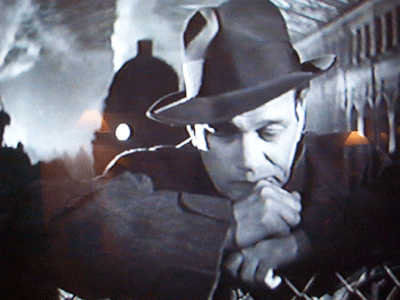
    Look at Holly there, leaning against a fence at the train station. He can’t save his girl from the forces of evil, from the lugubrious forces of bureaucracy, from the whims of her damned heart. “I could stand on my head and make all sorts of comic faces, and I wouldn’t stand a chance, would I?” he asks Anna. Of course not. For that’s Holly all over–a collection of parlor tricks, and when the shit hits the fan he’s bewildered and helpless. She loves an evil man, why can’t she love him? But Holly isn’t a good man or an evil man. Nothing he does in this film on his own works out; nothing he’s prompted to do does either. He gets his man, but at what cost? The reality is that Holly doesn’t even know himself.

    In the end, virtually no one was saved. In the final shot, Alida Valli marches toward the camera with a melancholy determination, right past Cotten, as the leaves tumble slowly around her. The black market still operates, children will live and die, Anna will grieve forever, and Holly’s work is as meaningful as those dead leaves. Holly just watches her go, and does nothing. After all, there’s nothing he can do.

    thirdman2.gif

  • A Miscellany After a Busy Weekend

    A long weekend and I’m still tired. Guests on the horizon–four adults, two children, and a pair of eight-month old twins–and I haven’t yet mowed the lawn, cleaned the house, or etc. Had the movies I sat through this weekend warranted discussion, you’d have a pair of reviews. However, they stank, so I’ll spare you the titles, and the details.

    What I have for you is a few links to other sites that have actually done their work lately:

    WellesNet, the Orson Welles web resource. Frankly, the guy who runs this amazes me–how he manages to post something new about the big boy (my favorite filmmaker in case you hadn’t guessed) nearly every day is baffling. Yet he does. Today’s entry is OW’s wonderful speech for receiving the American Film Institute’s Lifetime Achievement Award. The guy was eloquent, you have to admit.

    From one of my addictions, the New York Times Obits: Paul Gleason (Paul Xavier Gleason, to be exact) died, famed for playing Principal Richard Vernon in The Breakfast Club; as did Ted Berkman, who wrote Ronald Reagan’s fabulous Bedtime for Bonzo.

    In July I’ll be reviewing two of Preston Sturges’ great films, Sullivan’s Travels and The Lady Eve, which the Walker will screen in Loring Park this July. Check out the Sturges website in the mean time.

    That’s all for today. Over and out.

  • Guns and Flies

    proposition1.gif

    The Proposition, 2005. Directed by John Hillcoat, written by Nick Cave. Starring Guy Pierce, Ray Winstone, Emily Watson, Danny Huston, the foppish David Wenham, Richard Wilson, and the woefully underutilized John Hurt, and two of Australia’s greatest aboriginal actors: David Gulpilil (famous for Walkabout) and Tommy Lewis (from The Chant of Jimmy Blacksmith).

    Now playing at the Lagoon, instead of the Uptown, where they’re screening The Celestine Prophecy. Apparently, the finest films in the world don’t have a home at this Landmark Theatre.

    For those of us who love westerns–and I count myself amongst that forlorn group–The Proposition is as welcome as, well, as welcome as a the ghost of Sam Peckinpah in a lonely Montana hotel on a cold evening. Like old Sam’s best movies, this one is dirty, has vile characters, bucketloads of extreme violence, a morally compromised society, and gorgeous photography. Not to mention a decent script that sometimes falters but nevertheless serves its masters well. Like the films of Sam Peckinpah, this one’s being criminally neglected, shuffled off to the shoeboxes at the Lagoon theater, waiting to vanish like a bad dream.

    Even better, The Proposition doesn’t soak itself in Peckinpah’s drunken machismo, has a sharp female character who is not simply a whore or a saint.

    The facts: Captain Stanley (played by Ray Winstone, whose tense performance almost gave me a headache) and his scurrilous crew blast apart a brothel in order to apprehend half of the infamous Burns gang. After killing scores of prostitutes, the captain gets his men, Charlie and Mike Burns (Guy Pearce and the angel-faced Richard Wilson). Stanley makes a deal with the intelligent Charlie: if you go into the outback and murder your brother Arthur, the maniacal leader of the wicked clan, then the baby, Mike, won’t die at the hangman’s noose. Charlie accepts, is given a gun and a horse, and makes his way into the unforgivable desert.

    Nothing, of course, can go right. The Proposition cuts between the two societies, that of the criminal in the desert and the face of law and order in the town. But the Captain has troubles: his men, as rotten as the criminals they pursue and nearly genocidal in their attempts to rid Australia of aborigines, don’t trust him; his wife (played by Emily Watson, a beacon of cleanliness and clear morality in this wasted land) seeks justice for the murder and rape of her best friend (at the hands of the Burns gang); his superior Eden Fletcher (played by David Wenham, whose lispy performance is ridiculous, the only weak spot in this fine film) is after him to get results, and eventually disrupts this proposition by having the feeble Mike Burns flogged to death.

    Nick Cave’s screenplay is nice, even as it threatens to slog into Cormac McCarthy’s He-Man Spiritual Territory. I might also add that Cave’s soundtrack is astounding, and should be required for future westerns. But I digress: the menacing Arthur burns, played with one of the great slow-burners in Danny Huston (John’s grandson) is simply fabulous–a philosophizing bastard who stares at sunsets and ruminates on love and family. John Hurt is along for the ride, acting with the subtlety of John Lovitz in his Subway ads, but it’s great to see the old coot brandishing a gun, snot dripping from the end of his nose. The film is relentlessly dirty, and insects are everywhere, crawling on men and women, biting and buzzing.

    One could argue that The Proposition is a study of the madness of society versus the madness of family. For the Burns’ clan is, indeed, a close-knit family who might even be said to love one another. Captain Stanley’s little town in the middle of nowhere is a civilized place, where no one trusts one another and deceit is the first order of business, as long as everything is in its place. But the Burns’ are vile creatures, rapists, murderers, and in the final analysis, no one emerges clean and clear and unwounded.

    The Proposition is a film you could analyze until the dingoes come home, and in doing so find scores of little contradictions, mistakes, and etc. It’s not a perfect film, but for the lover of the western, it is perfectly entertaining, provided you can stomach some its violence. I could, and would see it again.

    proposition2_.gif

  • "This F'n Vaseline Thing"

    For those of you who are still reeling from Matt Barney’s Drawing Restraint 9, I have just the thing for you: tonight at the Walker Art Center they’re showing the documentary Matthew Barney: No Restraint at 8:00–and it’s free (provided you get there on time–tix available at 7).

    Quite frankly, this documentary is, in my mind, more entertaining than the film itself. Barney talks with his ‘aw-shucks’ Idahoan accent, and there are weird public access television shots of Barney the high school football player–who woulda thunk? Also, there’s some great commentary by the very earnest captains of the whaling company and their baffled crew. The director, Alison Chernick, made a similar feature on Jeff Koons, who I personally consider the worst artist ever walk the face of the earth, so you also get heaping platters of pretension from gallery owners in NYC (though no critics). Nonetheless, the film is a winning companion to the wacky film. My only complaint is that they weren’t showing it before I sat through DR9.

    The titular quote, by the way, is from Barney himself.

  • Conversations Real and Imagined: The Puffer Ship of My Heart

    maggie1.gif

    The Maggie (High and Dry), 1954. Directed by Alexander Mackendrick, written by William Rose. Starring Paul Douglas, Alex Mackenzie, Tommy Kearins, Hubert Gregg, James Copeland, Abe Barker, Andrew Keir, and Meg Buchanan.

    Quite possible the only place to get this remarkable movie is at Netflix.

    Did I ever tell you the story of when I first saw Alexander Mackendrick’s The Maggie? This was ages ago, when I was still in college, still wasting my time hungover, eating cold Whoppers first thing in the morning (two for two bucks meant breakfast, too), still thinking I was better than everyone else, you know, smarter, cooler, wiser even at twenty-two. A jerk, basically, so I still find it incredible, even to this day, that I actually paid attention to this lovely little film and came away feeling like I’d been keelhauled. Emotionally.

    I used to drag my sorry ass down to a funny little bar called The Pickle Barrel nearly every day. The Barrel was the only place near my Midwestern campus that didn’t have a television. They had a jukebox that was friendly to anyone who had decent taste: aside from the usual standards (Doors, Beatles, Creedence), you could find Beat Happening, The Breeders, and, at my insistence, all four of the Feelies albums. Inexplicably, there was also Tom T. Hall’s Songs of Fox Hollow, whose track “Sneaky Snake”, the neighborhood mailman used to play after a half-dozen Anchor Steams. The Barrel was relatively quiet, with dim lights that had the soft, waxy glow of gas lamps and a bar-sized pool table in the back. The place was run by an old fellow named Hickory who used to drive truck for a chicken factory, a job he used to describe as “the worst job an American could have”. That was why he didn’t serve chicken sandwiches in the place, because of that “feathered holocaust”. They did serve the best hamburgers in town, and, in the mornings, the worst doughnuts–deep fried in the same grease as the prior night’s onion rings.

    The place was owned by one Jack Sullivan, a guy who’d made his fortune in real estate and rentals. He owned a pair of strip malls with high turnover, the usual head shops and comic book stores, beaderies and sub shops that pop up like dandelions near any campus. I once rented an apartment from him, a dingy place with a carpet in the kitchen that smelled like feet. The Pickle Barrel was in the middle of Sullivan’s empire, and was, in fact, owned by the man himself.

    Mr. Sullivan took all his meals at the Barrel, four doughnuts and the Barrel’s hideous coffee for breakfast, a basket of fries and a diet tonic water for lunch, and a Swiss cheese burger and a Miller Lite for dinner, followed by his four cigarettes. He used to suck down three packs a day, Hickory once told me, but cut down to four smokes a day after the death of his brother. All four at night, while the lonely Sullivan sat and listened to the ballgame on a headphone radio at the end of the bar. He would not ask for the music to go down, or anyone to be quiet. “Sully knows it’s not guys like him that keep this place afloat,” Hickory said.

    So Sullivan never appropriated The Pickle Barrel except once: on a balmy May evening some twenty years ago, now that I think of it. I should tell you, too, that we used to have some fun at Sullivan’s expense: the guy was roly-poly, seemingly unmarried, none too friendly, and as a landlord could be a real dork–he once asked me to hang a plastic Santa Claus on my window one Christmas because it would cheer up the place–I did, and thereafter had to suffer through baubles for every holiday, from St. Paddy’s day to Easter to a black curtain over the door on Memorial Day and a Spanish flag on Columbus Day.

    This May evening, some pals and I were hungry for some beer and grub and irritable that the patio of The Barrel was packed, and would be for some time. We settled down inside and grumbled at the silence, and I made my way to the jukebox only to find it unplugged. “Sully’s going to show a flick tonight,” Hick told me. Sure enough, there was a screen and a little projector in the back, and a pile of six movie cans on a table, next to a pitcher of diet pop.

    “Shit, does that mean no talking?” I asked.

    Hick shrugged. “It’s not my place.”

    So the lights dimmed to candle strength. Hick had taken down the large oil painting of the Liberty ship he used to sail on and hung the screen–acutally, just a plain bedsheet–and Sullivan got the show on the road. A shaft of light with smoke, and the crunch of peanut shells, the tinkle of glasses and dim conversation filled the place. With the credits my pals and I were really laying into it, with its silly Scottish jigs meant to lighten the jowls of every Englishman. I perked up at the sight of Alex Mackendrick’s name on the credits: he’d helmed Sweet Smell of Success, an acrimonious film of the highest order, a classic amongst bastards like myself and my friends. So we shut up for a moment, and watched.

    Well, The Maggie wasn’t like anything I’d ever seen. It was goofy and sentimental, hilarious and ultimately heartbreaking. This coot, Mactaggart, has this old puffer ship that chugs along the rivers of Scotland hauling freight and in violation of every British naval code there is. They get the hammer dropped on them right at the start, told that they’re not seaworthy any more. As fate would have it, they manage to get in the right place at the right time, and end up hauling a rich American’s cargo to a distant Scottish Island. The American realizes his error and tries to stop the ship, eventually boarding it at one point, and hilarity ensues.

    Only it doesn’t. As The Maggie rolls on, the scenes of unchecked chaos become more and more heartfelt. The three men and the bowl-cut kid (we actually see the haircut) are really down on their luck; in fact, they don’t eat well and are as crotchety a group as you’ll likely see. But the heart of this amazing film, what got me while I was sucking down yet more beer, was Paul Douglas as the American. Douglas, I found, played heavies most of his life, finally freeing himself from the choke-hold Hollywood put on him, only to die of a heart attack at a young age.

    Douglas, as the American, is going to learn a lesson for sure–he’s hauling tons and tons of supplies to build a dream house for the wife he’s neglecting. A bundle of nerves, he seethes and argues, threatens to sue anyone that laughs at him, all the while slowly becoming enamored of the little ship.

    The drunker we got, the more we started laughing at this lovely little film. Everyone in the bar would sit and chuckle, whoop and applaud, at various points shouting toasts the crew of The Maggie after squeezing out of yet another scrape.

    Toward the end there’s a scene I’ll never forget: Mactaggart is ignoring his duties, and has docked the Maggie in a small town in order to celebrate Davy Macdougall’s hundredth birthday. The American watches from the shadows as the townsfolk celebrates the life of this cackling little blind man. And then, without bluster, without fanfare, he’s invited inside, and simply dances with the lovely Scottish girls.

    Douglas didn’t miss a beat. Later, he asks the young girl he danced with about her two suitors. One is a simple fisherman, not so handsome, who goes out with his brothers on the boat; the other a handsome young man who owns a store and is about to buy the other. It seems, says the American, that the choice is obvious: the latter will give you whatever you want, and is an ambitious young man who will go places.

    True, replies the girl. But I’ll go with the other, because when he comes home, she says with a wistful sigh, he will think only of me and not his future.

    There is virtually no catharsis in The Maggie, no sense that the men who run the boat will be spared the encroaching changes of post-war Britain, or that the American will salvage his marriage. In fact, one gets the distinctly opposite feeling–and when the last reel flipped to an end, filling the Barrel with a harsh white light, there was a long silence.

    Mr. Sullivan relooped the film and began rewinding each reel. He appeared terribly pained, clearing his throat every now and then. The sounds of the bar quickly rose again, and he nodded to turn the jukebox on, which blared “Fly Like An Eagle”, which grated on my nerves. But I was curious as to where old Sullivan found this movie, and what he thought of it.

    “Good movie,” was all I said. He didn’t answer, so I pressed on. “What is it you liked about it?”

    “I don’t like anything about it,” he told me, while clearing his throat halfway through that short sentence. “It’s a piece of crap.”

    “Piece of crap? I loved it. Why would you show it if you thought it was a piece of crap?”

    He gathered up the cans under each flabby arm, grunted, and said, “You kids never pay attention to anything.” As he walked out the bar he shook his head, and kept clearing his throat.

    “Six!” Hick said as I ordered another beer. “Guy smoked six cigs tonight, instead of the usual four.”

    “Said he hated that movie,” I said.

    “That’s what he always says. But he must’ve paid a good penny for it, and the projector. And he shows it here every year for the last four years. Last year, I swear I saw a tear in the poor man’s eye. Something about it gets to him. Gets to me, too. It’ll hit you when you get older. If you ever see it again.”

    Mr. Sullivan died a few years after I left school, and he left Hickory the bar. Hickory still honors him by showing The Maggie once a year. “When Sully died there was a note in his will that I got the movie, and instructions simply to keep it in one of those mini-fridges he also left me. I guess if you keep the film cool it’ll last. I didn’t have to show it, didn’t have to watch it, just keep it. If I got tired of it, he told me to find someone who would appreciate and care for it. But I show it every year because I like it.

    “I don’t quite get the thing, except to say that it hurts when it’s over, like the good ending isn’t quite there. Over the years there’ve been some weird reactions–one guy calling it the worst thing he’s ever seen, another woman bawling because of a throwaway line from one of the crewmen, something about being hungry all the time. Some people dig the boy, others the American. I like the old man. Every year it’s something different. That little puffer ship really gets to people.”

    maggie2.gif

  • Two Fisted Laff Fest!

    davinci.gif

    The Da Vinci Code, 2006. Directed by Ron Howard, written by another embarrassing Academy Award winner, Akiva Goldsman. Starring Tom Hanks, Audrey Tautou, Ian McKellen, Paul Bettany, Alfred Molina, Jurgen Prochnow, Jean Reno and Etienne Chicot.

    If there’s one thing I never would have guessed, it’s that Ron Howard had such a preposterous sense of humor. The Da Vinci Code is quite literally the funniest movie of the year, a comedy in the grand tradition of Cecil B. DeMille’s laugh riot The Ten Commandments. See it at your own risk: you’ll be doubled over with laughter as I was, beaten senseless by a never ending stream of jokes, hilarious performances, and a musical score that just never lets up. Amazing!

    The story is as goofy and convoluted as anything Monty Python has conjured up. Professor Langdon (Tom Hanks), a Professor at Harvard’s famed Department of Symbology is in gay Paree lecturing on–what else?–symbols. Earlier in the day, a fellow educator he was supposed to meet for drinks is shot and killed in the Louvre. The assailant, a grey-eyed albino monk–a telling nod to the albino killer in that 70s classic Foul Play–manages to get into this unsecured little museum and shoot this poor, aged curator. In his dying moments, bleeding from a wound in his gut, this curator, a very old man, manages to walk clear across the Louvre, hide a giant key behind a picture, head over to the Mona Lisa and deface her with a clue written in ink that glows under a flashlight. Then, he shuffles back to another section to write more notes with this fabulous pen of his (don’t all curators have one?), undress, draw a circle that surrounds his soon-to-be-dead body and a star on his chest, both in his own blood. Then he’s able to lay down in a pose similar to the Vitruvian Man and finally die.

    Langdon is brought to the museum by police Captain Fache (Jean Reno, so bellicose you can almost see steam screaming out his ears), who has been tipped off by a priest, and is trying to nail the professor for this murder. Along comes Sophie (Audrey Tautou, as earnest as Bambi’s mother), who is herself a cryptologist with a secret–the dead man is her grandfather! Mon dieu! Director Ron Howard, with his usual light touch, gets Sophie and Langdon out of the clutches of the evil Detective Frenchie, using a cell phone, a beeping transmitter thrown into the back of a trash truck, and the general incompetence of the French police force–this time a loving wink to the great Pink Panther films of the past.

    Glorious filmmaking, this! While Sophie and Langdon race around the Louvre discovering the invisible ink clues, we’re given such comic gems as–

    Sophie: “This is an anagram!”
    Langdon: (With a scowl) “An anagram is right!”

    Whooee! Did I mention the backstory? I didn’t! Langdon, for his part, fell down a well as a child and now can’t stand to be in elevators, airplanes, the back seats of cars, or locked tight in an armored truck. That is, until Sophie rubs his head, and then years of anxiety melt away. Sophie, on her end, lost her entire family in a car accident, when the folks inadvertently plowed into a semi, thus proving that foreign vehicles don’t have the crisp turning power of their American counterparts, at least as the ads portray them. Sophie and her grandfather lost touch over the years, but you find that she’s been carefully trained to dance and sing and solve puzzles–all of which will be of great use in the next 24 hours!

    Next, we see that this is all a part of a conspiracy mounted by the dyspeptic souls in the Opus Dei, a secret group that spends its time shooting pool in the Vatican and wearing sour faces. One of these wicked priests is played with suppressed gusto by the great Alfred Molina, who is the puppet master for Paul Bettany’s wonderfully sadomasochistic albino monk. This homicidal padre whips himself, flares his nostrils, grits his teeth whenever he’s got someone under the knife, and bleeds all over himself from chains he’s got ground into his flesh. John Cleese couldn’t have played him better.

    Oh, the plot just keeps getting better, as this maniac chases after our heroes (not before killing a nun by whacking her upside the head–I think Dan Brown has some issues). Eventually, our heroes find their way to the castle of Sir Leigh Teabing (Sir Ian McKellen), another symbologist who also happens to belong to the Knights Templar, some group of nuts whose job it is to watch over the corpse of Mary Magdalene, the wife of Jesus H. Tapdancing Christ.

    Did I let that out? That’s one of the big secrets of The Da Vinci Code, the one that has the church down my block seeing red. Ron Howard sends this thing up wonderfully, with Sir Teabag jousting verbally with a baffled Langdon, whose own character slowly begins to resemble Scooby-Doo’s square Fred Jones, or perhaps a Hardy Boy with long, flowing locks. Anyway, Sir Teabag has this computerized big-screen version of Da Vinci’s “Last Supper”, which proves beyond a reasonable doubt that Jesus was wed to Magdalene and sired a child, the descendants of which are, in reality, the Holy Grail. You can see this because the guy to the left of The Christ (to use Mel Gibson’s vernacular) is not a guy, but a woman, Magdalene, who also, when shifted electronically to Jesus’ other side, looks as if she’s whispering secrets in his ear.

    If this sounds like something the bearded crackpot shouts from the dusty streets of Life of Brian Jerusalem, you’re right. Such is the genius of Akiva Goldsman’s screenplay–only he could have topped the sheer madcap humor of his Oscar-winning Beautiful Mind. Eventually this tomfoolery will lead to someone from the present day being a Christ descendant, which can be proven by doing a DNA test, apparently from the shards of Christ’s body we have laying around.

    By the way, this is only about the halfway point of the film. Suffice it to say, the film grows even more bat-shit crazy, as all good comedies must. It doesn’t quite close with the Python’s habit of abrupt endings, and it gets a bit long in the tooth, but eventually everything works out and someone is discovered to be Jesus’ Great-Great-Great-Great (and etc.) Grandchild. There’s more silly gadgets and gimcracks, some of which were designed by the great Leonardo of Vinci, others by the obviously bored Templars. All the while this past history is recounted, Ron Howard takes us back to the time of Constantine and his hippie dancers from “Hair”, bewigged fat people stumbling into London churches to celebrate the death of Isaac Newton, and witch hunts which just make you want to yell out “She turned me into a newt!”

    Finally, in one wonderfully delirious moment, in a church filled with glowering gargoyles, another ‘surprise’ evil bastard (you can tell from the snarls, but I’ll let you figure it out) points a gun at our heroes and declares “I’m glad this bullshit is over!” Aren’t we all. Of course, the bullshit is far from over, as a swarm of pigeons will upset his plans, and our heroes will race, yet again, through another foreign capital, eluding evil butlers, albino monks, glowering Opus Dei priests, bumbling French cops and squinting modern-day Templars who seem to enjoy plaid.

    Ron Howard clearly pulled out all the stops in making this a comic masterpiece to surpass It’s A Mad, Mad, Mad, Mad World. Like all classic satires, this one does a mighty fine job of skewering the church, new agers, long-haired adventurous Harvard professors, and those feisty Opusmen and Templars. These are not easy targets, especially since most of us don’t even know who they are, unless of course we’re trapped at a coffee shop with some wide-eyed kook who insists upon bringing you up to date on the latest Christian conspiracy. But I digress–The Da Vinci Code deserves a place in the annals as one of our finest comedies, a perfect double feature with either of the Python flicks and a some great recreational drug.


    Drawing Restraint 9
    , 2006. Starring Matthew Barney, Bjork, Rumi Tsuda, Shigeru Akahori, Sosui Oshima, and the crew of the Nisshin Maru.

    Now playing exclusively at The Lagoon.

    Again I’m bowled over: Matt Barney, the Idaho-cum-Gotham artist, got it though his head that you could stage a comedy upon, of all things, a Japanese whaling ship. In Drawing Restraint 9 you have perhaps one of the most controversial occupations on earth, and Barney proceeds to drag his spouse, Bjork, and himself on board along with hundreds of gallons of liquid petroleum jelly that hardens to make a big, greasy pile of nothing. All the while, he and Bjork do some crazy tea-drinking (oh, and what kind of tea it is!), and then cut their own legs off and become a whale-like thing in what I think is more liquid petroleum jelly.

    The crew of the Nisshin Maru does its level best to keep a straight face, at one point resorting to downing a barrel of sake to keep from falling over in tears. They also eat some gelatin that comes in the shape of the Vaseline sculpture and ignore both an on-board clown and a Japanese girl who spits out ball bearings (with quite a dollop of saliva, I might add). Children play with whale barf. Bjork gets to ease her generous bottom into a giant metal tub with lemons, while Barney, looking thin as whip and in his Levi’s, gets his hair cut by a drunken barber while he sleeps. Laurel and Hardy couldn’t have made better slapstick!

    Drawing Restraint 9 is not for the faint of heart, not because of the gore–which is as funny and innocent as the Black Knight scene in the Holy Grail–but because that type of condition would lead one to fall into a deep sleep during this rather long film. It’s funny, don’t get me wrong, but funny in a sort-of pseudo intellectual style. More The Magic Christian and less RV.

    For those of you interested in an experts opinion on this movie, the Walker’s going to have a free screening of Matthew Barney: No Restraint next Thursday. Undoubtedly, there will be some wonderful footage from the film and comparisons between this work and the works of other comedians.

    restraint.gif

  • Rake Appeal { Sweet Spot

    There is probably no more beleaguered building in all of Minnesota than the Hubert H. Humphrey Metrodome. If there’s one thing both sides of the stadium debate can agree on, it’s how hideous the place is for baseball. Nevertheless, in its twenty-four years, Minneapolis’ “Rec Room” has become surrounded by a nebula of strange little shops, odd industrial enterprises, and food vendors on game days. It is precisely these places that make the Metrodome area so promising to the meanderer.

    A casual walk through the area—the Dome peeking through gaps between buildings, like a mad scientist’s cloud floating through the city—reveals a pleasant mix of old industry, inner-city churches, the greenery of Elliot Park, government buildings and, to the north, the now-artsy Washington Avenue strip. You get places like the Justice Center, where a couple was recently wed by an ex-soap-star-turned-Ventura-appointed judge, and the eye-popping rainbow mural on the Valspar Building, by Peter Busa. There’s even three white clapboard homes with unkempt lawns. This section of the city is a reminder of the days when the game of bat and ball was considered blue-collar, attracting beer drinkers instead of cocktail sippers.

    It is also a pleasure for the greasy-spoon connoisseur. Hubert’s, the famed meeting spot for football and baseball fans, has a fine menu, offering what is perhaps the city’s best BLT. And for eighty-one days during spring and summer (and into fall, if the Twins are lucky) you can lay claim to a wax-paper tray of cheese curds or a corndog dripping with ketchup on the plaza outside the stadium, aka Kirby Puckett Place. Vendors hawk their wares, straining their voices over the pre-recorded train whistle that signals the light-rail train, and you can admire the man whisking cauldrons of hot kettle corn like a modern-day Vulcan. There are children everywhere, goofballs with their scorecards, vendors hawking those scorecards, and crazy scalpers buzzing around like bees in a dumpster.

    Crackpots abound on game days. The Metrodome attracts all manner of street musicians, for example. Just the other day, a guy was scraping a bow across his violin, turning “Take Me Out to the Ballgame” into a spine-tingling affair. There are fireworks. Police officers loaf about with assault rifles in plain view. These are to keep terrorists at bay, for “guys with weapons of mass destruction and stuff,” as one officer put it.

    You can also stop into the musty Dome Souvenirs Plus, owned by Ray Crump, a man who’s also running a museum out back. The Original Baseball Hall of Fame Museum of Minnesota is made of equal parts Twins memorabilia and celebrity photos. Of these, there’s a plethora of country-western singers, from Tom T. Hall to Porter Wagoner, and even a disturbing picture of Ray and his wife with a topless Hank Williams Jr., who lounges not-so-seductively on a cheap motel bed.

    Vikings owner Zygi Wilf has pledged that, should the football team get its new supercomplex in the burbs, he will redevelop the area. But for what purpose? The Dome seems to be the area’s sole raison d’être—aside from, maybe, the few who still punch time clocks over at Valspar Paints. Nevertheless, it’s inevitable that the Metrodome will go the way of Met Stadium or the old Armory, just three blocks west. When it does, the vendors, street musicians, and Ray Crump and his wall of heroes, will probably dry up and blow away, like empty peanut shells.

  • Hollywood Hit ’n’ Run

    Though it now seems long ago, it’s only been a few weeks since a brace of bona fide Hollywood stars descended on downtown St. Paul. The city was abuzz with famous people and the regular folks who admire them, but nothing rivaled the enthusiasm of the international, domestic, and local press. Since this was, after all, the national premiere of a major motion picture, a full-scale, Hollywood-style press conference was set up inside the Saint Paul Hotel. There were dozens of lensmen, talking heads, beat reporters, stringers, and hacks in attendance. There were big-timers from organs like People magazine and the Associated Press.

    Lori Barghini and Julia Cobbs, the “Drive Time Divas” from FM-107, immersed themselves in the press pool. Comporting themselves as unofficial ambassadors of the Twin Cities, they flitted around the ballroom, welcoming newcomers and sizing them up for gossip. There was a hunky, bed-headed guy from Le Journal de Montréal, and a sharp cross-dresser in a pinstripe suit and black beret—Daisy D, a personality from the Deco Drive show on a South Florida Fox TV affiliate, who was once scheduled to wrestle Tonya Harding. While Julia chatted up Mr. Montreal, Lori offered an enthusiastic early report. “Over there,” she said, gesturing to a section of apparently special attendees who were not obligated to wear press badges, “that’s Mark Singer from the New Yorker. He was really reluctant to tell me who he was.”

    She pointed out a number of bewildered Canadians, some looking bored and others looking like they were ready for a drink. “Minnesota Daily,” she said, gesturing toward a shy, bespectacled redhead with a messenger bag, sent by the University’s student newspaper.

    At last the stars sidled in, to much applause. “It was wonderful … enjoyed it … learned a lot,” said Lindsay Lohan of her experience working with so many esteemed and much-older actors. “ … fun … tremendous fun,” said Meryl Streep and Lily Tomlin. “… hard to keep a straight face … we were all having so much fun,” said Kevin Kline. “ … I don’t expect to have that much fun anytime soon,” said Garrison Keillor.

    That hint of merriment from the notoriously stoic host emboldened Diana Pierce. “What are you feeling today? You must have quite a lot of emotions right now!” Keillor shrugged. A friendly cajoling ensued and the KARE-11 anchor pressed her advantage. “It’s a historic day for you—and for Minnesota.”

    “Minnesota was admitted to the Union?” Keillor asked. Pierce tried a different tack. At least it was a “big” day, right? The stars, the red carpet, the horse-drawn carriages. “It’s a big day for the horses,” he allowed. Pierce was not backing down. But what about him? “Today is a big day in downtown St. Paul,” Keillor said with a gravity that indicated her time was up.

    Bill Carlson, the elder statesman of WCCO, had the honor of asking the last question. In stentorian tones, he gave a preamble in which he mentioned “motion pictures” several times. Ultimately, he demanded to know, “Was this not one of the most enjoyable experiences you’ve ever had making motion pictures?” No one dared disagree.

    Later that afternoon, Wabasha Street was lined with folks waiting to see the stars in their carriages. The crowds were thickest in front of the red carpet at the Fitzgerald. Children, old men and women, Mohawked punks, harried security, hustling PR attendants, and a gaggle of young girls carrying Lindsay Lohan DVDs and CDs. One girl with a determined gaze, toting a bouquet of flowers and a letter, stood out in the crowd. She scoffed when a reporter asked if she was waiting for Lindsay Lohan. “I am Meryl Streep’s number-one fan,” announced Cara Pennington, who is fourteen. She has been pursuing Ms. Streep for five years—not in the stalking manner, but as a young girl who’s watched every last Streep vehicle, written letters, and daydreamed. “I love her values. I’m trying to do well in school so I can go to Yale, just like Meryl,” she said. “I used to want to look like her, but then I read that Meryl wants us to love ourselves, and so I thought she’d want me to be myself.”

    Suddenly there was a scream, and a dozen other girls chimed in—but it was just the marching band, not the movie stars, who did, however, arrive soon after. Eventually Meryl was spotted holding Cara’s bouquet, while a guy accompanying her held the letter. Streep and Lily Tomlin were the last stars inside the Fitzgerald. The reporters followed, security muscled everyone else away, and the doors closed for good.

    The crowds evaporated quickly, but girls lingered to pose with their friends. One reposed on the red carpet and sighed. Out back, in the alley, a young man leaned against the stage doors of the Fitzgerald, listening for whatever whispers of fame were coming from within.

  • Support Your Local B-Movie

    phantom1.gif

    To wit: the Heights Theatre is giving everyone another opportunity to check out Christopher R. Mihm’s local B-Movie homage Monster of Phantom Lake. This time, the film will be even better than it was back in early March, only because we’re going to have the great early summer weather that these frightfests deserve. I use ‘fright’ loosely: Monster is a barrel of fun but hardly scary, which is just as it should be. And it is well served by stopping next door at the DQ for a malted with your bobby-sock sporting girlfriend or your duck-tailed boyfriend, if you’ve got either… or if you can convince your spouse to don that get-up, which I can’t, and we’re still arguing about that.

    Ahem. Once again, I lament the fact that our theaters are filled with Poseidon and Mission Impossible and the forthcoming Da Vinci Code but not this little gem. If there’s anyplace that should feature The Monster of Phantom Lake, it’s one of our endangered drive-in theaters, where you could groove to “A-Rockin’, A-Rollin’, All the Way A-Ramblin’”, which sounds pleasingly as if it were being broadcast from the local AM station between sounds of thunder.

    Check it out tonight only at The Heights. Or, you could purchase this thing on DVD and project it onto your garage one warm summer evening, and let the kids fall sleep in their backyard tents and dream of bug-eyed lake monsters.

    My original review is here, and contains adult language (the review, not the film, which is good for all ages).

  • Conversations Real and Imagined: Am I Franz Kafka? Am I Anthony Perkins?

    trial1.gif

    Le Proces (The Trial), 1962. Written and directed by Orson Welles. Starring Anthony Perkins, Jeanne Moreau, Romy Schneider, Elsa Martinelli, Madeleine Robinson, Anoldo Foa and Billy Kearns as the inspectors, Suzanne Flon, Carl Studer, the lovely character actor (and Welles stalwart) Akim Tamiroff, the madman William Chappell, and Orson Welles himself, as the magistrate.

    Where did I find myself when I first saw The Trial? Frankly, I can’t remember, except to say that I was in some dilapidated movie house, and I think that there was even the sound of water dripping from behind the screen, it was that bad. Lots of steel beams and dust, I remember that much. You know I’m mad for Welles, how could I refuse? In fact, I barely remember who told me about this show, it seemed as if it was given to me in a whisper, in a cat-nap, by a young girl who frightened me.

    But this was Orson Welles, a The Trial is a minor film of his, a disaster according to some. Dry and sexless and ‘classic’–it would, if all went well, move me like his films always do, intellectually, leaving me amazed at what he could do with a camera. I had difficulty finding the place, it was showing in the basement of some run down train station. I couldn’t find it now if I wanted to.

    An attractive woman tore my ticket in half, at the same time pursing her lips as if that act was either quite pleasurable or a difficulty, I’m not sure. She was dressed in black and white and her hair was black, her skin a perfect white, so that she appears, in my memory, as if in monochrome. Her eyebrows were sharp curves over heavily made up eyes, eyes that were also gray, and she never smiled, but grinned as if in on a little secret. She escaped later to run the projector, and I could see her shadow in the glass of the projection booth. I swear she watched me the whole time.

    Troublesome. The Trial is–was, no, still is–troublesome. Shot in wasted cities, no, shot in Paris, in an abandoned train station and in Turkey–I knew it’s story, it was the same as all the rest. Fat old Welles, barely able to get financing, all the etc. of any late project. I was ready for the menace of an impersonal government, the accused trying desperately to get to the bottom of his so-called crime. Kafkaesque, perhaps even a bit Orwellian. But as it is quickly revealed, the picture is mired in… what? It’s not Freudian, I think… No, The Trial is not so easily reduced into a horror show of the past, a damning look at a long-ago beaurocricy. That would be easy to digest. But it’s about women. It’s sexuality. You don’t know this right away, but slowly, slowly, the terror creeps up on you, as it does on Josef K.

    In Josef’s apartment:

    INSPECTOR 1: What’s this thing?
    JOSEF: That’s my pornograph… er, my phonograph.
    INSPECTOR 2: What’s this?
    JOSEF: What’s what?
    INSPECTOR 2: A circular line with four holes.
    INSPECTOR 1: (Writing) Circular…
    INSPECTOR 2: It’s not really circular, it’s more ovular.
    JOSEF: Don’t write that down, for heaven’s sake!
    INSPECTOR 1: Ovular. Why not?
    JOSEF: (sarcastically) Ovular?
    INSPECTOR 1: We can’t not write it down just because you say we shouldn’t.
    JOSEF: Ovular isn’t even a word.
    INSPECTOR 2: You deny there’s an ovular shape concealed under this rug?
    INSPECTOR 1: He denies everything.

    Ovular. Ovular. What was it about ‘ovular’ that kept after me as I watched The Trial? And when Jeanne Moreau walks in, smoking, tired from a night of servicing men, and she lounges on the bed and her garter belt peeks out at us, it slowly dawns on you that this movie is not about Josef K. fighting with the state. Josef K. is wrestling with is his own sexuality.

    Nothing like that has any meaning in my life, I told myself, sinking down into my seat, which seemed more than willing to swallow me with a creaky groan. Turning, I saw there was no one in the cinema, just myself and the monochrome woman, staring out at me from her porthole, smoking, gesturning ever so slightly for me to turn and watch the film.

    HILDA: Look at my stockings. I’ll come back soon and then I’ll go with you wherever you want and you can do with me whatever you want.

    The Trial whispers its dialogue, whispers its allegations. Hilda shows off her stockings and then is carried away by a leather-clad thug who also works for the state. And while Hilda is a prize peach, while your heart thumps with anticipation, there is a palpable sense of dread. Josef cannot do anything other than barely kiss these women. I remind myself that Anthony Perkins was a gay man, that perhaps Welles found in Perkins the perfect actor to play this role, and all his films are somewhat autobiographical.

    But I know this is not true. Someone is pointing an accusing finger at me.

    Impotent men hide in shadows, fearful of Josef and the women who pursue him. Detectives who bothered him are later stripped to the waist, mouths taped, beaten and submissive. Why is it that the court archivist is the beautiful Paola Mori seen only briefly, enough to whet one’s appetite, but streaking your heart with fear?

    LENI: Will you spend the night with me?
    JOSEF: Your eggs are burning.

    Her eggs are burning, indeed.

    Dirty pictures spring out of the massive tomes in courtrooms, while Leni, the aide to the magistrate, with a sexy deformity of webbed fingers, tries to seduce our hero on a stack of legal documents. Josef is rarely pursued by the state, which seems fairly impotent in the face of these daunting females. Later, Josef tries to get assistance from William Chappell’s insane painter, and is pursued by a terrifying gaggle of young girls.

    As The Trial arrives at its climax, the women have vanished, like all dream women do. I don’t recall leaving the theater, don’t recall coming home, but I do recall seeing the monochrome woman again, in the lobby, smoking her cigarette and grinning at me. I wanted to talk with her and I wanted to flee. I fled. Later, feverishly, I read Kafka’s Trial, hoping to find something of what I’d seen in the book. But it was not there. Not that I could see.

    trial3.gif