Author: Stephanie March

  • Fancy a Festival?

    foodfestival1.jpg
    What do you feel like doing today?

    If I was deeply and importantly bored for the rest of April and had a glass elevator that could take me anywhere at any moment, these would be appropriate diversions:

    The World Gourmet Summit in Singapore April 10-28
    Forget the exotic locale and international chef sightings, I’d go for The Macallan vertical tasting alone. The class details note that dress should be Smart Casual, as if we Macallan drinkers could be anything but.

    Country Cajun Crawfish Festival in Biloxi, MS April 20-23
    We’re talking 20,000 pounds of hot, spicy crawfish and The Charlie Daniels Band. That’s quite an afternoon. Fork over $10 to get into the judging area for the Super Boil Crawfish Cook-Off and help determine who gets braggin’ rights.

    Stockton Asparagus Festival in Stockton, CA April 21-23
    Everyone says they’re going to visit Asparagus Alley to pick up some recipe ideas, but what they’re really checking out is the World Deep-Fried Asparagus Eating Competition. How can you miss 105-pound Korean Sonya Thomas who can put down 5.7 pounds of the stuff in ten minutes? I’m assuming the Porta-Potties are situated a good distance from the festival grounds.

    Taste of Chinatown in New York City April 22
    They open at 1pm and close at 6pm. That gives us five hours to hit every one of the over fifty restaurants, tea houses, bakeries, and shops that are offering $1-$2 tasting plates. That’s roughly one sample every six minutes. It’s the New York marathon, my style.

    Vidalia Onion Festival in Vidalia, GA April 26-30
    No other onion deserves a festival, that’s for sure. I’d be snarfing onion rings all day long. It has the usual cook-offs and Miss Onion pageants, but I might camp out at the Boy Scout’s Vidalia dutch oven demonstration.

    Vermont Maple Festival in St. Albans, VT April 28-30
    I’m grabbing a stack of pancakes and heading to the Fiddlers’ Variety Show. Because when can you ever get enough fiddlin’ and pancakes.

    Show Me Gourd Festival in Sedalia, MO April 29-30
    I’m not exactly sure if they actually eat gourds at this festival, but they do make hats and quilts from them. So I have that going for me.

    Shad Fest in Lambertville, NJ April 29-30
    Stonyfield Farms is a Shad Fest supporter, might we expect a shad flavored yoghurt? I’d go simply to hear Susan McLellan Plaisted of Heart to Hearth Cookery give a lecture. To food geeks like me, she’s Aerosmith.

  • Home Plate

    minor-league-baseball-team-food.jpg

    I remember my first baseball hot dog like it was yesterday. Sitting under the bright sun with the perfectly green field stretched out in front of me, I gently held the plump pink dawg, dressed only with the vivid yellow mustard of ballparks and hockey rinks. Amidst peanut shells crackling underfoot, I took that first salty bite as the ump called “strike three!” and I tasted the freedom of summer.

    At least that’s the mythology I’ve created.

    You see, I came late to baseball. The first love of my life was a Cubs fan and I was too young to understand. He took me to Wrigley Field and I complained about the cold. We sat and drank bad Busch Lite and maybe I ate some nachos, but he loved the Cubbies more than me, so I couldn’t abide them.

    The second love of my life showed me the real game as we sat on the couch watching TV and eating pasta with glass after glass of Barolo. I was comfortable in my skin and able to admit ignorance of just what defined a Texas Leaguer. I am now an idiot for April.

    These days, as my family piles into the car to head down to the ballpark, the discussion volleys between “Who’s on the mound tonight?” and “Are you going to get a pretzel? Will cotton candy be allowed? Can she get a hot dog AND a burger? What’s the rule on nachos tonight?”

    Everything in my life seems to, rightly or wrongly, relate to food. And the baseball I have come to love (the game filled with its own legends, mythologies, ghosts and superstitions) deserves a grand memory, a significant food moment. But most of my hot dog memories are like Josh Gibson, I’m left wondering what could have been.

    Tonight I’ll sit in my plastic blue seat and unwrap the foil of this season’s first Dome Dog. But while its hard to beat the magic of the myth, with every salty bite, every base hit, every kid of mine screaming SA-WING BATTER at the top of their lungs, the myth fades just a bit.

  • Feeding a Gaggle

    go1346.jpg

    Dahling, those pants are simply divoon!

    The Challenge
    There is a gaggle of women coming to my house for dinner Saturday night. Women and food. This is a complicated arena in which to perform. The last time we all got together, there was (in my opinion) too much talk about who was too fat and who was envious of whose legs. Nobody was mean, in fact it was mostly self-deprecating which is worse if you ask me. But I saw how they were looking at the food, taking only a sliver of this, pushing that around their plate, denying themselves the dessert completely. The complexity of women seems greatly evident in their differing relationships to food.

    Now that I am hosting, my challenges are:
    1. Different grades of palates, some sophisticated some not.
    2. Creating a menu so that they won’t eat self-consciously and run directly to an all-night Pilates class after dinner.
    3. Putting out something interesting, as is always expected at my house.

    The Menu
    Flat breads and cheeses for early nosh. Plus, Escargots Vol au Vent. This is the rogue dish of the evening, snails in puff pastry with herby butter. The daring and intrepid will try them, some will be surprised and like them, some will not be able to surmount the textural issues. Some won’t even hazard a try, but I don’t care because it just means more for me.

    Steak Salad. Replicating the one I ate at Pop! the other day, I’m using mixed greens dressed with a simple balsamic vinaigrette and crumbled Maytag blue cheese. Grilled and sliced flank steak will be laid over the top. This should satisfy the Gluten-Free girl and the Carb-Avoiders.

    Couscous with Grilled Chicken. Using whole wheat couscous should satisfy the South Beachers. Couscous also challenges some people to think differently about what a starch offering can be.

    Haricots Verts. With a kicky shallot dressing, these little French beans taste like Spring to me. They are good for everyone and so cute they won’t intimidate the Non-Veggers.

    Creme Fraiche Chocolate Cupcakes. They’ll never know there’s creme fraiche in there until I tell them. They come out with a slightly tangy bite that pairs well with the dark chocolate. I’m topping them with a dollop of rum-sweetened mascarpone and an edible flower. Too pretty to pass up.

    In the end, we will laugh more than we gripe and probably drink too much wine to even taste the food or remember to care about the size of our rumps.

  • Children of Persephone

    grilling.jpg

    It’s time to light the fires. It’s above 45 degrees, it’s time to reclaim cooking outside.

    Nothing is more significant to a warm April evening than the smell of a freshly ignited grill wafting through the neighborhood. I guarantee that campus kids all over town will be huddled around their mini-Webbers, grilling up burgers and dogs to go with their leftover keg beer.

    It’s the same thing that drives us to look for restaurants with open patios on the singular sunny day in March. We’re coming above ground, we’re leaving the coats at home, we’re wearing flip-flops even if our toes are cold. It’s the understood bargain of living here, we are the children of Persephone, escaping Hades for the beautiful and the brief.

    In celebration, I think it’s completely appropriate to burn some food. A crispy blackened hot dog, splitting with exuberance is a fitting tribute to the first frog sounds in the swamp. Daylight Savings allows me to actually see the steak I’m cooking, leaving the pinky warm center uncompromised. I don’t care if the kids are covered in mud, as long as they stay clear of the asparagus while I gently roll it across the hot iron. All this and no bugs.

    But just as Holiday stations started stock-piling bags of charcoal, a story came over the wire about another study showing that grilled meats caused cancer in rats. Does it give me a moment of pause? Do I look at my grill through the window and consider shutting it down? Never.

    I’m not glib to the potential darkness of cancer, quite the contrary. I lost a very important man during the Spring a few years ago. This man was a thunderstorm, sometimes bellowing and causing confusion, but always leaving things greener and fresher in his path. He took nothing for granted, whether it was the last beer in the case or just a good day to take the kids for a ride on the orange tractor. Harding’s cancer came in the worst way possible for someone in our circle, his throat closed and he could no longer swallow food. Yet he still sat with us at dinner, enjoying us enjoying the meal.

    He taught me that it’s not the quantity of life lived, it’s the quality of it.

    I refuse to let the fear keep me underground. Granted, I’m also not going to go and eat three charred chickens everyday either. What I really seek is the balance. I love a blackened rib eye, but this year I’m making sure it’s from Thousand Hills Cattle Company where the grass-fed beef is chocked full of healthy omega-3’s. And certainly I’ll wash it down with a glass of red wine as I watch the sun moving quickly across the sky.

    Light ’em up. Grill on.

  • Cheese Parade

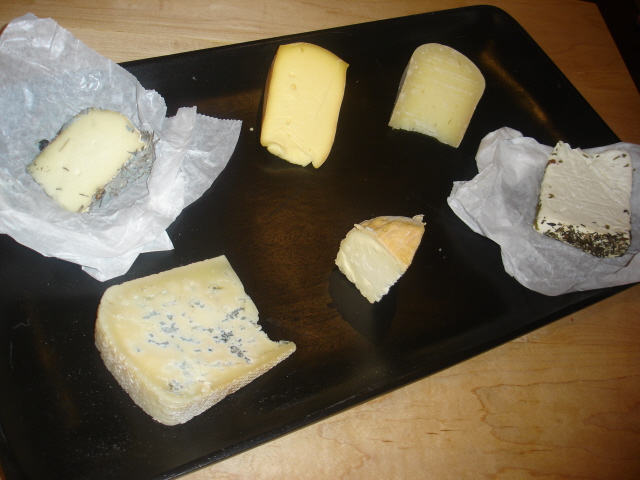
    of livestock and mold

    cheese2.jpg

    Starting in the upper left and moving clockwise.

    French Brin D’Amour
    The “sprig of love” is a cheese made from Corsican sheep. The rind is encrusted in the aromatic herbs with which it spends three months curing. The juniper berries and rosemary give its pale ivory paste a floral flavor. It’s a pretty, pretty cheese. This is the cheese to come home to after a bad smelly cheese experience, a bad date or a bad marriage. It restores the faith.

    Chimay Bierre
    This cheese is washed with Chimay, the beer of Belgian monks. It’s a smooth cheese with nuttiness and a tart finish, but I kept thinking: Why aren’t I just drinking Chimay?

    Bellwether Farms San Andreas
    The sheep on this California farm have the San Andreas fault running right through their land. I expected the cheese to have a flavor of foreboding with a hint of grassiness and fear (you know how animals can sense forthcoming doom and all). And yet, this is an easy table cheese that is mild with a piquant finish. My three year old ate nearly the whole wedge.

    Tome Verte
    Fresh goat cheese is soft, lilly white and cuts the normal tangy nature of goat by more than half. This French version is coated in fennel, thyme and pink peppercorns which give it a nice herbal flavor. Don’t expect the richenss of aged cheese, instead think of a wind-swept meadow exploding with spring clover.

    Red Hawk
    This triple cream cheese from the Cowgirl Creamery in California is somewhat of a darling in the cheese world, garnering awards from the American Cheese Society left and right. Washing the rind provides the signature sunset-orange tint, but it also gives the cheese its smell. Stinky. Bad-celery-melting-in-my-veggie-drawer stinky. My first taste was overwhelmed by the stinkiness, making me think of creamy cabbage. But the second taste (after I had presumably primed my tastebuds) was mellower and creamy with a nice earthiness. I’m eating this with some Caymus Conundrum on Saturday when my sunny patio hits sixty degrees.

    Bleu des Basques
    A nicely balanced bleu from the French Basque region. There’s just enough saltiness to work with the tang, it’s full of character without having that overbearing ego. Be warned, when you bring the cheese to room temp (which you should do before eating) it might sweat a little due to the lovely fat content. Just keep it loosely wrapped in wax paper while it warms up, and never hold fat content against a cheese.

    All these cheeses can be found at Surdyk’s.

  • Who Can Blame Her

    rome-restaurant_4.jpg

    Reuters recently reported that a mysterious woman has perfected the dine-and-dash in many of Rome’s best restaurants. The alleged “gourmet food junkie” has been known to dine fabulously on fine wines and exquisite fare, simply to find when the bill arrives (ooops) her wallet has been left in another purse. Revealed only as DN of nearby Viterbo, the “mooch artist” has been dealt with accordingly: she has been banned from Rome for five years.

    Not arrested, banned. Not made to pay restitution or scrub pots and pans, just banned. And maybe that is the ultimate punishment for a food-lover, not only taking the good stuff away, but keeping it just out of reach.

    Not surprisingly, Roman police have reported that despite the ban, our daring and naughty DN continues to sneak into Rome. Who could have predicted that one?

    It’s just not in the nature of Italians to deny anyone food. I think the waiters secretly hope she turns up at their table. What will this hungry woman want? Will she have an appetite for pungent cheese with honey and figs or will she just order a simple ravioli with dusky truffles. There’s no doubt that every bite will be savored, every moment a mark on her memory of this amazing meal. They’ll pour her a glass of prosecco while she watches the sunset, their hearts secretly proud that she chose them for her potentially last meal in Rome.

  • Who Are You Calling Disorganized?

    As with others who work in the food business, I—and especially my chef husband—have had new friends express their reservations about cooking for us. (Usually this comes out over a few glasses of wine at our house.) But in truth, the only real differences between a home cook and a food pro are time and tricks. Sadly, most of us have less and less time to wade through an ever-expanding battery of culinary advice and implements, let alone master the tricks that are most helpful.

    I’m lucky enough to live with an impatient know-it-all who points out when I am wasting my time. Through him and all my own experiences in commercial kitchens I have learned that there are a few things that can go a long ways toward transforming the way you cook. One is to develop “asbestos fingers” so that you can pluck a piece of chicken from a sauté pan at a moment’s notice to check for doneness. Another is tongs. They are a seamless extension of a good cook’s hands (especially one who hasn’t developed asbestos fingers yet). But the best and most important trick of them all is to master the essential art of mise en place.

    Literally translated to “put in place,” the French term mise en place (rhymes with “peas on moss”) is used in kitchens throughout the world. Basically, it refers to the preparation of a dish before one cooks it: Assembling the necessary tools and ingredients, chopping and prepping, and pre-heating the oven all count as mise en place.

    I used to think I was pretty slick as a fly-by-the-seat-of-my-pants cook. If a recipe captured my interest, I’d start cooking. Maybe halfway through the process I’d notice that the butter was supposed to be at room temperature (so I might nuke it, then end up melting it), or that I needed cream but only had skim milk (no one would know, right?), or that the dish required three hours in the oven (and guests were expected in one). Consider what a restaurant kitchen has to accomplish. Even if only a hundred people come for dinner, that’s probably about three hundred plates that come off the line. Can you imagine throwing a dinner party and assembling three hundred plates as a seat-of-the-pants cook? Bombs away.

    That’s why one of the keys to success for a pro is mise en place. Everything in its place. While you’re driving to work in the morning, pondering where you might go for dinner, cooks all over town are chopping tomatoes, cleaning squid, and making stock—all so that when you place your order that evening, your line cook has his world at his fingertips. In order to be prepared for whatever the chef commands, the good line cook must have a near-blind faith that minced onions will be on his left and finely grated parmigiano reggiano in the cooler by his knees. That is what ensures that the chaos of a restaurant kitchen can be finely orchestrated, instead of evolving into disaster. Obviously, this is crucial for speedy cooks turning out food in high volumes, but who among us throws dinner parties for three hundred?

    The real secret is that mise en place, more than a trick, is practically a way of life. It’s a concept that demands you show up with your head in the game. It means full attention and focus, respect for yourself as a cook, for your time spent making something that is well crafted, and for those who will eat it. Realizing the mise en place ideal means envisioning the entire production of a dish (or menu) with each element necessary for a beautiful, delicious result.

    In my pre-mise en place days, I thought creativity meant spontaneity, that improvisation had a higher value than skill and technique. I could blame the media for glamorizing chefs as artists and producing cooking shows that promise perfection in thirty minutes, but I think it was probably more a combination of ego and laziness. Mise en place taught me to balance creativity with production.

    Sundays are my favorite cooking day. Older kids are mired in homework, critical husband is mired in the couch, toddler is content to roll tomatoes across the counter. I am free to work on dinner, all day. My mise en place begins with looking out the window: Is it a soup day? A roast day? With a dish selected, a survey of the fridge and pantry usually means a quick shopping trip. Once I have all my ingredients, I begin prepping them. This has become my favorite task. While chopping an onion, I focus on how I hold my knife, how the angle of the blade yields a cleaner slice, how uniformly I can make each piece. The meditative nature of this simple task has helped me understand not only why technique is important, but how food yields to different techniques. Which has led me to a better understanding of food.

    After prepping, my kitchen is populated with small dishes heaped with brightly colored, fragrant ingredients. By the time people show up for Sunday supper and I begin assembling and throwing things into the flame, what may seem like the beginning of a dish is actually the end. What I serve forth, be it success or failure, has undoubtedly taught me something. I’m still working on the asbestos fingers, though.

    Chorizo Tapas

    2 T. olive oil
    1 c. chopped yellow onion
    2 cloves garlic, finely chopped
    2 tsp. paprika
    1 c. hard cider
    2 bay leaves, broken in half
    1 lb. Spanish chorizo, cut diagonally,
    into 3⁄4 -inch pieces
    1⁄4 c. sun-dried tomatoes, coarsely chopped
    1⁄4 c. chopped fresh parsley

    Heat oil in a sauté pan over medium-high heat. Add onions and garlic; sauté about 5 minutes, add paprika and cook about 1 minute more. Add cider and bay leaves; bring to a boil. Reduce heat and simmer for a few minutes. Add chorizo and sun-dried tomatoes; let simmer for 3 minutes. Remove bay leaves, toss in parsley. Serve in shallow bowl with crusty bread for dipping.

  • Consider the Egg

    egg (Custom).GIF

    In Chicago to open a restaurant, I was invited to dinner with my friend Elizabeth and her parents. Elizabeth’s father, Dr. Pepper (no lie), had just completed a crazy-difficult robotic arm techno-surgery. He hurriedly gave us some scant details before turning to me and asking how the restaurant opening was going.

    The robotic arm story was left on the table while they asked question after question about kitchens and sous chefs and menus and servers’ shoes and pasta. I kept thinking we were missing a great conversation about the future of health care and that the trivial workings of a restaurant opening were best left as server fueled pub-fodder.

    But I get it now. I get that people who spend their days wielding robotic arms with someone’s life in the balance may absolutely need to talk about how you go about mashing fifty pounds of potatoes. People who spend their days wielding computers in fuzzy grey cubicles may need it even more.

    And so I’m Doris Day. I will sit at my piano in the embassy and belt out my song of quince, meatballs, cocoa and eggs until your poor little kidnapped souls can run freely down the stairs into the yolk colored sun.

  • The Gow Choy Express

    The average home cook, it turns out, has only about a dozen rotating specialties in his or her repertoire. Pot roast, meatloaf, spaghetti, you know the drill. This type of déjà vu dining becomes especially depressing in March. While the lucky few fly away to warmer climes and snack on fresh tropical fruit, the rest of us feel sentenced to a state of not-yet-spring, in which we’d rather eat a travel brochure than another baked chicken. Seeking out the fresh and new may seem daunting, especially as you lie on the sofa with the television clicker on your belly, but there is hope—inside the Asian markets scattered throughout the Twin Cities.

    Asian markets offer glimpses into other worlds, right when you need them most. For those who shop at them regularly, this is hardly a revelation. But if you are like I once was (hugely aware of my tendency to stammer when I don’t know how to ask for something, and frightened to death of being offensive), just stepping through their doors can seem daunting. It turns out that all it takes to get over yourself is one trip to Shuang Hur or Duc Loi. You’ll be mesmerized by the tightly packed shelves of interesting ingredients and overwhelmed by the hospitality of the people who work there. In an effort to reveal the delights of these and other local Asian markets, I undertook a whirlwind shopping spree with friend and food expert JD Fratzke, the head chef at Muffaletta Café in St. Paul.

    One of the best things about Asian markets is the availability of fresh and unusual herbs and leaves. You’ll find, likely near the vegetables, generous bunches of herbs that are less expensive than the plastic-boxed sprigs at the average grocery. Some of the most common are garlic chives (gow choy), which have a grassy top and pungent smell, and sweet Asian basil (bai horapha), with its slight anise flavor. More exciting are the leaves—la-lot leaves, kaffir lime leaves, and sword-shaped pandan leaves—which can be used to wrap fish and meats while they steam.

    Oddly shaped roots are also plentiful. JD proved once and for all that beauty lies within when he snapped open a squat, dirt-covered water chestnut root to reveal its perfectly creamy white inner flesh. The basics include taro root, a starchy tuber that acts like a potato but with a slightly sweeter flavor; spicy galangal, a member of the ginger family commonly used in Thai cuisine; and jicama, tumeric, ginger, and lotus roots. A tip from JD: If you’re looking for bamboo shoots, go easy on yourself and buy the ones that have already been peeled and rinsed.

    Enthralling, but confusing, are the many varieties of leafy greens. Of course there’ll be bok choy on hand, but why not try gai larn (Chinese broccoli) instead? The stems make a vibrant side dish, chopped and flash boiled in salted water. Choy sum is a flowering cabbage often crowned with little yellow buds; both the leaves and stems can be thrown into a stir-fry. Water spinach (kangkung), with its long, narrow leaves, is best wilted in olive oil with a bit of garlic.

    The meat cases in Asian markets are packed with the usual cuts of beef and pork, alongside more unusual offerings like pigs’ feet and snouts, beef stomachs, and what JD calls the Asian movie snack: chicken feet. Fish can be found frozen and whole or sliced and marinated in a traditional spicy chili paste. Many markets offer cooked meats like HOFO duck (head on feet on), or barbecued hog. Both make for very easy meals.

    One of the best treasure troves of all is the frozen foods section. Surprises from the far reaches of the globe can be found behind the glass doors: bags of pond snails, packets of air-dried fish, cases of quail eggs, boxes of Chinese sausages. Great deals can be had on bags of frozen mussels, scallops, shrimp, and other seafood. JD laughed aloud when he saw the same brand of frozen shrimp sold to his restaurant sitting on a shelf for markedly less. The big winner for me is the variety of dim sum treats. It’s so very nice not to have to leave home for a steamy breakfast of bao buns.

    Of course, the basics would only get you so far without the aisles and aisles of vinegars, sauces, noodles, rice papers, spices, canned lychees, and dried mushrooms. The selection of soy sauces alone can be exhilarating. JD is on the constant lookout for an exotic white soy sauce a fellow chef once lent him. The hunt is half the thrill. On one of our trips I found fine French butter, small production Taiwanese honey, and a can of bubblegum-flavored jackfruit.

    Strategywise, JD recommends starting with a recipe and a list of ingredients. And never be afraid to ask questions, he says. While we stood, obviously confused, in front of a meat case, a sweet older Asian man motioned in a gesture of aid. After a few minutes of pointing and a mix of odd linguistics on all our parts, we at last learned via pantomime that the gelatinous mass we’d been eyeing was beef stomach. We all smiled and nodded, feeling lucky to be in Minnesota. Even in March.

    United Noodles 2015 E. 24th St., Minneapolis, 612-721-6677

    Shuang Hur 654 University Ave., St. Paul,

    651-251-2196; 2710 Nicollet Ave., Minneapolis, 612-872-8606

    Duc Loi 2429 Nicollet Ave., Minneapolis,

    612-870-8684

    M&A Food Store 721 Jackson St., St. Paul,

    651-310-0109

  • Out of Your Shell…

    It’s hard to admit, but my real first encounter with escargot was at Bunny’s Bar and Grill in St. Louis Park, with a flock of hospitality bats. Some of my fellow bartenders thought it would be funny to order the strange appetizer—what was escargot Bourguignon doing there alongside nachos?—and someone else thought it would be even funnier to drop one in my mouth without telling me what it was. Once I understood that I was eating snails, I could no longer understand why this definitive dish in the cuisine of cuisines was so maligned. In truth, my initial taste of these slimy creatures was an odd sort of awakening. The earthy, buttery softness of this accidental escargot led me to oysters and sushi and other culinary adventures that might have been postponed for who knows how long.

    Piles of shells excavated from archeological digs across Europe indicate that snails have been enjoyed as a food by a number of ancient peoples. The Romans cultivated special vineyards where their snails could feed. By the sixteenth century, dining on snails was so fashionable that the Catholic Church classified them (along with frogs and turtles in France) as “fish” and they were therefore allowed on meatless days. But it wasn’t until the mid-1800s, when Alsatian-run brasseries proliferated in Paris, that escargot became a defining dish of French culture. Today the French consume some forty thousand metric tons of escargot each year, more than the country can produce. Just last year, the Burgundy Snail Festival was saved by the importation of Polish snails to handle the demand (to the delight and chagrin of the French). In fact, heliciculture, or snail farming, is becoming a popular economic solution for Eastern European countries as demands across the globe increase.

    Gastropod mollusks, snails occupy one of the largest classes of animals and can be found all over the planet in both water and land environments. Gastronomically, the most popular are Helix aspera (or petit-gris), the common garden snail, and Helix pomatia, the famed Burgundy snail. Spending their lazy days grazing on wild herbs and vineyard plants, wild Burgundy snails are not as widespread as they once were, due to land development and farming practices. Meanwhile, the garden snail is detested by green thumbs because of its insatiable appetite for plant matter and its prolific breeding ability. (It helps that most snails are hermaphrodites, and toggle back and forth between male and female.) Indeed, it must be hard to appreciate critters on your table that you curse in your garden. Other haters are usually people who have, shall we say, “textural issues” with foods. Just thinking of the slimy, gelatinous nature of a raw snail is enough to set off their gag reflex. And yet many of these people would happily wolf down a lobster, the cockroach of the sea, which is actually similar in texture to a cooked snail.

    The Slow Food organization, those champions of fresh and independently produced food, and of the meaningful and lengthy enjoyment of a meal, uses the snail as its logo. Puns aside, cooking fresh wild snails is a slow and laborious undertaking. Although gardeners may be inspired to boil up their nemesis as a tasty revenge, caution should be heeded as snails, more so than most animals, are what they eat—including pesticides and plant life that may be poisonous to humans. Therefore, preparing snails for consumption involves holding them in an untreated wood box while they fast for three to four days as a detoxifying process. It also may include burying them alive in rock salt to draw out harmful toxins, or boiling them at length while removing the frothy scum that gathers on the surface of the cooking water. Not surprisingly, canned snails are a popular alternative to the home-cooked variety; many brands use age-old French preparations and are becoming more readily available in the U.S. through gourmet websites.

    Most of us, however, think of escargot as de rigueur on the menu at any traditional French restaurant. At Vincent in Minneapolis, escargot is prepared in the classic Burgundy style, with garlic, shallots, and butter; when perfectly cooked in this way, it is amazingly soft and delicate—like a divine portobello. (You will know the overcooked snail when you meet it: Chewy and rubbery, they lose all magic.) For a departure from the Gallic, venture to Solera for a warm tapas of snails with mojo verde.

    While escargot may seem hopelessly retro, young chefs are rediscovering the dish. Over the last year, restaurants across the country featured such creations as escargot-stuffed figs, escargot with truffled parsnip puree and artichokes, escargot parfait with potato puree, and parsley pesto-dotted escargot pizzas. Escargot on the menu gives a restaurant a certain pedigree, since most everyone has heard of escargot, and many consider it a luxury item, whether they enjoy it or not. So perhaps these chefs are at the forefront of a new international trend, and soon enough, escargot will be as popular as steak frites.


    Escargot Pasta

    6 to 8 ounces linguine pasta

    3 tablespoons butter

    1 10-ounce can artichoke hearts,

    drained and sliced

    1⁄2 cup quartered mushrooms

    (such as baby portobello or porcini)

    1 7- or 8-ounce can escargot, drained

    2 to 3 cloves garlic, chopped

    1 teaspoon chopped fresh sage

    1 teaspoon chopped fresh parsley

    1⁄2 cup freshly grated Parmigiano cheese

    Cook pasta in water until al dente.

    While pasta is cooking, melt butter in large sauté pan over medium heat. Add garlic and sauté until golden. Add mushrooms and artichokes and cook until mushrooms have softened and browned.

    Stir in escargot, sage, and parsley, cooking until just warmed. (Don’t overcook snails or they will be tough.) Remove from heat.

    Toss cooked pasta with half of cheese and place in serving bowl (or on plates) and top with escargot mixture. Sprinkle with remaining cheese and serve. Makes two large portions.