Tag: architecture

  • Lyre

    There are certain works of art the body wholly understands before the mind kicks in with its distancing powers of disembodied detachment and analysis. In the Twin Cities, there is very little art in the public realm — in what we now call "the commons"– that does this. Most public art, strained through the cheesecloth of three or four bureaucracies, is earnestly mediocre, almost by necessity. Much of what wins competitions is "plop art," dutifully commissioned to meet the tithing requirement for one-percent-for-art public building projects.

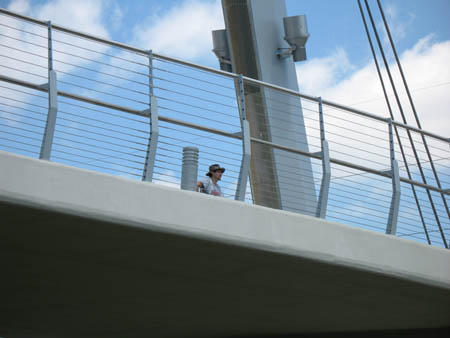
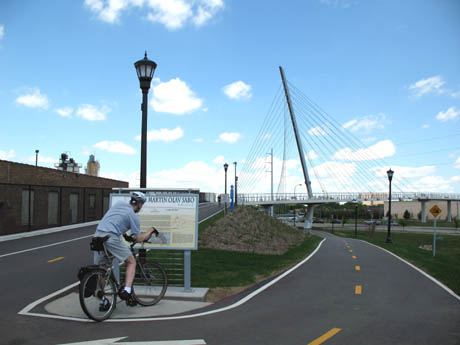
    I can think of a few exceptions –not many– where viscerally beautiful works have come to see the light of day as public art despite the pitfalls of the commissioning process. One of them is the Heilmaier Memorial Bandstand, by the artist and architect James Carpenter, the bandshell with the saddle-shaped roof of glass on Raspberry Island in the river off downtown St. Paul. Another (right nearby, actually) is the powerful "Floodwaters," the roiling torrents of cast bronze flanking the southern gateway to Harriet Island Park, by Jeffrey Kalstrom and Ann Klefstad. Yet another, a work beautiful against all odds, is one that was never primarily intended as sculpture but turned out to be more compelling to the senses than many things currently called that. It is the new Martin Olav Sabo Bike and Pedestrian Bridge that spans Hiawatha Avenue and the light rail tracks adjacent to it, just north of 26th Street in south Minneapolis.

    The Sabo Bridge, named in honor of the congressman who secured federal funding for the project, is of a type known as a "cable-stayed bridge." Although they employ cables, the mechanics of cable-stayed designs are different from those of suspension bridges like the Brooklyn or the Golden Gate. A display panel on the bike path’s western approach to the bridge explains the design principle. From an engineering standpoint, a cable-stayed design presented the most elegant solution to the problem of spanning six lanes of traffic and two sets of light rail tracks without having to resort to intermediate support pillars in the middle of the road. The design wasn’t imposed on the site; it was inspired by the site’s constraints.

    The first time I saw the bridge was when I drove under it one evening at dusk a few months before it was completed. Its structural logic made itself understood on first sight. I felt it right away in my bones, sensing the forces working through and upon it the way people sense the rightness of the lines of a boat. Every one of the elements, the incredible back-bent mast, the deck, the fanned-out cables, the backstays converging onto bulwarks rooted deep in the ground, gave expression to the insight of the biologist D’Arcy Thompson that "structure is a diagram of forces." The bridge’s structure correlates with something internal, with one’s felt understanding of the structural mechanics of one’s own body. The sensation of it being in some way analogous to the way you yourself are put together tempts me to call the bridge a work of figurative sculpture-abstract, but nonetheless a human-figural representation of the forces and counterforces; metaphorically, of a tug-of-war; a stevedore hoisting a pallet aloft with a block and tackle, a puppeteer, a fisherman casting a fly. It is what it is –a bridge– but it triggers a chain of associations. It arouses the imagination in ways that few works of public art seem able to do, inert with virtue as most of them are.

    Call it a bridge or call it a sculpture, the new Sabo bridge is an inspired work, a piece of lyric engineering in the tradition of such masters of structural music as Santiago Calatrava, Pier Luigi Nervi, Eero Saarinen, and Frei Otto. Its elegantly tapered steel mast, backbent at an angle almost equal and opposite to the angle of its massive, similarly tapered concrete footing below the bridge deck, is a form sprung from the soul of Brancusi. The bridge is a stirring sight as you approach and go under the deck by car or light rail, and it doesn’t disappoint up close, when you walk or ride a bike over it. It is lovingly detailed: the workmanship in the steel and concrete is rigorous and clean, the care of the contractors readable in the panoply of the hardware, in the tensioning turnbuckles, tie rods, and railing cables, in the dramatizing spotlights mounted alongside the protective rubber boots on the ends of the bridge cables where they connect to the deck, in the backstay cables as their sinews converge in massive connectors to the concrete footings on the ground below.


    Cyclists in colorful gear flash across the bridge like shuttles of a loom. The balusters of the bridge railings are shaped with a bend like the mast’s. The railings themselves—the thin tension cables that pass through the balusters–are like the lines of a musical staff. They make the balusters read like the bars on a musical score, and a little like the frets on a stringed instrument, which in a way this whole construct is. The bridge is a lyre, a harp strummed by the wind. Reach over the railing and touch one of the cables that hold up the span. You can feel it thrum.

  • Twinkle, Twinkle, Little Starchitecture

    Art museums are host to two species of rats, those that skulk in the basements, gnawing on the art in storage, and, lower on the food chain, the people who handle the art. “Museum rat” is trade slang for the stagehands, the workers who hump crates of art off trucks at the loading dock, maneuver sculpture into position, hang paintings, set up lights, build pedestals, perpetually paint and repaint the walls of the galleries, and generally do the bidding of the museum’s commandants. Museum rats are the movers, but not the shakers, of the art world. Most of them are artists of one sort or another themselves, which is to say, bust-outs and delinquents in t-shirts printed with the names of bands and film festivals you never heard of.

    During the nineties, I was one of that floating pool of feckless souls in the Twin Cities who get hired when a museum has two weeks to go before the opening of a show and too few hands to get the work done (the custom is to hire you for a stretch but then lay you off before you qualify for benefits or pensions). Most of my employment was at the University of Minnesota Art Museum, which before it transmogrified into the Frederick Weisman Art Museum consisted of a series of grubby galleries and offices strung along the fourth floor corridors of the moldering Northrup Auditorium. When the museum moved to its new quarters in Frank Gehry’s destroyer-class WAM–the crumpled sketch that served as the tuneup for the Guggenheim’s aircraft carrier in Bilbao–I was one of the deckhands, one of the crew who installed the billboard-size works by Roy Lichtenstein and James Rosenquist that hang in the front lobby and gallery of the museum. And it was I who with clammy male hands in white cotton gloves hung Georgia O’Keefe’s Oriental Poppies, said at the time to be worth two million bucks.

    One of Gehry’s early sketches for the Weisman, scribbled on a cocktail napkin and since preserved with the reverence accorded a holy relic, was seized upon by the museum for a logo, hoping with this to create a perception of the place as a hotbed of spontaneously combusting creativity. The with-it acronym, WAM, strives desperately for the same effect—POW! For all that, the place is basically just a gift shop (the first thing you encounter on entering the building) with a small teaching museum attached. Besides teaching students how to make purchases of tasteful gifts and stand frowning thoughtfully before works of art, the Weisman also makes money by hiring itself out as a catering hall for conferences, receptions, yuppie nuptials, etc. Often when I came in to work on mornings after one of these events, the floors of the galleries would be garnished with wet bits of wilted lettuce and little gobs of buttercream from pieces of sheet cake accidentally flipped off paper plates the night before.

    Gehry’s buildings, in my book, are architecture’s version of torn designer jeans. They imply radical experience without actually having to go through it. They gesticulate without it meaning anything. Inside the Weisman, the yawing walls reflect the gratuitously skewed planes and pointless curves of all the tin-snipped bling hung off the outside. In the museum’s carpentry shop, where I worked, the wall is canted uselessly inward; anything as sensible as a plumb wall would have been too mundane. I never measured to be sure, but it always felt like the shop’s longest dimension is the height of its absurdly unusable vertical space. The shop has no windows either—no eyes. . . it was like working inside a dumpster with the lid closed.

    Rhapsodizing over the Weisman when the building opened fourteen years ago, however, critic Herbert Muschamp of The New York Times pronounced the new museum’s galleries “the five most beautiful rooms in the world.” I rubbed my eyes to be sure I’d read this right, but this was before I understood anything about criticism’s contributions to the science of buzz. The process by which a work is pronounced great is compounded of many sidewise glances at what other people think. Gathering mass, the consensus keeps snowballing, burying us in an avalanche of conviction that such and such a thing is so -– it must be. . . someone more important than us said it is.

    It fell, then, to a couple of obscure museum rats, two anonymous art schleppers, to do something to subvert some part of the world’s received wisdom. One lunchtime a few weeks before the museum’s grand opening, they decided to circumvent the curators and put up a favorite work of their own as the very first picture ever to hang in the new galleries. The work was a portrait they’d found —actually a jigsaw puzzle, still wrapped in cellophane–of Barney the Dinosaur, sporting the beret of an artiste, a pallet and brush in his purple mitts. Following Barney’s installation as the museum’s maiden work of art, one of the perps set up a music stand in the middle of the echoing gallery and with great verve proceeded to play a rousing march on his dented old farting tuba. It was the high point of my life at the WAM.

    Now, whenever I bike along the opposite bank of the river, I look across to the Weisman and think of that dinged-up tuba and the wags I used to work with in the building’s lower depths. As it happens, a fenced-off stretch of the riverbank opposite the museum has this past year been serving as a storage lot for some of the violently twisted steel recovered from the collapse of the I-35 W bridge. From its vantage point across the river, the Weisman, a building that itself appears to have been cobbled together from gum wrappers, looks out upon all that contorted steel rusting in the weeds across the river. Last year, Gehry was sued for dereliction after a $300 million research building he did for M.I.T. in 2004 started falling apart a few months after it opened. Before time stole his thunder, the great and terrible Ozymandias declared, “Look on my Works, ye Mighty, and despair,” but maybe what he meant to say was “repair.”

  • Where We Live

    I’ve been living in the same city for a long time. Maybe that’s why I crave the unusual. I abhor cookie-cutter architecture, which is just as prevalent in urban areas as in cul-de-sac suburbia. How many three-story brick condos with railed terraces have you seen constructed in recent years?

    I want buildings that curve, use everyday materials in strange ways, use strange materials in everyday ways, inspire fear, or give me pause. I like to nestle next to Moos Tower on a sunny day, bike under the Guthrie’s blue-black cantilever at night, and duck into that new box buried behind the Walker Art Center that frames the winter sky.

    I also like the dangerous: decrepit structures with peeling paint and collapsed roofs. Walking across the cracked, aging pedestrian bridge at I-94 near Augsburg College-with cars buzzing on the highway below-makes my heart beat a little faster. Crossing the Lowry Avenue truss bridge is thrilling when you poke your head out the window to look at the Mississippi River’s waves through the steel openings of this 1955 landmark. (Let someone else drive.)

    In choosing pieces for this collection, I was drawn to art that took me away from the everyday: dances, architects, buildings, and photographs of lonely places that lifted my spirits, showed me hidden beauty, or poked my face in decrepitude.

    Originally appeared in issue 19.2 of access+ENGAGE. Subscribe to this free arts e-magazine at mnartists.org/accessengage.

    Pictured Above: Bigelow Chapel Interior – New Brighton, by Joan Soranno
    This is a delicate building by a rising star in architecture. At Bigelow Chapel, Soranno uses five wavy curves to create a cocoon-like atmosphere for worshippers. Soranno also designed the Barbara Barker Center for Dance at the University of Minnesota and the much-heralded University of Alaska Museum of the North in Fairbanks, Alaska, and is now working on the B’nai Israel synagogue in Rochester, Minnesota.

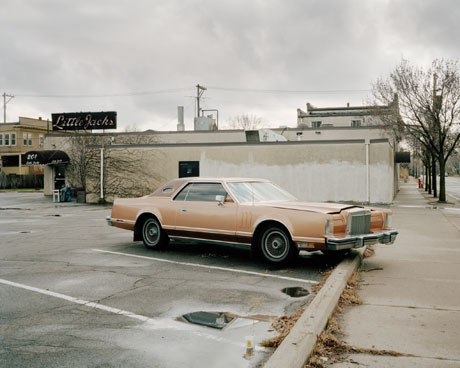
    Little Jack’s (from the Cream City series), Colin Kopp
    I love this Colin Kopp photo. It’s vaguely reminiscent of Donnie Brasco, that Johnny Depp-Al Pacino film where the undercover FBI agent and the gangster bond. And it takes me directly to an imperfect part of Minneapolis that I love: Northeast. Moss clings to the parking barrier like lost hope. The slightly opened hood of the car suggests abandonment. The white washed wall of Little Jack’s covers graffiti and a glorious past.

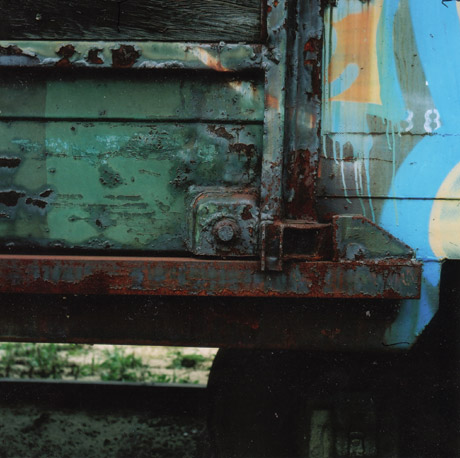
    Railroad Car #1, Burlington, VT, 2005, by Robert Roscoe
    It would seem easy for a preservationist to fetishize cupolas and other architectural details from decades past. Instead, Roscoe focuses on beauty in unexpected, even dilapidated, places.

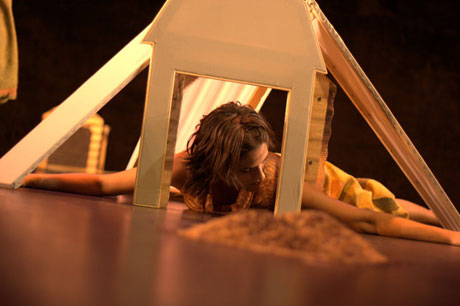
    House/Home by Maggie Bergeron
    House/Home is that rare dance that works as both a story and as a metaphor. Five dancers wearing greens and browns snuggle, curl, and finally break away from their four tiny on-stage homes. Throughout the work, they return to their homes, attempt repairs, crush them and start fresh, share them with a lover/friend, push away the lover/friend, and begin again. The dance, a new work by up-and-coming choreographer Maggie Bergeron, shows our connection and disaffection with our surroundings (and our lives), expressed by a continual need to remake, remodel, and reuse. Performed in the Soranno-designed dance center at the U of M.

  • Cabin For the Uncommon Man

    "Log cabins are a dime a dozen,” said Richard Olson, lighting up yet another Marlboro. “We looked at some of those. They were junk. They were put together by amateurs. Some of the logs had separated; you could see right through them. All these trees here, tip some of them on the side, and you’ve got a log home … logs, logs, logs.” A suggestion is put forth: Is a log home in the woods, well, redundant? “Yeah,” he agreed, clanking his spoon around in his coffee cup, “something like that.”

    Richard was sitting with his wife Debbie on the patio of their cabin in the woods, a couple of miles from Ely. This is certainly no nostalgic log structure, but rather a striking example of modernist simplicity and Scandinavian restraint. It’s actually a one-level ensemble of buildings: a garage and a two-part cabin, composed of a square and a rectangular form, all dressed in a very un-cabin-like blue-black stain. Situated across the patio from one side of the living-room end of the cabin is a white brick “unchimney,” or flueless outdoor fireplace—a design signature of the home’s architect, David Salmela.

    When the Olsons bought the cabin, on a wintry St. Patrick’s Day six months ago, they had never heard of Salmela, despite his international reputation and local celebrity. They certainly would not have considered themselves design aficionados. Nor were they necessarily the kind of buyers that Salmela and developer Brad Holmes, from Gilbert, Minnesota, had in mind. (Holmes has built sixteen of Salmela’s residential designs over the years, including Ravenwood, photographer Jim Brandenburg’s compound at the edge of the Boundary Waters Canoe Area Wilderness.) Yet Richard and Debbie Olson’s immediate attraction to the cabin speaks to the broad appeal and understated artistry of this simple, small, and modestly priced project.

    The Fergus Falls couple discovered the cabin while searching the Internet for a vacation home; it was the first of five to be completed in a development owned and planned by Holmes. Richard Olson drove over, had a look, and purchased it immediately. “I didn’t analyze it when I bought it. I just liked it,” he said. “When you drive up to this place, it says, ‘I’m separate and distinct from the surroundings.’ I like that it’s different. It’s not something everyone has.”

    Lake access is not something every cabin has, but it’s an amenity many second homeowners in Minnesota automatically associate with “cabin.” The Olsons, however, prefer their wooded seclusion. “We can drive out of here in any direction and be on the water. There’s water all over here,” Richard pointed out. “But if you’re on the water, you’re next to someone. It’s like living in an apartment. There’s no privacy.”

    Unlike the other cabins he looked at, Richard continued, this one is “solid, well-built. You could tell that the minute you walked in. The place is super insulated, with all the latest technology. Everything is done correctly, the way houses used to be built.” He also enjoys the novelty factor of Salmela’s architecture. “Everybody that comes in here says, ‘Wow.’ An old guy picked up my lawn mower the other day and said, ‘I had no idea this was down here. What is this?’ I had to explain it all to him. He just shook his head. He’d never seen anything like it. That’s what I like about it.” Built in 1995, Ravenwood is a cluster of living, working, and studio structures, which Salmela designed to accommodate the needs and desires of Brandenburg, arguably the country’s foremost living nature photographer. In the book Salmela Architect, published earlier this year, author Thomas Fisher describes this six-thousand-plus square-foot complex as “an ancient Scandinavian village, forgotten deep in Minnesota’s northwoods, as if the past had taken a quantum leap forward into the present.” After building Ravenwood, Holmes was inspired to take a somewhat entrepreneurial approach to residential development. He wanted to undertake a project in the Ely area that involved smaller, year-round homes—homes that would be designed by Salmela without input (or interference) from clients.

    “I wanted to enjoy building something with just me and David,” said Holmes. “The way he uses light with all of the windows, you feel like you’re outside among all those beautiful trees when you’re inside. David knows how to do that in every project.” Holmes purchased a wooded property outside of Ely and divided it into five seven- to nine-acre lots. He then planned to build the cabins one by one, in his spare time. He asked Salmela to design a low-profile dwelling that “looks like it’s been there in the woods for a hundred years,” he said. “Everybody wants those huge log cabins. I told him, ‘Let’s try something different.’” Salmela agreed. The architect drew up the cabin design, which totals fewer than a thousand square feet, and in exchange, Holmes built wardrobes and cabinetry for Salmela’s own home that are similar to those in the Ely cabins. The Olsons bought the prototype cabin for $195,000; a month later, a younger couple bought the second for $185,000 (it’s the same plan as the first, but flipped, and it has no built-in furniture or exterior stain).

    With its lap siding and a wood truss projecting from beneath the slightly peaked metal roof, the Olsons’ cabin recalls houses lined up along a picturesque seacoast in Norwegian travel brochures. The trio of structures—the garage and the two cabin components—were all built using fourteen-foot trusses. The garage is large enough to accommodate racks of canoes or a sauna, while the main living/dining/kitchen space is a modest fourteen by twenty-four feet. A wood-plank walkway connects the garage to the living space. Visible outside the floor-to-ceiling windows is the patio, with its pergola and unchimney. The other “wing” of the cabin is situated off the kitchen, where a long corridor links a series of simple, square rooms—sleeping quarters, bathroom, and laundry room.

    This compound-like arrangement is found in much grander manifestations throughout Salmela’s work, from Ravenwood to the planned community of Jackson Meadow, outside Marine on St. Croix (which Salmela designed in collaboration with the Minneapolis landscape architecture firm Coen & Partners). In his book, Fisher describes the arrangement of homes, garages, fences, and walkways in Jackson Meadow as “recalling the small yards of historic towns”—an effect present in his Ely cabin design, albeit on a much smaller scale.

    The cabin has other Salmela markers, as well, such as a string of square windows marching along the exterior of a long, narrow form, which is also found in the Jackson Meadow homes, the Wild Rice Restaurant near Bayport, Wisconsin, and at the Jones Farmstead near Nerstrand. Another characteristic is the blurred distinction between inside and out. The feeling of being outdoors while inside the home is such that the Olsons can watch fires in the unchimney from inside the cabin, as well as from the patio.

    While Salmela’s work has a distinctly modern feel, it’s far too traditional, despite being occasionally whimsical, to fall into the modernist camp. “This is what I perceive modernism to be today,” said Salmela, sitting in the office he keeps in his 1920s home on a hill in Duluth, surrounded by awards, publications, models, and drawings. “It’s the warmth of things you’re familiar with, like forms and materials, and the planning and efficient way a structure goes together. It doesn’t have to look super modern, like the minimalist things done to prove they’re really modern. I’m trying to use common sense about how something goes together. These cabins are so easy to build, so simple when you look at them on paper, that you can’t perceive there’s anything really unique about them.”

    The architect tore a length of tracing paper from a roll and started sketching squares and rectangles. “See, it doesn’t look spectacular,” he said, “and the chimney isn’t very high.” At twelve feet, unchimneys at the Ely cabins are shorter than the monumental versions at the Wild Rice Restaurant or the Golob-Freeman cabin, also known as “Two Black Sheds,” on Madeline Island. “But when you start to build, this becomes quite dynamic.” The forms, windows, and walls are both functional and visual devices, he adds. The metal roof, wood siding, and outdoor fireplace recall the vernacular of the northwoods. Salmela alludes to his own heritage in suggesting that the cabin “looks like 1960s Finland. It’s really a very pure, straightforward, mid-modernist era structure, with no pretension.”

    For Salmela and Holmes, the cabin is also an experiment in creating ready-made architecture. All a buyer needs to bring are the essentials of daily living: bedding and towels, groceries, kitchenware, clothes, sports gear. Included with the cabins are appliances and cabinets, a built-in couch (whose angled cushions, when flipped, make a guest bed), a wood dining table (the Olsons bought their own chairs), slate floors, and built-in beds and wardrobes. “Traditionally, cabins are a lot of work,” Salmela said. “Here, everything is already done for you, and in a more sophisticated way.” Of course, there’s also the added cachet of purchasing a cabin designed by a noted architect, one whose star continues to rise, without paying an architectural fee.

    And the wooded, lakeless setting? “Canoers don’t need to be on a lake, because if you’ve got your canoe, you can go anywhere you want,” Holmes says. “We figured not being on a lake wouldn’t be a problem.” Buyers of the cabins, Holmes and Salmela concur, would get out their boats every day, venture to a different lake to paddle, then return home to read, relax, work, and have a fire. These expectations imply a certain type of buyer, as well. “The concept, from my standpoint as a designer, was to create an affordable, environmentally sensitive, development, with a simple, modernist set of structures that satisfy the needs of people living outside the area, within a natural setting of woods—versus being on a lake—that becomes a statement in itself,” said Salmela.

    However, the five-cabin development, as originally envisioned, may not become fully realized. A few months ago, a man from the Twin Cities called Holmes about purchasing one of the lots. “I told him I’m not selling, because I’m doing five cabins in there,” Holmes says. But the caller was persistent. “So I threw out a ridiculous price and he didn’t blink an eye. I didn’t know what to do. I guess in the long run, money talks.” The lot’s buyer hasn’t decided whether or not he’ll construct a Salmela cabin. “It’s the lot on the far end,” says Holmes, implying that he minimized the potential for the development’s disruption. “The other four are still grouped together.” Nevertheless, the sale threatens the pair’s architectural experiment.

    “It’s a neat idea,” Salmela said of the Ely cabin development, “but the odds of it succeeding are a long shot. It’s necessary to have a continuity to complete these things. If you break it, you can’t repair it. That’s the experiment. Brad knows he needs to keep an integrity to the project. But does he have the perseverance? If we can’t get beyond the two cabins, then we say the notion was good, but it was a concept that failed.”

    Then there are the Olsons, who don’t fit the yuppie environmentalist type of buyer that Salmela and Holmes had in mind. Richard is a gruff, gravel-voiced, chain-smoking retired business representative for the Machinists Union. Debbie works as a bookkeeper in a plumbing store. They don’t own a canoe or kayak. They’re not likely to bring laptops or copies of Dwell (which recently put a Salmela home on its cover) along on weekend visits. And in an artful pile of rocks behind the unchimney, Richard has “planted” bouquets of silk flowers, a decorative statement that Salmela calls a “major violation.”

    Richard was quick to justify his décor. “My wife hates them. But I’m colorblind, so to me it’s colorful.” Besides, he added, the floral facsimiles won’t be there forever. “We’ve got stuff planted,” he said with a huff and a sigh. It’s entirely possible that the fake flowers are a sign of Olson reveling in his own irreverence, making use of his relentlessly wicked sense of humor in a place he was immediately attracted to but had never imagined living in before—a place he now appreciates on a deeper level, especially after reading up on architecture (including Fisher’s book on Salmela) and spending the summer there.

    The Olsons clearly are enamored with their cabin, which is otherwise free of decoration inside and out. Debbie tells of waking up to deer peering through the floor-to-ceiling bedroom window and her delight in low kitchen cabinets that don’t intrude on outdoor views while preparing meals. They keep their eyes peeled for foxes and chipmunks. And they love firing up the unchimney; Richard especially enjoys the reactions from visitors who’ve never seen the cabin. “Strangers came in one day to buy something I was selling and thought the unchimney was a giant refrigerator!” he says. “People don’t believe it will work. But it does work. It works beautifully.”

  • People of the Skyway

    Peter Bruce is a slight, sandy-haired, serious man who moves and speaks quickly and with purpose. Bruce loves the skyways, how when it’s raining or too hot or too cold they convey people between offices and restaurants and stores. While most people have never heard of him, anyone who’s connected with the skyways—whether in retail or in planning or policing them—knows Peter Bruce and listens when he talks. And he says things like, “I’d say, just from my observations over the years, that for every ten degrees below room temperature it is outside, skyway traffic goes up between five and ten percent.”

    Bruce, a mild-mannered convert to the Mormon religion, can talk like that because he makes a significant portion of his livelihood by counting pedestrians and gauging traffic in the skyways and on the street. His clients are retailers and government agencies. He estimates he’s counted foot traffic for eighty to ninety percent of the buildings within the skyway network as part of the Minneapolis business he started thirteen years ago. Before founding Community Enhancement/ Pedestrian Studies, Bruce conducted financial and market research for downtown real estate developers. After he struck out on his own, his first big job was to design the color-coded signage system in St. Paul’s skyways to help ease confusion for the overflow of visitors the capital city expected for the 1992 Super Bowl at the Metrodome (in which, by the way, the Washington Redskins beat the Buffalo Bills, 37-24).

    Bruce most loves the skyways, though, when they “augment the flow of people into and out of downtown cores”; when they “naturally complement and interact with the street level” to create a fast and efficient and, yes, eye-pleasing system of people-moving from office to condo to sandwich shop to theater. But he knows that doesn’t happen often enough. Like anyone who regularly uses the skyways in the Twin Cities, Bruce knows how difficult it can be to figure out how to get access to them from the street, or how to get back to the street once you’re in the skyway. This is the big challenge for planners, and it’s a longstanding conundrum. “No downtowns that remove people from the street, via skyways or tunnels, do that well,” Bruce says. (Some twenty or so other U.S. cities have skyways or tunnels—like Houston; Charlotte, North Carolina; and Hartford, Connecticut—though, when combined, the skyways in Minneapolis and St. Paul are the most extensive system in North America and probably the world.)

    Exceptions to the street/skyway barrier do exist. Bruce points to his newest favorite example, the Target Store on Nicollet Mall, where a pedestrian on the street can see, through the building’s glass entry, the escalator that ferries people to the second-floor skyway. The other legendary connection is the Crystal Court, whose expansive glass entrance leads into an open atrium where the escalator is clearly visible, and the skyway level is packed with retail. “Buildings could be retrofitted to be more like those,” Bruce says.

    But that’s probably not going to happen, as Peter Bruce is well aware, because he knows the downside of the skyway concept. “Anyone thinking about the vitality of the streets downtown can see that the street life is weakened by skyways,” he says. “But second-level retail is strengthened, and I think most people would say that I want more retail that I can get to while still staying warm in the winter.”

    If Peter Bruce is the ultimate scholar of the skyways, then Carol Robertson is the ultimate user. As this unofficial “Queen of the St. Paul skyways” knows, they appeal for reasons beyond the climate-controlled retail. A slight and energetic eighty-nine-year-old who looks barely old enough for retirement, Robertson takes to the skyways four or five times a week for an hourlong walk, during which she usually racks up three to four miles on her pedometer. Friendly yet reserved, she has lived a full and active life and is discreetly proud of it. And she loves the skyways for the chance they give her, in the twilight of her days, to walk and think and observe in comfort and safety.

    We meet one afternoon on the eastern fringe of the skyway system in Galtier Plaza’s food court. Robinson has lived on the forty-first floor of Galtier since 1991. Normally, she keeps to a precise route, moving quickly and with determination, but given her role today as a tour guide, she’s taking it easy. Given my arthritic knee, however, I still find her pace too swift—something she keeps apologizing for. Over the course of the next two hours we cover nearly the entire system, a rather odd couple making our way through the grid as best we can. From Galtier Plaza we head to the US Bank Center, whose Great Hall we circle three times, passing through the adjacent Pioneer and Endicott buildings and over to the First National Bank.

    After criss-crossing Fifth Street through two different skyways, we enter the Bremer Building, where the former St. Paul Athletic Club sits—now a fitness center. “That was a real loss,” Robertson says. “My husband and I loved the restaurant there.” (Her husband, Edward, died in 1996.) It’s clear that the skyways are more than a walking track for Robertson, that in fact they’ve been something more of a lifeline, giving her sheltered access to restaurants, banks, stores, and many other necessities of life that can be hard to get to, especially at a certain age. One of her favorite spots is the view from a skyway attached to the “new” Pioneer Press Building, where a twisting scarlet sculpture is ablaze in the afternoon sun. “Isn’t that just beautiful?” she says, without interrupting her pace.

    We cross Wabasha Street into the Lowry Medical Building and the City Hall Annex. Robertson asks about my knee, and offers to stop and go back, but I decline. We push across St. Peter Street and pass the Saint Paul Hotel. We hit another prime spot, the Town Square skyway, which even in midafternoon is filled with people. We’re in the home stretch. Another favorite spot of Robertson’s is the 400 Building, which has a huge lobby where matching indoor and outdoor trees face each other through windows that stand two stories high. “I love how this lobby brings the outside in and pushes the inside out,” Robertson says. A few minutes later, I drop her off back at Galtier. Later, examining a map of the St. Paul skyways, I calculate that the two of us traversed about half the system.

    When I chose to move from downtown Chicago to downtown St. Paul in the last days of January 2003, my friends in Illinois thought I was nuts. I couldn’t really argue. As it happened, the winter of 2003 was a mild one in Minnesota, not much different from a typical Chicago winter. So I was more than a little surprised to find so few people on the streets. And then I realized why: Most people preferred the skyways to the sidewalks. This annoyed me because, while the sidewalks seemed like frigid deserts, overhead people made their way through the city in sacrilegious comfort, minus the usual winter gear they should have been wearing—that I was wearing.

    I’d only lived in Chicago and New York City—two places where the quality of street life defines the quality of life. Two walking cities. And now I found myself in a place where people seek shelter from the streets in second-story terrariums—skyways, skywalks, elevated pedways, “plus-fifteens” (the name Calgary uses to describe their skyways—fifteen feet above ground—that connect all its downtown office towers). Most stores, restaurants, barber shops, and bars turned to the skyways, carrying out one of the most common dictums of business: Go where the people are. During my first few months in the Twin Cities, I stubbornly disdained these street-life-draining monstrosities. I could handle whatever changes the weather threw at me, unlike my new neighbors, these supposedly weathered and hardy Minnesotans.

    Which got me to thinking: Why doesn’t Chicago or New York or any of dozens of other cold-climate urban centers have skyways? After all, the main difference between winters in the Twin Cities and in other places is the outlier months, November and March, which tend to be colder and snowier here. The answer is simple to urban architects and planners like Ken Greenberg, head of Toronto-based Greenberg Consultants: Skyways are a bad idea. “The skyway network is a prime example of a highly focused, oversimplified solution to one problem—exposure to climate—that in turn creates others,” he says. “Climate protection is achieved but at a great cost. Street life virtually disappears; retail is moribund, functioning at best for weekday noon hours but not on weekends or in the evening.” That criticism hits its mark in both downtowns, but particularly in St. Paul, which practically ceases to exist outside regular office hours. As one fellow bus-rider remarked to another the other day, heading from downtown toward Lowertown, “This really is a ghost town after five.”

    A primary mover behind the downtown development blueprint St. Paul has been following since 1996, “The Saint Paul on the Mississippi Development Framework,” Greenberg points out that retail and street life can and do thrive in similar, very cold urban areas without skyways—even in places just outside downtown. “A good example is Grand Avenue in St. Paul,” he says. And downtown St. Paul itself, before the skyways. “Where skyway solutions have been employed in other cities like Toronto, Calgary, and Edmonton,” Greenberg adds, “the results have been similar.”

    For evidence, Greenberg points to an April 11, 2004, editorial in the Hartford Courant, in which urban planner Toni Gold delights in the demise of that city’s twenty-year-old skyways (which they called “skywalks”). Gold, who works at a New York City nonprofit called Project for Public Spaces, begins her commentary: “Hartford’s skywalks are coming down, with barely a whimper of protest from their one-time proponents, or even a hurray from their one-time opponents. Well, hurray, I say. Two cheers for city sidewalks. It’s now become obvious and widely acknowledged that cities should reinforce their sidewalks, not compete with them.” She ends her piece by quoting one of the most well-known urban planners of the last century: “As usual, William H. Whyte had the right take. Speaking at a conference in 1981 he said: ‘It’s distressing to go to a city and know what’s going to be there. You can almost plug your second-level walkways right in…But we already have in the central city the most fundamental spaces of all, the streets and street corners. These are our great treasures, and they’re right under our noses. They’re messy. They’re crowded. They’re full of all kinds of people. They’re animated. Absolutely full of life. And they’re our future.’”

    Greenberg even suggests that Twin Cities leaders should reconsider the necessity of skyways. He believes it’d be better to build “mid-block passages,” which he describes as sheltered or semi-sheltered public pathways or interlinked lobbies that lead through the interior of blocks—as opposed to skyways that link buildings across streets. “They provide partial protection from the elements,” he says, “and while they require people to cross streets, they make for a reasonable winter-city experience. These could be grand, well-lit, and attractive street-level protected spaces that could make a real contribution to the quality of downtown pedestrian life.”

    Mid-block passages sound nice, but the fact is that skyways are an entrenched and virtually irreplaceable part of downtown Minneapolis, and, to a slightly lesser degree, downtown St. Paul. How did this come to be? Most people will tell you that the opening in the mid-1950s of Southdale Center, the first fully enclosed shopping mall in the country, played a big role in the skyways’ development. Political and business leaders in both cities understood that they had to do something to keep their downtown retail and entertainment markets viable in the face of the pending exodus-to-suburbia that was sweeping across the U.S. in the post-World War II euphoria of the fifties. Skyways are among the earliest results of suburban influences on downtown Minneapolis, a kind of proto-mall decades before City Center and Gaviidae Commons were built. The idea was to make it more convenient for Twin Citizens to spend their dollars downtown rather than out in Richfield, Bloomington, or White Bear Lake. In other words, to offer roughly the same experience as the suburban malls were offering.

    Edward Baker—the architect who designed the first two skyways in Minneapolis in 1962 and 1963 and later collaborated with Philip Johnson on the IDS Center and its Crystal Court—agrees with that line of thinking. But he also offers another, more pointed and political explanation, one that centers on the urban renewal plans for the Gateway District in downtown Minneapolis.

    His story begins with a Minneapolis mayor by the name of Hubert Humphrey, who got it into his head that he wanted to redevelop the seedy red-light district along Washington Avenue. “A Democratic friend of his owned most of the property around there and was given a long option on it, about a dollar per square foot, I think, as long as he redeveloped the area,” Baker says. One of Baker’s clients was a man named Leslie Park, who owned a significant portion of the real estate around Seventh and Marquette. “One day Park told me, ‘We have to do something, because if we don’t, the whole downtown will shift over to Washington Avenue.’ He and other property owners around Seventh and Marquette weren’t going to let that happen.”

    Park asked Baker to come up with a creative idea for that area, something that would catch people’s eye and imagination—and keep downtown centered there. “I made a sketch on how to connect all four corners of the Seventh and Marquette intersection with a plaza, making it light and airy, and with a restaurant at the second level over the street, so that people could walk on the second-floor level.” The driving idea, Baker explains, was to alleviate the traffic on the street by putting the pedestrians on the second floor. As it turned out, however, Baker could never have built a restaurant above Seventh and Marquette, because the City of Minneapolis, which owns the actual streets, would have charged exorbitant fees to allow retail to occur above them. “So we went with bridges connecting the buildings across the streets with walkways that became skyways,” Baker says, adding that connecting that block cost $26 million.

    Watson Davidson is the man most often credited for starting the skyway system in St. Paul (though some skyway purists disagree). The Davidson family at one time owned a great deal of downtown St. Paul, including the historic Pioneer Press and Endicott buildings. Seeing the success of the Minneapolis skyways, Watson Davidson built one in 1967 connecting the Pioneer and Endicott buildings across Fourth Street to the Federal Courts Building; the second came in 1970, when the Fifth Street Center project included a skyway over Cedar Street.

    Minneapolis’s IDS Center, completed in 1973, was the first to incorporate a retail center built around skyways. After that feat, it got to be so that “if you built a building downtown, you had to include a skyway,” Baker says. “The system became enormous—and, frankly, a little unwieldy, I think. But it’s become a way of living, because people do find it’s a wonderful way to go to work.”

    Indeed, thanks to the transportation division of the City of Minneapolis, the pedestrian commute between parking space and office space, for many workers, no longer involves going outside at all. Mike Monahan, an engineer, was intimately involved with the huge expansion of the skyway system during his career—he joined the Transportation and Parking Services division of the Department of Public Works in 1969 and was its director from 1985 until he retired in 1999. During that time, he saw the skyway transformed from a quaint, even amusing urban oddity of the frigid North into an irreplaceable feeder system that conveys tens of thousands of people each day from ramps on the fringes of downtown Minneapolis into the business and retail core. Ed Baker points to the threat of Washington Avenue development as the initial inspiration for the skyway system; Monahan knows intimately how the system achieved its unprecedented growth: “The parking ramps became economic tools, is what happened,” he says. “When the Government Center ramp went in [1973], the Government Center wasn’t there, the Lutheran Brotherhood building wasn’t there. ‘Build it and they will come’ was the idea—and they did.” The city built one ramp after another at the fringe of downtown, knowing the skyways would follow, until it was virtually ringed with major parking complexes.

    It wasn’t that easy, of course. Someone had to pay for all those garages. This is where Minneapolis hit the mother lode: Starting in the late 1980s, the city got the federal government to pay ninety percent of the $100 million bill to construct three massive parking ramps around the Target Center along Fourth, Fifth, and Seventh streets. Known collectively as the Third Avenue Distributor (“TAD”) ramps, they contain seven thousand parking spaces, which were subsequently tied into the skyway system as anticipated. How’d Monahan and his colleagues do it? They did it by convincing federal officials that enabling commuters to park their pollution-spewing vehicles in these fringe parking lots would help improve air quality in the downtown core. No matter that the ramps would also encourage the auto-centric culture that does overall damage to air quality—the federal government went for it. Minneapolis and the state paid only $5 million each for the $100 million project, which stretched into the 1990s.

    “The ramps are nicely connected on all corners by skyways to downtown via the Target Center,” says pedestrian counter and skyway expert Peter Bruce. “And so they really do promote the whole idea of a skyway culture.”

    “One writer from out of town called the skyways ‘gerbil trails,’” laughs Todd Klingel, president and CEO of the Minneapolis Regional Chamber of Commerce. “I loved that one; it’s probably my favorite description. Because we do have whole groups of people exercising in the skyways.” Klingel, owner of a robust sense of humor, has been involved with downtown Minneapolis issues for twenty-five years and he loves the skyways. He calls them “the biggest indoor winter cabin in the world.” But he’s also aware of their limitations. The lack of a universal signage system in the skyways makes it difficult for people to find their way through them, and the fact that the skyways are not open twenty-four hours can cause real problems, especially for visitors. “I’ve heard stories from visitors about how on a really cold night they went to dinner through a skyway—so didn’t take their coats—and then find the skyway closed after dinner, forcing them outside. So they’re cold and lost. There are some bad things that happen because the skyways aren’t open twenty-four hours.”’

    There is a wealth of untold stories from thirty years of life up in the skyway. Rob Allen, police inspector for the First Precinct in Minneapolis, remembers his moonlighting days doing security there: “I guess there’s something about skyways that makes people feel romantic, because occasionally I’d have to get on the speaker and tell some couple to get a room. People don’t realize how many security cameras there are in the skyways.” Which brings me to another point: Two of the most prominent stores in downtown Minneapolis, Marshall Field’s and Saks Fifth Avenue, allow people to walk from skyway to skyway right through their stores—even when the stores aren’t open. One would assume that sticky-fingered people have taken advantage. While such thievery does occur, Allen says, it doesn’t happen nearly as often as you’d think. Ann Massey, general manager for the downtown Saks, says the store opens its doors for the skyway pass-thru at 7:30 a.m., while the store itself doesn’t open until ten. “It’s the truth,” Massey says. “People don’t steal. It’s because Minneapolis people are so nice and honest. Really. I think it shows that we trust the public and they trust us.”

    The Minneapolis Downtown Council, which favors skyways—and was in fact created to monitor the skyways—keeps a list of locations where it believes the city should build additional skyway bridges because of heavy foot-traffic, or remove skyways because of under-use. It is possible to recycle the latter into the former. In the early 1990s, Lutheran Brotherhood decided that a new Sixth Street skyway connecting its building to the Government Center would be superior to the Fifth Street one that already existed. Monahan and Greg Finstad, a former assistant, recall how one cold Sunday morning at five a.m., workers finished dismantling the one hundred forty-foot skyway, loaded it in pieces onto trucks (fourteen axles, ninety-eight tires), and drove it to a rail yard along Interstate 394. A few years later, the city wanted a skyway connecting the Seventh Street parking ramp across First Avenue to the Carmichael Lynch Building. “And so I said, ‘Hey, I’ve got a skyway for you,’” Monahan laughs. That’s how one hundred and forty feet of skyway got recycled. “We saved $300,000 by doing that,” Finstad says. “With Minneapolis being pioneers in recycling, we thought it’d be a good idea.”

    For better or worse, the skyway system exerts a major influence on the culture of both downtowns—their daily look and feel and pulse. There are more than one hundred skyways in the Twin Cities (about seventy in Minneapolis, forty in St. Paul). Are they really efficient at bringing customers to retail operations? Apparently they are. In St. Paul, for example, according to a walking survey the city mapped in 2000, there were slightly more than two hundred skyway-level businesses, compared to ninety on the street. In Minneapolis, the ratio is closer to sixty-forty, though no one knows for sure, because, for some odd reason, no one in Minneapolis has ever counted. But the power of this discrepancy is evident in the lease rates. In St. Paul, skyway space costs between twenty-five and thirty-five dollars per square foot, depending on location and the ease of retail access. The cost of sidewalk space is much cheaper—between ten and twenty dollars less per square foot, a huge difference in commercial value. In Minneapolis, skyway-level rent is in the range of twenty to fifty dollars per square foot, whereas street-level property goes for ten to thirty dollars per square foot. It’s clear that retail wants to be on the second level.

    Equity Commercial Services manages four buildings in downtown Minneapolis, buildings that include twenty-eight skyway-level businesses. Chuck Howard is a principal at Equity. “You’re selling two different things when you’re talking street level versus skyway level,” he says. “The thing that draws a business to the street level is if they are a national group and want a corner that really stands out. In general it’s preferable to be on the skyway, because for the most part skyway traffic stays on the skyway. It’s a detriment if you aren’t connected in downtown Minneapolis.”

    Now that I work in downtown Minneapolis, I understand the draw of the skyways. It’s amazing how often I—a person who disdained skyways for my first four months here—have found myself walking through those that ring the building where I work (the Pillsbury Center), rushing to the credit union or the dry cleaners or to the several lunch places I favor. Many days I don’t feel the fresh air on my face from the moment I head into work until the moment I leave. It’s funny. Even on beautiful days, when a walk outside would be a pleasure, I rush along from Point A to Point B indoors because, well, it’s so much quicker. I’m more than a little amused that I’ve become a skyway stalwart, a victim of the seductive ease and convenience of the system.

    So: Skyways are wonderful urban conveniences that do a great job of delivering people from car to office and office to stores or restaurants or theaters—or they are bloodsuckers erasing the life that downtown streets should be teeming with. No matter which side one takes, anyone who knows the skyways well knows their two faces, their yin and yang. Even Ed Baker, the putative inventor of the skyway, recognizes the mixed blessing. That they drain life from the street, he says, is “a valid criticism.” But the solution, he argues, is to get more people to live downtown by increasing available housing, which would put more people on both the streets and in the skyways. “Then the skyways could be a great amenity not just for people working downtown but also for people living downtown.”

    Pedestrian consultant Peter Bruce also knows the downside of skyways, how they can suck the marrow from the street fifteen feet below. For a city center to be healthy, Bruce knows that people must be on the streets, too. “We’ve done a great job here of helping people avoid the streets,” he says. He praises Minneapolis mayor R.T. Rybak for refusing to build a large hotel adjacent to the Minneapolis Convention Center, precisely because “people wouldn’t get out on the streets enough.” What Bruce envisions when he looks into the future is “a new science” of city-center urban planning, one that more elegantly holds together everything that a downtown can be, one that includes street amenities like outdoor sculpture (he considers the “Peanuts” campaign in St. Paul a particularly brilliant example) and clear signage and traffic signals and well-paved sidewalks, as well as easy-to-access and more transparent skyways—in other words, smooth and enjoyable transitions between the street and the office and retail and housing and entertainment, efficient exchanges that not only make life easier for people who work downtown, but also pique people’s curiosity and lure them to live and play downtown. “Now that’s planning I’d really like to be involved with,” Bruce says.
  • The Prefigured House

    It’s early June, and the house going up near Cedar Lake is still weeks from being completed. Already, however, its roof needs replacing. The new roof has just been dropped off at the construction site: It consists of metal-encased foam panels bundled into large, rectangular plastic-bound packages—kind of like a giant, shrink-wrapped twenty-four-pack of Kleenex from Costco. The old roof is not cracked or leaky or flimsy; rather, it’s what you might call dishonest. Its panels (which double as the home’s upstairs ceiling—there’s no attic) are finished with a white, mottled texture—an imitation of sorts of the coating on certain types of drywall, which in turn vaguely imitates stucco or plaster, or whatever might camouflage the inherently flimsy nature of drywall. The new roof panels, with their perfectly smooth finish, don’t evoke or refer to anything other than their own whiteness and smoothness.

    This is what Charlie Lazor, the genial and boyish architect of the house, is getting at when he talks about “truth in materials.” Picky? Perhaps, but it’s warranted. This house, where Lazor will live with his wife and their two children, is the prototype for a system of “manufactured architecture” that he’s been developing since early 2003. That’s when he set up an architectural practice, Lazor Office, next door to Blu Dot, the thriving furniture design firm that he co-founded in 1996 (and where he continues to work as a designer). Lazor is still dealing with panel finishes and working out a host of other kinks from his manufactured architecture system. But several variations on the “Flatpak House,” as it’s been christened, are on order already, and if all goes according to plan, lots more people will soon be building them. There’s even a catalog with a stickers-and-worksheet “game” to help them make their own designs. “I wanted to re-think in a quiet way how things are put together, how industry makes things,” Lazor says. That’s kind of a humble way of saying that he’d like to revolutionize the home-building industry.

    It’s no secret that this is one trade that’s ripe for change. A century of unprecedented technological progress, including the constant developments in materials and manufacturing systems, has improved virtually every commonplace object under the sun, from cars to toothbrushes. But most any architect will tell you that the business of “stick-built” homes is shamefully backward. “It really hasn’t changed significantly since Jesus’ time,” says Lazor. “The industry is totally fractured. There are no standards, unlike in Europe. That’s why building houses is incredibly inefficient, and expensive, for what you get.”

    There are a couple of exceptions, however. Sears had success with its kit homes in the first half of the twentieth century, a business that gave way to a small but steady market for mobile homes. But there’s no contemporary version of a kit home (how many people today would take on the seventy-five-page assembly manual?), and mobile homes are pretty much permanently relegated to trailer parks. Old, even ancient ways of building the average home persist. What’s worse is that once-commonplace but labor-intensive features—stone fireplaces, brick facades, mullioned windows, built-in cabinetry—are now prohibitively expensive, so cheap imitations and poor substitutes abound, all in order to serve a diehard domestic dream.

    That hasn’t stopped architects in their perennial quest to build the perfect home for the masses. Le Corbusier described his Villa Savoye as a “machine for living,” and Frank Lloyd Wright imagined his Usonian homes sprouting all over the American landscape in the forties and fifties. On the more quixotic side are Buckminster Fuller’s geodesic domes, and the ongoing efforts of Paolo Soleri (a student of Wright’s) and his disciples at Arcosanti, a utopian community in Arizona. Now, a younger generation of architects is avidly taking up the challenge, armed with new materials and manufacturing methods. Many were no doubt inspired by Dwell, the influential shelter magazine, and its recent prefab design competition (which in turn was likely inspired by Arts & Architecture magazine’s landmark Case Study House Program from the 1940s). Among a host of designs for prefabricated or modular homes, Alchemy, a firm in St. Paul, offers “weeHouse” steel-and-glass modules. One can serve as a 336-square-foot studio or office, or several can be aligned to create a one- or two-story, one- or two-bedroom home. Rocio Romero is now taking delivery on her sleek, silvery, 1,150-square-foot “LV Home”; and this past May, Sunset magazine unveiled the “Glidehouse,” billed as an eco-friendly modular system by its architect, Michelle Kaufman. These and other models, all designed to be built quickly and at a relatively modest cost, are getting fawning “next big thing” coverage from design and lifestyle magazines, and even Time (which goes to show how “good design” has gone mainstream).

    Prefab and modular designs, however, come with a basic requirement: Their components can be no wider than twelve to fourteen feet, or what can fit on a flatbed truck (thus the twenty-four-foot “double wide” mobile home, which comes in two pieces). The Flatpak House, as its name indicates, gets around that constraint with panels, not modules. Made of glass, concrete, metal, wood, or cement fiberboard, with different colors and finishes, the Flatpak panels are basically sheet goods, which are manufactured in the U.S. to a standard eight-foot width. The cedar cladding panels on the Flatpak prototype, for instance, are more commonly used for high-end garage doors, says Lazor.

    The main advantage of the Flatpak House over prefab or modular designs, then, is that it maximizes flexibility. Like sectional sofas, modular wall or storage units, workstation components—or Legos, for that matter—the Flatpak House can be configured in any number of combinations to suit both a homeowner’s needs and the particular demands of a site. This flexibility is why Lazor calls his house “manufactured architecture” rather than prefab. (Also, like any good designer, he knows that naming, packaging, and marketing are essential to the success of a product.) “This way of designing is all about finding an answer to a problem,” he says, “rather than expressing the will of an architect. It’s the opposite of the individual genius model.”

    In other words, Lazor is merging good design with good business sense, seeking to accommodate a wide range of buyers while keeping costs relatively low. In this sense, the Flatpak house has a strong affinity with Ikea, notwithstanding Lazor’s Blu Dot pedigree. The Swedish behemoth revolutionized household goods by taking advantage of efficiencies in manufacturing, storage, transportation, and distribution, and by developing the “flatpack” concept for furniture. (Incidentally, it is now in the home-building business, too, with prefab developments in several Scandinavian towns.) The Flatpak House also seeks to maximize those efficiencies, with its prototype costing about $130 per square foot. Eventually, Lazor aims to get the square-foot cost down to $100 or so.

    The 2,600-square-foot Flatpak prototype sits on a long, narrow lot right alongside the Kenilworth Trail, and hard by Cedar Lake’s Hidden Beach. Because of its proximity to those public areas, the west façade of the house is mainly comprised of an eight-foot concrete wall, with wood panels and large windows on the second story. One portion of the concrete is perforated with portholes to allow views outside while limiting views into the house. “That’s not because I don’t like people,” says Lazor. “But there’s a lot of traffic on the trail—more than on the street. We realized that people will probably always be stopping to look at the house, but that doesn’t mean that we always have to be looking at them.” For views, Lazor opted for floor-to-ceiling windows looking out on thick stands of trees on the short ends of the house. “On a typical city lot, which is fifty by one hundred and twenty feet, you’d lay things out differently,” says Lazor, “because you’d have neighbors.”

    Like most modernist designs, the layout of the Flatpak House is basic and wide open: Downstairs, the living room, kitchen, and dining room flow from one to the other; upstairs, there are three bedrooms and two baths. A bridge and a courtyard connect the main house to a smaller structure with an office on the ground level and a guest room/common area above. Lazor points out another “truth in materials” issue when it comes to the Flatpak’s windows and walls. Their design was inspired by homes by Louis Kahn and Richard Neutra, which had fixed windows and used wall panels for ventilation. “When the panels open out, they catch the air and draw it right into the house, much better than a window does,” he says. “So the windows serve their essential function, providing light and views, and don’t have to be more complicated, or more costly, by being operable. This is also re-thinking the wall so that it can actually perform a function, rather than just be this object that’s taken for granted.” (Maybe I’m a diehard in this regard, but I’d argue that windows are for leaning out of too, not just looking out of.)

    Extraordinarily ordinary, the Flatpak House is part of Lazor’s mission to design what he calls a “contemporary vernacular.” (Not to be confused with “soft contemporary,” an abhorrent residential style apparently devised for homebuyers who think they might want modern architecture but aren’t quite sure.) Contemporary vernacular is not so much a style as a condition of design, one that Lazor explores in work with his Blu Dot partners, and with students in his U of M classes in furniture design and manufactured architecture. “The Flatpak house is not going to be like your neighbors’ house, of course, but there is a simplicity and regularity to it that makes it seem rather normal. That’s because its design is completely of its time,” he says. “The vernacular is what you get when the solution to a problem makes so much sense that it’s totally obvious.”

    Lazor’s manufactured architecture also harks back intriguingly to the work of Charles and Ray Eames. Like Lazor, the Eameses made comfort, ease of use, and affordability their chief concerns; their cheerful, curious manner contradicted the designer stereotype of severity, egotism, and attention-getting spectacles. Moreover, as the first “nice modernists,” to borrow a phrase coined by Dwell, they found great success—as Lazor has—in designing furniture and an array of other goods. The Eames House, their entry for the Case Study House Program, was built in 1949 in Pacific Palisades, California, and quickly became an icon of modern architecture. One of their goals was to put the manufacturing power created during World War II to a peaceful use, by designing a home whose materials—wall panels, steel beams, factory-made windows—could be ordered from a catalog.

    Appropriating materials and technologies that have only become more accessible, wide-ranging, and sophisticated—such as those foam panels for the roof—Lazor is updating that basic idea. So if Flatpak House takes cues from the Eames House, it’s more out of pragmatism than nostalgia (for one thing, Lazor had to account for the Minnesota climate). In other words, Lazor’s 2004 Flatpak house has more in common with the fifty-five-year-old Eames House than the Eames House would with any 1890s-era dwelling, however radical. That’s because the proliferation of new technologies altered the average person’s daily life more drastically in the first half of the twentieth century than in the second. Charles and Ray Eames rode the crest of that revolution in the forties and fifties, and became folksy giants of twentieth-century design. Could Lazor, picking up where they left off, make his own mark on the twenty-first?

  • Public Icon, Private Property

    Imagine: It’s springtime, there’s a sense of optimism in the air. Best Buy is about to open its new corporate headquarters in Richfield. Everyone’s talking about it. Some say it will usher the Twin Cities into a new era; others argue about whether or not that’s a good thing. Wanting to include the community in the historic event, Best Buy paints one of the thousands of steel construction beams white and leaves it on the sidewalk for several days. Ordinary citizens are invited to sign their names to it before it’s used for the “topping off” ceremony at the apex of the new building. The turnout is huge; when the mayor comes by, accompanied by reporters from every local news outlet, he can barely find space for his own autograph.

    OK, so this isn’t what happened last year, when Best Buy unveiled its shiny, nondescript corporate headquarters, a vaguely cruise-ship-shaped building plying the suburban seas just off I-35 and I-494. But that’s precisely what occurred thirty years ago when the IDS Center was built in downtown Minneapolis.

    That was a true community event. From the placement of the first beam to the final opening gala, the local papers monitored every detail—how many tons of steel were being used, how many panes of glass, how many light bulbs. They covered the seventeen helicopter trips required to haul the mechanical window-washing equipment to the top of the tower. And they related humorous anecdotes, such as the family of bats that had made a nest within the structure while it was under construction, only to come out of hibernation and fly into the Crystal Court, swooping above the heads of terrified Woolworth’s patrons. It was like celebrity gossip, with the building itself as the celebrity.

    Today, of course, it’s hard to pick out the IDS as the tallest amid Minneapolis’ brace of skyscrapers. But back in the 1960s, the tallest building was Foshay Tower, and its exceptional stature was obvious to the eye. Foshay was the Minneapolis skyline, and had been since 1929.

    “I still remember coming in on the train at the Milwaukee Road depot,” says Charlie Nelson, an architect with the Minnesota Historical Society. “And coming round the bend and this older man next to me growing very excited and pointing out the window and saying, ‘Look, it’s the Foshay Tower! That means we’re home!’”

    The IDS was built to tower over Foshay. It was built to bring focus to downtown, to connect the skyway system at a central point, to push Minneapolis into the modern age. As its website proclaims, the IDS was “a building so impressive, they built a city around it.”

    “It was a bold statement,” says Chuck Liddy, who was part of the Minneapolis Historic Preservation Commission from 1979 to 1984. “There’s been kind of a gentleman’s agreement not to build anything taller, because it was such an icon when it was built.” The Wells Fargo Center is a foot shorter than the IDS; 225 South Sixth (formerly US Bank Place or First Bank Place), a foot shorter still. The IDS remains the tallest building in the city, even if you can’t tell by looking.

    If things had gone as initially planned, the headquarters of Investors Diversified Services, Inc. would be a simple twelve-story building sited on one corner of the block. It was not intended to top Foshay or to bring Minneapolis into a new era. However, Baker Properties, Inc. had determined there was a great need for more office space in downtown Minneapolis and, in close partnership with IDS, it set out to provide some. This was 1963. The new plan was to take up half of the block and include a twenty-five-story office tower, skyway links, an apartment complex, and parking ramp. Soon afterward the proposed tower grew to thirty-six stories, and again to fifty stories in 1967. Then a 1968 study prompted another round of considerations to expand still further.

    The Fantus Company, commissioned by the Greater Minneapolis Chamber of Commerce to assess the potential of Minneapolis and Hennepin County as a location for corporate headquarters, had found the area “excellent” but the availability of space only “fair.” So Investors Diversified Services, Inc., realizing that its development could have an effect on downtown Minneapolis as a whole, devised yet another plan: a four-building complex covering the entire block and linked by skyways. Its anchor would be a central glass-roofed indoor plaza; its highlight, a fifty-seven-story, 775-foot tower—the tallest between Chicago and San Francisco, and one that would outstretch the Foshay Tower by an awe-inspiring 225 feet.

    The design commission went to Philip Johnson, an architect of international stature who had collaborated with Mies van der Rohe on Manhattan’s iconic Seagram’s Building, and his partner John Burgee. Their innovative zig-zagging windows allowed for up to thirty-two corner offices on every floor; the building as a whole, once completed, was proclaimed “one of the finest skyscrapers built in any American city” by no less an authority than the New York Times. Fortune magazine said it made Minneapolis “a leader in architectural innovation.” The words of IDS CEO Stuart Silloway, who in 1969 had described the project as “a demonstration of towering confidence in the future of Minneapolis,” rang true.

    Meanwhile, a similar phenomenon was occurring in New York with the World Trade Center, whose two main towers were erected between 1966 and 1972. Like the IDS, it began as a rather modest proposal and grew to gargantuan proportions. Its planners hoped the World Trade Center would revitalize lower Manhattan, create a new office district to rival Midtown, and bring renewed pride and confidence to the entire city. Critics in the Big Apple complained that the WTC was too big, that it didn’t fit in, that it would rob New York of its character and disrupt the legendary skyline, spiked by the Chrysler and Empire State buildings.

    Minneapple critics posed the same arguments: the IDS Center was like a giant looming over downtown, threatening to squash it. Its architecture appeared alien, completely out of context with its surroundings. In a local cartoon, a Minneapolitan showed a tourist the new skyline, saying: “There’s Foshay Tower, and there’s the box it came in.”

    There was also some resentment of the fact that designers Johnson and Burgee were New Yorkers. “Up until that time, all the great buildings here had been designed by Minnesotans,” explains the historical society’s Nelson.

    But others were eager to welcome the postwar skyscraper to Minneapolis, eager to see a city that outsiders could associate with something other than cows. And for them, the IDS was a gem. “Modern architecture tends to get dumped on as being blah, not very humane—hard to love, if you will,” says Nelson. “But the IDS is vibrant. It changes with the light; it changes with the movement of clouds.”

    1972 saw one grand opening after another at the IDS Center. On June 17, the Crystal Court had its debut with a fifty-dollar-a-ticket formal symphony ball. After a Minnesota Orchestra performance, a dance band from Palm Beach, Florida, took over. Andy Warhol was in attendance. Four months later, regular folks were welcomed to the Crystal Court, and in November, the short-lived movie theater on the lower level opened with The Darwin Adventure. Finally, the fiftieth-floor Skylook Observation Gallery went into business, open until midnight every day of the year.

    The glamour and novelty dissipated with the recession of 1973 and 1974. Investors Diversified Services, Inc. was broke. The culminating grand opening for the entire complex was canceled. In 1975, IDS sought to decrease its tax burden by reducing the official valuation of its building from $92 million to $76.6 million. The lesser valuation was granted. The building had cost $125 million.

    While the IDS was not a stunning financial success, its cultural success was immediate. The building won awards from the American Institute of Architects; it was talked about in more cosmopolitan cities like New York; it was immortalized as the location of the TV station on The Mary Tyler Moore Show. The IDS Center, for all its financial troubles, quickly became an icon.

    The Crystal Court was the crown jewel of the building—and, it could be said, even downtown as a whole. Practical in the Minnesota climate, beautiful in its construction, and ideal in its location, the indoor plaza was a perfect place to escape the hectic pace of downtown. Trees in planters provided a park-like feel, and seating cubes were strewn across the court. There was even an informal sidewalk café. The court also pulled the budding skyway system together and gave downtown a central focus, like the central square in a medieval European town. Locals loved it. Architects from all over called it the best people place in the country. Philip Johnson, the architect, talked about its importance on WCCO: “Every city has to have a place where it’s natural to be together,” he said. “I hope there will be lots of little Grecian fountains, and little kiosks with flowers for buttonholes… And guitars.”

    The love affair was short-lived. The Crystal Court’s sparkle gradually dimmed, and in 1979 Bernard Jacob, then editor of Architecture Minnesota, wrote an editorial criticizing changes that had taken place since the court’s debut. The indoor greenery had become sparse, and the seating had been dispatched to the margins to make way for an upscale restaurant on a raised, carpeted platform, which had replaced the self-service café. With the main space now open only to those with the time and money for full-service dining, the Crystal Court was no longer a truly public space.

    But the real trouble began with the first of a series of ownership transfers. In the early eighties, Investment Diversified Services sold its namesake building to Oxford Development, a company that was not only controlled by Canadians who would likely value their bottom line over the social and culture welfare of downtown Minneapolis—but also the very same company that had constructed City Center, widely considered downtown’s ugliest building. The public was wary from the outset.

    Oxford did little to dispel their fears. In 1983, the company decided the observation gallery space was too valuable and gave its managers two choices: pay double the rent, or vacate the premises. The managers opted to bail. The gallery had been drawing around a thousand guests per Saturday, but on December 31, nearly seven thousand people showed up for one last visit.

    Next, Oxford announced its plans to renovate the Crystal Court. The space was bringing people in, but not the kind who were inclined to spend wads of cash at the nearby shops. Oxford planned to move one of the escalators to the south side of the court and to cut a hole in the floor to bring light to the lower level, which to this day has yet to prove itself a viable commercial space (it currently functions as an employee cafeteria). Finally, the company was going to allow the Center’s retailers to modify the facade of their shops.

    The Minneapolis Heritage Preservation Committee would have none of it. They quickly voted to designate the Crystal Court a historically significant structure, which would mean that any changes would require city approval. The Oxford managers were stridently opposed. The preservation committee was attempting to impose government control over private property, they complained; if the designation was made, the building’s value would plummet.

    “People seem to think the city owns the IDS, like it owns a park,” City Council member Barbara Carlson told R.T. Rybak (then a cub reporter with the Minneapolis Star and Tribune) in defending Oxford. “As much as I would like that, it isn’t the case.” In 1984, the Minneapolis City Council held the final decision on whether to designate the Crystal Court as a significant structure. Both Oxford and the Heritage Preservation Committee lobbied hard, and Rybak reported that a shouting match broke out in the council chambers after a March public hearing. In the end, however, the parties managed a compromise. Oxford scaled back on its planned renovations, and the City Council agreed to withhold its “historically significant” designation.

    Less than a decade later, the Chicago-based Heitman Advisory Corporation, the new owners of the IDS Center, bought out the remainder of Woolworth’s sixty-year-lease. The beloved five-and-dime, which had been on the block since before the IDS Center was built, was replaced by the Gap, Gap Kids, and the Gap-owned Banana Republic. Windows on Minnesota, the restaurant on the fiftieth floor, was closed to the public. But by far the most upsetting change was the bleak state of the Crystal Court, which Heitman’s management swept clean, removing all the seating and creating a granite wasteland. People still passed through, but there was no reason to stay. Editorial writers once again began making snide comments about the court. Heitman promised changes, but for years, apart from the occasional art exhibit, the court stood empty.

    “The management would always say ‘well, we’re working on it but we want to do it right,’ and people didn’t believe them,” says Linda Mack, who covers architecture for the Star Tribune.

    Yet to everyone’s surprise, Heitman stayed true to its promise. At long last, in 1998, seating returned to the Crystal Court. Black olive trees were shipped in from Florida. The designers examined Philip Johnson’s original plans and discovered a fountain that had never been built in 1972 because of the recession. Upon further investigation, they discovered the needed structural supports for the fountain were already in place beneath the floor. There were even water pipes in the ceiling, and extra light fixtures trained on the spot where the fountain was to stand.
    The original 1972 concept was for a fountain in brass, one that was quickly deemed too small (at fifty-some feet)—and too phallic. But the 105-foot rainfall that was eventually installed met more or less unanimous approval. Minneapolis had reclaimed its public city center.

    Its panoramic view of the city, however, may be lost for good. Technically, one can see thirty-five miles from the top floor of the IDS Center—a distance that is significantly decreased by cloud cover and pollution, but is still a lot better than what most of us will see today. The observation gallery has never been reopned since its 1984 closure.

    For awhile, there was still a restaurant people could go to, and the rumor was they wouldn’t kick you out if you just wanted to enjoy the view and not buy anything. Now that restaurant, still called Windows on Minnesota, is a private rental space run by the Marquette Hotel, and visitors can’t get there without an access key. Renting the ballroom for a wedding or bar mitzvah will run you $6,000. According to Nigel Pustam, a manager for the Marquette, opening the restaurant to the public would be “a bad business plan.” There are dozens of restaurants on Nicollet Mall, he explains; it’s the view that gives Windows on Minnesota the “uniqueness” which enables them to make thousands of dollars off the space. Guests at the $300-a-night hotel can ask for an escorted tour, but the average tourist off the street is not allowed. No exceptions.

    “I get a lot of people from other countries and out of town who want to go to the top of the building,” says Carrie Stowers, the “customer service ambassador” for the IDS Center. “It’s really sad to see the looks on their faces,” she adds with a tone of tragic perkiness.

    Gone, too, is the stream of gossip and anecdotes coming from people like Stowers. RREEF, the building’s current management, has a website with a few simple facts, which is where they direct nosy reporters. Anything beyond that is a “security concern.” Jim Durda, IDS general manager, wouldn’t even say how large the cleaning staff was. “There’s an adequate team to clean the building,” he assured us. And what equipment do they use? “The methods are proven, and they work, and they’re efficient.” Pressed for more details, he politely apologized. “Because of the heightened security, there’s a lot of questions that we just don’t answer.”

    But it’s not just the heightened security. This is the modern age. The corporate age. The impersonal, privatized, “what’s-it-to-you?” age. The IDS was constructed in a small city where the pride of a community swelled as each floor was added, but that was a different time. Any maybe that is the point: That’s what the IDS Center used to represent. It was Minneapolis’ symbolic entry into the world. It was the Minneapple’s rite of passage from a small town to a cosmopolitan city. If the building that set off that change has become impersonal, inaccessible, and all too corporate, maybe that’s only appropriate.