Tag: media

  • Tommy B: King of All Ratings

    So this time it’s the Native Americans going after Tom Barnard. I’ll watch with amusement to see if Clyde Bellecourt can extract even an ounce of pain from the Twin Cities’ most dominant entertainer (and, in my opinion, most potent "new media" political pundit). But based on historical precedent, I’m be betting heavily that Barnard will dismiss any protest Bellecourt can muster with the sangfroid of a grazing water buffalo flicking a buzzing gnat away from his big, muddy rump.

    (Here is Terry Collins’ story from this morning’s Strib. The 19 year-old file photo gives you some idea how much contact Barnard has bothered to have with the Strib in all those years. He doesn’t need them in the least.)

    Why won’t Barnard suffer? Because his key audience loves this stuff. It is exactly what they want to hear. It is the anti-MPR. You can’t feed them enough knuckle-headed riffs on drunken/in-breeding/selfish/rich/dirt-poor Indians, ungrateful/unassimilating Hmong (his 1998 run-in with SE Asians), or, well hell, pick any group that isn’t blue collar and white and take all the shots you want.

    The experience elsewhere with the excesses of Opie & Anthony (they encourage a couple to have sex in St. Patrick’s Cathedral, get canned and soon hired back WITH a fat satellite deal to boot) and Don Imus tells you everything you need to know about the public appetite for the Barnard/morning "zoo" style shtick. It is too immense for any programming executive to resist. In this not at all unique universe your cred for "being real" is enhanced by warehouse john toilet jokes, anything involving the word "tits" and verbally mugging minorities.

    How popular is Barnard? According to the most recent Arbitron ratings, released last week, (the VERY BUSY Ms. Rybak and I will break them down later today or early tomorrow), Barnard, put simply, IS morning drive radio in the Twin Cities. Everyone else could save the electricity. Among men 25-54 his show gobbles up a 31.7% share of the audience. 93X, (KQ’s sister station), is second with 8.2%.

    Among all men 12 and older, Barnard has a 24.5% to 9.1% lead over second place WCCO-AM.

    Among WOMEN 25-54 Barnard is FIRST, with 11.8% of the audience, with KS95 second a couple points back.

    Point being, Barnard not only has nothing to fear from Clyde Bellecourt, but if the past is prologue, he’ll emerge from this incident stronger in the eyes of his core audience for having taken shots from precisely the kinds of people they tolerate least.

    Five years ago I got tipped to the intriguing correlation of Barnard’s area of highest listener-ship and Jesse Ventura’s heaviest voter turn-out, namely, the northwest exurbs around Ramsey and Coon Rapids. One thing led to another. For a little atmosphere I went out to a huge bowling alley up in Ramsey to talk to people at random, and sure enough almost everyone, men and women, not only listened to Barnard’s show but were in complete synche with him on cultural-political issues. Paul Wellstone was a wimp. Norm Coleman, (who courted Barnard assiduously for years and now is best of buddies), was a shining light of reason.

    Digging a little deeper, the racial tenor got pretty nasty. A few too many of Barnard’s most avid fans held unabashed grudges against "niggers" and "gooks" who they thought were cutting in line ahead of them for jobs and privileges. In the story I included the dark and pathetic ramblings of one postal service employee for anecdotal effect.

    More significantly though, in terms of the undeniable influence of "new media", i.e. people employing Imus and Barnard’s infotainment pop demagoguery, shrewd political operatives like Brian McClung, now working for Tim Pawlenty, freely conceded the importance of Barnard’s endorsement, tacit or explicit. You had to try getting on his good side. Barnard’s stamp of approval, several offered, was more important to them than an endorsement by the Star Tribune. (No one mentioned the Pioneer Press).

    If you missed that story, there’s a reason. After seven torturous re-writes the PiPress killed it, allegedly on the basis that I did not ID the postal worker I quoted, in violation of the paper’s strict "no anonymous sources" policy. I pointed out that he had good reason to fear disciplinary action from his employer were he to appear in print sounding like a racist turnip.

    But by that time KQ’s manager at the time had gotten wind of the piece and called upper level editors to complain that I had filled in one day on KFAN, a clear display of conflict of interest KQ claimed, so I should not be allowed to write negatively on Tom Barnard. (I had received permission from the paper to do the radio bit, and said repeatedly on-air that I wasn’t being paid.) In truth, the story was a very difficult sell because the managing editor in charge at the time had never heard of Tom Barnard, and none of the brass was too pleased at me suggesting they were no longer on the short list of "must get" endorsements in our rapidly evolving media universe.

    The point(s) of that little drama were these:

    (1.) Barnard is remarkably influential with a certain, large demographic that mainstream newspaper managers believe they must appeal to, (usually with outdoors and sports coverage, etc.), but in fact generally ignore, therefore don’t understand particularly well and rarely interact with in their personal lives.

    (2.) Barnard is a powerful indicator of the gulf between the "news" audience that is open to whatever the facts may show, and another substantial group, marked by palpable resentments, that is primarily interested in personalities that fortify their unexamined prejudices.

    Tommy’ll survive this one just fine.
     

  • "War of the Worlds" at the Fitz: Fear Factor

    It was purely coincidental. I got an e-mail as I was surfing through cable coverage of the California wildfires and caught … Fox News … asking the rhetorical and self-serving question: Might “terrorism” be behind the multiple infernos?

    They had no evidence of course. No more reason to shout “terrorism!?” than I do for that flat tire I had the other morning. But when you’re in the fear business like Fox News is, when promoting fear is a fundamental factor of your business plan, you never want to miss a chance to goose your coverage just a wee bit, on the off chance that tinder dry conditions, 70 mph winds and the presence of 19 million people living in a desert environment — i.e. “reality” — isn’t scary enough.

    Keith Olbermann took his shot at Fox News’ cynicism here.

    Anyway, as I’m watching this I get an e-mail from the publicist for WNYC’s “Radio Lab Live!” promoting tomorrow’s show sat the Fitzgerald in St. Paul, titled, “Decoding the ‘War of the Worlds’.” Prior to reading the attached copy all I knew was that NPR science correspondent Robert Krulwich, who I always enjoy, was going to be doing something with the classic Orson Welles’ Mercury Theater Martian invasion broadcast that spooked a chunk of the population back in 1938.

    As I read through the copy I came across this line, “[Producer Jad] Abumrad and Krulwich will hear from eyewitnesses, scientists, and master storytellers to investigate the nature of belief and skepticism, uncovering the neurological differences between those who believed and those who did not.

    Bingo. If you’re in the business of following the media, you’re also in the business of trying to understand why X% of the population appears to have such stunted abilities for critical thinking and why they are so damned susceptible to fakery and bullshit.

    I arranged an interview with producer Abumrad and caught him just before his lunch was about to arrive Thursday afternoon.

    He said that that “neurological” separation business was what intrigued him most about this particular episode. (Abumrad and Krulwich began by producing five “Radio Lab” episodes a year, now distributed through 170 public radio affiliates, but “we’re now ramping up to do ten.”)

    Abumrad said a Princeton scientist, (“War of the Worlds” was set in New Jersey), did a survey immediately after the hysteria died down, looking to see what characteristics defined those who believed and those who properly sorted through the available clues and accepted it as fiction. The survey asked questions testing respondents’ levels of insecurity, phobias, their church-going tendencies and levels of personal confidence.

    What the scientist did and didn’t find out is part of Krulwich and Abumrad’s production, so I won’t ruin anyone’s enjoyment. (Tickets are still available. 8 p.m. Saturday. Only $15. mpr.org/events.)

    I had never heard that re-stagings of Welles’ broadcast — years later — had inspired similar hysteria. Abumrad says a 1949 Spanish language re-staging – in Ecuador — ended with 15 people dead. (Most after a mob, angry at being duped by the hoax, attacked and torched a radio station.)

    “There are so many factors to examine in why some people accept or default to what is called ‘magical thinking’,” said Abumrad. “There was an interesting study out of Israel which looked at the effect the stress of the Scud missile attacks during the first Gulf War had on some people. Frankly, after you look at these studies the question you start asking yourself is, ‘Why didn’t everyone believe?’”

    The only semi-concrete percentage of the morbidly credulous, as I like to think of them, is the Princeton study’s estimate that 12 million people heard the Welles’ broadcast live and somewhere around a million “ran out of town screaming”, as Abumrad puts it, with a little comic hyperbole. That’s not great science, but a little over 8% is roughly the combined audience share for cable news these days.

    I didn’t push Abumrad on my Fox News obsession, but he freely offered that TV news in general operates on a fear format to hold and build audiences, and a shrewd impresario like Orson Welles, (already writing the script for “Citizen Kane”), certainly understood that “fear works”.

    Abumrad and Krulwich’s “Radio Lab” 90-minute show will take audiences through the psychology, historical context and showmanship of the Welles broadcast. There will be a Q & A. And a podcast will be up, “in December or January”.

    In another related bit of coincidence, the news this morning includes this sadly surprise-free survey of Americans’ belief in haunted houses, ghosts and assorted bogeymen. (Note that more liberals than conservatives claim to have seen a ghost. Maybe the Ghost of Critical Thinking.)

  • Sir Ian & Brenda v. CJ: The Final Bell

    RYBAK: It’s so hard to keep up with the folks on DishZilla C.J.’s shit list: it just keeps growing all the time. This week she trashed respected KSTP reporter Bob McNaney–not really for remarks he made at the Midwest Emmys, as she wrote in her column– but because he never makes remarks to the Strib gossip. And as people who really don’t want to deal with C.J. know–like an elephant, she never forgets.

    Evidently, another person on her "must trash" list is Twin Cities’ star restauranteuse Brenda Langton (Cafe Brenda, Spoonriver), who was the focus of a big C.J. "scoop" a few weeks back because her restaurant allegedly turned away actor Ian McKellen–then appearing at the Guthrie as King Lear–because he came before the restaurant opened, or didn’t want to sit at a table–or who the hell knows why, given C.J.’s convoluted copy.

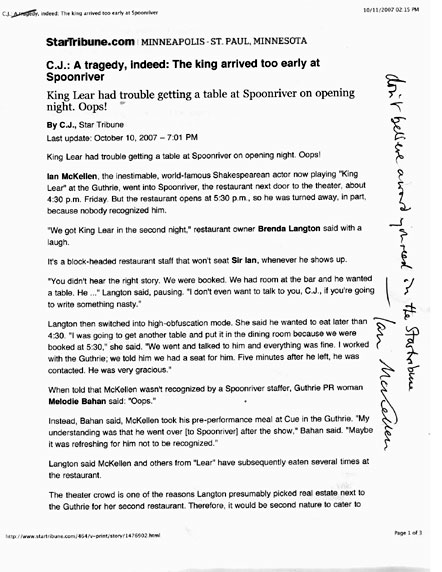
    We were subsequently shocked, SHOCKED to learn that Sir Ian held a different view of that column item, as evidenced by his handwritten note on a faxed copy of the October 10 column. "Don’t believe a word you read in the Star Tribune," it reads.

    BrendaIanNote.jpg

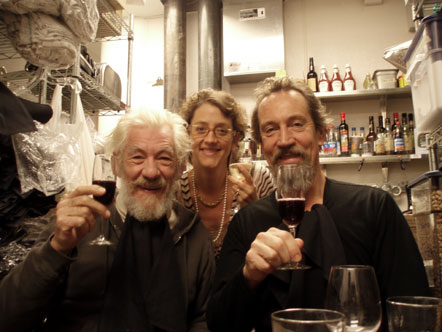
    Skeptics might be further assuaged by this picture of Sir Ian with Brenda and and Lear co-star Jonathan Hyde, who played the Earl of Kent.

    IanBrenda.jpg

    The Strib has steadfastly ignored complaints about C.J., preferring instead to praise her regular appearance as one of the top columnists (on and off line) at the paper (not really that hard to do if you’re writing about media, gossip or sports, three of the reading public’s favorite topics/guilty pleasures).

    Why would this change just because one of the world’s greatest living actors thinks she sucks (and, now, the paper as well)?

    Perhaps the Pioneer Press’s marketing department (if it still has one) should give the McKellen note a look…it could make a dandy billboard, don’t you think?

    LAMBERT: I called Ms. Langton, a.k.a. Brenda, this morning to get a little better idea how this CJ classic actually went down. I mean, the clear inference from the Oct. 10 column was that Brenda’s clueless, rube-like people had snubbed the great actor and … uh, maybe … we might imagine … McKellen was miffed. Right? (Again, hard to tell from the column.)

    "It was just so stupid," Brenda remembers. "She [CJ] called up and was just so super nasty. She had this tone. And she’s saying things like, ‘Do you have weekly meetings?’ Uh, yes, CJ, we have staff meetings. What’s your point? ‘Well, don’t you think you might want to put up pictures of all the famous people in town so your staff recognizes them if they come in?’"

    Brenda’s response was a steely, "No." She explains — and I freely admit we’re deep into This Has Nothing to Do With the Price of Rice territory — that she spotted McKellen looking at a Spoonriver menu one afternoon as she was on the phone, coincidentally enough, to the Guthrie. By the time she got off, the aged, rumpled McKellen, who doesn’t exactly have the same recognizablity quotient as, say, George Clooney, had left. Brenda asked her staff what happened, and they explained that, it being 5 p.m., they didn’t have a table free right then and McKellen didn’t have time to wait. No volcanic outrage on the great man’s part. Busy restaurant. Tight schedule. Can’t make it today. It happens.

    Long(ish) story short, Brenda calls her Guthrie pal to tell them to tell McKellen she’s very sorry and she’ll find a spot for him. Word gets back that McKellen was not at all offended but couldn’t make it back that day; he would however try again. Still, at this point, no harm, no foul, no snubbing, no nothing — except the insinuation in the area’s largest newspaper that the provincial Midwest chowderheads bungled an opportunity to serve a lion of the theater.

    Such a nice, light touch.

    Anyway, according to Brenda, McKellen, true to his word, stops in a few days later. Again at 5. The restaurant is full. But this time Brenda jumps in and offers him and fellow actor Hyde "executive dining" in her tiny kitchen office. McKellen likes the idea. "Mah-velous! Mah-velous," he says. Lear must eat! Brenda tosses on a crisp white tablecloth, and the two men enjoy a fine meal before posing for a picture and heading back over to the office.

    "They were both wonderful," says Brenda. "Ian went around and greeted everyone in the kitchen."

    At some point, someone mentions CJ’s column to McKellen, and Hyde cracks something to the effect, about how, in general, "You can’t trust these papers." Off that cue, Sir Ian merrily autographs a Xerox of CJ’s Oct. 10 opus, which Brenda might well-consider framing by the front door. It’s a terrific reverse-barometer review, in a way.

    "Famous people have been coming in for years," says Brenda. "Joe Perry of Aerosmith came back to talk to (the kitchen staff) one time. Elvis Costello comes in every time he is town. So does k.d. Lang. But I’m not about to pounce on people. You know?" (She says she hasn’t done the Sardi’s or Carnegie Deli thing and framed pictures of her famous clientele, but may start. "I’m 50 now. So what the hell, right?)"

    She says CJ — who is nothing if not relentless — comes around frequently demanding to know, as opposed to "asking" — who has been in. (That velvet touch thing is so overrated, you know.) "She’s mad because I don’t tell her who has been in."

    Brenda says she didn’t send CJ a copy of the autograph but did kick over a copy of the group photo you see here. "She didn’t see the humor in it. She called and asked if someone was playing a practical joke on her."

    If there’s a bottom line to this "issue" it’s an almost pathological deficit of humor. But that’s not news, is it?

  • RADIO (Magazine) Dials Down

    RYBAK: Word trickling out of Kenan Aksoz’s Metropolitan Media Group in Bloomington is that its newly launched RADIO magazine has encountered some static after just two issues. Kenan told me Tuesday that RADIO, which is jointly owned by Metropolitan and the radio marketing group Marketing Architects, “will be put on hold while we assess the model.”

    Kenan acknowledged that, at 100,000 copies per issue, RADIO was an ambitious launch. “The initial feedback from readers and distributors was better than expected.” However, “the advertising was a little slower to come by.” He said it wasn’t unusual to “have an initial launch, then put it on hold for a few months to re-evaluate it and then come out with a regular schedule.”

    LAMBERT: Metropolitan Media is the outfit that turns out Escape [Sun Country’s inflight magazine], Saint Paul, City South, and all those shiny suburban city magazines that come free in the mail, Edina, Woodbury, Eden Prairie, etc.. They’re all based on the notion that you and me and the celebrity-crazed housewife next door are eager for a peek at the lifestyles of famous media folk like, uh, Dan “The Common Man” Cole and — more specifically — any woman. preferably blonde, who has ever read off a TelePrompter in front of a live camera.

    While I accept the apparently inexhaustible advertiser faith in the appeal of the lifestyle magazine format, when MMG announced a monthly built exclusively on Twin Cities radio personalities, our reaction I dare say was, “WTF?” It would be an understatement to say we had doubts about market enthusiasm for a magazine focused on such a narrow media niche.

    RYBAK: I asked Kenan about that during our conversation and he readily agreed that the concept was unusual: “It’s the first of its kind.” He said the rationale was that there were only a handful of TV stations here and that they were already covered by local media. “But radio is barely covered by anybody.” Given that big TV dogs like Don Shelby have their own radio shows and that other big dogs like Jeff Passolt regularly appear on other radio shows, “they would show up in our magazine anyway.”

    LAMBERT: Still, everyone knows that once you get past Tom Barnard, Jason Lewis, Dan Barreiro and a small handful of recognizable names, the celebrity impact quotient of local radio starts to slide pretty drastically. I mean, if you’re a life-style magazine the assumption you’re selling is that the celebrities featured in your magazine have lifestyles worth envying. But the reality is that most radio jocks are working for little more than your average SuperAmerica manager. No one is going to envy their Ikea kitchenette and classic ’97 Nissan.

    That said, damn but I’d love to see the outtakes from a foo-foo lifestyle shoot at the homes of the Barreiros, or the Lewises or — my personal fantasy favorite — Joe and The Long Suffering Mrs. Soucheray. (“Joe! Joe! Joe, come up and say hello to the nice reporter!”) I’d pay for pics of the boys posing proudly in front of their new chintz drapes and overstuffed love seats.

    RYBAK: Although Kenan said that a couple salespeople were let go, the fact that RADIO editor and former WCCO-TV reporter Bridgette Bornstein still has a job would indicate that there may be some broadcast life yet left in the mag. He said a final decision could come in a week, or take a month.

    Certainly things aren’t hurting at Metropolitan, which currently publishes 20 magazines. Kenan told me that City South, which covers Southwest Minneapolis, has been so well-received that he’s bumping it from a quarterly to a monthly publication. Three other quarterlies–Burnsville, Chanhassen and St. Croix Valley–will also increase pub dates from quarterly to bi-monthly.

    So, you can smirk all you want, Brian, but damn does that lifestyle concept sell. Just think, someday Kenan might even launch a mag called BLOG and feature glossy pics of all of us at home working in our pajamas….

    LAMBERT: Hey, give ’em my number. If they’re nice I’ll strike a series of erotic poses in front of my Coleman grill and show off the couch with the dog drool down the arms.

    But my point, and I had a conversation earlier this year with the Met Media bosses, is that I don’t get their active disinterest in anything newsworthy. As is, they have a magazine consciously avoiding information. My argument was that if they spread the concept out to all Twin Cities media, rolling in the hot-shot cool kids in advertising, publishing, TV and radio, plus their well-fed bosses and balanced out the dingbat “Ooo, look at the beautiful teak crown moldings” stuff with a little news about how these people operate their magazine might make a little bigger impact.

    RYBAK: I acknowledge your point, but think the “non-newsworthy” label can be affixed to a lot more media outlets than Metropolitan. One local publisher was complaining recently that all it takes is one scintilla of un-Pollyanna like writing/reporting to scatter advertisers to competitors offering no newsworthy whatsoever, just print infotainment–interesting little nuggets that don’t hurt anybody. So, in the pursuit of the almighty advertising dollars, nobody’s doing newsworthy–let alone controversy–anymore.

    That said, I absolutely agree that a magazine that covered a variety of local media, rather than just radio, would have seemed a smarter choice.

  • KMSP, WCCO Big Winners at Midwest Emmys

    (UPDATED)

    Okay, okay…enough with the ranting about fake presidential candidates, weathercasters and global warming.

    Media news (of sorts) transpired over the weekend — the annual Upper Midwest Emmy Awards — and I’m here to break up the six-pages of winners into some edible doses for y’all.

    Lambert, who finds award-tallying to be beneath his station, will hopefully weigh in later with some truly dignified poop about the nasty pistol-whipping-in-print that C.J. inflicted on crack KSTP I-Teamer Bob McNaney for his Emmy presenting.

    First things first. It was a close race, but KMSP edged out WCCO in most Emmys won — Channel 9 nabbed 17; Ch. 4 won 15, including a couple biggies: Best Evening Newscast for its 10 p.m. show and Best Sports Anchor to mainstay Mark Rosen. KARE pulled in third with 11 awards, followed by a tie between KSTP and Fox News North, each with 7. KSTP’s Emmys included one for anchor John Mason, several for its breaking news coverage–on air and online–plus one for perennial winner Jason “On the Road” Davis. Twin Cities Public Television took home three Emmys, two of them to “Almanac.”

    Almost half of KARE’s awards went, as they always do, to features from super-reporter Boyd Huppert, who must have a warehouse full of hardware by now (including a national Emmy this year). KSMP investigative journalist Trish Van Pilsum was another multiple award-winner, along with ‘CCO “Good Question” asker Ben Tracy and that segment’s pro shooter, Joe Berglove. Fox Sports Net North’s Anthony LaPanta took home several awards–one for sports play-by-play–as did producers Jeff Byle, Trevor Fleck and John Stroh.

    Photojournalism Emmys went to KARE’s Jonathan Malat (sports), KMSP’s Andy Shilts (news) and Phil Thiesse at KSTP (program).

    Online — or “advanced media” as it is known to the Upper Midwest Chapter of the National Academy of Television Arts and Sciences — was a prominent category this year, with awards in 17 categories. Judging from the number of awards it garnered–5–KMSP has gotten the hang of online much better than its competitors. Coming in second in this category with four awards was–watch out–startribune.com, definitely a new face at this shindig.

    There were even blogging awards (do you hear that, Lambert?). WCCO’s Jason DeRusha was named best online personality affiliated with a media outlet; Sheletta Brundidge won in the independent online personality category.

    (Lambert Adds:) Awards for blogging? Does this mean I should bathe, groom and buy a tie? Maybe next year, huh?

    I called Bob McNaney about this latest shot from C.J. The man was not pleased, but knows the C.J. game — react negatively and feel the pain for additional months on end — well enough to leave his on-record response at either, “Who cares what C.J. says?”, or “I’m not giving her the time of day”, take your pick.

    I haven’t exactly made a science of this, but apparently the Strib’s most relentless local media watcher — sorry, Neal (Justin) — has been after McNaney for years. But it flared up anew this past winter when McNaney filed several tough pieces on U.S. Attorney Rachel Paulose, simultaneous with C.J. defending/lauding the curiously inexperienced and partisan-tainted replacement for Tom Heffelfinger.

    A professional assessment here; I regard McNaney as one of the half dozen best TV reporters in town. His stuff is invariably solid. But that’s just my read on the small stuff … i.e. how he does his job. I gather that unlike quite a few other TV types, skittish anchors in particular, McNaney hasn’t played the C.J. game, parceling out “scoops” like protection money to curry favor and avoid her wrath, and those railroad cars full of ink.

    Maybe next year we’ll give out awards … unless we win a blogging Emmy, of course.

  • The Rant: Cold on Colbert

    (UPDATED 10/22) I am not without a sense of humor (anybody see the Ambiguously Gay Duo/Minneapolis police spoof on SNL Saturday?) and I am a big, big fan of the Jon Stewart-Stephen Colbert week-nightly comedy hour on Comedy Central.

    So why don’t I find this recent “I’m running for president as both a Democrat/Republican in South Carolina” schtick of Colbert’s particularly funny? The rest of the media is just wetting its pants over it, as evidenced by the boatload of press the faux right-winger has generated since he hinted at his big announcement last Tuesday on his pal Stewart’s show, then made the announcement on his own show.

    Nobody’s been more anxious to be in on the joke than the New York Times , which seems particularly devoted to the satirist’s nascent campaign.

    Maureen Dowd appeared to start it all a week ago with the cute trick of turning over her column to him, where he hinted at the pending “news.” This is the same Pulitzer-Prize winning hardballer who turned into a blushing, giggling schoolgirl around Colbert and Stewart during an interview for Rolling Stone last year.

    Colbert’s announcement was followed by a second Times story that intimated that the man was really serious, having placed calls to South Carolina political apparachiks.

    Now today, following Colbert’s appearance on Meet the Press [transcript here]our adored local boy and big time columnist David Carr weighed in on l’affaire Colbert and finally, finally began to peel back the Saran Wrap on this bullshit…even if he did so with the utmost in respect and tenderness.

    Big media was taken to task during the release of “Borat” for playing along with Sacha Baron Cohen’s grotesque character rather than forcing Cohen himself to the forefront of interviews. The media hung its head in shame–kind of–and the movie went on to make gazillions at the box office. Now it appears that hangover has subsided and it’s once again time to report sham as news and vice versa, and send Colbert’s book sales and ratings soaring.

    Steve, my plea borrows some infamous words from your buddy Jon: Stop. Stop. Stop hurting America.

    Stop helping mainstream media behave like fawning wannabe-cool assholes. Stop. Go do your show. Sell your book–you’ve got a platform most authors would kill for.

    I’m seriously trying to figure out whether the stock market’s going down the tubes, if we’re about to bomb the shit out of Iran, and which actual presidential candidate is worthy of my attention. Frankly, all your dicking around is distracting formerly reputable journalists from doing their jobs. It was cute when Pat Paulson did it–everyone knew he was kidding.

    I’m not even sure half your viewers know that your show is a spoof, let alone your candidacy. That’s the scariest development of all, if you continue with this bit.

    LAMBERT:
    I have to add this, from hyper-glossy Portfolio mag. It pretty well echoes Deborah’s take on the Colbert campaign.

    LAMBERT: Oh boy. The wagon is rolling. Now there’s this from Gawker.com. And this from Huffington Post.

    RYBAK: They can eat my dust. Cool, gives Jimmy and his buddy others to yell at….

  • Should We Care What the Weather Anchors Think?

    While hunkered down at the cabin over the long MEA weekend watching a monsoon-like system refill northeast Minnesota rivers and lakes I had to laugh at a front-page (above-the-fold) story in the Duluth News Tribune. It seems Duluth NBC affiliate weatherman Karl Spring, formerly of KSTP and WFTC here in the Twin Cities thinks Al Gore is “a left wing nut” with “an agenda”. At least that’s what he said on a panel discussion on a Twin Ports public radio show.

    Tsk, tsk. Mr. Spring’s response to the kerfuffle he set off and the News Tribune’s interest has been to tuck it in, keep his head down and bury himself in five-day forecasts. No further comments have been forthcoming, no doubt on strict orders from his superiors.

    But I kind of like the fact he said what he thinks. I don’t agree with him for a second, especially if his “Al Gore is a left wing nut” rant is code — as it seems to be — for disparaging the human effects of global climate change. But at least he had the guts — OK, more likely the “imprudence” — to say what he believes about an issue of greater relevance than whether the kiddies should wear their galoshes at the bus stop in the morning.

    Not that I look to TV weather people for any great depth of science, much less a political point of view. But the perhaps sad fact is that for a lot of folks the TV weather anchor is their most frequent interface with meteorological science. With that in mind, and with climate change as profound an issue to everyone as it is (with or without Al Gore, although Gore’s knee-jerk adversaries seem incapable of separating the two), it seems valid to me that those charming, glib people clicking through the weather maps offer a clue to their, uh, educated opinion on climate change.

    I’ve mentioned this before, but here in the Twin Cities, WCCO’s Paul Douglas is, for all intents and purposes, alone in his unconditional view that climate change is upon us, it is serious and human activity is a key component. This is to Douglas’s eternal credit and, to my mind anyway, greatly enhances his credibility. His primary competitors … eh, not so much.

    It would be fascinating to hear Douglas, KSTP’s Dave Dahl (or Chikage Windler), or KARE’s Belinda Jensen or Fox’s Ian Leonard on say, Kerri Miller’s MPR show talking seriously about the yeas and nays of climate change. Conventional wisdom says that any weather anchor at KSTP knows better than to wade into any “pro-Gore”-like thinking about climate change. Stanley Hubbard the boss of KSTP, after all, has actually produced his own documentary suggesting “global warming” is rank alarmism at best, and a hoax at worse. (And good luck finding a link to that gem on the KSTP website.)

    Over at KARE, where according to the well-tuned Gannett formula, they have perfected the game of never offending anyone, the educated, professional opinions of weather department employees are blocked by well-tailored socks in their mouths.

    Oh, and do I have to even mention that Mr. Spring, up in Duluth, concedes he hasn’t even seen Gore’s movie?

    BTW: Relative to Mr. Spring, here is a fascinating column from the Baltimore Sun collecting reader response to the news story on Gore winning the Nobel Peace Prize.

    Frankly, fear of exactly this kind of vicious, almost unhinged reaction is what prevents your average timorous weather anchor from saying anything about climate change.

  • PiPress Deal Beats a Poke in the Eye with a Sharp Stick — Barely

    The tentative deal between the Pioneer Press’s newspaper guild and Dean Singleton’s MediaNews doesn’t look so hot at first glance — the guild agreed to a pension freeze, a one-time vacation concession and significant changes to its medical and disability plans in return for a paltry two to three percent raise. [The entire agreement is detailed in the previous post].

    Still, unit chairman and bargaining committee member Alex Friedrich said Thursday, “We’re feeling relief that it wasn’t worse.”

    Expectations were extremely low when Singleton’s people started throwing out all kinds of shitty ideas during negotiations. Among them: Imposing a two-tier wage scale, reducing mileage reimbursement from 45 to 35 cents, and taking team leaders out of guild coverage.

    “There were more than a dozen things like that,” Friedrich said. “So these [concessions], although really big hits, were not as bad as the entire package could have been. I’m not about to say it’s a great deal. But considering what could have happened during a long-drawn out negotiating period, it’s the best thing we could have gotten under the circumstances.”

    Friedrich was proud that the Guild didn’t accept management’s health care proposal: “We came up with a compromise medical insurance plan that had not been proposed.”

    The Guild also got management to agree to look “into a wide range of issues and complaints that have been bubbling in the advertising section.”

    [A lot of those problems arose following then-publisher Par Ridder’s detrimental reorganization of the department shortly before he bailed out of St. Paul to move across the river and inflict more “right-sizing” at the Star Tribune.]

    The full Guild will discuss and vote on the new contract late next week and Friedrich acknowledged that “there are going to be a number of people who are really upset with these large concessions–I’ll admit that some of our veterans are going to be peeved.”

    Of course, there aren’t as many veterans to be peeved as before, since so many of them have already exited on one of the paper’s many buyout offers.

    So why did Singleton pull back from what many expected to be a complete pulverization of the PiPress guild (much like what Avista has planned for the coming Strib’s guild contract negotiations)?

    Friedrich was circumspect. “I can only offer my opinion, but anyone who’s been paying attention to [Singleton’s] own filing reports on Standard and Poor’s could question his situation regarding the amount of debt that MediaNews has taken on.”

    I still smell a Joint Operating Agreement brewing in the two papers’ futures.

  • PiPress, Guild Reach Agreement

    This just in: Dean Singleton’s PiPress and the newspaper guild have a tentative deal. Here’s the memo:

    October 18, 2007

    Guild, Pioneer Press reach tentative agreement on 4-year contract

    After three days of intensive, off-the-record talks, the Guild and the Saint Paul Pioneer Press reached agreement late Wednesday on a four-year contract covering 340 employees.

    The tentative agreement, which runs through July 31, 2011, would increase wages for all employees by 2 percent on July 1, 2008; 2 percent on July 1, 2009; and 3 percent on 2010. The MediaNews matching 401(k) plan would be offered to eligible employees upon ratification.

    The agreement includes a pension freeze, a one-time vacation concession, and significant changes to medical insurance and disability pay. It leaves intact nearly all of the language in the contract, including seniority on layoffs, the right to daily overtime and mileage reimbursement. It avoids the two-tier wage scheme the company had sought, and newsroom team leaders would remain covered by the Guild.

    If ratified, the agreement would bar layoffs through December 31, 2008.

    Three key issues that Guild members identified as critical to the future of the Pioneer Press were addressed in the talks: 1) the company agreed to partner with the Guild to apply for a grant of up to $400,000 from the state of Minnesota to design a training program focused on multimedia skills and the paper’s digital future; 2) the company agreed to a joint committee to investigate and make recommendations to resolve issues and concerns affecting productivity in advertising; and 3) the company agreed to include content employees at TwinCities.com in the Guild.

    A membership vote on the tentative agreement will be scheduled for the middle part of next week. More details about the agreement will be provided beginning Friday, Oct. 19. A unit meeting will be scheduled on Wednesday, Oct. 24 to present the agreement and answer questions.

    Unless otherwise noted in the following summary, all existing contract language would remain unchanged.

    Duration of contract: Four years, expiring July 31, 2011. Wages: Across-the-board raises of 2 percent on July 1, 2008, 2 percent on July 1, 2009, and 3 percent on July 1, 2010. Medical insurance: This proved to be the most difficult issue to resolve, because of significant changes planned by MediaNews in 2008 — changes just recently made known to the Guild bargaining committee. In a nutshell, the changes include a new, less expensive base plan upon which our rates for the HealthPartners plan, which most of our members use, is based. The effect was to create large increases in premiums for members on the HealthPartners plan. The company would have imposed those changes on January 1, under the terms of our expired contract, regardless of whether a settlement was reached. The Guild committee worked to mitigate the impact of the change by seeking new quotes from HealthPartners for the existing plan, and for a new, second HealthPartners plan that would be more affordable but would have higher co-pays. As a result, HealthPartners premiums will rise, but not as much as they would have otherwise. The Guild also secured a cap on costs for the hardest-hit group: two adults with no children.

    (More specifics on the changes: The former Knight Ridder Blue and Green plans offered by United HealthCare would be replaced effective January 1, 2008 with two new national, self-insured plans offered by MediaNews. The two plans, administered by Blue Cross, include a “core” option and a “buy-up” option with a higher premium. Under both options, employees choosing single coverage would pay 22 percent of the premiums; the three other coverage options — employee plus spouse, employee plus children, and family — would be offered at 30 percent of the premium. The current HealthPartners plan would continue to be offered, alongside a new HealthPartners option with benefits similar to the old Knight Ridder Blue plan. The Blue Cross “buy-up” plan would serve as the base plan for calculating premium contributions for the HealthPartners plans. Several factors will cause the employee share of the HealthPartners premiums to increase substantially. )

    Retiree medical: The current retiree medical options would continue to be offered to employees who are 55 or who turn 55 and who choose to retire before July 31, 2011. Coverage would not be available to employees retiring after that date. The change does not affect retirees now receiving medical coverage.

    Pension: The Guild pension plan would be frozen, but, for the life of this contract, employees would continue to receive service credit. That means veteran employees can accrue service under this contract to qualify for early retirement, and less senior employees can continue to accrue service to vest in the plan. The freeze does not affect any benefits accrued by employees to date, and has no effect on retirees now receiving benefits. The company must continue to make payments to bring the plan to fully funded status.

    401(k): Guild-represented employees would become eligible upon ratification for the MediaNews 401(k) program under the same terms as management employees. The plan includes a 50 percent match up to 6 percent of an employee’s contributions (3 percent maximum employer match). Previous service with the company counts toward vesting.

    TwinCities.com: Content employees at TwinCities.com would become part of the Guild bargaining unit. Freelance: The Guild agreed to language permitting the company to use freelance material for prep and small college sports, as well as for police blotter items and daily suburban briefs similar to those written by news clerks. Training: The company would work with the Guild to identify and partner with a local college to apply for a state Job Skills Training Program grant of up to $400,000. The money would be used to create and provide a training program specific to the needs of Pioneer Press employees as the paper continues to expand its presence on the web. Among other things, the grant would help newsroom employees obtain and enhance multimedia skills.

    Advertising: The company agreed to a joint Guild-management committee to investigate workplace issues and concerns in the department and to present recommendations designed to improve communication, productivity, and revenue growth. The Guild agreed to eliminate minimum commission rates that had been replaced with a different commission structure in the department (so-called “commission-grid plans”), and also agreed to allow business development accounts of roughly $40,000 or less and inactive accounts to be transferred from salaried to commission sales representatives. The company agreed, in turn, to index base wages for commission-grid plans to the raises negotiated for other employees; to elevate sales representatives on the commission-grid plans from Tier 1 to Tier 2 base pay not later than 15 months from their date of hire; to guarantee for two months the payment of a minimum of 100 percent to goal for new hires and for commission sales representatives transferred to new territories; to use average daily earnings as the basis for computing paid time off; and to resolve a grievance filed over average daily earnings by making all affected employees whole for their losses.

    Vacation: The Guild agreed to move to a new accrual system. The effect of the change is this: the company eventually gets to wipe more than $1 million in accrued vacation off its books, resulting in a one-time savings. Members who continue working do not lose any vacation time. The number of weeks granted per years of service is unchanged. But when a member leaves the PP, chances are he or she will not receive the payout for previously “accrued” time as in the past. Here’s how the change would be implemented: Effective January 1, 2009, employees will earn and use vacation in the same year; currently, employees earn vacation in one year and use it in the next. (Employees will be able, in the new accrual system, to take vacation before it’s earned.) Effective January 1, 2008, when the transition to the new system would begin, employees would be eligible to use the full amount of vacation earned in 2007, but would not accrue new vacation until January 1, 2009. The change, again, would have no affect on the amount of vacation to which employees are entitled; an employee who earns four weeks of vacation each year still would be eligible to take those four weeks in 2008, 2009 and beyond. The change would affect employees eligible for a payout of accrued vacation upon resignation of employment.

    Severance: The Guild agreed to add “gross misconduct” as a basis for denying severance to terminated employees. The severance cap of 38 weeks remains unchanged.

    Job security: The company agreed to no layoffs for 14 months, through December 31, 2008. Sick leave, short- and long-term disability: The current sick leave pool of 10 days annually, with a maximum bank of 20 days, would remain unchanged. The Guild agreed to replace existing short- and long-term disability policies with those offered to management. Those policies pay 70 percent for a qualifying short-term disability and 60 percent for a qualifying long-term disability. The company must supplement short-term disability for Guild-covered employees so that they receive 100 percent of pay for up to 120 days; thereafter, employees would receive 70 percent of pay for 60 days, and 60 percent thereafter.

    The Guild bargaining committee included Julie Forster, unit chair Alex Friedrich, Meggen Lindsay and Jim Ragsdale of the newsroom; former unit chair Jack Sullivan of the newsroom (through August); Dave Noble of advertising; Lance Forys and Duane Maxson of circulation; and Marilyn Clements and Darren Carroll of the Guild office.

    The committee has been supported throughout the process by three dozen Guild leaders and activists including Mara Gottfried, Cheryl Burch-Schoff, Tim Nelson, Dave Orrick, Fred Melo, Kelly Blaiser and more than 30 Guild contacts. All took part in an unprecedented level of preparation for bargaining.

  • The FCC and More Media Consolidation: The Monster that Will Not Die

    We’ve all seen movies with monsters — aliens, masked serial-killers, cyborgs from the far future — that just will not die, no matter what you do to them. Incinerate ’em and a loose gram of their psychotic essence reconstitutes itself and the battle is on again.

    So it with the FCC announcing that it is going to try to fast-track a ruling allowing giant media corporations (the only ones who can afford to play this game) to, among other things, own both a newspaper and television station in the same city. Here in Minneapolis-St.Paul the one immediately conceivable combo-platter like that would be Gannett Inc., which already owns KARE-TV, buying one of the two daily papers … and tell me Avista Capital Partners, the Strib’s hapless owners, wouldn’t be open to an offer?

    This idea was roundly slapped down a couple years ago when the previous head of the FCC, Michael Powell, (Colin’s kid), tried it. As The New York Times reports this morning the outpouring of negative comment, not to mention the aggregation of some very strange bedfellows, (NOW and the NRA!), was unprecedented. The public — the wisdom of crowds — understands very well that LESS consolidation is the direction media in this country needs to go, not more.

    This is — big shocker here — yet another intensely partisan crusade. The FCC is currently a 3-2 Republican-Democrat split, and will remain that way through the remainder of the Bush administration. (If 3 to 2 sounds eerily like the 5 to 4 vote that put Mr. Bush in office, well, it’s a weird world, isn’t it?) Currently, as the Times reports, the Commission’s two Democrats are, A: Surprised this is back on the table, and B: Digging their feet in to fight again.

    Commissioner Michael Copps sounds more adamant than his colleague Jonathan Adelstein, who is quoted expressing concern that such a ruling should require more diversity in the system by somehow guaranteeing access to women and minority buyers of media companies.

    Please. Women and minorities are no more impervious to the siren song of fat buy-out paydays than your average Clear Channel/Gannett/Media Corp. white guy. If the system required women and minorities to maintain ownership and exclusive programming control for 10 or 20 years, maybe the “diversity” argument would be more appealing. But as it is/has been the first time one of the giants wanders in with a 20-times earnings buy-out offer, “diversity” is a fleeting memory.

    I could go on for hours about the deleterious effects of media consolidation, but try this for a quick and easy “explainer.”

    Consolidation=debt=budget cutting=less truly local coverage=more and more “economies of scale” (syndication, low-brow news and entertainment.)

    I’m open to anyone who can make the argument that the Clear Channel model of consolidation — the biggest and the arguably the most self-serving — has created more thorough and accurate local (or national)news coverage, more listener access to a wider range of musical talent, and less of the profoundly and demonstrably inaccurate and false, not to mention poisonous demagoguery of consolidated, syndicated “talk”? Now imagine if that kind of micro-managed, cutthroat, C- student quality thinking were granted the right to “program” your local newspaper as well? (Ok, no worse than Dean Singleton and Avista, you say? Damn, you might have me there.)

    I strongly suspect the current FCC head, Kevin Martin, is getting orders to ram this through before the limos of all good Bushies are egged on their way out of DC in ’09. And it seems reasonable to speculate how much campaign dough is lined up for deposit in Republican National Committee bank accounts — hello, Rupert! — to get this in to law before some “socialist” Democrat comes in with the lunatic idea that tamping down on consolidation might depress speculative media acquisitions and create more access by less gargantuan owners, some maybe even local, some maybe even female and/or minority.