I recently sat down to speak with Douglas Fogle–the curator of the 2008 Carnegie International–in his office at the Carnegie Museum of Art. It was a fine, bright spring day about one month into the run of the latest version of the great survey exhibition of international artists that was first mounted in 1896, and Fogle, who left the Walker Art Center in 2005 after eleven years to take this job, looked relaxed–if somewhat more internally care-worn than the last time I’d seen him at the beginning of his stint in Pittsburgh. (Full disclosure: I worked in 2006 for a brief time as a part-time media relations person at the Carnegie Museum of Art, where the Carnegie International takes place every three or four years.)
You can also, if you’re so inclined, read "Oh Man, Look at Those Cavemen Go!"–my expansive review of this sizeable exhibition.
Michael Fallon: The first question I wanted to ask is about the show’s title, "Life on Mars." I read that it came from the David Bowie song, and I’m curious if the first line of the song–"It’s a god-awful small affair"–was in your mind as you were organizing the exhibition, which is obviously a huge affair.
Douglas Fogle: It wasn’t the first line. I was a huge David Bowie fan as a kid, when I was in high school. Actually I came to a lot of art and cultural stuff through music–not just David Bowie, but other bands. Living in the suburbs of Chicago, that was kind of how I got my cultural fix. I learned a lot through music about film and art and other things.
I was well into working on the show before I titled it. The exhibition has never had a title for the show in 112 years. That was sort of the radical gesture, according to Pittsburgh, which asked "you’re having a title?" To give something a title rather than just saying this is the Carnegie International, that was just the way I wanted to do it. The idea was really to have the exhibition start before you walked in the door, for a question to be asked. At the Walker Art Center, titling your exhibitions was always a contact sport. In the curatorial department, we liked to compete with each other in coming up with good titles that were evocative without dominating the artists. And "Life on Mars" really came out of the idea of the kind of humanity that is discussed in that song. It’s a very human song, about a world spinning out of control, and are we looking for another world to go to, or is this world itself an alien place? It really made sense to me to give it something that was open-ended, and you could read many things into it.
The way I read it now is it tends to refer to the different worlds that many contemporary artists will take you to. Each of them will take you to some other world, which is often–or usually–our world slightly put askew, so you can look back at it from a different angle.
Michael: The "god-awful small affair" sort of speaks to that, which is interesting. The song starts out as a domestic moment, then opens up to a lot of the more outward-focused imagery in the lyrics. And there’s a lot of work in the show that’s very intimate, domestic, personal that then opens up to something larger.
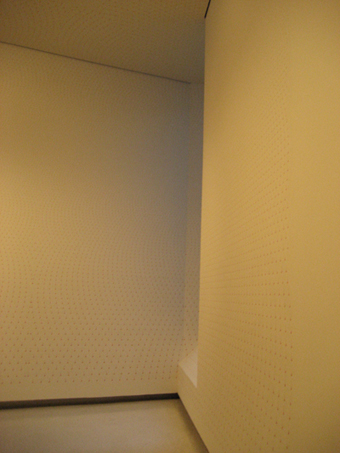
Douglas: The idea of intimacy and immensity, which in my essay for the exhibition catalogue I talk about a quote by the French philosopher Gaston Bachelard, who wrote a book called The Poetics of Space. He talks about oceans that are both intimate and immense at the same time. Outer space is the same thing, in a way. And that idea–of the one individual grain of sand in the millions of grains of sand in a pile of sand, where you see the pile of sand but you also see the individual grain–that was something that a lot of the artists I was interested in were doing in a metaphorical, or even in a real way. In Richard Wright’s painting on the wall in gouache, there are thousands of little triangles that he’s painted on the wall. It’s a very intimate and a very ephemeral thing too. That painting gets painted out at the end of the show, it’s over.
So as for the song, it’s funny. You choose artists and you put them together, and all of a sudden you start seeing connections that you never saw before. You choose a title and you don’t think about all of the implications, and then it becomes more and more interesting as you put the work together and you start to think about how you can interpret different works in different ways. One thing I always wanted to stress before the show opened was it’s not a show about science fiction. It’s not a show about space, even if that’s a great metaphor. But who knows–now we have Mars in Pittsburgh…
Michael: Well, and the Bowie song is not really about science fiction either. I promise I’ll get off "Life on Mars," but I wanted to ask one more question about it. The first line of the second verse was very interesting as well. It was, "It’s on America’s tortured brow/that Mickey Mouse has grown up a cow…," which sort of takes the personal moment in the song and begins to politicize it a little bit. Was that also an influence on the show?
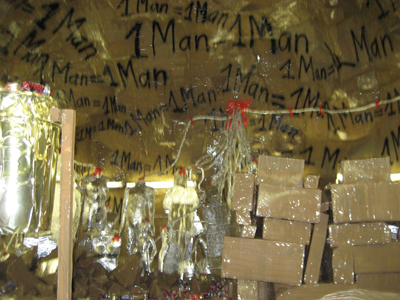
Douglas: No, I would hate to push the show towards any sort of a political thing, because it’s not. There are individual artists who have a different take on things. The most so-called political artist in the show would be Thomas Hirschhorn. But he would say, "I’m not a political artist, I make work politically." It’s for him the formal stuff–using duct tape, packaging tape, cardboard, tinfoil, photocopies, everyday materials, very democratic materials–that’s really important. His piece "Cavemanman"–which has been seen in Minneapolis at the Walker Art Center a year or two ago so some of your readers might remember it–has a cave in the back, of the many caves that make up this 2,100-square-foot installation, that has scrawled words "1 Man = 1 Man." And that’s about as political as it gets, which is one person should never equal less or more than another person. It’s a very democratic ideal, and very much this sort of universal equation of ethics, I think, the bottom line that if you reduce ethics to an equation that’s what it is.
So it’s not really a show about America, especially since only eight of the forty artists are American. It’s a show about the world and about a relationship to, I hate to say it, the human condition. That just sounds so pretentious, but it’s not about Hannah Arendt writing about the human condition. I think about authors who write very much about what it means to be a human. It could be a novelist too. I think a lot of these artists take this on in different ways. It might just be they’re using their hands a lot in the work, such as in the ceramics that Rosemarie Trockel makes, which refer to this domestic 50s furniture in a very modern, yet all-ceramic and hand-made way. They have that push-pull between the mass produced and the handmade, between the absent body and the body that’s supposed to sit on a sofa. Yet, you can’t sit on these things because they’re made of 200-pound ceramic objects.
So, in the end, I think there are different worlds being evoked. You could make a case for Mario Merz’s work being political, and about the times. One of the last works he made is in the show, from 2003. It’s a set of newspaper stacks, and he took the newspapers that were just from the days around which he made the work, which happened to be right when the U.S. was going to war in Iraq. On top of that, it is a neon French phrase which says, "A roll
of the dice will never abolish chance," which is the title of a Stéphane Mallarmé poem from 1896 or so–around the time, actually, that the International was founded. It’s a paradox, a symbolist poem that was also graphically designed across the page so that you would read it in multiple ways. You could read it very different ways depending on how you started reading it. It’s a paradox: A roll of the dice is supposed to eliminate chance, because that is chance. You roll the dice and then, boom, you get your, you know… Marcel Duchamp appropriated the phrase for a work he did as well. I think it’s very interesting and so open to interpretation: What does that mean on top of these newspapers stacks that happen to be newspapers covering the beginning of the Iraq War? I didn’t know the newspapers were from the beginning of the Iraq War when I asked to borrow the piece. I knew there were newspapers, I just didn’t know from when. These are all chance things that you can think about and keep yourself updated with, in an interesting way.
Michael: A friend of mine saw the show and he actually used the word "apolitical," though I don’t think the show’s really apolitical since there are politics and social concerns in there. Did you consciously think you wanted to stay away from politics with the artists that you chose?
Douglas: No, I studied international relations and political philosophy. The first section I turn to in the newspaper is the op-ed page every day after the front page. So, no, there are artists who make very didactic work. I’m not so interested in didactic work. I would say that Thomas’s work is the closest to that in the entire show, and it’s not that at all, in my mind. It’s so much not about that, it’s about the formal questions that come up in Hirschhorn very much translated to content in a very particular way. And so no.
Actually, I think it’s very political, strangely enough, to do a show about the human condition. I think that if you want to do a show about issues, that’s a different thing, and I think kind of boring, quite honestly. The artists that I’m most interested in are the ones that are much more open-ended in their questioning, rather than didactic.
No, I didn’t think "I’m not going to do a political show." In fact, the first essay after mine in the catalogue is Jonathan Swift’s "A Modest Proposal," which is a total satirical and political indictment of the English in 1727 of their occupation of Ireland. It’s a piece of satire and that’s where I think it becomes very interesting. When you have people writing things like that, which are humorous but also completely devastatingly political.
Michael: And your essay also mentions Goya and [filmmaker] George Romero in a political-social context, which is interesting because those are quite stark, quite dramatic instances of very in-your-face politics that didn’t really appear in this exhibition…
Douglas: Well, except so few people would read George Romero that way.
Michael: Still, it’s a very stark and dramatic, black-and-white Zombie movie. There’s really nothing like that in this show.
Douglas: And Goya’s work, his "The Disasters of War," was very political, but it was also dark and modern in its own weird way that was not didactic. The "Disasters of War" by Goya were very much political, because they done as prints and they could be distributed, but those black paintings they talk about–"Saturn Devouring His Children" and whatnot–those were never even meant for public consumption, yet they share the very same kind of dark look at the world as the "Disasters of War" did. I think that the essay is one more aspect of the exhibition, as is the catalogue, that is a separate thing, but it’s very much a parallel project. I don’t know–you look at Thomas Schutte’s work and you look at zombies, I don’t know that I would call that political, but I have to say Thomas is the one whose work I wrote about last year and talked about Jonathan Swift and he said "I love that essay." A lot of Thomas’ work is about taking apart the idea of monumentality. When you talk about the monument, he’s thinking of the political monument, the artistic monument, all these different ideas of the monument. And those zombie sculptures are taking apart his own work, his earlier works–the big ghosts. Except he is taking those apart and reconfiguring them.
So, no, we’re not talking about John Heartfield anti-Nazi collages, but I think there is politics if you look at Phil Collins’ film. I think it depends on how you define politics. It’s an incredibly beautiful, incredibly human, incredibly heart-breaking film, really really beautiful, and probably the most sophisticated thing he’s done as a filmmaker, but it’s very ambiguous. In its cinematic qualities–the light, the camera, the way he directs the cameraman–in its content, in its stance, you know. This is a Serbian family living in Kosova, and they are seen now as the "bad people," but they were kicked out. So Phil didn’t want to go for the easy thing and just talk to the Albanians about the Serbian language. He went and talked to other people from there and about what happens with a language when it’s the official language and yet there’s another language spoken by the majority. What happens? Before he made the piece, the questions he wanted to ask people were, "Do you often accidentally reach for a word in Serbo-Croat, instead of Albanian? Do you accidentally dream in Serbo-Croat, because you grew up speaking it in school? Do you think of a folk song or start humming a folk song that was actually Serbo-Croat, even though you’re an Albanian and aren’t really supposed to speak it anymore?" It was a really difficult project for him to do, and I have to say that’s the kind of political inquiry I’m interested in, in terms of the art world–the investigating of those ambiguities. As Collins put it, someone told him, "What you’re asking people to talk about is very difficult. It’s like going to Israel after the War and asking people to speak in German. People who escaped." He said you’re asking Albanians to speak in Serbo-Croat, and we don’t speak it anymore. That’s a real brave act as an artist to go and take that kind of thing on. It’s a very textured piece, it’s a really beautiful film. If that’s not political in an interesting way, then I don’t what is. I think that relates directly to the kind of things I talk about in my essay in a very different way, because I hadn’t seen the film yet.
I think there are lots of other things like that–from the Hirschhorn, to Mario Merz’s work, to Phil Collins’ work, to Mark Bradford’s abstract paintings that are political in a very different way. You could talk about it in very different ways depending on your point of view. Sometimes though there’s a lot of different work in the show. Sometimes, as Paul Thek said in the 70s, why can’t I just make a pretty, beautiful picture? There’s a level of engagement with the hand and the naïve sort of expression, child-like sensibility in his work. You could say that’s political. Peter Fischli and David Weiss recapturing the essence of what it means to be a kid, and the idea of play. That’s a radical gesture too in it’s own way. It’s not "we hate Clinton," or "we like whatever." It’s not didactic. I think contemporary art that’s didactic fails. I think it’s not interesting.
Michael: One of my takes on the International is I found it much more interesting and affecting on a human, social, political level than the 2006 Whitney Biennial, which was filled with a lot of work that was very overly political, very angry, and, maybe, didactic. I wondered if that show was in your mind when you were putting this together.
Douglas: Well, two of my friends curated that show, but the Whitney is its own animal. It’s all American, for the most part. It’s every tw
o years; it’s one hundred artists, instead of thirty-five or forty. It’s a very different project. I’m actually one of the few people who liked that show. It got criticism I think for how dense it was, but I thought it was really interesting.
The Whitney and the Carnegie are two of the oldest shows in America. The Carnegie is a really different animal. It’s international. It’s an older show. It’s also museum based, which is interesting because they’re very comparable that way, but historically the Carnegie always had about 35-40 artists, which is all you can really accommodate in any kind of serious way giving people enough space. I probably could have had 35 instead of 40 artists and given everybody a little bit more room, but when you put together a show you’re never quite sure how it’s going to fit together and you keep wanting more and you have to temper yourself.
I think it’s just a different take on the world. I’m a different person. This is the show that I felt I needed to make, a different take about where we are now in the world. I do think, honestly, the choices I made were very political in their own way. I just would not call it didactic, I guess.
Michael: I wanted to ask about the fact that a lot of critics of record have written in the last ten years of so about the declining influence of international survey shows like the Carnegie and the Whitney, in the face of the rise of art fairs like the Armory Show and Art Basel. How do you feel about this now that you’ve curated this show?
Douglas: I think the Carnegie International is a very different show. It is its own animal. It’s the oldest international exhibition in the world, except for the Venice Biennale–by six months only. The way my methodology and thinking worked was, when I got the job, I thought how do you approach it? Are you going to do a survey show with one from column A, one from column B? I’m going to go to 500 countries and blah blah blah. Or do you think, OK, I’m going to have a spine and I’m going to try to build around it, because it’s just one show? I’m going to do other shows in the future, so this is not the be-all end-all. It has to be a show, so that’s why I gave it a title and had a certain idea about what I wanted to do.
But, I don’t know, I think Venice will continue to be Venice. I think this show will continue on. I think the Whitney will continue on. Some of the small biennials might drop off. I think it really depends on who’s doing them. You know, I have no problem with art fairs. I learn a lot at art fairs, they’re great. I don’t want to go to all of them. The Basel Art Fair is happening this week and I’m not going because we have a board meeting, and it’s the first time in probably in eight years that I’ve not gone, and I’m kind of happy about it, it’s fine. I think the art fairs are a different venue. I do bemoan sometimes the overheated market for art, only in the sense–I mean I’m really happy that artists are able to make their living–but museums start to not be competitive. We can’t buy art. All these collectors, the François Pinaults of the world, are hoovering everything up before we can get to it, or we can’t afford it as a museum. That’s how I see these things in this market affecting public institutions, and all of these people wanting to start their own private museums. Of course this, I have to say, is what happened with the Walker Art Center and the Whitney. The Walker began as a private collection, and lots of other museums have as well. My hope for these institutions–these one-person museums–is that they do merge into or morph with other institutions. I just think that all of the institutions that we work in and the museums just need more help. It’s sad that people are founding their own museums when there are plenty of museums to help shape with your collections and your resources.
Is the biennial going to die? I don’t think it’s even an interesting question. They seem to keep going, and Documenta is still happening, and Venice is still happening. The Tehrani Biennial and some of these other smaller biennials around the world, maybe they’re not happening as much. And people talk about "festivalism" and all this stuff, but the art world goes in cycles. I do think there is a place for these exhibitions. I don’t know that I want to do another one right away–a big group show. I’d like to do a nice monographic exhibition now.
In the end, the art fairs serve their purpose, and as the market changes some of it might dry up. It happens, there are cycles. I’ve been in the business slightly long enough to see a couple of cycles. I started at the beginning of the 90s after the crash of 89-90, so things we really different then and I’ve seen the escalation of the art market and the biennials and all that. I think the Carnegie International will go on, I think the Whitney Biennial will go on. And I really don’t think those art fair are the proper way to see work. The bottom line is they’re fun to go to and look at new work, and sometimes you see things you hadn’t seen before, but it’s not the proper way to see work. I think there will always be a place for museums and these big exhibitions, especially the classic ones: Sao Paolo, Documenta, Carnegie, Venice.
Michael: A question for folks back home, how do you think the Walker prepared you for this big grueling experience, and how do you compare your experiences here in Pittsburgh to your experiences in Minnesota?
Douglas: First of all, the Walker prepared me better than any experience I could have had. I worked over eleven years there with other curators on shows, and then my own shows, which were smaller versions of this kind of a big group show. "Painting at the Edge of the World," "How Latitudes Become Forms," all these shows I worked on with my colleagues were smaller models of an international-type exhibition. Then, I worked with some of the greatest colleagues in the world there, in all different departments. It really let me figure out what I wanted to do. The catalogue for this show is a real testament to the Walker and the type of catalogues that I did there. We [the Carnegie Museum] don’t have an in-house design team, so I chose a designer recommended by the Walker design director. I really wanted to do a book very much like the ones I had done for "The Last Picture Show" and the "Edge of the World" that became a reader as much as anything else.
Pittsburgh and Minneapolis are very similar. They’re very similar communities. They’re around the same size. They’ve had the same sort of economic reinvention in different ways over the years. They’re also both, pound for pound, incredibly acculturated cities. In terms of per capita, there’s way more culture here than there should be. It’s a testament to the two cities’ great level of patronage over a hundred years or more–from your T.B. Walkers and Pillsburys in Minneapolis, to your Carnegies and Mellons and Fricks here. Both of them are similar, nineteenth-century, philanthropy-based cities. I miss Minneapolis and a lot of things about Minneapolis, but I don’t miss the dead of winter, I have to admit. It’s really horrible to say. But I love Minneapolis. I try to go back a couple of times a year to visit, and I will always have a real soft spot for it.
These are very similar cities, but this institution is very different from the Walker. This is closer to the MIA, because it has a department of fine arts before 1945, a department of contemporary art from 1945 and up, and also a great decorative arts collection and great architecture program, and we’re part of the larger Carnegie Institute, where we’ve got the Warhol Museum, the Natural History Museum, and the Science Center. So it’s a very different kind of structure from being in a completely contemporary institution, and there’s no performing arts department here or film department here like at the Walker, though there are lots of colleagues in town in those fields that I
work with. The institutions are very different, but I feel as comfortable here as I did there. Having a director who is a contemporary curator and had done the International certainly helps a lot, because I feel like I have colleagues to talk–whereas I had six or seven to talk to talk to at the Walker. You have your run in a place like the Walker, and we did great stuff for eleven years. And during Kathy Halbriech’s time, her leadership there was amazing. I credit Kathy and Richard Flood for keeping me interested in being in the art world and eventually coming to this. They were really instrumental in my early career, and I thank Minneapolis for that. People in Minneapolis are as great as people are here. I felt comfortable the minute I stepped off the plane. It felt like a similar city.
Michael: Do you know what’s next for you?
Douglas: Well, this is next. I’m not going anywhere at the moment. I’m working on the reinstallation of the permanent collection. When the exhibition comes down, half of the galleries that we use for the International are actually our collection galleries from 1945 on–the contemporary galleries. So, maybe later this month or July I’m going to start planning for next spring, to reinstall the collection. We’re working on keeping the show going. I’m giving tours every other day still. I’m doing a lot of programs in the fall. There’ll be a lot more programming. I’m working on acquiring some of the works from the show for the collection. The reason the show was started in the first place, in 1895, was to build a collection of contemporary work from this exhibition. So, I’m busy right now. There are a lot of other things to do. I’m thinking of other projects we could do here in the future, and starting to get the schedule ready so we see when the next Carnegie International will be. It looks about 2012 right now.
Michael: Thanks for your time.
Douglas: You’re very welcome. Thank you for coming.