Tag: wine

  • Liquid Incense

    I must say I have never understood what the Playboy bunnies saw in Dr. Kissinger. Perhaps they’re professionally equipped to detect charm and wit where mere men miss it. Who knows, the long fluffy ears may contain hidden sensors programmed to relay subtle messages to secondary brains located in the bunnies’ gluteal powder puffs, which, when they are not using them to the same end as the brontosaurus did its rear brain—to regulate the wagging of its great tail—can then transmit in appropriate code to the State Department in Foggy Bottom.

    Certainly one of the most delicious moments I ever heard on the BBC Home Service was an interview with Dr. Kissinger conducted by Jeremy Paxman, the Rottweiler of English political radio. It was a Monday morning, and the return leg of the school run. I had what MPR calls a “driveway moment” so powerful that I had to pull over. Dr. Kissinger clearly thought he had been invited to talk on the wireless so he could puff the sales of his new book. Instead he was asked some rather direct questions about the bombing of Cambodia. The scraping of the chair as the bodacious doctor rose to his feet was punctuated by Mr. Paxman’s running commentary: “Dr. Kissinger appears to be leaving … Bye, Dr. Kissinger.” Gee, those Brits are so polite.

    I guess what irks me most about him, though, is the well-known Kissinger dictum on academic politics, namely that infighting in universities is so bitter because what is at stake is so insignificant. Insignificant to whom, one may ask. Intelligent folk give their lives to enterprises like the breeding of fruit-flies or the study of Shi’ite theology because they think them important (and you never know when such pure study may come in handy—Foggy Bottom could perhaps use a spot of Shi’ite theology). More to the point, pure research is an enterprise often lonely and always imaginative. That is why it engages the passions. When someone whose intimate life has been engaged from an early age with understanding the Middle Ages is told that professional mediaevalists do not actually need to know Latin, it is scarcely surprising that he suffers an acute sense of humor failure. Of such differences are academic disputes made. They may seem insignificant to folk like the erstwhile plenipotentiary, but they are bitter for the rather prosaic reason that they often involve principles that the participants care about passionately.

    It is the same in churches. You can get good Christian folk to disagree about lots of things, from civil unions to the Doctrine of the Trinity. But in my experience the easiest way to incite a spirit of uncharitableness is incense; I am sure Uncle Screwtape would not disagree. For some folk, incense is insincere show, the reek of Rome, the epitome of vain repetition. For others, holy smoke is the prayer of the faithful rising up before God, swirling, shot through with sunlight, shared; they recall how early Christians witnessing the martyrdom of their comrades remarked on the sweet smell emanating from their seared flesh. Incense matters because it has to do with the way Christians pray, and that, presumably, is something they really care about.

    For those who find incense makes them wheezy, let me suggest a method of appreciating it in liquid form. It comes in slim green bottles containing wine made from Carignan grapes by Cline Cellars of Contra Costa County in California. Carignan is a variety with few friends. It has long been widely planted in southwestern France, where it has generally been blended with other varieties to produce vin very ordinaire, promote hangovers and cirrhosis, and sustain full employment in the French agricultural sector. Carignan vines contributed copiously to the Common Market’s “wine lake,” and in recent times French growers have been encouraged to grub them up.

    But where many Frenchmen have failed, Cline Cellars has made a distinctive, strong, dry red wine from Carignan grapes. I sipped it recently at a local hostelry alongside a plate of good oily spaghetti Bolognese. The acids cut right through the oils. But what was most remarkable was the smoky aroma that rose through the roof of the mouth directly from the tannins at the center of the taste. I have seldom met anything like it—the nearest thing I can think of is a nobly nutty, dry Oloroso sherry drunk a quarter-century ago. This is not a wine for everyone—bunnies, I am told, prefer champagne. But those who do like it should find it feeds the imagination. Give it a try.
  • Fresh Pink Innocence

    End-of-term gifts from one’s pupils are a recurrent pleasure of professorial life. Like the boarding-school boy who thanked the aunt for the bottle of cherries pickled in brandy, one enjoys them not only for themselves but also for the spirit in which they are given. Only once have I been given an apple (and then in a spirit of irony). Port, of course, is always welcome.

    Some of the offerings that have thus come to ornament my office enjoy an oblique, even recondite significance. There is the plastic McNugget that for nearly twenty years has been ever ready to perform the function kindly envisaged by its thoughtful donor, namely to differentiate between two senses of the present participle neuter of the Greek verb “to be.” Unadorned, the McNugget is mere Being, pure Essence. But accoutered with his little ten-gallon hat and his red-and-yellow McGunbelt, he becomes a Specific Being, That Which Is.

    The token of appreciation that most often catches the visitor’s eye is my Plastic Action Figure of Pope Innocent III. His Holiness stands about six inches high in a maroon vestment, pallium, and triple tiara. He holds up a number of fingers in a gesture, perhaps of blessing, and has at hand a scroll reading, “Filii Hohenstaufenin, osculamini asinum meum.” I guess this is meant to allude to Innocent’s political manipulation of the Holy Roman Empire; rendered roughly into the vulgar tongue, the words might mean, “Sons of the Hohenstaufen, you are kissing my donkey.”

    Innocent must be one of the least aptly named of all Roman pontiffs. He gave ecclesiastical backing to the unspeakable Fourth Crusade of 1204, which one historian has called the last of the barbarian invasions. Its knights never went near the Holy Land; instead they appropriated Constantinople, the venerable capital of the Christian Emperors of Byzantium, who had formed an intelligent symbiosis with their Muslim neighbors.

    Look westward and Innocent’s effect is no brighter. The Cathars are not heroes of mine, a set of dismal dualists who denigrated the flesh and whose promotion as early avatars of modern hedonist (sorry—liberal) theology is (shall we say charitably) difficult to understand. But whatever the Cathars’ faults, there was no need for Pope Innocent to fire up knights from northern France to invade the Cathar region—what is now southwestern France but was then a distinct land with its own language, the langue d’oc (so called because its word for “yes” was oc rather than the French oui). One of the northern aggressors was so ferocious that he exhorted his subordinates, who could not tell Cathar enemy from innocent bystander: “Kill them all; God will recognize which ones are His.”

    The city walls of Carcassonne, one of the great Cathar strongholds, no longer echo with the clash of swords. They were extensively rebuilt in the nineteenth century by the Gothic fantasist Viollet-le-Duc, and breathe a heavily romanticized version of the last enchantments of the Middle Ages.

    A reassuring reality is to be found a few miles northwest of Carcassonne. The Château de Pennautier is the leading winemaker in the small, relatively new appellation of Cabardès and its 2004 rosé, available for about $12, is a proper summer tonic. It is made from Syrah and Grenache grapes, varieties one most associates with the Rhône valley, but it is much less heavy than most Rhônes.

    When I first poured this, I found it confusing. The color is a clear carroty pink, the nose subtly sweet. The initial flavor recalled soft fruit, then tannins kicked in, redolent of mild black pepper, and finally came a series of aftertastes, including the slightly numbing sensation that wine folk associate with pear-drops. But for all its lightness, this wine stood up well to a small steak. What I really liked, however, was the way the wine settled into the glass. A day later it was no longer confusing. The wine had achieved the boldness one associates with innocence. It had come together in a combination of sweetness, acidity, and salutary bitterness—as refreshing as a fine, fleshy, pink grapefruit. Now that’s something no student has ever given me.

    Oliver Nicholson is a classicist at the University of Minnesota and former secretary of the Wine Committee at Wolfson College, Oxford.

    Read more of Oliver Nicholson’s wine selects at www.rakemag.com/restaurants

  • Screw It

    90088l.jpg

    Don’t get me wrong. I’m as caught up in the romantic rituals of wine drinking as anyone: the instruments, shining and nearly surgical; the bottle long stored at a tilt; the small effort required to remove the cork; the serious sniff, the careful pour, the sip. But there are times I’m just not in the mood for the whole production. It seems there’s always a bottle of corked wine sitting on my countertop, waiting to be taken back. And I’m tired of my corkscrews being confiscated at the airport.

    The solution to all this: screwcap closure. Good for the industry, which loses a substantial amount of cash on the roughly 7 percent of wine bottles (according to a recent Wine Spectator study) containing TCA — a bacteria whose scientific name is 2,4,6-trichloroanisole — that are returned after purchase. Cork taint causes a wine to smell musty, like wet dog, and taste both rancid and "flat." The incidence of corkedness may be on the rise because some pollutants catalyze TCA. Also, in my opinion, we’re getting more discriminating about wine, rejecting the ever-so-slightly tainted bottles our parents might have drunk.

    We’re also an active generation, drinking wine wherever we go. My husband and I, for instance, are bikers who take long road trips by motorcycle, stopping along the way in inexpensive roadside motels, buying a bottle to share in our room after the day’s riding is done. At least one trip in three, we forget to pack the corkscrew, which means either buying one or picking up a screwcap wine. In a lot of small towns, this limits us to a couple sweet, dull, bottled-yesterday varieties. But happily, better wine stores now carry a range of no-cork wines from reputable vintners including Beringer, Hogue Cellars, and Beam Wine Estates.

    Haskell’s, the largest purveyor of fine wines in the five-state area, carries dozens of screwcap options. Today, Mitch Spencer, wine director for Haskell’s, says most of the screwcap wines he sells go for less than $15. But that’s changing. "Two years from now, I’ll have a full line of more expensive wines under screwcap," Spencer predicts. "The winemakers in Oregon, California, and Washington are all going in that direction."

    Luckily, though, the affordable screwcap wines he has available right now run the gamut from adequate to amazingly tasty. Here are some you might want to try:

    Gazela Vinho Verde 2006 (Portugal) — this is a sweet, frothy, nearly sparkling white with a melony aroma, effervescent mouth feel, and a clean, complete, finish; a beautiful label (which I’m told is important to the majority of female buyers) featuring artistic renderings of flowers and rain, 9% alcohol

    d’Arenberg Stump Jump White 2006 (Australia) — conjured out of Riesling, Sauvignon Blanc, Russanne, and Marsanne grapes, this blend is lemon-yellow and clear; mildly citrusy with a little chalk; and mellow but with a surprisingly musky finish; simply nice and a great accompaniment for a meal of pasta or white fish, 13% alcohol

    Domaine de Pouy 2005 (Cotes de Gascogne) — a clear, sun-filled white so clean it tastes diamond-cut; an aroma of wet rocks, hay, and field, with a full, assertive grassy flavor that lingers on the back of the tongue; excellent for drinking alone, 11.5% alcohol

    Bonterra Sauvignon Blanc 2006 (Mendocino and Lake counties) — so startlingly redolent of cantaloupe, drinking this wine is like eating a slice of fresh fruit; secondary notes of wildflowers and tart fruit; a full-bodied wine that can be paired with everything from shellfish to pork, 13.3% alcohol

    Newhaven Sauvignon Blanc 2006 (New Zealand) — a bewildering blend of sharp green pepper and pink grapefruit, this is an aggressive wine with complex layers of flavor and a full, flinty finish; a big taste that may not be for everyone but will provide ballast for a hearty vegetarian meal, 13.5% alcohol

    Le Grand Pinot Noir 2006 (Southern France, vineyard not specified) — truth, I detested this wine, but it’s one of Haskell’s top sellers, so others must disagree; flavors include soft plum, licorice, and — to my palate — a stale bit of shoe leather; light with no finish to speak of, 13% alcohol

    Laurel Glen Reds 2005 (Lodi, CA) — a blend of Zinfandel, Carignane, and Petite Sirah, this is a big, nearly heavy table wine with plenty of fruit; nice, if slightly off balance, it tastes of oak, cherry, and cassis; best served with burgers or brats, 14.5% alcohol

    d’Arenberg Stump Jump Red 2005 (Australia) — the first cousin of Stump Jump White is equally as drinkable, with an ultra-smooth blend of Grenache, Shiraz, and Mourvedre; woody, with notes of perfume and black cherry; big flavor with a dazzling finish; a great choice for a picnic: bread, cheese, fruit and wine, 14.5% alcohol

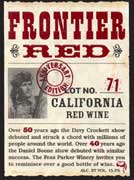
    Fess Parker Lot 71 Frontier Red (California) — this is a brand-new wine from a new vintner, and it’s phenomenal; earthy and ever-so-slightly meaty with generous touches of blackberry, cherry, violet, sandalwood, cinnamon and cassis; it’s a colossal taste that’s overtly sexy; drink this alone or with food, just drink it, 15.5% alcohol

  • Echoes of the Empire

    I shall spend a lot of this summer reading Polybius. The rise and fall of empires is in the air, and Polybius is the most coherent historian of the rise of Rome—not least because he was a Greek and smart. When Polybius describes how the Roman general Titus Flaminius accomplished his mission in the Second Macedonian War of 200-196 B.C. and then promptly promised that the Roman army would withdraw so that Greece might now be free, one cannot avoid a sense of déjà vu all over again.

    Such Roman blandishments did not on the whole fool Polybius, but, in general, the old Greek admired Rome; he saw it as the new world called into existence to redress the balance of the old. What other people considered Roman aggressiveness he extolled as efficiency; what others deemed their unthinking arrogance, he thought of as honest confidence. For all Polybius’ praise of Roman discipline, I admire more the Romans’ fierce adversaries, the bright-eyed Celts who threw themselves in waves against the solid wall of Roman shields at the Battle of Telamon in 224 B.C., ululating their wild war cries, wearing nothing but their weapons, their long hair, and the gold collars round their necks.

    Of course not all empires are the same, either in the trajectory of their rise and decline, or in the spirit animating them. It would be hard to find in Roman imperial verse such a sense of the fragility of human aspiration as that expressed in the High Victorian ode that Sir Edward Elgar turned into his cantata “The Music Makers.”

    One man with a dream, at pleasure,
    Shall go forth and conquer a crown;
    And three with a new song’s measure
    Can trample an empire down.

    More remarkable still for its humility is “Recessional,” the ode written to celebrate the Diamond Jubilee of Queen Victoria in 1897 by Rudyard Kipling, the archpoet of Empire:

    Far-called, our navies melt away—
    On dune and headland sinks the fire—
    Lo, all our pomp of yesterday
    Is one with Nineveh and Tyre!

    Try getting a Roman emperor (or American president) to utter the final couplet of “Recessional”:

    For frantic boast and foolish word,
    Thy Mercy on Thy People, Lord!

    Of course no empire ever entirely dies. The Romans brought the cherry to Italy and the grape to France, and they seem to have survived. Go to Nîmes in Provence and admire the Roman temple known as the Maison Carée, which still has its Roman roof. Then head out on the old pilgrim road to Compostela ’til you come to pebbled slopes facing south across the marshes of the Camargue, famous for its wild gray horses and pink flamingoes (naturally pink, not kept that way by being fed carrots or shrimp shells like the ones in zoos). Here are the vines of Château L’Ermitage, makers of a wonderful white wine that can be had for around eleven dollars hereabouts.

    The 2005 vintage of Chateau l’Ermitage has a trajectory like that of an empire. In the beginning, the color is clear and cloudless, the immediate aroma redolent of flowers from the south. I was reminded of a snuff I used to take that was scented with North African carnations. The initial taste is fresh and light, like melons, almost like watery Chenin Blanc, followed by no sharpness but lots of low and dirty tannins, like Melba toast. Wait, though. The wine grows upon your very tongue. Roussanne grapes, a rather rare variety grown mostly along the Rhône, contribute half of the juice in this vintage (the rest is Grenache and a little Viognier) and in a warm year they produce wine of great richness. The flowery first impression and the forceful tannins fuse into a flavor that is full bodied, powerful, and pungent like gunflint. Enjoy it with old-home chicken—potatoes, garlic, onions, and boneless breasts of chicken (never understood that—I thought most breasts were boneless), fried together and mixed with yogurt just before dishing up. (Make sure you use the plain yogurt, not the strawberry flavor.) Eventually, a day or two after the wine has been exposed to the open air, acid will creep in round the edges. Sic transit gloria mundi. Time to open another bottle.

    Oliver Nicholson is a classicist at the University of Minnesota and former secretary of the Wine Committee at Wolfson College, Oxford.

    Read more of Oliver Nicholson’s wine selects.

  • Flowers by Contrecoup

    Being brought up in a family with three doctors gives one an odd outlook on life. It was not just the anatomy textbooks, with their foggy monochrome photographs, that rubbed shoulders with the wildflower guides and J.B. Priestley novels in the family library. Nor was it only the medical advertisements that came in triplicate by each post, some embellished with color photographs of lurid lesions, others appealing to the more cultural proclivities of the medical profession. I recall a whole series of advertisements for a preparation called Cetiprin, each adorned with a frameable brass-rubbing of a medieval man-at-arms encased in chain mail and plate armor and labeled, “Pity the Plight of the Ancient Knight without Cetiprin.” Cetiprin was meant to cure incontinence.

    The most lasting impression was made by Father’s stories of medical school at Edinburgh before the First World War. There was the one about him and his dissecting partner taking a small packet of rare roast beef into the dissecting room. (“George, stop eating the corpse.”) But the most memorable was the tale of the fracture by contrecoup.

    One day the body of a sailor was fished out of the Firth of Forth, just north of Edinburgh. It was duly brought to the Royal Infirmary, but no next of kin came forward to claim it. This left the professor of anatomy feeling conflicted (or maybe it was morbid pathology, the medical specialty where no patient ever answers back). The cause of the seaman’s demise was a textbook example of a certain sort of head injury, what is called (as was explained with the sort of professional detail enjoyed by small boys) a fracture by contrecoup: The contusions are on one side of the head, but the break in the bone of the skull is on the other.

    The professor wanted this head for his teaching collection. After some weeks, he could wait no longer and had it severed and pickled, consigning the rest of the body to a respectful burial. As luck would have it, the following week the next of kin made contact—auld Jock had been lost at sea, they wondered maybe if … The professor thought fast. He would not want to deprive the bereaved of the chance to see their relative; on the other hand, he did not want to get into trouble. He had the head laid out under a sheet with a decapitated tailor’s dummy extended below it. The next of kin were led in. Gingerly, the professor drew back the sheet to show the face: “Aye, indeed, that’s auld Jock, he was a guid man … ” They turned and began to leave. The professor started a sigh of relief. They turned: “Professor, may we see the little finger of the left hand.” Well-concealed consternation. The professor drew himself up to his full height (was he not the heir of Lord Lister, pioneer of antiseptic surgery, of Sir James Young Simpson, promoter of chloroform anesthesia): “No,” he said in oracular tones and a mild court-Scots accent, “you may not see the little finger of the left hand.”

    What stuck in my mind was less the immense dignity of professors (not easy to sustain when what you profess is Latin), but the notion of contrecoup. This sense of unintended consequences became a word to live by. Sometimes, says Charles Williams, it is necessary to build the pyre in one place so that the fire from heaven may descend in another. If you teach people about the history of the Near East in the sixth and seventh centuries, they will be less likely to foul up the modern politics of that fouled-up region.

    Sancerre is a white wine that works by contrecoup. It is made from the Sauvignon Blanc grape in the Loire region of western France. Take the 2004 vintage of Justin Monmousseau (available around here for less than twenty dollars). The nose is sweet, not sugary, and yeasty like spring flowers. The taste is overpoweringly—but not unpleasantly—acidic, with acrid overtones like the smell made by Boy Scouts when they strike fire from flints. It is the acid that deals the contrecoup. It promotes salivation (sorry to be so anatomical), but what you taste is not just sourness, it is the fresh sense of flowers that you met first in the smell. This Sancerre is as much an idea as a wine. Drink it with simple things, like salad or good goat’s cheese, but perhaps not with rare roast beef.

  • In Vino Veritas

    Take a piece of paper and write on one side: “The statement on the other side of this page is untrue.” Then turn the piece of paper over and write the same thing on the other side. Then apply for a tenure-track position in a university philosophy department, where they will tell you that this is called the Cretan Paradox and has been puzzling people ever since the sixth century B.C., when a Cretan called Epimenides said “Cretans, always liars.”
    What underlay this reputation for mendacity were the tall tales the people of Crete used to tell in antiquity about the immortal gods. Zeus, Greatest and Best, they claimed, had been born on their island and they had concealed him from his divine father Kronos (who wanted to eat him) by doing war –dances ’round his cradle whenever his infant wailing threatened to betray his whereabouts. As Greek myths go, that was unremarkable. What bothered people was the Cretans’ further claim that Zeus had also died on the island and was buried on snow-capped Mount Ida, in a tomb marked by the inscription ZAN KRONOU—Zeus the son of Kronos. So much for immortality.
    Even in more recent times Crete seems an island larger than life. Take the tales about Cretan resistance to the German occupation during World War II told by an older generation of classical scholars, some of whom shared the tough life of the Cretan andartes, sleeping in caves and shepherds’ huts, scragging German soldiers, and breakfasting on ouzo. A fine film from the 1950s tells one such tale. Ill Met by Moonlight relates in atmospheric monochrome how a posse of Cretan partisans and a pair of young British officers kidnapped a German general as he drove home to his headquarters one spring evening in 1944, then led him through the mountains to a motorboat that carried him to Cairo and a lengthy stay as a guest of His Britannic Majesty. (It is good sometimes to see a film that does not suggest that the war was won by the unaided efforts of John Wayne.)
    Both of the British officers involved wrote accounts of this operation. One of them, Patrick Leigh Fermor, described how, in a pause on the trek across the island, the general looked up at the peak of Mount Ida and spoke sotto voce lines the Roman poet Horace had written about the distant view of mountains seen from Rome in the days before pollution: “Vides ut alta stet nive candidum Soracte.” (You see how Mount Soracte stands, bright white with deep snow.) One of his captors completed the quotation. “Ach so, Herr Major,” said the general. “For a long moment,” wrote Leigh Fermor, “the war had ceased to exist.”
    What put me in mind of all this was a good-hearted red wine from Crete called Kretikos. It is bottled by the well-known Greek firm of Boutari and the 2005 vintage may be had around here for as little as ten dollars. This is one of those pellucid wines that make glass shine from the inside out; its crimson color is not unlike that of Pinot Noir. At first, the center of the taste also recalls the sweetness of Pinot Noir, bracketed here between a fine initial bite and a pleasantly tannic aftertaste. Revisited after a day or two, the sugars have been absorbed, but the wine retains fine muscular strength.
    Whatever philosophers say, truth is seldom pure and never simple. The essential truth about this wine is that, like the great red wines of Bordeaux, it is a blend of two varieties of grape. The Mantilaria, widely planted in the isles of Greece (where burning Sappho had her fun) is relatively low in alcohol, high in tannin and a pleasing ruby hue. The Kotsifali grape is more characteristically Cretan; the wine it makes has more sugar and alcohol, and can go a little brown ’round the edges, like aged claret. They make a happy marriage.
    This Cretan wine would taste good with all sorts of meat. It happened to be Easter time when the party that kidnapped the general arrived on Crete to make their preparations. The shepherd they were with selected a lamb, and it was expertly roasted on a spit. They drank quantities of wine—drawn from the barrel, not bottled by Boutari—then lined up colored eggs and used them for target practice: “Christ is risen!” Bang … “He is truly risen!”… Bang. Good wine tells no lies.

  • Red Heat from Spain

    I have often thought that the Forty Martyrs of Sebasteia should be the patron saints of Minnesota. Never mind that they are most likely mythical; they can stand for all the other martyrs the Romans executed in the first three centuries A.D. And the myth is certainly appropriate to our chilly state.
    The Forty, it is said, were Roman legionaries serving on the Empire’s Euphrates frontier in what is now eastern Turkey when they were given the command to offer sacrifice to the Roman gods. When they refused, they were ordered to stand out in the middle of a frozen lake ’til they changed their minds. One of them did actually give way, legging it to the shore and then to a nearby bathhouse, which had been fired up by the detachment’s commanding officer in order to provide an allurement to apostasy. He promptly exploded. And the bathhouse keeper no less promptly ran out onto the ice to make the number of martyrs back up to forty. What then? Crowns, of course, descended from heaven onto the martyrs’ frozen heads, to the accompaniment of unearthly music and the crashing applause of the first-night audience. Martyrdom on Ice: If Minnesota doesn’t like the title, you could try it on Broadway.
    An appropriate saintly patron is also apparently being sought for the Internet. The heavenly protector of Al Gore’s invention will probably be Saint Isidore, bishop of Seville in southern Spain in the early seventh century, and compiler of a work that swiftly became the medieval equivalent of Wikipedia. The Internet and Isidore surely deserve each other; Isidore’s Etymologies are replete with secondhand information, difficult to navigate, and often inaccurate. While the Internet …
    What Isidore says about wine, for instance, is a characteristic blend of the derivative, the unpalatable, and the obvious. He alludes to Falernian, the famous sweet white wine from ancient Campania, which he had read about in Roman authors like Horace but is hardly likely to have savored himself. Beverages he is more likely to have actually sampled sound rather less pleasant—for instance, Oenomelum, a sickly syrup compounded of wine and honey.
    But then, just as you give up on him, Isidore displays a gem of genuine interest. He mentions the wines of Gaza, carried from the Holy Land as ballast in the ships bringing pilgrims home from Jerusalem. This is interesting because archaeologists find the distinctive, dumpy flasks that held Gaza wine at excavations of post-Roman sites all over Western Europe. In fact, they find them as far away as the southern coast of England, where grand beach barbecues seem to have greeted the arrival of merchant ships coming from the eastern Mediterranean. It is good when the written story fits the physical facts. In fact, Gaza wine is important as evidence that Mediterranean trade long survived the end of the Roman Empire, until the Arab invasions swept through the lands east and south of the Mediterranean, reaching, within a century of his death, southern Spain where Isidore had lived and written.
    Funnily enough, Isidore has nothing to say about the wines of his native Spain. It seems that they were no better publicized in the seventh century than they are now. That may be why they are such an excellent value when you do find them.
    Try, for instance, the 2004 vintage of Protocolo, which costs less than seven dollars hereabouts. This wine comes from the high plains of La Manchuela in the bottom right-hand corner of Spain, an area with extremes of climate that the Forty Martyrs would have found familiar. The color is a deepest red, like the workers’ flag (which shrouded oft our martyred dead)—this area was a stronghold of the International Brigades during the Spanish Civil War. The grape is the Tempranillo, the variety made famous by Rioja, but Protocolo is innocent of the turpsy oak associated with those famous wines. This is a well-balanced and fruity wine with a firm scrunch in the center of the taste. This was pleasing with a piece of steak and tasted just as good with pasta. One can imagine it accompanying paella. At that price one could even mull it with suitable spices. If you do, be careful not to boil off the alcohol (there’s plenty). Anything to keep winter at a distance.

  • Anjou Reviver

    Heaven knows the European Community (or whatever they are calling it this week) fails to warm the cockles of the English heart. (How would you like life in Minnesota regulated in detail by a bloated bureaucracy, living on expense accounts in a foreign land?) But one of its pleasanter side effects has been a scheme of international town-twinning—“Partnerstädte in Europa,” the bumper stickers call it. Sometimes the partnerships between cities in different countries are rather elegant. Oxford, for instance, is twinned with Leiden, seat of the oldest university in the Netherlands.
    Indeed, sometimes these seem to be matches made in heaven rather than in Brussels. The committees responsible have been rather kind in twinning the small town I come from in southwest England, Tiverton in Devon, with Chinon, an even smaller town on a tributary of the Loire River in western France. I am not sure what we did to deserve this good fortune. Although Tiverton is more than twice its size, Chinon has by far the more distinguished history. It was a stomping ground of Joan of Arc, Rabelais, Cardinal Richelieu, and King Henry II of England. Tiverton was a place where the medieval Earls of Devon stayed to hunt stags; it then grew into an industrial center that did very nicely thank you in the early modern cloth trade—solid and lovely—but not the scene of great romantic deeds.
    In fact, the only thing I can think of that the two places have in common is that each has a twelfth-century castle that towers high over a river. Tiverton Castle, though, preserves little from the Middle Ages. The Parliamentary armies captured it during the English Civil War (a lucky cannon ball broke the chain holding up the drawbridge) and they did not leave a lot standing.
    The remains of Chinon Castle, on the other hand, are massive. And its origins were royal—it was built by Henry II of England (who was also Count of Anjou). Connoisseurs of cinema will know it as the setting for The Lion in Winter, where Peter O’Toole, impersonating Henry II in robes remarkably ragged for a monarch, trades swift Stoppard-like repartee with Katherine Hepburn posing as a rather unregal Eleanor of Aquitaine, “that fertile and fateful female,” as my old tutor used to call her. The only hint that the characters in this film are anything more than spoiled celebrities is a long shot near the beginning showing the castle massive and mysterious from across the water. Shakespeare did royalty better than this. (So did Helen Mirren in The Queen.)
    The wines made around the two towns are not really comparable, either. Tiverton lies on the same latitude as the Moselle River. So there is every reason it should produce good wine, but I have never seen our local Yearlstone vintages for sale in the United States. The Loire Valley, on the other hand, produces more different sorts of wine than anywhere in France. They range in flavor from the Granny Smith bite of Muscadet to the dark mysteries of red Saumur. After a hot summer, Rosé d’Anjou comes somewhere in between—light, fruity, and refreshing.
    Try a delightful rosé made just upstream from Henry II’s crenellated residence. Charles Joguet’s Chinon Rosé 2005 (just over sixteen dollars hereabouts) is made wholly from Cabernet Franc grapes, the same variety used to make red Saumur, but for the rosé the juice is taken from the must (the crushed grapes) before the skins have had time to color it much. The result looks just like the pink juice of mountain-ash berries as one boils them down to make rowan jelly, the perfect foil for roast lamb or venison. The wine also has the same sequence of tastes that you find in rowan berry juice—fruit followed by delicious, long, waxy bitterness. Think pink grapefruit without the acid, but with a little tingle in the taste. This wine drunk with a venison paste would have revived a royal palate jaded by a difficult day inventing the Assize of Novel Disseisin; with appropriate charcuterie, it might refresh a Brussels apparatchik after hours in committee-making regulations about straight bananas. And for us, in the dark time of the year, it could fuel an entire dinner party, from smoked salmon through rack of lamb to a baveuse wheel of Brie. Vive les Angevins.

  • Light and Holy Drinks

    After twelve happy years in Oxford, the happy year I spent in Cambridge was a far greater culture shock than (several years later) coming to Minnesota. The first thing I learned was that in Cambridge, it is not polite to be rude to people. If you say, “I read your book; what a lot of rot,” they think you mean it, acute sense of humor failure occurs, and you will have offended against the precept that “a gentleman is one who never gives offense unintentionally.”

    But there is something about Cambridge books I never entirely understood: It is the emblem that the grandest offerings from Cambridge University Press bear upon their title page. Nobody has ever satisfactorily explained to me why scholars consulting The Prosopography of the Later Roman Empire or an edition of Epistulae ad Familiares should encounter—up front, close and personal—an oval embracing an etching of the upper half of a naked woman displaying, for universal cynosure, what the novelist Thackeray refers to as “famous frontal development.”

    For the learned, Cambridge University Press provides a cryptic clue. Around the oval run the words “Hinc Lucem Et Pocula Sacra,” which my third-year Latin class would render rightly as “Light and Holy Drinks From Here.” If this is an allusion to the excellence of Cambridge college port, I could not possibly disagree; port is one of the more splendid of the superficial similarities between the two ancient English seats of learning. But I fear it is a reference to the famous frontal development. The literal translation of alma mater is, after all, wet nurse; an alumnus is one who has imbibed in the way that nature intended from a lady not his natural mother. (Thackeray indeed was a Cambridge alumnus.) The holy drinks may be on the university, but they are strictly nonalcoholic. Pity. Who wants learning when there is a possibility of port?

    Port rhymes with thought. Unlike the great wines of Bordeaux, port does not absolutely demand that you switch your mind on while drinking it, but, like an intelligent woman, it does furnish substantially more pleasure if you give it your thoughtful attention. Thought requires information. The best place I know to find out painlessly about the finer points of wine is Jancis Robinson’s Oxford Companion to Wine. A magnificent new edition, just out, is a must this Christmas for the oenophile who has everything. From the rosé-tinted pages of front matter to the tables at the end (did you know that Kyrgyzstan produces 951,000 U.S. gallons of wine a year? Rather a lot for a mostly Muslim land), this is a riot of delicious information. You can savor swift pen portraits of famous connoisseurs, such as Robert M. Parker Jr., whose system of scoring wines numerically has been “easily and delightedly grasped by Americans familiar with high school grades,” and Hugh Johnson. You can grieve over phylloxera, wonder at the possible taste of the Roman wine coolers described by Pliny, or come to grips with the difference between Ruby and Tawny, Vintage and Late Bottled Vintage port.

    And while you are about it, sip a glass of Fonseca ten-year-old Tawny Port, available hereabouts for a little over $30 (about half the price of The Oxford Companion to Wine). Tawny port lacks the rich, oily glory of vintage port, but it lacks also the rich, oily price. It needs none of the TLC, cellaring, or meticulous decanting without which vintage port—the product of a single outstanding year, long-matured in dusty bottles—is simply wasted. Tawny port has aged in wood but does not taste of it. The color is comparatively light; there is a whiff of grappa in the nose followed by fruity sweetness. On the palate there is warmth, a good grip, and a lingering pleasantness. Go on, have a second glass.

    It would be genial to savor this port after dinner. Or, let us be honest, to keep it behind the filing cabinet for those long, cold Minnesota Saturdays when inspiration is frozen, when you stare, snow-blind, at a blank computer screen wondering how best to use the next precious moments of research time, when even the title page of The Prosopography of the Later Roman Empire has ceased to please. Put it on a billboard: Fonseca, freeing the ice floes of the scholarly imagination since 1822. Hinc vere lucem et pocula sacra.

  • Rouge Almost Noir

    If you go down to the woods south of London, you may be in for a big surprise. Not the teddy bears’ picnic—that seems to be what a good many urban folk seem to expect in the countryside these days, as though farms were all film sets and the animals, a collection of animated stuffed toys. (Was it a wish for revenge on his father that inspired Christopher Robin Milne to sell the rights for Winnie-the-Pooh to Disney? Hush, hush, whisper who dares, Christopher Robin is getting even …)

    The surprise is something quite unforeseen a generation ago. In the 1980s, English farmers, fed up with the agricultural policies of the European Union, spotted that consumers were no less fed up with the way that pork sold in supermarkets tended to taste more and more like blotting paper. Their response was to domesticate and rear wild boar, with exceedingly palatable results. Inevitably, though, some of the boar found their way out into the wild, where they ensconced themselves most successfully with their litters of little stripy piglets in woodland less than an hour from Gatwick Airport.

    Though more than a hundred of the animals were let loose last Christmas when the fencing around a farm near my family home was cut by animal-liberation fanatics, I have yet to meet a boar in the wild. But I have read the description of pig-sticking in India by the British cavalry officer Francis Yeats-Brown in The Lives of a Bengal Lancer, and the speed and ferocity of the aroused boar sound terrifying. Boar are almost the weight of a Harley-Davidson and even quicker off the lights. The Yeats-Brown prescription is to stand your ground, with the spear out in front of you, so that the boar impales himself thoroughly; otherwise, you will get crushed and then rootled by the same sharp tusks that do such a thorough job of carving up farmers’ fields. Naturally, the Yeats-Brown sporting ethic requires that you “honour while you strike him down, the foe that comes with fearless eyes.” No wonder Yeats-Brown was one of the earliest western devotees of yoga. And no wonder it’s illegal to introduce the European wild boar to Minnesota.

    The French, though, have always had wild boar, and nowhere more so than in the Loire Valley, southwest of Paris. Many of the grand sixteenth- and seventeenth-century chateaux along the river were built as hunting boxes for the nobility of the Ancien Régime. I don’t know if they still hunt the boar with hounds through the forests there. They certainly hunt deer in a musical and stately manner, a style that makes English fox hunting seem like a mad cross-country dash. As one might expect in wooded country, hound music is highly prized, and the solemn playing of the hunting horn is taken very seriously, especially to honor dead quarry.

    The Loire Valley also produces a greater variety of wines than any other part of France. Most of them are white; the area is quite far north. But let me commend a red, the 2004 vintage from the lieu-dit Les Poyeux in the appellation Saumur-Champigny. This wine is made from the Cabernet Franc grape (an ancestor of the better-known Cabernet Sauvignon) and is available locally for around $15 in a bottle embossed with the old French Royal Arms. It is powerful stuff; drink it slowly. It improves with acquaintance and would improve even more with keeping. The color is on the red side of bituminous; the initial nose is almost nonexistent except, perhaps, for a whiff of alcohol. There is less fruitiness in the initial flavor than I found in the highly concentrated vintage from the baking hot summer of 2003. What is interesting, though, is the way that the concentrated tannins in the center of the taste open out level by level, unfolding successive, refreshing bitternesses and leaving a lingering, tingling aftertaste.

    This is wine that demands your attention; it comes with fearless eyes. Honor it with the sort of fully flavored food you might eat with a Côtes du Rhône: venison roasted with a bitter cocoa glaze, well-hung wild boar, or a juicy sirloin with lots of horseradish. Your patience should be rewarded.