Tag: Yo Ivanhoe

  • I Smell Sneakers And…And…The Lusty Odors Of Earth And Cattle

    tintin-teeth 2.jpg

    I have two options when, as now, the Muse deserts me (and this has so often been the case of late, and over, say, the last dozen years).

    Well, actually, I suppose I do have more than two options. I could recognize, for instance, that anyone who uses the phrase “the Muse deserts me,” or even just “the Muse,” deserves his desolation.

    I could simply stop.

    But I do not like to stop.

    Or I could keep going, Muse-less and muddling, which is, of course, the usual routine around here. If there’s one thing I’ve pretty much figured out how to do, it’s how to keep going. I can keep going with the best of them, just so long as we can agree that by ‘keep going’ we really mean ‘keep saying.’

    I could also repeat myself, which I’m more than happy to do in a pinch. Sometimes, I swear, I don’t even know I’m doing it. There are words all around me, stuffed in books and in the pockets of jackets and pants, scrawled on index cards, scraps of paper, napkins, ATM receipts, and Post-It notes. There are shelves of black, lined journals that are also full of words, words that stretch back now over a decade. Those books are a loose –very loose– chronicle of my long nights, an inventory of the conscripted words that march across my skull in the wee hours.

    Sometimes, out of desperation, and out of that frankly terrifying and inexplicable impulse to keep going, I just grab whatever words are at hand and force them to flee through my fingers a second time. In the process they are occasionally transformed, often (well, not often) in surprising ways. Most commonly, in fact, they are entirely unchanged from the day they were born –homely, in other words, and entirely lacking in sense.

    When I’m truly strapped for inspiration, though, I turn to Jean Kent’s The Professional Writer’s Phrase Book, an essential tool for any struggling writer. Don’t be daunted by that title; you don’t have to be a pro to use Kent’s book. Even a fledgling scribe will find “thousands of descriptive tags that put pizzazz in any copy.”

    It says so right on the book’s cover, and the professional writer who wrote those words wasn’t kidding. I have no idea anymore where the book is (things tend to get lost and buried around here, or it’s entirely possible I loaned it out to a professional writer colleague and never got it back), but I did, once upon a time, jot down some handy examples in a notebook. I’m sure you’ll agree that just about anybody could write a professional-quality story using almost nothing but these phrases and a few simple words of their own.

    Take a crack at it and see if I’m not right.

    ANGER

    time to bring out the heavy artillery

    the words were sudden and raw and very angry

    feisty as hell

    she gave him a most unladylike dustup

    the rage in him was a living thing

    their eyes traded strings of malevolence

    like an awakening giant

    if I hold it in any longer, I’ll blow out my teeth

    LIMBS

    hooked her thumb in her panties and cocked her hip

    he swatted her behind

    raising the tea cup to his heavily mustached lips

    kissed his bunched up fingers…MNYEH!

    a moth-wind flutter of her hand

    rotates a finger near his temple

    HEAD

    he twisted a benzedrine inhaler up a hairy nostril

    and took a somewhat beery breath of fresh air

    she pushed her hair back, the better to glare at him

    BODY IN MOTION

    all his gestures were outside and violent

    grabbing up her gown for the run to the kitchen

    she slapped her sleeves to get rid of the crumbs

    grasped his tightly rolled umbrella like a sword

    she ditted around past all the channels

    he sat on the porch and waved away the flies

    a body so supple it twanged

    he moved like a slug

    the slow-spitting and squatting men watched her covetously

    standing at the lip of a hole

    she walks like a construction worker

    he moved with the sure grace of a forest creature

    a nudge here, a hip there, and an occasional light shove

    left the room like a scolded hound

    still beavering away

    taking on that ‘Let’s be reasonable’ slouch

    BODY MOTIONLESS

    a thin old man, frozen on the edge of the fallow fields forever

    huddled in the water

    standing there with an indolent, tomcat grace

    TRADE TAGS

    bronzed and beautiful

    the massive chest of a body builder

    a tropical tan even where it doesn’t show

    foundation training in the iron game

    highly visible in an alluring bikini

    with great stability in the shoulder girdle

    BUILDINGS–EXTERIOR

    a small, nasty shed with a furtive look

    a security system that had everything but a moat filled with alligators

    it wasn’t an ordinary building but a home

    a suspect motel named El Ranko

    the sort of railroad flat you find in the ghettos

    INTERIOR

    sat at a table about as big as a diaper

    a husky oak table

    the walls started to sweat

    the room smelled of dust, mildew, and old love

    rancid grease hung in the air like a wet sheet

    CRIME AND FIGHTING

    a man doesn’t become an investigator without a capacity for cruelty

    a man who didn’t think but let his sinews rumble him to oblivion

    his first foray into thrilldom

    and then came a moment of atavistic horror

    he was covered with blood and vomit

    the pain in the testicles streaked up to his stomach

    the velvet trap of easy living and hard drugs

    the code of the vendetta was absolute

    an animal instinct told him all was not well

    no gun racks in the pickup truck

    he ran like unleashed hell

    my goal is to stay out of the morgue drawer

    DEPRESSION

    in the twilight world of the half alive

    restless, seeking

    hoping the wind and rain would take away the brooding hurt

    he stood in the burning lake of himself, unable to escape

    slumped into morose musings

    pain and loneliness walked with him in the dark

    a life which daily negated all her dreams

    FACES–DESCRIPTIONS

    the upper-echelon mafioso type

    his nose looked like a wedge of cheddar

    perspiration on her forehead, like water beads on good butter

    a nose that could slice cheese

    he looked something like a hawk with mumps

    he had a face like a benediction

    HAPPINESS

    a few crocuses of hope poked through the surface

    the feeling of happiness rising wonderfully inside you

    beer commercial joviality

    when I feel this delicious, I laugh at practically anything, sometimes nothing at all

    Enjoy!

    INNER THOUGHTS

    he took the world by the nose

    I still believe happiness can be worked out. I am a fool.

    there’s nothing worse than a hero out of work

    you could catch it and kill it and pin it down, but then it wasn’t a butterfly anymore

    The world was a jungle. Only the strong survived.

    Bastard! she whispered behind his back.

    yet deep, deep inside he still burned with his love for her

    preoccupied with matters of nomenclature

    you can’t fall off the floor

    love was a weed that flourished in the dark

    as bad as being told God dislikes you


    PHILOSOPHY

    I live in a silent movie

    a satisfying influx of Mexicans

    not everything was cotton candy

    two nice people made for each other

    when you walk among women, do not forget your whip

    Who knows where terrific things begin?

    SMELLS

    I smell sneakers

    I could smell her light, warm femininity

    the lusty odors of earth and cattle

    See what I mean? Wow! What you have here are the raw materials to make a writer out of the drabbest, most tongue-tied closet dreamer. And I haven’t even made it to the phrases related to lovemaking (he took a look down her decollete). I’ll buy lunch for the person who can send me a reasonably coherent story –or, what the hell, an entirely incoherent story– that makes judicious use of the largest number of these helpful phrases, and I’ll also post the story for at least twenty-five other people to see! So start beavering away! And send those entries to zellar at rakemag dot com.

    miles city-C.jpg

  • It's The Middle Of The Night And Dude Here's Gettin' All Heavy On Ya

    angel trio 2.jpg

    There are surfaces you can’t get a look under. You see just a flat line, for instance, or a face, or the horizon, but that doesn’t mean there’s not something beneath or beyond them.

    It never means that. There’s something behind or under everything, depths and layers and distance, and it’s a rare thing that’s simple enough, small enough, or that will hold still long enough for you to properly dig around and pin down what’s really under the surface.

    Face value truly is the currency of our understanding, and of our trust and our faith. Human depths we infer from art or action or speech or behavior; we take people at their word, choose to believe in their sincerity or in the truth of how they present themselves or the stories they tell about who they are.

    We learn all the time to our great disappointment (and disenchantment) how flimsy and unjustified this faith is; we are lied to and betrayed and deceived hundreds of times every day, and yet still we continue to believe and to embrace the idea of depth, and to wrong-headedly confuse this notion, somehow, with virtue, as if depths were not just as often roiling with darkness and ugliness and contradictions and mystery and even evil; as if one of the primary functions of surface and depth were not to conceal.

    A wall is a surface, as is a facade, a trap door, a mirror, a mask, a voice.

    Most of the time –an overwhelming majority of the time– we are left to wholly imagine what is beneath a surface, and this gives the imagination its incredible freedom, even as it serves as an open invitation to our basest insecurities and fears.

    This is what gives our heart its hope, and allows it to dream and to love and to tell stories. And this is also how our heart gets trampled and broken and then put back together, again and again and again.

    panda clown.jpg

    Do you think it’s easy,

    not biting

    the one you love?

    Try loving someone so much

    your mouth is only at home

    in the place where your teeth

    meet the flesh

    of your beloved. Try

    not tasting the flesh,

    not taking in your mouth

    the beloved, not

    going all the way.

    Jim Moore, “Teaching the Dog Not to Nip”

    pelican.jpg

  • From A Dream In Progress

    horse detail.jpg

    1) This, Vesithia LaRue said, is not living. Decidedly. Not. Living.

    Ms. LaRue was in the bar of a Chinese restaurant, where she was sitting straight as a pin at a corner table and bathed in an almost infernal red light. Though she was a non-smoker, she had the mannerisms and dramatic demeanor of someone who was smoking cigarette after cigarette.

    With her long fingers dangling from impossibly thin wrists she was drawing slow, continuous circles with a pink plastic straw in a drink that was the color of an exotic and idealized lagoon.

    Vesithia’s table companions had been reduced to silence by her churlish mood (which was increasingly her prevailing mood). To venture even the most innocuous comment was to invite a withering lash from her acid tongue.

    In a story that she often related, Vesithia explained that her name was that of an imaginary flower that had come to her mother, Estelle LaRue, in a dream.

    Do not think, Vesithia was now saying, do not dare think for even one moment, that I have been wounded. (Everyone at the table –and, in fact, everyone of Ms. LaRue’s acquaintance– was decidedly of the opinion that Vesithia had, in fact, been badly wounded.)

    Although, Vesithia added after a moment, I suppose that boredom, if it becomes terminal, would have to be classified as a type of wound.

    Eventually, in timid response to one of the conversation’s earlier tangents (or, more properly, one of the fragments of Ms. LaRue’s halting and ongoing monologue), one of Vesithia’s companions ventured, “I feel certain that the body retains some memory of every encounter it has ever had with human hands.”

    Hogwash, Vesithia said. Utter fucking hogwash.

    If there was one phrase that defined Vesithia LaRue (and in truth there were a great many), it was, “I strongly disagree.”

    As strident and forceful as Ms. LaRue could be –and she could be very strident and forceful indeed– she never, ever resorted to outright exclamation, although the temptation to insert exclamation points after her utterances was nonetheless irresistible.

    2) Vesithia LaRue had a dog. It was smallish and ordinary-looking, the type of dog of apparent mixed breed that one was likely to encounter at any dog park or animal shelter. So ordinary looking was Ms. LaRue’s dog, in fact, that her mother, Estelle, had once referred to the animal as a “generic sort of dog,” a description that Vesithia pronounced “unpardonable,” and which led to a protracted estrangement between mother and daughter.

    Estelle LaRue was now (fairly recently, in fact) dead, but while she had been among the living there had been many such protracted estrangements with her daughter, all of them caused, the older Ms. LaRue would contend, by small misunderstandings.

    Vesithia LaRue had a long history of misunderstandings large and small –of misunderstanding others and being herself misunderstood. Many, if not most, of these misunderstandings were the result of her insistence that others abide by her own version of the truth, a version of the truth which might charitably be described as peculiar.

    Vesithia would claim, for instance, that her smallish, ordinary-looking dog –which, owing to her characteristic inability to make up her mind, was called either Pronto or Presto– was an African Dancing Dog. This, she asserted, was an extremely rare breed, and had once been on the endangered species list. Vesithia had acquired the dog, she said, on a trip to Nigeria.

    Despite the animal’s purported breed, no one could recall ever having seen Pronto (or Presto) dance. Many people, however, had heard the dog bark. What it was apparently lacking in dance skills, Vesithia LaRue’s little dog more than made up for in the noise-making department.

    The creature’s incessant barking had, in fact, prompted Ms. LaRue’s eviction from a half dozen different apartments.

    3) Vesithia LaRue had been born Vesithia LaRoach, a name that had been for her a torment of longstanding. It was, she would tell her mother from a very early age, insufferable. It was unpardonable, egregious, and an affront to someone of Vesithia’s refined sensitivity.

    These words Vesithia had learned from a book called Thirty Days To A Larger Vocabulary, which she had stolen from the library at Blanche Patch Middle School, along with another book called The Golden Keys To Self-Improvement. There was a chapter in this latter book –“If You Don’t Like Yourself, Be Someone Better!”– that Vesithia had revised in her mind to “If You Don’t Like Yourself, Be Someone Different!”

    Toward this end –her goal was to be someone entirely different– Vesithia was determined to change her name. Her nickname at Blanche Patch Middle School was “The Roach,” and hearing these words hurled at her every day by cruel schoolmates, Vesithia would tell her mother, had left her permanently, irrevocably scarred.

    “But, dear, it is your name,” Estelle LaRoach had told her daughter. “There is not a thing in the world you can do about it.”

    Vesithia knew that in this, as in so much else, her mother was mistaken, and the day she turned eighteen years old, with money she had made working at the perfume counter at the Younker’s Department Store, she had applied for a legal name change for both her mother and herself.

    The elder Ms. LaRue knew that it was pointless to resist her daughter in any matter on which she had set her mind, and so reluctantly went along with the change. In time, she would eventually admit, she had come to appreciate her new name.

    4) In my private moments, Vesithia LaRue would say, I cannot deny that I feel my soul to be an unspeakably forlorn place.

    Vesithia was not in the least bit reluctant about making public the many feelings that were incubated in her private moments.

    Despite her frequent insistence that she had not been wounded, it was generally assumed by all who knew her that Vesithia LaRue had, in fact, had her heart broken by Roland Thames Trempeleau, a postal carrier and classical music composer whom she had met once upon a time at a Mensa meeting.

    Roland Trempeleau, Vesithia was fond of recounting, had wooed and courted her with “elegant zeal and uncommon ardor.” Roland had been a perfect gentleman, and he had been –or so Vesithia would claim– unabashedly smitten with her.

    I have been swept off my feet, she would often report in the early days of her tempestuous yet wholly covert courtship with Roland Trempeleau.

    Whether people were inclined or disinclined to believe these reports varied a great deal, but it was nonetheless undeniable that no one who had ever been subjected to Vesithia’s breathless accounts of her affair had ever so much as laid eyes on the man, let alone made his acquaintance. They were, however, told that Roland Trempeleau had a habit that drove Vesithia absolutely wild; whenever he checked his wristwatch, it was said, Roland would jerk his whole body upwards, roll back on his heels, hunch his shoulders dramatically, and then raise his right arm, cocked at an extreme and exaggerated angle, in front of his face.

    Vesithia would often provide public demonstrations of this ritual, and it was, she claimed, the sexiest thing she had ever seen.

    Alas, Roland Thames Trempeleau, once such a perfect gentleman, had in the end been revealed as just another cad, this after he purportedly abandoned Vesithia for an “internationally renowned cellist with a major American orchestra.”

    To reveal any more information than this, Vesithia would insist, would be indiscreet.

    horsewindow001.jpg

  • Walking Backwards Into Babylon

    It’s pretty obvious by now that I’ve run out of gas. I think everybody has run out of gas. The only thing more depressing than a baseball team playing out the string in late September is a baseball team from which you expected big things playing out the string in September.

    It messes up your whole world, and even as you watch it slip away you know that winter is out there in the night, marching doggedly toward the city. In the distance you can already hear the rattle of its drums and see the smoke from its campfires.

    In no time at all the 2005 season will be splayed on the autopsy table in a dank basement morgue, and it will be all you can do to make the trip down the stairs to poke around in the cadaver looking for answers.

    I don’t suppose I’ll do much poking around this winter. When a stiff comes through the door with a massive blunt trauma to the skull it doesn’t take Quincy to figure out what killed the damn thing. In this instance, though, I’d imagine that even a cursory probe of the guts would nonetheless reveal some unpleasant surprises.

    The blow to the head –or the repeated blows to the head– might be the final verdict on the cause of death, but I suspect that if the poor bastard had had a bit more fight in him he might have avoided the blows in the first place, and he might still be standing, might still be breathing.

    How the Twins managed to stagger the last two-and-a-half months without a pulse is a mystery for the ages.

    Since 1982 I have managed to hang in there right down to the wire in every single baseball season. I’m sure if I looked back through my scorebooks I’d see that I attended the last home game of the year in at least 80% of those seasons.

    I won’t be there this year, though. I’ve had a hard time being there almost from the beginning. Life has gotten in the way all season, and the Twins have obliged by giving me few reasons to regret that I’ve mostly stayed home.

    They have gone from frustrating to disappointing to just plain bad.

    Baseball is, though, a damn hard habit to break, and on each of the previous two nights I found myself sitting down in front of the television and watching the games from start to finish.

    That, I’m sure you realize, took some patience I didn’t even realize I had left, particularly on Monday night. That 5-0 loss to Kansas City (and the horrendous J.P. Howell) may well have been the low point of the season, which almost made it worth watching. Howell, of course, is lefthanded, but by now it really makes absolutely no difference. The Twins couldn’t hit Thurston Howell. They couldn’t hit Norman Fell, and I’m not even sure Fell is still alive.

    For almost the entire season Minnesota’s starting pitchers have had to approach their jobs with the mindset of soccer goaltenders, and it has been depressing to watch. If they give up three runs –or three goals– the game is essentially over. The now overwhelming evidence suggests that if they give up two runs the game is over.

    Last night, at least, with Johan Santana on the mound, you knew going in that the Twins had a pretty good shot at winning one of those 2-1 games for a change. It was big of them to tack on that extra insurance run in the late going.

    There is no reason in the world, other than the fact that he has had to labor for the 2005 version of the Twins, that Santana is not cruising towards his second Cy Young award. As it is it’s a wonder that the guy has managed to win fifteen games with this feeble lineup. On a decent team, a team with even a modestly competent offense, at least four Twins starters would have fifteen wins.

    I will say this, though: This team wasn’t that bad. Or, rather, they shouldn’t have been this bad. I think it’s just been one of those years. Teams have them. Some teams, of course, have them routinely. I don’t think that’s going to be the case with the Twins. I honestly believe –because, really, what choice do I have?– that they’ll be much, much better next year.

    Hell, even now, I still believe they’ll be much, much better tonight.

  • From The Ruins

    spam cat.jpg

    There will come a day, mark my words, when every conceivable disappointment will meet in a giant hangar somewhere in Kansas. Every dashed dream and broken heart from all over America will converge there on the edge of some dusty little town to awkwardly mingle and avoid eye contact. Just as in Vegas, in the hangar there will be no natural light and no clocks, and the only way to mark the passage of time will be by the exhaustion in people’s eyes.

    Among those who will make the discouraging trek: The man who once upon a time dreamed of becoming an astronaut and grew up instead to become an unhappy insurance adjustor. The woman whose naked body was never seen –let alone touched– by anyone outside a doctor’s office. The failed writer of science fiction novels who lived with his mother until her death and, oafish and sweating, stalked about his old neighborhood in camouflage and, well into middle age, raced remote control cars up and down the sidewalk in front of his house. The jilted lovers, brides left at the alter, and infertile couples. The boy who asked Santa Claus for a Dukes of Hazzard pinball machine and received instead a Slinky, a seemingly small and isolated letdown that nevertheless in time planted the seeds for a lifelong pathology of disenchantment.

    Also present: Beauty pageant rejects, disgraced public servants, neglected children, actors that never got a break, persistent writers of ignored doggerel, bitter misanthropes and alcoholics, those for whom an adolescent crisis of faith became crushing and permanent, brooders and pipe smokers, and all manner of neglected or talent-less musicians, artists, and philosophers.

    You can be sure the sleepless will be there, standing in zombie pockets at some remove from packs of the pathologically shy, the socially awkward, and the chronically fatigued.

    Should you make the pilgrimage you will be joined as well by stalled middle-managers, the perpetually startled, orphans, gimpy quarterbacks, cheerleaders who grew old gracelessly, bankrupts, and scores of broken refugees from Nashville, Hollywood, and New York.

    There’ll be quite a crowd, to be sure, and you’re virtually guaranteed to recognize all sorts of old friends, neighbors, and former co-workers, and they’re certain to bitch ceaselessly, provided they haven’t been made entirely mute by their disappointment.

    God knows there’ll be plenty to bitch about: It will rain every day, the food will be lousy, and the accommodations will be sadly lacking. Entertainment –for lack of a better word– will be provided by an assortment of some of the worst garage bands, barbershop quartets, choirs, magicians, mimes, ventriloquists, and baton twirlers you’ve ever seen.

    As the evening wears on a bullhorn will be passed among the congregation of the disappointed, and each person will be allowed to shout out one sentence or declaration.

    It’s interesting, if fruitless, to speculate what those present might make of this brief opportunity to express themselves. How many do you suppose will use their moment in the spotlight to merely blurt terse, general condemnations laced with profanity? How many, however disappointed, will declare some enduring love or eternal regret? You can certainly imagine that there will be a great deal of stammering, and many will simply attempt to articulate some already broken promise, ineffectual apology, or impossible wish. Others, of course, will have nothing to say.

    Should you or I find ourselves there in that awkward crowd of the bruised and broken what words would we find to speak to the assembled? What might we say to the better, happier people we –all of us– should have been? And do you suppose there will be even one among us who will have enough small courage or faith remaining to utter some message of hope?

    Finally, at some point in the endless night, black and white balloons will be distributed, and on command they will be released to rise slowly up into the distant rafters of the hangar. This gesture will mean different things to different people, and to some it will mean absolutely nothing at all.

    cat-rabbit.jpg

  • Rilke, Badly Mangled, With A Line Stolen Outright From Stevie Smith

    yellowstone river.jpg

    I live my life in shrinking orbits,

    which move inward from the things of the world.

    Perhaps I can never fully silence my heart,

    but that will be my attempt.

    I am shadow boxing with God, around and around

    this small, dark room, and I have been plodding in circles

    for a thousand years. And I still don’t know,

    still don’t know if, still don’t know what I am.

    I was much too far out all my life

    and not waving but drowning.

    night driving 4.jpg

  • That Will Be Fine. I Think That Will Be Just Fine

    cemetery dogs.jpg

    Time stands still

    And we and things go whizzing past it,

    Queasy and lonely,

    Wearing dogtags with scripture on them.

    James Galvin, “Two Horses and a Dog”

    We’ll be all right if nothing goes wrong with the lighting.

    Robert Frost, from “It Bids Pretty Fair”

    All day words were swirling, assembling themselves, unbidden, in inspired formations. It was a thing of real beauty, and I sprawled in the grass and watched them with wonder.

    I let them go.

    Time and again it occurred to me that I should make some effort to catch them, to capture them, that I should bestir myself and blast them from the sky; that I should gather them up and soak them in some preservative and pin them to something for permanent display.

    But I did not stir.

    I watched them gradually dissolve and disappear and fade away into the clouds and into the distance and, eventually, into the falling darkness. There would, I felt sure, be more where those came from. I always feel certain there will be more where those came from, even as, still, I have absolutely no idea where those, where they, where any of them come from, or where they go when they flee.

    I get to the bottom of the day and sit here listening to the trilling of the dying cicadas as autumn advances resolutely on the city; and suddenly I find myself thinking that perhaps, after all, there are not, or there will not be, more words where those came from, even as they keep coming, ever more slowly now, exhausted, diminished and disconsolate as the dying cicadas.

    One day certainly they will disappear for good, they will stop coming finally and forever, and then there will be only silence and a vast sky empty except for the sun.

    That will be fine.

    I think that will be just fine.

    Words are not people.

    klee.jpg

    Paul Klee, Angelus Novus

    A Klee painting named ‘Angelus Novus’ shows an angel looking as though he is about to move away from something he is fixedly contemplating. His eyes are staring, his mouth is open, his wings are spread. This is how one perceives the angel of history. His face is towards the past. Where we perceive a chain of events, he sees one catastrophe, which keeps piling wreckage upon wreckage and hurls it in front of his feet. The angel would like to stay, awaken the dead, and make whole what has been smashed. But a storm is blowing from Paradise; it has got caught in his wings with such violence that the angel can no longer close them. This storm irresistibly propels him into the future to which his back is turned, while the pile of debris before him grows skyward. This storm is what we call progress.

    Walter Benjamin, “Theses on the Philosophy of History”

  • Night Stand: Reading In The Dark

    dashboard-night.jpg

    A pair of epigraphs and some random gleanings from the archives of the Wangensteen Medical Library at the University of Minnesota:

    When I lie down, I say, when shall I arise,

    and the night be gone? And I am full of tossing

    to and fro unto the dawning of the day.

    –The Book of Job, 7-4

    This relentless repetition of the same illegible text….

    –Yannis Ritsos, “Insomnia”

    Melancholics are not so sleepless as maniacs, yet the want of sleep is often an early and prominent symptom. They do not readily sleep, and if they do, they awake soon to be tormented by the vilest misery that it is possible for human creatures to endure.

    –A.W, MacFarlane, M.D., Insomnia and its Therapeutics, 1891

    Want of refreshing sleep we believe to be the frequent origin of insanity, dependent upon moral causes.

    –John Charles Bucknill and Daniel H. Tuke, Psychological Medicine. 1858

    Those who pursue a desultory method of thinking are very often the victims of an obstinate and peculiarly distressing form of insomnia. During the day such persons are observed to apply themselves with apparent zeal to the regular vocations of life; but, if closely observed, there is often visible a certain absence of concentration and devotion to the particular matter in hand. When questioned upon this point, they admit that they are ‘absent-minded’; and, while only too willing to apply themselves, are frequently tormented by the intrusion of ideas totally foreign to the particular subject at hand….they carry their responsibilities to bed with them; and, while other minds are at rest, their own intellection is morbidly active. Midnight, and even the small hours of the morning, find such individuals speculating upon the pros and cons of the past and future with an intensity which often drives them to a state of positive desperation. The small ills of life assume alpine proportions, and even the most trivial circumstances are distorted and magnified a thousand-fold. When at last sleep actually does supervene, it is no longer psychological, but, on the contrary, perverted by dreams and unconscious cerebration to such a degree that these unhappy individuals can hardly be said to have slept in the ordinary sense of the word.

    –J. Leonard Corning, Brain Rest. 1885

    Under [insomnia’s] influence injurious changes are permitted by the patient to be made in his daily habits; pursuits which formerly engaged his attention no longer interest him; even important business concerns are sacrificed; and against such tendencies no pre-existing vigour of intellect will afford any defence; the strongest minds (intellectually considered) may sink into apathy and feebleness.

    –James Russell, M.D., “On Sleeplessness.” British Medical Journal, November 16, 1861

    After dinner, my friend drove me, in a carriage, some five miles back into the country –the greater part of the way, along the margin of Migunticook Lake, and under a terrific precipice, whose boulders every moment threaten destruction. In fact, the whole of a bright sunny day, cooled with healthful zephyrs, was spent in pleasurable excitement. Interesting conversation beguiled the evening; and, after family worship, I sunk to rest in a luxurious curtained bed. Ere long, I slept; and, about five o’clock next morning, was awakened by the crowing of the cock. This was the only night’s sleep I have had these last six years and seven months; so help me God. Since then, my nights have been tedious, as usual, without sleep, and some of them distressing.

    –“An Example of Protracted Wakefulness,” Boston Medical and Surgical Journal. July 31, 1845

    Experience in private practice, and extended observation in the wards of general and lunatic hospitals, have taught me that the ordinary hypnotics are frequently unreliable, and that in some instances their use is attended by results as bad as, if not of more serious consequence than, the conditions they were intended to remove. I do not wish by this somewhat sweeping assertion to be understood to condemn the ordinary hypnotics, or to doubt their efficacy in suitable cases; but it seems to me that we run great danger of becoming routinists in the matter of sleeping-draughts….Like most of my fellow practitioners, I constantly meet patients who have run through the whole gamut of sleep-producing drugs, and find their last condition, in many instances, worse than their first.

    –Edward N. Brush, M.D., “Some Clinical Experiences With Insomnia,” The Practitioner, January 1889

    nocturne2.jpg

  • Gloria Was The Little Girl's Name, And An Accordion Was Her One Fierce Desire

    accordian.jpg

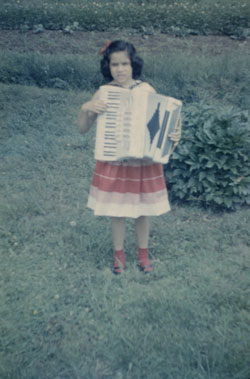
    For many months, on her way to and from school each day, Gloria had paused at the pet shop window to gaze with a combination of adoration and desire at the pretty little accordion nestled there in its kennel.

    Each night at the dinner table she would beg her parents to let her have an accordion –and not just any accordion, but the one, lonely accordion in the pet shop window. How she longed to have that accordion in her arms, to have it for her very own!

    Her father, however, was insistent that they would never have an accordion in their home; Gloria, he said, was much too young, and an accordion was a serious and expensive thing. The world, he proclaimed, was already full of abandoned and unloved accordions.

    Perhaps, her mother said, when she was a bit older, Gloria might get an accordion. But her father looked sternly at his daughter across the table and said, Not as long as I am in charge of this house. I don’t have a moment of peace and quiet and can barely make ends meet as it is.

    At this, Gloria’s mother winked at her and said, Someday you will be older and you can work hard and save your money for an accordion of your own.

    Finally, one day when she had all but given up hope, Gloria came home from school to find the pet shop accordion wrapped in a red bow and resting on her bed. She took it lovingly in her arms and was startled to discover how much larger it had grown since the first day she had laid eyes on it in the store window.

    And then, as she cradled the accordion in her arms, Gloria found herself seized with a sort of panic that cast a dark shadow over her joy. An accordion, she suddenly realized, was a tremendous and perhaps terrible responsibility.

    What, she wondered, shall be my accordion’s name? And what will I feed it?

    As Gloria studied her accordion intently and ran her fingers over its beautiful details she also thought, How will I ever sleep again?

    family.jpg

  • Limbo, Limbo, Limbo

    Question: How low can you go?

    Additional question: When was the last time a Major League baseball team played so many games that so closely resembled World Cup soccer matches?

    Another question: Who wants to weigh in on this team’s chances of finishing above .500?

    One final question: What the hell?

    And, further food for thought: Has anyone else noticed how oddly taboo David Ortiz’s name has become in any analysis of the strengths and failures of this organization? I mean, I know people have whined plenty about missing him, but that goes without saying. What really needs to be explored is how the hell this team let one of the most dangerous hitters in baseball –exactly the kind of hitter the Twins so desperately need– simply walk away just when he was entering the prime years of his career (and money, of course, had absolutely nothing to do with it)? How could they not have recognized his potential?

    Just who the hell was the Twins’ hitting coach when David Ortiz was here in Minnesota? Help me out here, because I’m having a hard time remembering the guy’s name.