Year: 2005

  • Is There a Doctor in the House?

    We’ve been catching up on “House” reruns, which started immediately after the season finale a couple of weeks ago. We rashly made the pronouncement that it was “the best show on TV” after seeing just half of one show. We’re willing to stick with that assessment, but it’s interesting how the show really picked up quality with each episode, the actors began to fit their roles, the dialogue–always well written–started fitting their mouths better, everything just began to run more smoothly. By the time the finale aired, the show had the feeling of a series hitting its mid-career peak, two or three years down the line. (We hope that doesn’t mean an accelerated lifespan, but great writing and acting tends to be unsustainable for more than a two or three seasons. Consider, for eample, Sorkin-era “West Wing” and the shows sad decline into mediocrity.)

    Of course, “House” would be just another general hospital potboiler if not for the brilliantly sketched character of the show’s namesake. Hugh Laurie has done an admirable job of creating a peevish, repellant anti-hero to enunciate all those clever put-downs, come-ons, and punchlines. We didn’t think it would be possible to see workplace sexism, dubious medical ethics, and persistent, recreational drug use as a relief, but after a harrowing season of “24” (which, in some aspects of its pro-torture, ends-justify-means agitprop, makes Leni Riefensthal look like Hitler’s biggest critic), we are–well, relieved.

    “House” is billed as a new twist on generic mystery-TV, and so it is–although it combines some prurient CSI-style interest in its actual medical footage (kinda gross; the wife covers her eyes in disgust and makes little wretching noises), as well as a tendency to point beyond itself to larger social and political issues like euthanasia, health insurance, gun violence, and so on.

    But we’ve had the sneaking suspicion for the entire season that “House” was actually an upscaling of an odd, uncelebrated, occasional front-of-book department in the New York Times Magazine, called “Diagnosis.” You can always tell the pioneers by the arrows in their backs. This was an innovation of editor Adam Moss which seems to have been scalped by NTYMag’s old new editor, Gerry Marzorarti. Probably for the best. What that department really lacked is what the TV show has in aces: characters who instantly evoke a sympathetic response. Medicine as a whiz-bang diagnostic science has its appeal, of course, but it doesn’t sell beyond the pages of JAMA or New England Journal of Medicine, or even Nature. What doctors count as an asset–the ability to distance oneself emotionally in order to actually get through the waiting room in one piece, makes for lousy general-interest reading, but we can think of several wonderful examples of medical journalism that achieve what “House” achieves.


  • Weekly And Monthly Rates

    howdy-2.jpg

    In room eleven there was an old snapshot with serrated edges taped to the mirror above the dresser, a photo of a dark-haired woman, her eyes closed and her head tilted slightly back, standing in a dark angle of shadow. Outside the shadow the sun was shining on an impossibly bright pastel world and a street lined with vintage automobiles.

    On top of the dresser was a rusty tacklebox, full of corks, keys, paper clips, and pencils; a bottle opener, screwdriver, fingernail clippers, pocket knife, and a few bucks in change. The drawers of the dresser held a disorderly sprawl of socks, underwear, tee-shirts, and a few pairs of slacks. Just inside the door was a clothing rod on which was hung a handful of snap-button western shirts, a blue windbreaker, a plaid wool jacket, and a nylon parka.

    On the bedstand were several pairs of fine sunglasses and an assortment of baby food jars, each of them blooming with an almost lovely green mold. Under the bed we found six pairs of shoes –sturdy, plain, solid browns and blacks– and a shoebox full of old photographs of horses. There was a battered leather suitcase stuffed with scandal magazines and paperback westerns.

    The man had a small refrigerator, inside of which were three ketchup bottles, eight cans of Budweiser, and an opened can of cling peaches.

    He also owned a nice Stetson Stratoliner cowboy hat and two pairs of worn boots. There were no paper documents, no letters, wallet, or checkbook; no reliable identification and not a single photograph of another human being other than the woman on the mirror. Were it not for a battered old Rawlings Enos Slaughter model baseball mitt with a name written along the fat thumb in black magic marker the man would have died entirely anonymous.

    The mattress was now stained with blood black as motor oil, and there were random splashes on the wall and bedstand that were dusty as powdered tempura.

    hammer-2.jpg

  • Is The Glass Half Full Or Half Empty?

    Each of the Twins three Division titles has been sort of strange, and in almost exactly the same regard. Every year the team confounds expectations every which way, and still finds a way to win.

    I don’t know why I expected this year would be any different, but I know I wasn’t alone. I watch a lot of baseball games, and listen to the rest, and maybe this is just the hyper-critical reaction of a fan who has seen too many games and been spoiled by all those titles, but this team just doesn’t seem like it should be as good as it is.

    Why is that, do you suppose? It’s certainly not because the Twins aren’t as good as they seem, because “good as they seem” doesn’t mean a damn thing in baseball. The numbers speak for themselves.

    The thing is this, I think: once again, as so often in recent years, the Twins have had to improvise to a degree that is both characteristic and uncharacteristic of winning teams. After all the hullaballoo coming out of spring training, the original starting shortstop is back in Rochester, replaced by a mix-and-match combination of journeymen. The starting second baseman –no real surprise here– has been supplanted by whichever journeyman isn’t playing short on any given day. The third baseman has been alternately dismal, encouraging, and erratic, and still doesn’t have numbers a major league third baseman should be proud of. The guy at first base continues to be snakebit, missed a big chunk of time after getting hit in the head, and was in a freefall before he got briefly shelved again by a bone spur in his elbow. The phenom catcher has also had a hard time staying in the lineup.

    Last year’s team, of course, also battled through injuries. Nothing you can do about that, as the old salts will tell you. No, but it’s the production of the guys who have not been injured that continues to puzzle. In 2004 the Twins didn’t have a single player with thirty homeruns, and nobody with either 100 RBI or runs scored. Shit, no regular hit .300. That seems highly unusual for a team that won 92 games and the division, particularly in this day and age.

    The Twins appear to be on a similiar course so far this season. Shannon Stewart leads the team in homeruns with eight, and is on a pace to possibly score 100 runs. It sure seemed for awhile that Justin Morneau was going to easily hit thirty homers and get that monkey off Minnesota’s back, but that’s no longer the lock it once was, and even twenty might be a stretch.

    The story, of course, is the pitching, which has been even better this year than last. The Twins lead the majors in ERA and fewest runs allowed, and they’ve got an unreal strike out-to-walks ratio. The starters have been tremendous, and the bullpen has been even better.

    Minnesota’s giving up fewer than four runs a game, and the magic number to win baseball games has been at four runs for several years now. The Twins definitely need that slim margin, because their offense seems determined to just squeak by.

    Consider this, though: Kyle Lohse has the highest ERA on the entire staff, at a more than respectable 4.25. Both Carlos Silva and Joe Mays have lower ERAs than Johan Santana and Brad Radke.

    The strange thing is that the White Sox have been a virtual carbon copy of the Twins, which was pretty much their stated goal coming out of spring training. They’ve scored almost the same number of runs as the Twins (as of a couple days ago Minnesota had actually scored more), and are second in the majors in team ERA.

    One of these teams is going to either have to step it up offensively or go out and get a banger for the middle of the lineup. Chicago seems far more likely to adopt the latter strategy, but if past performance is any indication they’ll accomplish nothing by doing so. They can’t very well find a way to swing trades for Carl Everett or Roberto Alomar again this year. The more plausible scenario –and it’s hard to say, really, how plausible this is– is that Frank Thomas comes back and gives the White Sox just enough offense to put them over the top.

  • Secret Signs

    God bless our man Chuck Haga, who like a friendly health teacher with a high beltline, a stylish combover, and a full quiver of PG-13 puns, has compiled a little refresher list of euphemisms for marijuana. Strib readers who receive their copies of the paper at their guard stations can thus be dutifully outraged today by the “dopers” who are “sucking up” street signs in rural Minnesota. (420th Street–get it? “High Street” has been a target for decades, of course, but the Strib is just getting up to speed here, so bear with ’em.)

    A couple quick observations on this. First, where is the Strib article decrying the well armed militia of gun-nuts out there who insist on blasting every rural stop sign out of existence? Is the $80 cost of replacing street name signs somehow more onerous than the $80 cost of replacing all those ventilated stop signs? Or is it just more fun to single out the harmless hippies rather than the trigger-happy rednecks? (Extra credit: the Strib has “no guns allowed on these premises” notices on all of its buildings and entrances. Everyone knows that this is a covert, liberal statement of protest about Minnesota’s soft-headed new conceal and carry law. When the editors hear about this, how long will it take them to remove the signage as a natural consequence of their ongoing Red Shift?)

    Second, why must local governments insist on naming every little dirt road through hell’s half acre as if this alone will make the dangerous outback safe for the McMansion developers?

    Finally, if this is truly the epidemic it appears to be, how about not naming any rural roads “420”?

  • Why didn't we think of this?

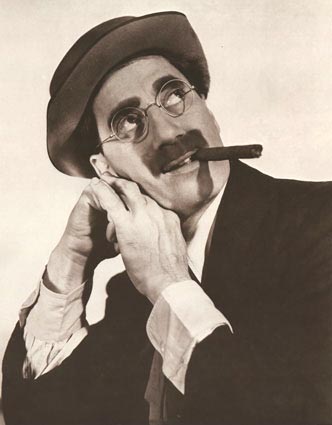
    groucho.jpg

    I wouldn’t want to pay taxes to any state that would have me as a resident.

    Got an urgent email alert from The Taxpayers League of Minnesota today urging me to call my legislator and let them know I was against the proposed increase in the cigarette tax.

    The rationale given was that, according to a Harvard study, it actually saves the taxpayers money in lower pension and nursing home costs if smokers get sick and die earlier than non-smokers.

    More dead people equals lower taxes. What a great idea! I know I’m going to send David Strom a big box of cigars for coming up with this one.

  • But Enough About Me

    bucyrus-3.jpg

    Here are your waters and your watering place.

    Drink and be whole again beyond confusion.

    Robert Frost, “Directive”

    I am looking back into a world now gone forever. Thinking of a time that will never return. A book of photographs is looking back at me. Twenty-five years of looking for the right road. Post cards from everywhere. If there are any answers I have lost them.

    Robert Frank, The Lines of My Hand

    All I ask is for the recognition of me in you, and time, the enemy, in us all.

    –Tennessee Williams, Sweet Bird of Youth

    You were directionless for a brief time in the 1980s. Okay, for ten years in the eighties.

    You’re trying, you swear.

    You wouldn’t go that far.

    You don’t really want to get into it tonight.

    You’ve scratched mosquito bites until they bled.

    Tom Cruise can kiss your ass.

    You’ve been so drunk you thought you might never be sober.

    You make frequent use of the phrase I never thought I’d see the day, and you mean it.

    You once found it amusing to throw rocks at cattle, until you read somewhere that casual cruelty to animals was a frequent precursor to homicidal tendencies.

    You were soundly defeated by algebra.

    You used to think Howie Mandel was sort of funny.

    In past lives you were a jack rabbit, an astronomer, and a concierge.

    You’ve got a box of old letters around there somewhere, including one from either Hall or Oates (you can’t keep them straight anymore, but it was the shorter one with the curly black hair).

    You don’t know what you were thinking when you bought that Cuisinart.

    Your boss is a Jewish carpenter.

    That? No, that’s not yours.

    Briefly, you had a thing for that Julie girl at Arby’s.

    Your get up and go got up and went, and then unexpectedly came back with renewed gusto (unrelated to directionless period in the 1980s).

    Your refrigerator is full of mysterious condiments.

    You still have a box set of James Herriot paperbacks on your bookshelf and, bless you, you’re not the slightest bit self-conscious about it.

    You occasionally dream you are a fish.

    You wished on the moon.

    You once had a disastrous adolescent haircut that made you wish you’d never been born.

    Sure, you once owned a pair of earth shoes. They were really comfortable, and went well with your painter’s pants.

    You lost your virginity to a complete fucking asshole.

    You have very little patience for the drum solo.

    You can’t keep a secret.

    Oatmeal was never your thing.

    You sometimes look at your record collection and wonder what you could have been thinking.

    You do not want a whale-sized penis, but thanks for asking.

    To your eternal regret you did not buy that photo of the blind ventriloquist you once saw in a junk shop.

    You forgot what you were going to tell me.

    You’re sorry.

    This wasn’t what you had in mind.

    You regretted your words the instant they left your mouth.

    You never should have sent that letter.

    Etc.

    sunset.jpg

  • Trading Up When The Market Peaks

    Our friend Molly Priesmeyer notes that three key curators at the Walker Art Center have announced that they’re leaving, along with the Walker’s chief operating officer. Both WCCO (who reported the news yesterday) and Preismeyer are worried about what this might mean, and they point out the alarming cost overruns of the new digs on Vineland Place as a possible goad, though we can’t see exactly why that would impact the curatorial staff. It’s not as if Director Kathy Halbreicht wants to lose her best lieutenants, nor that she can shop for better ones at a savings.

    Aside from COO Anne Bitter (who somewhat cryptically “resigned” to “resume a private consulting practice”–which could be a harmless statement of fact, or an ominous, thundering euphemism) it looks to us like the time was right for some serious cashing out among the team’s top talent. Everyone agrees that the Walker’s relaunch was the event of the season–and not just locally but nationally. In fact, the Walker’s international reputation and celebrity have never been higher. If you were working in the trenches of the WAC for ten years and hoping eventually to step up a rung in the industry, to the very tippy top where you’re not supposed to stand, now would be the time to do that. We note that curators Flood, Vergne, and Fogle are all taking promotions at other major museums.

    When Lance Armstrong wins the Tour de France and wears the maillot jeune down the Champs Elysees, his best captains get poached shortly thereafter by rival teams for more money, more responsibility, and more prestige. Success of the finest thread-count often breeds this sort of accretion; it is a cost of doing business well, and you either build loyalty into your budget or you read a lot of resumes.

  • Defeating our army

    My cousin was in the Army, stationed in Germany during the cold war. His duty for a while was commanding an anti-aircraft battery. He described it like this: “I commanded a $58 million missile launching system. I had a lifer sergeant, who really knew his stuff, but the men who actually had to aim and fire this intricate computer guided system were a bunch of high-school drop outs who never really learned how to operate the system. I figured if the Russian air force attacked, we could get the thing calibrated and get off a shot about the time the planes were over Paris. My only consolation was that I knew that there was a Russian commander a few miles to my east who had exactly the same problems.”

    So, I wasn’t surprised when I saw this story in Slate. It notes, as many other stories have done lately, that recruiters are having a tough time filling their quotas for the Army and Marines. The Slate piece even reveals that we’re keeping undesirable soldiers in the military, in order to keep up the fiction that we have enough troops, when the commanders who have to deal with these bad soldiers would rather muster them out.

    The Slate piece puts forth some really good ideas about how to address the problem of declining recruitment without resorting to keeping bad soldiers. It also points out one of the idiocies of the current “privatization” of military functions…the unintended consequence of bad military policy of the current administration. I became personally aware of this when a retired Marine friend of mine told me he’d been offered four times his Marine salary to lead what amounts to a private Marine rifle squad in Iraq.

    “Who would be in this squad?” I asked. His reply, “Guys like me; guys we spent millions to train to be the best fighing men in the world, then pay them like crap and starve their families while they’re on deployment overseas.”

    And, it seems, make them serve with guys who’ll get them killed, just so we can say we’ve got enough boots on the ground.

    By the way, today is the 61st anniversary of D-day. Thank a veteran, particulary a WW II vet, today.

  • Take Our Paper, Please!

    A crazy day around here, but lookit: We hear Washington City Paper has decided to take their paper to the streets, in an apparent effort to staunch their lightly bleeding circulation numbers. The approach is simple: Put twenty real, live human beings on the streets handing out the paper to passersby (much as D.C.’s two daily commuter freebies do in the morning, although City Paper figures afternoon is a better time to hit their readers). Now the official reason they give is that retailers who normally carry the alt-weekly line of publication–the coffee shops, bars, restaurants, and so on–are cracking down on freebies that contribute not much to their interior ambience besides litter.

    For our part, we certainly are familiar with this struggle, and we make it a point of business practice to maintain good relations with the fine people who allow us to distribute the magazine in their lobbies and foyers. We know from painful experience that there are a number of challenges facing the freebie crowd–in the first place that it is a crowd, with dozens and dozens of pamphlets, broadsheets, chapbooks, real estate and automotive and sexual shoppers, and so on, cluttering up entryways and gutters throughout the city.

    Most publishers of materials like this do not ask for permission before dumping their reams off wherever and whenever they please. They see legitimate and reputable publications doing it, and they assume it’s OK to do the same. It probably would be OK, if they took the same care that the better operations take, i.e. to clean up after themselves and others, to tidy things up, to show a little respect to both the business owners and the other publications, to ask permission, and so on.

    Second, it is true that many of the national chain retailers have no sympathy for local publishers, and have policies and attitudes that frankly don’t win them much favor in our pages. (The irony is that a magazine like ours has found a terrifically passionate readership in the outer suburbs where national chains flourish—but we have to work like dogs to make it available to them.)

    But when we look more closely at the sitch in D.C., we have couple of questions. City Paper execs say they are having trouble getting distribution, and yet they have not actually lost any distribution spots during the period that their circulation has declined considerably. Lost spots have been replaced by new ones, they say. Thus many lost retail positions have been replaced with street boxes.

    So why is circulation still going down at City Paper? It seems to us that it may have less to do with uncharitable merchants and more to do with a disinterested readership, and the need for an editorial opening of windows. If readers really want a publication, if it’s a true must-read for a significant portion of the city, they’ll find it wherever it is distributed. It’s interesting that some City Paper readers say they can’t find the paper, or that it’s gone by the time they get around to seeking it out, and that strikes us as a problem of staying stocked where you are most wanted. (The two free dailies cannot be helping much, but what we’ve seen of most of these commuter papers is that they make a good seat cover on the bus, and a fine place to deposit used chewing gum.)

    Now, as to whether it might be more effective to have a pushy human being in an orange T-shirt pressing the paper into your hands, we can’t say. But it is interesting that City Paper’s readership is an alarming ninety percent single, and undoubtedly starving for human contact.

    Now there’s a savvy approach to a serious circulation challenge: merging the desperate, growing singles space with the declining rate base right out there on the streets of Washington D.C.

  • God hates fruity fruit flies

    fruitfly.jpg
    Watch out for the gay married terrorists

    Bad news today in the NY Times for all the religious nut cases. It seems there are gay fruit flies, and they may be after your sons and daughters.

    Ok, I’m kidding about your sons and daughters.

    But, scientists have discovered that they can implant a certain gene in a male fruit fly and make him act…well…gay, as in being sexually attracted to other male fruit flies. Same goes for another male type gene being implanted in female fruit flies that make them want to have sex with other girl fruit flies.

    Now, being scientists, the guys who did these fruit fly experiments aren’t making any claims they can’t back up, such as there might be a gene in humans that determines whether we’re gay or straight. But they are only being reticent because that’s a tenet of their profession–to not make outlandish claims they can’t back up.

    Of course, one of the things about science that aggravates the hell out of the religious right is just that tenet. Because, what is religion if not a crock of outlandish claims that can’t be substantiated? And what is the biggest danger to a right wing concept of religion if not the apparent truth that God makes people homosexual?

    But let us really be honest here. Most politicians don’t really believe that God stuff. They only say they do because the rubes from their districts seem to. That’s why they are so against teaching biology in the schools, because an educated electorate presents a clear danger to their political aspirations…and to the idea that God hates the fruits of his own creation.