Year: 2007

  • The Death and Life of American Imagination

    In February 1953, a violent North Sea storm crashed through the Dutch levee system, killing 1,835 people and leaving a hundred thousand others homeless. In the aftermath, the country responded by building the Delta Works, the world’s most sophisticated system of flood defenses. According to John McQuaid, a reporter for Mother Jones on assignment in the Netherlands, the system is “engineered to a safety standard 100 times more stringent than the current goal (not yet achieved) for New Orleans’ most heavily populated areas. Even Dutch pasturelands have more protection than the Big Easy.” As one government engineer told McQuaid, conceiving and building the Delta Works “was like putting a man on the moon.”

    That was half a century ago. Why the disparity between what the Dutch could accomplish then, and what the U.S. (the country that did put a man on the moon) has conceived to protect New Orleans, one of its most historic and treasured cities, and the surrounding region? You can call it foresight, or innovation, but beyond that, what the Dutch response required—and where we appear to be failing in our response to the aftermath of Katrina—was tremendous imagination.

    Imagination is an intangible, unlimited, and free resource. It is not, at least for the purposes of this discussion, the same as fantasy, where universal laws cease to apply, where elephants might speak Latin or humans travel back in time. Nor is imagination reserved for artistic pursuits, though imagination is the core of creativity. Applying imagination to problem-solving requires the ability to come up with an idea, and to break that idea down into the steps that will bring it to fruition. It also requires an alchemical mix of will, vision, discipline, and action, not to mention stubborn perseverance in the face of frustration or opposition.

    A prime example of this use of imagination would be George Hotz, the seventeen-year-old who spent all summer cracking Apple’s iPhone; he broke the lock that tied the phone to AT&T’s wireless network and freed it for use on other carriers’ networks, even overseas ones. Hotz spent five hundred hours with four online collaborators, and was motivated by the challenge and by “fun.”

    Presently, imagination of this sort is very much in demand. One wake-up call to the erosion of imagination in American culture came in 2004, when “failure of imagination” was cited in the 9/11 commission report as the primary reason U.S. officials misjudged the threat of the 2001 terrorist attacks. Maybe government officials couldn’t imagine terrorists flying planes into the World Trade Center, but plenty of others could and did—and not just those who actually carried out the long-planned and highly complex attack. The ability to prevent terrorist attacks depends on leaders who are as imaginative as those who would carry them out.

    While imagination is one key to national security, it’s also crucial to economic security. In 2004, executives at leading technology companies like Dell, Cypress Semiconductor, and IBM spoke to Lee Todd, president of the University of Kentucky, about creating sustainable jobs for the U.S. in the years to come. All said the same thing, according to Todd: Imagination and creativity represent the future of the U.S. economy. On a broader level, the World Economic Forum chose “The Creative Imperative” as the theme for its 2006 conference in Davos, Switzerland. Writers like Daniel Pink, author of A Whole New Mind, point to the new “imagination economy” as a trend that’s just taking off. He sees it in quite simple terms: “People have to be able to do something that can’t be outsourced,” Pink told me. “Something that’s hard to automate and that delivers on the growing demand for nonmaterial things like stories and design. Typically these are things we associate with the right side of the brain, with artistic and empathetic and playful sorts of abilities.”

    Government leaders in education are joining the chorus, too. “American education’s single-minded focus on science, technology, engineering, and math (‘STEM’ subjects) is admirable but misguided,” wrote two former assistant U.S. secretaries of education in the August 12 issue of The Wall Street Journal Online. What makes America competitive in a shrinking global economy, they claimed, is “our people’s creativity, versatility, imagination, restlessness, energy, ambition, and problem-solving prowess.” As they summed it up, true success—economic, civic, cultural, domestic, military—depends on a broadly educated populace with “flowers and leaves as well as stems.”

  • Zoom In: Dona Schwartz

    Spend a few minutes with photographer Dona Schwartz and you’ll start to see a bit of grandeur hiding beneath humble day-to-day routines. “I want to see what’s amazing that’s right under my nose,” she explains. “To me, that’s really compelling. But to photograph daily life, you have to first really see it. You have to be really quick and really observant.”

    And so began In the Kitchen and Soccer Mom, two series that document, respectively, the comings and goings of family and friends in Schwartz’s own home, and parents at their kids’ soccer matches. Seen through Schwartz’s lens, these snatches of family life are surreal and evoke the changeable nature of parent-child relationships. Occasionally they’re funny; sometimes, they’re uncomfortably frank.

    “I think about how I can incorporate my photography into the life I lead,” Schwartz explains. “I can’t entertain the idea of leaving—photographing across the country or around the world for long stretches of time. I have these children, and I love these children. I can’t just go off and leave them. But I don’t think it’s trivial to look at things closer to home. To me, part of the challenge is to say, ‘Look at just how amazing and complex these things you take for granted are.’”

    For Schwartz, photography is about finding a good story and telling it as best you can. “Meaningful work doesn’t have to have exotic subject matter, ” she argues. “I can tell you this,” she says, leaning in. “It’s a ridiculously euphoric experience when you lock a truly decisive moment within the frame. It’s like recognizing your own thoughts crystallized in an image.”


    This article originally appeared in issue 15.1 of access+ENGAGE.
    Subscribe to this free arts e-magazine at mnartists.org/accessengage.

  • In Review: In the Realm of the Senses

    Fieldwork…

    What is it we want from fieldwork or a field of view? Beth Dow prunes the romantic notion of the artist-above-nature with the punctum of an enlightened gardener. Despite straightforward appearances, her work teems with history and philosophy in a comforting, meditative way, like gardens of the sublime domesticated and available for personal consultation.

    Nineteen or so sixteen-inch-square plots of palladium prints, with their large tonal range, show patterns not fully visible to our colored, roving eyes. Dow guides us through spaces that are not black and white, but suffused with gray hovering mists, and positions our field of view within them. Perhaps here we can find our simple wish: to wonder at the presence of infinity and singularity.

    Speaking of presence, Dow has said that Led Zeppelin IV was an early influence—“something ominous.” And it seems that mood is part of the existential drama at the roots of her work. The cover art for that album shows a country man hunched over by a large bundle of sticks on his back, propping himself up with another stick: a gesture of self-assertion. It’s an image that shows interdependency between humanity and nature, like many of the gestures recorded in Dow’s landscapes.

    — Sean Smuda, from “Complicated Grey Eyes,” a review of Fieldwork by Beth Dow at Franklin Art Works


    From the Environment of Invention exhibition at MMAA:
    Detail of Errant Ecosystem by Liz Miller; mixed media; 2007.

    Environments of Invention

    Paper icebergs; tree stumps made of cardboard; little cartoon woodland scenes in ceramic and felt; a biomorphic scatter of machine-made forms; a landscape of fully interchangeable smooth white parts; another landscape of giant bedclothes, limned delicately along a plaster wall.

    Nature still lends its forms to these artworks, but it’s experienced as mediation, as a made thing.

    This used to be news. Twenty years ago it was Baudrillard’s news, Lyotard’s news. These French thinkers wrote that we now live in a fully mediated world, that of the simulation, the world where there’s always a scrim of human culture between us and the big world that was here before humans existed. In fact, the scrim is so thick we can’t really even tell whether there’s anything else out there. The things that we take for granted as our environment—what you might call the ground of existence, the given—are all apparently human, now.

    From left, clockwise: Disengenuous Growth by Erika Olson, felt and mixed media, 2005; Stump 2 by David Lefkowitz, cardboard and Formica, 1998;
    Lady Luck Lotus by Holly Anderson Jorde, stoneware, glaze, paint, wood, 2004.


    At a panel discussion of the show, when one of the artists spoke of driving up the North Shore and seeing the environment of trees and scrub as being not very appealing and, well, “messy,” it became even more apparent that the art world is fully encased in a solipsistic universe, eating and creating culture.

    Artists, of course, haven’t created this situation, but they do report on it. The show is an affecting and effective report from the changing boundary between nature and human culture. It’s witty and amusing, and also, from the standpoint of this somewhat misanthropic treehugging critic, terribly sad.

    The world in which icebergs come from National Geographic photos and forest landscapes come from Disney cartoons, and where our closest contact with trees is through our use of their macerated flesh in cardboard cartons and printer paper, is very much the real one. We might wish it wasn’t, but the first step toward fulfilling that wish to realize that it is.

    — Ann Klefstad, from “Our Invented World(s)”: a review of Environments of Invention at the Minnesota Museum of American Art, featuring work from Holly Anderson Jorde, David Lefkowitz, Cherith Lundin, Liz Miller, Erika Olson, and Margaret Pezalla-Granlund


    Body by Anne E. Harris; graphite, colored pencil, pastel.

    Beyond Likeness

    I am particularly taken with Anne Harris’s drawings, a literal body of work. Harris has drawn her own body in studies “of gravity and inner space.” These are fleshy images, often in large formats, and succeed at showing the viewer the nature of the physicality of being a woman, compounded by a kind of transparency—that of never really being able to objectively evaluate oneself. Harris says, “I don’t know what I look like anyway,” and her grid of dozens of small portraits featuring only her face and head are testament to this impossibility.

    Women have consistently struggled with representation and in today’s world of digital manipulation, it is common for even Oprah, that paragon of “woman-ness,” to have her images digitally slimmed. Art in itself has become about fashion, and how the female artist looks sometimes competes with the content of her art. Harris’s heavy and sagging studies challenge this societal expectation of perfection. It is relieving to find her bodies more about a state of mind—how do I feel inside my body—than a statement of contemporary beauty.

    There is an obsessive quality to all the work in this show—whether writing endless lines with henna, paring the human form into basic shapes, creating meticulous reproductions or drawing lines of shifting human form—that gives the viewer an enormous amount to consider, with the eyes, heart, and mind. Laurel Reuter has put together a provocative exhibition that deserves to be seen by a wider audience. Which means, readers, we need to get out of our little worlds and get ourselves to the other side of the state. The best art no longer happens in the big cities—thanks to tenacious curators like Reuter.

    —Suz Szucs, from “Light Shed on the Body,” a review of Beyond Likeness, a show by Ann E. Harris, Elizabeth King, Jennifer Onofrio, and Lalla Essaydi at the North Dakota Museum of Art in Grand Forks


    Tangle #18 (Glare) by David Lefkowitz; oil on panel, 14" x 13".

    Unnatural Nature

    David Lefkowitz has long explored the topic of human intervention in nature. Tangle builds on his earlier series Flora: Introduced Species, which also took a microscope to the oil-and-water relationship between technology and nature. In Tangle Lefkowitz takes the expanding conflict one step further: Not content with his repurposed type of genre painting or the ongoing human-versus-nature wrestling match, Lefkowitz gives yet another twist of his critical knife. Unlike the Flora works, the backgrounds of the paintings in the Tangle series are no longer simply neutral fields for the conflict. Here, some have been painted to suggest an endless sea or a timeless, eternal space glowing with light and atmosphere (Heaven?). Others depict a grainy, out-of-focus background, as if the works were not paintings at all, but common photographic snapshots, legitimizing the conflict as real. And by painting weeds, plants known for their rampant growth, instead of more exotic flora, Lefkowitz constructs a parallel narrative to the out-of-control growth of technology.

    If initially these paintings seduce through their veneer of beauty and an offhand sense of humor, their dark side quickly subverts this appeal. “We may be beautiful and full of artifice,” they seem to suggest, “but this conflict is real.” It is no longer so easy to see where nature stops and human engineering begins.

    — Mason Riddle, from “Unnatural Nature,” a review of Tangle by David Lefkowitz at Thomas Barry Fine Arts

  • Bouncing Around: Rockies, Peterson ascendant; Wolves dinged to faretheewell

    Great pick of the Diamondbacks, eh? Compassionate readers for the most part decided to withhold their “what are you thinking!?” comments on me picking against a team that had lost once in a month and clearly have some scintillating mojo warped right into their wheelhouse. Here’s my excuse, and confession: I have seen Brandon Webb pitch three or four times in the past couple years and been mightily impressed every time. So I ignored the Rockies’ success against him, both at Coors (where, as one commenter pointed out, the movement on his pitches flattens in the thin air) and Bank One. And I underestimated the Rockies’ no-name starting rotation, conceding the fine year of Francis but not understanding that the mojo had even affected Josh Fogg (!), who hadn’t compiled an ERA of under 4.64 nor a WHIP under 1.45 in the past five seasons for the Pirates and Rockies.

    Here’s the confession: As one who believes one’s religion to be a literally sacred thing, best cherished internally and practiced by example instead of screed, I blanched and then was annoyed at the big “we’re gonna be a Christian team” push that the Rockies (or perhaps just an overzealous media) embarked upon last season. I don’t mind clean-cut, upstanding, high-character, whatever you want to call it, but when a religious agenda get put into the games I watch, even obliquely, I react negatively. It’s bad enough that politics are already suffused with it. And then there’s the Coors family and their wonderful politics (Google it if you want, I’m not going further on it right now) putting their name on the ballpark as a final sour note. So, despite the fact that the D-Backs have their own baggage–they borrowed, from the league no less, their way to their only championship while the rival Giants were building a stadium with private funding–I went with Arizona.

    Which is all a way of saying when you let non-sports-related emotions get in the way of your picks (as opposed to your rooting interest), you’re asking for a dunce cap. I’m wearing mine now. And no, having the Indians-Red Sox shape up in a manner much as I predicted, at least thus far, doesn’t compensate.

    On a much more pleasant topic, I heartily agree with frequent reader/commenter Andy B that the performance by Adrian Peterson Sunday immediate turned future Vikings games into must-see TV. It was among the handful of marvelous, spectacular displays of man-among-boys I’ve ever witnessed on a football field. I am old enough to remember Gayle Sayers going off for something like five or six touchdowns when I was a little boy, and this had the same spendid aura, this very real notion that he could take it to the house every time he touched the ball.

    That said, I am probably in the minority in agreeing with Chilly’s decision to essentially split the running back duties between Peterson and Chester Taylor. It makes sense for a lot of reasons. First and foremost, as I noted one of the first times I wrote about Peterson earlier in the season, the guy runs in a manner that courts injury, and you can’t change it without limiting his natural intuition and runner’s identity. But you can minimize the injury risk a bit AND soften up the defenses by giving the ball to a very capable and bruising back like Taylor a fair bit. Lost in the shuffle of Peterson’s glory was Taylor’s respectable 83 yards on the ground in half-time duty. Plus I like the idea of putting Taylor and Peterson in the same backfield more than occasionally, to give the aging and contact-heavy Tony Richardson a blow and force defenses stacked up against the run to worry about Chester up the gut enough to give Peterson a split-second more glimmer on the outside, which, as we saw, is all he needs. Finally, if you are going to keep Peterson returning kickoffs (something I don’t think is wise, because that is where his upright running style faces the greatest injury threat), you want Taylor to feel like more than simply Peterson’s stand-in.

    I’ve ripped the expensive left side of the Vikings’ line a fair bit, but have to hat-tip them on this game. Nearly all of Peterson’s breakaway runs from scrimmage came behind McKinnie-Hutch-Birk. The coaching staff clearly worked profitably during the bye week to iron out whatever was ailing this lumbering crew–and no, I don’t think McKinnie’s bout of the flu explains all of it by any stretch–and for the first time since they came together, they blocked the way they were supposed to for most of a football game.

    I say most because any die-hard Vikings fan (don’t look at me) has to be chagrined at the way a 1-3 ballclub essentially thought they had the game in the bag and rolled over late in the fourth quarter, on the road against the defending NFC champs, no less, on Sunday. Those final two offensive series, where even Peterson’s stupendous talent stood no chance against the onslaught, were pitiful, and displayed a lack of heart and killer instinct that augurs for a miserable second half of the season regardless of Peterson’s gifts. And the play where Hester blew past Dwight Smith on what was a blatant “prevent defense” situation–WTF?

    Thoughtful fans will respond that the O-line broke down because the Bears knew the Vikes would run the ball and stacked everyone to stop it. True: the one pass play that was attempted, a slant over the middle to Wade, was there for the taking except that Tavaris Jackson threw the ball behind Wade and nearly created an interception. But that pass, as well as Jackson’s less than stellar 9-22 pass completion-attempts log, indicates why the Vikes aren’t going to be making a playoff push any time soon. A one-dimensional offense, even when that dimension is gilded by the likes of Peterson, doesn’t cut it, even in the woeful NFC. And that’s not even talking about the horrid pass defense. No matter: Even if the Vikes get thumped 41-17 by Dallas on Sunday, the chance to watch AP roam will put me in front of the set.

    Last, and least, we have the Timberwolves. Thanks to AK for the super-secret decoder link to a voice that will actually describe what this dinged up ballclub is doing during tonight’s game, because my search for a connection last night came up nada. And fittingly so. Of all the things that could have happened during this preseason, a pile of nagging injuries is among the worst, as it retards the crucial winnowing process and will inevitably make the losers of the playing time competition believe that the circumstances were unfair to their cause in some way shape or form. It also provides a ready-made excuse for what will almost certainly be a shakey start to the regular season.

    From last night’s boxscore, the preseason comments of Coach Wittman regarding the non-exclusivity of Randy Foye at the point, and the performance we’ve seen thus far from Foye and Sebastian Telfair, it appears as if Marko Jaric is going to get a fair amount of time running the offense this season. On that score, it is illuminating to revisit my interview with Wolves owner Glen Taylor last season with respect to Jaric. I can’t remember whether any of this made it into print or even the longer online edition last season. In any case, it implies that Jaric was misused as a point guard two seasons ago and, by the almost unanimous opinion of those including Randy Wittman, is better suited to play the two or three. Now, granted, much of Taylor’s talk is about Marko having trouble with quicker point guards, particularly on defense. But unless Foye can stay with the lightning bugs and bear the scoring load at off-guard, it seems like Marko’s fragile confidence, referred to by Taylor, may be destined to take another hit. Bottom line, lack of a classic point guard to provide a steadying influence remains the largest of the Wolves’ many problems heading into this season.

    Here is the relevant part of my Glen Taylor interview, conducted in mid-October of 2006, with respect to Jaric.

    Britt Robson: Well if I remember Casey was emphasizing a defensive identity for the team right after he was hired and that was clearly thought to be Jaric’s strength.

    Glen Taylor: Yeah. And I would just say that they sold me. I had seen him play before and I didn’t see quite what they saw. But they were saying, “Gee the guy is 6-7 and he can play all these positions and do all these things and boy wait until the fans see him” and all this type of stuff. Here’s what I would say on that, what I would say to our fans. Let us see what happens this year–[he’s talking about the 06-07 season here] and judge that. Because whatever we did last year, we really messed up. And actually there is a player who comes and talks to me, so I can tell you what I know about him. Number one he was really eager to come here. He would do anything the coach asked of him. I don’t know that he wanted to play point guard nor did he think he should be playing that, but he never, this is just a guy who won’t back off and if he is told to do that, he does that. I think, as we all saw, he got exposed. The opponents realized that, “If we put a little fast guy in there, it kills their whole defense.” Because we built a defense around pushing guys certain ways and we put a guard in who couldn’t do that, so all of a sudden Garnett’s got to do it differently and Trenton’s got to do it differently and so no one is doing their job anymore. So not only does it kill your defense but there is a breakdown in the players because the players in a defensive mode have to trust each other. You lose a little trust in a guy and pretty soon you start questioning the guy and all of a sudden that whole thing started to break down. Now talking to Marko and kind of asking him—after the fact, you know?—he said, “You know, I came in, I didn’t say anything, I was willing to do it. I’m going to go back and look at it.” He said, “I worked so hard that summer. I came here so enthused starting out. And it was just like I hit a wall.” He said, “It had never happened to me before but I just hit a wall. I am tearing after these guards and my mind was like just trying to keep up with it. I had never been there before.” So he said he thinks that probably playing all summer and then being so enthused and then he hit that wall and I think we all saw it. He was going good and then all of a sudden the coaches and the players were like…

    BR: There was a lot of pressure on him.

    GT: And then he lost confidence in himself and everyone lost confidence in him. And so then you say, “Gee, you gave a number one draft choice and Cassell, for this guy?”

    BR: And you signed him to an expensive long-term deal.

    GT: Yup, a long term deal. So came this summer, I started out with the assumption that they are going to say, “Can we trade him?” But as it came around I didn’t have one guy on our staff who said that’s what you should do. The coach [Casey] went out and brought Randy [Wittman] in, and so we asked Randy, because we was a neutral guy [for not being with the team last year], and he said, “You just used him wrong. He’s a nice player. I think you should keep him.” So I was going along, and I, I didn’t think we had to trade him, but I thought that’s what they would say to me. And nobody says trade him. They all say, we used him wrong. Rob Babcock comes back this year after being with another team. And we asked him, What do you think? And he says, “Well you guys used him wrong.” Everybody just said, He’s a different type player. I wouldn’t get rid of him. Okay. He’s tradeable. So first of all you say, had we made a mistake, we could have traded him this summer. There are other teams that see the value in him and would take his contract. So that surprised me. So all of a sudden it is like, “Okay, let’s bring him to camp and let’s see what happens.” I think the injury to Rashad [McCants] also slowed us down a little and made us say, “Wait a minute. What do we have here? Let’s not trade a guy.” So I think at this point in time, I think—I understand our fans and everybody saying, “Gee Kevin, you went out there and did this on this guy.” And if you just did it on what he has done up to today, I can see why people would say, “Kevin, big mistake on your part.” But what I am saying to you, is I see all that. But I now have some information where a lot of people have said, give it another year to make that judgment. So I am saying that on Kevin because I’ve seen that type of stuff happen on other players where you can look back and say, gosh that was a bad year. And right now we could be really critical. And that’s where I’m at, that right now it looks like it was a terrible trade. But I watched [Jaric] the week they were in Mankato and I’ve seen what he’s been doing since then. He is playing altogether differently than he was last year; he’s very aggressive in scoring and he’s really coming off a 2 or 3 guy [a shooting guard or small forward] so he is against bigger guys and he has found out he is quicker than them and that he can get to the [foul] line. Now can he continue that for the entire season? I know he has a slender body, but he appears to be a strong individual. I know we saw him last year when he lost confidence but I’m saying when you are talking to him, even last year when he had lost confidence, you don’t feel like you are talking to a guy that is depressed or whatever. He is pretty reasonable about saying things like, “I’ve never been here before. I can dig myself out but I am physically tired and even worse, I am mentally tired.” He said things that I understand.

  • The Unexpected Pleasures of Art Shopping at the Farmers' Market

    Beyond the plethora of plants, produce, and flowers, one of the pleasures of an expedition to the Minneapolis Farmers Market is the prospect of more abiding goods: The vendors who populate the south end of this market are selling everything from cell phones and bumper stickers to fire pits and fine crafts—and yes, even art. I’m pretty sure I’ll never renew my phone plan here, but there’s a great time to be had browsing the booths of the artists and craftspeople in the sheds tucked in the shadow of the I-94 overpass.

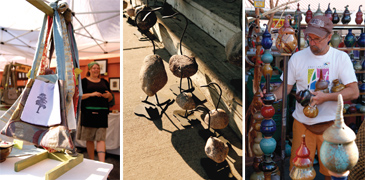
    Several stalls offer ceramics, but only Phil “Pottery Dude” Echert stacks his pots atop one another and calls them “garden art.” These sculptures are deceptive—the pots look precariously balanced but are threaded on iron poles, so the whole structure is really quite sturdy. Aside from the topsy-turvy trickery, it’s the glazes on Phil’s pots that will lure you. These saturated primaries capture the cheery feeling of a garden in full summer bloom. The best part: You can pick the pots to be included in a custom sculpture that Phil creates on the spot.

    A few stalls down you’ll find Cheryl Fitzgerald’s Iron Gallery. Like many of the market’s artists, Fitzgerald shows a lot of outdoor sculpture. Her pergolas and arbors have the appeal of lovely old iron gates and will lend any garden an aura of mystery, as if promising entry to an otherworldly realm just beyond the vines intertwined on them. On a recent trip, I was also entranced by an oversized flower sculpture and a stand of giant iron cattails. For those focused on practical outdoor accessories, Fitzgerald offers stylish tall tables and chairs to create a backyard patio bistro.

    Beyond the monumental yard art, plenty of vendors appeal to the connoisseur of smaller wares. Jewelry and textiles abound, if you don’t mind strolling by tables of knock-off sunglasses and watches to find these homegrown crafts. Be sure to check out Kendra Gebbia’s handmade purses printed with charming, stylized botanical images, and her beaded necklaces, along with her intricate, nature-inspired wood-block prints. Across from Gebbia are two vendors—J&K Glass Expressions and Erika Royer of Glamorous Glass—that should be sought out by any chick with a glamorous event on her schedule. Erika’s fused-glass jewelry and hair clips are colorful and unique, and J&K’s knockout coasters and platters can serve as distinctive accessories for gifts or entertaining.

    Deeper within the market, near the guitarist belting out ’70s and ’80s soft-rock hits, you’ll run across the Art Andes stall. Owner Melanie Ebertz imports gorgeous flat-weave rugs and textiles from Peru, and on at least one trip to the market, a visiting artisan from South America was demonstrating weaving technique. Though the process is ancient, these vibrant rugs, with warm colors and geometric designs, would look equally at home in a cutting-edge loft space or a cozy Arts and Crafts hearth room.

    Evla Pottery entices the market-goer with “Berry Bowls,” decorative colanders that come with saucers to catch water from freshly rinsed berries. You can wash, drain, serve, and store your harvest in the same vessel. These rustic earthenware pots are an ingenious necessity for any well-equipped kitchen.

    After fortifying yourself with a couple of fish tacos from one of the market’s fantastic seafood stalls, turn your attention to Francis Metal Works, where Chuck Adams uses large fieldstones and iron tube stock to fashion all manner of birds native to Minnesota. These sculptures are not your grandmother’s kitschy yard art. I love a good pink flamingo as much as the next girl, but these birds are subtle, sophisticated, and lovely.

    In short, you can rely on the farmer’s market for one-stop shopping. Where else can you pick up Minnesota-grown spinach for your Sunday brunch along with trendy beaded earrings for the Saturday night before? Who knows—you may even drive away with a giant daisy sculpture in the trunk.


    From left: handbags by Kendra Gennia, birds from Chuck Adams, and Phil Echert’s stackable pottery.


    This article originally appeared in issue 19.1 of access+ENGAGE. Subscribe to this free arts e-magazine at mnartists.org/accessengage.

  • Zoom In: Lori Greene

    Mosaic on a Stick hums with chatter from neighbors coming in to browse for supplies, gossip, sign up for classes, and admire new pieces on display. In the three years since mosaicist Lori Greene and her business partner Maria Ricke opened “The Stick” in Saint Paul’s Midway area, they’ve put down solid roots through neighborhood art collaborations—like the project that resulted in ten community-created, mosaic-embellished planters along Snelling Avenue. Greene’s personal work, which she creates in a studio behind The Stick, is steeped in imagery from her African and American Indian ancestry; her totems to femininity and motherhood, while beautiful, often betray an ambivalence and even fear of motherhood, too.

    In her most peculiar, powerful work, babies and dolls appear as regal and even somewhat frightening figures.

    Greene’s public work is no less intimate, focusing on the power of heritage and generational ties. Divination Systems, the series of large statues commissioned by the Midtown Global Market in Minneapolis, is particularly stunning. “They gave me a lot of freedom,” she said, “and I’d been dreaming of those pieces for years.” For Greene, art is no solitary affair, but rooted instead in personal relationships, neighborhoods, and family. “I’m not really even sure what all these pieces mean, to tell you the truth,” she shrugs. “But I can’t imagine not doing this work. It’s who I am.” —Susannah Schouweiler

    Detail from Sangoma by Lori Greene, photo by Usry Alleyne


    This article originally appeared in issue 13.1 of access+ENGAGE.
    Subscribe to this free arts e-journal at mnartists.org/accessengage.

  • Ganda: Rhymes with Wanda, not Panda

    Simply the best, most entertaining food site I know: check out Eat Drink One Woman. It’s the project of a young New Yorker named Ganda (rhymes with Wanda), who polls random people on what they eat, provides knock-out recipes, and makes touching, honest, memoir-ish entries that make me feel more human. Also hungry.

  • Peace (Coffee) Be With You

    coffee.jpeg

    October is Fair Trade Month (in addition to being Breast Cancer Awareness Month and, strangely, National Popcorn Month) and in observance of this, Peace Coffee will host an appearance by Monika Firl, Coffee Farming & Production Liaison of Cooperative Coffees, and Teresa Ortiz — a local activist, organizer, immigration expert and former Director of el Centro de Derechos Laborales (Immigrant Workers Rights Center) at the Resource Center of the Americas — this Thursday at Common Roots Cafe.

    Common Roots is, of course, the restaurant and bagel bakery that went into the old Soba’s location, at 2558 Lyndale Avenue South, and uses organic, locally-sourced ingredients. Peace Coffee actually is the for-profit arm of the Institute for Agriculture and Trade Policy (IATP), a tax-exempt, nonprofit organization devoted to promoting and supporting sustainability, family farming, and fair trade.

    “Back in 1995, we were working with some Mexican coffee farmers who were getting screwed,” says Jim Harkness, president of the IATP. “We decided if we’re telling the world to trade fairly, we should put our money where our mouth is and show that it can work. So one day a container load of coffee beans showed up and we had to figure out a way to sell it.”

    Unlike a lot of do-gooder coffee projects, however, Peace Coffee is premium stuff. Rich, soily, nutty arabica beans. It consistently wins taste tests. Peace Coffee defines fair trade this way: No one human becomes obscenely rich by making another human disgracefully poor. Here’s proof that the world can operate with dignity and produce high-quality products, if everyone is operating above board.

    Monika Firl and Teresa Ortiz at Common Roots Cafe

    Date: October 18th
    Time: 7:30 p.m.

    Call 612-871-2360 for more information.

  • Suffer the Starch

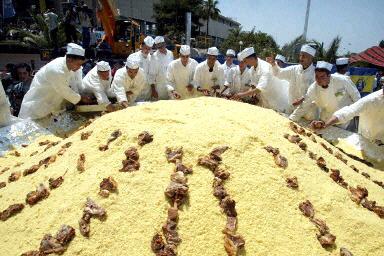
    mega couscous.JPG
    lottalotta couscous

    Sometimes I get ahead of myself. Getting all wound up with the protein and veg portion of the meal, I end up rather conceding the starch.

    God, not another pot of mashed potatoes, boring and blah no matter what cheese/herb/sauce is added. Oh, another loaf of bread warmed in the oven? Sure. What else.

    The other night was ripe for pot roast, which I had on hand. I was quite content to use the spinach from the drawer, as it could be easily sauteed with sliced garlic.

    Luckily with no taters on hand, and a real rooting desire to stay in my slippers, I mined the pantry and came up with couscous. I love couscous, but it can also be bland and boring and sad when the end-of-dinner clearing includes a still heaping bowl.

    With an eye on keeping the supper simple, I felt that I ought to wing it. This, my friends, is my biggest fear: winging it and bombing. If I use a recipe and fail, I can always blame the test kitchens or some drunk copy editor who must have missed something in the proof-reading. But when I open my cupboards and throw in, it’s all on me and my ego.

    Funny enough, my biggest lesson learned has been how to build a dish. There’s a reason you sautee onions before garlic … garlic burns quickly and will keep burning as the onions slowly soften. This is just one of those tiny tiny key elements that I’ve soaked up over the years, like the fact that it’s better to start with the flavor and add the couscous rather than trying to add it after it’s been cooked. I’m happy to say that more than a few things have soaked in, which is maybe why you’re here reading this blah blah blah about my starch, because it worked for me and might still win you love and affection.

    Winging It Couscous
    (with the caveat that I have a pretty stocked pantry)

    1. In a medium sauce pot, melt about 3 Tablespoons butter.

    2. Chop up about 1/2 a yellow onion (mine was in a baggy in the fridge) and throw into the pot, stirring so often, until slightly translucent.

    3. Quarter about 1 1/2 cups of baby portobellas, throw in with the onions and stir about until the mushrooms become golden and soft.

    4. Toss in some freshly chopped thyme, salt and pepper.

    5. Add a little more than 1 cup of water and bring to a boil.

    6. Remove from heat and stir in 1 cup of couscous (mine is whole wheat). Cover the pot and wait for 5 minutes.

    7. Remove the lid and fluff couscous with a fork, stir in 1 hunk of truffle butter.
    Serve it up proudly.

  • Nothing Is Certain or Unchangeable

    READINGS
    True Lies

    1007flimflam.jpgAs a former editor here, Jennifer Vogel penned some excellent Rake stories: on the emptying of North Dakota, on the necessity of libraries, on walking around a city that’s not exactly pedestrian-friendly. But none was as, uh, memorable as her own memoir, Flim-Flam Man, a book about life with a father who was also a con artist and counterfeiter on the lam from the FBI. While the book was well-received on its own, it was also seized upon by an impressive team of Hollywood players: director/screenwriter Jez Butterworth (The Birthday Girl) and producer Bill Horberg (Cold Mountain, The Talented Mr. Ripley). Tonight they’ll be joined by Vogel and some local actors at the Guthrie for a Screenwriter’s Workshop reading of Butterworth’s script. No word yet on whether the shooting of the movie will go local, too … –Julie Caniglia

    7:30 p.m., Guthrie Theater, 818 S. Second St., Minneapolis; 612-377-2224; $10.

    MUSIC
    Dee Dee Bridgewater

    1007bridgewater.jpgBridgewater won a Tony for her role in The Wiz, won a Grammy for an Ella Fitzgerald tribute, had early-career dabbles in fusion jazz and R & B; more recently, she recorded a disk dedicated to Kurt Weill, and another of Parisian café music sung completely in French. But her latest, Red Earth, ranks with Dear Ella as her best yet, featuring a seamlessly buoyant mélange of American jazz and African pop from Mali. She’s bringing over seven African musicians for a mere two weeks to supplement her marvelous trio (which includes ace Nuyorican pianist Edsel Gomez) and the Dakota has bagged two of those precious nights. –Britt Robson

    7 & 9:30 p.m., Dakota Jazz Club & Restaurant, 1010 Nicollet Ave., Minneapolis; 612-332-1010; $60 & $45.

    Humanboy Dons a Girlish Charm

    1007humanboy.jpgIf you’re looking for an agreeable local show this evening, with a slightly more manageable cover charge, I recommend the Humanboy show at the Varsity. Brie Harthun lends her sweet Bjork-influenced vocals to the edgy folk guitar of Ben Berg and Geoff Fischbein. Toss in a touch of synth, and you’ve got Humanboy: “At times traditional, radical, and both; always fresh and, yes – unexpected.” They’ll be headlining tonight, which unfortunately means they don’t go on until 11 p.m., but if you like traditional acoustic folk (with a light jazzy edge or a poppy air) you’ll enjoy the music of Molly Dean and Ari Herstand before the main act. This should be an excellent show, with Humanboy playing new songs, as well as ones from their CD.

    9 p.m., Varsity Theater, 1308 4th St. S.E., Minneapolis; 612-604-0222; $8.

    SOCIAL POLITICS
    The Politics of Possibility

    1007envirodead.jpgYou could actually make it a whole evening at the Varsity tonight. Before the musical extravaganza begins, Policy and a Pint will be hosting “The Death of Environmentalism” with Ted Nordhaus and Michael Shellenberger, authors (or should I say creators) of Break Through. Tired of the same old griping, the cynicism and unbudgingly negative perspective with no solutions? This might be for you. Nordhaus and Shellenberger offer “a new politics for a new century.” And they might have something here worth pondering.

    5:30 p.m., Varsity Theater, 1308 4th St. S.E., Minneapolis; 612-604-0222; $10 (students $5).

    BOOKS & AUTHORS
    Patchett Sings Another Bel Canto

    1007pratchett.jpgWhen a writer as accomplished as Ann Patchett has another book published, we must all stop and listen. Perhaps read. And maybe, if we’re lucky, we won’t be disappointed. This doesn’t happen too often, but if an Orange Prize-winning, Pen/Faulkner Award-winning author can’t do it, then by dogs who can? Patchett’s latest and fifth novel, Run — which she will be discussing this evening — has already been compared to her best-selling Bel Canto. Following a father’s efforts to protect his children over a one-day period, Patchett manages to weave together a story about shared humanity. Take in her presentation and enjoy the musical offerings of the Kelly Rossum Quartet. (I have to admit I still love this sound coming from a man with a mohawk.)

    7 p.m., Fitzgerald Theater, 10 E. Exchange St., St. Paul; 651-290-1200; $15.