Landscape has always been one of the strongest currents in the Minnesota art world. Now, new ways of perceiving and portraying landscape tie artists here to a global groundswell of art about the complex relationship of nature and culture. Recently, I sat down with a group of artists from around the state to discuss their work: photographer Chris Faust, painter Theresa Handy, sculptor Karl Unnasch, multimedia artist Margaret Pezalla-Granlund, and painter/sculptor Gregory Euclide (our cover artist); plus curator Theresa Downing, whose fascinating show, Environments of Invention at the Minnesota Museum of American Art this spring (see “In Review,” p. 18), was the opening topic. As Downing said, “The theme of the show was looking at the difference between raw experience of the natural world and our perception of it through the screen of our eyes, our minds, our emotions.”
Each artist had a different tale of the origins of their insight into the natural world. Euclide’s involved saturating himself in it. “Being a kid wandering through fields was important … experiences like falling in the snow and staying there for three hours and letting snow fall on you and just looking at the sky … Here I am thirteen years old and laying down in a river and letting the water flow over me for hours—if anyone saw me they’d think, you know … ” and he casts his eyes up.
When Faust was young, “the outdoors was where your real life was,” he said. He loved maps, and was fascinated by the split between their flat symbols and the look and feel of the places they represented.
Unnasch spoke of how and why he came to use landscape in his sculptures: “I’m interested in, for lack of a better term, I’ll say ‘innocence’—the thirteen-year-old’s stigmata. For myself, growing up in the country, being out in nature was the basis of that transition; it wasn’t smoking my first cigarette, it was catching my first trout.”
It became clear that the losses, memories, and entropy associated with the natural world all played a major role in most of these artists’ work. As Euclide described his childhood experiments, he spoke of a longing for an experience that would not fade, a desire for presence: “The growth and decay that I saw in the landscape was mirrored in my mind as experience and memory.”
Faust remarked, “Nature is continually trying to increase entropy, and humans are trying to decrease it. That’s why we paint the house, right? Nature is trying to erode the house, we’re trying to scrape and prime … Nature will always win.”
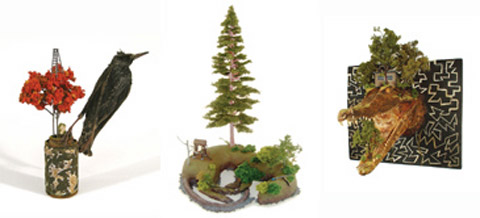
Starling, The Long and the Short of It, and Whudda Croc by Karl Unnasch
New Landscape for Old?
How do these artists view their relation to the traditions of landscape painting and photography? Is this relation ironic, transformed? Euclide noted, “I don’t consider myself a ‘landscape painter,’ even though that’s what I do.” For him, work becomes experience. “I’ll pile up sheets of paper, do a painting on one, then spray water on it. I think of it as a natural process, a temporal image, the landscape washed away by water; I’ll start painting on the next piece, these planes of paper mimic planes of experience in time, they get painted on the front and on the back to mimic the experience of walking through landscape. For myself, it’s a kind of longing, because I’m not in nature anymore, I’m in the city.”
Most of these artists are urbanites, though they may have memories of idyllic days in nature. Though Handy didn’t grow up in the country, “maybe my work talks about that sort of longing [for it],” she said. “And my work is a metaphor as well. Lately I’ve been making small works fastened together. They’re photographs that I paint on, editing out a lot of things in the photo. They feel like flashes of a memory of a place, a happening, a time … that editing mimics our inability to remember all the details.”
Of course, it is possible to see the urban environment as simply another sort of landscape. This became clear to Pezalla-Granlund when she was living in Los Angeles, which “was very different from the landscape I grew up in, but it was also similar, quite flat. I guess when I got addicted to landscape was in parking ramps, and also on L.A. freeways, because you’re up above.”
As the discussion stretched over a range of themes and topics, an undercurrent emerged: landscape as something we want to see but which is difficult to grasp. Faust talked about a rural ecology project he’s part of, which is trying to devise ways of easing the relationship between farmland and wild land. “We’re looking at this point where farmland and nature meet, looking at what farmers would call ‘chaos.’ The natural landscape looks messy to them. The Conservation District is trying to convince farmers to do different landscape practices. They’ll be asked to put in a buffer zone to filter field chemicals, but we have to order it somehow. You can’t just plant a bunch of stuff, there has to be some rhyme or reason to it—otherwise the farmers won’t do it.” Even for him, shooting pictures of these junctures isn’t easy: “It’s very odd-looking, I really have to sit down and look at it for a while. Jill Nassau, the project landscape architect, talks about this messiness, and how it’s innate in every human to try to order landscape. I find that when I’m out in natural landscape, I need to find some sort of thing that compositionally ties it all together.”
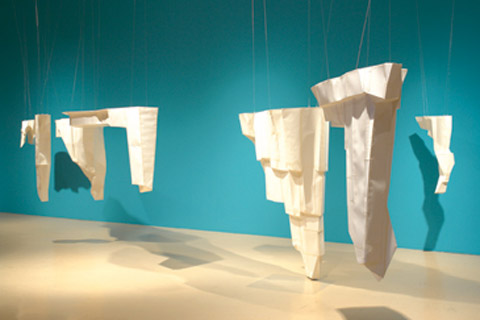
Missing Part (Iceberg Models) by Margaret Pezalla-Granlund
Unnasch agreed with this compulsion to order the world, noting, “I bet it’s hard to find a piece of ground that’s unaffected, that’s not somehow urbanized.” Euclide dreamily added, “You know what the most beautiful spaces I find are? Freeway ramps. I think that those are so beautiful, because they’re left alone.”
In response, Faust reported a comment he heard while driving along a highway, that “MNDoT oughta come in here and clear some of this stuff out!” Faust disagreed—it was nature working. Unnasch laughed. “People feel safer when all those trees are doing exactly what’s expected”—ensuring, in other words, that there’s no room for weeds. He added, “Now there’s another conceptual word—what’s a weed and what’s not? There are no weeds in nature, just like there’s no ‘natural disaster,’ only human disasters.” Faust answered himself, “Nature doesn’t care.”
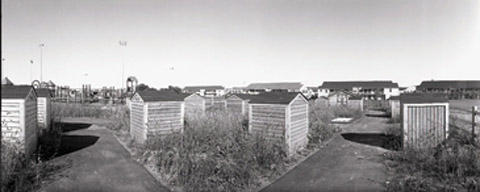
Safetyland by Chris Faust
But is there always a distinction between the human and the natural?
Handy points out the possibility that human alteration of the world is as natural as any other part of it. Her work is becoming more urban; she’s looking more at her immediate surroundings—skies, birds, telephone wires. Euclide told this story: “About six months ago I buried some paper. Later I used that paper covered with dirt, sprayed it with water, made shelves on the torn paper that caught the dirt and water, which became a three-dimensional construction that came out over the floor. I was interested in making the process mimic what the work represented, so the process and content were the same. There was decay on the paper, and where it came out from the wall I planted seeds that grew. The aesthetic parts were not my doing but created by growth and decay.”
The need to understand the disorderly order of nature, to gain a viewpoint beyond the human, is familiar to these artists. Downing described Google Earth, the online database of satellite images of the whole globe, as tremendously influential:
“I often sit and think about how I look to someone outside our atmosphere. For me it was hypnotic to go on Google Earth the first time and think about how we see ourselves and how others see us. It’s changing so rapidly.”
For her, landscape art is this kind of mediation, and both meaning and chance—which can include random techniques like tearing, seized compositions, as well as accident and decay—inform the work of the artists present.
Unnasch’s tableaus often include road-killed animals and found artifacts; the bases of his landscapes are “actual animals, not taxidermied … because I’m not interested in taxidermy, the craft of it. I want to know just enough to bring it off, to keep innocence, openness.” His work is formed half by himself and half by the ravages of time and decay on the animal corpses and the reclaimed objects that make up his sculptures.
That willingness to both see and to un-see—that is, to erase assumptions—is part of this new genre as well. “I’m interested in a continuum of landscape,” Faust said. “I want to draw a line on a map and shoot photos along that line, to unlearn assumptions about the land, to find out what it really is.”
But there’s an equal desire not to represent landscape but to become it, to have art be the processes that create the natural world. “I couldn’t just depict the experience of being in nature,” said Euclide. “I had to redo the process of growth and decay. The process of viewing it, then, becomes the equal of making the piece.” Two-dimensional painting that only depicts the world comes up short for him.
For all their innovative ideas, these landscape artists still owe much to the past, of course: a yearning for communion with the natural world, respect for perception, commitment to the wisdom of the senses. But there’s much that’s new here too. The landscape in these artworks is cut across by human markings, literally broken into pieces, or torn, or part of a body that was once living. Their works convey difficult beauties and tough-minded pleasure; romantic and scientific, earthy and philosophical, these artists are giving us the world that we need as well as the one we deserve.
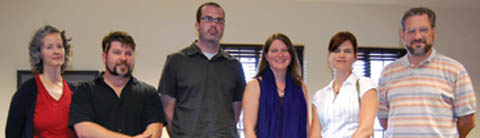
The participants: Margaret Pezalla-Granlund, Karl Unnasch, Gregory Euclide, Theresa Downing, Theresa Handy, Chris Faust.
 If you enjoy local fashion as much as I do, then surely you’ll be interested to know that Joy Teiken (a.k.a.
 Death, life, ritual, individual identity within the broader scope of the human condition. What else is there to talk about? Feel like talking a bit? Maybe just sit and admire — sit, look, listen. Inspired in part by the
  Taunt me. Lose respect. I’m a sucker for
  How do I begin with the last shot of a movie? How can I not?
  Before
  What’s with the general death theme today. Well, we certainly are fascinated with it, and it is approaching All Hallows’ Eve. The Red Eye Theater opened its season this month with the Twin Cities premiere of
  OK. So what’s up with this? I received an email from