Month: January 2008

  • All Hail Hicks

    I had to write and let you know how much I enjoyed Dylan Hicks’s short story in your December issue ["1984 Dodge Ram Roadtrek II – $4500"]. It was like reading a combination of S.J. Perelman and Steve Rushin. Thanks for making the holiday brighter!

    Amy Scott, St. Paul
    Letter

  • Arrivederci, Brix

    Italy is out, Texas is in.

    A visit to the website of Brix Wine Bar & Bistro confirmed a tipster’s report: Brix Bistro & Wine Bar in Saint Louis Park has closed, and will be replaced by Laredo’s Tex-West Grill & Cantina, a "Tex-West" theme restaurant:

    "Laredo’s
    will feature unique Tex-West entrees, authentic Mexican dishes &
    mesquite-grilled steaks in a fun, energetic atmosphere. Laredo’s
    Cantina will feature our soon-to-be famous Margaritas & ice-cold
    cerveza. We promise to be fun & affordable, but still provide
    great service with only the freshest ingredients on our menu.f you like the local food in Austin, TX, San Diego, CA and Cabo San Lucas as much as we do, then you’ll love Laredo’s! We are shooting for an early March opening."

    The ownership remains the same: the Collins Restaurant Group, which also owns the adjacent McCoy’s Public House.

    I’ll reserve judgment until I visit the new restaurant, but this seems like a real shame. When when I reviewed Brix, soon after it opened, I was impressed – and surprised. Brix offered authentic Italian cuisine, prepared with a level of skill and sophistication rarely found on the suburban dining scene.

  • I, Too, Have a Bone to Pick with Andrew Zimmern

    At any rate, what’s my big problem with Zimmern? Where to begin, where to begin? First, I should admit that I really don’t know who this Zimmern fellow is. I mean, I really don’t know who the hell he is, just as, I’m sure, he doesn’t know who the hell I am. I got wind of a recent dust-up in the blogosphere, however, and felt curious enough to search Google for images of the man. I start there whenever possible, because I have no problem at all judging a book by its cover, being a firm believer in that old business about a picture being worth a thousand words.

    At any rate, I spent some time looking at photographs of a man alleged to be Zimmern and quickly concluded that a thousand words were something like 975 words too many; a couple dozen, I should think, would suffice.

    I can definitely tell you that I don’t like the cut of Zimmern’s jib. I think he eats too much, and given that he apparently spends so much time eating, I also think it’s fair to presume that he eats bugs … no, wait—he does, it seems, eat bugs, but what I meant to say was that it’s fair to presume that he talks with his mouth full. I don’t care for that.

    I dug a little deeper to find out more about this Zimmern character, and discovered not only that—as I suspected—he eats too much, but he also eats almost entirely at places I’ve never heard of. I’m not a big fan of people who make a habit of eating at places I’ve never heard of, then proceed to go on and on about how great those places are.

    I’m guessing that Zimmern has never spent a morning hanging drywall and then, with dust all over his hands (and under his fingernails), eaten the hell out of a Manwich and a can of Pringles. I’m also guessing that he’s never spent a cold afternoon in the garage skinning muskrats then driven his truck to the Arby’s drive-thru and polished off the 5-for-$5.99 roast beef special all by his lonesome.

    Maybe that’s unfair. Maybe Zimmern has, in fact, laid drywall and eaten the hell out of a Manwich and a can of Pringles. Maybe he has skinned muskrats and gone to Arby’s to gorge solo. But I’ll say this: if I’m correct in my suppositions—and I feel confident that I am—then I’m also correct in saying that this is a man who doesn’t know a diddly-damn thing about truly great food and the supreme pleasures and surprises of eating when you’re flat-out hungry as shit.

    Answer me these questions, Zimmern, you hot shot:
    • Have you ever eaten a pie from Beek’s, King of Pizza?
    • Under the right circumstances (very, very hungry; very, very stoned and/or drunk; etc.) could you rave for hours about the wings at Shorty and Wag’s?
    • Can you name, with appropriate enthusiasm, a favorite brand of canned chili?
    • Could you, do you honestly think, tackle the Tremendous Twelve at Perkins?
    • Have you ever been so fucking hungry that you’ve eaten a microwave hamburger from SuperAmerica and felt like you’d died and gone to heaven?
    •Might you, as I did this very evening, mix together cans of Progresso vegetable beef and beef barley soup and eat the whole damn pot while seated on the kitchen floor?
    • Have you ever spent hours driving along a freeway praying for the appearance of a Taco John’s?
    • Do you agree that Tootsie Rolls and pretzels are often as not a perfectly suitable lunch?

    If you answered no to even half of these questions, Zimmern, you’re not only a piss-poor food critic, but you’re also a pussy.

  • Scratch That One Off

    I love a to-do list. In fact, I am such a master at list-making I can make lists of my lists. I can subdivide errands, chores, and activities ad infinitum. Sometimes I go numerically, by order of importance to my day. For example:

    1. Work out
    2. Breakfast
    3. Phone calls

    Other times, I mix it up to build in fun when I anticipate that drudgery and boredom will be looming:

    1. Return emails
    2. Make appointments
    3. Make a prank phone call to someone you know from sixth grade
    4. Laundry

    During periods of depression, my lists have taken on a rather frightening level of detail:

    1. Get up
    2. Shower
    3. Brush teeth
    4. Get dressed
    5. Go to work
    6. Come home from work
    7. Stay out of bed until it is dark outside

    I don’t imagine that I would have forgotten that those things needed to be done, but at those times in my life I needed to be able to cross them off one by one. A scarily basic daily to-do list was one of my only tenuous links to normality.

    I have had four vacations in my adult life. I am so connected to my lists that even on vacation I make a list of must-do fun things, or must-see interesting things. Here are three items cherry-picked from a list made during a trip to New York City:

    4. Go to a bar and don’t talk to anyone you know
    5. Talk to at least six people
    6. Do not touch anyone

    That kind of list has a “double dog dare” effect, catapulting me into social situations that would never have occurred otherwise.

    When I do stand-up I make a set list and carry it with me, even if I don’t look at it or reference it directly. These lists have a terrific surreal quality. If I am ever in some kind of accident, the paramedics will strip away my clothes to find that I am wearing dirty, sweat-stained, unmatched underwear with holes in them. They will pump my stomach and find a semi-digested handful of Sour Patch Kids, four rum-and-Cokes, and an entire rotisserie chicken. And instead of proper I.D., I will have a list in my pocket that says:

    1. Clorox Gel boobs
    2. Big Lots’ three-legged-pet store
    3. Margery Johnson’s Keebler elf pie

    The list, of course, will be given to my children, who will understand immediately.

    I like to cross things off lists, but I enjoy making them just as much. It gives me a false sense of security, like everything is under control. The greater me realizes this is folly, yet also indulges my compulsion to write down what I hope will, and should, happen next.

    By the time you see this article, I should be about one month into the Big Kahuna of lists, my New Year’s resolutions. I make them annually (duh), with widely varying results. There are efficiency experts who tell you not to make big promises to yourself or you’ll just get discouraged. I’ve made yearly lists of very specific things to do, with very excruciatingly detailed steps. I’ve also gone the route of putting only three things on my yearly list so I won’t be overwhelmed.

    Who knows if any of this year’s planning will pan out? Maybe yes, maybe no, and I’m OK with that. Two years ago, because of a New Year’s resolution to learn an instrument, I took four guitar lessons. Now I know how to play Deep Purple’s “Smoke on the Water,” which would have solidified my status as a hot chick to teenage boys in 1972, but in 2008 makes me feel a little embarrassed when I play it at parties. It’s like I’m Grandma come to call, kicking it old school and playing “Surrey with a Fringe on Top.” But I do it anyway. Because if I didn’t, I wouldn’t be following the resolution that makes it to the top of my list every year:

    1. Bring all of you, everywhere

  • White Wine for Men

    It is a pity there’s no reason to believe King Arthur actually existed. True, there was a sixth-century monk called Gildas The Wise who penned a wordy jeremiad that mentions a battle at a place called Mount Badon where the Celtic remnant of Roman Britain stemmed the tsunami of Anglo-Saxon invasion. It is also true that, long afterwards, Welsh monks with well-developed imaginations placed at Mount Badon one of the twelve victories they ascribed to Arthur. If you think that adds up to evidence for a historical Arthur, you probably also think that Saddam Hussein supported Al Qaeda.

    Of course, not necessarily existing is no barrier to being influential, as critics of the Ontological Argument sometimes discover. Imaginative folk of every era since Late Antiquity have peered back into the Age of Arthur and summoned the mythical monarch from the fifth-century mists, calling into the old world to redress the balance of the new. The monks of medieval Glastonbury felt they had solid evidence that Arthur would one day return and put old England to rights when, in 1184, they discovered a lead coffin allegedly containing the king’s bones. It was inscribed with his name and the motto “rex quondam rexque futurus.” Some 300 years later a Warwickshire country gentleman called Malory, in jail awaiting trial on a long list of charges including affray, deer-stealing, and carrying off a neighbor’s wife, wrote a long and eloquent account of King Arthur and the Round Table, lamenting in marginal notes to his manuscript that the age of chivalry was dead and that knights no longer had the noble souls they had of old.

    Later poets, too, have found ideals to feed their fancies at the court of the once and future king. The opera of Purcell and Dryden, King Arthur: The British Worthy, is as insubstantial as spun sugar, but no less pleasingly sweet. Alfred Lord Tennyson, gentleman-poet, sought high moral rectitude at the Round Table and found it in Sir Galahad, whose strength was as the strength of ten, because his heart was pure. (Did anyone less pure-hearted, one wonders, try to warn the old boy about his earlier line, “‘The curse has come upon me,’ cried the Lady of Shalott”?) In living memory, Charles Williams found in the Arthur stories a mystical means to understanding the coinherence of human and divine life.

    And then there is Mark Twain’s Connecticut Yankee in King Arthur’s Court. I loathe this book. Instead of parting the curtains of time to catch sight of Merlin’s Isle of Gramarye, Mr. Twain sends there a cocksure moron of his own era, a nineteenth-century firearms manufacturer yclept Hank Morgan, who turns the armored knights into sandwich-board men advertising soap and, as a final gesture, mows down rank on rank of mounted men-at-arms using an electric fence and a nest of machine guns. The message is: Whatever happens, we have got the Gatling gun and they have not. Mr. Twain (yes, I know it is a nom de plume) is no more imaginative in this book than the creators of the Flintstones, who assimilated even the Neolithic to the contemporary suburb, a habitat as specialized in its own way as that of any dinosaur, and therefore ultimately just as fragile.

    What is more, Hank Morgan’s is the sort of mechanical machismo which gives masculinity a bad name. Until his time, men in love with speed needed to develop “good hands” and a lasting relationship with a horse, an animal with more mind of its own than a supermarket trolley, willing when treated well but tricky if bullied. They could not simply pull a metal throttle and blast off into the sunset. Chivalry, as the etymology of the word suggests, involves not only strength but also the gentleness necessary for equestrian manipulation. For Arthur and his knights, manliness was more than force.

    Which is why, when I describe the 2007 Sauvignon Blanc from Mount Riley in New Zealand as a masculine wine, I do not mean merely that it knocks your socks off. It is a constant surprise that New Zealanders can make from this variety of grape, so evanescent when the French turn it into Pouilly-Fumé, a wine so muscular in character. The Mount Riley Sauvignon Blanc is bright and clear, the color of pale straw. It is strong and fresh; it is not sweet, but it is not unsubtle. It made me think of the taste of peaches with the sugars taken out. I detected also hints of pepper, such as you sometimes encounter in kiwifruit. A glass or two with a hot fish stew could help redress the balance of your world.

  • The Sweetest Simmer

    Now we’re fully settled into the bland, grayest days of winter—a time when I seek to imbue my life with more flavor. After all, woolen sweaters and bestsellers can only go so far in fighting the battle of the blahs. If I’m to be trapped indoors, then the kitchen had better be sending forth seductive smells of warm, satisfying dishes that make me happy to be holed up at home. That’s usually why, particularly at this time of year, the Sunday meal becomes a big braising event.

    Braising is one of those cooking terms that sounds technically daunting to the uninitiated: Do I need a special pan? Will it require kitchen string or a unique thermometer, neither of which I have on hand? But in truth, braising is so easy that, once you’ve mastered it, it starts to feel like cheating. Better yet, braising consistently produces soulful, and even good-looking, Sunday meals—meals that come for far less money and with a lot less mess than your typical fried, roasted, or sautéed productions.

    The basic technique requires slowly cooking a cut of protein while it is semi-immersed in liquid in a covered pot. But don’t confuse braising with stewing; braising relies more on the combination of liquid and steam to bring out the best flavors.

    Typically, braising is done with tougher, lesser-quality cuts of meat. In fact, braised classics like osso buco and coq au vin were invented for the very purpose of enhancing the flavors of such meats. The moist heat of braising breaks down the connective tissues in tougher cuts, melting the collagen and contracting the fibers. Those tissues then absorb some of the liquid along with the melted fats and flavors, giving the meat the tender, fall-apart quality that is the hallmark of a braised dish.

    Preparing the week’s capstone meal in a single vessel cuts down on clutter—and saves time. In the same pot, you can quickly sear the meat (giving it a nicely caramelized crust), add the liquid, and toss in some vegetables. Cover the whole thing and put it in the oven on low temperature. For the next few hours, while your meal develops many layers of flavor and your kitchen fills with warm and comforting aromas, you’re free to read a book, do your taxes, or just get on with your life.

    Cuts of meat that braise well include lamb and veal shank, poultry legs and thighs (think chicken cacciatore), country-style pork ribs and beef cuts including chuck pot roast, short ribs, flank steak, and eye or top round roast. That’s not to say you must have meat; sturdier vegetables like cauliflower, endive, leeks, and rutabaga braise quite well, as a matter of fact. The liquid component can also be varied. While most recipes call for a base of stock, the addition of wine, port, and beer is also common. During the coldest months, I like to braise pot roast with rosemary and Guinness. But the moment I sense the light of spring, I switch to braising chicken with citrus, white wine, and stock.

    In the meantime, as cold days continue to keep the family cooped up together all weekend long, there is likely to be a bit of sniping. But by braising a huge pot of short ribs, the cook can gently infuse the domestic surroundings with the smell of subtle spices, working a little homespun magic against the winter blues.


    Spiced Braised Short Ribs

    1 cup all-purpose flour
    2 tsp. salt
    1/2 tsp. pepper
    1/2 tsp. cinnamon
    1/2 tsp. unsweetened cocoa
    6 pounds bone-in beef short ribs,
    cut into 3-inch sections
    1/4 cup butter
    1 large onion, chopped
    1 1/2 teaspoons ginger
    4 cloves garlic, minced
    1 3/4 cups beef stock
    3/4 cup red wine vinegar
    1/4 cup packed brown sugar
    1/2 cup Sriracha (or chili sauce)
    1/3 cup tomato paste
    1/3 cup Worcestershire sauce

    Combine flour, salt, pepper, cinnamon, and cocoa in a large zip-lock bag. Add ribs in batches and shake to coat. Melt butter in a large pan and brown ribs on all sides. Remove ribs to a larger baking dish.

    In the same pan, over medium heat, sauté onion with ginger until translucent and soft; add garlic, stirring until fragrant. Add stock and vinegar and bring to a low boil. Add sugar and stir until dissolved. Add remaining ingredients and bring back to a low boil. Remove from heat and pour over ribs. Cover dish with foil. Cook in a 300-degree oven for four to five hours, or until the meat is easily pulled from the bone.

  • I Wouldn’t Care for This Health Care, No!

    Get with the program, health-care providers of America,
    and get a clue about the prices you ascribe to your services. While you’re at
    it, we wouldn’t mind if you went so far as to tell us the costs upfront. Yes,
    yes; I know the industry if rife with corruption–er, negotiated discounts–and, in fact,
    the prices are subject to much (much!) change. But here’s the thing: Very many
    of your customers are paying out of pocket nowadays.

    For example, me! At this morning’s 8:20 a.m. dental
    appointment (I’d saved enough dough in my HSA), I stumbled into a
    hundred-dollar situation: Apparently, they’ve got these five-year, full-facial
    X-rays for which they insert a progression of plastic doodads and snap a
    dozen-odd pics all around your face.

    "What’s different here?" I asked the hygienist on the fifth or sixth take. I get an
    X-Ray every year or so (I know these run me an extra thirty bucks), but I didn’t
    recall it ever being so elaborate before. It was at this point that,
    finally, I learned I was getting the Cadillac five-year, full-facial X-Ray and,
    even better yet, the hygienist assured me: "The insurance company treats them
    just like panoramic X-rays."

    "I don’t have dental insurance," I uttered icily–or as icy
    as I could be with a damned bite-guard in my mouth. I mean, who has dental
    insurance anymore? That’s, like, so-oo passé.

    I won’t bore you with the details of my temper tantrum, but I
    will say this: I’ve got decent chompers and would’ve passed on the hundred-dollar-plus
    X-Ray had I known about it upfront. This is akin to the time I took my junker Volkswagen
    for an oil change, only to learn, upon picking it up later in the day, that
    they’d replaced the $800 timing belt while they were at it, too. What gives?

  • Swallowing

    It is an established fact that we human beings want what we cannot have. When exorbitantly priced iPhones hit the market—already in limited supply—people line up at 2 a.m. And by telling a couple they are not allowed to have sex for a week, therapists say they can cause even the most uninterested spouse to churn with desire.

    So it is with absinthe, the drink preferred by Ernest Hemingway, Vincent Van Gogh, and Henri de Toulouse-Lautrec, which supposedly drove each of them crazy and was outlawed in the United States in 1912.

    It is supposedly the wormwood in absinthe that makes it so deliciously dangerous. An herb that’s poisonous in even moderate amounts, pure wormwood contains thujone, a ketone with hallucinogenic properties. It’s possible, I suppose, that absinthe provokes delusions in very rare cases—though the same can be said of sugar, sleep deprivation, over-the-counter cold medicines, and lust.

    Laws restricting the sale of absinthe have been loosening for years. In 1972, the Food, Drug and Cosmetics Act lifted the ban on the liquor itself and focused instead on concentrated thujone (which also occurs naturally in sage, thyme, and rosemary). Then American distillers realized that the absinthe they’d been drinking in Spain and Portugal—and believing had mystical properties—actually contained such a negligible amount of the hallucinogen that it qualified for sale in the U.S. They were faced with a conundrum: The very argument they could use for making the case that absinthe should be legal might also lessen its appeal.

    In other words, without the naughty element, what is left of absinthe but a foul-tasting green syrup with a nearly lethal level of alcohol?

    I am both a confirmed wine drinker and someone who does not care for the taste of anise. Keep these two facts in mind. But my experience tasting absinthe for the first time left me truly puzzled as to what all the fuss is about.

    It smells herbal with a touch of sweetness, like a bakery in the middle of a stand of fir trees; this I truly enjoyed. But the first sip was like dragon effluvium: livid, scorching, and green. It burns for a long time (a looonnnggg time): on the tongue, in the throat, and later in the gut. The predominant taste is licorice and leaf and something vaguely scotch-like—if your scotch had been subject to a nuclear flash.

    Most disturbing, absinthe’s flavor lingers for hours. Neither breath mints nor vigorous tooth (and tongue) brushing can expunge it. With an alcohol content of sixty-two percent—that’s 124 proof—it’s as if the imprint is soldered onto the inside of your mouth.

    I tried drinking it straight and as an absinthe drip, a process that reminded me of every heroin-cooking scene I’ve ever seen on TV. There is dramatic ceremony to this drink—no doubt one of the things that has made it popular among writers, artists, and actors. Traditional preparation requires a sugar cube placed on a slotted spoon that is set over a glass of absinthe. You trickle ice water directly over the sugar, allowing it to melt into the liquor through the spoon’s vents. This creates a “louche,” or pale white cloud, in the drink, topped with a ring of iridescent chartreuse.

    It’s pretty. But I actually liked the absinthe even less this way, preferring the pain and boldness of a flavor I found confounding to a watered-down, sugary slurry edged in green. The only way I could imagine liking this liquor, frankly, is in coffee with a heavy dollop of whipped cream—a variation on Irish coffee that would not only soften the flavor but might thankfully burn off some of the alcohol as well.

    On December 27, Surdyk’s opened early and began selling Lucid Absinthe Supérieure, one of only two varieties currently available in the United States, for $75 a bottle. And when Jim Surdyk, who had a five-day exclusive on the introduction, opened his door at 8 a.m., twenty-five people were already lined up to buy. (The day after New Year’s, Haskell’s began selling Lucid for $69.99.)

    “It’s just interesting to people, the whole mystique of it,” Surdyk says. I agree. I also think absinthe is a perilous drink, not only for the pocketbook but for public health: a century-withheld novelty that will make you very, very, very drunk very, very, very fast.

    This—in addition to depression, schizophrenia, and syphilis (respectively)—is likely what really caused the madness of Hemingway, Van Gogh, and Toulouse-Lautrec.

  • Beyond the Obvious

    Some guys—and gals—get all the ink. If you are a devoted Twin Cities foodie, you know all about Tim (and Josh), Vincent, Alex, Stewart and Heidi, Lucia, Doug, J.P., Lenny, and Brenda—and you can pair them with their restaurants. Odds are pretty good that you have also heard of Tanya Siebenaler, Don Saunders, Scott Pampuch, Mike Phillips, and J.D. Fratzke.*

    Google any of these names and you’ll get hundreds of hits. And by the time this issue is on the streets, your chances of getting a Valentine’s Day reservation at any of their establishments are slim or none.

    But plenty of other very fine restaurants don’t generate the same buzz and don’t make it into the Zagat Guide. Some of them are too new, others too old, some are a bit off the beaten path, and some are just a notch less ambitious than the places everyone’s talking about. Following are a few of these under-the-radar places that seem especially appropriate for Valentine’s Day, or any romantic occasion.


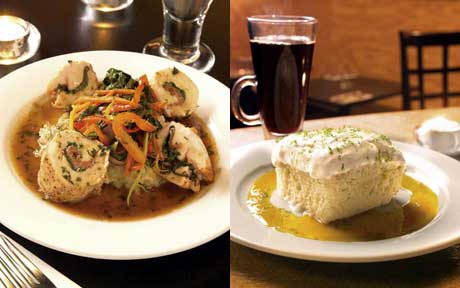
    At First Course: A chicken roulade with gorgonzola risotto, with a tres leches cake for dessert.

    Unless you happen to be his mother or one of his loyal customers, odds are pretty good that you have never heard of Travis Metzger, chef-owner of First Course. The décor at this little neighborhood bistro might be rather minimal for some tastes (varnished plywood takes the place of teak and mahogany veneers), but I find the place quite charming, fake fireplace and all.

    The first time we visited, Metzger was doubling as waiter, and listening to him describe the nightly specials made it clear that this is a guy who really knows and cares a lot about food. We started with a couple of his nightly specials: field greens and roasted beets with chopped walnuts, dressed in walnut oil with a pumpkin-infused goat cheese, and a tapas plate of polenta topped with a savory duck confit.

    I was a little skeptical about ordering the seafood stew in lobster broth, fearing a commercial soup base loaded with salt and MSG (there are no other lobster dishes on the menu); this version, however, was delicious: shrimp, mussels, clams, and calamari in a light but intensely flavorful broth, spiked with just enough chipotle pepper to command your attention. Other best bets from subsequent visits include the pappardelle with lamb ragu; braised leg of lamb with rosemary, white wine, and tomato; butternut squash ravioli with a brandy-Gorgonzola cream sauce; and the chicken roulade filled with prosciutto, spinach, and provolone, served over a Gorgonzola risotto.

  • Stop the Clock

    Perhaps no place on Minnesota’s Iron Range personifies its mythical, often misunderstood boom-calamity-boom nature better than tiny Kinney (its population flutters around two hundred), located in the middle of the Mesabi Range on Highway 169. In 1977, faced with an outdated water system and difficulty securing state or federal assistance, Kinney attempted to secede from the Union. In a letter to then-Secretary of State Cyrus Vance, town leaders announced that they were even prepared to declare war and surrender immediately, in an effort to expedite the delivery of foreign aid necessary to replace its water system. No official response was forthcoming, but the Republic of Kinney was born, and last July the town celebrated the thirtieth anniversary of its independence.

    To an outsider, the vast territory of the Range, with its gaggle of working-class towns and the unique landscapes created by its mines, does in fact have the feel of an old-world republic. The region technically encompasses the entire northeast corner of the state, including Two Harbors and Duluth, whose Lake Superior ports send Iron Range ore out into the world. But the Superior shore, and the area north and south from Ely, the Arrowhead region, has always had a distinct identity. With the Boundary Waters Canoe Area and a large swath of the Superior National Forest, this territory attracts scads of tourists and wilderness adventurers.

    The heart of the Iron Range, however, has never been high on the list of Minnesota tourist destinations. It’s not hard to find native Minnesotans who’ve never even driven through the region proper, despite its fabled place in state history and the fact that so many of the town names are ingrained in Minnesota lore: Hibbing, Virginia, Chisholm, Eveleth, Mountain Iron, Biwabik.

    Aside from a Bronx accent still evident after thirty-five years in Minnesota, photographer Mike Melman could easily pass as a native Iron Ranger at any Twin Cities social function. He’s got the laconic demeanor; the ruddy, slightly rumpled look of a man who’s just stepped in out of a cold wind; and the gift for being simultaneously deadpan and passionate. Not that Melman attends many social functions. He’s a rambler with a camera, “looking for places they haven’t messed up yet, but will,” and is generally out trolling for pictures in the dead of night.

    Melman took a circuitous route to Minneapolis, where he has lived since 1972. Born and raised in the Bronx, he attended New York’s Cooper Union and then Berkeley to complete his architecture degree. After college he served a six-year stint in the Naval Air Reserve, stationed at Floyd Bennett Field in Brooklyn. The Navy stuck a camera in his hands and sent him up in the plastic nose of a P2V prop plane to take surveillance photos over the Atlantic.

    Later, Melman went to England for several years, where he worked for architects and started taking photos in earnest. He and his wife then made the somewhat arbitrary decision to relocate to Minnesota (“a couple friends from Cooper Union ended up here, and said good things”).

    Melman worked steadily in architecture and promptly retired when he turned 65. “It wasn’t exactly a successful career,” he said. “I made a conscious choice not to do my own thing, so I was always working for firms. And the problem with that is that a lot of the time you end up working on stuff you don’t believe in.”

    Even as he was toiling at architecture, he was discovering that photography was the perfect medium for capturing the environment he found in the Midwest. “The move was a strange adjustment, initially. Growing up I was closed in all the time. I rarely left the Bronx. I’d look across the airshaft and see my neighbors at their table, and the elevated train passed right outside my bedroom window. I’d look out and see the passengers and they’d be looking right back at me. They didn’t look very happy. I didn’t realize it at the time, but I craved space.”

    Even so, Minnesota was an acquired taste, Melman acknowledges. “It didn’t take me long, though, to become quite addicted to all the space, the sky and clouds, the light and all the different kinds of weather you get here. Not to mention the sort of desertion you can encounter in the winter and the middle of the night.”

    All of those things—light, sky, space, and, particularly, desertion—have become trademarks of Melman’s photography. If anything, in fact, he has become somewhat notorious for the austerity and desolation of his pictures. He works very hard to exclude people, cars, and even trees in his shots. “People sometimes get appalled when I explain this,” Melman said. “And I like trees just fine; I just don’t want them in my pictures. I like the pure geometry of land, buildings, and sky, and the trees just confuse everything.”

    From the late ’80s through the ’90s, Melman (who does not own a car, and often travels by Greyhound bus) took photos all over the state. Most were nocturnes, or images captured at first light, for a project that eventually became his book The Quiet Hours, published in 2003. Then, at the suggestion of his editor at the University of Minnesota Press, Melman started poking around on the Iron Range. In 2006, he received a State Arts Board Initiative grant for a project there, and made twelve trips north that year.

    The culture of the Iron Range turned out to be a perfect fit for a guy who is fond of saying that he’d like to turn back the clock to the 1950s. “I see so much stuff—the strip malls, the condos, the crap along the freeways—and I’m always wondering, ‘Is this the future?’ ” he said recently. “Because if it is, I’m leaving. I don’t know what people are thinking. You have to wade through more and more trash to get to the good stuff.”

    Melman’s version of “the good stuff” is in ample evidence in his photographs from the Range. “They’ve got a different light up there,” he said. “It’s super clear. The legendary vastness of this country is all right there, and the scale of the mining operations is just stunning. The whole culture, there’s so much beauty. Towns come and go; they live and die by the mines, but the people try like hell to stay up there. You ask these old miners what they’re going to do when they retire and they want to stay right there, maybe get a cabin, and hunt and fish. They’ve had these incredible hard times, but there’s still this preserved way of doing things. I guess I’m always surprised when anything from the old days is still intact. It’s like a miracle to me.”

    Be sure to view the slideshow in the left column