Month: February 2008

  • Simulated Madness

    Who could forget the game last December when Douglas Stewart, the low-scoring walk-on from Minneapolis, stepped out from the shadows of his all-conference teammates to lead the Annapolis Fightin’ Crabs to a national championship?

    You’re forgiven if you don’t follow the defending champs; they don’t, alas, exist in the realm people persist in calling the “real world,” but rather as data warriors in the complex alternate universe that is SimulatedSports.com College Basketball.

    It’s a world that lurches to life every Monday, Wednesday, and Friday at the stroke of a keyboard, and to the flesh-and-blood coaches who guide the teams, its reality is corroborated by the hours they spend poring over play-by-plays, box scores, individual statistics, and the high school recruits that are the virtual game’s future. Take your pick: SimSports is a community, an extended metaphor, a reason to get up in the morning or stay up late into the night.

    The free online game, created in 1999 by SmartAcre LLC, is not a typical fantasy league; instead of using the stats generated by real-world collegiate hoops stars, the coaches playing SimulatedSports basketball recruit and coach randomly named players with computer-generated attributes.

    There is no actual on-court action, only static data posted to web pages. Games are viewed as box scores or play-by-play accounts (“D. Watson passes to M. Williams”). Of the dozens of pages detailing team statistics, players’ strengths, league standings, top performers, game strategy, and much more, only a few are interactive. Coaches set pre-game lineups and strategy through drop-down menus, and likewise apply points toward next season’s preferred recruits. Yet out of the numbers leap beloved players, future stars, bitter rivalries, miraculous victories, and another grueling March Madness-style tournament every nine weeks.

    It’s a pretty decent and entertaining simulation of real college basketball, but with better team names: Santa Fe Steaming Toads, Jackson Five, Amarillo Needs Women, Olympia Dukakis, Erie Coincidence, Twin Falls Hurt Twice.

    My own Boston Stranglers have hovered near the top of their league for a half-dozen seasons now, but have never quite managed to go all the way. That failure certainly can’t be attributed to lack of effort. I spend hours each week checking scores, adjusting lineups, scouting opponents, and browsing the ranks of high school recruits to build my dynasty.

    I’ve logged in at work, coached from Palm Pilots and public library computer terminals, from internet cafes in Mexican mountain towns and Garifuna villages in Belize. On my recent three-week honeymoon, I didn’t miss a game. What can I say? Addiction is a high-maintenance mistress.

    And I’m not the only junkie. According to Todd Nevin, who runs the game from his Baltimore home, in between his job as a programmer and his kids’ real-life Little League games, of the more than 4,600 teams in eighteen leagues, 4,035 have active human coaches (the computer runs the others). While coaches can buy credits (with small amounts of real money) to enhance their recruiting, that income covers costs but is “not nearly enough to make it my full-time job,” says Nevin.

    Coaches hail from as far away as Europe, Australia, and Japan, and include servicemen stationed overseas. “It sure helps to relieve the stress of war,” wrote one (who continued to coach while deployed in Iraq) in response to the questions I posted on the league’s very active message board.

    The online responses revealed the strength of the game’s grip on its devotees. One coach admitted spending twenty hours a week on the site; another coaches twenty-four teams at one time. Some use Excel spreadsheets and formulas to track statistics and gain an edge on opponents and recruiting. Computer programmers make their own custom-written game viewers and other software to track every imaginable aspect of each contest.

    As addictions go, SimulatedSports is a relatively benign one. Even so, not everyone understands it. “They definitely don’t get it but are happy I don’t do other drugs,” wrote one coach of his loved ones.

    Another said he’d used the game as “an escape from a marriage that had gone very wrong … I absolutely immersed myself in [the game] … I knew everything about every team in the league. The game actually helped me in some way get through a very difficult time in my life.”

    Others relish the real-life relationships formed through the message boards and, of course, the spirit of competition. Those champion Fightin’ Crabs are coached by a guy I introduced to the game, a Minneapolis IT professional who wouldn’t let me use his name because, he said, “people will make fun of me.” In less than a year and a half, he’s racked up a hundred and twenty-eight wins and forty-nine losses, two Final Four appearances and a league championship. After four years, I’m still waiting to win it all, but I continue to take no small pleasure in beating him.

    One local coach, who called the game his “dirty little secret,” recently walked away, discarding his Syracuse Lords A’Leaping (and four other teams) like so many unsmoked cigarettes. He claimed the habit wasn’t hard to kick, but it’s not like he went cold turkey. “I do spend a lot of time on the Xbox 360 now,” he said.

  • Stupid Is as Stupid Does

    A story appeared in The New York Times on Valentine’s Day with the headline “Dumb and Dumber: Are Americans Hostile to Knowledge?” It cited several recent books that bemoan America’s seeming self-satisfaction in the knowledge, that, well, we don’t need no knowledge, ’cause we’re Amurricans.

    I don’t think that’s the case. I think we don’t need no knowledge because, by golly, there’s money to be made on two fronts: We can sell stuff to stupid people; and we can sell stupid itself.

    Let’s look at the evidence of my first premise: George W. Bush, whom I like to refer to as President Forrest Gump. I’m not necessarily implying that President Bush is stupid, because I don’t think he is stupid. I actually think he’d make a great contestant on that TV show, Are You Smarter Than a Fifth Grader? I bet, for example, he knows more about the content of your phone conversations than you do.

    I like to call him Forrest Gump because Forrest Gump beat out Pulp Fiction for the Academy Award for Best Picture of 1994, just like Bush beat Gore for president in 2000, and for the same reason. He won because Americans prefer the world of Forrest Gump. It’s violent, complex and unfair, but can be successfully navigated the same way Forrest did. After all, life is just like a box of chocolates. Sometimes you get nougat, sometimes you get caramel, and sometimes you get Vietnam, AIDS, or global warming.

    Americans can swallow anything.

    I certainly don’t buy the rest of the world’s assessment of Americans as exemplified in the London Daily Mirror headline the day after Bush beat Kerry in 2004. It read: “How can 59,054,087 people be so dumb?” First, I ask, If we’re so dumb, how can we count that high (Ohio notwithstanding)? And second, does re-electing Bush make us seem any dumber as a nation than collectively spending over $250 million to see the last Ben Stiller movie?

    Which brings me to my second point. We need to do a better job selling stupid to the rest of the world. Stiller’s Night at the Museum did over $320 million in foreign sales, granted. (It was hurt by the bad weather in Slovenia on opening weekend or it would have made a few thousand tolers more.) Since we can’t sell Escalades in countries where urban streets are about as wide as two donkeys (and, I might add, gas has to be paid for in hard currency like the euro) the only commercial advantage left to us is to sell stupid in Europe and Asia. (I’m sure we’ll make more economic inroads in Africa when more Africans stop obsessing over the whole subsistence farming economic model and get digital cable like the rest of us.)

    I don’t even have to go back to Jerry Lewis’s inexplicable popularity in France to make my point. I’m not even counting President Gump’s backrub of German Chancellor Angela Merkel or his duel with the locked door in Beijing. I’m talking “commercialized” dumb. You know: YouTube’s dogs on skateboards or any movie starring Will Ferrell. Face it, we’re leaving a lot of Will Ferrell money on the international table.

    Americans spent $150 million watching Talladega Nights: The Ballad of Ricky Bobby, but it only did about $10 million in revenue overseas. Now, this is a movie that could have a lot of appeal for foreigners. First there’s the whole stock car thing, which foreigners think is pretty funny. (“Zut alors! Look at those guys driving around in a big circle when they could be actually displaying the ability to do something other than turn left and bump each other.”) When you throw in Ferrell running off the track in his tighty whities pretending to be on fire, well, it just doesn’t get any funnier than that.

    But, like I said, it seems the only reason that movie showed overseas at all is so the Chinese could bootleg the DVDs and sell them back to us on New York sidewalks for two bucks.

    For some reason foreigners haven’t yet developed a taste for stupid movies any more than they have for our foreign policy, unless of course the movie is Titanic. Titanic did over a billion dollars overseas, which I’m going to guess happened because they do have a taste for movies about rich Americans who die while stoically drinking expensive French brandy.

    So, I have a possible solution to at least part of our balance-of-payments problem. As I write this, President Gump is touring Africa, and since it would only be the Japanese and Chinese who would profit if he were touting HDTVs while doing so, I propose that he do his diplomatic mission, and also throw in a little plug for America’s No. 1 export. Instead of acting like Forrest Gump at the closing press conference, he could do some sample Will Ferrell imitations for the assembled cameras.

    From all reports, he’s really good at it.

  • IKI STYLE

    Ninety-nine percent of the Mahi Mahi sold in the U.S. mainland comes from South
    America, and it is transported on trucks in very slow 3rd world process, so by
    the time the Mahi reaches the U.S. mainland it has a lot of shelf life on it
    already and the quality is very poor. Many people do not get a very good
    impression of Mahi because of this, and they would not think that Mahi Mahi
    could be a Sashimi fish. However, in Hawaii it is highly prized as a
    sashimi fish.

    In Hawaii, the Mahi Mahi is considered to be so good that only
    the high end restaurants can afford to buy it. Many of the lower end restaurants
    actually do not serve local Mahi, but frozen imports.

    The technique used to
    catch "day boat" sashimi grade Mahi Mahi in Hawaii is called "IKI STYLE" (aka:
    ika shibi style). Essentially, the idea is to stablize this fish right after the
    catch, because Mahi Mahi has a tendency to flop around a lot when you take them
    out of the water. Many mainland fishermen and in other regions of the world do
    not realize that this is the time when your meat most vulnerable. Unnecessary
    flopping around ruins the meat, because the fish is stressed out and the histamine
    levels in the fish build up and go right into the meat. This is the difference
    between "sashimi" quality and just regular plain old Mahi Mahi.

    The "Iki" method
    is an old Japanese technique. As soon as the fish comes out the water they
    do not let it flop around. Instead, they stick a metal rod down the spine of the
    fish, stabilizing the fish, but at the same time not killing the fish. (Basically,
    it paralyzes the fish.) This way the fisherman keep the fish on ice all the way
    into port, and then right before they get ready to dock they pull the rod out
    the spine of the fish. This makes it as if you caught the fish right out of
    water and produces an amazing quality of Mahi Mahi meat unlike anywhere in the
    world. This unique method is only practiced in Japan and Hawaii.

  • Sushi: The Naked Truth, part one!

    It seems that not even ten years ago sushi was hardly known, or worse in smaller communities it was known as "bait." And if you asked someone if they liked sushi or if they had eaten sushi, the typical response was, "What suesheee??? Nahhh, we don’t eat our bait!"

    Now if you look around today sushi is everywhere! Spreading like a wildfire, sushi restaurants are popping up in every community. Grocery stores are jumping on the band wagon, and even American restaurants are being influenced with a bit of sashimi or tuna tar tar, etc.

    Like anything else that gets popular with rapid growth, the core is often forgotten, lost, overseen, or simply ignored.

    Spicy tuna: Spicy tuna came to be because when a tuna loin is cut down you will only get about an inch or so of good meat left before the skin because the amount of fascia (white connective tissue) is too chewy for it to be used for nigiri, sashimi, or even a roll.

    Because it is good meat, and sometimes even great if it’s fatty, and it’s toro, we take a spoon and scrape the meat to separate it from the fascia. The end product looks like ground beef and is then made into spicy tuna.

    I’ve had a few customers complain that our spicy tuna is too soft or mushy. Well, that’s because it’s not frozen chunked tuna; this is the real deal!!

    On that note, if you go to a sushi bar and see spicy hamachi, spicy scallops, spicy this or that, it’s not good because they are not turning the fish and as its starts to stink it’s masked with spices and sold, when it should be tossed.

    Cheers,

    Henry C,
    Giapponese

  • Let’s Pity-Party!

    A girlfriend of mine just suffered a pretty bad breakup. So I did what I could. I took her out for the Colleen Kruse Pity Party (patent pending). A proper Pity Party begins with the sixty-minute Walk/Cry. I have found that it is best not to talk at all during the Walk/Cry. An hour of ambling in silence is much more theatrically poignant. It’s a cleansing ritual, similar to a Scientology birth.

    When the Walk/Cry is finished, a few supplies should be at hand: fuzzy blankets to hide under, a couch long enough for two to sit facing one another, and a decent cabernet, for its spiritually numbing goodness. Also any salted and fried food product, plus maybe some Smokehouse almonds, must be part of your triage kit. Crying plus alcohol depletes sodium levels in the body.

    By the time the two of you are settled on the couch, everything you need should be in place (don’t forget Kleenex, bottled water, dark chocolate, the remote for the stereo, and the phone). Also—this part is very important—HIDE HER PHONE. Now the talking can begin. I don’t like to give my pals any advice during the first forty-eight hours of any romantic trauma. I find it is better to bleed all of the poison out of them. My strategy is to keep eye contact and bear witness to their sorrow, leeching as much misery from them as I can before the famed 20/20 hindsight kicks in and they recall each excruciating moment of betrayal. Once the anger sets in, you will be so happy you remembered to HIDE HER PHONE. And she will thank you. Later.

    After forty-eight hours, it’s time for one bit of hard-earned wisdom. If your heart is broken, nothing will fix it but time. Friends can ease the pain, being active and bawling your eyes out will get the dopamine moving in your bloodstream again, and a binge of French fries and vino won’t hurt. But Lord help any woman who gets herself a haircut within one month of a bad breakup.

    I’ve been there. Am I a cutter? Yes. I am the former queen of self-inflicted bangs. It starts out a little bit here, a little bit there just to even it up. And then before you know it Girl, Interrupted is crazily staring back at you through the medicine cabinet looking-glass saying, “Ha! I look like a whole new woman! HaHaHaHa! Won’t he be sorry!” Trust me, you will not make an ex-lover rue the day he lost you if, when he runs into you on Nicollet Mall, you’re sporting a matted skullcap of choppy, multi-colored cowlicks. He might say something noncommittal, like “Wow, you got a new haircut!” (hint: acknowledgement is not a compliment), but as soon as he’s twenty feet away he’ll be heaving a sigh of relief.

    Once the wild dingo of self-flagellation has eaten your bangs, then you’ll have to wait out both your heartache plus an ill-timed hairdon’t. The most extreme example of this last year was Britney Spears. Let’s recap!

    Crazy Britney walks into a hair salon in Tarzana, California. She sits down in a chair and asks the stylist (also the owner of the salon) to shave her head. The stylist is horrified and refuses. Crazy Britney calmly takes the shaver out of its holster and begins to shave her own head. Oh, and she is laughing and crying the whole time. Thirty minutes after shaving her head, she stops laughing but continues crying and ends up text messaging her ex, pleading with him to come back to her. These messages later get mysteriously forwarded to the tabloid press. (WHY DIDN’T ANYONE HIDE HER PHONE?) After that, she goes to a tattoo parlor and gets a cross inked on the inside of her lower lip.

    I give Pity Parties to friends for free. Watching the whole Britney thing unfold last year, I realized Hollywood would be the perfect place to hone my skills as a comforter to celebrities in crisis. If I could get my hands on Britney, I’d bet anything that, within a year, they’d all be speaking in hushed tones when I walked into the Ivy. “Is that her?” “Yes. She’s the Britney Whisperer.”

    It’s a niche market, I know. My parties also work for job loss and pet death. But there’s almost nothing you can do about a really bad haircut.


  • Fashioning a Movement

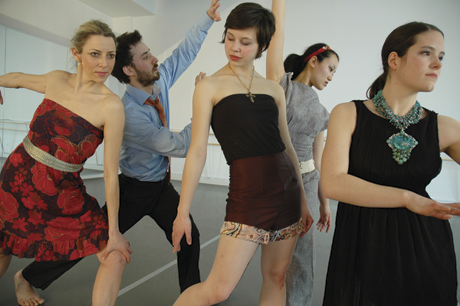
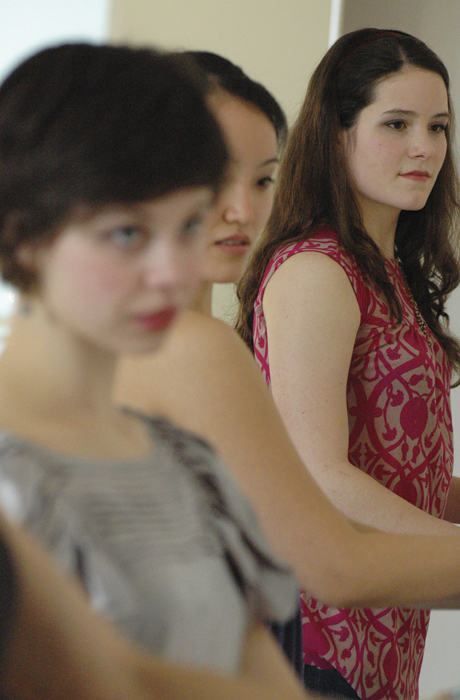
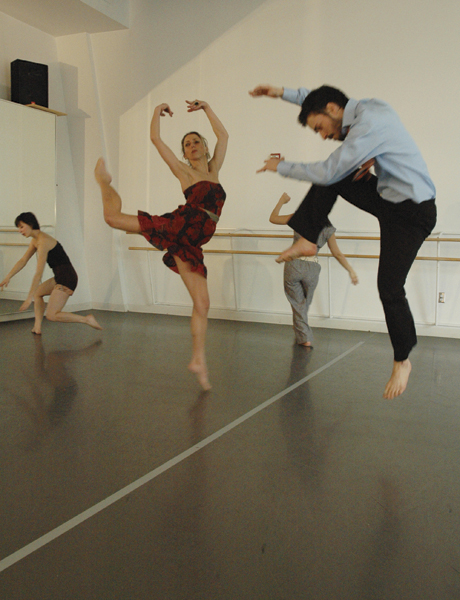
    To highlight our semi-annual selection of new fashion, we turned to a population that—let’s face it, unfair as it seems—looks delightful no matter what they’re wearing. Our models are four dance students at the University of Minnesota and their choreographer (who moonlights as The Rake’s stylist); we captured them during a rehearsal at the Barbara Barker Center for Dance on the Minneapolis campus. For the occasion, they donned an array of relaxed sheaths, stretch cotton pieces, and free-flowing mesh, plus splashes of bright prints—all trends to look forward to for the warm season.

    Spring Ahead

    Dancers at the University of Minnesota jump-start the season by flaunting all manner of fluid, warm-weather fashions, from high-waisted shorts and rompers to flirty strapless dresses.

    Luke Olson-Elm, a senior-year dance major, wears a key look for men: the shockingly bright necktie.

    Shirt by Tailorbyrd,
    $98.50 at Hubert White.
    Tie by Robert Halbott,
    $98 at Hubert White.
    Pants, dancer’s own.


    Perfect Balance

    Our sharply dressed dancers stand in formation, from left to right:
    choreographer/stylist Janine Ersfeld, Luke Olson-Elm, junior-year dance majors Julia Winkels and Yui Kanzawa, and senior-year English major/dance minor Teresa Tjepkes.

    On Ersfeld:
    Dress by Sweat Pea,
    $106 at Karma.
    Golden sash,
    stylist’s own.

    On Winkels:
    Tube top, stylist’s own.
    Shorts by House of Henry, $62 at Picky Girl.
    Cross necklace by
    Le Glitz, $54 at Picky Girl.

    On Kanzawa:
    Romper by Covet,
    $160 at Picky Girl.
    Canvas and leather belt by Le Glitz,
    $48 at Picky Girl.
    Jeweled velvet headband by Jane Tran, $36 at Karma.

    On Tjepkes:
    Dress by KAS Design, $69 (on clearance)
    at Karma.
    Turquoise necklace
    by Princess Mali,
    $325 at Karma.


    A Bold Move

    Tjepkes plays up the pink in a chic mesh top that’s plenty comfy to boot.

    Shirt by Weston Wear, $98 at Karma.
    Cross necklace by Le Glitz,
    $54 at Picky Girl.

    Flying Colors

    Ersfeld pairs two of the season’s essential trends: bold, floral prints and vibrant orange.

    Tube top and silk skirt, stylist’s own.
    Leather belt by Bennie and Olive,
    $58 at Karma.


    Worn With Grace

    Winkels shows off an ideal evening look for spring: a roomy silk sheath with gorgeous tailoring.

    Silk dress by Kenzie,
    $88 at Picky Girl.
    Earrings by Jill Smith,
    $32 at Karma.
    Indian jeweled bangles,
    $5 each at Karma.


    A Strapless Number

    Kanzawa models a bouncy cotton dress with all manner of lovely gathering.

    Dress by Miss Me, $62 at Karma.


    Rake Appeal Fashion
    Spring 2008

    Clothing and accessories provided by:

    Karma, 841 Grand Ave., St. Paul; 651-291-1997;

    Picky Girl, 1326 Grand Ave., St. Paul; 651-698-4107;

    Hubert White, 747 Nicollet Mall, Minneapolis; 612-339-9200;

    Concept, choreography, production, and styling by Janine Ersfeld

    Photography and videography by Marco Baca

    Art direction by Vangie Johnson

    Editorial by Christy DeSmith

    Hair and makeup by Lauren Spear
    (llspear@hotmail.com; 612-209-6534)

    Thanks to Anne Parr for production assistance.

    View a video of the quintet in a custom-choreographed performance designed to show off their garb.

  • Am I the First?

    Scott from Corner Table here. Well, you might have guessed what I will be talking about. LOCAL STUFF! I would hope that this is a blog that will be a place for us to comment on the people that comment on us all the time. I am sure that from "back of the house" to "front of house" there are plenty of people that would love to tell AB, AZ, KJ, RN, DM-G, JI, AP, PL, NN, what we feel is important to talk about. So, here goes.


  • A Casual Classic: Dinner and a Show

    WINE & DINE
    Metropolitan Delicatessen

    Enjoy a multiple course tasting menu with our favorite wine pairings tonight at The Rake’s World Flavors Tour. This month, join us at Be’wiched Deli for Metropolitan Delicatessen. Be’wiched
    Deli uses the freshest ingredients to create healthy food from scratch — featuring house cured and smoked meats and fresh bakery items. The meat they cure and smoke is raised by farmers who do not believe in using
    hormones or antibiotics. Space is limited and reservations are
    required. —Jennifer Havrish

    6:30 p.m., Be’wiched Deli, 800 Washington Ave. N., Minneapolis; 612-767-4330; $30.

    MUSIC
    Boy Toys or Toys Boy

    If you’ve found yourself missing New Kids on the Block and the Backstreet Boys lately, you should probably go check out the Jonas Brothers at the Target Center tonight (and then unsubscribe from this email, because I probably will never really write about anything you like — kidding, of course). But for a far more interesting show — with a fair degree of boyhood wonder and sap involved — you’re better off catching Say Hi to Your Mom at the Triple Rock. Sure, it’s emo. Sure, it’s computer generated. Sure, it’s vaguely pretentious and perhaps tries just a little too hard to be weird (just check out the bio on their website — talk about saying it all without saying a thing). But they—or rather, he, since it’s primarily Eric Elbogen—sings songs about toys with brains and the like. That’s pretty cool, right? And darn if they don’t sound nice. Listen to them here or here.

    9 p.m., Triple Rock Social Club, 629 Cedar Ave. S., Minneapolis; 612- 333-7399; $10.

    Or… you can get a little jiggy with it…

    Galactic Grooves

    Warm up with an evening of hot grooves from Galactic, a New Orleans based ensemble that may just be the rightful heirs to the godfather of soul’s funk throne. The band combines the neo-jazz sensibility of Medeski, Martin and Wood with the classic grooves of The Meters and then filters it all through a modern hip-hop prism. From The Corner to the Block is the band’s latest and perhaps greatest offering, a street-smart party record that will please lovers of the old and new schools of funk and fusion. And don’t worry, there’s no doubt that Galactic’s tight breaks will provide ample opportunity to get on down. Plus their live show is evidently quite a party. Opening is acclaimed neo-soul-hopper Ohmega Watts. —Christopher Hontos

    8 p.m., The Cabooze, 917 Cedar Ave., Minneapolis; 612-338-6425; $22.

    FILM
    Cinema Lounge Sells Out

    It’s time for another Cinema Lounge, and as usual, this one promised to be quite interesting – that is, if you like mocking commercial work — and who doesn’t? Tonight’s films are primarily spoofs, which ought to be quite amusing; but a few real pieces are tossed in just to frighten us a bit (actually, this will include entries from the Grain Belt Beer commercial competition, which should also be quite amusing). Stop by. Have a beer (or the tuna tataki). Have a laugh. Watch shorts by Idiot Box, Ryan Strandjorn, Jon Springer, Dave Ash, Dreamworld Studios, and Todd Cobery. And then meet the artists in person, ask them questions, and hear them talk about their work. You know the drill.

    7 p.m., Bryant Lake Bowl, 810 West Lake St., Minneapolis; 612-825-8949; free (but I’m guessing donations are more than welcome.


  • The Syringa Tree: Strange Magic

    Every morning, I get up all bleary and I pour my coffee and I sit down with my laptop and I tell my little stories. Character, plot, narrative, theme. I think I have a handle on these things. Most days, I feel competent.

    Then I read or see something like The Syringa Tree, which is playing at the Jungle Theater until March 9, and everything I know about how to construct a story seems hopelessly naive.

    Here’s the thing. I know beginning, middle, and end. I understand the journey, the epic, the Once Upon a Time. . . . and Happily Ever After motif.
    What I do not get is how playwright Pamela Gien took shreds of dialogue
    and monologue and memory and wove them all together into a sparkling web of a tale that spans 30 years and includes the politics of
    apartheid, the complicated allegiances of a liberal white South African family, and
    the shame that comes to those — both white and black — who feel
    responsible for the vicious acts of their kind.

    This is a one-woman show in which one actor (Sarah Agnew at the Jungle) plays 22 different characters — ranging from a six-year-old named Elizabeth Grace to a Catholic priest to Zephyr, a 60-year-old Zulu gardener — using nothing but the pitch of her voice, accents, facial expressions, and body language. She turns ever so slightly to one side, straightens her spine, and suddenly becomes someone else. Never do you wonder whether she is the child or the mother, the white doctor of the black maid. Agnew’s body is like liquid on the stage. She skips, weeps, cowers, and grieves. There is a world of people within this single small form.

    Watch in particular for the scene that takes place in a car — which does
    not, of course, actually exist. There are three people in the invisible
    vehicle: Elizabeth, her mother, Eugenie, and a driver. And Agnew moves
    in a continuous circle playing them all, carrying on a conversation
    with herself, until you could swear there actually are three people on
    the stage.

    No less is this alchemy present in the set. There is only a bare stage with a large swing hanging from the rafters, a backdrop cracked with sky-colored hues: pink, yellow, and blue for daytime; gold and green for dusk; shadows with slats of light. A man is beaten, a little girl watches in fear. It all happens before your eyes though of course, there is nothing there, really. Somehow, this amazing play makes you conjure the hat-sized blooming jacarandas and sly Rhodesian freedom fighters all on your own.

    How is this done? I only wish I knew. I feel as if I need to get ahold of a copy of the play and shake it until the secret falls out.

    Part of it must have to do with Joel Sass’s brilliant direction. It is worth noting that Sarah Agnew — who is luminous in this performance (or these performances, as the case may be) — also played Margaret in the Guthrie’s recent production of The Home Place. And though Star Tribune theater critic Graydon Royce singled her out as the "most satisfying" among a muddled cast, I, frankly, was hard pressed to see it. There, she faded. Here, in Syringa Tree, she is mesmerizing. But so too is the careful attention to movement, to her position on the stage, to the carefully choregraphed glances she casts to indicate action in another plane.

    It is only partly coincidence that I followed this magnificent evening at the theater, a mere 90+ minutes that seemed to go by in half the time, with a South African pinotage.

    In truth, I’ve always wanted to like South African wines. I like the idea of South African wines. But sadly, I’ve never tasted one that turned me on. Then, I found out there’s a Minneapolis company called Etica distibuting only Fair Trade winemakers — those that ensure workers are paid a livable wage, pay producers a premium for their products, adhere to eco-friendly methods, and re-invest in the local communities where there wine is made — and one of their top offerings right now is the 2006 Goue Vallei Pinotage.

    Pinotage is the principal grape in South African winemaking. A combination of Pinot Noir and Cinsaut, it has a distinctly dirty taste. I don’t mean earthy, peaty, or rich with soil. I mean old ashtray with a hint of green banana peel.

    But after becoming entranced by The Syringa Tree, I figured I was in as hospitable a mood as possible. So I opened the Goue Vallei and gave it a try. Perhaps it was due to Gien’s work and the memory of Agnew on her swing, but I can safely say this is the best inexpensive Pinotage I recall. It is dirty, but not intensely so. There’s a robust layer of fruit, cherry with a whiff of something tropical, and a rutting goat-ish finish that lingers for quite a while.

    I find it strange that this wine has no more in common with a French Pinot Noir than it does, say, with an egg salad sandwich. It’s not for refined sipping and it’s probably best drunk with plenty of sinewy dark meat, such as elk or deer. But it is — like the play — an interesting and entirely different experience. Plus, it’s probably the most humane and ecologically-responsible way to drink, right down to the bottle’s synthetic cork.

    If you want to try a glass, it’s on the menu at Birchwood Cafe, The Sample Room, Via, and, of all places, Green Mill. For a complete list of local retailers carrying Etica wines, click here.

    But here’s my advice: First, you should call The Jungle to reserve your tickets to Syringa Tree.

  • Text Your Tuna

    If you’re one of those people who is annoyed by restaurant texters, thumbs madly pumping away on their phone while they ignore the others at their table, relax. They may be saving the ocean.

    The Blue Ocean Institute has launched FishPhone the first sustainable seafood text messaging service. Embracing technology, Blue Ocean understands where the important decisions are made: in front of the menu. How often, when you’re in the whirl of a spectacular evening out, can you recall the specifics of your eco-training? Especially with seafood, a vast arena of eating that fluctuates with seasons and trends. No one can memorize the status of the thousands of sea critters.

    Enter the text. Simply send a text to 30644 with the message FISH followed by the name of the species you’d like to research. They’ll send you a text back with that species status: Green, Yellow, or Red.

    I sent FISH lingcod and received this: caught off US West Coast (YELLOW) some environmental concerns; bottom trawling damages habitat; HEALTH ADVISORY: High Mercury. … at this point I might choose to find out if the restaurant knows how the fish was caught, many chefs won’t buy anything trawl caught.

    When I tried to check out branzino: Sorry, we haven’t reviewed that species yet. Be sure to check spelling. We continually add species to our database so check back often! … Branzino is actually just the Italian name for European Sea Bass which is pretty common and well-regulated.

    For monkfish: (YELLOW) some environmental concerns; try US farmed catfish, US farmed rainbow trout, or US farmed tilapia instead … I like the recommendations, but you’re out of luck if they’re not offered on the menu.

    Additionally, for those with web-enabled devices, you can download Blue Ocean’s Guide to Ocean Friendly Seafood from fishphone.org.