Author: Christy DeSmith

  • Best and worst gifts of 2007

    Of course, this will be a personal list. If you have a
    hankering to mention a particularly tasteful or -less gift of your own, please comment below.


    WORST


    1. Body Fat Scale (from one fat ass to another?) On Christmas
    evening, after I’d had my fill of sugar cookies, at the most inopportune
    moment, I opened a body-fat scale marked "From Santa." Quickly programming the
    thing with my height (5′ 5.5") and gender, I hopped aboard and was horrified to
    read its measure: thirty-seven-percent fat. However, if I program myself as an "athletic
    woman," it puts me at only twenty-four. And when I weighed-in as a man? Ten. And
    if you sleep it off and try for better the next morning? Eighteen. Needless to
    say, I can’t stand the fucking thing.


    2. Portraits. Is it really appropriate to give framed
    portraits of your lovely children to the single, childless aunt who once walked
    away from an engagement to a hot, wonderful man (thus causing suspicions about
    her sexual preferences) and who, furthermore, lives in a 600-square-foot box? I
    don’t have room for that shit … in my apartment or in my frozen-over heart.


    BEST


    1. In Vogue. A coffee-table book providing a comprehensive
    history of Vogue magazine, with plenty of images, beginning with the
    illustrated covers of the 1890s through the ’40s and moving into the magazine’s
    heyday, from about 1950 through the mid ’80s.


    2. 20 Questions Game. This handheld, battery-operated doodad
    asks you to think of an object and then, after asking twenty questions, guesses
    what it is – and with amazing accuracy. I’ve found it to be a colossal, but nonetheless
    delightful, waste of time. Already, I’ve identified its weak points: food things
    and anything feminine other than bra and panties.

  • Oh, Our Wretched Uteri

    I saw the ad recently when, after a long, tiring workday, I was passing the evening as I often do: Snuggled up to the boyfriend on the sofa, flipping through an issue of Vanity Fair, and only vaguely paying attention to the television. But then a singsong remake of “We’re Not Gonna Take It”—yes, the Twisted Sister strain—snagged my ear.

    I looked up to see a montage of smiling beauties. A blonde office-worker reclined in her swivel chair and used her strappy high-heel to boot at a floating word: Irritability. A kick-boxer jabbed at moodiness. Inside a fitting room, a shopper popped bloating as if it were a balloon. Finally, a sexy young thing strutting down a city sidewalk jumped in the air and dunked the phrase feeling anxious. “Yaz is the only birth control proven to treat the emotional and physical premenstrual symptoms that are severe enough to impact your life,” promised the voice-over. Oh, and it makes your skin look better, too!

    “That strikes me as an irresponsible way to market birth control,” I said to my boyfriend. But of course, he didn’t particularly see my point. The medical establishment says birth control pills are safe and, by and large, the populace seems to agree. In fact, hormonal contraceptives have practically become a staple of contemporary living: like the timesaving microwave oven, so indispensable that it’s nearly pointless to argue their detriments. But how did the Pill ascend from mere contraceptive to all-encompassing lifestyle drug?

    In the beginning, this pharmaceutical innovation was targeted to married women. But early adopters in the ’60s discovered the pill’s power against menstrual cramps. Soon, unmarried women caught on, feigning debilitating cramps wherever there was a need for a prescription. Still, the drug was not without its side effects: nausea, weight gain, and, in many cases, an obliterated sex drive.

    Such word-of-mouth marketing among consumers—and, just as important, between pharmaceutical companies and physicians—held sway until 1997, when deregulation enabled the companies to begin advertising directly to consumers. When I joined the fake-cramps crowd and started taking Loestrin in 1992, I wasn’t told this particular drug would also diminish my periods. But that’s exactly what happened (after three years, they disappeared altogether). Back then it was alarming; nowadays, of course, Loestrin’s ads boast: “The pill with a short period.” Then in 1996, when a physician suggested somewhat half-heartedly that Ortho Tri-Cyclen might clear my complexion, I jumped at the chance to change prescriptions. This claim—“clinically proven to help your skin look better”—is now featured front-and-center on the Ortho Tri-Cyclen website, providing teenagers and other single women with another handy excuse to start dosing.

    It’s what good marketers do, right? They pick up on consumer trends and exploit them to the benefit of their companies or clients. We, the people, shape the messages of these ads and those messages, in turn, shape us. These days women are sold birth control for every reason except preventing pregnancy. It seems like anyone with stomach pain or pimples is taking a contraceptive, whether she’s sexually active or not. In fact, this is likely how Big Pharma gets away with marketing to “good girls.” Today’s birth control ads invariably feature slender, hyperactive youngsters (often swimming or wearing white pants); the implication is that our periods prevent us from looking so beautiful and engaging in such fun, not that these beautiful, young things might be having sex. It goes without saying that menstruation is an annoyance, if not a curse, as it was once called. But I wonder whether today’s birth control marketing puts even more perfectionist pressures on women.

    The message: Not only must we be professionally successful and effortlessly hot, we must also be cheerful, energetic, and sound of mind—even when it’s that time of the month.

    The most radical marketing developments have come in the past few years with Seasonale, the pill that limits menstrual periods to just four per year, and now Yaz, which seems to cure everything inherent to the female condition: the monthly bouts of moodiness, fatigue, increased appetite, and water-retention that often go along with our periods.

    These ads prey upon a particular cultural prejudice—that having this messy, punctuated hormonal cycle is not just a grave inconvenience, but a curable medical condition. Seasonale enables women to plan their periods around vacations or, in the case of a woman I know, running a marathon. As for Yaz, it starts to look a lot like an antidepressant. Of course, the insinuated correlation between femininity and mental illness is nothing new. (The etymology of “hysteria,” derived from the Greek for uterus, says it all.) I can’t help but wonder why the Yaz ad, which goes the furthest in characterizing women’s bodies as diseased, hasn’t triggered mass outrage or, at the very least, a few thousand bouts of extra-menstrual irritability. Perhaps our birth control is a little too fabulous.

    Now that the male pill is in trials, a sick, moody, and yes, female mind starts to wander: What groovy side effects might it offer? Already, it’s been shown to curtail libido, just as the female pill does. Might it cure other pesky byproducts of manhood, such as aggression, overconfidence, and snoring? For the sake of all that’s good and decent, one hopes scientists can engineer it to tackle back hair and Male Answer Syndrome, that sex-specific compulsion to present as fact all educated guesses. And if there’s any justice in this world, rather than causing fellows to accumulate fat around their hips, perhaps this new pill will trigger muscle loss in, say, their biceps.
  • Peripa-tech!

    This month, all sorts of lucky boys and girls are sporting shiny new
    electronic doodads, freshly delivered from Santa and other thoughtful
    gift-givers. It’s good timing: A hot-pink Motorola RAZR or aquamarine
    laptop does much to cut through the gray midwinter cloud cover, not to
    mention spruce up many a gloomy coffeehouse interior. In fact, around
    these parts, tech accessories are one of the few acceptable ways to
    incorporate fluorescents this time of year—especially if you’re in
    possession of a Y chromosome. Cell phones and iPods are only the most
    common of these gizmos; clothing and accessories designers have also
    devised a crop of stylish new ways to ferry—and flaunt—these devices.
    Somewhere deep in our cargo pants are additional treasures: pocket
    shooters (a.k.a. super- skinny digital cameras) in bright metallic
    hues, even USB drives encrusted with Swarovski crystals. Who knew
    gadgets could be so decadent?

    See Peripa-tech slideshow featured in the left column. 

  • Did Hillary Clinton Choose Her Fanny Over Her Face?

    Don’t think all the Hillary Clinton hullabaloo has gone
    unnoticed by the likes of me. Truth be told, I’ve been very busy at work this
    work, whereas my inner life has been consumed by a rage caused, for one,
    by the MPD’s horrific, paramilitary-style antics, but also by the revelation that certain
    political conservatives hate older women.

    OK, that’s not entirely true. In a way, I’m happy Rush et
    al. so freely expressed their misogyny (and forgive me for failing to link to their rubbish). Now, I can forward their screeds to all
    my female relatives, thereby turning them into life-long Democrats. 

    You see, I don’t think
    an ugly snapshot has necessarily ended Clinton’s
    presidential bid. (Urg, how irritating that I just had to fight an urge to refer
    to her by first name!) Rather, I think aging-and being criticized for your
    physical characteristics-is something that profoundly affects each and
    every woman. Most of us were held under the microscope at an early age. In my
    case, the tormentors fixed on my massive head of unruly, frizzy hair. The offshoot
    is that I, and almost every other woman alive, have a particular sensitivity
    about my appearance. In fact, I spend an embarrassing amount of time in front
    of the bathroom mirror most mornings, just staring at the constellation of
    wrinkles that increasingly lines my face. But no matter how much we
    women preen, pluck, or otherwise tend to our looks, we’re fully aware that these
    are essentially shallow pursuits. Being hot won’t make us happy. It won’t make us smart. Sure, we miss our beauty as it fades, but we don’t necessarily miss
    all the catcalls a walk down the street would inspire when we were in our teens
    and early twenties. Looks aren’t everything, guys! Pfft!!


    Anyhoo, much as we women like attracting (and deflecting)
    positive male attention, we’re also extremely sensitive to their mean-spirited
    attacks on our appearances. Look, Clinton
    looks a whole lot better than most of us look, or will look, at sixty years of
    age. Most women can only hope to look half this beautiful. Remember
    the way you reacted when your high-school boyfriend remarked that Winona Ryder
    looked sort of chubby in Heathers? Realizing she was, like, wa-ay thinner than you were, you
    then turned to him, clicked your tongue, and screamed at the top of your lungs: "That’s just a roundabout way of calling me fat!" OK, so maybe that was just me … But the point is this: An attack
    on one (of our faces) is an attack on all (of our faces). Heck, the way I see
    it, all those conservative blowhards just inspired a boatload of empathy from the
    2008 presidential campaign’s most important voting block: WOMEN!

    P.S. Here’s a thoughtful piece on the matter from Salon.com.

  • Particularly in the Heartland

    Part of the Walker’s Out There festival of experimental theater, this show, by a youthful New York City ensemble called the TEAM (Theater of the Emerging American Moment) defies rampant cynicism by presenting a work of resounding optimism. Set in Kansas, the action unfolds within an evangelical household. The parents have just been killed by an awful Kansan storm, but the children believe the rapture has taken them. What’s surprising about this work, especially in this age marked by Colbert Report satire, is how the TEAM avoids irony in painting its portrait of the earnest, often anti-intellectual culture of Evangelicalism. Instead, their feel-good show teems with rigorous dance and movement, sincere character study, and even wholesome Stephen Foster songs.

    Walker Art Center, 612-375-7600.

  • Raw Stages

    The History Theatre has hit its share of fouls lately—last fall’s production based on the life of Kirby Puckett was uniformly blasted, and the recent Hormel Girls had a lackadaisical score and a script wholly reliant on stereotype. But this institution also boasts a singular and noble characteristic: It commissions more original works by living, local playwrights than any other Twin Cities theater. Its annual Raw Stages series bundles four samplings of works-in-progress, each with a certain destiny for the History Theatre mainstage. This year’s lineup includes the chronicle of a haunted Summit Avenue mansion, by the edgy Minneapolitan Deborah Stein (see “Heavy Rotation”); and the story of Tyrone Guthrie and Ralph Rapson’s collaboration building the landmark Guthrie Theater at Vineland Place—by the prolific, Minnesota-based playwright and screenwriter Jeffrey Hatcher.

    History Theatre, 30 E. Tenth St., St. Paul; 651-292-4323.

  • Peer Gynt

    Who better than Robert Bly to revive this cautionary tale of misdirected masculinity? Peer Gynt is the most deplorable of characters, a swashbuckler who, during the course of a single play, manages to desert his mother, cajole a bride into the mountains on her wedding night, get crunk with some hillbillies, and go on a globe-trotting black-market bender. Contemporary audiences will notice that nineteenth-century playwright Henrik Ibsen makes an apt statement about a familiar, modern archetype: the fatherless adolescent whose thuggish ambitions eclipse all kindness within. What’s more, Ibsen wrote the entire thing in Norwegian verse; as with most English translations, Bly’s new adaptation duplicates that effort.

    Guthrie Theater, 612-377-2224.

  • Take a Hit

    That first hit made my brain tingle. And so, a few days later, I found myself reaching again for the can of enriched oxygen—just a few huffs before heading to the gym. Normally, those initial minutes of exercise are somewhat skull-rattling. On this occasion, however, I bounced along the cushioned surface of a gentle high, as if my heavy head had somehow emptied, as if I’d resumed that habit from junior high: sucking sweet, buoying helium whenever I got the chance.

    Contributing to this giddiness was the fact that Oxygen Plus, a new line of locally produced, concentrated oxygen-in-a-can, is so fashionably packaged. The O+Mini aerosol, a highly portable four-inch can that comes in metallic blue (peppermint-scented) and metallic pink (grapefruit) varieties, resembles a tiny can of Aqua Net. Then there’s the O+Stick: This foot-long refillable dispenser (made of recyclable aluminum) has a smooth, white surface and curved edges, and sort of resembles a vibrator. So long as these cutesy covetables were packed in the purse, I found, the party would go wherever I did.

    But the market isn’t always kind to such far-out products, and so, over the next three weeks, I shared Oxygen Plus with a variety of subjects in hopes of finding fellow enthusiasts (thus ensuring the stability of my supply from the manufacturer, Oxygen Plus, Inc., which is based in Mahtomedi). My first guinea pig was a close friend, a classically trained singer in her mid-thirties eager to try the stuff: “I breathe for a living” is how Andrea put it over a recent lunch. “It says three to five hits,” she said, examining the dosage instructions on a pink O+Mini. After an initial squirt, administered as one would a blast of Binaca, she observed: “Boy, it really does smell like grapefruit.” Two sprays and fifteen seconds later, she remarked: “I’m waiting for something to happen.” Five minutes later she reported that, in fact, she had felt nothing.

    The marketed benefits of huffing Oxygen Plus are not unlike those purported by Oxynate, the recreational oxygen bar at the Mall of America: relaxation, increased energy and alertness, relief from headaches and sinus problems, and improved performance for athletes. But time and time again, and much to this devotee’s chagrin, test subjects, including friends, family, and random passersby, were resistant to the oxygen’s charms. Subsequent trials on office mates, in the foyer of my apartment building, and even at the finish line of the Monster Dash half-marathon were equally discouraging. “But it can’t be a bad thing,” offered one of the random subjects, a thirty-nine-year-old businessman encountered at Uptown’s Green Mill Restaurant and Bar on a Saturday night. “I mean, you can’t get too much oxygen.”

    One of Oxygen Plus’s claims—that it’s an effective tonic after a night of heavy drinking— went untested. But one thing is certain: Oxygen Plus provides a healthy, or at least harmless, way to indulge illicit fantasies; when used in public places, it was observed that decent, law-abiding citizens can get nostalgic for youthful delinquency by stealing a puff. Indeed, several subjects made the association with magic herbs, even if they didn’t say so expressly. When a thirty-eight-year-old IT guy was offered Oxygen Plus at a party one evening, he took his hit as if he were, in fact, toking a spliff. He inhaled very deeply, then held the peppermint-scented, enriched oxygen in his lungs for several seconds before finally letting it go in a long, slow exhale. Did that make a difference? Nope, he said, he never got his high.

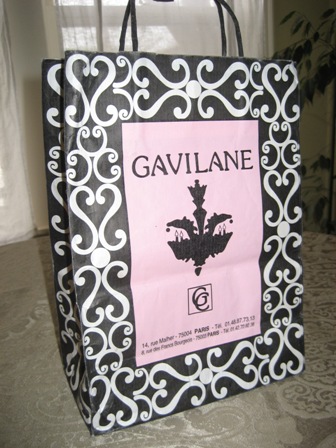
  • We Are All Bag Ladies

    Last weekend, in the Sunday Times, one of the meatiest, most
    interesting Style articles was found … in the business section. I also liked
    the ETSY profile in the Times magazine, but that’s a different matter-one that, I’m
    afraid, nearly inspired a very long, boring post about my preference for receiving
    hand-made Christmas gifts. In any case, the long and the short of the business section piece was
    this: Shoppers tend to hang on to the niftiest of their shopping bags. This
    inspired a reflection on my own stash:

    I purchased a beautiful pair of earring from this Parisian
    boutique back in 2003, but lost the earrings soon after returning aux etats-unis.
    The bag, however, hung around. For a good year and a half, I used it to tote my lunch. But when I realized it was starting to fray, I retired the bag to a
    safe place.

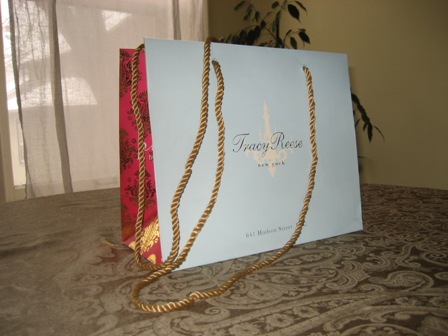
    I scored a $39 dress at Tracey Reese in NYC last summer.
    Like the dress, love this bag, which is made of a durable cardstock. I’ve used the thing twice for carrying items to and fro
    dinner parties.


    Any local bags in the collection?

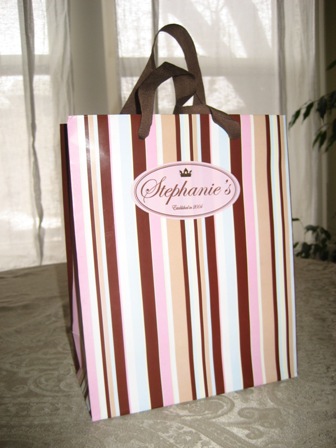
    Stephanie’s, in St. Paul’s Highland Park neighborhood, has a decent bag.


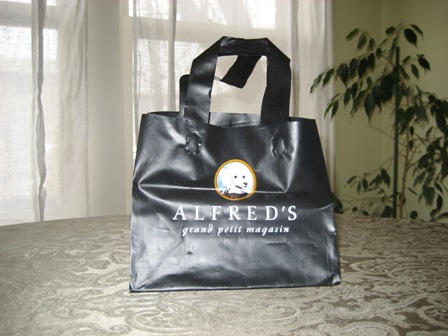
    Alfred’s, R.I.P., had these flimsy but cu-ute
    bags.

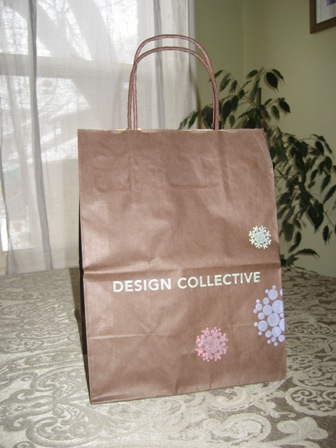
    The Design Collective seems to be hand stamping theirs, thus
    appealing to the aforementioned affinity for handmade.


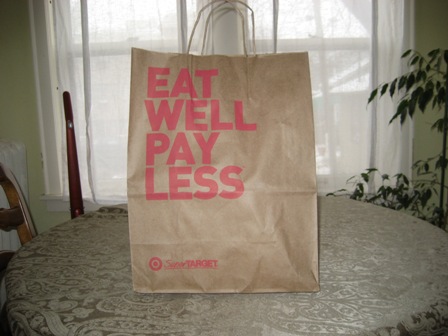
    Uh, Target makes a good bag for taking out the recycling.

  • Voltage Reload

    Whew, it’s been such a busy week as we’ve put finishing
    touches on our January issue (and we’re not done yet) that I almost forgot to tell
    ya: The Voltage 2008 designers were announced recently. (Yes, yes, by now it’s old hat … )

    Here they are, in any case – a who’s-who of great local designers: Amanda
    Christine
    , Annie Larson, Belle, Calpurnia Peach, George Moskal, Laura Fulk,
    Katherine Gerdes, Kristina Bell, Max Lohrbach, Pomije, Red Shoe Clothing Co.,
    and my pal, Russell Bourrienne. There are, of course, both familiar and
    unfamiliar names in this lineup. I’m very pleased to see the reappearance of my
    two fave local designers, Katherine Gerdes and George Moskal. And I’m glad to
    see the addition of Bourrienne, a menswear maven, too.

    This annual
    mash-up of local music and fashion is the definitive Minneapolis fashion event, friends. And it’s actually a juried affair, so it can be tough for designers to get in.

    As the April 16 Voltage event nears, I’ll be sure to lend a
    few how-to’s. This can be a very tough one to navigate if you are, like me,
    sort of old, sleepy, and crabby about standing on First Ave.’s concrete dance
    floor for hours on end. A good primer can be had at the Voltage preview event
    which, this year, is scheduled for February 7. If you care to experience (or relive) Voltage 2007, then click here.