Author: Jill Yablonski

  • Don't Go West! There's Gold Right Here with "Little House"

    photo courtesy Associated Press

    Feeling like a half-pint, seeing Guthrie’s Little House on the Prairie with my Pa, nostalgia was sure to abound. "Don’t be such a Nellie," he’d chastise me as a young girl whenever I took on the role of brazen tattle-teller. Tonight, though, a comparison to Nellie would be no disparagement. Sara Jean Ford is bursting from her petticoat’s seams with snotty delight at every turn. A master of the very-thinly-veiled backhanded compliment, Nellie wins the audience with her perky, self-serving ways.

    In a Sisterhood of the Traveling Pants-kind of way, Little House is a female force. The musical’s creative crew is comprised entirely of women. And among the cast, the Ingalls ladies prove a close bunch, if often due to necessity of keeping warm on the bitter plain. That’s not to say Little House doesn’t offer up something for those men in the audience. Scenes showcasing pioneers’ hardships will resonate with any man balancing the lure of adventure with responsibilities of family and home life. Charles "Pa" Ingalls is a proud man seeking not fortune, but sustenance. Steve Blanchard, as Charles, raises his fist and curses the sky more than once. But he is the foundation upon which the family can rest it’s weary, frontier blues; with a pluck of his fiddle, the group is enlivened and ready to face yet another disaster. The true backbone of the family, what Pa says, goes.

    Laura, though, has itchy feet and can’t figure out just where they should take her. At one point she sums up her distaste for "urban" life, as opposed to the wide-open yonder, by lamenting, "Town feels like sore on the prairie." (Similar to sentiments expressed by many concerning the new Twins’ stadium?) Depicting this "sore" of a town, set designers used minimal, suggestive pieces, rather than full-blown, cumbersome ones. This evoked a simple feel that rang true to the Little House book series, and therefore the times themselves. The use of sound often made-up for what couldn’t be shown on stage: wind storms, snow storms, ravaging crop fires, and any number of climatic maladies.

    "She can do a cartwheel," Dad leans over and points out during one of Laura’s giddy, grateful-for-just-being-alive outbursts. The frequent reminders of my childhood deficit of coordination never cease. Kara Lindsay plays Laura as the sassy, but earnest, and always likeable character we grew to love in both the novels and television series. We get to watch Laura transform from a tomboyish young girl to a tomboyish young woman in the course of the two acts. Her dialogue and delivery are at times hokey, but all in keeping with the spirit of the lore. This is hardly an issue being that actual spoken lines are few, what with a total of thirty songs performed throughout the play. Several of these songs feature Lindsay soloing; a polished, mature voice of obvious experience.

    Melissa Gilbert, television’s Laura, plays Ma in the humble way we always remember her character. Gilbert’s mainstream stardom never once overshadows scenes in which she isn’t meant to be the star. However, when the script calls for her to step into the focus, it appears comfortably easy. Her singing voice doesn’t come through quite as easily as it does for some of the others, but is certainly pleasant. Gilbert seems truly appreciative of the audience, her cast mates, the whole thing. It must feel a true "coming full circle"; playing TV’s half-pint for nine years, then watching a new half-pint cartwheel across the stage while looking on as matriarch.

    The other Ingalls girls are represented by local Maeve Moynihan (Carrie) and Jenn Gambatese (Mary). With Carrie, we don’t see much, if any, of a character arc. We note the passage of time as she goes from pig-tailed and pigeon-toed to, not. Mary plays a more prominent role as Laura’s big sister who is unexpectedly struck blind by Scarlet fever. Mary is always so good, as we are reminded in Laura’s song, "Good," performed once in each act. We don’t dislike her for a second, though. Her goodness is different than Nellie’s in that it is sincere. She’d rather tell a white lie than get a sister in trouble needlessly. She worries it’s selfish to pray for good crops so the family will earn enough money to send her to college. To this, Laura smartly replies that there would be no harm in praying for good weather over at the neighbors’, as it’ll surely provide the Ingalls’ land with good weather, too. We see Laura’s keen interest in richly describing her surroundings flourish, at first to help her blind sister picture the landscape, and further as her love for reading and writing blooms.

    This literary inclination, though, is not inherent in Laura. She takes on a teaching job, which she apparently does quite poorly. A quick pep talk from Ma refocuses our stubborn Laura, and her pupils are now angelic geniuses. As a former teacher, I found this a bit silly, or maybe I was coveting her skill set. Nonetheless, some time lapsing is necessary. If we had to witness just how many times Clarence had to be alternately praised/ ignored/ coddled/ tough-loved — we’d lose interest in the reality of it all. Little House isn’t meant to depict the actual, historical reality of pioneering families, but succeeds at encapsulating it, making it accessible, relatable, even laughable. When they square-dance, it actually seems enjoyable, unlike when you did it in gym class. Little House makes you want to saddle up to the hearth with your kin, even in this summer heat.

  • You're No Fun

    After a flamboyantly successful run at the Bedlam Theatre earlier this spring, You’re No Fun has been whittled down for a Fringe staging. The play centers around a present-day hobo who comes back to town, and finds that his ex-girlfriend has written a musical about his life. It is a tale of star-crossed lovers that, like any worthwhile addition to the tragic genre, features dancing dinosaurs. The Rake caught up with Samantha Johns – director of both versions- and Savannah Reich -the original writer – to talk a bit about the incarnation and reincarnation of the show.

    The Rake: Are there any differences between the Fringe version of the show and its original Bedlam staging?

    Samantha: Yes, we had to cut about 20 minutes off it to make it fit the Fringe standard. We cut a beautiful (and complex) barbershop quartet, a few hunks of dialogue are missing, and then I just lit a fire under the actors’ asses and got them moving and talking faster.

    Savannah: I haven’t been involved in the Fringe staging process – although I was pretty involved the first time around (until Sam kicked me out of rehearsal for continually trying to do rewrites).

    The Rake: You’ve stated that this is a show that asks, ‘Why do we do theater?’ Would you riff on that a bit?

    Sam: I honestly couldn’t tell you, and I don’t think there is one single reason; I couldn’t imagine a life without it.

    Sav: I tend to struggle with justifying to myself the idea of doing theatre- especially the kind of theatre I like to do, which is the totally ridiculous kind. That is the hope, anyways. Last fall I was going back to school to finish my degree in theatre arts at the U of M, and I was having this whole internal crisis about what I was doing with my life. I had all these friends who were going on houseboats down the Missisippi, or hopping trains, or moving to India, and it all sounded so much more exciting than staying at home and writing a three to five page paper about Brechtian technique or whatever I was doing. I just wasn’t convinced that art school was the best way to be an artist. I always wondered if I was the only one who still thought it was funny the way everyone is able to take themselves so seriously while wearing yoga pants and practicing different ways of falling down the stairs. On the other hand, I had all my other friends who were going to punk shows and traveling and working in collectives, just as much in their own little bubble as the theatre folks were in theirs. I ended up thinking a lot about how much these two worlds were alike, or at least presented the same problem to me, which is, "Am I wrong to want to spend my adult life in a very serious pursuit of fun?"

    I remember coming home from school one day, where I had practiced trapeze and juggling and then painted plywood to look like pink marble, and talking to this traveling guy that was hanging out on my porch playing harmonica. I lived in a big punk house at the time and we always had some random guy sitting on the porch and playing harmonica. So I was chatting with this guy about how I was worried that I was wasting my life in art school, and he gave me this big lecture about how I should drop out of school and go hop trains. And I said, "Well, I never said I didn’t think you were wasting your life, too."

    The Rake: How did the idea for the show germinate?

    Sav: So the play is about a relationship between this intense experimental theatre type and this anti-civilization hobo guy, and they both take themselves really seriously and each one sort of looks down on the other. They are both trying really hard to find meaning in their lives and their relationship, and meanwhile they are in this really goofy, ridiculous play, with all these corny musical numbers and dumb jokes and dinosaur costumes. So that’s my take on life on earth, apparently.

    The Rake: Given that there are dancing dinosaurs involved, it seems your notion of theater, no matter how serious it may be, is at least to have a little bit of fun, too, no?

    Sam: If we’re not having fun, there is no point. If it becomes painful, and is not helping the show, we stop, take a break, and come back at it a different way.

    Sav: We all have an invisible kickline of dinosaurs behind us and we might as well just stop trying to look cool.

    The Rake: Does it change from performance to performance?

    Sam: Yes, it’s live. Things wobble here and there, but in general, the feel of it always the same. The actors know what they have to hit and where, but in between, there is always room for movement. Beautiful things can happen in those moments, you have to allow the actors to play.

    The Rake: Have Fringe festivals in the past helped you with your larger theater life in Minnesota at all?

    Sam: This is my first Fringe, and before this year I would maybe see one or two Fringe shows a year, so I’m not sure. Seeing any piece of theatre is always helpful in the big scheme of things.


    See the Minnesota Fringe Festival website for remaining showtimes.

    To read John Ervin’s Inside the Fringe: Instamment One, click here.

    To read Jill Yablonski’s Inside the Fringe: Instamment Two, click here.

    To read Andrew Newman’s Inside the Fringe: Instamment Three, click here.

    To read Brandon Root’s Inside the Fringe: Instamment Four, click here.

    To read Max Ross’ Inside the Fringe: Instamment Five, click here.

  • A Chat with the Four Humors

    With their previous entries into the Minnesota Fringe all selling out by the end of their respective festivals, the Four Humors troupe has become something of an August favorite in Minnesota theater. This will be their fourth year participating in the Fringe, and the group is affiliated with three shows that will be playing around town through August 10th.

    The Spaceman Chronicles is something they’ve been carrying in their pockets since 2006; they developed Mortem Capiendum earlier this year, and have been touring it at various festivals throughout North America; and Shift was written in the two months leading up to this summer’s Minnesota Fringe. The assortment of plays represents a solid cross-section of what the troupe has been producing since joining together, showcasing the talent that has prompted critics to say they "offer up such wit and hilarity that audience members will be doubled over in their seats" (Star Tribune). The Rake had a chat with three of the four artistic directors – Nick Ryan, Jason Ballweber, and Brant Miller – to talk a bit about their recent work.

    The Rake: What was it like touring Mortem Capiendum?

    Brant: This is actually Four Humors’ first road show. It was kind of an experiment, just to see what it would be like. I don’t think any of us have ever done a tour before, in any capacity. So this is a first. What was it like touring? It’s a lot of work. In Minneapolis, people actually know us. We know we’re not huge, but in the community we’re known of. In every city you go to, though – Toronto, Winnipeg, Cincinnati – You’ve got to introduce yourself, and get people to come see your show, give you a try. It’s kind of like starting over. It would be like starting in Minneapolis all over again.

    Jason: Except for without the friends and family.

    The Rake: Did you use those festivals as sort of previews to hone the show?

    Jason: Yes. We used Cincinnati very heavily as a preview. We had minimal rehearsal time before we went there, so a lot of Cincinnati was spent working out, you know, the basics of the show. Like whose character’s doing what, and what’s the real big picture that we have going on here. So Cincinnati is what we call our workshop city, and we still had a lot of fun, and had a lot of fun with the show that we put up. And I think that the audiences liked it, but we really used that as a learning experience for what the show was going to become.

    The Rake: Will it change at all from performance to performance?

    Jason: Yes. A lot. It’s a much more open show than what we usually do. We usually include the audience a whole lot, but this one of the first productions where we are directly asking the audience questions, and treating them as if they are an audience that’s sitting before us. The conceit is that it’s a medicine show, and so [the characters] are trying to sell something to the audience. So when we ask questions – we expect an answer back, if we don’t get one that’s fine – but if they do answer, we’re able to talk back. We’ve had a few performances that have really been shaped by how the audience was taking it and what they were giving us. And it’s just the three of us on stage the whole time, and we’re three people who are very comfortable with each other on stage, and we’re able to play a whole lot together. I couldn’t say that any two performances of this show are similar, even.

    Brant: Also, I think we’re going to have done thirty-one performances over the summer? Which is the most we’ve ever done of any show of ours. And we like to keep it fresh for ourselves. It keeps us having fun, and stops it from getting stale.

    The Rake: Was it written collaboratively, and in general, what sort of process do you have for writing together?

    Nick: Well with Mortem Capiendum, it was written collaboratively, and it’s a bit of a change in direction from the shows that Four Humors has been doing. Up to this point, I’ve kind of written the script, and it’s been handed off to Jason, who would direct it, and that was kind of how we’ve done at least our Fringe shows for the last three years. With this one, though, we really wanted it to have been a collaboration between the four artistic directors of Four Humors, and just have us all discussing, and bringing ideas to the table from the beginning, and really have it shaped by the writing table atmosphere.

    Jason: To Nick’s credit, even when he does hand over a script, he’s been very open to our additions, and different actors adding things to what he’s written. So there’s already been a collaborative nature to how we work. This has just been the most unclear roles. We never sat down and said, "You are the writer. I’m the director. You guys are actors." It’s just been, "Let’s do a show."

    Nick: Everybody feels like they own the show in some manner. It wasn’t one person driving it to where it is.

    The Rake: Have there been any bad but preposterously funny reactions to the play as you toured?

    Nick: While Brant and Jason and Matt (Spring — the fourth artistic director) were in Winnipeg and Toronto, I was back here in Minneapolis, and I was checking online for any reviews of Mortem Capiendum. And there was one from the Winnipeg Free Press, and their basic premise was that our show was exactly like There Will Be Blood, in tone if not content, and that Daniel Day-Lewis shouldn’t lose any sleep over our performance. Basically, they were very upset that we weren’t as good as Daniel Day-Lewis.

    Brant: I’d also like to point out that I don’t think Daniel Day-Lewis loses sleep over any Fringe shows that are going on in the world.

    The Rake: Have been any good but preposterously wrong reactions?

    Nick: There was one woman in Cincinnati, who was apparently a mainstay at their Fringe. She was there every single night. And she saw the show. Jason and Matt and Brant play out to the audience a lot, so you can get a very good sense of whether the audience is enjoying it or not. And it was pretty clear that this woman was not enjoying it at all. And she came over to us and spoke to us at the Fringe headquarters. And she kept saying it was too much like the "Three Stooges." And I kept wondering why that was a bad thing. "Three Stooges" are fantastic to me. So we had this conversation, where she was saying it was too much like the "Three Stooges," and I kept saying thank you, and she said, "No, it was too much like the ‘Three Stooges.’" And I kept saying, "Thank you!" So she was upset that we didn’t hold the "Three Stooges" in the low opinion that she did.


    The Rake: Would you talk a bit about how Shift got into the Festival?

    Nick: Because Mortem Capiendum was going to be opened in Cincinnati at the beginning of June, my work as co-writer and outside eye was done by then. So I had a two-month block before the Fringe where I had nothing going on. A friend of mine, Jonas Gaslow, had a Fringe slot, and I approached him about collaborating on a one-man show. For the last few years I’ve been writing fairly exclusively for Four Humors, and I kind of took this opportunity to write something that Four Humors wouldn’t do. To try a show of a slightly different style. And Jonas comes from a very different theater background than I do, and the idea germinated from a numb
    er of conversations that we had together. We just met and talked about what sort of show we wanted to do. It morphed out of a few snippets of writing that I’d done before that, but it really blossomed into the show that it is when the conversation between Jonah and me started.

    The Rake: And how about Spaceman Chronicles?

    Nick: Again, because I knew that Mortem Capiendum was going finished in May, and that I would have this time, before I approached Jonas about Shift I had another slot in the festival lottery, that didn’t get into the general lottery, and I ended up on a waiting list. And I was fairly far down on the list. It wasn’t likely I’d get in. But about a week and a half ago we got a call from the Fringe main office, and they said they had a slot for us, if we wanted. We’ve had this show Spaceman Chronicles for a couple years, and it’s a very fun show, and we just decided let’s do it, let’s put it up as fast as we can, and it’s gotten very good responses so far. All three actors from Mortem Capiendum are involved, as well as myself.

    Jason: And the main confusion there is that you can’t have two shows under one production company name at the Fringe.

    Nick: That’s why we didn’t put the Four Humors name on it.

    The Rake: Have the Minnesota Fringe Festivals helped you to establish yourselves around town?

    Nick: It has really helped get the Four Humors name out. We’ve built a very good audience at the Fringe Festival. Basically all of our write-ups from the major papers in this city are from our Fringe shows. Though right now we’ve found it a bit challenging to take that success that we’ve had in the Fringe, and bridge it over to producing shows outside the festival in the larger Minneapolis community. While the Fringe has been great, we’re still making that leap into selling as well as we do at the Fringe, when we’re not at the Fringe.

    The Rake: Your stuff often deals with sort of higher entities (gods, devils, afterlife, metaphysics) — do you see any continuity in the shows you write from scratch?

    Jason: As a theater company, we like to take older myths and rework them. We’re a bit, um, post-modernist? We have the belief that there’s nothing new, and that you can take an old story and just re-tell it. I think there are, what, twelve stories in the entire world, and it’s just about how you tell them. Also, there’s the old mainstays. Poets keep writing poems about love because no one’s ever been able to explain it. Same with death. We’re interested with grand emotions, as well as the every day. Even if your shoelace breaks, in theater you have to treat it like it’s the end of the world. On stage it’s too mundane if it’s presented any other way. I guess post-modernistic…melodramatic…

    Nick and Brant: Comedy!

    Jason: That would be our main throughway — our interest in the humor of all these grand emotions.

    The Rake: Is there a certain type of show Four Humors likes to put up?

    Brant: We’ve been saying lately that the kind of theater we like to put on is the kind of theater we like to watch. So, that really sums it up. Stuff that engages the audience, and really brings them along, instead of just a fourth wall, feeling disconnected.

    Nick: And we’ve been operating under our mission statement for the last six months or so — we make the beautiful foolish, and the foolish beautiful.

    Jason: Also a little tag on: what we say as artistic directors is, "never treat the audience like idiots."

    Brant: Amen.

    The Rake: What’s harder – putting on a play, or trying to get status as a legitimate Minnesotan business?

    Brant: Well, for us – an assumed-name partnership is officially what we are, with a fiscal agent – just doing the paperwork was a big thing because we’re such artists that the business stuff isn’t right up our alley, we’re not as used to it as we are to creating a new piece of work.

    Jason: Which is not to say that putting up a show is easy.

    Brant: Not at all.

    Nick: We’ve just been honing that skill for a lot longer than we have keeping books and filling out paperwork and meeting deadlines.

    Jason: And just like any business, we’re going to have to consistently put out good shows for people to give us any money to continue putting on good shows. So one will lead into the other.

    See the Minnesota Fringe Festival website for complete listings of remaining showtimes for all the Four Humors’ works.


    To read John Erwin’s Inside the Fringe: Installment One, click here.

    To read Jill Yablonski’s Inside the Fringe: Installment Two, click here.

    To read Andrew Newman’s Inside the Fringe: Installment Three, click here.

    To read Brandon Root’s Inside the Fringe: Installment Four, click here.

  • An Interview with the Writer and Directors of "Orange"

    I was excited to be able to catch up with Rachel Teagle and Ben Egerman, two friends of mine and veterans of the Carleton College theater scene. As newcomers to the Fringe, they were kind enough to lend some of their perspective, caffeine induced hysteria, and details about their new show, Orange.

    The Rake: How was the play initially conceived? How do the two of you typically collaborate?

    RT: The play was partially inspired by a crazy Joe Orton farce we had both just read, and our desire to make the original cast do bizarre things – like kiss everyone or get eaten. Ben and I typically collaborate pretty well. It’s a bizarre, mystical process even we don’t dare to understand.

    BE: I think another thing that heavily inspired our writing this particular play was our common frustration with a lot of the mania you would see on television regarding various terror levels and threats. When we first wrote it, a few years ago, it seemed like that had reached a fever pitch.

    The Rake: Of all the plays the two of you have written, how did you narrow it down to this one for the Fringe Festival?

    RT: We thought Orange was the best play for the Fringe, because it was political and goofy and had enough substance to it to be more than just a skit. Also it had cannibalism, and that’s really big in the festival this year. Particularly homoerotic cannibalism.

    BE: Also it’s really funny, and we thought audiences would like it. But our decision was mostly due to the cannibalism.

    The Rake: How has the play changed since its first production?

    RT: Well, we’ve added a bunch. We’ve fleshed out Alex the office manager and Harriet the tech girl a bit, and we’ve done some other edits to accommodate the new cast. Also, I think it’s a much darker show now than it was, partially due to the realism of the props. It’s gotten a little gory.

    BE: I’d like to think we’ve matured it a bit. Which is to say, it’s now only mostly sophomoric. But in a good way.

    The Rake: This is your first foray into to the Fringe Festival as writer/directors. What is the experience like as newcomers? Is it what you expected?

    RT: Everyone in the Fringe has been so warm and welcoming. We felt immediately that we were part of a community. The Fringe staff in particular has just been awesome. It’s sort of a crazy week and a half, and it’s hard to evaluate now that we’re smack in the middle of it. It’s really exciting to make connections with local artists and other like-minded creative folk.

    BE: Fringe people are awesome. They’ve been wonderfully helpful and supportive of us as newcomers. A great example is Phillip Low, who’s doing a show called "All Rights Reserved: A Libertarian Rage." We wound up chatting with him after one of the Fringe-For-All preview shows, and he offered us the opportunity to preview our play at two shows he was involved in prior to the Fringe. It’s really amazing to me that just after moving here, and just after getting involved in all this stuff, I can head over to Fringe Central after shows are over and feel like I’m with old friends.

    The Rake: What kind of people do you expect to find in the audience?

    RT: Oh, we expect to find just about everyone in the audience, but the folks I think will most enjoy it are those that embrace absurdity, are looking for a very dark comedy, and anyone who wants to see Quentin Kennedy kiss everyone.

    BE: And anyone who appreciates a good Unabomber joke. After all, who doesn’t?

    Orange is playing at the Mixed Blood Theater on Aug. 6th at 7:00; Aug.8th at 10:00; and Aug. 9th at 5:30.


    To read John Irvin’s "Inside the Fringe: Installment One," click here.

    To read Jill Yablonski’s "Inside the Fringe: Installmant Two," click here.

    To read Andrew Newman’s "Inside the Fringe: Installment Three," click here.

  • Hippies: The Real All-American Heroes

    Rake photographer Denis Jeong is set loose in Detroit Lakes and tells us all he sees and hears. See the slideshows (Part 1 and Part 2) chronicalling his weekend, nudity and all.

    Boom-bam-bop-tap! Boom-bam-bam-pop-pop-pop! Is this what a drum circle sounds like? Maybe not, but that’s the sound I was hearing as I drifted in and out of sleep that first night. Drums ‘til dawn and a blazing hot sun by nine, not exactly the way I wanted to start my relaxing weekend away from the city. You’d think I’d be pretty grumpy the next day, and I was. Not for long though; who could be when surrounded by ultra friendly hippies and super jamming music.

    After a three and a half hour drive from the Twin Cities, I arrived at a hippie festival straight out of the 70’s. The 70’s with a 21st century twist, that is. There were, of course, the thousands of hippies ranging in age from about to be born–to about to possibly croak. There was the timeless image of long hair, tie dyed Grateful Dead shirts, and the desire to be "sustanic," but this time everyone drove his own car and rallied around their cell phones. It was the appeal of being free from politics and free from the corporate life that gave way for a weekend of dancing, camping, drum circles ‘til dawn, and just letting go. If all this sounds good to you, then there’s a good chance you still got a little hippie in you waiting to free yourself from the world.

    The 10,000 Lakes Festival, or 10KLF as it’s more commonly known, features more than 60 bands, plenty of unique food vendors, clothing, drums, hammocks and so on. The 60+ bands, most of which I had never heard of, were the inspiration for my weekend. Every band I witnessed had a way of embracing the crowd and never providing a dull moment. Whether the band played at noon or two in the morning, they always had people dancing. Even when there wasn’t any music at all, people were still getting down.

    One of the more well known acts was The Flaming Lips. They played Friday night, and started with one of the most elaborate openings I have ever seen. There was a member of the band inside a large ball rolling over the crowd, canons blasting confetti into the crowd, dozens of big colorful balloons beings bounced around the stage and crowd, groups of dancing Teletubbies on either side of the stage. At the start of the third song, a Led Zeppelin cover, front man Wayne Coyne told the crowd that he envisioned thousands of people getting naked for their next song then getting dressed again like nothing had happened. Luckily this did not happen, but a small group of women did end up dancing on stage with him, naked, of course. After that the energy slowed a bit, but it was nice to hear them play many of their classics.

    The Michael Franti and Spearhead performance was straight from the heart and covered many of the world crisis going on now. George Clinton & Parliament Funkadelic were decent, but nothing I would need to see again. EOTO, which are the percussionist and drummer from The String Cheese Incident, were a big hit to close out Friday night. Their style is a breakbeat, trip-hop, house, and drum n’ bass sound that is improvised as they play. It was very creative and fun to dance to. WookieFoot, who have created a sort of local celebrity status, brought their high energy, hippie purist music and tore it up. It’s hard to say who their band members are, as it seems the band is always growing; regardless, it’s a group of people who live for bringing happiness to people through their music.

    It’s hard to say who the headliner was, but I think if you said Phil Lesh and Friends, most people wouldn’t argue. Lesh, bassist for the Grateful Dead, brought to 10KLF what everyone was looking for. Their three and a half hour set was an inspiration to all jam bands, bringing together a oneness that emulated throughout the crowd.

    10KLF was an eye-opening experience for me. It showed there’s more to life than politics and economics. There’s a way of life beyond worrying about gas prices and deciding between fast food joints. The next time you find yourself sitting at a stoplight waiting for the light to turn green, take a cue from the jamming crowd at 10KLF: Turn on some tunes and turn on your life.

  • Fozzie Bear Giving it to Miss Piggy

    Local celebs in attendance tonight include Brenda Langton and some guy who’s supposed to be the funniest in the cities, whom I did see open at Acme for a genuinely funny (but non-local) guy. We three, and several others, were taking in the Fringe Festival Preview: Out-of-Towners’ Showcase at the West Bank’s Bedlam Theater. While I can’t speak for funny guy or Brenda, I offer up my synopsized reviews of the synopses we took in. Each troupe was allotted roughly five minutes to convince those in attendance they should cough up $10 to see their particular show in its entirety. Nineteen troupes in all, most from out-of-town, and a very Minnesota-nice welcome had by all.

    Reviews are short, in keeping with the spirit of abridgment in the air tonight.

    (1) "Systems: A Literal Interpretation of the Fourth Wall" –Billed as an ‘existential comedy,’ the two identically-clad Wisconsin actresses confirm this misnomer with the back-and-forth, "You’re tedious…No, you’re tedious." I’d have to say they tied.

    (2) "Karaoke Knights-A One Man Rock Opera"–This guy looks startlingly like House, MD with his same penchant (and talent) for soulful music.

    (3) "Red Tide"–Eh. Heralded as one of Miami New Times ‘Best of–,’ you know it’s sure to be alternative and original. A theater noir mystery that doesn’t leave me caring who’d committed the crime.

    (4) "Get it Off Your Chest"–Not a punny boob play, nor a women’s empowerment plea, rather the first great actress I’ve seen all night. Mary Helena plays a homeless Jamaican woman, possesses amazing stage presence, and implores the audience to share God’s love, all without sounding preachy. To the rich playground moms who clutch their children tightly as they pass by, Helena cries out, "Don’t pretend you no can see me! I’m too big; I’m too black fo’ you no to see me. I no goin’ ta eat you! I no goin’ ta eat yo’ babies!"

    (5) "How Does a Drug Deal Become a Decent 3rd Date?"–This one makes me laugh out loud, as they say in the industry. The actors are from Toronto, a city I quite like, so I admit this gives them an unfair advantage over the others from, say, Racine. The girl re-enacts a date with a sleazy blowhard who attributes his sleazy blowhardiness to not having a TV while growing up.

    (6) "Beowulf or Gilgamesh? You Decide!"–A ‘perennial Fringe favorite,’ this Charlie Bethel whom I guess I’m supposed to know, is welcomed by jolly boo’s and hisses. He eats it up, does his Gilgamesh thing, all the while reminding me a little of David Cross’ Arrested Development Tobias, though unintentionally I’m sure.

    (7) "Oens"–Holy (or wholly) creepy. The fellow’s face looks to be mime make-up that has been sweated off. He tells us of ships sailing with sturdy masts, aromatic incenses, and camphor. He wears a matador-type jacket, bike shorts, and white high tops. To be fair, his handout states the play ‘enacts the eternal wish for a better world.’ Nothing funny about that.

    (8) "Fool for a Client"–A stand-up act proclaimimg ‘Lewis Black meets Mark Twain.’ Mark Whitney works the audience, not a few times channeling Rodney Dangerfield. He tells a funny story of his privileged community and its attempt at implementing a Walking School Bus to combine fun with safety, a feat he claims "fucking impossible."

    (9) "The Attack of the Big Angry Booty" (if you click on any, click on this one)–The account of one Fringe actor’s ensuing diet rollercoaster following the tour. Delivered with the enthusiam of Jim Carrey’s Juice Man role. Upon a second look after the show, I found Juicer-Man to be quite small, in fact, lending even less validity to the lament over his Pizza Lucé addiction.

    (10) "The Cody Rivers Show: Stick to Glue"–Two talented singer/dancers performing a comedic animal number that will bring to mind summers spent at Vacation Bible School. There wasn’t actually any religious context, much like the animal songs you really did sing at VBS. These guys made you want to hold your laughs so you wouldn’t miss the next clever verse.

    (11) "The Pumpkin Pie Show"–The crowd loved this tale of a 5th-grade vagina lesson. I wish we could have seen more of the female lead (her acting, not flesh), because the resemblance to Tina Fey leads me to believe she’s darn funny.

    INTERMISSION: Audience called upon to drink more Summit (Fringe sponsor) and hob-knob with who’s who in the crowd. No more famous sightings, but several who fancy themselves so. One particularly doting mother, an honest-to-god Mel Brooks look-alike, wringing her hands in sheer joy listening to her beloved son go on and on about something surely unfunny. A lot of puffed-up chests. But what better place to try out your material? And what better audience than Mom?

    (12) "Ophelia"–Everybody likes to cuddle, but nobody likes watching other people do it. I don’t want to say this was awful, but the thesaurus keeps telling me that’s what I’m trying to say.

    (13) "Roofies in the Mochaccino"–An entry from a poetry slam, but not the ANGRY kind. This particular poem tells the age-old classic of ‘The Night Fozzy Bear Got Jiggy with Miss Piggy.’ With lines like, "This fine ass swine is mine all mine," and "Nipples tasting like bacon and sweat," you won’t be disappointed by this dirty Muppet porn. A poem whose author claims earned him both the highest- and lowest-ever recorded marks at its slam debut.

    (14) "Homecoming"–Man, it’s like this thesaurus is broken or something. My only thoughts throughout, "I should work my back muscles more. Hers look nice."

    (15) "Gone, Gone, Gone"–Great dancers. Hands clasped and masking-taped together. Set to Barry Louis Polisar’s opening credit song in über-smash- sensation Juno.

    (16) "The Thinnest Woman Wins"–Sigh. More about being fat (see #9). This time, though, with baton twirling. And awkward tumbling on the floor. I wanted to think the awkwardness
    was part of the act, I really did. But then she lost her baton behind the curtain. And I told myself, "That was written in, too." But then she says something like, "Well, my time’s probably up. Come see my show if you even want to." Looks stage left for shepard’s hook.

    (17) "Leaving Normal"–Another Torontonian. Girl grabs two "random" folks from audience to help with her McFlurry order scene. A semi-funny account of a match that almost was (because they both, uncannily, enjoy Oreo flavor).

    (18) "Boom"–One of the same funny guys as was in #10. But for something even funnier with boom in the title, click here.

    (19) "Sex Love & Vomit"–Two female storytellers. The stage lights went out prematurely and they got kind of shafted, just when it seemed they were getting rolling. I think the two would prove to be funny ladies, given more stage time (and light).

    The 15th Anniversary Minnesota Fringe Festival runs July 31st through August 10th. Read the officially submitted synopses of all 156 plays here.

    Read "Inside the Fringe: Installment One" by John Ervin here.

  • Caviar on Credit

    Through August 3, A Guthrie Experience for Actors in Training is presenting Caviar on Credit at the Dowling Studio. For the past 12 years, the Guthrie has taken pride in offering continuing education programs to young actors from institutions throughout the country and hosting a stage upon which they exhibit all they’ve learned. In return, the theater hopes to entice the players back to the Twin Cities once they pursue a full-time career: Of the 145 actors who have taken part in the program, over 50 have signed on in some capacity with the Guthrie following their training.

    This season’s show, directed by Marcela Lorca (The Secret Fall of Constance Wilde), casts 14 players in the comedic mystery of swindler Walter Jackson Junior. A case of masked identity and repeat suckers, the actors take turns playing the protagonists, lending a Bourne Identity feel to it all. Perhaps the most impressive aspect of the show, which was written by the cast itself, is the physicality: Each member has equal billing in dance numbers, most of which are cleverly choreographed, not campy, borrowing moves from eras long (and not so long) ago. With a heavy film noir influence, Caviar on Credit has fun playing with time period (jaunty fedoras, but also cell phones). Keep an eye on Laura Esposito who plays (among other characters) the spiritually-wandering Feta Karakas. A master of Cheri Oteri-like cuteness and facial contortion, Esposito doesn’t disappoint, even when focus is meant to be elsewhere on stage.

  • Story of the Sea

    Thirty seconds is my guess. The generation of 20-something over-stimulated technophiles has notoriously short attention spans, fitting snugly within the confines of rapidly flashing images in 30-second commercials, mind-numbing YouTube videos, maniacal iPod shuffling and ever shifting favoritism to "bands of the hour." But some musicians have managed to cash in on our generational ADD. Girl Talk is the best example. The Pittsburgh-based king of sampling weaves together furious seconds-long bursts of the best and worst dance hall hits to create songs sounding like a schizophrenic radio station that can’t decide which Top Ten number to play. The result is a schlepped-together creation, and a serious copyright nightmare, that stands on the legs of others instead of its own two feet.

    In contrast, Minneapolis foursome Story of the Sea takes on this similar fast-paced blitzkrieg approach in a more intelligent, and listenable, mode. The music is overwhelming. At the July 18 Triple Rock show, the waif-filled audience simply stood and stared, wondering where the band would go next. Story of the Sea may be the very definition of genre-hopping. The music consists of blips and blurbs meshing, coercing, exploding and sinking below the surface, breaking through, thrashing, smashing and ultimately fading away. One moment they fill the room with psych drone– a millisecond later they resonate with guttural fervor. Then the music is melodic, then angular, then it stabs through with jagged dissonance and seeps with interludes of grunge. Story of the Sea splits and reassembles genres like Mary Shelley’s monster and builds an entity just as fantastic.

    But this isn’t a band to watch. It’s a band to listen to. Story of the Sea appears wholly disinterested in lively distractions. It is literal shoe-gaze with no banter or audience interplay. Onstage the four are talented statues, barely acknowledging the existence of anything but their epic sound, this heavy, heady obelisk. Rarely, a thin grin emerges on their faces when they can tell it’s really working. Still there is an enormous presence. Drummer Ian Prince is the ultimate beat blaster with a sound that seems too massive to come from his rig. He is the hidden weapon that ties down the band’s constant, frantic diversions. He is the pace that grounds the intricate but stable fortress of guitars as they swoon, intermingle and coalesce.

    Story of the Sea is indeed a strange machine. Shucking trends, the band is the misfit inside the Minneapolis scene. Yet it is one of the city’s top contenders. I recently sat down with Ian Prince, brother of singer Adam Prince, bassist John McEwen and guitarist Damon Kalar to discuss its encapsulated mischief.

    Erin Roof: Are there any brotherly rivalries?

    Ian Prince: Not really, no. We have very different personality types.

    ER: What are they?

    IP: I’ll give you an example. [Adam] is three years older, and he had a paper route, which I could not wait to get a paper route. He broke his ankle, and I had to take over for his paper route. And people–when we were kids–people thought we were twins because we looked so much alike. And he used to do such a bad job. The route was after school. When he would do the paper route he would go after school and watch TV and deliver the papers a couple hours later. And I was so gung-ho I would do it right away after school. All these people thought I was him, and they nominated him as paperboy of the month. And he totally took the credit for it. Somebody from the paper came and took his picture and interviewed him. They asked him what his favorite band was. I remember his favorite band was Def Leppard. I was just like ‘Go fucking figure.’ That’s the story of our lives, basically.

    ER: When is your new album coming out?

    IP: We don’t have an actual date. Fall-ish.

    ER: Could you explain the difference between this record and the first one?

    IP: The production is different. The first one was really kind of blown out.

    John McEwen: Real glossy.

    IP: [The new album] sounds like you’re a band in a room, instead of in an arena.

    JM: We also got Damon in the band. We were a three piece before. So getting him in the band added that whole new element that we had written for but hadn’t actually played live.

    ER: Why did you decide to add another person?

    JM: The songs were always kind of written for four pieces. All the recordings had four pieces. The songs actually sound the way that we thought they would.

    ER: Damon, how did you feel about stepping into this already established band?

    Damon Kalar: I was just pumped. I heard that they were trying people out, and I jumped out of my seat. It’s so exciting to think about this because I’ve seen Ian playing around a lot, and it’s always been unreal. Adam was pretty good about talking to me about what he wants me to play, what he hears. He’s very specific about the parts he wants. Something I really appreciate is direction. These guys already had a great idea, and it translated easily.

    ER: Describe your sound. It’s very genre-hopping and difficult to describe.

    JM: We never really go into songs thinking we want a song to sound exactly like this, or we want it to sound exactly like that. It’s really whatever feel is on the mind. We like to do a lot of pop things. Really poppy bands or more math rock.

    ER: What are some of the bands you like?

    JM: None of us really listen to exactly the same thing. All of us have a different collection of music that we listen to.

    IP: Adam is the primary songwriter. He’s into old pop– Roy Orbison and stuff like that.

    JM: He also loves Britney Spears, really strange things.

    IP: He’s a sucker for a pop song.

    ER: But you’re not pop at all.

    IP: I think ‘cause we grew up on not really punk, but post rock type stuff, so we have that angular element. They really are somewhat pop songs, in a nutshell.

    DK: I wanted to be in Pearl Jam. Really. I loved grunge. If there was a type of music that influenced me the most, it was that, like Pearl Jam, a little Sound Garden, a lot of Alice in Chains.

    ER: Do you think you, as a band, fit into the Minneapolis scene?

    DK: I don’t know.

    JM: We try to pick good shows. We try to make it a show that everybody wants to go and see. We play with bands that we really like. With a scene, there’s so many different ones. Scene is kind of a tough word.

    ER: I don’t see anyone here trying to do what you do, which is why I asked the question.

    IP: We definitely try to pick oddball shows, where there’s an acoustic guy and a pop band. There isn’t necessarily a scene that we fit into.

    JM: There’s so many bands that fit into so many different scenes. We try not to be in one of those.

    ER: I think you’ve accomplished that.

    JM: Well, I hope so. If we’re not playing for new people all the time, then what’s the point?

  • Basilica Party All Blocked Up

    DAY ONE

    The warnings start off nicely enough, with the Basilica Block Party MC kindly asking people to stand further away from the stage, you know, for fear of electrocution or something.

    Then it is, "Ladies and gentlemen, if you’re worried about getting wet, you can go in the parking lot or go in the church. If you go in the church, you better say a prayer." That quickly morphs into the pleasantly shouted, "Head into the parking lot!" Then, essentially, "RUN FOR YOUR LIIIIIIVES!"

    The clouds had been broadcasting impending doom the whole afternoon. They dimmed the sky as Augustana took the stage to spout their pop-infused pick-me-uppers. The Californian quintet clearly doesn’t partake in the Minnesota tradition of the "summer haircut." All five don shaggy do’s and unwashed jeans, though it’s possible they paid for them to look that way. Augustana is your typical rock-by-numbers band. The music is not particularly inspired, an apt summary of the entire festival, but it’s easy listening. The band is all about earth tones, from their clothing to the color of their guitars, to their inoffensive piano-fuelled ballads. Still, on the side of the stage a gaggle of girls are enjoying themselves, slapping their thighs in time to the music.

    As a solid mass of gray eclipses the skies of downtown Minneapolis, concertgoers flood to cover inside the basilica and under a soon-to-be drenched highway overpass. The nearby parking deck turns into a five-level beer-drinking fiesta, as festival attendees hoot at every clapping thunder and bolt of lightning. They swoon under the force of 80-mile-per-hour winds rushing through and cause a general ruckus, stopping only to snap cell-phone photos of the monstrous purple cloud hanging over the highly embellished cathedral dome. The scene could only be more appropriate if snarling gargoyles hanged from the edge of the building, laughing frightfully at the weather.

    One woman takes things in stride: a professionally trained ballerina who leaps and dips and twirls on the outside deck of the parking garage, with not a centimeter of dry skin left. "My shoes are wet," the rain dancer says after sufficiently exhausting herself. By this time, her lack of dryness is a moot point. She smiles, "That was awesome."

    Outside, the festival looks like a deserted and wrecked movie set. Tents are overturned. A light inside the basilica is silently flickering. A tree split by the wind lays desecrated on the lawn. Everything is soaked, and the only thing not in danger of blowing away is a Brinks truck quietly lumbering down a nearby street.

    But the show must go on, even if it is an hour late. As lightning hushes the distance and the rain dies down, a beer-thirsty herd emerges from hiding. Those who don’t head for their cars become a mass of wet diehards, eagerly waiting for reggae all-star Ziggy Marley to begin. Bathed in blue light, the be-dreaded Marley’s only comment about the storm is a simple "Yeeeeaaaahhh!" shouted before he and his band fill the air with their uplifting, poppy reggae. In response to the reverberating wah-wah and the sight of a legitimate member of the legendary Marley clan, the audience is awash with high fives and handclaps. One man feels compelled to do jumping jacks. Why not?

    DAY TWO

    A gigantic piss cup is standing next to the Twin Cities’ mayors. Let’s be proper here. The piss cup has a name: Petey P. Cup. Petey P. Cup and Pokey the syringe, health insurance company Health Partners’ mascots, are just a small sampling of the infectious throng of corporate advertising at the Basilica Block Party. There’s Verizon with its free mini backpacks, Starbucks with its free samples, and Chevy with a small armada of show cars and its very own stage, on which two not nearly drunk enough women are yelping their way through Joan Jett’s "I Love Rock and Roll," and many more.

    St. Paul Mayor Chris Coleman and Minneapolis Mayor R.T. Rybak are standing next to the six foot tall piss cup in what, let’s hope, is a low moment in their respective careers. Mayor Coleman steps up to the mic and hollers, "You do this every night over here? Is that true?" Next, mayor Rybak gives "shout outs" to his children in the audience and loudly reminds them he is in charge of the police force, before flinging t-shirts into the crowd.

    Missy Higgins’ set is a sigh of relief. The Australian songbird is one of the only salvageable acts of the festival, joining local rockers White Light Riot on the shortlist. Higgins alternates between acoustic guitar and keyboard. Wearing a summer dress and appropriately rosy cheeks, her soulful, swooning alto hangs in the air like a thick, velvet curtain. Tunes like "Peachy" are rolling, spirited romps, while others sound more rustic and befitting of coffee shop showcases. Her songs of being in love, angry at love, missing love and love in general transfix the sunned audience.

    This cannot be said about either headliners. For reasons of mystery and poor planning, festival organizers chose the Gin Blossoms and Gavin Rossdale as the main acts. Maybe this would have passed a decade ago, but definitely not now.

    The Gin Blossoms’ music is as sagging as their skin. The half-hearted harmonies flounder, as does the band’s approach. They play like it is the thousandth time they’ve plunked the notes. The technical musicianship is apparent, but their enthusiasm died with Y2K. The saving grace of the Gin Blossoms’ set is singer Robin Wilson’s penchant for shooting devil horns. Devil horns. At a church-sponsored music festival. Granted, the money earned from the two-day event goes into the restoration of the undeniably gorgeous basilica and not to the J-man, but still. The whole evening has this "smoking in the boys’ room" vibe. People are sloshed on $5 beer with cigarettes hanging from their lips. Wafts of pot smoke float by. Who knew Catholics could be so cool?

    Gavin Rossdale’s set is negligibly better. He has faired better with time, though his long, curly locks are sorely missed. Rossdale pairs piano melodies with his trademark epic guitars that are full enough to slip into every nook and cranny of the city. He is still able to serve up upbeat thumpers with dashes of atonality, though his new music could easily be considered "Bush-lite." The lyrics are at times ghastly: "She started a fire/I was the wood." But Rossdale sings well, as long as he doesn’t try to get too creative with his vocal range. His stage presence is a different story. Rossdale often saunters across the stage like an ape in a confusing white room. Gone, also, is that "tortured rock star" aesthetic that was so pivotal to Bush’s success. Rossdale even sings a song called, "Happiness." Being married to Gwen Stefani, the guy can’t have much to complain about-which is, unfortunately, less than can be said about Basilica Block Party.

  • WHO Runs the Family Circus?!


    It’s been one week and we have already discovered who runs the circus–I mean house. Is it Louie, the English Bulldog? My husband has always loved English Bulldogs, so when our son turned 10 he convinced the whole family that we should have one for the son’s sake.
    We ended up with the "stud" of the litter, Louie, because his brother Eddie apparently had issues…

    When the breeder called and asked us to have Louie come back home and procreate more English Bulldogs, we declined. Louie was not a source of income for the family…He was family….NO hot English Bulldogs for him–

    He is a very confident dog despite his lack of …!
    Moving on—

    Next came Ernie. The backstory: Howard was trying to wind down from work by golfing with his buddies at Oak Ridge Country Club–yeah, I know, never name drop. But at this point in my life—WHO CARES?! So I took the kids to lunch at Figlio
    in Uptown. One crispy calamari, two homemade chicken soups, one order of grilled chicken wings, a huge plate of tortellini, and one of their great house white wines later…..
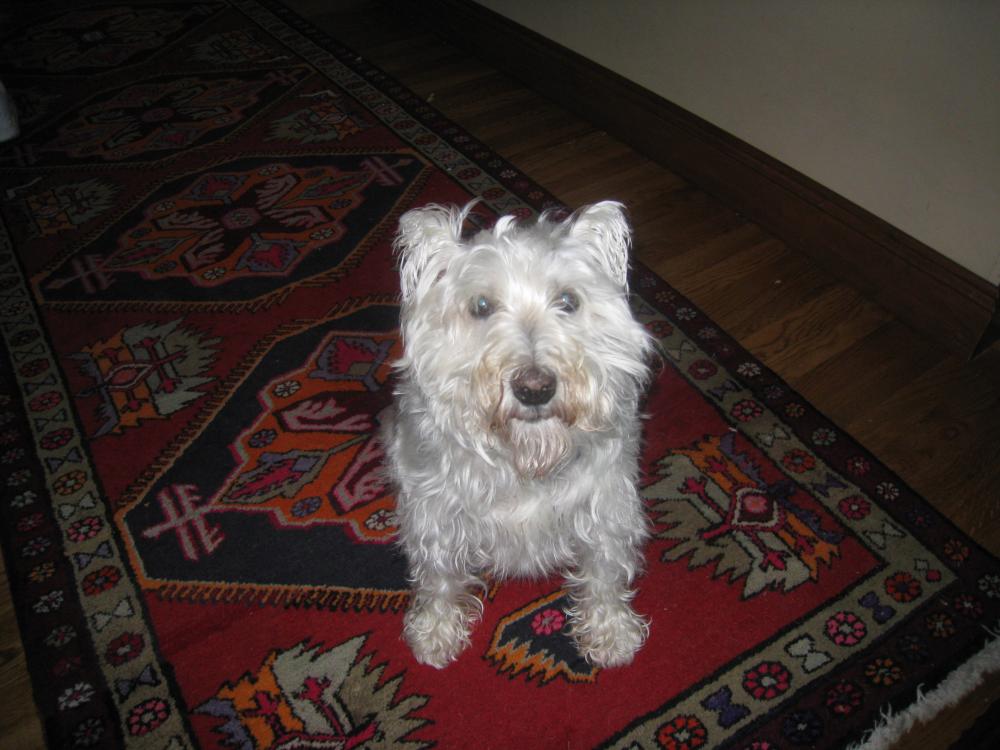
    The kids and I ventured down the street and saw this adorable so-called "rare" white mutt in the window of what used to be the Uptown Pet Store—-


    With both arms twisted…the expressions from my kids’ faces…..the wagging of his white tail—This little white $$$$$$$ dog was coming home.
    When we went to the golf course to show Howie …. let’s just say after a few "very funny, take that rodent back" looks….Ernie was now another addition to the …….. family.

    Smokey the rabbit, Bubba the guinea pig, and Freddy Fish (the 1st, 2nd and 3rd) were all now members of what I like to call the "JG Family Circus!"

    In between all of this madness, we had a loving wheaten terrier, Elmer, who my sweet sister-in-law Marcia was kind enough to give a great home to. That is, until a year ago when he, too, went to the big animal sky filled with pets of all kind that have brought so much joy to so many people!

    Bruno may be a teeny tiny little pupster, but make no mistake—–

    If you even think about adding to this circus here…Let me stop you by saying we are officially closed until Bruno can get over his issues of being A SMALL BUT FEROCIOUS YOUNG DOG…


    We are closed for business until everyone gets some sleep here at the JG Circus of Madness! Time for a nap or maybe a glass of wine from Figlio.