Author: Stephanie March

  • Picnic Love

    foodiePotatoSalad.jpg

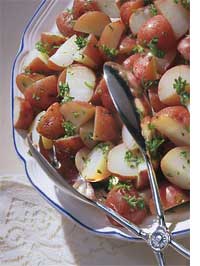
    It’s all about the Potato Salad.

    This is sort of an anti-pasto potato salad.

    This one is herby and light.

    This one, made with french fries, won a Food Network contest.

    Martha’s All American version.

    Ach du lieber, wir essen Kartoffelsalat. Sehr gut, ja?

  • Top Mayonnaise

    mmm.jpg

    Well, Tiffani lost. Harold has been named Top Chef.

    He’s going back to New York to open his own restaurant and I’m sure he will have investors and press knocking down his door. He’ll probably be successful, as long as he has a smart someone running his front-of-house.

    But did he deserve the win?

    In the final round, he took the safe route. His dishes were good, but they didn’t seem to WOW the guests while they were eating them. In fact they seemed to react to them more fondly during the panel discussion than they did during the actual tasting.

    Tiffani took a bold route. She put out twice the preparations saddled with a hungover/drunk crew. In any normal situation, Dave and Stephen would have been sent home or fired. Her dishes were good and interesting. In contrast, people seemed to really like her food during the tasting, then during panel gave it a “meh”.

    The choice had already been made. I knew that the show had chosen to villify Tiffani and make her out to be a baddie. I knew that meant that she was in danger of losing so that the show could “punish” her and let the popular kid win.

    I’m just surprised that the panel took the safe route and didn’t see risk-taking and perseverance through serious adversity as more winsome qualities than average consistency. If Colicchio were competeing instead of judging, which route do you think he would have taken? If it were Keller vs. Colicchio, do you think either would have taken the safe route? They would have attempted to dazzle, and if they were as young as Tiffani, they might also have fallen short on some dishes. But that wouldn’t change who they are.

    Shouldn’t the title of Top Chef speak more to whom they will become in the industry rather than how they failed or succeeded on a taste profile in one or two dishes? In Project Runway they always speak about the winner as the “next big designer”. The judges of Top Chef, it seems, were more concerned with their own abilities to judge food than they were about identifying a potentially serious player in the industry.

    I know Tiffani will land on her feet, and I know in the end she will be more successful than jealous Leeann, untalented Miguel, or the fool Dave (who, with all his on camera eye-rolling antics, will probably never be welcomed in a serious professional kitchen).

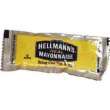
    I’m sure there will be another season. But if they choose to champion palatable mediocrity over spicy determination, I might as well make myself a mayonnaise sandwich and watch American Idol.

  • Trader Joe's

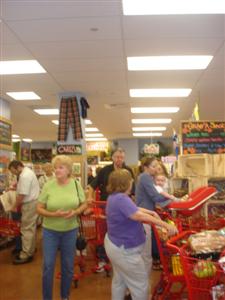
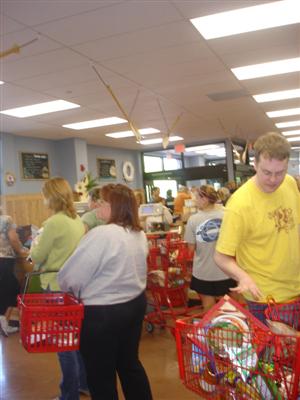
    Scenes from the melee that was the Trader Joe’s opening in St. Louis Park.

    melee (Custom).jpg
    Seriously, it was packed. Anyone with a cart was nearly lynched.

    corntower (Custom).jpg
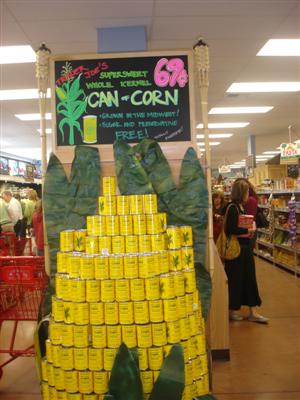
    Everything is sold under the Trader Joe’s label.

    cheeeeese (Custom).jpg
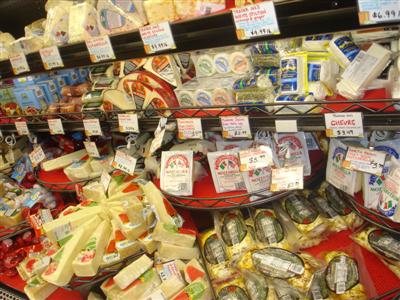
    The cheese selection was good but not phenomenal. And I want phenomenal cheese forever more.

    gazpacho (Custom).jpg
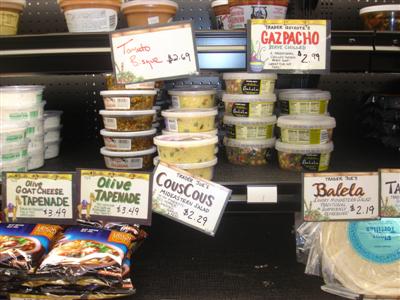
    Yay, gazpacho!

    fish (Custom).jpg
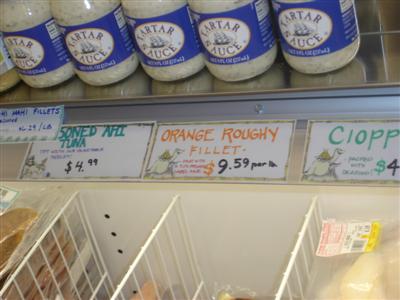
    A nice deal on frozen fish, a nice selection.

    checkout (Custom).jpg
    The guy in yellow is wearing a Wedge Co-op tee-shirt. Traitor.

  • A New Hope

    joey_chestnet_record.jpg

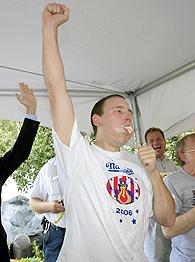
    Joey Chestnut, they muttered beneath their breath, Joey Chestnut could be the one.

    It may be too soon to talk about it, we may be jinxing the best chance we’ve had in a long time, but the world of competitive eating is a-buzz with Joey Chestnut.

    Last Thursday, in the Las Vegas qualifier for the Nathan’s Famous Fourth of July Hot Dog Eating Contest, Mr. Chestnut set a new American record by eating 50 hot dogs and buns in 12 minutes. “This is the greatest thing to happen in the history of American sports. Joey Chestnut’s accomplishment may change the course of a nation” said Richard Shea, President of the International Federation of Competitive Eaters.

    Since 1916, Nathan’s Famous has conducted their vaunted hot dog eating contest on Coney Island. For the last four years the title has been held by one Takeru Kobayashi, a slight 144lb. Japanese man who packs away HDBs (hot dogs and buns) like Tic-Tacs. His 2005 title came on the heels of a record 49 HDBs in 12 minutes. Thought by some to be the Greatest Eater in History, Kobayashi and his feats of degustation over the past couple of years have helped to catapult competitive eating into the mainstream. The Nathan’s competition is like the World Series of competitive eating, sanctioned by the IFOCE and given air-time on ESPN.

    And while watching diminutive Asian people (the 100lb. Korean-born Sonya Thomas came in second last year with 42 HDBs and is widely considered to be one of the toughest eaters alive) snarf hot dogs is entertaining, you can’t help but think that overeating is clearly an American stong-point, why can’t we hold the coveted Mustard Yellow International Belt?

    Enter Joey Chestnut, 22-year-old civil engineering student from California. A striking 6’6″ tall and weighing in at 230lb., Mr. Chestnut seems to fit the conventional ideal of a competitive eater. He slipped into the buzz last year when, as a veritable nobody, he won the Stockton Fried Asparagus Eating Contest. When it came time for Nathan’s, he shocked the veterans by coming in third. He looks hungry, and unlike Kobayashi, we aren’t left to wonder where it all goes.

    As of Thursday, the gauntlet has been thrown. Will 2006 play out the classic American Cinderella story? Will the phenom Mr. Chestnut take the title in the name of his brother, a National Guardsman fighting in Iraq? Or will it be a Kobayashi Maru: an imcomprehensible use of will power and esophagial skill to topple a mighty foe?

    The Nathan’s circuit has officially begun, the next qualifying competition in Philly on Memorial Day. After that eaters in Tempe, Norfolk, New Jersey and Atlanta will have a shot at winning a place on Coney Island for The Fourth.

    We will be watching, Mr. Chestnut, oh yes we will.

  • Artful Nosh

    food10.jpg

    Art-A-Whirl makes me hungry. Maybe it’s walking around all the inspiring art that makes me think I, too, am a starving artist. Maybe it’s all the pondering and provoking of thought that starts my tummy a-grumbling. Or maybe it’s the wonderous lack of cheese curd trucks combined with the knowledge that I’m surrounded by some of the best eats in the city.

    I’ll probably head to the California Building for the hot glass bead making demonstration by FlashGlass and maybe take the kids to the release of the new Kaleidoscopia coloring book. Mill City Cafe is right there and a great chance for some tasty lunch if you can grab a table.

    For sure we’re going to Jao’s speed painting in the Northrup King Building’s parking lot. We’ll also sneak up to Locus Architecture and bug my buddy Wynne who created my kick-ass kitchen (I think I might be a nightmare to work with so I’ll probably bring him some baked goods from Wilde Roast). A good place to sneak after that, if it’s early enough, is the Ideal Diner. But with only a few seats, it’s a gamble.

    Psycho Suzi’s killer patio will be packed undoubtedly, The Sample Room can offer lots of tasty options, or you can check into Mayslack’s and try to channel the old Nordeast neighborhood vibe.

  • Restaurant Decor

    Does anyone remember the House of Breakfast? It was this little counter-service joint run by two Eastern European women out of a house-front in South Minneapolis. The omelets were decent, the pancakes were fine, but that’s not why you went. It was the walls. Near the counter you could read the menu, which was scrawled on paper plates, but every other inch of wall space was covered in paintings: Pitiful puppies, sad harlequin clowns, waifish girls, and pathetic kittens—all with dark saucer eyes, rendered in the style of those kings of seventies kitsch, Walter and Margaret Keane—stood watch over your every cup of coffee. It remains the only restaurant that I’ve patronized specifically for the décor.

    Obviously, there are other places we go because of the buzz or to soak up a certain vibe, but often that has as much to do with the people attracted to the space as with how the space itself is put together. Would we still hang out at Chino Latino on a Saturday night if it were packed with nattering IRS auditors? The point is, décor and ambience are two distinctly different things. Case in point: The décor at Psycho Suzi’s, in Northeast Minneapolis, is a tacky tiki wonderland—but its patrons and cheeky staff give the place its edge.

    There’s no question that restaurant design—along with great food, service, and people-watching—is a crucial part of the magical and all-too-elusive formula that makes a restaurant successful. But there’s no template to follow, no style guide that ensures success. Note that I’m not including the theatrics employed by themed restaurants, as mechanical dinosaurs and timed thunderstorms are more than decoration; they’re more like a three-year-old’s chicken-finger-fueled acid trip. Those spectacles aside, you can basically define one end of the spectrum with casual-dining favorites like Applebees, which plaster their walls with flea-market finds (or impeccable imitations of flea-market finds). At the other end are fine-dining temples along the lines of 20.21, which artfully decline to put anything on the walls. The issue at hand isn’t whether one approach is superior. The question is: What does this all have to do with the dining experience?

    TGI Fridays, Applebees, Ruby Tuesdays, and the locally owned Famous Dave’s have become expert at the former approach. The collections of vintage photographs, battered musical instruments, wooden sleds, and all manner of other vaguely aged clutter serve to “localize” their restaurants, with the aim being to insinuate the place into the community. All that stuff on the walls is also supposed to grab our attention, make us feel at home, and incite conversation. But in some cases these heaping helpings of junk become a blur—a visual version of white noise that we’ve trained ourselves to ignore. Sensing a growing indifference, TGI Friday’s began reworking its design concept a few years ago, adding more contemporary objects like PeeWee Herman shoes, BMX bikes, and skateboards. The hope is that these things, more so than a Radio Flyer, will strike a chord of relevance with the younger consumers of mozzie-sticks.

    Moving up the scale in expense and prestige, the basic rule seems to be that the better the food, the less crap on the walls. Take the year-old Fugaise, in the East Hennepin neighborhood: an austere, windowless space with grayish walls and dark abstract art by a single artist, Daren Steneman. Some find the heavy color scheme severe, but when the food arrives, it’s clear that the focus is meant to be on the vivid squash soup set before us. As many of us can (and do) passionately argue, food is a conversation-worthy art form all on its own.

    Furnishing a restaurant can be a huge gamble if you’re looking to make a striking impression. Let’s not forget the ill-fated Rock Star restaurant and the first line Star Tribune restaurant critic Jeremy Iggers wrote in his 2002 review: “Loved the food. Hated the décor.” The room featured oversized black-and-white photos of pseudo-celebrities, harsh lighting and horrible acoustics, tacky carpeting that looked like it could have come from Elvis’ attic, and an unfortunate location in the Piper-Jaffray building. You couldn’t get comfortable, but neither did you quite feel glamorous (the only acceptable reason to sacrifice comfort). Not even the amazing dishes from Chef Steven Brown could overcome the drastic décor. But now that he’s at the warmer, friendlier Levain, which is tucked into a quiet neighborhood of South Minneapolis, Brown’s food is rewarded with a consistently packed restaurant.

    In response to an increased emphasis on interior design: Locally, restaurant design has become big business as Twin Cities-based entrepreneurs continue to test new concepts. When they demolished Nora’s just northwest of Lake Calhoun and rebuilt it as Tryg’s, the owners hired Shea Architects, a firm that has created a plethora of local restaurant spaces, from Solera to Famous Dave’s, to come up with something beautiful yet safe. (We might call it “Café Gabberts.”) Bucking this trend, the owners behind a newer Minneapolis venture, Five Restaurant and Street Lounge, hoped to strike upon something fresh by seeking out architects who’d never designed a restaurant before. The result is unexpectedly soft while maintaining a modern edge, keeping the diner at ease while introducing new ideas. Then there’s the much-anticipated Cue, the restaurant in the new Guthrie Theater. With a menu created by Lenny Russo (of St. Paul’s Heartland) and interior design by another well-known firm, the Durrant Group—all wrapped in a building by the vaunted French architect Jean Nouvel —it will be exciting to see whose influence leaves the most lasting impression.

    However, let’s not forget the middle of the restaurant-design spectrum. Call it a laid-back backlash against all the gloss and dough being shelled out for high-concept design, but there seems to be a trend toward a more organic approach to creating a dining room. The colors and artwork somehow tie in with the food (which is why some of us go to restaurants in the first place). The estate-sale finds, local artwork, and hand-carved furniture at Café Barbette in Uptown all work together to give the place its whimsical feel, and fit nicely with a menu that doesn’t take itself too seriously. Midtown’s new Town Talk Diner could have styled itself retro, but didn’t. Instead, the owners kept diner pastiche to a minimum, allowing the old, original counter to be reborn as their bar and evoke the spirit from which their snazzy menu draws. Restaurant Alma, in southeast Minneapolis, is another example. Its clean lines, modern maple tones, exposed brick, and birch branches give the dining room a fresh, natural feel, which makes sense given the menu’s focus on seasonal ingredients. Colors are easy and play well with candle light. Decoration is simple, timeless, and yet the minute we try to soak it all in, it fades to the back, allowing for the simple enjoyment of food and good company.
  • Restaurant Rage

    Last winter, over the holidays, a restaurant manager I know clocked what she wryly calls the “Best Five Minutes Ever” of her career. Just seconds after punching in, she was called to the bar to break up a couple of brawlers. While showing one-half of the drunken duo to the door, she came across a couple of baddies dealing drugs in the entryway. Upon throwing all criminals out on the street, she was headed to the phone to call the cops, only to be sidetracked by a page instructing her to check out the men’s bathroom. Standing there in the middle of the restroom she found a guy, pants around his ankles, playing his own instrument, if you know what I mean. She had to literally pull up his pants so that she could usher him out without freaking out the diners.

    Now, humility is a crucial quality for people who work in the hospitality industry; the notion that the guest is always right has been deeply ingrained within them. And as guests, most of us appreciate the service we are provided, and we express that gratitude with generous tips. Usually, this arrangement works out just fine, but there are exceptions to both sides of the deal. In recent years, in fact, it seems that I’ve been privy to more and more horror stories about diners. Maybe it’s because finishing schools and etiquette manuals are largely obsolete. Perhaps it’s due to “fine dining” being touted as a form of entertainment unto itself, thus raising the expectations of both staff and guests. Regardless, the upswing in ugly behavior has many restaurant workers questioning whether the guest is always right—and also wondering what the hell has gone wrong.

    More from the local restaurant-worker pipeline: An older, affluent couple frequented a top steakhouse on a weekly basis, and they never failed to find something to complain about. The steak wasn’t cooked right, the wine smelled funny, the forks were poorly polished—whatever the problem was, they voiced their feelings, very loudly, to whichever server had been stuck with them. For a while, management went out of its way to appease the couple—moving their table, switching their server, pampering them with extra attention, and on occasion, a complimentary meal. Eventually it became clear that nothing would ever make this couple happy. A manager sincerely apologized for being unable to meet their high standards and politely suggested they find another restaurant. To everyone’s surprise, the pair kept coming. But from then on, they found everything to be fantastic.

    Bad service should never be tolerated. If your food is cold, send it back. If your server was rude or inattentive, seek out a manager. No restaurant worth its salt wants you to suffer through a meal. Their goal is to have you leave happy and return later, credit card in hand. But a certain set of people seem determined to publicly humiliate or otherwise punish restaurant workers for service snafus. I theorize that these types are often asserting their version of a pecking order. People who spend days cowering in a cubicle to avoid an impossibly demanding boss—or, conversely, clawing their way to the top and stepping on many others in the process—are often all too delighted to blast anyone they perceive to be below them on the socioeconomic ladder.

    Worse still, their chosen scapegoats are charged with the task of trying to please them. The worst offenders, outraged at the slightest mistake (say their Caesar salad arrived without chicken), demand justice. They declare their dining experience ruined, and expect their entire meal to be paid for. How would these people respond should a similar principle be applied to them in their work? Imagine a boss finding a typo in a certain status report and demanding that the offender forfeit a day’s pay as punishment. If this became the norm, employment litigation would sprout all over the place. Yet it seems to have become socially acceptable to belittle servers and bartenders, perhaps because they are mostly younger people whose work is not considered by some to be a “real job.” Never mind that restaurants in this country are a $1.3 trillion business that employs twelve-and-a-half million people—an employment force second only to the government.

    Not surprisingly, booze plays no small role in this rash of bad behavior. Servers can be held liable if a drunk goes off and hurts someone, but the law that decreed this does not acknowledge how delicate a task it is to cut off inebriated people. Drunk people do not like being refused service; rich drunk people seem to like it even less so. Another recent story from the frontlines: A clean-cut man who’d been drinking was cut off and asked to leave an Uptown restaurant. After a short while he returned, claiming his sunglasses had been stolen. The manager threatened to call the cops and asked him to leave, but before he did so, the man responded by kicking her in the gut, leaving a boot-print.

    Some restaurants are taking steps to ban anyone who behaves outrageously. But some good servers are also leaving the industry, tired of suffering the abuse. If this becomes a trend, owners will have to pay higher wages to less-experienced workers, which will only drive prices up and satisfaction down. It’s a bit of a conundrum. Owners and managers must make their guests happy, attempting to turn every complaint into an opportunity to create a guest for life; at the same time, they have to provide their employees with a safe and hospitable workplace.

    But there’s reason for hope. Four out of every ten people have worked in a restaurant at some point in their lives. They can appreciate good service and sympathize with a mistake here and there. If they team up with current restaurant workers, maybe those diners with rage issues will eventually find themselves eating alone, at home.

  • Top Jello

    remote pop.jpg

    Tiffani is getting railroaded.

    I finally saw the “reunion” episode of Top Chef the other night, and I seriously couldn’t sleep afterward.

    Tiffani is being cast in the role of the villain. Don’t think for a minute that just because it’s Reality Television that there aren’t people behind the scenes working the events into “story lines” and pushing the players into “characters”. They are called editors and directors.

    I’m not saying Tiffani is a saint, if you’ve ever worked in a real pro kitchen, you know it aint stocked with saints. My problem is that they are taking some of her best attributes and by virtue of editing and bitter co-player assessment, turning them into unsavory qualities.

    Plus, the same people are trying to turn Dave into the Fair Princess. Poor Dave has been run over by Tiffani, poor Dave has had to endure being interrupted. Poor Dave needs to grow a pair.

    In a strange way it’s a bizarre sexism. The ballsy bitch is being beat down by the shemale. Huh?

    When you cut through all the dramatics, all the camera angles and created strained pauses, you come down to this: Who is more like Tom Colicchio and Hubert Keller and Charlie Trotter?

    Is it Dave who shows panic and flusters through a kitchen? Or is it Tiffani who is curt and focused and drives to get the job done, no matter what? Can you honestly see a legion of sous chefs and line-cooks responding to Dave with a respectful YES CHEF! while he twitches and mumbles to himself as the pressure mounts? It takes a strong person, someone to lead the battle that is dinner service in a top kitchen.

    What about Harold? I like Harold quite a bit, he reminds me of someone I know (I’m just a cook). But I worry that Harold doesn’t have the fire in the belly or the knowledge of the other side of a restaurant to really be a star.

    Who will win? Who knows. If Dave wins it will be Top Jello, pandering to the masses who want their winners to be sweet and palatable. If Tiffani wins it could be Top Bitch, which isn’t necessarily a bad thing in a real kitchen. If Harold wins, it will be because the other two started to believe their own press.

  • Maternal Appetites

    brunch.bmp
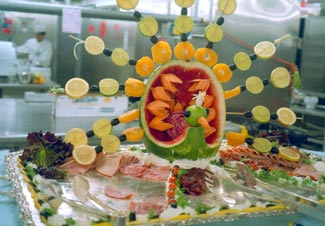
    Nothing quite says “Thanks Mom” like a giant fruit peacock.

    Screw brunch.

    Seriously, don’t you think you’re pulling a fast one on your Mom by taking her out for brunch? First of all, there’s little or no effort put by YOU personally into the meal. Secondly, by making it the morning meal, it’s like you’re trying to “get it over with” so that you can finish your Sunday as you wish.

    Plus, what do you get with brunch? Eggs? Pancakes? Fruit and whip cream? Yawn. When you’re celebrating your birthday, do you stand up and shout “Hey, let’s go out for brunch”?

    For the woman who has spent countless hours of her life pondering how to make a new and surprising meal from chicken: Make her dinner. Make her something special, something expensive with fresh ingredients you actually have to work to find. And clean everything up.

    For the woman who acknowledged her lack of culinary talent and made the Chinese take-out restaurant on the corner very rich: Take her out for dinner. Go somewhere she would think was way too expensive, give her the opportunity to wear nice shoes.

    As for gifts, flowers and perfume are so blah. What do they say about the hours she spent in cold hockey arenas at 5 am? What do they say about the trust she bestowed upon you the first time she let you run around The State Fair with your friends? What do they say about every time she slipped you the last twenty bucks in her wallet? Nothing, other than “You’ve raised an unoriginal kid”.

    Obviously, every Mom is different, and what one might truly appreciate, another will suffer silently. But you might consider finding something she loves, and upgrading it.

    No clothes, but maybe a beautiful apron for the cook.
    Never a vaccuum, but maybe some aroma therapy for the neat freak.
    Not just an hour away from the house, but a whole day.
    Forget cooking classes, hire her a chef for a week.
    A box of chocolates from SuperAmerica is dirt compared to these.
    Upgrade her sneeky-peek.
    Cheese. For a year. At least that’s what I want.

  • A-foraging we go.

    r2658984534.jpg

    This coming weekend might be a good time to join the lurkers in the woods. The mycologists are a-foot, stooping to look under fallen trees, brushing aside damp rotting leaves, all in search of their prize: mushrooms.

    Foraging for mushrooms, and other wild edibles such as ramps, can be a consuming hobby. Disregarding wet weather, soggy shoes, mud slides, private property signs, and little or no yield is part of the crazy-fun that draws hundreds of people into the woods.

    The Minnesota Mycological Society is actually the second oldest in the nation, founded by Dr. Mary Whetstone in 1898. A newbie might be interested in their class on May 22 where they’ll discuss local findings and identification techniques. They also hold guided forays into parks and woods that have been known to produce a strong growth of mushrooms.

    The renegade hunter may want to do a little research before heading out. Morels are the mushrooms of early spring, and they are well-sought by professional mycophagists (mushroom eating seekers). Dead elms have always been a marker for morels, but hunters have reported great finds among white ash trees as well. Looking among rotting leaves, small leafy plants, and vines with thorns have produced luck for some.

    The small town of Elba has been a central point for hunters, in past years even hosting a morel festival (can’t seem to find anything about this year…). The Whitewater State Park is located just south of town and boasts a lot of great hunting acreage. For the price of a parking permit, you can march into the woods and collect as many mushrooms as you can carry. A park ranger told me today that morels are indeed poking up all over the place.

    If you prefer to discover your mushrooms in a tasty risotto, you should make reservations with the Bayport Cookery for their famous Morel Fest dinner which runs through July 2nd.

    mush.jpg