Category: Blog Post

  • The Return Of Uncle Jumbo: An Introduction

    Early in my adolescence I played baseball one summer on a traveling team with this fat kid from a smaller town fifteen miles from the place where I grew up. I swear, this guy was the funniest, most bitterly cynical fourteen-year-old on the planet. He was also the best hitter I ever played with or against, just a monster who could spray the ball all over the field and hit homeruns with ease in every tiny youth league park around southern Minnesota. He couldn’t run for shit, of course, and wasn’t much in the field, but he played a serviceable first base for our team and more than made up for any defensive lapses with his bat. If I remember correctly this kid drove in something like seventy percent of our runs that summer, and hit more homeruns than the rest of the team combined.

    He ended up playing high school ball in his tiny hometown of Blooming Void, and had a career that was the stuff of local legend. I suppose because he was fat and not much of a student he apparently didn’t get any scholarship offers to four-year colleges, and ended up playing two years for a junior college in Kansas. That JC had a reputation of being a sort of farm club for major college programs, and he easily led his team in every major offensive category in both his seasons in Kansas. A half dozen guys from his team went on to play Division One baseball, but that was the end of the line for him.

    He went back to Blooming Void and worked at his old man’s hardware store. I’d always followed his career with interest, and would regularly hear about his exploits through the grapevine or in the pages of the local newspaper, but once he hung it up I pretty much lost track of him.

    Five years later, though, I bumped into him at a Twins game at the Dome, and we started hanging out a bit and eventually ended up working together in a downtown parking ramp, where we had many a ferocious Whiffle Ball battle on the top level after hours.

    By that point he had been transformed into Uncle Jumbo, a name that had allegedly been conferred upon him by his nephews. As the story went, when one of the nephews was a tot he’d misunderstood Jimbo as Jumbo, and the name stuck. It didn’t seem to bother Jumbo in the least, and he adopted it with enthusiasm.

    Jumbo was the worst person in the world to watch a baseball game with. He was a perfectionist, naturally belligerent, and a prodigious beer drinker, which was a terrible and combustible combination for a fan of any sport, but particularly dangerous for a baseball fan. He couldn’t accept the fact that even the best teams would lose fifty or sixty games in a season; this seemed to him a wholly unreasonable definition of success, and thus he found the game brutal and punishing. Every single loss, and an overwhelming majority of the victories, left him bitter and preoccupied.

    Jumbo was nonetheless a glutton for punishment, and a perfect specimen of a baseball masochist. He allowed the sport to ruin his prospects in life, refusing to consider any job that would not allow him to absorb every inning of every game of every season, whether in person, on the television, or via the radio. This flexibility was his sole criteria for suitable employment, and thus he was limited to a series of stationary, dead-ass jobs, mostly in parking ramp booths or security desks. When I again lost track of him he had allowed his phone to be disconnected and was washing dishes in the kitchen of a dive bar in south Minneapolis.

    Then, unexpectedly in the late-nineties I started seeing Jumbo’s byline in a weekly publication called Minnesota SportsPage, where he documented with often appalling candor the extent to which baseball was ruining his life. Those were very dark years for Twins fans, and Jumbo’s ruminations were frequently apoplectic, virtually always irrational, and often painful to read. They were also somehow grimly entertaining, perhaps because I knew the man and understood on some level the extent of his dark obsession.

    Eventually Jumbo got the gate at Sportspage, and settled back into the life of the anonymous and unhappy fan. I found him again recently, working the night security desk at the office building where my wife is employed, and we’ve been going back and forth for a couple months trying to reach an agreement that would have him contributing a column here at Warning Track Power once a week.

    I’m happy to say that the deal has finally been struck: an official Spalding stickball bat, a well-worn Boog Powell Rawlings Trapper first baseman’s mitt, a signed copy of Tony Oliva’s autobiography, a roll of Copenhagen, and a sealed DVD of Tawny Kitaen’s The Perils of Gwendoline in the Land of the Yik Yak, in exchange for one season’s worth of Jumbo columns.

    Jumbo has assured me that he’ll be good to go by next Friday, and in the meantime I’ll post one of his original, early columns (from opening day, 1996) by way of an introduction. I’ll also have my own season preview sometime tomorrow.
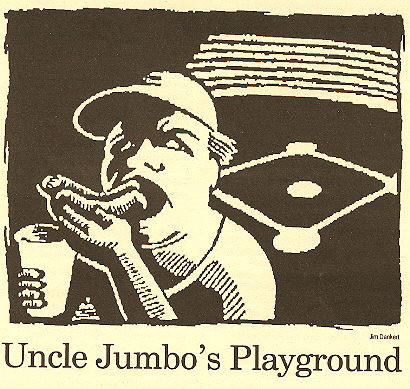
    uncle jumbo.jpg

    Uncomfortable admissions have long been one of my specialties, so here’s a whopper: I once wore a toga emblazoned with Lenny Faedo’s number to a Twins opener. I’m not sure what I was thinking, but in those days I was convinced that my one real shot at acquiring self-esteem and some kind of identity was to become a ballpark character, one of those guys –and they are almost always fat –who leads cheers from the top of the dugout. I had a little bit of nerve in those days, coupled with a pretty serious drinking problem.

    The first time I got hit with a well thrown Frosty Malt though, my nerve evaporated and I assumed my place in the rolls of the large and anonymous. In Minnesota, of course, any show of public enthusiasm is grounds enough for a drunk and disorderly citation.

    It still chaps my ass that the symbol of the rapturous Minnesotan will forever be that ridiculous Homer Hanky. That whole phenomenon really bothered me. It struck me as so –and I’m going to use a potentially objectionable old junior high school adjective here– femmy. You know? 50,000 people bouncing up and down on the edge of their seats and waving handkerchiefs, for chrissakes. If Western movies taught me anything it was that waving handkerchiefs was how gals said goodbye when their men rode out of Dodge or went off to war or just plain got the hell out of town. It was, like, a school marm thing.

    I wasn’t gonna get caught dead waving a handkerchief. But I did, of course; I waved the hanky, along with all the rest of the idiots. And to this day that’s the only thing about that entire season that I feel really lousy about. Well, that, actually, and the fact that I got so stinking drunk on 3.2 beer during the first game of the playoffs that I threw up in a Metrodome concourse, something I swear to God will never happen again.

    Remember Lombo, though? Remember that scrawny little bastard running around and waving that towel? That also chapped my ass. Another obvious lesson from the Westerns, right? Waving the white towel is the universally accepted form of surrender. I mean, come on, moron, you just won the World Series; is it too much too ask that you comport yourself in an appropriately masculine manner?

    I’M NOT A BIG FAN of life’s great moments. Birthday’s are right up there with stepping on the scale for me, and I would skip my own wedding if I could somehow pull it off. A wedding, I mean, you know, finding someone who would marry me. Nonetheless, opening day is the only calendar occasion I still observe with anything resembling religious devotion. I never miss opening day. I once quit a job so that I could be in attendance on opening day – granted, it was a job at Arby’s, but still. For years I would sit at home and drink like crazy before the opener, but I’ve mellowed quite a bit with age, and the last few years I’ve had a few beers at home and then gone to Baker’s Square for a pie. It’s not much as far as traditions go, but what the hell? It works for me.

  • Death be not proud

    cheneypope.jpg
    Before he died, the Holy Father admonished the anti-Christ

    by John Donne

    Death be not proud, though some have called thee
    Mighty and dreadfull, for, thou art not so,
    For, those, whom thou think’st, thou dost overthrow,
    Die not, poore death, nor yet canst thou kill me.
    From rest and sleepe, which but thy pictures bee,
    Much pleasure, then from thee, much more must flow,
    And soonest our best men with thee doe goe,
    Rest of their bones, and soules deliverie.
    Thou art slave to Fate, Chance, kings, and desperate men,
    And dost with poyson, warre, and sicknesse dwell,
    And poppie, or charmes can make us sleepe as well,
    And better then thy stroake; why swell’st thou then;
    One short sleepe past, wee wake eternally,
    And death shall be no more; death, thou shalt die.

  • Night

    by Percy Bysshe Shelly

    SWIFTLY walk o’er the western wave,
    Spirit of Night!
    Out of the misty eastern cave,—
    Where, all the long and lone daylight,
    Thou wovest dreams of joy and fear
    Which make thee terrible and dear,—
    Swift be thy flight!

    Wrap thy form in a mantle grey,
    Star-inwrought!
    Blind with thine hair the eyes of Day;
    Kiss her until she be wearied out.
    Then wander o’er city and sea and land,
    Touching all with thine opiate wand—
    Come, long-sought!

    When I arose and saw the dawn,
    I sigh’d for thee;
    When light rode high, and the dew was gone,
    And noon lay heavy on flower and tree,
    And the weary Day turn’d to his rest,
    Lingering like an unloved guest,
    I sigh’d for thee.

    Thy brother Death came, and cried,
    ‘Wouldst thou me?’
    Thy sweet child Sleep, the filmy-eyed,
    Murmur’d like a noontide bee,
    ‘Shall I nestle near thy side?
    Wouldst thou me?’—And I replied,
    ‘No, not thee!’

    Death will come when thou art dead,
    Soon, too soon—
    Sleep will come when thou art fled.
    Of neither would I ask the boon
    I ask of thee, belovèd Night—
    Swift be thine approaching flight,
    Come soon, soon!

    With the pope and Terri Schiavo in the news, who can think of anything but this topic? More tomorrow.

  • Advertisement for Ourself

    Ken Auletta had a nice article in last week’s New Yorker asking the question we’ve been asking around here recently—does advertising work? The short answer, we think, is that advertising is just like any other “content.” If it’s good, it works. If it’s bad, it doesn’t. That doesn’t go very far in describing or explaining the trillion-dollar advertising industry today, and we’re forever intrigued by the imbalance between the cost of a page of advertising versus the cost of a page of edit. (Speak with a commercial photographer sometime for a graphic description of the contrast between ad budgets and edit budgets.)

    We felt a little short-changed by Auletta’s piece, though, because he focused almost entirely on TV advertising; he made some of the usual common-sense observations about web advertising, and did not even mention print advertising. The reason to focus on TV is because it has a more easily reduced history— there was a time, he points out, when a major ad buy on one of the three national TV networks would literally reach 80 percent of the public. That sort of audience consolidation ought to result in a pretty clear picture of whether (TV) advertising works in any meaningful sense.

    As any advertising professional can tell you, one cannot think too simplistically about advertising. If you buy an over-the-counter ad and expect to see an immediate increase in business, you will be disappointed. This partly explains the massive explosion of the ad industry in the past fifty years—an ad is not in itself a commodity, and therefore the people who conceive, create, and buy ads rely on developing a relationship. Today, ad people call themselves “partners in your branding initiative”—and they fulfill the McLuhanesque prophecy in which the package fully eclipses the product. (In fact, the advertising begins to eclipse the physical packaging; it’s an information age in an attention economy, baby!)

    The point of all this is a simple one: Contrast. Distinguishing yourself in a busy, noisy marketplace is ninety-five percent of the battle. That is why we read and actually enjoyed Tina Brown’s little whine yesterday at the Washington Post—and why it always gets our hackles up when someone says nobody under the age of fifty is interested in reading long-form narrative journalism. “Elitist” is just a dirty word for contrarians, troublemakers, smart-alecks, and bred-in-the-bone attention-getters, and they are ultimately the only real economic engines in a marketplace that would die without constant, fresh inputs of restless novelty. Julie Caniglia recently foretold the rapture that may one day attend the End Times of ad-driven consumerism and media. She noted that inner peace is not a revenue-generating proposition for capitalism. In other words, we may not know whether advertising works. But we do know that not advertising does not work. You don’t want to be left behind, do you?

  • My Meat-Making Days

    ballroomboy5.jpg

    Dan Corrigan, “Eddie Potomac,” from the Ballroom Portraits, Rhinelander, Wisconsin. 1978.

    I worked side-by-side with this guy for seven years. Shooter Devaney. He’d been a hotshot basketball player back in high school, but something went wrong somewhere along the line, just like something went wrong for so many of the guys I grew up with, myself included.

    Shooter was always flinching. Looking through our old high school yearbook not long ago I noticed that he was even flinching in his class picture, so the seeds of the thing were apparently there all along. It was like the camera was a blow, like he couldn’t handle posterity or whatever it was.

    I’ve survived a few things, he’d say to me. Don’t think I haven’t. You know my wife? She’s likely at home right this moment dancing alone to records in our living room. When people ask her what she does she can’t just say she’s a housewife. No, she claims she’s a retired cheerleader. What woman in this town isn’t?

    Some people I’ve learned don’t need some anonymous tragedy to put a spook in their blood; they’re just born with some creeping thing that won’t leave them alone.

    My teeth are giving me fits, Scooter would say. My whole life I’ve never had a comfortable mouth. Or: I have no intention of ever getting on an airplane. That just ain’t my place, the sky.

    Scooter couldn’t sleep. He’d talk about that. He once asked me, Do you remember that big cage ball they used to bring out in gym class to roll right over everyone? That just did not seem like the correct proportions for any kind of a ball. I used to have nightmares about that thing.

    We were taking apart animals for a living back in those days, breaking them down into meat. There were billboards around our town that read, “Meat is Community.” It was bloody, stinking work, but the damn thing about it was you wouldn’t find a single vegetarian in the entire plant.

    I don’t know why this should occur to me just now. I suppose because it was such a long time ago, and seems even longer than it could conceivably have been, like I’ve been transported to where I am now from another planet. Sometimes when my head gets tangled up I can actually convince myself that such a thing is possible.

  • The worst are full of passionate intensity

    delay.jpg
    A gaze blank and pitiless as the sun

    Ok, it’s national poetry month, and I’m going to post a poem every day– Sometimes in addition to another post, sometimes just by itself.

    Enjoy.

    The Second Coming by William Butler Yeats

    Turning and turning in the widening gyre
    The falcon cannot hear the falconer;
    Things fall apart; the centre cannot hold;
    Mere anarchy is loosed upon the world,
    The blood-dimmed tide is loosed, and everywhere
    The ceremony of innocence is drowned;
    The best lack all convictions, while the worst
    Are full of passionate intensity.

    Surely some revelation is at hand;
    Surely the Second Coming is at hand.
    The Second Coming! Hardly are those words out
    When a vast image out of Spiritus Mundi
    Troubles my sight: somewhere in sands of the desert
    A shape with lion body and the head of a man,
    A gaze blank and pitiless as the sun,
    Is moving its slow thighs, while all about it
    Reel shadows of the indignant desert birds.
    The darkness drops again; but now I know
    That twenty centuries of stony sleep
    Were vexed to nightmare by a rocking cradle,
    And what rough beast, its hour come round at last,
    Slouches towards Bethlehem to be born?

    The lines about the best lacking all conviction while the worst are full of intensity kind of sums up things around here these days, no?

  • Did I Mention The Guy's Name Is Corky Miller?

    Corky Miller. Corky Mother-Humping Miller. Get serious. That name, I don’t think I need to tell you, just isn’t going to get it done.

    Corky Miller is the name of the grizzled chuckwagon cook in a western round-up.

    Corky Miller is the fat, beleaguered first baseman on a little league team in an After School Special.

    Corky Miller is the hayseed in the danceline of a Broadway musical.

    Corky Miller is an astigmatic junior high school shop teacher.

    Corky Miller is the bully with a crewcut in a comic book from the 1950s.

    Corky Miller is a Division I women’s basketball coach.

    Corky Miller is the host of a cable access Christian children’s television program.

    Corky Miller is a ventriloquist’s dummy.

    Corky Miller is a golf caddy.

    Corky Miller is a gentleman suitor.

    Corky Miller is a sidekick, an afterthought, a horse track rube, a meddlesome neighbor, a musclehead with a fake tan.

    Corky Miller is not a Major League baseball player. Not in the 21st century, he’s not. He better not be.

  • This is not about Terri Schiavo

    It’s about George Bush. Here’s his comment today when told of the death of Schiavo.

    “I urge all those who honor Terri Schiavo to continue to work to build a culture of life, where all Americans are welcomed and valued and protected,” the president said, “especially those who live at the mercy of others.

    “The essence of civilization is that the strong have a duty to protect the weak. In cases where there are serious doubts and questions, the presumption should be in the favor of life.”

    These preposterous words from the man who signed death warrants with gusto for juveniles, mentally handicapped and sincere penitents while governor of Texas. These from a man who presides over the torture to death or indeterminate imprisonment of people unlucky enough to be rounded up in Afganistan or Iraq. These from the man who blithely sends our soldiers to Iraq without body armor or armored vehicles. These from a man who manufactures evidence to precipitate a war.

    Shame.

  • Wonkery

    Our dear old friend Ana Marie Cox , aka Wonkette, has certainly had a hard time staying out of the limelight these past twelve months. As James Woolcott points out today, there are good reasons to worry for the welfare of the funny, smart, cute little pill in D.C.—a town where, we have to admit, someone with a real sense of humor stands out like teats on a boar.

    Now the NY Daily News reports that Wonkette may be sniffing around Richard Leiby’s gossip-mongering beat at the Washington Post—this despite her declared preference for humor over reporting. We’ll take her word for it, but we know that Ms. Cox has considerably more staying power than her fleeting daily output of punchlines would suggest— her real strengths lie along editorial lines, both in story concepting and editing, but also oversight.

    Now we’re not going to dwell too much on Q-Rating here, but she does seem to have the knack for somewhat less substantive media forms like TV punditry. Her metoric rise to the cover of the New York Times magazine occurred about the same time she stopped answering our emails, so we have no inside information here. But we can say it made us feel a little disappointed, knowing that she deserves to be writing in that magazine, rather than being glorified on its cover.

    We may have the distinction of being the last print publication to publish a piece from her that exceeded the blogging threshold of about 150 words with twelve bullet points. As we say, we would not presume to make career decisions on her behalf, and they say you gotta dance with the one that brung you—so we may not see her get off the carousel of blogging conferences and panels anytime soon.

    In the meantime, we’re happy to have her doppelganger firmly in place doing the things HE does best.

  • The Final Pieces

    It would truly be folly if, as has been rumored, the Twins end up keeping four catchers on their roster (two real catchers, and two imposters) and cutting Michael Restovich loose. I still have a hard time believing that’s going to happen.

    It’s all a result of a bizarre set of circumstances, of course, what with the Twins having a surplus at several positions and a dearth of satisfying alternatives at a couple others. I know they feel they need a safety cushion in case Joe Mauer’s knee flares up, but four catchers is both more and in this case less than a safety cushion, when two of those guys (Matthew LeCroy and Corky Miller) would be nothing but last resorts. Miller has done absolutely nothing other than presumably being able to crouch and don the catcher’s gear to deserve a spot on the major league roster, and I don’t see how he’s any kind of an upgrade from last year’s desperate measure, Rob Bowen. If Mauer’s knee truly becomes a concern they’re going to have to do something to address the problem sooner rather than later, and certainly none of the available candidates allows them to do that or (other than LeCroy) is even likely to be here next season.

    I think Mauer’s knee will be fine, by the way. I talked to him about it last year on a number of occasions, and I sense this is a case of a 21-year-old kid who’s never had an injury of any sort getting used to the idea that his knee doesn’t feel quite the way it once did. As anyone who’s had knee surgery could tell you –and Mauer’s surgery was a relatively minor procedure, particularly when compared to Jason Kubel’s reconstruction– there are always going to be flare-ups of pain and discomfort, and there may well be additional glitches down the road. But for the time being, at least, it seems to me that the whole idea of being vulnerable is just something he needs to get his head around.

    The real problem for Restovich is the insecurity involving the guy at second base, Luis Rivas, who has continued his maddening trend of answering questions with more questions. I don’t know anymore. I’ve tried to be positive about Rivas, and have pointed out his age as a potential cause for optimism. After the spring he’s had that just doesn’t cut it anymore, and how much worse off would the team be with Nick Punto at second? It now seems certain that they’re going to keep the switch-hitting Terry Tiffee as a bat off the bench, but let’s not forget that there’s still always the option of moving Michael Cuddyer over to second –at least from time to time– and starting Tiffee at the corner.

    I wonder if the Twins have ever seriously considered cutting Rivas loose? It would certainly make things a lot easier for the time being, and would allow them to keep Restovich, a guy who they’ve invested a great deal of time and money in and who’s never really gotten a shot to show what he can do at the Major League level. Toss in that he’s a Rochester kid, was regarded as a prospect as recently as a couple seasons ago, and has power potential and I can’t for the life of me understand why they’d let him go to free up a spot for someone like Corky Miller. It makes absolutely no sense to me.