Blog

  • Fake Out Fest

    Fake Sonny has that deer in the headlights look. The right side of his mustache is slowly slipping down to rest on his bottom lip, looking like a venomous breed of wooly caterpillar. It doesn’t take long for audience members to notice. They erupt in gut-breaking cackles at poor fake Sonny’s expense. This mockery is not undeserved, being that he did break rule number one of fake mustache wearing-make sure fake mustache is properly affixed.

    This is fake Sonny’s worst nightmare. But his recovery is quick. Ever the intrepid impersonator, he changes lyric "the beat goes on" to "the moustache stays on" and bravely attempts to play off the snafu. Only seconds later, in a moment of failure, fake Sonny slips his mustache into the palm closed around fake Cher’s spindly fingers.

    "I thought that was real, Sonny," fake Cher says, noting her partner’s suddenly naked upper lip region.

    "I wish," fake Sonny chides.

    "The things you don’t know about your own husband."

    Tonight Bryant Lake Bowl is celebrating everyone’s inner cheese ball with a night of double takes, cringes and unbridled guffaws as members of local impersonation troupe, Party Crashers, take the stage.

    The music begins with a solo routine highlighting Cher’s 80s hits. Decked out in a $5 wig, fake Cher rips off her miniscule black dress after the first song to reveal lingerie as scandalous as a 2 a.m. drag queen at Gay 90s. She looks much more pleasant after a costume change into the long white dress reminiscent of Cher’s earlier fashions. Following a rousing and authentic rendition of "Gypsies, Tramps & Thieves," Sonny again joins the stage with freshly spirit-gummed facial hair for "I Got You Babe." Amid fanfare, he quietly slinks behind the curtain, perhaps to retire the fuzz forever.

    The star of tonight’s show, though, is Terry Schulz, the Elvis Presley of the Twin Cities. Schulz is appropriately large for the latter day Elvis look. And his disco ball shaking pipes could rival the King’s own, were he still around for a croon-off. Schulz doesn’t need a microphone –he needs a muffler for fear of shorting out audience members’ hearing aids.

    With his rabid leg pumping, snarled lip and sweeping arm movements, Schulz accurately conjures his idol. Those in need of glasses could easily reminisce about being in a sold-out stadium with the real deal, instead of Bryant Lake Bowl’s small, sit-down theater, while looking upon Schulz’ bell bottom, black jumpsuit bedazzled with red and gold rhinestones. His fingers are weighed down by enormous gold rings and a massive cross is entangled in Schulz’ snarled black forest of Elvisian chest hair.

    Schulz, like the majority of Elvis impersonators, chooses to recreate the last shining moments of Elvis’ career. Strangely, impersonators choose to celebrate the era when Elvis was past his prime. Even though The Beatles never had an opportunity to pass their prime, their impersonators favor the early years, wearing mop-top wigs and Cuban heeled boots, even when they sing numbers from The White Album. The reason Schulz and his peers dress up in chintzy gear is because, by this time in Elvis’ career, he was, in a way, an impersonation of himself. Missing were the shaking hips, tight pants and sex appeal after the Army and the army of barbiturates that warped his persona. It was like looking at the revolutionary icon in a discotheque’s fun house mirror. Impersonating this era feels like kicking a man when he’s down. When Elvis emerges from his cryogenically frozen hideaway one day, will he laugh at these bastardizations or hang his head?

    In the height of his act, Schulz doesn’t seem to concern himself with these philosophical quandaries. He simply has fun. The crowd is eating it up.

    "This goes out to the girls right here," Schulz says, pointing a kingly finger at three elderly women before launching into "Love Me Tender." Crowd interaction is the focus of Schulz’ routine. Throughout the night, he tosses red scarves into the audience and bends down to hang leis around ladies’ necks, dripping sweat onto their unsuspecting forearms as he does so.

    During "(Let Me Be Your) Teddy Bear," he throws small, stuffed bears into the audience. A few songs later, a woman in the front row hands her bear to Schulz, making dabbing motions at her face. Shulz fills her request, wiping his drenched brow with the bear’s fur. The woman clutches it for the rest of the set, imagining it is a gift from the real thing.

  • The Marconi Brothers Take Over the Lagoon

    FILM

    The Marconi Bros


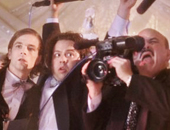
    I love independent film, and I love it even more when it’s free! Come on down to the Lagoon tonight for a screening of The Marconi Bros, a
    side-splitting comedy produced right here in Minnesota. Directors
    Marco Ricci and Michael Canzoniero will present their film, which was
    one of ten selected for participation in the IFP Rough Cut Lab
    last June, and made it’s premier at SXSW this year to fantastic reviews. This
    funny flick follows the antics of two doofy brothers (Dan Fogler and
    Brendan Sexton III) who leave their family business as carpet
    installers to try their hand at wedding videography, wooed by the
    charismatic Louis Lou Burns (John Polito), playboy and king of the Long
    Island wedding video business. And as you may have guessed, hilarity
    ensues. After the screening, follow the crowd over to The Independent in Calhoun Square for cocktails and film-chat with the directors.


    7pm, Lagoon Cinema, 1320 Lagoon Ave, Uptown, Free


    ART
    Split Rock Soirée

    An evening of art and culture never hurt anyone! Come to the Weisman tonight and enjoy an entertaining and informative event that celebrates the amazing energy, drive, and talent of the Split Rock Arts
    faculty. Listen as artists Anna Carlson, Cheng-Khee Chee, Ana Lisa
    Hedstrom, Clive King, Lampo Leong, and Patricia Mink discuss their work
    and creative processes, then stick around for a festive meet-and-greet
    reception where you can chat personally with the artists, check out
    their work, enjoy refreshments and learn more about Split Rock’s
    vibrant history and programming! Want to make it a date night? After
    the reception, hit the nearby Kitty Cat Klub for a late dinner and the alt-country stylings of Bernie King.

    7pm, Weisman Art Museum, 333 East River Pkwy, Dinkytown, $5 (free for U of M Students)


    MUSIC
    Frozen Tundra

    If
    you’re into music in any non-mainstream sense, you surely know that the
    Midwest is a major hotbed for up and coming rappers, hip-hoppers, and
    beat-makers. Just look at buzzed-about local heroes such as Atmosphere,
    P.O.S., Truth Maze, and Muja Messiah if you don’t believe me! Tonight,
    however, welcomes our homeboys from the near easterly land of cheese and beer (Wisconsin) to our own land of lakes and beer for an exciting performance that all hip-hop heads will appreciate. Frozen Tundra’s
    concoction of witty flow laid over cool choruses is as unique musically as it is clever, and with lines like "shake that ass like it’s a game of
    yahtzee", I can’t imagine you’ll have any problem identifying. The Hot
    Box and Lothario open.

    8pm, The Fine Line Music Cafe, 318 1st Avenue N, Downtown Minneapolis, $3

  • In the Woods

    It’s often said that you can’t go back, but sometimes it would be wise at least to try. A murder detective with a forgotten past is at the center of Tana French’s tense debut novel In the Woods – a man whose lost memories collide with the present in what should have been an open-and-close case.

    In 1984, three children disappeared in the woods next to their Dublin neighborhood. Only one boy is found, clinging to a tree in terror with blood-soaked shoes and no memory of what has happened. Twenty years later, the boy has grown into Detective Rob Ryan. He and his partner Cassie Maddox are sent to the very same woods to investigate and murder of twelve-year-old Katy Devlin, a local ballet prodigy. As the two detectives begin to interview potential suspects – including a father, mother and sisters who clearly aren’t telling all they know – they see connections between the two cases and wonder if solving one murder will solve the other.

    Told in terse, unforgiving first-person through Ryan’s eyes, the 429-page volume certainly takes its time to develop. For a great deal of the novel, little progress is made in finding Katy’s killer. But French wisely sidesteps banality by focusing the book on the inner workings of her detectives – detectives with more personality and pathos than the average sleuth. Ryan is hardened by his experiences, but not because of the horrible things he’s seen. He is dark and he is a loner because of the horrible things he’s forgotten; he professes to Cassie that his life began at twelve. As he delves further into Katy’s case, flashes from his previous life strike him. But those final moments continue to elude him.

    Ryan’s partner Cassie is as equally intriguing. French understandably doesn’t spend as much time explaining her psyche; the story is, after all, told from Ryan’s point of view and one gets the feeling Cassie wouldn’t be the type of person to blab about her feelings anyway. But French constructs a relationship between the two that is closer than close while eschewing any overly-predictable feelings of lust or unrequited love. The book’s main strength lies in the complexity of their need for each other. As Ryan spirals into a dangerous haze – trying to solve the case while hiding his connection to his own – Cassie’s importance becomes all too real. And even through we see the events through Ryan’s admittedly biased and unsure eyes, there is no question as to who is really there to help him.

    Avid crime readers will be pleased, as well. The murder investigation moves along with just enough twists and turns to keep readers on their toes without becoming ridiculous. When Ryan and Cassie begin investigating both crimes at once, the story becomes a bit muddled; fitting for Ryan’s frame of mind, but a bit frustrating for those who prefer a more straightforward story. Not that the storytelling isn’t unintentionally jumbled; aside from a few eye-rolling metaphors and stark images that seem like requirements in novels these days (people "moving back and forth among the trees as silently and intently as ghosts," etc.), French has a to-the-point, honest voice. The moments she tries to find poetry out of her situations are fleeting and far between. She’s interested in telling the story as plainly as possible.

    Not to mention truthfully. The world French has created is not something out of Law and Order or Agatha Christie. Ryan and Cassie are solving a gruesome murder that has devastating effects on them and the people around them. The sobering finale is a testament to the "there are no real happy endings" view of life, especially when murder is involved. In an ideal world, the characters would deserve more. But Ryan doesn’t want to make himself into a hero. If nothing else, the story is a burden that he must tell in order to find peace.

    With In the Woods, French introduces her knack for characters that will thrill readers of many types. Artfully balancing a gripping mystery with an honest and dynamic study of two flawed people, French easily maps out two stories without losing any of the tension or suspense she has built up. As the case boils down and Ryan sinks further into obsession with the Devlin murder and the disappearance of his friends, the question becomes not, Will the killer be caught, but Will Ryan survive? In making the detective himself as compelling as his case, French has crafted a unique debut showing truly a step apart from any average murder mystery.

  • An Existential Miscommunication

    I live over by Kenwood Elementary School…and steal their wireless Internet signal from time to time…somewhat by accident…Anyway, they’ve been doing a lot of construction on the school this summer. Right now they’re working on replacing the windows, I think, and there’s a big yellow cherry picker that goes up and down the side of the building, and a guy who takes out the old frames and puts in the new ones and then, I imagine, eventually washes the panes.

    I’ve been watching this for a few days now, and then read this poem by Stephen Dunn, from his Pulitzer-winning collection Different Hours, which shares the same central image. Buy it here. His work, to my mind, is filled with big themes, and tempered descriptions of them. Like all fantastic poets, he has a knack for pointing out those things we all know about, but don’t necessarily notice until someone explains how amazing they are. Different Hours largely has a somber tone to it, which Dunn explains, somewhat coyly, is the result of his being an optimist (because he always expects good things to happen, he’s often let down).

    Better than I’m able to set a background for the poem, perhaps the poet himself, will explain a bit about his work.

    The following is taken from an interview with Guernica:

    Dunn: But the world is always somewhat vicious. I take that as a given, but at various times in various circumstances that fact will be no more than a shadow or an echo behind the poem. Other times it will be more manifest. I try to write myself into articulations of half-felt, half-known feelings, without program. I’m always working toward getting my world and, hopefully, the world outside of me into a version that makes sense of it. Viciousness requires the same precision as love does.

    And this is from an interview with Nightsun, Frostburg State University’s litmag.

    Dunn: The notion of restraint and extravagance has interested me for a while, I think especially because I tend to be someone who is temperamentally restrained. The great danger for somebody like me is that he might employ restraint out of habit, as opposed to employing it to heighten effects. I think restraint matters when it is harnessing something of size, something a little uncontrollable, something wild. I use the example of Fred Astaire, who seemed to me and to everybody, always under control. He was really using his skill to regulate emotion and to keep out the extra gestures that make art feel false.
    I like the poets of extravagance too. I love Whitman, I love Ginsberg’s "Howl," but I’m just not that kind of expansive poet.


    So here it is:

    "Men in the Sky"

    Leaves are falling as the telephone men
    ascend to the tops of poles.
    They are riding a magic long-armed
    machine. No need anymore to climb.
    To speak through wires is as natural now
    as falling leaves, natural as men in the sky.
    The telephone men in the cupped palm
    of the long arm are reducing the static,
    helping me reach far out of town.
    They are beautiful in their hard orange
    plumage. Finches and cardinals: mere birds
    by comparison, unchangeable, nervous.
    It’s a shame the men must come down.
    I stood next to them at the 7-Eleven
    at lunch break, heard them order ham
    and cheese on a hard roll, Dr. pepper.
    I saw them get out of their trucks
    and spit. Now the leaves graze
    their shoulders suddenly more golden
    for having touched them. My phone
    is ringing. It’s one of the telephone men,
    the highest, the one with a sufficiency
    of tools around his waist, calling to see
    if everything’s all right. Everything isn’t.

  • Willie Nelson and Wynton Marsalis

    Joe Fornabaio

    If you regard this Willie-Wynton matchup as a strange bedfellows mating of country and jazz, you’re missing the forest for the trees. These two iconic masters have far too much in common for any genre differences to disrupt their stylish little party, a series of live performances recorded at Lincoln Center in January 2007. Both artists are conservative to the core. All that talk about Willie as "country outlaw" in the late 70s was a fleeting-truth-cum-marketing-coup for a singer who literally has become indistinguishable from, say, Tony Bennett, in his choices of concepts and cover material–with an abiding love for the verities of musical Americana. That the two musicians have the good sense to emphasize the contribution of New Orleans jazz and Delta country blues in their Great American Songbook reveals how tastefully attuned they are to the real history of song in this country. No, nobody is trying to reinvent the wheel here–they just want to create the roundest, smoothest-rolling, structurally-solid wheel possible. And they do, with the kind of refined, sublime, consistently ingenuous collaboration that can give artistic conservatism a proper good name.

    The ensemble is a septet that includes four stalwarts from various Marsalis bands and Nelson’s trusty harmonica player Mickey Raphael. They don’t play the music so much as decant it, adding their distinctive flavor to the essential ingredients of the songs like an oak casket imbues the taste of the whiskey. They haven’t stinted on the aging process either: The newest material among the ten tunes were the ones composed by Nelson himself: "Night Life," which was a hit for Ray Price in 1962, and "Rainy Day Blues" from 1965. Willie’s vocals are renowned for the conversational way he takes his time, so that even as the band is nailing the groove of a jump blues like Louis Jordan’s "Caldonia," for example, he’s lagging, savoring the length of a vowel or a nuance in the narrative. But the jazz cats thrive on such improvisatory wrinkles and Raphael is intimately familiar with Willie’s wiles. They don’t "wait;" they pivot and freelance, secure in the knowledge that these songs are in everyone’s DNA.

    The least interesting, albeit capably rendered, songs are the Hoagy Carmichael numbers Nelson has recorded before, "Stardust" and "Georgia On My Mind" (although Wynton’s wah-wah-with-mute solo on the latter track is delightful). But they’re in the middle of the set between the sprightly openers and the razor-sharp clowning of the last four numbers, where the performers make the audience relax and laugh with deceptively crisp mugging and interplay. "Rainy Day Blues" benefits from some tambourine and Willie’s banjo-ish guitar; "My Bucket’s Got A Hole In It" features Wynton’s vocal detour into "I Hear You Knockin’ (But You Can’t Come In)" before some wonderfully weepy horn exchanges between Wynton, Raphael, and the resourceful saxophonist Walter Blanding. The rhythm section of rising-star pianist Dan Nimmer, drummer Ali Jackson, and Carlos Henriquez on bass, can, as inferred earlier, jump and clatter with barrelhouse gusto or mine a stark and plaintive blues vein.

    Willie Nelson and Wynton Marsalis have become such brand names to the general public that it is easy to be skeptical of their mainstream success. Two Men with the Blues is an ironic title for a disc that reminds us not only of the creative depth of their predictable stylistic choices, but the sheer joy that they derive, and impart, performing this music they so obviously cherish.

    **** (Four stars)

    Willie Nelson will be appearing at the Grand Casino in Hinckley Saturday, July 18.

  • Bill Maher

    Maybe the best thing about Maher is his refusal to be pigeonholed, his keen negotiation of the difference between unorthodoxy and hypocrisy. He’s variously proclaimed himself a libertarian and voted for Ralph Nader for President (after supporting Bob Dole in 1996), aligned himself with PETA and NORML, and was the first to bring Ann Coulter into the limelight via his Politically Incorrect show—which became a victim of our post 9/11 hysteria when Maher was vilified and PI cancelled when he said lobbing cruise missiles from 2000 miles away was more cowardly than flying airplanes into the World Trade Center. That’s Maher, for better and (occasionally) for worse a fearless slayer of shibboleths of all persuasions, at once a notorious skirt-chaser who was a regular at the Playboy Mansion, a staunch supporter of gay marriage and an unremitting critic of the Catholic Church for looking the other way while pedophilia was taking place within the clergy. Along with Jon Stewart and a few others, he’s in the vanguard of a current wave of social commentary that is simultaneously hilarious and astute, as anyone who checks out Real Time with Bill Maher on HBO already knows. He’s also extremely topical, so expect a few zingers on the stories in this week’s newspapers—and perhaps a few words about his friend and mentor, the late George Carlin.

  • Kevin Mahogany Sings Big Joe Turner

    Mahogany’s resemblance to Turner is more physical than vocal. While matching Big Joe’s large, expansive frame, Mahogany is more dulcet crooner than blues shouter, closer in spirit to another vocalist he feted four years ago on his Mahogany Music label, Johnny Hartman. But Mahogany did play a Turner-Jimmy Rushing composite in Robert Altman’s film, Kansas City, and as recently as last year was playing Turner tribute gig at Birdland in New York with the likes of saxophonist Red Holloway and pianist Cyrus Chestnut. While not quite so star-studded, the lineup at the Dakota includes a gloriously gutbucket rhythm section of Blue Note and Groove Merchant recording artists Reuben Wilson on the B-3 organ, Grant Green’s son, Grant Green Jr., on guitar, and renowned session and ex-Living Colour drummer JT Lewis—and vocalist Kathy Kosins to boot. But the main attraction remains Mahogany who in addition to the Turner material has done albums devoted to romantic ballads, big band standards and Motown hits, and unearthed the essential strengths of every style while showcasing his own silky baritone. Listening to this ace band launch into “Roll ‘Em Pete,” “Shake, Rattle & Roll,” or other standards associated with Turner will likely open the spigot on the more freewheeling side of his nature.

    July 21st & 22nd, 7pm & 9:30pm, Dakota Jazz Club, 1010 Nicollet Mall, Downtown Minneapolis, $20-$25

  • Gastronomy in Germany? Ja, Sicher!

    photo: diners in Bad Lauterberg listen to the bawdy stories of Fra Davolo

    Goettingen, Germany. Most people don’t come to this German university
    town in search of great cuisine, and I didn’t either. I came because my father
    is recovering from quintuple bypass surgery at a clinic near here.

    Everything you have heard about prices in Europe is true,
    mostly. I pulled off the Autobahn to get a quick bite at a rest stop, and spent
    $4 for a bottle of water (same price for soda pop), and $4.50 for the German
    equivalent of a hot dog. (Of course, this was a much bigger and better hot dog
    than you get at SuperAmerica for $1.39, but still…)

    For a town of 130,000 or so, Goettingen has a pretty
    impressive selection of restaurants. You name it, they’ve got it – Thai, Greek,
    Italian, Indian, Turkish, Middle Eastern, Chinese, etc. About the only cuisine that’s
    hard to find here is German. This part of Germany has never been known for great food, and the local populace has eagerly embraced foreign cuisines.

    My first night in town, my mother and I headed to what we
    are told is the best restaurant in Goettingen, the Gauss-Keller, on a hot
    tip: They offer a late-night three course menu for 18 Euros (about $28,
    including tax), including a glass of Bordeaux, a bottle of mineral water, and a
    cup of espresso. This turns out to be a truly great meal, and an amazing value,
    since their regular prix-fixe menus range from $59 for three courses to around
    $89 for five.

    It’s actually four courses – if you count the
    appetizer-sized amuse bouche of chicken pate, served with a marinated cherry
    compote and herb infused oil. The courses are simple but ample: a salad of
    field greens; Serrano ham and melon; followed by a main course of maultaschen,
    the German version of ravioli, stuffed with minced beef and bathed in a rich
    mushroom sauce accented with chanterelles. The dessert was a strawberry
    pannacotta, accompanied by a house-made strawberry sorbet and fresh
    strawberries. The after-dinner espresso arrived with a little plate of tiny
    sweets, and when the bill arrives, it is accompanied by a pair of tiny white
    chocolate truffles.


    The next morning, before visiting my father at the rehab
    center, we strolled the Goettingen farmers’ market, which offers a great
    selection of local fresh fruit and vegetables, plus stalls and wagons selling a
    big selection of cheeses, meats, olives, etc.

    Bawdy tales: The next night’s dinner was a journey from the sublime to
    the ridiculous– a special outing organized for cardiac patients and their
    families to a nearby café (in the resort town of Bad Lauterberg), for a Tuscan
    theme dinner, organized around the fictional adventures of a Tuscan monk named
    Fra Bartolo. About 40 people sat around a U-shaped table garnished with
    abundant tomatoes, heads of iceberg lettuce, red and green peppers, parsley,
    onions and other seasonal veggies, plus what seemed to be an unlimited supply
    of cheap but decent Italian wine.

    The first course was a do-it-yourself salad, assembled from
    the table decorations, and dressed with olive oil and balsamic vinegar. The
    remaining courses were served by two waiters dressed as monks, in brown
    cassocks with white rope belts, and between courses one of the monks
    entertained the diners by reading ribald stories about Fra Bartolo’s
    adventures, gastronomic and amorous. Who says Germans don’t know how to have
    fun?

    The courses of penne
    tossed with ham and tomato, and roasted chicken cacciatore with mashed
    potatoes, and the dessert of semifreddo custard with Amaretto and biscotti were
    all only a notch or two above the Old Country Buffet caliber of volume cooking,
    but a good time was had by all. Cost for the whole extravaganza – a mere 10
    Euros, or $15.60, all-inclusive.