Tag: obama

  • Protest Music for the New Millenium

    (Todd Smith already wrote this article)

    On stage, Steve Earle led the crowd in a sing-a-long of "Steve’s Hammer (for Pete)" – a song that picks up on that parenthetical Pete (Seeger)’s "If I Had a Hammer," from 1949.

    "I’m gonna say a line, and you’re gonna repeat it back to me," Earle said. "And none of the just-mouthin’-the-words stuff. I grew up in a Methodist church, and I know all about that shit."

    The audience, in attendance for the 1st Annual Take Back Labor Day Festival at Harriet Island, acquiesced to Earle’s demands. Hippies and hipsters, whole families and lone children, organizers in support of workers’ rights and apolitical groupies who came just to see their favorite bands – everyone yelled the musician’s lyrics back at him. Though there were fourteen-year-olds in the front row who’ve probably never even had a job yet, everyone was eager to add their own energy to the day’s momentum.

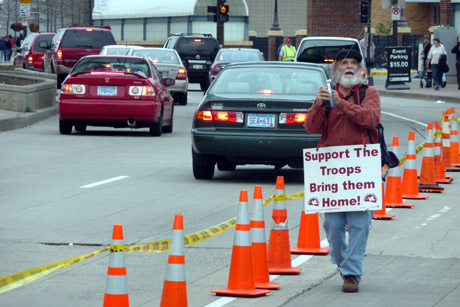
    Later, just across the Mississippi River, more than 280 protestors would be arrested for varying degrees of felonies, and a faint stench of tear gas would linger in the city’s grass. There would be a bomb threat on the Roberts Street Bridge. A man in the center of downtown St. Paul’s labyrinth-like riot gates would stand in a spotlight, preaching salvation, though no one would listen. Hidden speakers would blare "Danger Zone" throughout the metropolis.

    Now, though, at the concert, people sat cross-legged in the sun, and others kicked around a hackey-sack, and Steve Earle alternately played songs and lamented Woody Guthrie’s absence.

    The quietest presences were those backstage. During Earle’s set, a number of Iraq Veterans Against the War milled about, partaking of the festival’s various fried foods and texting friends on their cell phones. Some listened to the music, but none sang along. Certainly they seemed to be enjoying themselves, but they were distanced somehow from the celebration.

    "We came as part of a group of veterans to the DNC and RNC, to address issues affecting vets," said Eddie Falcon, who served four tours – two in Iraq, two in Afghanistan – as well as helping out in post-Katrina New Orleans. He was dressed in a black tank top, silver dog tags hanging loosely over the cloth. "We want all occupying forces out of Iraq and Afghanistan – you know, just, ‘troops home now’ – and we want full benefits for veterans. There are a lot of things that happen back home: PTSD (post-traumatic stress disorder), suicide, depression, alcoholism…and a lot of veterans aren’t getting the help they need."

    It’s strange and disturbing to think that of all the people gathered under the aegis of Taking Back Labor Day, the people enlisted by our government to protect our country are some of the most mistreated by their employers.

    In about forty-five minutes, when Tom Morello would be finishing his set with a rendition of Woody Guthrie’s "This Land is Your Land" (subversive lyrics reinstated), Falcon and his twenty or so peers on stage would pump their fists during the chorus and jump like they were listening to Kris Kross. Backstage, though, they were subdued, maybe accustomed to explaining their difficult positions to the media. Low-key as they seemed, though, they were very aware that they were under threat of arrest.

    Last week at the DNC in Denver, the group – then reportedly comprised of more than sixty vets – enacted Operation First Casualty, which, Falcon explained, was a piece of guerrilla-style theater.

    "With that we were bringing the war home," he said. "We dressed in our full fatigues, and had planted allies throughout the city, and we would detain them, handcuffing them and masking them in the middle of the crowd, to simulate what happens every day in Iraq."

    Then a group of veterans composed a letter listing demands they wanted to present to Obama’s campaign. They marched, Morello explained during his set, through the streets of Denver, and as they got closer and closer to the convention’s headquarters, a group of policemen in full riot gear began to block their path.

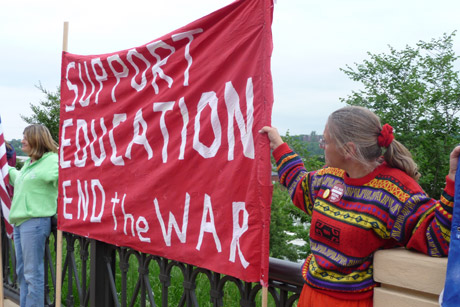
    That’s the absurd thing, isn’t it? That war veterans could get arrested during what really was a peaceful, even pacifist event – back home in the U.S.

    But the vets were undeterred. Eventually their letter was delivered and, Morello said, the dialogue with the Democratic Party will continue.
    In St. Paul the vets drafted a similar missive for the McCain camp. "Our First Sergeant got an escort through St. Paul to see McCain and bring him the letter," Falcon said. "But McCain declined to come out."

    During the latter half of the show, when the music shifted from Steve Earle-style folk rock to rap, the veterans began congregating on the wings of the stage. They danced along to Atmosphere, Mos Def, and The Pharcyde. The terms ‘PTSD’ and depression resounded in the mind – diseases that by definition set one apart form larger society. The vets had backstage passes, were touring with the musicians, and jamming on the set, but one wonders when, if ever, they’ll be able to re-join the larger crowd.
  • Yes We Can!

    Bad design is all around us, but there’s no bad design like bad election year design. Let’s take a moment here to catalog some notable atrocities from recent election cycles, and then hang our heads in bipartisan shame. Offender number one is Bush/Cheney’s militantly mindless logo from 2004; you can almost hear the designer making phlegmatic war movie sound effects to himself as he drafted it. There’s Howard Dean’s bumper sticker from the same year – the one that actually had goddamn yellow crayon writing on it. I sent the good doctor a whole bucketful of cash and I still couldn’t bring myself to slap that thing on my car. The Kerry/Edwards ‘04 logo was so incompetently designed it looked like an advertisement for a personal injury attorney named "Kerry Edwards" (and not one of the better ones, either). As for this eyesore, which looks as if it belongs on a bottle of your dad’s favorite aftershave circa 1982, the less said, the better. The sad fact is most campaign materials look, at best, like they were designed by an adjunct professor of design at an unaccredited two-year evangelical college (which may well be the case in some of these campaigns). At worst, they just drip willful contempt for the viewer’s intelligence and taste.

    But think now for a moment about the material Barack Obama has been putting out in the last year. Start with that typeface the campaign uses on all of its official signage, a sans-serif called Gotham. It’s clean, assertive and streamlined. Regardless of your political or aesthetic inclinations, you can easily appreciate that it’s the kind of elegant typeface that you don’t really see in most political campaigns. Gotham was created only a few years ago by a prominent New York typographer, but it draws heavily on mid-century sources, and there’s resultantly an authoritative, timeless sense to it. It looks great and it’s highly functional. Gotham is a capital-M Modern typeface that carries all the cultural implications of Modernism with it – optimism, clarity, progress.

    I know that seems like a lot to pin to something as simple as a typeface, but in the current electoral visual landscape, Obama’s clean, simple design look downright radical, like it came from another world. It certainly calls to mind some of the more inspiring parts of our collective past, but not in a way that panders to baser reactionary tendencies.

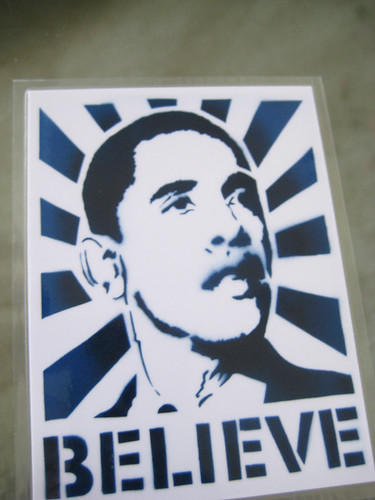
    A show of New Deal art called By the People, For the People will be closing this weekend at the University of Minnesota’s Weisman Museum (you can read Julie Caniglia’s outstanding review of the show for mnartists.org). Seeing it a few weeks ago, I was struck by how much the work on display reminded me not of fireside chats and Woody Guthrie ballads, but of the junior Senator from Illinois. I doubt that it was a conscious decision on the part of Obama’s design squad to make explicit references to the aesthetics of the New Deal in his campaign material. But think of that Shepard Fairey poster that looks it like it came right out of an IWW print shop. Think of the explicit references to the American heartland in the campaign’s it’s-a-flag-but-it’s-also-a-farm "O." Even that ridiculous Latin-enhanced faux-presidential seal that the campaign trotted out a few weeks ago (and then promptly retired) bore a strong resemblance to the logos of FDR’s so-called "alphabet agencies" like the NRA, WPA and CCC.

    Throughout the show, I detected a certain philosophical, functional and aesthetic kinship between our era and this one – it’s all easily-deciphered, populist, progressive art-making practices in service of the civic good. I don’t know if it is Obama’s intention to suggest outright that he’s the direct heir to FDR’s high-minded hard-times liberalism (and his detractors would say he’s hubristic enough to do just that). But there is something stirring about his campaign – yes we can! – that owes quite a bit to the outsized optimism of the 1930s, and a lot of that has to do with the aesthetic decisions Obama’s campaign and his supporters have made.

    Much of the work in the Weisman show was created by obscure regional artists working under the auspices of the WPA Federal Art Project, another one of those alphabet agencies that put American artists to work capturing the Great Depression on paper and canvas. I should say rather that many were obscure at the time, and then went on to have very successful careers later. But most did not; most were artists that were paid to do a job well, and went out and did it. As you might expect with work of this nature, it really ran the gamut in terms of quality. Some of it was very staid and workmanlike, some of it was quite distinguished. What was most remarkable about all of it, though, was the uniform clarity and toughness throughout with which the subject matter was depicted.

    The Great Depression battered America in a way that makes our recent economic troubles seem piddling by comparison, but there is a sense to all of the artwork that America is perfectly capable of drawing on its strengths and pulling itself out of unimaginably difficult circumstances. It’s a broad coalition of regular people, too, that will step up to carry out that task, the kinds depicted in the work – miners, laborers, scientists, factory workers, sharecroppers, truck drivers, builders.

    The Weisman show reminds us that artists, too, were a part of that populist coalition. With the death of Jesse Helms this month and all the editorial hand-wringing that has followed regarding the late Senator’s one-man crusade against contemporary art, we forget that artists could ever be a part of a broad-based populist coalition. And yet there they were, being paid to document the troubled times in which they lived and aligning themselves not with the elite and the influential, but with the dispossessed and the downtrodden. Granted, the work they made was not always popular with those Americans it depicted, and the kind of s
    ocial realist art the WPA produced is often bogged down by the struggle between the high-minded principles it espouses and the difficulty and grittiness of the subjects it depicts. But thinking back to those pre-Culture War times and considering that talented artists would be permitted, and even encouraged, to engage in such a dialogue – well, that’s what seems most surprising and satisfying.

    One of the best surprises for me in the show was a photograph of farm laborers by Ben Shahn, the much-admired mid-century painter and printmaker. Shahn was the kind of old-school Brooklyn Jewish left-wing artist that the Obama campaign, for all its talk of inclusion and progress, would probably take great lengths to demographically disassociate itself with – too radical, too East Coast, too "elite"! I’d had no idea Shahn was out there in the field snapping photos for the Farm Security Administration, but there he was, right next to Dorothea Lange and Edward Weston. Would an Obama administration give a contemporary Ben Shahn, an artist with demonstrably leftist sympathies, the opportunity to get out there into the heartland and create art? Would a contemporary Ben Shahn even want to undertake such an endeavor? Hell, are there even any artists left in his adopted neighborhood of Williamsburg making political art?

    Obama’s campaign has been a fascinating one to watch. At times I have felt (a) like it seemed too good to be true, (b) like it was the true last hope for whatever might be salvageable of the American dream, (c) like the whole thing was hopelessly personality-driven and vaguely demagogical, (d) like Obama might be the only major political leader in my lifetime I could get genuinely excited about, and (e) like it was all noble sentiment and erudite speechifying with no real call to sacrifice and action – often all of these confusing sentiments within the space of a week. Many Americans on both ends of the political spectrum also felt the same sort of ambiguity about Roosevelt. FDR’s harshest critics went so far as to decry him as a Fascist, a charge that has recently been unearthed again in two recent books from both the right (Jonah Goldberg’s phenomenally stupid Liberal Fascism) and the left (Nicholson Baker’s elliptical account of the lead-up to WWII, Human Smoke).

    When we look at this moment in time from a purely aesthetic perspective, it seems to me that we’re looking at a mainstream progressive movement that values good artistic practices and welcomes artists back into the fold, for perhaps the first time since the New Deal. In fact, one of the minor planks in Obama’s long-term plans is the creation of an "Artist Corps." Would the Ben Shahns of 21st century Williamsburg clamor to join such a movement for the good of the nation? Before you answer with a flip remark about the callous solipsism of the youth of America, it’s worth visiting this gallery of Obama-specific street art, which runs the gamut between officially-sanctioned campaign iconography and totally wacky guerilla work. Compare it to these beautiful specimens of WPA poster art. Even if Obama’s cult of personality is a bit overemphasized at the expense of the broader issues in much of the newer art, I would say the aesthetic, functional and ideological parallels are readily apparent, and the comparison on all counts is generally favorable. It looks, at very least, like the opening arguments in a long overdue national discussion over what role art is going to play in contemporary political engagement. That’s something worth getting fired up and ready to go about.

  • Gonzo

    To be honest, I didn’t know who Hunter S. Thompson was until after he killed himself. It was a miserable year in college. Bush had slithered his way into the White House for the second time and winter at Carleton seemed even more bitter than usual. Our anger had given way to numb depression as we shuffled about our lives. Not that I was alive then, but I couldn’t shake the feeling that we had lost something over the past 40 years. In the ’60s and ’70s, Hunter S. Thompson embodied the kind of restless anger the country needed during the Bush years. What happened? Along with our parents, somehow we became the generation of complacency. You can understand my surprise when my very same criticism was leveled at the audience not by Thompson, but by Pat Buchanan. Wait a second! Pat Buchanan is in a documentary about Hunter S. Thompson? Gonzo, a documentary by Alex Gibney, is full of surprises. If you are a fan, or even if you’re not, this one is not to be missed.

    Far from the star-struck mythology that often follows other famous suicides (see: Kurt Cobain), I was pleased you actually get a sense of who Thompson was, and it wasn’t always flattering. The truth is, Thompson was kind of a douche. Through a mixture of interviews, stock footage, film clips, and reenactments, the film is a surprisingly earnest and deeply fascinating celebration of his life. In roughly chronological order the film proceeds through the events that shaped America, and Thompson along with it. It can be hard to lose yourself in a documentary the same way as a good film, but the seamless mash-up of material and tight pacing makes it easy.

    Like Buchanan, the film features a number of high profile interviews ranging from Jimmy Carter to George McGovern to the co-founder and publisher of Rolling Stone. I was struck by not only the extraordinary effort on the part of the filmmaker, but also the exceptional influence he must have had to bring together such an unusual cross-section of American culture 30-40 years after landmarks such as Fear and Loathing on the Campaign Trail.


    Even though the film sort of putters out towards the end, and could have trimmed some things down here and there, it is well worth your time. I think its greatest contribution is, without question, its immediacy. In the stock footage of RFK, you can hear Obama’s voice. In Nixon, you can feel the repugnant sleaze of the Bush years. In Thompson, however, was a voice we now need more than ever.

    Want a good example of modern gonzo? Check out the Rolling Stone coverage of the Michael Jackson trial. It was angry, subjective, judgmental, and struck me as one of the most honest things I had ever read.

    See also Max Ross’ The world is full of downers…which is maybe why Gonzo took so many uppers.

  • Signed, Sealed, and Delivered

    We deserve Barack Obama.

    That is tonight’s message.

    And Obama has arrived!

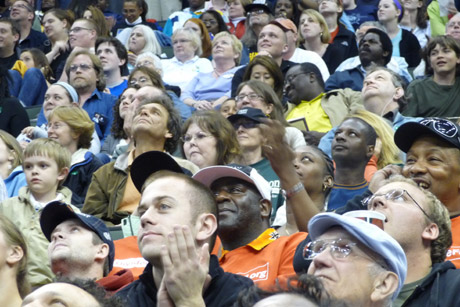
    The crowd roars — everyone on their feet, so many of them smiling, laughing, a few even silently crying. Is this the message of change?

    He can barely be heard above the din. For three whole minutes the crowd roars, only getting louder before they finally leave their voices in Obama’s care.

    "Thank you…"

    And the crowd roars again.

    He dedicates the evening to his grandmother.

    And the crowd roars again. MN for Change. Women 4 Change. Students for Obama. Aarp for Obama. Vets for Obama. Even Christians for Obama. They’re all here.

    "Our primaries season has finally come to an end," he declares.

    And, of course, the crowd roars again. We all know what this means.

    "I will be the Democratic nominee for president of the United States."

    There it is people. Yes you can.

    And I think I’m deaf now.

    Obama continues. He sings Hillary’s praises, claiming to be a better person because of her, from running against her.

    He addresses those that say the Democratic party is weaker now because of their campaign. He brings up the millions of Americans who have cast their first votes. Judging from the crowd in here, he is right about this. Sure, there are folks of all ages — but so many young ones. Folks of all races, ethnicities, cultures, even countries. Folks of all kinds. And I wonder how many of these — even I — might vote this year were it not for him. For this campaign. And I wonder how many other — who might not even vote for him — might vote because of him. And I can’t help but think that this is good. That this is something.

    Something is happening here. Oh, I hope — whatever it may be. Something is happening here.

    More applause.

    "We may call ourselves Democrats and Republicans, but we are Americans first."

    The crowd roards again, and a man, far back in a third-row seat, stares dumbfounded at the screen as we wipes his eyes.

    People believe this guy. They believe in him. And they believe that he believes in them.

    "America, this is our moment. This is our time to turn the page on the policies of the past."

    Do they really believe this is going to happen? That we will care for our sick? That we will provide jobs for all? That we will stop destroying our planet? They sure seem to. And I must say, it’s a beautiful, beauitful dream.

    Before he waves good-bye, he hugs his wife. And she says, "I love you." I’m pretty sure she’s not the only one.

  • Inside the Press Area

    7:28
    Inside the press area

    Obamamania takes no prisoners. The bloggers, who never entertained the pretense of objectivity, are the first to fall. One writer for local blog MNpublius is pacing the press area looking for a way out.

    "We are quarantined here!" he tells me.

    "It is morning in America. I wanna be cheering," he bellows to another writer, and then he turns and heads for the nearest gate. "I’m gonna go see if I can go to the risers…with the people. I don’t wanna miss this!"

  • Not with a Bang, But a Whimper

    This is the way the Democratic Primary season ends, not with a bang but a whimper.

    The presidential campaign that started with a listening tour designed to state the obvious — that people wanted Hillary Clinton to run — will end the same way, with people telling her it’s time to hang it up.

    Earlier in the day, McCain’s speech got the attention of the crowd. Two hours later, as Hillary addresses supporters in New York, there is not even a mention of the event inside this venue.

    Hillary Clinton is speaking in New York. She looks more relaxed than she has looked throughout her entire campaign, but gives the same speech she has been giving all along. Nothing new. Even now. Nothing new.

    "This is a long race, and I will not be making any decisions tonight."

    There will be no concession this evening, my friend.

    She asks the viewers to visit her website, as if somehow raising her traffic numbers will win her the race.

    She thanks. And she thanks. And she thanks her family, of course. She thanks Bill, of course.

    And she tells us of a woman in South Dakota, a woman who wants health care, and woman who — like everyone in this country — should have health care. And she is right. But we all know this.

    "There is nothing we all can’t do, if we just start acting like Americans again."

    She’s right. We’re not acting like Americans. Thank goodness.

    And yet… aren’t we?

    Here in the Xcel Center, no one is hearing this speech. Here we are all listening to Stevie Wonder and watching ourselves cheer on the overhead screen. Here we are clueless, except for those with laptops and portable devices.

    Here — down in the press area — we are worshiping our gods. Thomas Friedman is passing again, my friends. And Hill is done.


  • Turn It Down

    Press access to the general public has now been cut off. The only way out of the press area is through the tunnel.

    According to Tim Russert, Obama’s people are negotiating Hillary’s withdrawal. Hillary insists she should be offered the VP position, so she can turn it down and withdraw with dignity. Obama’s people are game, as long as she puts it in writing that she will not accept.

    At this point, it’s hard to say what speech to expect. How long before the Democratic nominee can gloat a little?

    Tom Friedman just walked in surrounded by cameras. Biggest star treatment yet. Thomas Jefferson arriving in Paris.

    8:25 p.m.

    The Xcel Center is filled to capacity, the crowd high on caffeinated drinks, fried foods and nachos are getting restless. We’re told the Xcel administration cut the crowd off at 20,000, but the center continues to fill with people, even behind the press risers, where the view, if any, is very limited.

    Outside the stragglers and protesters are dispersing. Inside the music is blaring.

    Hillary Clinton is expected to speak to her followers in New York at any moment.

    In 39 minutes the final polls close, and this marathon of a primary will end.

    Tonight, the buck stops here.


  • MSNBC — Reporting from the Twin Cities

    The screams continue as the overhead screens show MSNBC reporting from right here, the Xcel Center. Ah… now I understand why news reports always show people cheering in the background. They’re just cheering themselves on. How quaint. Somehow, as a viewer, you always assume the cheers are for the politician. (I should have known better.)

    It’s 7:12 PM, and the entire front area of the arena — the only part from whence you can see the stage — is now full. My bad. I see about twenty seats in the upper far corner, all the way in back.

    O-BAMA! O-BAMA! The crowd chants.

    Really we’re just sitting here watching the news, only with more applause — and more traffic on the way here.

    7:44 — Watching McCain’s speech in Lousianna.

    7:56 — "Yes We Can" video playing overhead.

  • Eye of the Storm

    After the press is settled in, the doors open to the general public. It’s about 10 past six. The crowds file in, steadily, slowly, filling the arena. Is this an arena? I think it is. And right now, it feels like we’re the show — broken gladiators. I don’t see anyone turn to the crowd. Photographers line up on the riser before the stage. The rest of us sit at tables behind them, on computers, on phones, jabbering away with fellow reporters, documenters of the times.

    $175 for an internet connection. $175! There are two of us. One of us will Twitter from the phone. Awful. Just awful. $175! (So much for Minneapolis public wi-fi when you’re in St. Paul.) Sodas are $4. They banned me from the $2 soda machine, which I though was bad enough.

    About three sections of the Xcel Center are completely full. That and half the center area — with press folk, of course.

    The crowds will continue to file in. We will continue to wait. It’ll be a while before the Man arrives. But now, he appears on the overhead screens. The crowd roars.

  • When I say "O", You Say "Bama!"

    7:00 p.m.

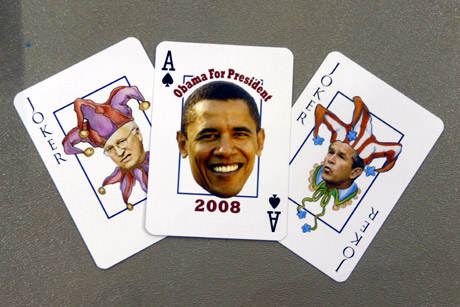
    Out on the sidewalk, the lines of people snake around the block. A pack of Obama playing cards sells for $10.

    The Obama volunteers are warming up the crowd as they make their way into the venue.

    "When I say O," chants one Obama volunteer. "You say…"

    "BAMA!" the crowd yells back.