Month: January 2008

  • Apologies, Promises, and News

    Sorry I’ve been slow to update, but I wanted to send alert of this upcoming fashion show LATER THIS WEEK (Thursday) that’s titled,
    appropriately, Avoid The Grey. The show is being produced by Cliché, a fabulous
    Lyn-Lake area boutique. The intent, even more appropriately, is to inject some color
    into our beige-um-gray winter palettes, and also to tease us with the promise
    of adorable spring fashions, which we in Minnesota never quite get to enjoy the
    way inhabitants of other towns do, since our springs are so belated and, uh,
    SHORT.


    Featured fashions are mostly local: Kjurek Couture, Amanda
    Christine Designs
    , Red Show Clothing Co., Laura Fulk, Belle, and more. I
    promise to post some snaps by Friday afternoon.


    Also, note that I’m judging this coolio apparel-design
    contest
    from MNfashion, West Photo, and mnartists.org.

  • Doing Lines: When Actors Fail to Recall

    Peer Gynt: It’s a fairly good Guthrie production, in my
    humble view–although it would’ve been smart, even merciful, of the director,
    had he condensed the meandering fourth and fifth acts. But what I’m more
    interested in discussing here is the review penned by Star Tribune critic Rohan
    Preston, in which he derides lead actor Mark Rylance for not knowing his lines.
    Is that fair, do you suppose?

    Preston did something
    similar in November ’06 when reviewing The Rivals at the Jungle Theater. It
    seemed Claudia Wilkens, who played Mrs. Malaprop, hadn’t memorized her lines in
    time for opening night; in fact, she hadn’t yet mastered them when I saw the
    show two or three nights later. From an audience perspective, this proved a
    problem: How to know where the malapropisms stopped and the fumbled
    lines began? But still, I was surprised by the chitchat in the theater
    community following Preston’s critique: Had he
    hit Wilkens below the belt, people wondered. Is it fair to criticize an actor
    for not knowing his or her lines, since a critical review is traditionally more
    concerned with the substance of the play?

    Methinks it’s fair to criticize actors when their flubbed
    lines impede upon the theater-going experience. But then again, I’m an audience-centrist.
    I write from an audience perspective; I write to the audience, as if they might
    one day care to see the show. And misfired lines do a lot to hurt our
    experience. In fact, we feel ripped-off when artists
    aren’t ready to present the work we’ve shelled for! At last night’s showing,
    Rylance was still flubbing a few of his lines, but it wasn’t enough to interfere
    with my experience. As a matter of fact, by then, he had done a fine job
    inhabiting the character. He used a mumbled, sort of messy speech pattern that, I felt,
    brilliantly captured the inner workings of this troubled, cloudy-thinking youth.

  • Honor Martin Luther King, Jr.

    MUSIC
    Jazz at Lincoln Center Orchestra with Wynton Marsalis

    Ever since Wynton Marsalis seized the reins of the JLCO
    in the early ’90s, both the orchestra and the organization have been
    hallmarks of supreme scholarship and top-notch quality control in the
    effort to enshrine jazz as America’s classical music. The only danger
    was that Marsalis would smother his project with love, favoring
    hermetically sealed technique over goosebumps. But the theme chosen for
    JLCO’s twelfth tour—Duke Ellington’s
    love songs—banishes those worries. From “Sophisticated Lady” to “Satin
    Doll,” to “In a Sentimental Mood” and “I Got It Bad and That Ain’t
    Good,” the repertoire should set the stodgiest stick-in-the-mud all
    atwitter. And with a stellar fifteen-piece band—the trumpet section
    alone includes Ryan Kisor, Marcus Printup, Sean Jones,
    and Marsalis—channeling some of Duke’s most heartfelt compositions, the
    gig shapes up as an ideal Valentine’s date, albeit three weeks and
    three days early. —Britt Robson

    7:30 p.m., Orchestra Hall, 1111 Nicollet Mall, Minneapolis; 612-371-5656; $35-$77.

    Also tonight, 24-year-old hottie Sophie Milman steams up the Dakota with her sultry chanteuse stylings.

    FILM
    Orson Welles and Rita Hayworth

    It may not be one of Orson Welles‘ best films — not even close — but what The Lady from Shanghai lacks in brilliance, it makes up for in Rita Hayworth glamour shots. The woman is fabulous; what can I say? Though she caused quite a stir when she chopped off her trademark red hair and went blonde for this film, she’s definitely at her finest; and she tops it off with one of her famous musical numbers. Serving up a twisted murder mystery aboard a yacht, this film noir classic is best known for a shoot-out in a house of mirrors.

    7:30 p.m., Parkway Theater, 4814 Chicago Ave. S., Minneapolis; 612-822-3030; $5.

    SPORTS
    Is Figure Skating Really a Sport?

    The 2008 U.S. Figure Skating Championships started yesterday, kicking off an entire week of graceful athleticism on ice. Get out from behind that television and watch some of the country’s best skaters compete live.

    Xcel Energy Center, 175 W Kellogg Blvd., St. Paul; 651-989-5151.

  • Weekend Hot Dish Surprise

    Okay, this is the day to check and see what’s left in the
    fridge and needs to get served up before it spoils, and it looks like we have
    enough left-overs to make up a meal: a half-cooked review of the new Strip Club
    in Saint Paul, news of an upcoming beer dinner at North Coast in Wayzata, and a
    Mardi Gras dinner at Barbette.

    Carol and I stopped in Wednesday night at the
    Strip Club, the night after it opened to the public, and had a delightful dinner. Then Thursday, as I was half-way
    through digesting the experience for this blog, I discovered that my esteemed
    colleague Cristina Cordova had scooped me. It’s too early for anybody to write
    a full-fledged review of the place, but Cristina covered all the basics very nicely, and
    sampled a lot more dishes than we did.
    So check out her post for more details, but here are a few random thoughts:

    I knew enough not to expect naked ladies, but I
    did expect to find a big menu of steaks, plus baked potato sour cream, etc.,
    just like the downtown places, only maybe a little cheaper, because it’s a
    neighborhood joint (in Saint Paul’s Dayton’s Bluff, across from the Metro State
    campus.)

    Turns out chef J.D. Fratzke, (late of Muffuletta) and the
    owners (from the Town Talk Diner in Minneapolis) have created
    something much more interesting. There are a couple of steaks on the menu, and
    a few gourmet items like foie gras, (locally produced at Au Bon Canard in
    Caledonia, MN), and escargot. But basically, Fratzke, who grew up in Winona,
    pays homage here to the kind of plain cooking that doesn’t usually make it onto
    restaurant menus: deviled eggs, beans on toast, even a Braunschweiger sandwich.

    There are a couple of trendier entrees on the list, like a
    bone-in duck breast with wild rice polenta, roasted mushrooms and port wine
    glace ($19), and seared ahi tuna with root vegetables, French olives and
    preserved lemon ($22). But Fratzke’s inclination is towards heartier, earthier fare:
    Swedish meatballs with mashed potatoes and a black truffle gravy, ($14); a pork shank for two with mashed potatoes,
    Brussel sprouts, apples and roasted garlic jus.

    We enjoyed everything we sampled – especially the grilled
    Caesar salad the ahi tuna, and the lean but flavorful ball tip steak (all their beef
    is grass-fed, from Thousand Hills near Cannon Falls.) The big challenge with very lean grass-fed beef is to compensate for the lack of juicy marbling, and Fratzke met the challenge beautifully, pairing the flavorful meat with savory white beans and grilled onions. I suspect that the best
    time to sample Fratzke’s culinary artistry will be late summer, when fresh
    local produce is at its peak, but I expect to return long before then.

    The Strip Club, 378 Maria Ave Saint Paul, MN 55106 651-793-6247.

    I have been a long-time fan of chef Ryan Aberle’s cooking at
    North Coast in Wayzata, but I never felt that the casual atmosphere – and the
    13 flat-screen TVs in the adjacent bar – quite fit the cuisine. But that’s
    about change. "We are closing to the public on the night of January 19 and
    reopening on January 23," reports Aberle. This will complete the first phase of
    the remodel… allowing us for the first time clear definition of where the
    dining room ends and the bar begins. The new bar (to be completed by
    Valentine’s Day) will retain a single plasma TV and it will barely be visible
    from the main dining room."

    Aberle, a beer connoisseur, has put together what might be
    the ultimate beer lover’s dinner – a 15-course extravaganza on Saturday, Feb. 2, featuring just
    about every brew Sam Adams makes. Courses range from a sweet potato pancake with Morbier, duck
    leg confit, burnt orange syrup, accompanied by Boston Ale, to pan-seared
    Minnesota foie gras, port lacquer, and wild mushroom risotto served with Black
    Lager, and a course of Pho with shaved prime rib, rice noodles, cilantro
    and a glass of Winter Lager. Cost is $80, plus tax and tip.

    North Coast Restaurant, 294 Grove Lane E., Wayzata, 952-475-4960.


    Barbette’s Mardi Gras menu, served February 4-5, should be
    pretty authentic: Barbette’s
    new chef, Sarah Master, went to culinary school in New Orleans, and studied
    under Susan Spicer at Bayona in the French Quarter. The menu sounds terrific,
    especially for the price ($32): baked oysters Laveau, followed by a choice of crab cakes or
    sausage gumbo. The main course options are chicken etouffee, blackened catfish
    with macque choux and collards, or fried mirliton (chayote), collards and
    spoonbread. For dessert, your choice of king cake, pecan pie or bananas Foster.

    Barbette, 1600 W. Lake St., Minneapolis, 612-827-5710.


  • JP: Even Better Than You Remember

    For a long time, whenever people asked me to recommend a restaurant — not by food critic standards, but a personal favorite — I immediately told them to go to jP American Bistro.

    Why? It was everything: the simple, clean decor; the mid-priced menu with absolutely drop-dead beautiful, satisfying perfectly-proportioned dishes; the crack staff that provided a level of service you typically cannot find without dropping $500 on a meal. For a year and a half, this was my favorite special occasion place. It’s where my husband and I ate in September 2006, the night before leaving on our honeymoon.

    Then, I quit going.

    There were three reasons. First, life got very complicated for a while and I simply didn’t have as much time for dining out. Second, I found a couple other restaurants that I loved (even on my off-time) nearly as much. But third — and this is important — I simply hated fighting the construction traffic at Lyndale and Lake.

    It’s hard to admit this. I was part of the problem, a little bit of the reason that JP Samuelson and his staff suffered a scare in 2007. The street outside was torn up. The intersection often had a ten-minute wait for a left turn. Business slowed. It was still busy on nights when the Jungle Theater was running a popular show, Samuelson told me. But weekday nights, this once-red-hot eatery ran 1/3 full.

    I’m ashamed, and after visiting again over the weekend, downright grateful to all the people who did keep going and sustaining this jewel. Because JP is better than ever.

    One thing you should know, if you’re not already familiar with this restaurant, is that JP is one classically-trained chef who doesn’t do guest appearances, radio shows, newspaper columns, or photo sessions. He doesn’t leave the line to schmooze with the restaurant guests. What he does is cook, with singular focus and consistency. (The shot of him, above, with his wife and pastry chef, Cheryl, came from his website and is one of the only such photos I could find.) He’s also a very smart businessman who hires great people and empowers them to run the front of the house.

    It works. With one notable exception — which I’ll get to in a minute — JP’s had the same people working for him for years. Andrew Pickar, the dining room and bar manager, and Mark Mckenzie, his head waiter, both take a proprietary interest in the business, caring for the people who walk through the door the way you imagine they might guests in their own homes.

    I will cop to the fact that after a year’s absence, both men greeted me by name and stopped by my table. I will also attest that I saw them do the same with any number of other patrons. Once you’ve been to jP two or three times, you’re part of the in-crowd.

    There were four of us on Friday, and we sat in the bar, which is a lovely candlelit alcove looking out on Lyndale Avenue. We started with the calamari, a lightly-breaded version spicy Thai dipping sauce and a spun nest of carrot and cabbage strips on top.. . .plus an order of pommes frites with a very garlicky aioli (hands down, my husband’s favorite bar food in the world). Then I had a duck confit salad so savory it had elements of bitter earth, with crunchy thick bacon, radicchio, and a nearly sweet ginger-pear vinaigrette. We also tried the fettucini with braised pork shoulder, onion, charred tomato and parmesan — a warm, smoky winter dish — and the fish special, a trout served with garlic mashed potatoes and a mango salad.

    But the best by far was JP’s handmade butternut squash agnolotti in a lemon beurre, tossed with toasted walnuts and pecorino. I love squash and pumpkin pasta, but indulge infrequently because too often its more bread than root, an imbalance that ruins the dish. This was perfect: plump cushions of pasta with a hefty little serving of pureed squash inside — enough so you got the smooth mouthfeel and Thanksgiving flavor. Then a rush of toasty, salty, lemony cream.

    I have only one complaint about jP American Bistro, and that has to do with the only original fixture who’s left. Used to be Karl Rigelman, sommelier extraordinaire, saw to the wines there. Now that Rigelman has moved on to the Minikahda Country Club, the wine list at jP has become disappointingly pedestrian.

    On the white side, they offer a La Poule Blanche Languedoc and a Saint M Riesling each for $7.50 a glass — mediocre wines at best, which retail for $8 and $10 a bottle respectively, making the markup around 300 percent. As for reds, they have a passable Parker Station Pinot Noir ($8), a Hahn Cabernet ($8.50), and a Milton Park Shiraz ($7).

    They also, supposedly, have a Cabardes Pennautier Languedoc, a blend of cab, merlot, malbec, syrah, and grenache, which was the wine I was interested in drinking. After I ordered, however, I was told they’d run out. I asked the waiter for something comparable; he suggested the shiraz. (This would by like my ordering a spinach omelet and his suggesting I have a Caesar salad and T-bone instead.) I declined, and they accommodatingly opened a bottle of Le Jaja de Jau, a French blend — yes — but one that is entirely syrah and grenache, fruity and sweet, sweet, sweet. Imagine you’re craving a square of dark Belgian chocolate and someone hands you a Three Musketeers Bar. . . .

    I yearn for the days of Rigelman, when wines at jP tended to be unique, well-chosen, and dry. But still, I will return — soon and often. Samuelson is ignoring the wines just as he ignores the press, the hype, and the trends, in favor of producing some of the best food in town. He’s a balls-to-the-walls kind of chef who keeps his head down and cooks, the ultra-chic, leek-and-goose-foam culinary world be damned, getting better (and better) with each passing year.

    So the next time someone asks me for my favorite place, it’s an even bet I’ll say it’s jP.

  • THEATER: Particularly in the Heartland

    Judging by the size of last night’s audience, there should
    be tickets left to see Particularly in the Heartland. And if you happen to be
    the type who’s a little tired of our pop culture’s present mood (rampant
    cynicism peppered with ironic snark)–in other words, if the Colbert Report
    doesn’t entirely resonate, or if the plights of Britney Spears don’t exactly
    inspire, in you, a sense of schadenfreude–then this show might be something you’d
    care to see.

    It stands in stark contrast to the Walker’s initial installment of the annual Out There series: last week’s performance by Miguel Gutierrez and, ahem, "the Powerful People," which struck
    me as a masturbatory, self-indulgent piece of artless hipster quackery, passed
    off (unsuccessfully) as an exercise in shapes and whimsical personalities
    emerging from pattern. Last night’s show, rather, made me feel good about my
    place in the world. It’s a sprawling, even diffuse, and loosely-connected play. The basic premise is shamelessly ludicrous: A trio of
    evangelical kids, living out in the middle of nowhere, lose their parents to a
    Kansan twister, but believe the folks have been raptured. (One kid claims
    to have seen it happen.) To make a long story short: The ghost of Bobby Kennedy
    shows up, as does a female Wall Street type, and the effect, I suppose, is to
    turn an inner eye at our blue-state prejudices. For example, there are plenty
    of moments when the evangelical kids make ridiculous statements; the
    youngest of the kids, a ten-year-old spitfire named Anna, waxes poetic on her
    science textbook, which gives plenty of ink to creationism–and, as an audience
    member, you’re already rolling your eyes. We’re accustomed to
    encountering the occasional ironic and/or hateful usage of red-state stereotypes.
    (The conditioned response is to write them off, focusing instead on the play’s other virtues.)
    But in this show, predictable leftism is not what unfolds–not in the least.
    Nor are we led to believe the death of Bobby Kennedy was the single event that led
    this country into its present mess; even he is painted as a complicated
    character, with plenty of flaws as well as strengths. The message seems to be
    this: There’s plenty of beauty to be discovered if only we allow ourselves to wander
    outside our black-and-white thinking. Also, people–even (especially?) evangelicals–are
    essentially good.


    In one of the show’s most powerful moments, the cast breaks from
    the script and invites the audience to ask questions. What became clear to me
    then was that these performers are so entrenched in, and care so much for, their
    characters that they can even improvise, while staying in character, with
    relative ease-and without hitting false notes. Again, I reflexively thought the
    cast would get about the sport of lampooning fundamentalists. But instead,
    the play’s sincerest moment came to pass: An audience member asked Sarah–the middle
    child, a teenager dabbling in lesbianism–what she plans for her future. The response–to
    be a better person "and hopefully see my parents again"–startled me. And so,
    finally, I abandoned my hardened expectations and began to feel the play for
    what it was. It left me feeling lighter, with a renewed sense of optimism. Go
    see it.

  • Raging

    Something terrible happened to my family this week.

    What it is isn’t important, and I’m not being self-effacing when I say that. Individual calamities mean little but to the people who suffer them. Tragedies occur every day: Little children are struck by cars and killed; young people are diagnosed with hideous diseases; old people die after slowly losing their minds. We assume, generally, that this is the natural order of the world. It is only when it is happening to us that we object.

    There are those who learn to make peace with their suffering. They accept and accommodate and make alternate plans. This always reminds me of the maternity nurse who attended me when I was 21 and giving birth to a nine-and-a-half pound baby boy. "Just give in to the pain," she told me. "Work with it. Let it help you." Luckily, my husband at the time — a large man — stepped between us before I could kill her.

    And later, when that child was diagnosed with autism (the event which preceded, in many ways, the crisis that took place just three days ago), I read Harold Kushner’s When Bad Things Happen to Good People. A rabbi, Kushner wrote this spiritual self-help manual after the death of his own son, Aaron, from progeria. He deconstructed the Book of Job, claiming it proved that God is both benevolent and fallible. To suffer, Kushner claimed, is simply to be fully human. The secret, he said — this man who certainly knows anguish — is to embrace one’s lot and look to God not for help but for strength.

    I tried to find solace in his words. But I couldn’t. Because no matter what the circumstances, I fight. Back in the early 90’s, I abandoned Kushner and read the works of a man whose outlook on the world rather frighteningly matched my own. A chronic philanderer and suicidal alcoholic, the Welsh poet Dylan Thomas better captured my philosophy, then and now.

    So late yesterday afternoon, in the spirit of Thomas, I poured a glass of Elderton Shiraz 2003 well before the official cocktail hour. I didn’t like this wine, frankly. It’s pricey (a $40, 14% alcohol vintage that someone had given me as a gift) and I’ve no doubt it’s good by objective standards, but it was far too jammy and bold for me. Dark fruit and red licorice flavors marched across my palate like a high school band, raucous and insistent but with no refining grace. I like my wine more subtle — as you know — yet, in the tradition of DT, I drank steadily simply because the bottle was there.

    Then I read, as I have so many times:

    Do not go gentle into that good night,
    Old age should burn and rave at close of day;
    Rage, rage against the dying of the light.

    Though wise men at their end know dark is right,
    Because their words had forked no lightning they
    Do not go gentle into that good night.

    Good men, the last wave by, crying how bright
    Their frail deeds might have danced in a green bay,
    Rage, rage against the dying of the light.

    Wild men who caught and sang the sun in flight,
    And learn, too late, they grieved it on its way,
    Do not go gentle into that good night.

    Grave men, near death, who see with blinding sight
    Blind eyes could blaze like meteors and be gay,
    Rage, rage against the dying of the light.

    And you, my father, there on the sad height,
    Curse, bless me now with your fierce tears, I pray.
    Do not go gentle into that good night.
    Rage, rage against the dying of the light.

    And as they always have, these words gave me comfort. I’m a Jewish woman who doesn’t know from acceptance. But rage, I get.

  • We're Having a Party!

    SPECIAL EVENT
    Celebrate Theater All Year

    If you only do one thing this weekend, join us for a fabulous celebration of Theater All Year. Start the evening off by kicking back a few Newcastles and sampling the natural and organic victuals of Whole Foods. And then stick around for a presentation by The Lighthouse Group. An artist of the year, an Ivey Award honoree, a Mentor Award winner,

    two dancers, and a director will come together to present a clown act,
    a dance, and a new drama for the audience. The evening promises to be a hoot.
    (Want the celebration to last year round? Treat yourself or a friend to a 6-voucher Theater All Year
    package
    , and check out the available performances.)

    Sunday at 5:30 (reception) and 7 p.m. (performance), Illusion Theater, 528 Hennepin Ave., Suite 704, Minneapolis; 612-339-4944; reception free, performance $12 (to reserve
    tickets, call Illusion Theater and use
    the codeword PARTY).

    FILM
    Cloverfield

    It looks like producer J. J. Abrams (the man behind Lost and Alias) took a few cues from legendary horror-meister Val Lewton. In Cloverfield,
    Abrams’s Godzilla-like monster wreaks havoc on New York City—except he
    does so at night, and we can’t see a damn thing except shadows and
    fleeting images of the beast as things blow apart, casting flickers of
    light on the carnage. Abrams understands, as did Lewton when he made The Curse of the Cat People
    some sixty-five years earlier, that imagination is the best special
    effect—and it’s cheap. The web is already alive with anticipation for
    this one. If the trailer is any indication of Cloverfield’s thrill-a-minute qualities, this should be one helluva popcorn flick. —Peter Schilling

    Area theaters.

    Walk into the Sea

    Be
    a part of the unveiling of a story that up until now has remained untold.
    A Walk Into the Sea is a bittersweet tale about the brief but brilliant
    life of Danny Williams, a man who was defined by his stunning work as
    a filmmaker in collaboration with the Warhol Factory. Williams
    made more than twenty films and designed light shows for the Velvet
    Underground, but his relationship with Warhol ran much deeper than that. Now his poetic life story is finally being told by his niece, filmmaker
    and director Esther B. Robinson. Robinson offers a glimpse into the
    life and works of Danny Williams, but if her documentary makes you crave
    more, then be sure to also explore Danny Williams’ Factory Films,
    a compilation of the films Williams produced while working under the
    Warhol Factory. —Kate Leibfried

    Friday and Saturday at 7:30 p.m., Saturday and Sunday at 2 p.m., Walker Art Center, 1750 Hennepin Ave., Minneapolis; 612-375-7600; $8 (members $6).

    ART
    Closing this Weekend: Michael Kareken’s Urban Forest

    Scrap yards and paper recycling form Michael Kareken’s usual
    subjects (though he has other, more conventional ones as well—figures,
    usually); many of the works in this show depict the Rock-Tenn recycling
    yard near his studio. Tough-love limnings of crushed heaps evoke the
    huge stone Aphrodite that stood at the old Getty Museum on the Malibu
    cliffs, her voluminous draperies blown by a hurricane and torn and
    broken by two thousand years. The formal visual qualities of these raw
    heaps is exciting in itself, but Kareken also manages to infuse the
    drawings and paintings with the pathos of drapery—material that takes
    on the shape of that which it clothes, be it divine flesh, the force of
    tearing winds, or the mindless crush of waste. These scraps record the
    currents of our desires. —Ann Klefstad

    Friday 12-5 p.m. and Saturday 12-4 p.m., Groveland Gallery, 25 Groveland Terrace, Minneapolis; 612-377-7800.


    Opening this weekend: Dan Havel’s Open 24 Hours

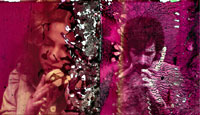
    Dan Havel’s latest installation has been brewing for 14 years. Two years after leaving Minnesota for Houston, Texas, in 1991, Havel was working on a site-specific installation at an abandoned adult movie theater where he came across numerous old film reels. Over the past year, he has revisited these reels, pulling together a series of digital prints from the water-damaged ’70s porn films. The result is a fascinating fusion of decay and kitsch. "The colorful surfaces are cracked and scratched, with fractals of pooled emulsion intertwining and framing the various figures, stories, and locations in the films." Certainly not something you see every day, you won’t want to miss this.

    Saturday from 8 p.m. to Midnight, Icebox Gallery,1500 Jackson St. N.E., #442 & #443, Minneapolis; 612-788-1790.

    MUSIC
    Something for Everyone

    Lovers of the classics will delight in a perfect fusion of film and orchestra tonight (8 p.m.) at the Sounds of Cinema Festival, where the Minnesota Orchestra will accompany Chaplin’s City Lights — one of the best films of all time.

    Those looking for a some truly beautiful, indie-alt-folk vocal stylings should head to the Cedar tonight (8 p.m.) for the sweet, lulling songs of Haley Bonar and Pieta Brown. These sexy ladies are topped only by their fabulous voices and stellar song-writing.

    Saturday is Janis Joplin’s birthday, so if you’re up for some old-school ’60s rock, you should make your way to Mayslack’s Bar (9:30 p.m.) for a birthday extravaganza featuring Happy Birthday Janis! Several featured performers will pay tribute to the legend, including Monica Heuser and Jill Mikelson from the Ordway’s presentation of Love, Janis, and Andra Suchy and Kari Shaw from local country group The Dollys.

    Also on Saturday, Aaron
    Smith, Steve Tacheny, Tate Schoeberlein, and Chris Hansen of The Slack
    invite you to "a magical night of music and tomfoolery" at the Terminal Bar (9 p.m.).

    And on Sunday (4 p.m.), join gospel quintet The Steels in honoring Martin Luther King Jr. with a From Every Voice concert at Ted Mann Concert Hall.


  • Childhood … for Grownups

    Chuck & Buck, a somewhat underrated 2000 film that was one of the first major releases shot on digital video, revolves around Buck, a 27-year-old man (Mike White) who, for all intents and purposes, is an 11-year-old boy. He perpetually sucks on Blow Pops, fills his room with toys, wears ill-fitting windbreakers, and speaks to other adults in a simplistic, gee-whiz monotone. The story begins with the death of Buck’s mother, a tragedy that sends him in pursuit of a childhood friend, an LA music producer named Chuck (Chris Weitz), with a stalker’s determination. Buck is clearly not developmentally challenged; he simply seems to be stuck in a time warp set to the years he and Chuck played make believe. A ridiculous tale? Perhaps. Yet, while Buck may seem an implausible character, there are, in fact, adults in real life — fully functioning members of society who are well educated and can live independently — who pursue the articles, activities, and attitudes of childhood with more dedication than most actual tykes.

    One case study of this, a prominent Minnesotan who, sadly, died last August, would rightly be called the ultimate pursuer of this strange approach to life. For starters, his name was Joybubbles. He loved stories and had imaginary friends. And he was an avid fan of Mister Rogers and similar shows, as well as an incessant collector of toys, dolls, and other playthings, listing his age as "five" until the day he died, at 58. All this despite the fact that he was once a graduate student in philosophy with an IQ of 172, who could imitate the analog dial tone that used to be a fixture of the phone system. It was this last talent that briefly brought him international fame as the grandfather of a short-lived movement known as phone phreaking.

    Blind since birth, Joybubbles entered this world as Josef Engressia in 1949, in Richmond, Virginia. In 1991, he legally changed his name to Joybubbles, which he happened upon several years earlier at a motivational seminar in Minneapolis. The leader of the conference asked attendees to describe themselves in one word. The first thing that came out of Engrassia’s head was "Joybubbles!" This confabulation gave the participant so much reason for living, he applied it to all unofficial and official documents, including his social security card.

    The reason behind this alias, and Joybubbles’ fixation on collecting Raggedy Ann dolls, Curious George books, and Sesame Street episodes, was borne out of a desire to recapture the childhood he felt he never had, and to escape the adult world he no longer wished to be a part of. "Childhood is a protected status," says Ross MacDonald, an associate professor of sociology at the University of Minnesota, "No one really expects anything of you. It’s a time of fun and frivolity, at least in theory. Someone uninterested in the pressures and responsibilities of adult life, and there is no natural reason to want them, would likely find childhood a fairly palatable state."

    A quite unpalatable past drove Joybubbles’ infatuation: the sexual abuse he suffered when he was actually a child. According to longtime friend and executor of his estate, Steven Gibb, young Josef’s mother refused to believe her son’s reports about the molestation he experienced at the hands of a nun, who was also one of his grade school teachers. Consequently, as the years went by, mother and son would become so estranged that they ceased direct communication, using his father and later, following his death, his equally blind sister as go-betweens for messages.

    Another source of the friction between child and parent, and a driving force in Joybubbles’ need to make up for lost kid time, was the isolation that he felt from other children, thanks to his ability to read at an advanced level and enjoy cultural pursuits far above his age group. The latter, above all, included phone phreaking, which involved duplicating the tones that connected long-distance numbers, thus allowing the phreak (a hybrid of the words "phone" and "freak") to make long-distance calls without the phone company making a record and charging the caller.

    This bizarre hobby was made possible when human switchboard operators were replaced by automated systems that relied on tones. From the late ‘40s through the mid-‘70s, the telephone network relied upon a 2600 Hertz, or Hz, tone to indicate when a long-distance trunk line was idle, and used pulses of 2600 Hz to send dialing information. Most phone phreaks needed mechanical whistles to duplicate this sound (this included one acclaimed individual called Captain Crunch, so named after the cereal, whose whistle prize he used to imitate the tone), but Joybubbles, who was born with perfect pitch, could do so simply with his mouth.

    It’s not hard to see the members of this niche movement as antecedents of today’s computer hackers. In fact, Steve Jobs and Steve Wozniak, the founders of Apple, started out as participants in this game. Phil Lapsley, an Oakland, California author who is currently working on a book about phone phreaks, claims: "Phone phreaking and hacking started to intertwine in the 1970s as computers became more widespread. Many of the skills that made one a good phone phreak also made one a good hacker. If you can understand how the telephone system works, you can probably understand how computers work, too."

    As it happens, Joybubbles was one phreak who did not join the computer revolution, in no small part because he was blind. Even when Jaws and other audio systems enabled the visually impaired to use the technology in as sophisticated a manner as sighted people, and e-mail accounts could be had via telephone, Joybubbles, following a brief dalliance with the internet in the late ‘90s, never developed an interest in it. But, in the era of phreaking, he amassed an impressive "rap sheet" — ever since the day in 1957 when the eight-year-old Josef Engressia discovered that whistling the fourth E above middle C would stop a dialed phone recording. This went on until the end of the ‘60s, when, as a graduate student in Tennessee, he was given a suspended sentence for malicious mischief after making long-distance calls for friends at a dollar a minute.

    Engressia became such a celebrated member of this cult that an NBC Nightly News report featured him on November 27, 1968 — a clip of which can be found on YouTube and which is likely the only visual documentation of his life available to the public. He was also the inspiration for the blind character of Whistler, played by David Strathairn in the 1992 movie Sneakers.

  • An American Truth

    There are those, here in Boston, who will say that Paul Revere never made his historic Midnite Ride, that he actually sent a neighbor to warn the countryside. And some people will giggle at your naïvety when you mention the Boston TEA Party, as if everyone should be so silly to think that it was actually tea being stored in those rum barrels.

    It’s enough to shake a history buff. But if you run back to your historic hotel, where you decide to take refuge in culinary history, you might not be comforted.

    I admit that part of the reason I chose to stay at the Parker House was because it was the birthplace of the Parker House Roll and the Boston Creme Pie. I can put up with tiny, cramped, stodgy rooms and early morning construction noise as long as I can get a bite of the past.

    I wasn’t expecting much from the rolls. After all, they’re white dinner rolls. But after having to actually pay extra to add one to my meal, the forthcoming roll wasn’t even warm. And you’d think an icon would deserve to be accompanied by more than just a common foil wrapped chunk of frozen butter. Was a small dish of whipped and salted butter simply too much to ask for a national treasure?

    And still, it got worse. It turns out that the place which claims honor for the original Boston Creme Pie (a true inspiration for doughnut eaters everywhere) has done the unthinkable: THEY’VE CHANGED THE RECIPE. Instead of a classic 1855 dessert of dense cake and custard, covered with a deeply chocolate ganache, we now have a fluffy, spongy thing covered with coconut and drizzled with white chocolate in a modern spidery design.

    And so you lose a little religion.

    But I did find faith again in a little restaurant called The Ivy, tucked away down an alley off of Boston Commons. It’s an Italian small-plate restaurant with a nice wine list: any glass $9, any bottle $26. We showed up a little late and asked if the kitchen was still open. The manager at the front was nice enough to run downstairs to check. As we settled into a booth, resigned that we were going to get a glass of wine regardless, he came to inform us that the kitchen had closed. I asked if there was even any bread we could snack on, and he again ran down to check.

    Upon his return he informed us that, although he couldn’t cook anything from the grill or the fryer, he’d be happy to whip us up a salad or make something from the saute side. We said we’d be happy with just about anything and would take what ever was easiest. When he suggested the bolognese and brought it to us within a minute, it hit us like a ton of bricks…"Is this supposed to be YOUR dinner?" He had given us the meal prepared for himself. As restaurant people, we all knew the value of sitting down for a hot meal after a night on the floor, shuffling plates, dealing with guests, running up and down stairs … sometimes that meal is the only thing that keeps you going.

    Of course we protested, and of course he wouldn’t take it back, claiming he ate it every night and could use a break from it. Wide, flat pasta was richly covered in a pink veal and pork ragu. The soft meat was perfectly done and not a bit greasy, like some bolo can be. With a bite of pasta it was almost creamy, yet subtly tangy with just a touch of red pepper. We ate it hungrily and gratefully. We drank our wine and vented our lives and tipped graciously.

    That bolognese is my new Boston icon.