Month: January 2008

  • Don't Call Me Sweetheart

    I just picked up my two children from their school-supported daycare, at which time a young woman put her finger in the air and motioned for me to have a moment with her. I stepped aside and proceeded to listen to her complain that my son had been calling her, and other students and teachers, "sweetheart." She told me that she and some of the other students did not appreciate it, and that this behavior was unacceptable.

    I know my face must have resonated with a "you must be fucking kidding" look. Sweetheart! He’s five. If it is not endearing and humorous, it certainly cannot be very disruptive.

    I wanted to to tell her that "bitch" and "my ass" are bad words, but "sweetheart" has no malice. One can deduce bad intent if it comes from a greasy man at a bar, but my son is a cute 43-pound Guatemalan boy. (By the way, when I asked him to get on the scale, he said, "OK, honey.")

    I am so taken aback that this women has nothing better to do than to rat on a little boy who is trying to be funny. I informed her that there are a lot more destructive behaviors to focus on than a child saying "sweetheart." This daycare worker just would not let it go. She argued that if she or any children did not want to be called sweetheart by my son, he should follow their wishes, and that this needed to be addressed.

    I don’t know what makes me more angry — the fact that this woman is just being STUPID (a word my son is not using) or the long-term effect of not letting a five-year-old be OK with who he is. What’s next? Not using the word "love" or "friend"? No, I know: the word "honey."

  • Spaghetti Red and a Seductive Nose

    "Don’t you find," he said, "that there’s a funny taste of
    chicken coops in Rhone wines? Especially Beaucastel."

    "Chicken coops?" Was he pulling my leg?

    "Even the great wines, you know, have a whiff of chicken
    coops. It’s well known."

    I offered him a glass of the Beaucastel. I tasted it
    again, now frantically looking for traces of sublimated chicken coops. The
    waiter winked at me, was he suggesting I’d been had?

    "Taste it?" he said. "A bit poopy, eh?

    "Well, I said, "maybe I can taste chicken coops."

    I couldn’t taste anything of the sort. But we swirled and
    sipped and agreed that the chicken-coop element gave the wine its complexity."

    Lawrence Osborne, The Accidental Connoisseur, North Point Press, 2004.

    Whenever I read those florid descriptions of wines – "a
    direct and seductive nose overflowing with floral notes, gingerbread, cocoa,
    candied cherries, a mouth which is spherical, sexy, fleshy –
    , in wine
    reviews or on those little tags at the wine store, I have two reactions:

    1)
    I wish I could write like that.

    2)
    Are these guys just making that stuff up?

    I’ll admit it, I’m no expert on wines. I know what I like –
    big, full-bodied reds, mostly – but unlike my esteemed colleague Ann Bauer, I
    don’t have much of a vocabulary to talk about it. And I can appreciate the
    difference between a $10 bottle of Cabernet and a $50 bottle, but I usually
    don’t think the difference in experience is worth paying for – at least if I am
    paying. And when I see a $50 price tag on a bottle of wine, I also start
    thinking about people who don’t earn $50 a month.

    My wine career has been a never-ending search for cheap
    drinkable plonk. In the 80s and 90s, it was focused on the wines of Romania,Il Circo Ruche
    Bulgaria and the former Yugoslavia – remember Avia and Premiat? , These days it
    has shifted mostly to Spain, and the garnachas and tempranillos and monastrells
    in the back left corner of Hennepin-Lake Liquors.

    Every once in a while, though, a cheap wine jumps out at me
    as something out of the ordinary. I first discovered
    Bonny Doon 2003 "Il Circo" Ruche
    di Castagnole Monferrato
    on a wine list at Taste Wine
    Bar (that quirky little spot hidden inside The Newsroom), and liked it so much
    that I started looking for it, with no luck, at local bottle shops. Then, last
    week, I stopped in at Gigi’s for their happy hour, and lo and behold, the
    featured $3 happy hour red is Il Circo Ruche.

    I happily drink a
    glass and a half, and return the next night for Gigi’s Thursday night cheap
    date spaghetti special – two plates of spaghetti, garlic toast, and a bottle of
    wine for $25. The spaghetti was great -the red sauce with spicy meatballs
    robustly spicy (vegetarian also available), and the noodles actually al dente.

    And sure enough, the red wine was Il Circo Ruche. This time
    around, I tried to figure out just what it is that I like so much about the wine,
    put it into words, but I got absolutely nowhere. I try out all
    those words that wine writers use – blackberries, leather, hints of cinnamon
    and passionfruit, but none of them seem to fit,. Mainly, it seems complex but
    balanced, but that doesn’t say very much.

    The label on the
    bottle said that ripe Ruche was redolent with roses, but I couldn’t for the life of me smell anything
    that tastes like roses. Complicating things further, Carol, who was sharing the
    bottle with me, didn’t taste anything special about this bottle at all. So I
    cork up the last quarter of the bottle, and bring it the next day to Ann, who
    really is good at describing wines. "Cherry and cassis with a touch of
    dark honey;" Ann reported back the next day," a resinous flavor that becomes cigar-like as it warms; undertones
    of earth, but very dark, no peat at all.
    A dry, almost dusty finish. That
    thing about roses? I didn’t get it at
    all — unless you count the dusty, earthy scent and flavor, which reminds me of
    DECAYING roses."

    A tip from a friend research led me to Robin Garr’s
    wineloverspage.com, where Robin Garr’s posted his 2005 tasting notes on the
    Bonny Doon Il Circo Ruche, "an Italian red grape so obscure that it’s only
    grown in a few small villages in the Castagnole Monferrato hills northeast of
    Asti in Piemonte."

    Wrote Garr: "This is a very dark purple wine with a bright
    reddish-violet edge. Luscious aromas offer a benchmark example of Ruche with a
    heady, rosy floral scent accented with warm brown spice. Rich and full in
    flavor, tart red fruit and spice, mouth-filling and plushy on first impression,
    but a firm core of acidity carries it into a clean, medium-long finish, with an
    unusual, intriguing hint of caraway seed and light tannic bitterness
    lingering."

    So Robin Garr did discover the rosy floral scent in 2005,
    but Ann and I couldn’t detect it in 2008, That actually makes sense, since Garr
    predicted that the floral scents would soon fade from the young wine.

    Of course, there are lots of factors that influence how we experience the taste of wine, as this story from Bloomberg News illustrates:

    "Volunteers in California who were given sips of wines with
    fake prices said they preferred the cabernets they thought were
    more expensive to the ones they thought were cheaper about 80
    percent of the time, according to the study published … in the Proceedings of the National Academy of Sciences…. In a follow-up experiment eight weeks after the original
    study, patients were given the wines to taste without any
    suggested prices. Most chose the $5 wine as their favorite, (a researcher) said."

  • Heartland Wonders

    THEATER & PERFORMANCE
    Particularly in the Heartland

    Part of the Walker’s Out There festival of experimental theater, this show, by a youthful New York City ensemble called the TEAM (Theater of the Emerging American Moment)
    defies rampant cynicism by presenting a work of resounding optimism.
    Set in Kansas, the action unfolds within an evangelical household. The
    parents have just been killed by an awful Kansan storm, but the
    children believe the rapture has taken them. What’s surprising about
    this work, especially in this age marked by Colbert Report satire,
    is how the TEAM avoids irony in painting its portrait of the earnest,
    often anti-intellectual culture of Evangelicalism. Instead, their
    feel-good show teems with rigorous dance and movement, sincere
    character study, and even wholesome Stephen Foster songs. —Christy DeSmith

    8 p.m., McGuire Theater, Walker Art Center, 1750 Hennepin Ave., Minneapolis; 612-375-7600; $20 (members $16 & $14).


    PERFORMANCE
    The Force Is With You


    Fun equals…physics? For
    all of you non-believers out there, here is a show that is out to prove
    that physics is not the stuff of long lectures and tedious equations,
    but the stuff of zip and pizzazz! Physics Force, an entertaining
    physics demonstration team from the University of Minnesota, will perform
    their annual Physics Circus today in Northrop Auditorium. This
    is a unique opportunity for people of all ages to learn a little more
    about the face-paced world of physics and to be entertained at the same
    time. Be sure to get there early because tickets are free and
    there’s a high probability that this show is going to generate some
    electricity! —Kate Leibfried

    7 p.m., Northrop Auditorium, 84 Church St. S.E., Minneapolis; 612-624-2345;

    free.

    SPECIAL EVENT
    Jazz, Art, and Wine

    Join us for Gallery Grooves, The Rake’s monthly art, jazz, and
    wine event. Socialize and discuss the latest jazz with Kevin Barnes
    from KBEM, view artwork for sale, and enjoy wine info and sampling courtesy of The Wine Company. This
    month, view illustrative paintings by Joel Barkley at the Minneapolis
    School of Flower Design. Barkley’s collection of artworks, both fantasy
    and realism, represent a sampling of his imagination. —Jennifer Havrish

    7 p.m., Minneapolis School of Flower Design, 79 13th Ave. N.E., Minneapolis; 877-322-5666.

    MUSIC
    Old School Freight Train

    Acoustic music is undergoing a revitalization.
    Look out! It’s a bird. It’s a… train? Well, sort of. Old School Freight Train is the name of an up-and-coming acoustic band
    that is playing at the Cedar tonight. The band
    combines thought-provoking lyrics with captivating melodies, soulful
    vocals, virtuosi instrumentals, and imaginative arrangements. Blending
    folk, jazz, soul, pop, bluegrass, Latin, and Celtic, Old School Freight
    Train offers a unique musical experience. Just like the locomotive
    in the 19th century, Old School Freight Train is being called
    the "next big thing," and it would be a shame to miss this exceptional
    musical performance. —Kate Leibfried

    7:30, The Cedar Cultural Center, 416 Cedar Ave. S., Minneapolis; 612-388-2674; $17.


  • The Strip Club Steak House

    Thanks to Rich Goldsmith for the use of his camera, and for his photos.

    The Strip Club finally opened last night in Saint Paul, and while it perhaps lacked the expected tits-and-ass show, many a mouth was watering throughout the evening.

    I must confess, I had absolutely no intention of going — after all, this is Iggers and Bauer turf I’m stomping on here, and they’re hardly run-of-the-mill opponents. But several email exchanges later (the power of the internet), I found myself with boots in hand. Maybe I was swayed by the misguided idea that three or more people wanted to see me. (I’m sure they hardly cared, but it’s so hard to tell with you stoic Minnesotans. Perhaps it’s merely a convenience to think so.) Maybe I finally caved into a self-imposed sense of responsibility to get out more and offer first-hand accounts. Or maybe I just needed a drink.

    Thanks to Max Sparber and Courtney Mault, I got one. (And you can blame them, and a few other, for this post you’re getting as a result.)

    The Strip Club — a joint venture between Tim Niver (who greeted us with great enthusiasm) and Aaron Johnson, of the Town Talk Diner, and Chef J.D. Fratzke, previously of Muffuletta — sits in Dayton’s Bluff, on the corner of Maria and 6th Street. The space is beautiful, charming, in fact — smaller and far more refined than the Town Talk, with the elegance of Muffuletta. The main level has a beautiful bar in which I could easily see finding a regular stool, and somewhere around 10-12 tables from which to choose. The decor is simple and elegant — white painted brick loosely speckled with mirrors (a wise choice given the relatively narrow quarters).

    To the left of the entrance, however, stands a quaint old spiral staircase leading to the sweet-spot of the house. The second level, a balcony of sorts, overlooks the main floor, gives a fabulous sense of privacy (despite the fact that it contains almost as many tables as its lower half), and brandishes many fine points to admire: a wall of varied glasses (which for reasons I cannot explain, I found quite beautiful); an ornate, seemingly iron, black railing (matching the staircase); and a fireplace embedded into an actually functional door.

    This is not the most flattering photo (everyone looks so mean), but you’ll notice the fireplace mantle behind Courtney (left). Try to ignore the hideous blue ribbon on the plant — the only touch of gaudiness to be found. That entire wall panel, upon which the mantle is built, opens up into another room behind it. It is, in fact, a big square door. Precious!


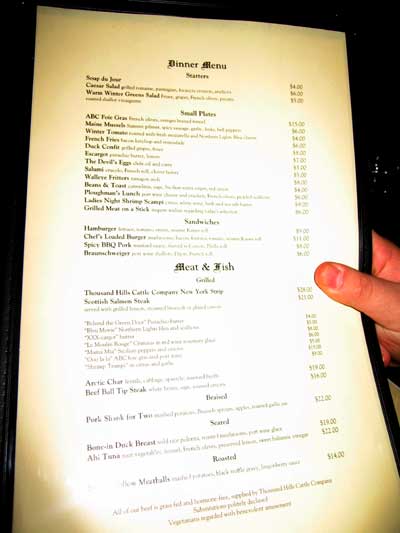
    The menu.

    Drinks first, of course. The drink menu boasts numerous prohibition-era cocktails: the Joker, the Sidecar, the Old Fashioned — all quite good, though at your typical $8-a-pop prices. Two beers on tap — a great blonde (also at $8) and an unconvincing porter (with a strangely bitter afterbite). Numerous bottled beers. And a great looking, somewhat modest, wine list. The wine list actually surprised me by not emulating every other wine list in town. A nice selection indeed.

    The food.


    I’ll go anywhere for a good glass of wine with escargot. When I was three years old I took my own bag of snails (from the beach) to a restaurant in Spain and asked them to cook them for me. The waiter took the bag, winking at my bewildered mother, and brought me out a dish of their escargot — which I eagerly devoured, thinking they were mine.

    The Strip Club escargot did not disappoint — though, I must say, it’s almost a crime to not serve some bread with which to wipe the plate. (The bread is a bit pricey at $4 a plate — which includes about five pieces.)

    This is, of course, just one of many Small Plates offered on the menu — making that regular stool at the bar that much more desirable.

    The Lady’s Night Shrimp Scampi, served in a champagne glass, was quite good. And the deviled eggs have a wonderfully spicy touch of curry and chili oil.

    Max went nuts over the whole scallions served with the Ploughman’s Lunch — essentially a port wine cheese plate. At least this came with crackers. And the crackers were quite wonderful, though oddly, despite their perfect plainness, they seemed to overwhelm the cheese.

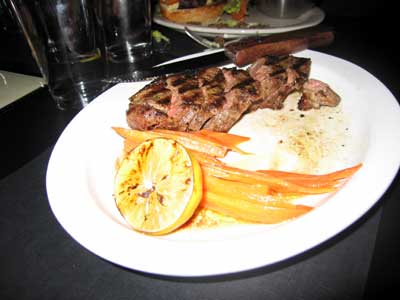
    I didn’t try any of the main courses — no strip steak for me — but those that did seemed more than satisfied.

    The set-up is great. Steaks come with a choice of eight different toppings (or none, like the one above) — ideal for all tastes. A couple members of our party raved about their steaks, while one lone member seemed unimpressed. "It’s ok." (More stoicism perhaps?)

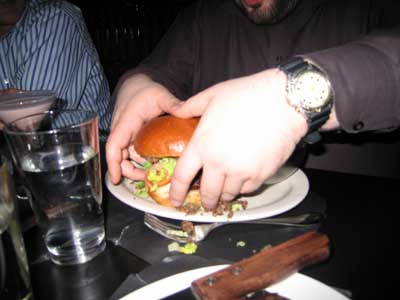
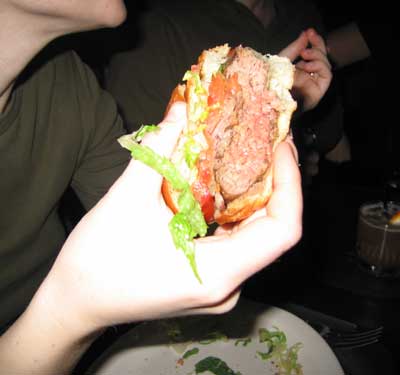
    The burgers were a hit all around.

    Cooked to perfection. It’s nice when medium really means medium.


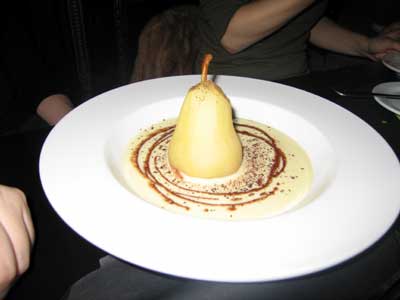
    If presentation were everything, I’d have to give it up to the dessert.

    Our party ordered this beautiful pear dish.
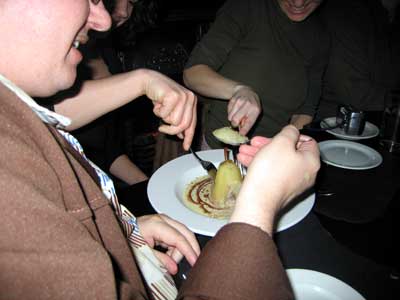
    But when it came time to actually eat it…

    They had a little trouble getting the forks in. The pear wasn’t cooked, you see; and pears aren’t exactly the softest of fruits. I’d guess a little baking time — perhaps poaching to preserve the juices — would soften it up, bring out the flavor, and better swathe the chocolate at the core.

    Overall, the experience was delightful: the space charming, the drinks intoxicating (and, yes, delicious), the food satisfying, the presentation all-around lovely, and the service absolutely fabulous — but, judging from Tim’s visits to the table and a final round of shots on the house, I gather we may have had somewhat special treatment. A smart man (men, actully, since the other owners were involved), indeed. It’s never a bad idea to treat a group of local bloggers well on opening night! Never a bad idea at all. See for yourself: Aaron’s post, Ed’s post, and Courtney’s photos. Trust me, their photos are far better than the ones here. (Sorry, Rich. Don’t take it personally. Your camera has a better sense of humor.)

  • A Dream Deferred

    It was difficult to sleep, yet almost impossible to move. It was easy to be irritated about everything that was of no consequence, yet care about nothing that mattered.

    Richard Flanagan, The Unknown Terrorist

    There is no love. There is only proof of love.

    Denis Diderot, or maybe Jean Cocteau

    One of the firemen from the station across the alley was peeking in Katherine’s windows. She could hear the crinkle of his heavy yellow coat and the tread of his big rubber boots tramping through her garden, where for years the firemen had been stealing tomatoes and zucchini in the moonlight.

    This one, the peeker –Katherine had never actually seen him, yet she nonetheless had a clear image in her mind– was a big fellow, sturdy, and modestly handsome, but old as far as firemen go. She imagined he’d fallen through a roof or two.

    Katherine had been a thin, graceful dancer in her younger days, but she’d recently been gaining weight.

    Things didn’t always –or even often– turn out the way that people planned. Katherine’s father, who was certainly living proof of this fact, took every opportunity to remind her of it nonetheless. He wasn’t a cold or mean-spirited man –quite the contrary, in fact– and Katherine understood that he intended the words to buoy rather than discourage her. She couldn’t deny, though, that she was feeling a bit discouraged, but she was also a deeply practical woman, and had a keen understanding (or so she believed) of the way the world worked.

    Still, she knew that she had lost her life, or at least any life other than the one she had. Her father had always told her that it was never too late, and while this may have been literally true, she also knew that she had become a special case. She was more and more convinced that she was slowly being washed out, becoming invisible.

    At some point –it now seemed like such a long time ago– her mother had become ill. She had died very slowly, and afterwards Katherine had stayed on to look after her father and keep him company. This was the way the world in which she lived worked, and she had always accepted that there was a rightness to it. The usual horrors were easier to bear when one had the courage and decency to do the right, simple things, even if they were seldom so simple.

    She still carried the life she had once imagined inside her, and it was still as beautiful as it had ever been, and likely more beautiful than it would have been if even a small part of it had been made real. Those old dreams, however, had become in time a very real retreat, and at considerable cost to Katherine’s social skills and comfort level when forced to go out into the world.

    She still had her piles of old movies, fashion magazines, and travel brochures, though, and there was still a magic to them that even her retreat had not been able to dispel. She could still quite vividly imagine herself aboard cruise ships and strolling through foreign cities with a smiling, handsome man at her side.

    Katherine had now been alone in the big, old house since her father died. The calendar on the kitchen wall still showed the month of his death. It had been almost five years, and she still missed his gentle voice, kindness, and old fashioned manners. In the year before his death he had been bedridden, and Katherine would read to him from the newspaper and from his old favorite books. He loved Sherlock Holmes and Trollope. When she would appear each afternoon with his tomato soup and grilled cheese sandwich he would kiss her on the cheek and say, "Don’t you just carry a candle to my heart?"

    Her father worried about her. Once upon a time he had built her a large, ornate dollhouse –she was a girl who had from a very early age rejected dolls, dismissing them as "dead children"– and had presented it to her for her birthday one year.

    The dollhouse was a beautiful thing. There were tiny chairs and tables and four-poster beds; above the dining room table there was a miniature chandelier, and the living room featured a fireplace and candlesticks on the mantle, a detailed oriental rug, and a coffee table on which were stacked tiny books and magazines. There was even a coat rack inside the front door.

    "Who lives here?" Katherine had asked her father.

    "That is for you to decide," her father said. "In the meantime, you will live there in your imagination, and every night there will be music and lively conversation and all manner of happiness."

    One side of the dollhouse was wide open, and when she was a little girl Katherine would crouch beside it in her bedroom and stare into its still, dark, quiet rooms. It was lovely to her, but there was something about it that also made her sad.

    Then one summer she started capturing grasshoppers in the weedy lot of the old abandoned Mormon church at the end of her block, and she would carry the grasshoppers home and place them gently in her dollhouse. She went to the public library and read about grasshoppers in the encyclopedia, and scattered green grass and carrot shavings and green peas and corn throughout the rooms of the dollhouse. She lined one of the four-poster beds with grass, and was delighted to discover a grasshopper drowsing contentedly in the middle of a bed one evening.

    Katherine brought home more and more grasshoppers, and they would always disappear after a time, but there were nights where her dollhouse would be trilling into the early morning with their lovely music, just as her father had once predicted.

    As she got older, and particularly after her mother’s death, Katherine’s father would often tell her that she needed to get out and meet people. She would answer that she’d never met anyone in her entire life, a petulant statement that nonetheless had some truth to it.

    She was shy, and had always believed that she would find her future, and whatever friends she might one day make, somewhere else out in the world. She had never liked to go to church with her parents because there was never anyone there that she knew.

    She did take dance lessons for a year or two, studying with an old woman who lived in town and had allegedly once danced on Broadway. Katherine had displayed a natural aptitude for dance, and she had enjoyed the experience and the freedom she felt when she was moving. Eventually, however, she danced exclusively in the privacy of her bedroom, dancing to songs on her phonograph and practicing to to be the person she never became.

    One night, after the fireman –whose presence she had still only sensed, but never seen– had been peeking in her windows for several weeks, Katherine realized that she was just lost enough to be stirred by the attention. She was simultaneously tickled and disturbed by how stirred she felt. She felt for the first time in a very long while like a candle had been carried to her heart. The idea that she was being watched, that someone was seeing her, recalled to her the private magic of those long-ago nights when the music of the grasshoppers had filled her room and she had fallen asleep with her head full of beautiful dreams.

    Katherine showered, brushed her hair, and went to the hall closet and found her mother’s prettiest dress. She dug out and lit some ancient Christmas candles. And then she put one of her father’s old Strauss records on her phonograph player and she danced.


  • The Three Pointer: Not Enough Talent

    AP Photo/Jim Mone

    Game #37, Home Game #18: Golden State 105, Minnesota 98

    Season record: 5-32

    1. Low IQ. Low skill level. Low chance of winning.

    All things being equal, the Minnesota Timberwolves without Randy Foye and Theo Ratliff, opposing the Golden State Warriors on a sub-zero January night having already clearly established themselves as the worst team in the NBA, will lose to the Golden State Warriors.

    Well, all things were essentially equal tonight. Al Jefferson and Rashad McCants were off their games a bit, but Antoine Walker emerged from a long slump, Ryan Gomes continued his solid play, and I thought Randy Wittman both coached well and summed up the defeat in a succinct, intelligent fashion from the postgame podium. Or maybe this loss sort of blurs into the other 31 because I’m just not inspired enough to hash out particularly innovative nuggets of wisdom that seem particularly different than the various recaps of so many other games. This wasn’t a special loss in that it was a tough, close encounter or a monster blowout, or that one particular facet of the other team was vitally important or one particular player on the Wolves was the giant goat. So rather than pretend we’re doing depth tonight, let’s just wing it with the impressions and see what happens.

    But first, Wittman’s take. Asked about the large disparity in backcourt performance (Monta Ellis and Baron Davis were a combined 39 points, 6 rebounds, 13 assists, 5 steals and 4 turnovers in 73:34, versus Telfair-Jaric being 16-7-11-2-6 in 70:05), Witt rued the decision-making. "We talked before the game about how they are the number one team for turning turnovers into points," he stated, noting that the Wolves coughed the ball up 20 times, costing them a whopping 31 points, 13 more, in a 7-point loss, than Golden State yielded via its 12 turnovers. His troops were committing the kind of turnovers that result in 3-on-1 breaks in transition, Witt lamented, then shrewdly observed that instead of making the extra, safer pass, "we tried to split the seams with our passes" and the seams weren’t there.

    Without calling anyone out by name, Wittman cited the dumb inbounds pass McCants made that was stolen by Baron Davis in the last 4 seconds of the third period and transformed into a layup by Matt Barnes just before the buzzer. This concluded a sequence where, after McCants drove for a layup to cut the lead to 10 with 1:08 left in the third, the Warriors scored 7 straight points to bump it to 17 at the conclusion of the quarter. Witt also called out the turnover spree after the Wolves had whittled the lead back down to 4, 96-92, with 4:11 to play. McCants had his shot blocked, Walker committed an offensive foul, and Jaric was called for a carry, a borderline whistle after a series of inept calls that prompted Wittman to earn a technical.

    2. The Little Two

    Normally the big two, at least in terms of scoring, Jefferson and McCants both had off nights. Shaddy’s was by far the more obvious. On a day when the Strib had spotlighted his inconsistency in a feature piece,he showcased most of his flaws, including the stupid fouls–ladled with an increasing sense of victimization that is at once partially accurate and conveniently overblown in his own mind and emotions–the holding of the ball in the half-court, the silly turnovers, and the sporadic bouts of energy and lethargy. It all amounted to 11 points in 30:12, albeit with 5 rebounds, 3 assists and a team-best plus-minus of zero, which only makes the time he is forced to sit on the bench more aggravating. When he grabbed his second foul with 3:23 to play in the first, for instance, the Wolves scored a mere 4 points in the next 5 minutes, turning a one point lead into a 5 point deficit in the process before Walker went on one of his handful of personal mini-runs (he finished with 26 points).

    Jefferson had better numbers: 18 points on 7-14 FG, and 14 rebounds, but Wittman didn’t like his lack of aggressiveness looking for his own shot. "Al let them off the hook too much in the first half," said the coach. "No offense to anyone, but if [Al] can get Austin Croshere [guarding him], he’s got to back him down and put it in the basket." Jefferson was a game-worst minus -19, Croshere a game-best plus +17. Actually, Jefferson looked for his own shot more in the first half, when he was 4-10 FG, versus the second half, when, despite 3 offensive rebounds, he only launched 4 shots, making 3. Yes, ‘Toine was rightly the focal point of the offense, but no way Jefferson should be tied with Marko Jaric as the team’s fifth most-frequent shooter in the second half, especially against a paint-challenged squad like Golden State. (For the record, ‘Toine had 9 second half shots, Shaddy and Gomes 7 apiece, and Telfair 6.)

    For what it’s worth, Jefferson ducked the media after the game. He follows the now standard custom of not wanting to conduct postgame interviews until he is fully dressed. He came out, put on his pants, then went back into the trainer’s area. A few minutes later, a Wolves’ locker room assistant came out and scooped up the rest of his clothes. Jefferson still hadn’t emerged by the time almost all the media had gone.

    3. Quick Hits

    ‘Toine’s breakout game was his first bout of productivity in weeks. Because both he and Gomes understand how to play the game so thoroughly, they are fun to watch, but recently only Gomes has been able to take what he sees the opponent giving him–‘Toine simply hasn’t executed. But Golden State’s fly by night D has a tendency to heal all slumps. Playing at the power forward slot, ‘Toine already is a natural floor spacer, causing mismatches either on the perimeter on down low and finding the open man or making a team pay for whatever mismatch they choose. Tonight he shot 4-5 FG from down low, especially little turnaround jumpers spinning baseline on the left block, and 3-4 from beyond the arc. Half of his 26 points came in the fourth quarter, when he went 5-5 FG. He also snatched 10 rebounds, second only to Jefferson among all players on both squads. But zero assists, because, as with Jefferson, the Warriors weren’t emphasizing the double team.

    Corey Brewer may be hitting the proverbial rookie wall, usually judged to begin slightly before or after the midpoint of the 82 game season. Yes, I know Brewer’s minutes have been cut, but it isn’t the game-time lack of energy so much as the constant practicing, travel, level of competition, and, in Brewer’s case, all the losing. A key point in tonight’s game occurred when Brewer subbed in after McCants’ third foul with 6:13 to play in the second and the score tied. Mickeal Pietrus proceeded to school him for a trey, reverse lay-up and alley oop dunk in the next 1:48, compelling Wittman to utilize a quick hook and bring in Greg Buckner. That followed a desultory first quarter stint where Brewer committed a turnover and a foul in his first 70 seconds of action. For the game he had one missed shot, one assist, one block, three fouls, two turnovers and was a minus -12 in just 8:24 of action.

    Asked what happened in the Brewer-Pietrus matchup, Wittman said the difference was "just experience. I would be comfortable putting Corey on him again." But 8:24 proves he was not comfortable with it–and appropriately so–tonight.

    The referees were horrible. The worst display was a no-call on a breakaway layup where Stephen Jackson clearly travelled, but there were a bevy of others. McCants and Craig Smith both got jobbed and then had reason to overreact to all the legit fouls called upon them–there is a reason they lead the team in whistle frequency. But what was also telling is McCants getting whistled for pretending like he was going to fling the ball into the stands, a situation where he seemed as mad at himself as at the refs; versus the veteran Walker screaming at them for no calls during a rebounding scrum and getting only a delay of game for tossing
    the ball away. The terrible crew: James Capers, Scott Foster, and Tommy Nunez Jr.

    While I laughed at Gerald Green running around like a chicken with his head cut off while constantly looking to the bench for instruction on defense, GG went plus +10 during his 8:25 on the court–not coincidentally spent almost entirely with Walker.

    Sebastian Telfair is dinged up, perhaps his back. Teammates took turns holding on to his arms and gently lowering him to the floor (instead of a chair) during his times on the sidelines.

  • Movement and Music

    DANCE & PERFORMANCE
    Wreck

    Black Label Movement
    received a hearty welcome with its debut 2006–07 season, garnering
    praise both for its evocative choreography and athletic, hyperkinetic
    dancers. The company repays that kindness by opening its sophomore
    season with the ambitious Wreck, artistic director Carl Flink’s first evening-length piece. Claustrophobics beware: Wreck
    depicts ten sailors trapped inside the last watertight compartment of
    an ore boat at the bottom of Lake Superior. Confined to a small space
    defined by several benches, the dancers artfully flail, careen, and
    collide as they run out of air and time. Vintage 8-millimeter footage
    of an ore boat, along with a score by acclaimed Twin Cities-based
    composer Mary Ellen Childs, provide a backdrop. —Danielle Kurtzleben

    8 p.m., Southern Theater, 1420 Washington Ave. S., Minneapolis; 612-340-1725; $18 (but tonight’s show is a pay-what-you-can show).

    FILM
    Cinema Lounge Goes MTV

    What’s better on a cold January
    night than curling up to an independent film or listening to some music? How about independent films AND music! Cinema Lounge has done
    it again. They have created an exciting new line up for their
    monthly movie event at the Bryant-Lake Bowl Theater. Everyone is welcome
    to come in, kick back, and enjoy some original music videos from local
    independent filmmakers and some great new bands. These are not
    like your average YouTube clips. Cinema Lounge promises
    "smart and well-crafted" videos that are sure to please.
    And the cost is pleasing too: FREE! —Kate Leibfried

    7 p.m., Bryant Lake Bowl, 810 West Lake St., Minneapolis; 612-825-8949; free.

    MUSIC
    A Mature G Love


    G Love’s
    heyday may have been in the early ’90s when backwards caps and funky alterna-rock were somehow considered chic. But he’s proven himself a perennial favorite amongst the aging slackers that don’t want to move into the 21st century of music. That portrayal may be unfair though, because G Love’s recent albums indicate a growing sense of maturity and songwriting talent just as rich as the keen-eyed exuberance of his earlier and more revered albums. Opening are the folksy Wood Brothers, featuring Chris Wood of Medeski, Martin and Wood. —Christopher Hontos

    8 p.m., First Avenue, 701 First Ave. N., Minneapolis; 612-332-1775; $25

  • Sex and the Fat Man

    I learned again last week that any blog, book, or article with the word "sex" in the title will be read. Not that this was news to me. But it’s a lesson that was reinforced by our nifty Popular Today list, which proved that sex sells better than anything except basketball. Which, when you think about it, is an interesting commentary. . . .

    Now, I don’t know the Lakers from the Bears, but I do know sex. And I even have a legitimate reason to write about sex because my new novel is absolutely chock-full of sex. Really good sex. Only the person who’s having it happens to be an attractive but very, very large man — and I do mean that, in every way.

    So you should know that I spent my entire morning searching for a photo of a sexy fat man for this blog. Finally, I gave up and e-mailed our web guru who spent her entire afternoon searching. And what did we find? Well, what’s above is the best by far.

    I sorted through photos of fat men wearing baseball caps and stuffing enormous hamburgers into their mouths; clinical shots of obese men with pendulous fins of flesh hanging off their 1,000-pound bodies; pictures of sumo wrestlers in diaper-like garb. The closest I could come to a stud with a little meat around the middle was a stock shot of John Goodman, back in the Roseanne years. Yet — and I find this interesting — when I looked for cheesecake photos of hefty women they were in large supply.

    What’s that all about?

    Well, I’ll tell you what it’s all about. We women can talk about weight discrimination until we’re 90 (and probably will): the way men want stick-thin babes on their arms, women who look like heroin-addicted teenage boys and have collarbones that could kill. But suddenly, I’m not at all convinced that the problem isn’t really the other way around.

    Men are out there looking at jpegs of zaftig females lounging on pillows among dozens of cats. They’re getting turned on by women with rounded Rubanesque tummies and thighs that meet. But women, it appears, are not at all interested in looking at photos of beefy, hairy, barrel-stomached men.

    This has become a real hot button issue for me because my book is about a synesthetic 40-year-old food critic [nothing autobiographical there] who begins dating a smart, witty, reliable, thoughtful six-foot-six-inch 300-pound guy. (And no, for all of you who are wondering, my new six-foot-one-inch husband weighs a mere 203 dripping wet. . . .)

    The plot of my novel hinges around the fact that in high-falutin’ foodie circles, fat is simply not acceptable. Oh, the people who attend restaurant openings may talk about food constantly, describing as if it were sex, longingly and with hungry eyes. But they don’t eat much. And they do not care, as a group, for people who do.

    Mind you, I’m exempting real food lovers, most chefs (they eat constantly but they also move constantly,which is how they stay so thin), and those lusty gourmets of the Ruth Reichl type. What I’m talking about here are the socialites who attend every haute cuisine gala in town. When my heroine tries to bring her big man along as escort to one such event, he is openly derided for being not of the right type.

    So the couple ends up instead frequenting a small Persian restaurant in suburban Chicago where he, a scientist, is treated with dignity and she, a food critic, is not even recognized. They fall in love over a dish called fesenjoon, which she describes this way:

    The flavor reminded me of the mood rings we used to have when I was in grade school, with stones that would change color — supposedly depending upon the wearer’s emotional state, but really due to body temperature. Fesenjoon seemed to change in the air: its scent was of one thing and then another. Berries, citrus, bakery buns, roasted chicken, nuts, and earth.

    I wrote this, however, before ever having tasted fesenjoon. I’d read about it. I knew the ingredients (chicken, pomegranate juice, walnuts, onion, and citron), so like a person who can read music and hear the melody in his head, I conjured up the scent and flavor of the dish based upon its recipe.

    Last Friday, my normal-sized husband and I went to Shiraz Fireroasted Cuisine, on 60th and Nicollet, so I could taste the dish around which I’d based the whole crux of my book. Let me tell you, I was nervous. . . .

    "What if I hate it?" I asked my husband in the car.

    "You can write about something else," he said. "Send your editor the changes." He was nice enough, you’ll notice, not to point out that I might have tried fesenjoon before sending the book in.

    Shiraz was, I’m sorry to say, nearly empty. We sat in a booth next to a miniature Persian rug that looked like a little flying carpet. The lights were low and the walls a warm rose color. It would have been a very pleasant place to be except that the noise of clattering dishes coming from the kitchen echoed through the cavelike space.

    We ordered the fesenjoon (called fesenjan at Shiraz) and a ghormeh sabzy stew. Each came with a plate of white rice and lemon zest. I spooned a little of each on my rice and tasted.

    "Do you hate it?" my husband asked.

    I shook my head. But the truth is, I didn’t love it, either. The fesenjan was redder and sweeter than I’d expected, and the Shiraz version seemed to have no onion in it, nothing savory to counter the syrupy pomegranate sauce. The other dish, however, was extraordinary: chunks of rich, tender filet mignon with red beans in a thick gravy made of beef juice, herbs, and lime. It had a nearly South American flavor, mixed with the wondrous plain meaty taste of a rare Manny’s steak.

    Speaking of Manny’s, they have fat men there. Lots of them, and they’re sexy, too. Forget the wifty, silk tie types who hang out at places where the food is vertical, these are guys who take their 4-pound steaks lying down.

    So could someone get over there right now and take a picture. Please?

  • Eyes on Mondale

    On January 8th, 2008, Walter Mondale spoke at the Phillips
    Eye Institute’s
    annual dinner and review. As the daughter of an
    ophthalmologist for this clinic, I’m
    not usually invited to the dinner, which I consider a blessing after having endured 18 years of LASIK eye
    surgery and patient stastistics. But this was Mondale, after all; and I was curious to discover what stellar contributions he might offer the opthalmology community.

    Much as expected, the clinic president subjected the audience to more statistics and eye surgery stories before ceding the stage to Mondale — the price to pay, I suppose. But he still left me wondering what a former presidential candidate was doing at an ophthalmologist dinner — a question that Mondale himself finally shed some light on.

    According to Mondale, he was having his
    eyes checked and his doctor asked him if he wanted to talk at the annual
    dinner, to which he replied, “What am I going to say to a bunch of
    rich, Republican doctors?” His doctor suggested talking about the
    primaries, which is precisely what Mondale set out to do, focusing on the differences between today’s campaigns and his own campaign against Ronald Reagan in 1984.

    One big difference, Mondale pointed out, is that the states are having their primaries and
    caucuses closer together. Each state wants to have an impact on the
    next state, so they’ve all pushed their caucuses and primaries
    earlier in the year. This year, about 20 states (including Minnesota)
    are having their primary elections on February 5th, known to the news
    networks as “Super Tuesday.” These close election dates make it harder
    for the candidates to campaign. While in the past they might have had more time to visit the states, talk to citizens personally, and go to town hall meetings, they are now limited to national debates and speeches — a fact that could cost less-skilled public speakers votes.

    Mondale went on to describe his one-day trips from New York to California, stopping in other states along the way. Back when there was more time between primaries, candidates would do this regularly, he explained. He would arrive in
    California, fly back to New York, and start over the next day.

    According to the former presidential candidate, the Internet has also helped with the candidates’ fast campaigning. Each
    candidate has his/her own website, where you can sign up for mailing
    lists, catch up on campaign news, or volunteer. The Youtube
    Democratic debate, as well as many groups, debates, and polls on Facebook,
    have involved more people with the election.

    Mondale spoke briefly about the differences in cost between the
    elections. In 1984, Mondale’s campaign cost him $325 million. This
    year, each candidate will spend about $1 billion just for a
    nomination to their party. That’s a lot of wasted money for those who
    don’t get nominated.

    This election is significantly different from any other election
    because of the candidates who are running. This is the first time in
    history that a woman, an African American, and a Hispanic American are running
    for president in this country. Mondale mentioned that many other countries — such as
    India, Argentina, and Germany — are ahead of us by already having
    multiple presidents who more widely represent their country. During his campaign, Mondale
    took a huge risk by choosing Geraldine A. Ferraro as his running mate,
    making her the first woman nominated to this position. Now Hillary
    Clinton is running for president, which shows how much our views have
    changed over 24 years.

    No analysis is complete without a few suggestions for improvement, so of course, Mondale tossed in some ideas to making the primaries a little less
    hectic for the candidates, and a little more interesting for the rest
    of us. He thinks that we should change the order in which the states
    have their primaries. Instead of Iowa, have South Carolina or Arizona
    be first. He also suggested that the country be divided into eight
    different geographical regions, each with its own date for primaries. This would give candidates time to campaign in each region prior to the primary election.

    Overall, the ideas he proposed seemed like good ones, but let’s face it, politics moves very slowly. Despite the current candidates’ continued focus on the need for change, we all know politicians — and this country, in general — are reluctant to major modifications. I doubt that the way primary
    elections are run will change any time soon.

  • Hell Yes, Holly

    Last week, while continuing work on
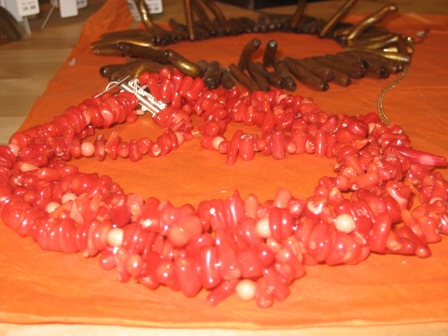
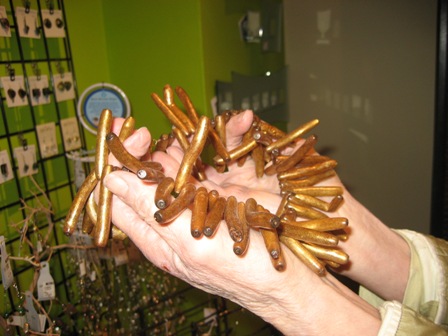
    the February fashion feature (coming soon), I stumbled upon this fantastic jewelry
    collection at Key North, a new-ish eco-retailer in Northeast Minneapolis.


    The earrings, of course, are my fave – they’re made of something called African turquoise. Each of the above pieces are by Holly J., a Minneapolis-based
    designer.