Month: February 2008

  • Letting Go Of The Hate

    I used to think hating Diablo Cody was only a regional pasttime. This is, after all, an area lousy with writers who have not written Writers Guild of America award-winning screenplays or gotten incredibly rich and famous or appeared on David Letterman. And sometimes, when the wind is blowing in the right direction, I swear you can hear about 500 of them grumbling: I wrote for City Pages once years ago. . . .and I could have been some skanky sex worker if I were willing to stoop that low. . . .and every single one of those screenplays sitting on my closet shelf is about a million times better than Juno.

    Of course no one says exactly this. They jeer at her nom de plume and make fun of the length of her skirts and talk about how Juno — a sweet, decent film in a year full of overblown, overdone losers — sucked anyway. If Cody wins an Oscar, I imagine the gnashing and retching will go on in our local writing community (and believe me, I use that phrase loosely) for years to come.

    Now, however, I come to find that the irrational antipathy for Cody has spread. In an article in Slate, writer Dana Stevens describes how what I previously thought of as a Minnesota phenomenon exists from coast to coast. People all over the world, apparently, hate D.C. and her movie (which, by the way, has grossed over $100 million, so some people must like it. . . ). And despite a mostly even-handed exposition of the whole controversy, Stevens herself even gets in a few digs.

    In a strangely similar turn of events, it seems Hillary Clinton hating is on an upswing as well. Now, the Bush-Cheney set has always hated Hillary. (Since the day she announced her candidacy, my father has called her "Billary" — which causes me to grind my teeth practically into dust each time we’re seated next to one another at Sunday dinner.) But here’s a new twist: now, just as with Cody, it is Clinton’s putative fellow thinkers who are spewing the most bile.

    In "Hate Springs Eternal," his column in the New York Times yesterday, political commentator Paul Krugman wrote, "I won’t try for fake evenhandedness here: most of the venom I see is coming from supporters of Mr. Obama, who want their hero or nobody."

    What’s going on here? We’ve got two immensely talented women — and I’m not going to make this a gender thing, because I truly don’t think it is — being reviled as sport. Why? Jesus, I don’t know. Pure envy in the first case, it seems. Zealous and cult-like political behavior [and let me say, I think this has little to do with Obama himself] in the other.

    Now, listen my children: You should know that hate — whatever its genesis — will curdle your blood and cause painful ingrown hairs. It leads to cancer and shingles and bad posture. And more important, it’s just bad juju for the rest of us, making this world an uglier place in which to live. So stop it!

    And why should you listen to me? Because, I’m going to lead by example. I, too, have allowed hatred to creep into my heart. But I’ve seen the light and banished the darkness from my soul. I. . . .are you ready for this?. . . .have returned to Trader Joe’s.

    Back in November, I wrote about their trademark wine, Three-Buck Chuck, in a post that began, "Have I mentioned how much I hate Trader Joe’s?" Well shame on me! I have been guilty of doing the devil’s work with my foul words. What’s more, I’ve actually, sort of, in a sense changed my mind.

    It all started one day last week when I got a craving for white cheddar popcorn. One of my guilty secrets — even back when my soul was sullied — was my love for the snacky popcorn products available only at Trader Joe’s. So at 3 in the afternoon, I drove over to get a bag. And while I was there, I stopped into the wine shop and picked up an $8 2006 Bordeaux from Chateau Michel de Vert.

    It had a nice label. And we’re working on saving money, my husband and I, particularly where wine is concerned. What the hell, I thought. And I trotted home with my white cheddar popcorn, which I ate immediately, and wine, which I uncorked around six o’clock.

    I was dismayed even as I poured. The wine had a thin purplish color I didn’t quite like. And it tasted. . . awful. A combination of fireplace ash and cough syrup. I took a swallow, gave my husband one. Then we stuck the cork back in and opened a bottle of the Portuguese wine I was raving about last week that we now buy by the case.

    I had planned to absorb the eight dollar loss and call it a lesson: Trader Joe’s is vile (unless you need a popcorn fix). But then, I recalled something vaguely. I’d heard a rumor, once, that TJ would take back any product for any reason. All you had to do was show up and demand your money back.

    I was skeptical even so. I called the manager to ask, Could I return a bottle of wine that wasn’t corked or heat-damaged or in any other way defective, simply because it wasn’t to my taste?

    "Absolutely!" he said. "Just look for me."

    And so I did. Yesterday afternoon, I grabbed that old, warm bottle, took it back without so much as a receipt, and the manager — no questions asked — handed me my money. So pleased was I, it seemed natural to pick up yet another ultra-cheap Bordeaux: Les Caves Joseph 2005, which sells for (you’re sitting down, right?) $5.99.

    Was it special? Er, no. But what do you expect for six bucks. It was a spot-on average table wine, sweet and decent (much like Juno!), with a cherry-ish flavor and a little bit of rough wood.

    So. Heed this story. I have seen the light, given up my hatred, and cleansed my spirit with a profoundly mediocre French wine. If I could, I’d buy a thousand bottles, get all the writers and rabid Obama supporters I know, and put them all together in a room. I see a big, diverse Bachannalian event. An orgy of the liberal and literati. All cheaply lubricated, thanks to Trader Joe’s.

  • Oh Ee, Oh Ee, Oh

    I watched the Grammy Awards last night, but it wasn’t Amy Winehouse nor Kanye West I wanted to see perform. My heart belongs to Morris Day and The Time, whose performance I eagerly awaited. I mean, how much fun was it watching Jimmy Jam, Terry Lewis, Jerome Benton, Morris Day, Jesse Johnson, and the rest of the original Time group perform, just like they did 20 years ago, with the same energy and infectious smiles they have always had?

    Have these guys aged like the rest of the hit-makers of the early ’80s? Hell, no! BETTER. They still made me get up and do the Jungle Love in front of my horrified kids. Hang on. I have to do it one more time. Oh ee, oh ee, oh. (Deep breath.) Dammit, my rhythm still sucks.

    Now, it is important that I disclose a few things about my relationship with these guys, so that you know I am not being a biased friend, but more a fan of the group that along with Prince put Minnesota music on the Map.

    I first came to know these guys when I was in my late teens looking for a summer job. Through the kindness of mutual friends, I was able to land a job with American Artists (Jesse Johnson’s management company), as the head of the Jesse Johnson Fan Club. Like most people starting out as a glorified gopher, I basically answered phones and made sure that Jesse was always happy and taken care of. The one difference was that I had… kind of dated… John McClain, a top executive at A&M Records and the brilliant man behind Jesse’s bread and butter. So, while I was making sure that Jesse’s favorite chicken wings from Runyon’s were being delivered to his house — hot — I was also fielding phone calls from fans and accepting extravagant deliveries from my "friend" John.

    Confused? Yea, well, so was I!

    John would come into town to do business with Jesse, but he was also overseeing a project that he put together: a Janet Jackson album produced by Jesse’s former band-mates Jimmy Jam and Terry Lewis. So instead of spending my weekends going to shopping malls, like my friends, I was flown off to California, where I handled Jesse’s fans while — better still — being treated like a princess by my… uhh… friend John.

    Rough life? No! Confusing? Absolutely. I was dating the man that was responsible for making or breaking all of my bosses. So, I did what any normal young woman would do in this position: I made sure that my bosses knew that I was NOT going to take advantage of the situation. I continued to answer phones, make photocopies, set up Jesse’s schedule, and so on. But as soon as John would call, I took full advantage of being treated like a real Jewish Princess.

    Well, after a long and hard reality check, I realized that I was very young — too young to be involved in a serious relationship with anyone, so my time as John’s girl slowly came to a halt. And although I quit the gopher job, I did stay friends with Jesse and the rest of the crazy crew who went on to make Janet Jackson a household name and establish themselves as the top production team of Jimmy Jam and Terry Lewis, otherwise known as Flyte Tyme Productions.

    To this day, I still keep in contact with Jimmy, who married the beautiful
    Lisa and has three ridiculously gorgeous kids; Terry, who also
    married his love Indira and is proud papa to a whole team of great kids; and Jerome Benton, who drives a limo for celebrities in Los Angeles when he is not performing — and who SHOULD HAVE HIS OWN REALITY SHOW ON VH-1!

    What is so bizarre to me is that Terry’s oldest son was my son’s Senior buddy when he was a little tyke, and his daughter and my daughter have been friends since kindergarten without even knowing that their parents knew each other way back in the ’80s, when life was big, crazy, and whole lot of Jungle Love!!! Until NOW…

    As far as John goes… I am told that he has continued to be successful in the music business and that it is HE who I have to thank for my fondness and appreciation of Orchids and Louis Vuitton.

  • Of Ice-fishing, Lust, and BBQ

    Speaking of running into ex-crushes …

    There I was at the DMV, getting my license renewed when I thought I recognized the guy sitting in the row behind me. Because I was thoroughly primped for my photo-op (this time I swear it’s going to be a good pic), I felt a little bit psyched that fate had dealt me the chance meeting on that particular day.

    The guy, who for good reason we’ll call Guy, had distracted my world for most of my senior year in high school. I think I was a game to him. He was dark and slightly broody and always held himself a little away from the rest of us. Guy was cocky and arrogant, but I seemed to be able to break him down and make him laugh.

    We’d flirt at parties. There was clearly an electric charge between us, and we’d end up making out in the corner or behind the garage. Just a lot of heavy breathing and smooching, nothing too nasty. But other than that, he’d pretty much ignore me. We all hung together in a rather big pack, but if there were a lot of others around, I was wallpaper to him.

    It drove me crazy. I would drive by his house at night just to see if I could glimpse him in his window. At school, I would go out of my way to walk a different hallway just to stroll by him, but then I’d be torn as to whether I should acknowledge him or just breeze by. The whole thing was secret and sad and thrilling and tormentous.

    Then one night, a bunch of us decided to party at a cluster of ice-houses on the lake. I had decided to play it cool, and Guy was working hard to be charming. This pleased me. After a few rounds of cards and quarters, some decided to make a food run. Guy suggested we stay and watch for fish.

    What ensued was some serious mashing and fumbling on the smelly ice-house couch. Things were getting hot and heavy and I remember feeling almost lifted away by warmth of his hands on my body. But I was a good girl, and I had pride and expectations. Part of me also wondered, if he achieved his ulitmate goal would all the excitment and anticipation end? Would I be full-time wallpaper? He tried a few more earnest advances but when met with my rebuffs he delivered a statement that I’ve never forgotten "C’mon Steph, I can’t help it, I’m a guy."

    That was that.

    With lightening speed I re-adjusted my wardrobe and stepped outside just as the others returned with food. Loud and laughing, we jammed ourselves into one of the larger houses and ate bbq like sloppy cannibals. The sauce was hot and tart and I remember feeling like I could eat a thousand ribs. Refusing to reveal my bitterness, I made sure to be very hilarious and had everyone nearly shooting bbq sauce from their noses. Guy sat three people away from me and I never met his gaze.

    By the time I’d worked up my courage at the DMV, I turned around and he was gone. It probably wasn’t even Guy anyway.

    That night I drove to Tonka Grill & BBQ in Spring Park to grab a couple slabs of ribs for take-home. The smokehouse smell starts pulling at you the minute you leave your car. Their sauce is sweet and tart with a vinegar kick that I appreciate, the ribs meaty and generous. The stacked pork sandwich is nothing to scoff at, either. It’s a small, local, family-run joint and they’ll offer you a free cup of coffee and chat you up while you wait for your order. Or, you can just stare out the front wall of windows at Lake Minnetonka, a vast white expanse dotted with an ice-house here and there.

  • Letters from Eurydice

    Hi,
    this is Steve Hendrickson, a local actor living in the Twin Cities and
    an Artistic Associate of Ten Thousand Things Theater (hereafter known
    as TTT). I’ve been asked by The Rake to do a blog on TTT’s upcoming
    production of Eurydice. TTT is the brainchild of Michelle
    Hensley, who founded the company in LA and then moved it here to the
    Twin Cities. TTT is distinctive in that is has no permanent theatre
    venue. Instead, TTT takes it’s productions to people who might
    otherwise never be able to experience a live theatrical performance. We
    tour prisons, homeless shelters, drug rehab facilities and other sites
    who minister to the poor and otherwise disenfranchised of our society. (We
    also do two weeks of paid public performances. These occur the first
    two weekends in March at the Open Book and Minnesota Opera Center.
    Check the website below for dates and move fast, these performances
    sell out fast.)
    We perform for these audiences, not out of charity
    or pity, but to acknowledge our common humanity and facilitate a
    wonderful barter: our audiences participate in the wealth of a live
    performance and, through them, we re-explore, re-imagine and
    re-invigorate theater.

    OK, lofty grant-proposal words. In common parlance, here’s how they translate:

    Being a TTT actor is hard. TTT shows tour
    and must play in spaces not designed for performance- gymnasiums,
    cafeterias, lobbies, etc. Of necessity then, the productions must be
    spare. There is no theatrical lighting- we perform in whatever light
    the room offers, frequently fluorescent. Everything we bring, sets,
    props, musical instruments, etc. Must fit in the back of one small
    rental van. The company (frequently at 9:30am) unloads the van, sets
    everything up, get dressed in a classroom or bathroom or no room at all,
    plays the show, stays and talks with the audience if they’re willing
    and able, takes down the set, packs it back into the van and heads home.

    But
    because TTT shows are spare, they focus almost exclusively on the text
    of the play, it’s characters and their relationships. TTT presents
    theatre at it’s most essential, reductive level. There’s an old adage:
    you need four elements for a theatre: an audience, a player, a passion
    and a place to stand. There can be no disguising the shortcomings of a
    TTT production through dazzling scenery, lighting and special effects.
    It’s just the actors and the audience, an arrangement at once
    terrifying and exhilarating because…

    Our
    audiences are smart. Not educated, perhaps (though you would be
    surprised at how often they’ll quote Shakespeare back at you), but you
    can’t survive on a poverty level income without knowing a bit about the
    world, the people in it and how they think and engage with each other.
    They recognize dishonesty, deception and plain bullshit five miles away
    whether upwind or down and have no reservations about letting the
    characters in a play (or the actors playing them) know when something
    smells. These audiences are used to dealing with officials in power,
    where the wrong form or the wrong word could mean the difference in
    getting a hot meal or a warm bed on a twenty below night in St. Paul.
    In non-prison venues if they don’t like the show, they leave, usually
    with a "this is bullshit!" for us to remember them by. On the other
    hand, true kindness, compassion, generosity and love are also quickly
    noted, prized and embraced. TTT audiences can be openly engaged,
    enchanted, enthralled. With the intelligence of adults but seldom any
    of the reserve of traditional audiences, they are the closest modern
    equivalent we have to the groundlings of Shakespeare’s Globe Theatre.
    Hamlet, sword in hand and pondering the killing of King Claudius as he
    is praying asks "and so he goes to heaven, And so am I reveng’d?"

    Audiences at the Guthrie may think things like "No, wait!" or "do that motherfucker!" TTT audiences will say them, no, shout
    them. And, gentle readers, let me say when that happens there is no
    situation close to it. It is one of the most exciting, visceral
    theatrical experiences anyone, actor or audience member, can undergo.

    Which
    is why, for most local actors, working on A TTT production is a highly
    prized gig. TTT attracts some pretty impressive talent: Sally Wingert,
    Bob Davis, Sonja Parks, Richard Ooms, Kate Eifrig, Jim Lichtscheidl,
    Kevin Kling, Norah Long and Bradley Greenwald, to name only a handful,
    have all been tapped by TTT and I suspect are eager to return.

    So TTT is something extraordinary among extraordinary theatres. Next time, I’ll write about our current production, Eurydice by Sarah Ruhl.

    For more information on Eurydice and all things TTT visit our website at http://www.tenthousandthings.org

  • Cat Psychiatry with a Hawk's Eye

    MUSIC
    Cat Power

    Last
    time Charlyn Marshall played Minneapolis, her set was half songs and half
    nervous chatter, owing to the notorious self- consciousness that occasionally
    overshadows the subtle beauty in her music. But her 2006 triumph, The Greatest,
    has given the shy and sad kid a renewed sense of confidence that will only be
    further buttressed by her pro backing band, The Dirty Delta Blues. Expect
    plenty of The Greatest, along with a generous assortment of masterfully
    evocative tunes from her new Jukebox, which, like The Covers Record from 2000,
    consists of stark interpretations of an array
    of old classics. If nothing else, count on the beguiling Marshall to
    deliver more bangs for your buck. —Christopher Hontos

    8 p.m., First Avenue, 701 First Avenue North, Minneapolis; 612-338-8388; $25.

    FILM
    Charlie Bartlett Special Advanced Screening

    Jon Poll’s name has been in the credits of many an amusing movie: producer of The Forty-Year-Old Virgin and Meet the Fockers, editor of Scary Movie 3 and both Austin Powers movies (are there more than two now?), and now director of Charlie Bartlett. Catch a sneak peek of Poll’s directorial debut tonight, two weeks before its official opening. The film stars Anton Yelchin as a loser high school student who finally manages to make some friends by turning himself into the unofficial school psychiatrist. "When he starts doling out advice, and the
    occasional pill, to classmates, his popularity soars in this witty take
    on teenage insecurity." And who is there to confront him but a disenchanted principal played by Robert Downey, Jr. You can never go wrong with Robert Downey, Jr.!

    7:30 p.m., Oak Street Cinema, 309 Oak St. S.E., Minneapolis; 612-331-3134; $8, seniors $6, members and students $5.

    Also tonight, the Film Noir series continues at the Parkway with Night and the City.

    BOOKS & AUTHORS
    John Minczeski

    "Let me be the one hawk / migrating late / my white underside / against low clouds

    "let me dive / to what you can’t see / in the grass

    "let wings collapse / then spread / and talons grasp"

    Let local poet John Minsczeski whisk you away this evening as he reads from two collections, Glass Elegy and November.

    7:30 p.m., Magers & Quinn Booksellers, 3038 Hennepin Ave. S., Minneapolis; 612-822-4611.


  • Bohemian Rescission

    After days of agonizing over much hard work lost to a dead hard drive. After weeks of researching digital news media for an upcoming story. After months glued to my laptop for your reading pleasure. I took refuge last night in a friend’s home, where I can always turn for the simplest bohemian pleasures. Five to seven bodies huddled in a dim-lit room strumming guitars and plucking banjos, blowing blues harps and crafting verse.

    But even the most sacred of spaces has been infiltrated by the net, even the doggerel.

    Charlie has a daughter who’s 19 years old. His name’s not Charlie, but he has a daughter, and his daughter’s name’s not Ann. Ann lost her billfold, he says, this man that’s not Charlie, of his daughter, who’s not Ann. She lost her billfold with her driver’s license, credit cards, $70 in cash, and a check for her rent. She really lost her billfold.

    Some man found Ann’s wallet. Or he found someone else’s whose name is not Ann. And he looked her up on Facebook. And he found this girl, not Ann. And now he wants to meet her, though he knows her name’s not Ann. And now she wants to meet him, to get her billfold from the man.

    My advice: "Don’t go alone."

    A conversation about Puerto Rican nationalism — yes, I confess, not a rare topic of conversation when I’m around — leads to an argument over who was president when four Puerto Rican nationalists held up congress in 1954. Why wonder when Google lies awake in the next room? Was it I who woke the beast?

    Truman. It was Truman. No, not this Truman, Harry S. Truman.

    And now twenty minutes spent on Sneezing Panda and the like. Six million people across the globe have done the same.

    And close to a million have watched three-year-old Kassie tell us what she’s going to do if a monster comes for her.

    There was a dachshund in the house, which explains this one. "Wait. Wait. Listen to what she says at the end," says another Charlie, who is not Charlie, to another Ann, who is not Ann."

    "Have you seen Dramatic Chipmunk?" 5,752,712 people have now wasted five seconds of their time. That’s a total of 479,393 minutes, or 7,990 hours, or 333 days. Good thing it’s short. We’ve wasted close to a year.


  • From the Wayback Machine: My Brief History of Magic

    Elmer Gylleck was a Chicago architect who did a bumbling
    comedy-magic act built around a character he called Dr. Clutterhouse. Dr. Clutterhouse would come on stage clutching a briefcase and carrying
    an umbrella. The briefcase was possessed, full of odd spirits; ghosts
    would fly from it, and gunshots would ring out whenever Clutterhouse
    opened the thing. When the briefcase wasn’t bedeviling him, the Doctor
    would be having table problems (he invented a wonderful collapsing
    table prop) or any of a number of other slapstick scenarios that were
    reliable crowd pleasers. Gylleck had a nice, clean act, with solid
    magic chops and plenty of laughs. Very influential. I’ve seen I don’t
    know how many third-rate Clutterhouse knock-offs over the years.

    In the ’60s there was a shift, and the theatrically baroque Clutterhouse sort of thing pretty much disappeared. There were all of a sudden these balloon workers all over
    town. A guy named Jim Davis was working Old Town, making thousands of
    balloon animals a week and drawing crowds and making lots of money.
    This fella was actually pretty good. He’d make giraffes, elephants, all
    sorts of interesting stuff. He actually wrote a useful little book on
    the subject —One Balloon Zoo, I think it was called. And
    there was another guy, Jack Dennerlein, an ad-man who also did good
    balloon work –tremendous birds– and he did a book, New Twists For Balloon Workers.
    Don Allen was one more Chicago magician who cashed in on the whole
    balloon thing. He’d gotten his start, I seem to remember, as a
    bartender who did magic tricks for the customers, which is something I
    don’t believe you see much anymore. Which is really a shame, because
    little pocket and card tricks are things that can help a bartender pick
    up a few extra tips, not to mention the occasional private party or
    corporate gig on the side. Anyway, I think Don Allen did a book on
    balloon tricks as well, Don Allens Balloon Work…or, no, it was Don Allen‘s Rubber Circus. That’s right. That’s exactly what it was.

    For a long time I was kicking around the idea of doing a little book
    of my own, something more like a history of balloon work, maybe even a
    historical overview of balloons in general, but to be honest with you
    it just seemed like too much fucking work. Steve Martin, of course, had
    some wild early success with balloon work. Everybody knows Steve
    Martin, but guys like Jim Davis and Jack Dennerlein are pretty much
    forgotten.

    When I graduated from college I used to hang out at magic shops,
    great old places like Magic, Inc. in Chicago, or Eagle Magic in
    Minneapolis. I was never really much of a magician myself; I didn’t
    really have the discipline to get much beyond the hobbyist stage. But I
    always loved the whole culture of magic, and for a number of years I saw as
    many magicians as I could, and for a time I got steady, small-paying
    work writing patter lines for a number of magicians around the Midwest.
    I also did a short-lived newsletter that ran profiles of regional
    magicians, history pieces, a patter column, and a lot of
    advertisements for mail order gags and pocket tricks. We had quite an
    impressive roster of subscribers and the thing made money on a
    shoestring, but it just got to be too much work for me, and I’ll be the
    first guy to admit that work has never been my strong suit.

    When it comes to magic buffs I’m kind of an oddball in that I’m
    happy as a fucking clam if I have no idea how a guy did what he just
    did, if you see what I’m saying. I don’t want to know. I still like to
    be fooled. That’s the appeal of it for me. I want to be one of the
    slack-jawed yokels in the crowd, shaking my head in dumb amazement. I
    like the history more than the how-to; the history of magic is full of
    tremendous characters, genuine oddballs, and, frankly, a number of guys
    who were crazy as shithouse rats. I like a magician who has a spooky
    little something in his eyes; the very look of the guy should raise a
    few questions in the mind of the audience. If the guy’s already got you
    wondering before he’s even done a single trick, well, hey boy, he’s
    got you right where he wants you.

    Magic’s an amazing thing. The same basic repertoire of tricks has
    been baffling and entertaining people for generations, and precisely
    because the majority of the people in the audience feel exactly like I do –they
    don’t want to know how all those old tricks are done. Which is why
    you’ll still see these characters in tuxedos doing tricks with scarves
    and pigeons, and sawing women in half and pulling rabbits out of hats.
    If Joe Blow really wanted to he could figure out how every one of these
    tricks is accomplished with one visit to a library or a little poking around on the internet, but he doesn’t want
    to. And that’s a beautiful thing. That’s the real magic.

    The other thing I like to tell people is that magic is a whole lot
    more than just the usual elaborate smoke and mirrors productions you see
    so often these days. A great magician can still blow your mind with
    nothing but a quarter or a deck of cards. I remember Max Holden, a hand
    shadow artist who could hold an audience and mesmerize them every bit
    as effectively as these guys who move Winnebagos or make elephants
    disappear. I never did figure out how Holden did his famous "Monkey in
    the Bellfry" number. And for my money there’s still nothing better than
    a real professional close-up man like Milton Kort, a cups- and-balls
    fella who was also a virtuoso with coins and a deck of cards. A man like that
    could fool and entertain an audience in even the most casual and
    intimate of settings.

    Another terrific old
    balloon performer who I should mention just came to mind: Jim Sommers, who used to do a
    routine with balloon animals at the Pickle Barrel North in Chicago, and
    also, I seem to recall, did his own little book on balloon magic, Blow By Blow.

    I’ve also seen some dandy cigarette acts in my time. That sort of thing is, of course, taboo these days,
    what with attitudes about smoking being what they are. But I still
    remember a fat redhead –for some damn reason I can’t recall the
    fellow’s name to save my soul– who did a masterful bit he eventually
    marketed to the trade with the high-falutin’ title, "Ireland Simplex
    Cigarette Production." And then there was Ed Marlo’s brilliant "Cigars,
    Cigarettes, and Pipes" routine, which I saw a half dozen times in the
    early ’70s. That guy did things with a cigarette I still can’t believe
    are possible. As I was saying, I’ve always admired a man who can work
    without fancy props, stooges, or floozies.

    And despite what some of the Bible-bangers might think, magic
    doesn’t have to be at odds with the teachings of the Good Book. I have
    fond memories of a fellow by the name of Joseph White, a magician who
    called himself "God’s Magical Midget." This guy did an entire act built
    around Bible stories and religious lessons. A very effective little
    production all around, a dynamite show, and I’ll be the first to admit
    that I’m not exactly a holy man. A fellow who could learn to perform basic
    routines with a Biblical theme or religious patter was guaranteed
    steady work at chuch functions, socials, and Bible schools.

    I still remember when "Industrial Magic" was a new concept, and guys
    were learning that they could use magic presentations to sell product.
    In the mid-’60s it seemed like every trade show, convention, sales
    meeting, and grand opening featured a magic act. It was damn good
    business all around until the bottom pretty much fell out of the whole
    thing. These days they hire motivational speakers or they get
    half-dressed broads to stand around their booths to hand out
    promotional materials.

    I have a precise memory of the very moment magic first got me in its
    clutches. I was at a little carnival somewhere with my grandparents,
    and there was an aging illusionist who broke a slab of granite over the
    body of a purportedly catalepsed subject who was suspended from the backs of two
    chairs.

    "Ladies and gentlemen, I give you the Human Bridge!" the old magician shouted, and then he swung his sledge hammer.

    This was a long time ago, of course, and I think what I saw that night was magic. Like I say, though, that’s the beauty of the racket. All these years later I still don’t know, but I remember that moment like it was yesterday.

  • Wi-Fi Vampires

    photo by McClatchey News Service


    It was, says Lisa Berg, a "humbling" note to write.

    The single sheet of paper hangs inside the restroom at her coffee shop, Blue Moon Coffee Cafe, and describes her plight. The place is nearly always full — in that there’s nowhere for walk-ins to sit — and people are reading, writing, typing away. But there’s often only one customer to a table. Few people are talking, and those who do are shushed. Worse, patrons will order a single drink and sit for hours, occupying a four-top spread with computer, books, legal pads, and pens. Business is down more than 30 percent. For the first time since she opened the shop in 1994, Berg is afraid she might have to close.

    "This has been happening since last summer," says Berg. "We look out and the place seems busy. And I love the company and love our customers and I’m grateful. But what we notice is that even though it’s full and people will come in and leave because there’s no place to sit, is that people will linger with one cup of tea for three or four or five hours, getting water refills while they do their work. And I don’t think that’s going to work much longer for us."

    Granted, Blue Moon and other Lake Street businesses were dealt a blow by the year-and-a-half-long construction project that routed traffic away from their doors. Profits began to flag back then. But though they’ve had Wi-Fi for more than three years, Berg has noticed a shift recently. In short, people are treating her coffee shop — and others, according to her friends who own similar places — like a public facility where they can get a free Internet connection, ice water, and bathroom facilities.

    "We’ve always had lots of writers and students and teachers," Berg says. "That’s the coffeehouse culture. But the atmosphere used to be about conversation and it had that sort of vibrancy. Now that the shift is to study hall, it’s so quiet. People are tippy-tapping on their computers and I want to accommodate that but I also want to have people be mindful that this is a business, not a library."

    Several times lately, she’s had to mediate when a customer who was working became irritated because there were children gabbling and playing nearby. She’s even watched people come in with a bag lunch and bottles of their own drinks, claim a table, and sit for an afternoon buying absolutely nothing.

    Friends have told her to shut down the Wi-Fi when freeloaders park and use it. Other coffeehouse owners use this method, whispering to their regular, paying customers that the outage is temporary but leaving it off until the vampires pack up their gear and leave.

    Berg thought she’d try writing a civilized note, instead. After all, most of the offenders are themselves writers and scholars. A month ago, she says ruefully, this seemed like the best way to get their attention.

    Not so.

    There was little response to Berg’s plea. A few customers mentioned it and were concerned, she reports. One was offended. But nothing changed. Even people who acknowledged her situation and talked at length about the sad state of the economy did not start buying more. So Berg is faced with a few tough choices: She can raise prices, increase seating, or hang signs — similar to the ones at Coffee News and other high-volume, college-area coffeeshops — insisting people buy something, share tables, and vacate within one hour during peak times.

    "I think the solution is to provide more seats and maybe to raise our prices a little, which we haven’t for a couple years," she says. "We serve mostly organic and stuff has gone up but I just hate raising prices because this is a humble neighborhood in a lot of ways and I want to keep Blue Moon accessible to people."

    Of course, she admits, it won’t be accessible if it’s gone.

    As for the last option — demanding that people buy something and sit for no more than an hour — Berg says for partly selfish reasons, she is unwilling to go that far.

    "I want to keep this a place where people can just come be and hang out," she says. "I love seeing people doing their day, whatever that means: reading the paper or writing a dissertation or doing the crossword. I wouldn’t enjoy what I do so much without that kind of thing."

  • The Three Pointer: Getting Past the KG Hangover

    Copyright 2008 NBAE (Photo by David Sherman/NBAE via Getty Images)


    Game #48, Home Game #24: Boston 88, Minnesota 86

    Season record: 10-38

    1. Kevin Garnett, Over and Out

    The big man came, he smiled, he waved, hit his heart once or twice, and left. The applause from the fans was long and genuine, but not so enthusiastic as to induce goosebumps, or to make either side of this classically Minnesotan, passive-aggressive relationship believe that something historically special was taking place.

    It’s another small but significant step of separation, and I’m glad it is over. As someone who has covered the Timberwolves on a near game-by-game basis since 1991, I’ve struggled to be a person of perspective, to suck it up and take the long view, and to give this current squad a chance for their talent, and their potential, to be judged on its own merits. I’ve tried not to be baited by the inevitable but absurd KG-Al Jefferson comparisons, by the various members of the media who say they’d rather have Jefferson than Garnett in a Wolves’ uniform, by the folks who seem enthusiastic, almost giddy, about the trade that occurred this summer. So I am going to dive into this one more time and then hopefully leave it alone.

    When Kevin McHale was named the most successful executive in pro team sports last year by Forbes.com, the hoots and hollars of derision were appropriately widespread. People who didn’t look at the methodology wondered how such a conclusion could possibly be drawn. And the answer is, in the context of the dunderheaded Wolves management that had existed before, be it Bob Stein or Trader Jack McCloskey or the Musselman-McKinney power struggle, McHale did indeed look like a genius. The Wolves never won more than 29 games in an 82-game season before McHale came on board. And because he was instrumental in acquiring Gugliotta for Donyell Marshall, drafting KG and Stephon Marbury, installing Flip Saunders on the sideline, and weeding out the Laettners and the Riders, McHale laid the groundwork and then filled in the pieces, culminating in Spree and Cassell, for a franchise that *averaged* 51 wins per season from 1999 through 2004. That’s a hell of an improvement, and that’s what impressed the statistical formula Forbes.com was using.

    The Garnett trade can be regarded with a similarly diverse, contextual perspective. For those who endured the increasingly dysfunctional, dispiriting decline in the team’s fortunes the last three years, ending the inexorably fractious KG drama in exchange for a bona fide cornerstone player in Jefferson, a couple of draft picks, huge cap relief in Theo Ratliff’s contract, and a couple of keepers in Gomes and (surprisingly) Telfair is a very good trade indeed. When the trade occurred I considered the circumstances and endorsed it. I still do. It was the right move and–*in context*–a good deal for the Wolves.

    But proponents of the trade should stop right there. Don’t blame Garnett for the Wolves’ failures, or proclaim that, all things being equal, you’d prefer to have Jefferson instead, because you risk looking like a fool. Yes, I understand that Jefferson is just 23, already averaging 21.5 points and 12.3 rebounds a game, whereas KG at a similar age was averaging 18.5 and 9.6. I was there when KG was 23. He was putting together a season in which, if Jefferson’s current averages hold out, had him block 37 more shots than Jefferson will block this year, steal the ball 55 more times, and, on a team where a relatively selfless Marbury was the point guard, passed for more than triple the number of assists Jefferson will deliver this year. Then there is the small matter of the 24 minutes when the Timberwolves don’t have the ball.

    Right now, the Celtics are 38-9 and Kevin Garnett is on a very short list of MVP candidates. Meanwhile, Leon Powe went 8-10 FG on Jefferson last night, and when Powe ran down and tipped in Ray Allen’s missed layup with one-fifth of a second on the clock, Jefferson had not yet stepped over the half-court line. I say this out of no disrespect for Jefferson, a marvelous player who did not ask for this comparison, and who will make my job infinitely more pleasurable over the next five years. I say it out of disrespect for clueless homers suddenly contorted into revisionist history, who, because they don’t want to think about how little this franchise reaped of a utterly distinctive and magical performer during his dozen years here, are overpraising what was salvaged via the KG yard sale.

    Now you know why I’m glad this latest Garnett frenzy of attention is over. It brings out the grumpy old man in me. Because when it is all said and done, I miss the athletic beauty, and the consistency of effort and execution. I miss, with an ache and a surly passion that will now hopefully go back under wraps, the opportunity to watch Kevin Garnett display his multifaceted virtues on a near daily basis, including live and up close at least 40 times per year.

    2. Now About The Ballgame…

    You can probably blame it on such a young and inexperienced roster, but aside from Ryan Gomes, there is not a single player on Wolves who sports a balanced overall game of solid offense and solid defense, a fact that was apparent throughout last night’s enjoyable game of roller-coaster highs and lows. Corey Brewer not only throttled Paul Pierce as well as can be expected for the second time this season, but was a whirling dervish of steals, rebounds and defensive rotations for most of the game–it ranks up there with his 18-rebound, 5-assist performance against Atlanta as his best game of the season. (Wittman, who started Brewer over Rashad McCants at the 3 to get the matchup on Pierce, says he thinks Brewer’s length is the key, that Pierce likes to clear space for his jumper and Brewer is too long and tenacious to let that happen.) But Brewer was only 3-10 FG, a total that didn’t appreciably diminish his 35.2% field goal accuracy for the season. Marko Jaric likewise hounded Ray Allen into 5-16 FG, but when Jaric went up for an uncontested jumper with the game on the line, did any Wolves fan feel good about the probable outcome?

    On the flipside you’ve got Jefferson and Craig Smith. Be it Big Baby Glen Davis or the smaller, quicker James Posey, the Rhino cavorted at will in the paint, shooting 7-10 FG that included a desperation trey miss. But on defense especially, Smith is a ‘tweener without position, unable to handle the behemoths backing him down or the larger 3s and quicker 4s who roam beyond the paint. As for Jefferson, once he was rid of his old practice partner– the Celts starting center Kendrick Perkins, who wrenched his left shoulder late in the third period–he was unstoppable whenever Boston couldn’t prevent him from getting the ball. It is easy to forget how much of Jefferson’s post-game relies on guile; his upfakes, the footwork, the spectrum of options he has at his disposal and the unpredictible ways he combines them. But Perkins went against him every day in practice during most of that formative process, and defends Big Al with uncanny clairvoyance. Last night, Jefferson was 4-11 FG, had two shots blocked and committed six turnovers before Perkins went down. After that he was 5-6 FG without a miscue. But, as with Smith, defending people is more problematical.

    On the perimeter, it is blatantly obvious that McCants is Minnesota’s premiere scoring threat via perimeter jumpers or dribble penetration. The seemingly effortless elan with which he twice dribbled through two or three Celtics en route to a layup during the first 2 minutes of the second period was simply the latest in a string of constant reminders this season that no one on the Wolves can get his own shot more effectively than Shaddy.

    And yet, with equally numbing frequency, it is apparent that McCants is endurin
    g a star-crossed campaign. Despite three steals and disciplined play at both ends of the court during the first half last night, the defense of Jaric and Brewer deprived Shaddy of court time until the final three minutes of the third. Then, with 8:51 to go in the game, a fateful play occurred that began with a steal by Antoine Walker. ‘Toine got the ball to McCants and the Wolves were 3-on-2 on the break. But McCants, whose skill set certainly gave him cause to try and take it all the way himself, instead followed the bball catechism of rewarding the ball-hawk if logically possible, and dished to Walker on the right wing. Walker flubbed it on the dribble, the Celts converged, and the ball rolled down his back and was up for grabs. McCants did not go down on the floor to get it, Tony Allen did, and fed it to Eddie House for a layup. At the next stoppage in play, Wittman subbed in Brewer for McCants, berated Shaddy as he went by, and left him on the pine the rest of the way. During the postgame, without naming names, he twice specificed the importance of getting down on the floor for loose balls as one of the little things that decide a ballgame. Whether this is tough love or residual disgust, standard discipline or a delayed blowback to Shaddy’s snit the other night, is difficult to know. But the drama continues.

    Then there is the point guard position. Randy Foye is the incumbent in waiting, the guy expected to sidle beside Jefferson for unquestioned team leader status. But Foye isn’t ready yet, and that’s being charitable. Readers are forgiven if they don’t recall that one of my mantras last season was that "Foye is not a point guard," but I didn’t remember either. But a few games seeing the difference between Telfair running the offense and Foye dribbling out on the perimeter has refreshened those impressions. Wittman was actually telling the truth when he said of Foye that last night was "one of his best games," although he once again reiterated that Foye is taking way too many three-pointers. The line on #4 was 3-12 FG, including 1-5 3ptFG, plus 3 assists and 2 turnovers, in 25:15. What the line can’t show is the lack of grease in the team’s offensive execution with Foye at the point instead of Telfair. The problem with Bassy, as always, is he can’t hit the broad side of a barn with that jumper. He was 1-8 FG tonight in 22:45, which puts a large dent in that otherwise nifty 6/1 assist-to-turnover ratio, if you regard missed shots as the onset of a probable turnover.

    Even Foye’s defenders don’t claim him to be Anthony Johnson, let alone Magic Johnson, when it comes to conscientiously doling out the rock. That may eventually came back to haunt the Wolves–as it currently stands, their future is Jefferson, Gomes, Foye, Brewer, and a center, which is a pretty shaky quintet on the handle. But for even that to pan out, Foye has to play defense better than the statuesque poses he’s been making thus far this season, and he has to not only find his offense but incorporate it into a sharing philosophy. The best sight of the night for Wolves fans had to be the time Foye drove the right lane and–in a more pleasant flashback from the glorious of last season–hung in the air waiting for the contact before banking the shot home. As Wittman said, you spend 3 and a half months not playing, it is a long and slow road back. Foye showed too much to imagine that he won’t bounce back. But, flat-out, you give Telfair Foye’s 4th quarter minutes last night and Wolves win that game. As it was, Foye missed 9 shots in 25:15 to Telfair’s seven misses in 22:45. That’s a collective 4-20 FG from your point guard position, added to Brewer and Jaric playing a collective 63:11. And that’s 86 points on 41.7% shooting, despite a combined 16-27 FG from Jefferson and Smith.

    3. Two Big Deals

    With the All-Star game just a week away and playoff positioning beginning in earnest, I will be devoting this third point in the trey increasingly to various observations about other teams around the league. Today, it’s my quick take on the recent blockbusters swung by the Lakers and the Suns.

    The Lakers now boast arguably the best player in the Western Conference in Kobe Bryant, and arguably the deepest team in the NBA. If Bynum comes back healthy, they are the biggest threat to the Spurs’ return to the NBA Finals. What’s great about Gausol in this context is the flexibility he provides their roster. LA is large–7 guys on their roster are 6-10 or above, only 3 are less than 6-5–yet remarkably quick for their size. Guys like Kobe, Luke Walton, and Lamar Odom are matchup nightmares for most swingmen. the two-headed point guard situation with Farmar and Fisher is a great mix of flashy kid and savvy vet. Ronny Turiaf, Sasha Vujacic, Vlad Rad, and even Trevor Ariza, should he ever find some minutes in edgewise, are the kind of players who can burn a second unit that isn’t paying attention or merely going through the motions. The roster’s personnel is well suited for the triangle offense, mobile and fairly smart (losing Kwame Brown boosted the BBIQ), and yet the team can ambush you in transition. The only questions are whether Bynum can be the stud in the paint that he was becoming before the injury, and whether team defense with respect to Gausol, Odom and the two point guards is sufficient in a rugged playoff series. I know Memphis clears lots of cap with Kwame and wants to feature Rudy Gay, season their point guards and line themselves up for the lottery, but even so, advantage Lakers.

    The Shaq to Phoenix bombshell is a little different. As with the Lakers’ trade, I’m probably not saying anything that hasn’t already been said, ad nauseum (fortunately I haven’t had time to read it, just getting it through osmosis in hoops talk with friends), but it is obviously a matter of Steve Kerr going for broke, figuring that spending tens of millions on a potent tub or lard is better than spending tens of millions on a cancerous swiss army knife (that would be Shaq and Shawn Marion, respectively). Phoenix’s odds of winning the NBA Championship go up about 10 percent with this deal. Unfortunately, their odds of being eliminated in the first round of the playoffs go up about 30 percent.

    How does a team getting the most out of Shaq also be a team that gets the most out of Steve Nash? It is difficult to think of two stars whose offensive games are less compatible. One of the precious few blessings of the deal will be that D’Antoni can significantly cut Nash’s minutes, and I would imagine they won’t share the court for any more than 12-20 minutes a game, tops. But it is hardly a secret that both don’t defend very well–who guards Duncan in a matchup with San Antonio? For that matter, who is their premiere low-post defender–Brian Skinner? Losing Marion puts pressure on a physically fragile Grant Hill and a mentally fragile Boris Diaw.

    The greatest justification for this trade is that Phoenix needs to do exactly what Kerr did–push all their chips on to a longshot hope of taking it all this season, because after that, the window is closed. New Orleans and Portland will soon take their place alongside Dallas and the Lakers as championship threats over the next 4-5 years. Better to get rid of the bitching Marion–who, even more than Joe Johnson, wins the Mr. Clueless award for wanting out of Phoenix–and have the aging Nash and the aging Shaq coming off the books; take the team down to the ground and start from scratch. But before that happens, see if D’Antoni can use his offensive genius to get a two-headed horse to go in the same direction. See if the change of speeds discombobulates opponents. See if Shaq and Nash can put their phenomenal talents and their considerable pride ahead of what common sense would say is a disastrous marriage.

    As much as I love and have defended both Shaq and Nash in recent years, I think common sense wins out. I’ve already made a wager with a colleague on the regular season: He wins the bet if the Suns finish among the top three seeds; I win if they finish between sixth and eighth. (Four an
    d five seeds are a push.) And, to bring it around to the Wolves, that Miami draft pick owed Minnesota in 2010 is going to be a lot worse with Marion joining Wade plus a high pick this season on the 2009-10 Heat roster.

  • Exclusive Sneak Peek of Voltage 08

    Unbeknownst to most folks, there was a public preview of the
    Voltage ’08 fashions at last night’s 10,000 Arts Party. Mostly I spent the
    evening being a bugaboo to the models backstage. (Don’t they look irritated?) But I also managed to take
    these snapshots of the looks:


    My favorite dress of the night was this casual number
    (above) by Annie Larsen. This piece is very youthful, which is in accordance
    with Larsen’s previous work. However, what truly captured my heart was the defined
    waistline. And that’s no belt, my dears. It’s stitched right into the dress. This,
    I think, makes it friendlier for wearers who are getting up there in years …


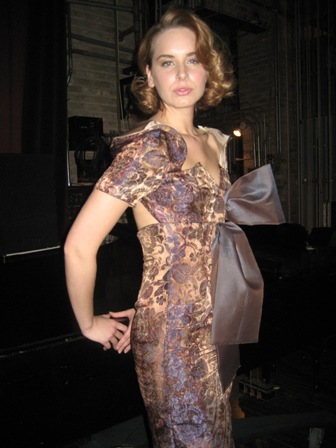
    The above dress is by Amanda Christine, who seems to be
    gaining more and more momentum as well as a fan base. You can buy her clothes
    at Cliché, mind you.


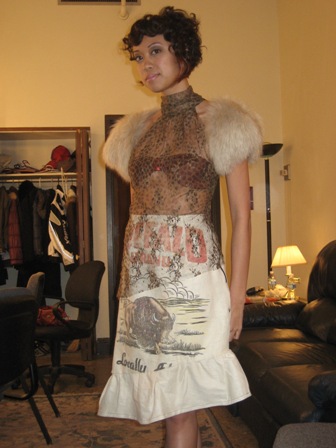
    This ensemble seemed fairly characteristic of designer Laura
    Fulk
    –what with the asymmetrical cuts and juxtaposition of fabrics. However, I found
    it to be much more feminine than her previous work, probably because of the
    transparent top and the fur shrug.


    George Moskal is genius. It’s as if he innately knows how to
    flatter the female form. Here’s something I recently learned (through the
    grapevine) about him: His day job is designing Liz Lange maternity clothes for Target.
    Suddenly I see why the tent dresses jump to me from the clearance
    racks.


    And finally, here’s what’s new from Katherine Gerdes, who is
    still up to her old tricks as far as draping goes. However, she’s added a new
    twist, as you see here: hand dying the jersey fabrics.