Author: Brad Zellar

  • If You'd Be So Kind

    dankert-sleepless.jpg

    James Dankert

    I need some new links. I love most of the folks over there in the column to the left, but they’re all pretty much holdovers from my old site, and I’ve noticed lately that some of them are no longer active –a lot of them, actually, which I’m sure is a reflection of the often frustrating disparity between labor and reward that dooms so many excellent internet galleries or ‘zines.

    I’ve often pointed out how much I despise the term “blog.” I’m no longer quite sure why, other than that it means too many different things, and is a homely word. Lately, of course, blogs have made all sorts of news, most of which I’ve paid little or no attention to. When what people call the mainstream media starts talking about blogs, they’re virtually always talking about the Rock ’em-Sock ’em Robots world of political blogs. Many such sites are virtuous and even indispensable (i.e. Cursor, Daily Kos, Wonkette, and This Modern World), but though we may all be first and foremost political animals, however helplessly, I’m afraid I lack the spine to absorb the constant (daily, hourly, minute by minute) reminders of what wretched and ineffectual creatures human beings can be.

    I’ll beat you to the punch: I’m fully aware that this thing (see lengthy official title above) is one more such reminder, albeit a reminder in the abstract, wearing the threadbare clothes of the microcosmic, the prosaic, the down-on-his-luck sidewalk fire breather or the bedraggled and gibbering organ grinder. I’m down in the basement building ships in bottles while upstairs my family starves from malnutrition and neglect.

    I love people who build ships in bottles, though. I love, and am entertained by, too many things, even if there never seem to be enough of them to keep me entertained. I’m easily bored, and the internet is easily boring. I don’t have the slightest idea how to go looking for the things that might keep me entertained. In a perfect world I would have a curatorial office in a giant warehouse somewhere –a building that would be equal parts natural history and science museum, art gallery, rag and bone shop, and library– and I would have a team of interns and assistants who would come to my office each day laden with items of interest for my inspection. These people would understand that I am severely deficient in attention, attracted to all manner of peculiarity, and an incurable dilettante.

    I don’t live in that perfect world, but I’ve never stopped dreaming of it. And, strangely enough, people do come to me –not each day, but often enough– laden with the sort of odd and beautiful wonders that sustain me in what feels more and more like a vigil. I’m always waiting for something more, connections, voices or objects that stir something in me, minor miracles, visits from entertaining madmen and oracles; I’m always hoping that when I open an atlas I will find its pages teeming with new countries, strange roads, entire worlds of the wholly unfamiliar. Every time I crack the pages of a dictionary my secret wish is that all the words will suddenly be transformed into a language understood by no one on the planet but me and a small group of my closest associates.

    I’ve said before that my goal as a child was to create my own set of encyclopedias comprised entirely of entries on everything that had ever, however momentarily, claimed my attention, made my head spin, or given me a feeling of wonder or joy. Things that give me happiness literally make me leap around; when I am delighted my response is to try to leap as far from the surface of this planet as I possibly can, and when I am extremely delighted I can hurl myself again and again –straight up or, occasionally, at forty-five degree angles– into the air. I suppose I’m attempting to fly, or to “slip the surly bonds of earth,” as Ronald Reagan once said, cribbing the words of a dead World War II Canadian airman.

    You can make me leap by sending along sites that might be of interest to me (and, certainly, to you), or that you think would make worthy additions to my list of links. I’m going to go through there sometime soon and reluctantly prune away all the dead branches. If you haven’t taken the time to explore what’s over there, I’d recommend that you do so. There are lots of people and places there that make me happy on a regular basis, people and places like Big Happy Funhouse, letting loose with the leptard, Life in the Present, Paul Collins, The Minor Fall, The Major Lift, wood s lot, Glubibulga, and Word Shadows.

    Just today I discovered two more sites that I’ll be adding to my encyclopedia: the wonderful Village Eclair, and my pal Peter Schilling’s latest venture (a remodeled version of a lamented former venture), The Bug. Violet Horvath at Village Eclair has a voice that sounds like the sort of disembodied voices that comfort me at four a.m., and Peter would almost certainly be one of my associates in that museum of my dreams.

    I should also mention that this site is merely an offshore subsidiary of the magazine I write for, The Rake. It’s a pretty damn good magazine, I think, and you should make a point of checking it out and letting me (or us) know how you think it could be better.

  • Uncle Jumbo's Playground

    uncle jumbo 2.jpg

    –Illustration by James Dankert

    Here’s the deal: years ago —years ago– I spent a few holiday seasons working at one of those sausage and cheese kiosks at a local mall. I did this, as I do most things, purely out of laziness. The employee discount was attractive to me at the time, and I thought: How hard could it be to sell sausage?

    Pretty damn hard, actually, but thank God I wasn’t getting paid a commission. Six-and-half bucks an hour, straight up, which was like free money for sitting on my kiester all day with my nose stuck in a book. I have no idea how those places stay in business year after year, to be honest with you. I suppose the key to their survival is the fact that their customers are even lazier than I am –people who need some gift for somebody they don’t have any actual feelings for. Lazy bastards and senior citizens, that was basically the clientele for holiday sausage and cheese assortments. Apparently nothing says Merry Christmas to old folks quite like sausage and cheese. Lest you think I’m passing judgment on anybody, I should mention that I love both sausage and cheese, am a lazy bastard, and gave everyone on my gift list a cheese ball and a giant roll of sausage every year I worked at this place.

    I mention this because though, as I said, this was many years ago, I’m constantly running into or hearing from people from my old hometown who say to me either, “I hear you’re selling sausage,” or “Are you still selling sausage?” This misconception has been propagated by my mother for over a decade. Granted, I have a sketchy job history and have worked many, many terrible and insignificant jobs, and I probably can’t expect my mother to stay on top of my employment status. For the life of me, though, I can’t understand why she continues to tell people that I’m selling sausage. For the last several years I’ve told her I’m in building administration, but for some reason it doesn’t stick.

    That ‘some reason,’ if I’m going to be honest with myself, is that my mother is batshit crazy.

    Anyway, I called into sick at work yesterday so I could take in the game against the Royals at the Dome. I have not been in a good mood the last week, and for six months of the year my moods are almost entirely dictated by the performance of the Twins. Zellar’s terrible, and I say this as someone who I suppose considers him my friend –my old man had a word for guys like Zellar: fullofbeans– but he’s at least done a serviceable job of documenting the ugliness of the last five games. You probably know all about it as well, but it’s one thing to know about something and quite another to see it in person and to have paid to see it.

    By the second inning of yesterday’s game I had seen enough, but I’ve never left a game early in my life and I wasn’t about to set a dangerous precedent. So I sat there fuming, getting more pissed off by the minute, and eventually, yes, I suppose I was bellowing. I don’t throw things, as much as I might like to sometimes, but I do shout, loudly, and perhaps I jerk around and gesture aggressively. There are times, I know, when I’m no longer truly aware of what I’m shouting, and I become oblivious to the presence of people around me.

    So yesterday I’m in the middle of what I guess you could call a fit when this woman in front of me turns around and says that I’m frightening her kids.

    “If your kids were actually paying attention to the game instead of running up and down the aisles and shoving shit in their faces they’d have even more reason to be frightened,” I said to her, or possibly shouted. At which point a guy seated nearby says, “Relax, fella, it’s just a game.”

    There is virtually nothing you could say to me in a baseball park that would make me blow a gasket quicker than, “It’s just a game.” I don’t have a clear memory of the particulars, but things got pretty ugly in a hurry. The yahoos out in the bleachers were turning on me in a hurry, but I had no intention of backing down. Next thing I know a security guy is jerking at my arm. “If you could just step out into the concourse for a moment,” he said.

    I was furious, but I followed him up the aisle, accompanied by the applause and jeering of the yokels around me. When we got to the top of the stairs I paused and turned around so as not to miss a pitch in my scorebook. The security guy was standing next to me, blathering some nonsense, when suddenly he stopped mid-sentence and said, “Don’t you work at the Hickory Farms at Rosedale?”

    Jesus,” I said. “I haven’t worked at that place in years. Are you from Blooming Void?”

    I couldn’t blame my mother this time. The security guy, it turned out, worked at a calendar kiosk opposite my sausage stand one year. He remembered that I used to sit there on my stool poring over the Baseball Encyclopedia. I guess this odd common ground must have cemented some sort of bond between us in his mind, because after making this connection he couldn’t have been a better shit about the commotion I caused, and he actually walked me around the concourse and let me sit in one of the empty seats above the bullpen.

    The rest of game was plenty ugly, but at least I didn’t have to lug a loss home with me. And now I’ll have the luxury of watching the games for the next week while sitting around my apartment in my underwear, drinking beer, screaming obscenities, and poisoning myself with frozen pizza and microwave chuckwagons from Super America.

  • Rockin' The Teflon Dump

    The guy who pumps the music through the Metrodome speakers during Twins games is a fellow by the name of Kevin Dutcher. I have no idea how much attention people pay to that sort of thing during baseball games, but I started noticing a few years ago that the selection of tunes at the Dome was surprisingly eclectic and hip compared to any other baseball stadium I’ve visited. I love the ballpark organ as much as anyone, and I’ll admit there are times when I still get nostalgic for the days at the old Met when Ronnie Newman provided the bulk of the musical entertainment.

    Newman died a couple years ago, but he still held down his post in the Dome’s organ loft pretty much right to the end, and though it sometimes gets lost in all the other stuff that now goes on during a baseball game the Twins did hire a replacement. These days, though, the bulk of the in-game music comes from Dutcher’s perch above the press box behind home plate.

    Whenever I ask people if they notice the music during Twins games all anyone seems to recall is that wretched anthem of peckerwood patriotism that turned the seventh-inning stretch into an interlude of absolute brain-squeezing torture. I don’t even remember the faux-sodbuster’s name who warbles the damn thing (repression can be a wonderful survival tool), but I can assure you that he’s basically ripping off the incomparable C.S. Lewis, Jr. from the late, great Mr. Show.

    If you aren’t paying attention, however, you’re missing some wonderful music. In the last year I’ve heard, among others, the Replacements, Outkast, Modest Mouse, the Ramones, Iggy Pop, Kiss, Chuck Berry, The Who, Devo, Weezer, the White Stripes, and Bush. That’s the sort of play list that’s earning MPR’s new The Current so much adoration (and cash). Dutcher, meanwhile, works in almost complete anonymity, and provides his own tunes to boot.

    Each member of the Twins has the opportunity to select what Dutcher calls their “walk-up music.” These are the songs that get played when a player’s name is announced in the on-deck circle. Some guys are apparently very picky; others don’t give a rat’s ass. Jacque Jones, for instance, provides Dutcher with a number of selections, and likes to mix things up from time to time. For the players who don’t have any particular preference Dutcher chooses something he thinks seems appropriate. Last season he picked Joe Mauer’s music, alternating Joe Walsh’s “Life’s Been Good” and the White Stripes’ “The Hardest Button,” the latter, Dutcher said, because he figured “a twenty-one-year-old kid should like the White Stripes.”

    I’ll run down the songs for this year’s starting line-up, and include some selections apparently beloved by former Twins, but first I’d like to make a personal plea to Ron Gardenhire: Gardie, please call your slumping third baseman into your office immediately and discuss with him what strikes me as a hugely inappropriate and emasculating song choice (OutKast’s “Behold A Lady”). This reminds me of the days when Dodger pitcher Robinson Checo’s appearances would be heralded by the playing of Simon and Garfunkel’s “Mrs. Robinson.” This, though, seems much, much worse.

    Here’s the line-up:

    Shannon Stewart: Last year Stewart used Usher’s “Yeah.” This season his walk-up music is an unnamed hip-hop instrumental that he provided to Dutcher.

    Jason Bartlett
    : LCD Soundsystem, “Daft Punk is Playing at My House.” (Dutcher’s selection.)

    Joe Mauer: The Game, “How We Do.” (Never heard of it.)

    Justin Morneau: AC/DC, “Back in Black.” (Same as last year.)

    Torii Hunter: Bonecrusher, “Never Scared.” (Same as last year.)

    Jacque Jones: The Game, “Where I’m From.” Juvenile, “Bounce Back.” T.I., “Bring ‘Em Out.” (Dutcher: “Jacque likes variety and is very specific about his music.”)

    Lew Ford: Tree 63, “Treasure.” (A Christian rock song, if I’m not mistaken.)

    Michael Cuddyer: OutKast, “Behold A Lady.” (See above. Suggested inappropriate alternates: “Three Times A Lady,” “Dude Looks Like a Lady,” “Pretty Woman,” and “Lady Sings the Blues.”)

    Luis Rivas: Petey Pablo, “Freek-A-Leek.” (Dutcher’s selection. Suggested nicknames for Rivas: Petey Pablo and Freek-A-Leek.)

    Matthew LeCroy: Charlie Daniels Band, “South’s Gonna Do It Again.”

    You might recall that jaunty little Latin number that accompanied Cristian Guzman to the plate during his last several years here. For those who might wish to recreate those wonderful memories in the privacy of their own homes, the song is called “Fiesta Mora,” by Alabina, and is from a CD called “Sexy Latin Beats.”

    Corey Koskie’s song was Rush’s “Tom Sawyer,” and, sometimes, a tune called “Joy” by a Christian rock group whose name Dutcher did not recall. Eddie Guardado, of course, took the mound to AC/DC’s booming “Thunderstruck.” Joe Nathan’s warm-up music features “Stand Up and Shout,” by the fictional band Steel Dragon (vocals by Sammy Hagar) from the “Rock Star” soundtrack, mashed with Big Head Todd’s version of John Lee Hooker’s “Boom Boom.”

    There you have it. Somebody please burn me a CD of this schizoid mix so I can drive my wife bananas on road trips. I’d also be delighted to entertain suggestions for alternate selections –perhaps something you think might be more appropriate– for any of the above named players. Or any players, period, I guess. What would Ted Williams’ walk-up music be, I wonder? What was Ron Coomer’s? What should it have been?

    Oh, lord, the possibilities are endless.

  • Fragmented Transmission From A Ghost Satellite

    belljar.jpg

    The head running slow, churning, moving up a long, steep hill in the last hours of darkness. Already a few early birds, noisy, to keep me company.

    Here, take a look at my disaster movie, my shoebox full of footnotes, my personal wasteland. All my sleepless nights. While you are sleeping, while you are dreaming, I am still on my feet, moving from table to table with a pen in my hand, taking orders in a language I can no longer understand.

    You’d think the confusion would be condensed, but you’d be wrong. You’d think you’d eventually find your way into some kind of clearing, or perhaps even a long valley with a wide river. You’d think the middle of the night would be the mind’s Big Sky Country. Wrong again. I keep hearing astronauts in my right ear, lost, forlorn, the transmission fractured and breaking up. Sometimes their exhausted sorrow sounds almost like yodeling.

    It wasn’t an astronaut, but a truck driver who once told me, “Where there’s gasoline a fella can usually find him some pussy.” I’ve never attempted to corroborate that statement, but I have discovered that where there’s gasoline a fella can usually find him some beef jerky.

    My God, I get tired of dinosaurs, stomping all over automobiles and knocking over patio furniture with their tails. Seriously, all I’ve ever wanted is to know my shit.

    I cooked a burrito in a microwave oven. There was little pleasure involved in this procedure, very little pleasure. (“Make your own leaps.” —P. Metcalf.) Cue singing of angels. Believe me, I know a little something about neutral objects. I raise rubber children in tiny jars.

    No getting around it: you have mostly chosen. Others might find more peace, or consolation, in a revelation like that, if, in fact, you’d like to call it a revelation. They keep making the hole bigger, so you can swallow more, so you can bury more in the hole. There are moments when you can literally feel the earth tilt beneath you, your heart swaying dully in your chest like an empty bell. Ladies and gentlemen, I am not going to stand here and sugarcoat it. I am simply unable. I can find nothing positive whatsoever to say about recent events in the region. I’m afraid it’s the same old story: lame fucking white men, many of them grossly overweight, swinging sledge hammers.

    There it is, there’s the familiar thump of the newspaper at the front door.

    Something crippled and almost recognizable creeps towards you with the first bruise of light from the east. Come on now, kiss your fat little fable goodnight and let’s just see if it wakes up still resembling truth.

  • Lord Have Mercy

    I’m not even going to bother to try to reconstruct the haywire play-by-play from the last four games. I was intending to go back over the game logs at some point tonight, but the prospect is frankly just too exhausting at the moment. All I know for sure is that I saw more variations of ugly than you’re likely to see this side of the Deliverance wrap party. Somebody out there will know how many times the Twins had the bases loaded over that stretch, and how many runs they managed to get out of those situations. I’ll just take a wild stab for the hell of it: the Twins had the bases loaded twenty-five times and scored one run. I think that’s right.

    This I do know, though, because all I have to do is look at the boxscores: Four games, thirty-seven hits, fifteen walks, thirty-eight runners left on base, nine double plays hit into, eleven runs scored, and a 1-3 record. Folks, I know it’s a difficult game, but it’s hard to do what the Twins have been doing (or hard to not do what the Twins haven’t been doing?). Something like that.

    Look on the bright side, though. Seriously, have you looked at the pitching numbers for Johan Santana specifically, and the pitching staff in general? Johan has now struck-out thirty-seven batters while walking two. Those are Dennis Eckersley numbers, from when Eckersley was a reliever. It’s unreal. And it’s not just Santana. The entire staff has walked sixteen and struck-out ninety-four. Juan Rincon’s strikeouts to innings pitched ratio has got to be inching up there close to Santana territory. (Okay, I just looked: Rincon’s K/9 –15.00– is actually better than Santana’s –13.50.)

    I don’t know how to explain all the home runs Johan’s given up so far, other than just to remember that it’s still early, he was lousy for the first month or so last year, and the league’s got a much better idea of how he operates. There’s also the Joe Mauer factor. Henry Blanco was a very good signal caller, and the pitchers raved about him all last season. I don’t know how long it’ll take Mauer to get a good handle on the batters around the league, and maybe right now they’re calling most of the pitches from the dugout. I don’t think so, though. All I know is that if you could throw back half the homers Twins starters have allowed –and there have been a lot of two- and three-run shots– we wouldn’t even be talking about all those stranded runners and double plays.

    Well, we’d probably still be talking about them, or bitching about them, but we’d pretty much be nit-picking. I’m not going to do too much bitching tonight, however, consternated as I am, because I got an earful all night from my pal Jumbo, and I know only too well how tiresome it is to listen to somebody piss and moan. I actually got up and switched seats in the middle innings because I’d had enough of his bellowing. I’m sure you’ll hear all about it on Friday.

    Tomorrow I’ll give you the rundown on the tunes that escort each of the Twins from the on-deck circle to home plate, most of them personal selections. I’ll also, finally, assign an artist and a title to that damn song they played for Cristian Guzman the last couple years he was here. I think you know the one. I’m pretty sure, in fact, that you could hum it right now.

  • Straight From The Bedstand of MC Z-Diggedy-Dawg

    moon-j.a.whipple-harvard.jpg

    –J.A. Whipple, early daguerreotype of the moon. February 26, 1852. From the Harvard Daguerreotype Collection.

    People who frequent low drinking resorts eight nights a week are liable to get –vulgarity says it best– they get fucked up. They are assaulted by too much truth and, at the same time, too many lies; they lose their sense of proportion, of balance; their vision of reality is chronically blurred by alcohol and elation and hangover and depression; they get manic, they are at turns garrulous and quarrelsome, their dispositions sour, they fight among themselves over imagined slights and shadowy suspicions; in the dark of their minds they brood upon mortality and, worse, upon the death of love. A dreadful affliction, all in all….

    Ed McClanahan, Famous People I Have Known. 1986, Penguin Books

    While we ate we talked. People say that conversation is a lost art: how often I have wished it were.

    American girls are getting larger all the time, and she was a woman of the future.

    Randall Jarrell, Pictures From An Institution. 1954, University of Chicago Press

    In the mid-centre of America a man can go blank for a long, long time. There is no community to give him life; so he can get lost as if he were in a jungle. No one will pay any attention. He can simply be as lost as if he had gone into the heart of an empty continent. A sensitive child can be lost too amidst all the emptiness and ghostliness. I am filled with terror when I think of the emptiness and ghostliness of mid-America. The rigors of conquest have made us spiritually insulated against human values. No fund of instinct and experience has been accumulated, and each generation seems to be more impoverished than the last.

    Meridel LeSueur, “Corn Village”

    It is of little use trying to suppress terrorism if the production of deadly devices continues to be deemed a legitimate employment of man’s creative powers. Nor can the fight against pollution be successful if the patterns of production and consumption continue to be of a scale, a complexity, and a degree of violence which, as is becoming more and more apparent, do not fit into the laws of the universe, to which man is just as subject as the rest of creation.

    E.F. Schumacher, Small is Beautiful. 1973, Perennial Library

    The council, which assembled on this occasion, was conspicuous for the absence of the essential thing known among the common people as common sense. In general, we somehow don’t seem to be made for representative assemblies.

    …after organizing some charitable society for the benefit of the poor and subscribing a considerable sum, we at once gave a dinner to the prominent dignitaries of the town in honor of so laudable an undertaking and, needless to say, spend half of the subscribed funds on it; with what is left of the money we at once rent magnificent offices with heating facilities and porters for the members of the committee, and all that is left for the poor is five and a half rubles, and even over the distribution of this sum the members cannot agree.

    Nikolai Gogol, Dead Souls. 1842, Penguin Classics

    Fortunately, or unfortunately as the case may be, most chimpanzees, in fact all that have been observed, persist in being good chimpanzees, and do not become quasi-human morons. Nevertheless I think that the average psychologist is rather longingly hoping for that chimpanzee who will disgrace his simian ancestry by adhering to more human modes of conduct.

    Norbert Wiener, The Human Use of Human Beings. 1950, Avon/Discus

    What a country calls its its vital economic interests are not the same things which allow its citizens to live, but the things which enable it to make war. Gasoline is much more likely than wheat to be a cause of international conflict.

    Simone Weil, The Need For Roots. 1949, Beacon Press

  • That Hauntingly Familiar Ugly Math

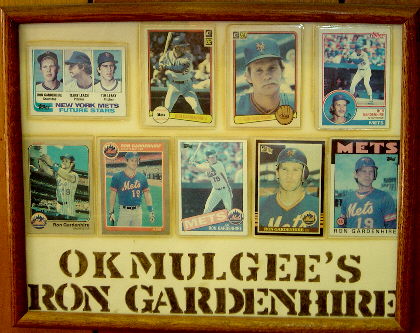
    gardenhire 8.jpg

    –Ralph’s Barber Shop, Okmulgee, Oklahoma

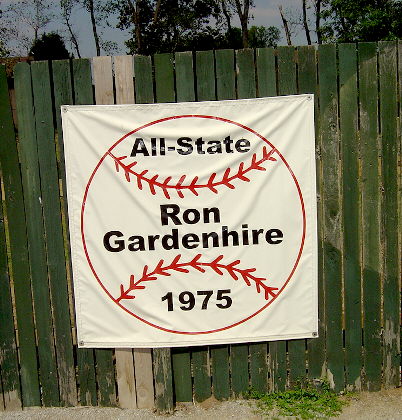
    gardenhire 3.jpg

    –Bateman Park, Okmulgee, OK

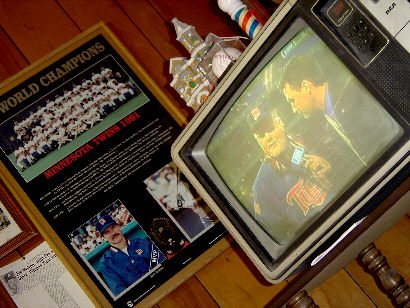
    gardenhire 6.jpg

    On the tube in Ralph’s Barber Shop, Okmulgee, OK: Twins clinch 2004 Central Division title

    It shouldn’t be possible for nine hits, seven walks, and a hit batter to add up to four runs. That’s the sort of line the Twins regularly threw up last year when they were scuffling to score runs.

    Compare the runners left on base for the White Sox tonight (one) with the number of stranded Twins (ten) and you pretty much have the story of the game. It didn’t help, of course, that Kyle Lohse gave up a couple of two-run homers and a solo shot.

    It’s actually more frustrating for me to watch Lohse right now then it was last year, when he was so clearly battling himself and his coaching staff. This year I think we’re seeing a guy who’s doing his damnedest to get with the program and really learn to pitch, but after years of refusing to see himself as anything but a fastball/slider power pitcher, Lohse’s attempts at an on-the-job transformation to a four-pitch guy are probably going to hit some pockets of turbulence in the early going.

    Lohse was obviously trying to mix in his curveball and change-up tonight, but you can tell the confidence isn’t quite there with either pitch yet. As Bert Blyleven could tell him (and Carl Everett, for that matter), the curveball can be a very effective pitch, but if you hang one it’s generally going to get mashed. You’ve got to learn to forget those mistakes in a hurry. Late last season, those hanging curveballs that got knocked out of the park made a pretty dark impression on Lohse, and he went through an angry stretch where he was stubbornly resisting Rick Anderson’s attempts to get him to alter the approach that had helped him to win 27 games between 2002-03.

    One of the things Anderson talks about a lot is what a challenge it is to get guys who’ve gotten attention since they were in high school for being able to throw ninety miles-an-hour to recognize how effective a 75- to 83-mph offspeed pitch can be. Why should a guy who can throw 93 serve up a 75-mph breaking ball to a major league hitter?

    Lohse is learning, it seems to me, and though he’s getting punished for his mistakes you’re not seeing guys just sitting on his fastball and racking up huge innings like we saw so often last year. He still needs to figure out the best situations to throw that offspeed stuff, and to which batters. His book on hitters for the last four years is being essentially re-written series by series, and if he’s going to stick to this new approach and not get frustrated (which so far, anyway, all indications are that he hasn’t), he’s also going to have to recognize that in many ways he’s starting over –or at the very least making some major adjustments and trying to alter the type of pitcher he’s going to be from here on out. The encouraging note so far is that he’s only walked two batters in his first three starts of the year, this after issuing 76 free passes last year. His strikeout totals are also down from 2004, but that’s to be expected as he dicks around with his repertoire.

    I still believe Lohse’s going to end up pitching close to 200 innings for the Twins this year, and I just predicted to somebody today that he’ll finish second on the staff with sixteen victories.

    During the last homestand Lohse talked about his need to be patient, and I just hope the Twins’ staff will be patient with him in return. At the very least, he continues to have real value to the organization. If some of the arms in Rochester prove to be ready later this summer, Lohse would almost certainly generate trade interest from any number of teams.

  • Deconstructing Laser Floyd—Stone Sober!

    One might think that the Pink Floyd Laser Spectacular would be a disorienting experience for someone with eighteen years of sobriety under his belt and only the haziest recollections of unnumbered adolescent evenings spent hunched over a power-hitter and listening to Dark Side of the Moon on the eight-track player of a 1972 Cougar.

    That was our assumption the other day as we prepared to attend Laser Floyd at the State Theatre. We’ll admit to certain hardwired preconceptions regarding Pink Floyd and Pink Floyd fans, and we’ve also heard a few things about lasers. Given this admittedly sketchy background, we had reason to fear some at least mild psychological disturbance, if not outright flashbacks and seizures.

    Precisely to bolster us against such fears, we felt it prudent to choose an appropriately seasoned chaperone to accompany us, someone whose own drug experiences and knowledge of the Pink Floyd catalog was a bit more up to date, shall we say. We’re not ashamed to acknowledge that our personal phone directory is full of candidates whose credentials on both these counts are impeccable, but the clear front-runner to play Virgil to our Dante for the Laser Spectacular was our old friend and occasional bookkeeper, Dutch Gaines.

    We were unsurprised by Dutch’s enthusiasm for our proposition, even as we were nonetheless unprepared for the advanced state of torpor in which we found him—enshrouded in smoke and listening to Jim Reeves’s version of “Gentle on My Mind”—when we arrived at his basement apartment.
    This alarming spectacle made it abundantly clear that we would be chaperoning Dutch to the Laser Spectacular, rather than the other way around. So obviously indisposed was Dutch that when we eventually managed to steer him into the lobby of the theater and immediately encountered a booth for the National Organization for the Reform of Marijuana Laws, the do-ragged caretaker of the booth took one look in our direction and bawled, “Lots of weed smokers here tonight!”

    For those who might be unfamiliar with the Pink Floyd Laser Spectacular, it is, according to its website, the “longest touring theater show in history!” The phenomenon has spawned a host of imitators (e.g. Laser Nirvana, Laser Zeppelin) in its eighteen years on the road, but, we are assured, it remains the undisputed king of all laser shows. Judging by the steady emission of satisfied chortles and dissonant bleats we noted from our companion, we feel it’s safe to say that Dutch would soundly endorse this contention.

    But we’re getting ahead of ourselves. A few words of advice: When you have a chance to check out the P.F.L.S. in the future, fork over the two bucks for the 3D glasses. Thus goggled, we discovered that even the theater’s exit lights were positively lysergic, and the uniform weirdness of the things only added to the goofy esprit de corps.

    The show itself really is quite a lot to process, and frankly we had a hard time fathoming how anyone with smoldering brain cells and crackling synapses could handle the multi-tiered assault. Dutch was so fully engaged in the experience that he was of little help with the set list. Near as we could tell, however, the evening’s first half featured the entirety of Dark Side of the Moon, blasted at maximum volume (never mind the decibels, this was ten thousand watts), while the battery of lasers cut through clouds of smoke, and strange imagery was projected onto three huge screens on the stage. There was a good deal of footage from The Wizard of Oz, and as we were unfamiliar with the theories regarding the alleged synchronicity of Dark Side with that film, we’ll admit to finding these juxtapositions at times somewhat confusing and unsettling. The computer-generated imagery resembled everything from colorful Spirograph doodles to Spin Art, and there were plenty of moody interludes that featured various flying things (including a bloated, sexless baby) and religious iconography transposed over what appeared to be vats of bubbling pudding; tornadic bursts of blood; protoplasm sloshing around in a skull; and video footage of a colonoscopy. An androgynous moon-man with perfectly shaped buttocks and a bottle of whiskey did an interpretive dance, rode on a merry-go-round, and played a trumpet. Things sometimes got vaguely erotic; we were frequently dazzled.

    The audience seemed comfortably numb but did manage the occasional collective gasp or burst of applause, often at oddly inexplicable moments. As for Dutch, he didn’t end up being of much use other than as a spectacle of slack appreciation. His commentary on the evening consisted of exactly two full utterances, one for each set of the show. The first, during an early segment from Dark Side, was, “This is like a really incredible screen saver.” The second came as “Learning to Fly” pulsed through the speakers—or perhaps it was “Run Like Hell.”

    “Pink Floyd,” Dutch leaned over and observed helpfully, “is all about containment and freedom.”—Brad Zellar

  • Discomfort Food

    My dad loved a buffet, or, as we used to call them growing up in Minnesota, a smorgasbord. These giant, mind-blowing restaurant spreads were still something of a novelty for a Midwestern kid in the 1960s, even if the basic concept wasn’t that far removed from those familiar church basement potluck suppers and extended family gatherings where everybody brought dishes to share. Still, dining out was a special experience in our family, and as kids we marveled at the sheer excess, variety, and freedom of choice afforded by the all-you-can-eat buffet. We looked forward to our infrequent trips to the Twin Cities, when we would often be treated to a local smorgasbord. There was something so exotic and decadent about these meals, which were almost ridiculously copious in comparison with the more modest and even spartan fare we were accustomed to at home. The basic components of the Midwestern buffet haven’t changed much in thirty years: a selection of meats, tubs of congealing condiments, mystery casseroles, and the kinds of frothy and fluorescent fruit salads that might plausibly be classified as plebian exotica.

    My father never did get tired of buffets, but for the rest of us, I think, our enjoyment of the experience was forever ruined the day my brother threw up in the serving line at the old Jolly Troll Smorgasbord in Golden Valley. There were plenty of painless potlucks and trips through even the most unappetizing of buffet lines in the years that followed my brother’s humiliation; but at some point I acquired a profound fear of anything suggestive of a buffet. For a number of years now, the gag reflex has been my helpless reaction to such mass assembly-line productions of food prepared by an army of strangers and displayed like exhibits in a criminal trial. Even a stolen glance at the mounded plates of my table neighbors can summon a wave of nausea.

    I am not exaggerating, nor am I being a snob. My misery is very real. And I know from unscientific research and purely anecdotal experience that I am not alone. I’m going to make the brazen and perhaps crazy assumption that there are thousands, if not millions, of others out there who share my pain, although, as far as I’m aware, this affliction—let’s call it Buffet Syndrome—has never been properly diagnosed or understood.

    Perhaps this fear is psychosomatic, a manifestation of my soul sickness with general American sprawl and our culture of conspicuous consumption. For what, really, is an all-you-can-eat buffet but a sort of culinary strip mall, an arcade of debased appetites, and a microcosm of the culture’s infatuation with the gargantuan?

    Like so many other things that repulse me, buffets are a personal fascination. I am eager to understand why it is that something that obviously gives pleasure to so many other Americans causes me such distress. It would be easy enough to see in my revulsion some instinctive class reaction. Buffets, after all, seem like solidly proletarian feeding grounds. But those are my people; I come from that world, and I’m an otherwise entirely undiscriminating eater. I’m almost as uncomfortable dining in a fine restaurant as I am standing in a buffet line—although my discomfort there is a product of class, fueled almost entirely by feelings of being an interloper. And certainly the displays of gluttony you occasionally see in, say, the Four Seasons are every bit as offensive as the scrums that can occur at an all-you-can-eat buffet.

    Whatever its origins, I resolved to conquer this fear of the buffet, and to tackle the problem by adopting the G. Gordon Liddy approach. Liddy, you may recall, tried to overcome a childhood fear of rats by capturing one, and cooking and eating it. My own strategy would not be quite so drastic. I would dine at the Old Country Buffet.

    It took quite a long time to actually carry through this decision, however. I procrastinated for many months, then spent several more weeks trying to talk myself into driving to an Old Country Buffet near my home. I also lobbied my wife, numerous friends, acquaintances, and food experts to accompany me, with no success. Even the prospect of a free dinner, not to mention the additional “all-you-can-eat” enticement, wasn’t enough to persuade even my most undiscriminating friends. I would, I realized with growing trepidation, have to go it alone.

    “Certainly it is now unfashionable to overeat in public,” M.F.K. Fisher observed in An Alphabet for Gourmets. “It is safe to say, I think, that never again in our civilization will gluttony be condoned, much less socially accepted, as it was at the height of Roman decadence, when a vomitorium was as necessary a part of any well-appointed home as a powder room is today, and throat ticklers were as common as our Kleenex.”

    Fisher was writing those words in the wake of the privations brought about as a result of the Great Depression and the Second World War, and one can only wonder what she would make of gluttony’s triumphant comeback in America.

    These days, of course, the buffet is a staple feature of many tourist towns, cruise ships, and restaurants, from those offering standard cafeteria-style cooking to neighborhood and strip-mall establishments serving up luncheon troughs of all manner of ethnic fare. For those averse to the steam tables with their crusted and curdled offerings, the lumpen grotesqueries of the serving line, and the small comfort of the sneeze guard, these ubiquitous monuments to American appetite and excess are an unavoidable horror. God help any of them who might venture to this country’s playgrounds of the lowest common denominator—Las Vegas, Branson, the Wisconsin Dells. In such places it’s appallingly clear that the buffet is the prototypical intersection of natural human gluttony and American vulgarity.

    I don’t much enjoy the experience of watching other people eat, yet I’m nonetheless a helpless voyeur in restaurants. People are so vulnerable when they’re shoveling food into their faces, so exposed; eating is raw psychology in one of its purest forms, and it can make for a shocking, even bruising spectacle. Perhaps, however, I’m projecting. After watching people eat for so many years I’ve become a self-conscious eater myself, uncomfortable dining in a room full of strangers. The buffet, of course, ups the ante all around. Its atavistic, herds-and-hordes approach elevates eating to the level of a Darwinian competition and a grotesque spectator sport. As a dining experience, a buffet can be social to the point of bacchanalian (large, loud groups) and yet also almost heartbreakingly lonely (solitary diners alone with their hunger). There are additional aggravations: the forced camaraderie of the serving line, the ogling and probing of the selections, the shared utensils and hands of strangers shoveling divots in the vats of mashed potatoes and creamed corn.

    Then, of course, there are the old mysteries, the sense in which the buffet, as a throwback to those church basement potlucks and family gatherings, is an archive of food memories and appetites: mounds of pastel fluff, gelatin cubes the color of ox blood, some frenzied-looking concoction of raisins and shredded carrots, casseroles concealed beneath a crust of what appears to be baked sawdust and laminated cheese, and meatballs that look as if they have been boiled in formaldehyde. And finally, there are the participants (there seems to be no other word for the buffet habitué): the true gluttons who gracelessly negotiate the aisles with impossibly loaded plates; the timid spinsters with their tiny portions of cottage cheese and fruit salad; the feral children making ugly collages on their plates.

    Naturally, this whole phenomenon terrifies most nutritionists. In a culture where rampant obesity and all manner of unchecked appetites war constantly with the mixed messages from the health and beauty industries and the harsh, guilt-tripping realities of global starvation, the all-you-can-eat ethos is a powerful and malleable metaphor for American
    immodesty, disproportion, solipsism, and insecurity. When you’re on deck in a buffet line, staring down the lineup of food stretching away before you, do you feel a sense of weakness or power? What, really, does “all you can eat” mean to you? While on the one hand those words are a generous invitation of sorts, there’s also no doubt that the phrase poses an open challenge for many. It also stokes the average American’s fierce desire to get the biggest possible bang for their buck. For some people, the basic convenience and economy of the buffet make it an easy and affordable dining choice, particularly for senior citizens and families with children. For others, it represents a grim expedition of pure endurance eating, a sort of unofficial arena for culinary gladiators.

    There certainly seem to be a number of biblical injunctions against the various sins and indiscretions that might be committed at the buffet. Gluttony is, after all, a deadly sin, the violation of which, according to Dante, carries a harsher punishment in the afterlife than unchecked sexual appetites. It is also, as Francine Prose has noted, the only sin whose effects are prominently written on the body. And a buffet can be a terrible temptation to even the most restrained of omnivores. I don’t doubt that it is possible to violate all seven of the deadly sins at, say, one of those free (and free-for-all) steam-table spreads laid out at company holiday parties or media events or casinos. It could be that the feat has already been accomplished, perhaps on countless occasions. I have often enough witnessed the riot of appetite, the cutthroat competition in the serving line, the heaping plates of mismatched food, the anger over missed opportunities, and the post-buffet torpor. I have seen sated buffet vultures splayed at tables amid the ruins of their repast, looking for all the world like bleary-eyed Yanomamo tribesmen in a stupor brought on by the snorting of powerful jungle hallucinogens.

    In March 2004, there was a much-publicized buffet melee at a senior citizens’ home in Winter Haven, Florida. An eighty-six-year-old resident took umbrage at another man’s handling of salad bar offerings with his fingers. Words were exchanged, punches were thrown, someone was eventually bitten, and three seniors were taken to a hospital for treatment. I’m sure it was only the advanced age of the combatants that elevated this otherwise surely not uncommon story to the status of national news. I imagine that it’s only a matter of time until the phrase “buffet melee” becomes a staple of the American vernacular, and trips as comfortably from the tongue as “road rage.”

    Some people credit a man named Herb McDonald with creating America’s first all-you-can-eat buffet. This was in Las Vegas in the late 1940s, and McDonald, a legendary publicist and civic booster, introduced his innovation at El Rancho, the first hotel on the Vegas Strip. El Rancho’s One Dollar Chuckwagon Midnight Buffet, or the Buckaroo Chuck as it came to be known, was immensely popular and widely imitated. It promised “every possible variety of hot and cold entrees to appease the howling coyote in your innards in the late night-predawn hours … everything you can eat, and you’ll want it all.” There are those who would challenge Herb McDonald’s claim as America’s pioneer buffeteer, however, giving the honor instead to Norman Asing, who was the proprietor of the first Chinese restaurant in the country, Macao and Woosung. That establishment opened in 1849 in California. Almost one hundred years before the El Rancho launched its Buckaroo Chuck, Asing is said to have offered his customers an all-you-can-eat Chinese buffet, also for a buck a pop.

    Today, the undisputed king of the all-you-can-eat concept is Buffets Inc., the Eagan-based behemoth that operates 376 restaurants in thirty-seven states, including 176 Old Country Buffets. Roe Hatlen and C. Dennis Scott, veterans of the buffet business, founded the company in 1983, and it is now the thirteenth largest restaurant chain in America.

    The original Old Country Buffet, the company’s flagship restaurant, is still located in Richfield, in the middle of a warren of typical suburban development. I eventually summoned the courage to venture out to Richfield on a Thursday night. The parking lot was packed, which served only to increase my anxiety. Inside the restaurant, I discovered that the cashier’s station is situated at the end of a long hallway, which is separated from the dining area by a sort of retaining wall. One gains admission to Old Country Buffet by paying the cashier in advance (an adult dinner costs $9.57) and receiving a ticket, after which you pretty much have the run of the place.

    I took a small booth along a divider in the middle of the room, and immediately assumed what I felt was the appropriately abject posture for someone who dines alone at an all-you-can-eat buffet. A giant bee was wandering the dining room, dispensing balloons to children. This, it turned out, was O-C-Bee, the company mascot, and it was family night at Old Country Buffet. A woman was painting children’s faces and applying temporary tattoos—dragons, tigers, that sort of thing—to tiny hands and arms. I was struck by the astonishing diversity of the clientele; in fact, I’ve never encountered such a broad cross section of melting-pot demographics anyplace in Minnesota. Virtually every ethnic group in the Twin Cities was represented, often by large, double-digit gatherings that spilled across random clusters of tables.

    There were also couples of all ages, most prominently seniors, and small parties of younger men, as well as a surprising number of solo diners like me. These were mostly male, and many of them gave off a distinct Travis Bickel vibe. One guy who was seated at a table adjacent to mine wore camouflage pants and an oversized vinyl parka with a fur-lined hood, and when one of the restaurant employees stopped by to gather up some of his empty plates, I heard him remark, “The pain takes all my energy.”

    Surely for many of the immigrants and seniors, the excesses of Old Country Buffet are all the more impressive given shared memories of privations endured and whatever conflated version of the American Dream they might have once harbored. It’s sort of a modern version of Cockaigne, the mythical land of plenty that provided a vision of abundance and leisure for exhausted, overworked peasants in the Middle Ages. In Cockaigne, every day was a festival of idleness and satiety, with mountains of cheese, cooked geese falling from the sky, and roasted pigs wandering the village begging to be eaten.

    The décor at Old Country Buffet is deliberately low-key, down-home Americana, with lots of wood veneer, muted colors, and Norman Rockwell prints on the walls. The large dining room is broken up by low, unobtrusive partitions that allow smaller parties to have a modicum of privacy. Even on a crowded night the din of the place was as muted as the color scheme.

    I had deliberately avoided the serving stations when I came in. I needed to get acclimated, to study the lay of the land and steel myself for my first tentative sortie to the actual buffet.

    Thankfully, OCB had a sort of buffet counselor on hand, in the form of Cathy Milota, the Richfield restaurant’s Community Representative. After I got settled in my booth, I noticed her, an attractive and amiable older woman who was working the room, chatting up the patrons at their tables. It was apparent that many of them were on familiar terms with Milota, and it didn’t take her long to zoom in on the novice in her midst.

    It turns out that every Old Country Buffet has its own Community Representative, whose job is to serve as an educational and marketing goodwill ambassador for the restaurant. It was plenty clear that Milota is good at her job and relishes the opportunity to provide support and guidance to even the most buffet-phobic of customers. Though she spends much of her time actually out in the community, s
    hepherding the company’s literacy programs and spreading the OCB gospel, family nights are Milota’s baby, and it is she who handles the face painting (and the face-to-face table interactions) on Thursdays.

    Milota and service manager Leslie Lozano took turns sitting at my table, attempting to ease my fears and correct my apparently common misconceptions regarding the Old Country Buffet experience. They work hard, they assured me, to provide customers with nutritional information and education on healthy food combinations, and each restaurant strives to provide the broadest possible array of foods so that there will be, as Milota said, “just about anything for anybody, or at least something for everybody.” Lozano was as no-nonsense as Milota was charismatic, and made it clear that she has no qualms about cutting off customers who might get carried away with the whole idea of all-you-can-eat. This is apparently the buffet manager’s version of the bartender’s prerogative, and Lozano clearly intends to run an orderly ship. If she has anything to say about it, there will be no records for endurance eating broken on her watch.

    Both of these women struck me as the best sort of non-threatening true believers. Buoyed by their enthusiasm and the seemingly orderly spectacle at the tables around me, I finally felt emboldened to approach the actual buffet.

    And there, at the front of the restaurant, is where the true compassionate genius of Old Country Buffet is most in evidence. Rather than simply heaping the various offerings along a seemingly endless serving line (with meat carvers waiting at the end, when the plates of customers are already overloaded), OCB has instituted what it calls a “scatter bar” system. What this essentially means is that on even the busiest nights, patrons are spared the discomfiting jostling-at-the-troughs atmosphere that characterizes so many of the more nightmarish buffets. Instead, there are six stations—two salad bars, a carving board, separate islands for hot entrees and vegetables, and a dessert bar. The claustrophobia of the usual buffet experience is abated by a judicious use of space, and each of the offerings is prepared continuously throughout the day and put out in small, controlled batches to prevent waste and the kind of degradation that can make for enduringly unpleasant associations for the buffet-phobic.

    I was most pleased to discover that, despite the crowded dining room, I never found myself in any sort of real line at any of the stations, which allowed me to ogle the food at my leisure. Admittedly, some of the things I saw there gave me pause. The sight of chicken fried steak, for instance, never fails to induce a queasiness that is rooted somewhere in a childhood food trauma, and the tubs of macaroni and cheese and baked beans also put a dent in my already shaky appetite. There was a raisin and marshmallow salad that was frankly terrifying, and several versions of the sort of whipped gelatin creation that gives me the heebie-jeebies.

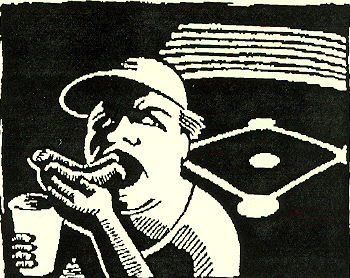
    That said, I was proud of my persistence. I made four halfhearted but relatively pain-free tours of the stations. The salad bar had plenty of tasty offerings, and I made easy work of a plate of fresh fruit. I also enjoyed a small portion of spaghetti with a vegetarian tomato sauce, and a slice of the pork loin from the carving station. Nothing, however, made me quite so happy as the miniature corn dogs. They were so good that I went back for seconds, and could easily envision a future visit during which I would eat nothing else. In fact, had I been able to convince anyone with a sadistic or competitive bent to join me at the OCB, I might easily have been goaded to gorge myself on mini corn dogs to the point of actual sickness.

    While that revelation troubled me, it was also a triumph. I don’t imagine I’ll be champing at the bit at any future potluck suppers, or make a habit of patronizing buffet restaurants. But I do believe that it was only my long-cultivated reserve—a resistance I sensed was eroding with each subsequent and emboldening trip to the buffet stations—that ultimately kept the beast in me from running amok.
  • Little Help, Partners

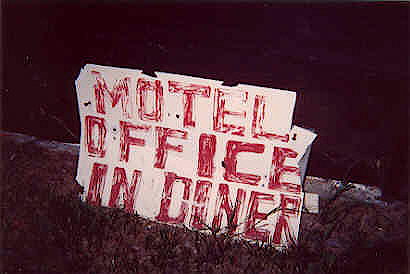
    moteloffice001.jpg

    As I was driving around town today I was writing this country song in my head. I had the whole damn thing worked out –verses, chorus, tune, the whole shebang– and it was shaping up to be a real humdinger of drunken regret, a first-class jukebox classic, and something of a comeback record for me.

    I’ve written quite a few deathless country tunes in my day, as any number of my fans could attest, and back in 1978 I recorded an album (“Rodeo Clown”) under the name Buck Warden that you’ll still see around in thrift store bins from time to time. That’s me on the cover in the hayseed clown costume, trying to break up the feuding lovers and taking a jug of moonshine upside the head for my trouble. (Sample lyric from the single: “Oh, baby, you get so wild/and you get so crazy/that I think sometimes maybe/I oughtta go out and get me/a rodeo clown.” You might remember the way I rode those last five syllables down the scale. People in the roadhouses used to really love to sing along with that one.)

    At any rate, like I was saying, I had this killer song all ready to roll the minute I could get home and sing it into my phonemail at work (I lost my old tape recorder somewhere along the line). Yet when I pulled up to the curb in front of my house I realized the tune was almost completely gone. Somewhere in less than ten blocks the darn thing had just evaporated on me. Maybe this has happened to you when you’ve been working on a new country song in the car. It happens to me all the time anymore, and the missus likes to joke that I must be coming down with Old-Timer’s disease.

    Honey, I tell her, for a tremendous number of pitiable Americans that is no laughing matter.

    I ended up sitting there on the couch all afternoon, drinking and feeling more miserable by the hour as I tried without success to summon that tune. The closest I’ve been able to come is the first line, and I thought maybe if I tossed the line out there, you kind folks could collaborate with me on finishing the damn thing to my satisfaction. I swear to the dear Lord my mama raised me to believe in that I’ll share all subsequent proceeds with anybody who makes a positive contribution.

    Here’s the first line, as best I can remember it right this moment:

    I’ve been crawling around/and painting the town/with a brush/that I hold/in my toes.

    Go ahead and see what you can do with it. You’d be doing an old boy a kind turn, and I’d be mighty appreciative for the help.