Author: Jeremy Iggers

  • Malaysian Restaurant Does Chinese New Year, Singapore Style

    Yusheng means raw fish, but it’s pronounced the same as
    another word that means increasing abundance, which is why raw fish salad is
    eaten on Chinese New Years, when it is traditional to dine on foods whose names
    or shapes may augur good fortune in the year ahead. Yusheng, however, isn’t an ancient Chinese tradition – it was
    invented in a Chinese restaurant in Singapore in 1964, and it isn’t widely
    eaten in China proper, though its popularity has spread to Malaysia and Hong
    Kong.

    Peninsula Malaysian Cuisine on Eat Street is offering yusheng (listed as Good Luck Rainbow Raw Fish Salad) as one of
    the courses in their 12-course Chinese New Years menu, available through Feb.
    21. The complete banquet costs $268 for a party of 10, but you can also order
    the individual courses a la carte, and the yusheng ($12) is definitely worth trying.
    The new year – the year of the Rat, was actually last Thursday, but you aren’t
    too late for yusheng – it’s traditionally eaten on the seventh day of the new
    year (i.e., this coming Thursday, February 14), which happens to be the same
    day that everybody turns a year older, according to the Chinese way of keeping
    track.

    The ingredients for yusheng are on display on a table near
    Peninsula’s entrance: mounds of shredded daikon and jicama in shades of bright
    red, yellow, orange and green, slices of raw squid, dried papaya and bags of
    wonton chips and sesame seeds. If you order the dish, the ingredients are
    brought to your table on a platter, and the server does the final assembly,
    adding a few small strips of raw salmon, pouring over a sweet plum sauce, and enthusiastically
    tossing it all together with chopsticks.

    We sampled a couple of other auspiciously named dishes, but
    our luck was mixed: the Good Luck Seafood Crabmeat Soup ($12/$18) was
    delicious, but the House Full of Silver & Gold Buddhist Yam Pot (actually,
    a basket of fried taro root stuffed with stir-fried vegetables just wasn’t very
    interesting, or very tasty. Still, I would gladly go back to try some of the
    other New Years Specials, like the Prosperity Seaweed with Chinese Mushroom and
    Dried Oyster, the Double Lobster, or the Coconut Butter Jumbo Shrimp. And I am
    a big fan of a lot of the Malaysian dishes on the regular menu, such as the nyonya laksa curry soup ($7.95), and spicy golden tofu ($10.95).

    Peninsula Malaysian Cuisine, 2608 Nicollet Ave., Minneapolis, 612-871-8282.

    Just down the street at Rainbow Chinese Restaurant, chef-owner Tammy Wong
    is offering a list of a la carte specials through Saturday, February 16 that
    ranges from a starter of king crab salad, celery hearts and Belgian endive
    tossed with yuzu dressing and topped with caviar ($13), to entrees of tangerine
    beef fried with kumquat, ginger and rock sugar ($16),
    Chilean sea bass with black bean sauce over spinach ($30) .and an egg custard with
    asparagus and king crab ($16).

    Rainbow Chinese Restaurant, 2739 Nicollet Ave.,Minneapolis,(612) 870-7084.
  • Polish Fusion: An Idea Whose Time Has Come

    Last night in the bar-restaurant at the Bedlam Theatre, I
    couldn’t help feeling like I was in a play – to judge by the funky décor, maybe
    Lanford Wilson’s Hotl Baltimore, or something by Beckett. Every few minutes,
    somebody would trudge through the bar – a woman carrying an enormous potted
    plant, a man pacing with a look of intense concentration. The bartender had a
    shiny metal ring in his nose. The bar and theater occupy the former Baja
    Riverside / Knickerbockers building, a few steps from the West Bank light rail
    stop.

    The menu seemed like a perfect set up for a comedy: it’s
    billed as Polish fusion. Head cook Jim Bueche, whose mother is Polish, decided
    to put an eastern European spin on the current trend towards local and
    sustainable fare: he tries to buy everything from local producers and
    distributors, and to offer a seasonal menu, which in mid-winter means lots of
    cabbage, beets and beans.

    The limited menu offers pirogi, a kielbasa plate, a dish of
    beans and barley, or chicken stew and barley, and a list of small thin crust
    pizzas ($7.50) that includes a Polish pizza
    topped with sauerkraut, beets and mushroom, a Polka pizza with sweet-potato sauce, chipotle chicken, spinach and
    red onion; and a John Paul II pizza, which commemorates the Polish pontiff with
    a pizza topped with olives, sun-dried tomatoes, red onion and feta.

    I
    ordered the kielbasa plate, which came with a small piece of juicy Polish
    sausage, three delicious pan-fried pirogi, (obviously homemade), stuffed with
    cabbage and mushrooms, pickled beets, horseradish, and a generous dollop of
    sour cream, all for $9.50. The salad of goat cheese, pickled beets and pecans
    with balsamic dressing wasn’t quite as refined as it might have been at, say,
    Lucia’s, but for the price ($4.50), it wasn’t bad. Ditto the John Paul II
    pizza.

    There’s
    a nice selection of cheapy wines by the glass, mostly priced at $4-$5. We
    arrived a bit, too late for the 4 to 7 happy hour, but the bar tender offered
    us the wine special anyhow: any bottle of wine for half price. This knocked the
    price of a bottle of La Vielle Ferme Syrah down to $10 or so, and the bill for
    dinner for two came to a whopping $39.83, including tax, tip, and a bottle of
    wine.

    It turned out there was a play going on, or rather a
    rehearsal, behind the red curtain that separates the bar from the theater: the
    20% Theater Company’s production of After Ashley, by Gina Gionfriddo, which
    opens Friday. Tickets are $15, or $12 for seniors, students and Fringe Festival
    button owners, and you get a $2 rebate if you arrive on foot, by bike, or by
    public transportation.

    I still haven’t made it to a play at Bedlam, but I like
    their style. Bedlam’s website says their mission is to "produce radical works
    of theater with a focus on collaboration and a unique blend of professional and
    community art…" and describes their "distinctive aesthetic as "combining an
    overtly playful performance style with low-tech spectacle, bold visuals,
    experimental absurdism, both cuttingly-direct and nonsensically-obtuse satyric
    barbarism, socio-political imagination, and usually some live music."

    That sounds like it’s worth going back for. Especially if
    you arrive in time for happy hour.

  • Think You Know Sushi?

    Test your sushi knowledge with this fun sushi quiz:


    1) Which specialty sushi roll was invented in America?:

    a) the spider roll

    b)
    the rainbow roll

    c)
    the California roll


    2) What gives most sushi-bar salmon that bright orange
    color?

    a)
    their diet of krill and plankton

    b) their genes

    c) food coloring


    3) What gives most sushi-bar tuna that bright red color?

    a) hemoglobin

    b) mercury

    c) carbon monoxide


    4) Which religious organization makes millions from sales of fish
    to the sushi market?

    a)
    The Church of Jesus Christ of Latter Day Saints (Mormons)

    b) Jehovah’s Witnesses

    c) The Unification Church (the Moonies)


    5) Which popular sushi fish is banned in Japan?

    a) fugu (blowfish)

    b) koi (goldfish)

    c) matsu (super white tuna)


    6) That little wedge of green putty on your sushi boat is
    most likely:

    a)
    real wasabi – "Wasabia japonica"

    b)
    fake wasabi

    c) Play-Doh


    Answers:

    1. All of the above. Those high-fat specialty rolls are an
    American invention.

    2.c Most sushi bar salmon is farm-raised on a diet of fish
    meal. Two chemicals, astaxanthin and canthaxanthin are commonly added to their
    diet to give them the orange color of wild-caught salmon. The European Union
    recently set limits on the use of canthaxanthin, because it can damage eyesight
    in high doses/

    3. Raw tuna, whether fresh or previously frozen, quickly
    turns brown. If your tekka maki is bright red, the odds are pretty good that it
    has been treated with carbon monoxide. The ever-vigilant Food and Drug
    Administration permits the practice, but, according to the New York Times,
    carbon monoxide treatment is banned in Canada, Japan and the European Union
    because it can be used to conceal spoilage.

    4. c According to a detailed investigative report in the
    Chicago Tribune, most of America’s estimated 9,000 sushi restaurants get their
    raw fish from a company called True World, which is a subsidiary of Unification
    Church International, a company with close ties to the church.

    5. c. Matsu, often sold as "white tuna" or "super white
    tuna" isn’t actually tuna at all – it’s escolar, also known as snake mackerel
    or walu. Its fat contains waxy esters
    that can cause gastrointestinal symptoms, including diarrhea and oily orange
    leakage. Because of these side effects, it has been banned in Japan since 1977.

    6. b. Odds are, it’s fake wasabi, a cheap blend of
    horseradish, mustard and food coloring. Real wasabi, wasabia japonica,
    which has a more subtle flavor, is hard to grow and very expensive – up to $100
    a pound.

  • Sanctuary: What a Difference a Chef Makes!

    What a difference a chef makes!

    Patrick Atanalian is now in charge of the kitchen at
    Sanctuary, and the cuisine at the Washington Ave. hideaway is dramatically improved. It’s a reunion for the
    talented Marseilles-born chef and Sanctuary’s managing partner Michael Kutscheid, who first worked
    together back in the mid-90s, when Kutscheid owned Kapoochi’s, one of the most
    innovative restaurants of its time. After a dishonest employee bankrupted the
    restaurant, Kutscheid went on to become a familiar face as a manager at
    Oceanaire, Martini Blu and Babalu, and Atanalian went on to work at the Loring
    Café, Vintage, A Rebours and Le Cordon Bleu’s culinary school.

    Atanalian became notorious for such cutting edge culinary
    pranks as beef tenderloin with plantains, pepperoncici, sweet mango rum sauce
    and a Coca-Cola crème fraiche, and halibut with a gummi bear crayfish
    broth. He plays it a bit straighter this time around, but there is no lack of
    invention in the current Sanctuary menu. Among the highlights of my most recent
    visit: starters of carpaccio enlivened with white anchovies, a candied lemon
    fennel salad ($8), and a Napoleon of crisp taro root, roast mushrooms, sundried
    tomato tapenade and a mascarpone mousse ($6). The lamb shank braised in coconut
    curry ($19) and the glazed salmon with sweet and sour potato wontons ($23) were
    both delightful, but there is a lot more on the menu that I would like to try –
    including the duck confit risotto croquettes, the salad of baby frisee, salmon
    gravlax and goat cheese, and a chateau of sirloin with lobster reduction and
    potato cakes ($25).

    Kutscheid says he plans to start offering a prix-fixe $35 five
    course tasting menu Mondays through Thursdays, starting next week, with an optional flight of four selected wines for $12.

    One little annoyance to mention: to park on either side of the
    building, you have to pre-pay an automat, which reportedly is fussy about
    accepting credit cards or paper money – so bring along $3 in quarters.

    Sanctuary, 903 Washington Ave. S., Minneapolis 612-203-5058.

  • Dinner and a Show? – Valentines Dining

    Do you have any favorites places that offer live
    entertainment — preferably cheap or free — along with food? I am starting to compile a list, and so far I have:

    Bluegrass and old-time music at Dulono’s Pizza
    Occasional concerts at Kramarczuk’s (like the Tamburitze
    Orchestra)

    Karaoke at Pancho Villa

    Jazz and more, weekends at Café Maude

    Rhonda Laurie and her trio, Wednesdays at Cave Vin

    Friday night jazz at Crave in Edina

    Speaking of cheap dates, the Valentine’s Day, here are a
    couple of options that won’t break the bank:

    From Valentine’s Day through Sunday, February 17, Joe’s Garage is offering "Valentine for the common
    man (and woman)" : platters for two that range from wild rice meatloaf or
    buttermilk fried chicken with mashed potatoes and gravy (both $20) to walleye
    or barbecued ribs for $25, or a grilled beef sirloin with sundried tomato
    butter, sauteed mushrooms and fries for $30. And you can add a bottle of Red
    Truck Red or White Truck White for $15.

    Bryant Lake Bowl, famous for its
    Monday night Cheap Date Night dinners for two that includes two entrees, a bottle of wine or
    a couple of beers, and a game of bowling for $28, is going (slightly) upscale for
    Valentines Day with a Not so Cheap Date Night: they are adding soup or salad, and raising the price to $38. And if you want to make it a really memorable evening, you can enjoy your dinner in the adjacent BLB theater, where Joseph Scrimshaw will be performing an all-new version of his interactive romantic comedy, Adventures in Mating. Shows are at 7 and 10 p.m., and the doors open an hour earlier – tickets are $12, or $10 with a Fringe Festival button.


  • Arrivederci, Brix

    Italy is out, Texas is in.

    A visit to the website of Brix Wine Bar & Bistro confirmed a tipster’s report: Brix Bistro & Wine Bar in Saint Louis Park has closed, and will be replaced by Laredo’s Tex-West Grill & Cantina, a "Tex-West" theme restaurant:

    "Laredo’s
    will feature unique Tex-West entrees, authentic Mexican dishes &
    mesquite-grilled steaks in a fun, energetic atmosphere. Laredo’s
    Cantina will feature our soon-to-be famous Margaritas & ice-cold
    cerveza. We promise to be fun & affordable, but still provide
    great service with only the freshest ingredients on our menu.f you like the local food in Austin, TX, San Diego, CA and Cabo San Lucas as much as we do, then you’ll love Laredo’s! We are shooting for an early March opening."

    The ownership remains the same: the Collins Restaurant Group, which also owns the adjacent McCoy’s Public House.

    I’ll reserve judgment until I visit the new restaurant, but this seems like a real shame. When when I reviewed Brix, soon after it opened, I was impressed – and surprised. Brix offered authentic Italian cuisine, prepared with a level of skill and sophistication rarely found on the suburban dining scene.

  • Beyond the Obvious

    Some guys—and gals—get all the ink. If you are a devoted Twin Cities foodie, you know all about Tim (and Josh), Vincent, Alex, Stewart and Heidi, Lucia, Doug, J.P., Lenny, and Brenda—and you can pair them with their restaurants. Odds are pretty good that you have also heard of Tanya Siebenaler, Don Saunders, Scott Pampuch, Mike Phillips, and J.D. Fratzke.*

    Google any of these names and you’ll get hundreds of hits. And by the time this issue is on the streets, your chances of getting a Valentine’s Day reservation at any of their establishments are slim or none.

    But plenty of other very fine restaurants don’t generate the same buzz and don’t make it into the Zagat Guide. Some of them are too new, others too old, some are a bit off the beaten path, and some are just a notch less ambitious than the places everyone’s talking about. Following are a few of these under-the-radar places that seem especially appropriate for Valentine’s Day, or any romantic occasion.


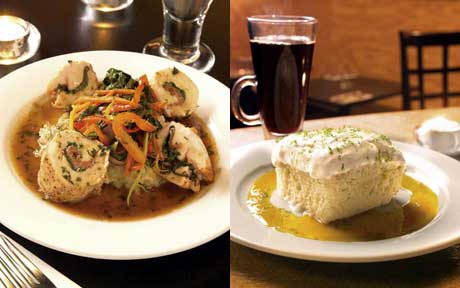
    At First Course: A chicken roulade with gorgonzola risotto, with a tres leches cake for dessert.

    Unless you happen to be his mother or one of his loyal customers, odds are pretty good that you have never heard of Travis Metzger, chef-owner of First Course. The décor at this little neighborhood bistro might be rather minimal for some tastes (varnished plywood takes the place of teak and mahogany veneers), but I find the place quite charming, fake fireplace and all.

    The first time we visited, Metzger was doubling as waiter, and listening to him describe the nightly specials made it clear that this is a guy who really knows and cares a lot about food. We started with a couple of his nightly specials: field greens and roasted beets with chopped walnuts, dressed in walnut oil with a pumpkin-infused goat cheese, and a tapas plate of polenta topped with a savory duck confit.

    I was a little skeptical about ordering the seafood stew in lobster broth, fearing a commercial soup base loaded with salt and MSG (there are no other lobster dishes on the menu); this version, however, was delicious: shrimp, mussels, clams, and calamari in a light but intensely flavorful broth, spiked with just enough chipotle pepper to command your attention. Other best bets from subsequent visits include the pappardelle with lamb ragu; braised leg of lamb with rosemary, white wine, and tomato; butternut squash ravioli with a brandy-Gorgonzola cream sauce; and the chicken roulade filled with prosciutto, spinach, and provolone, served over a Gorgonzola risotto.

  • Something Fishy in Woodbury

    I wasn’t quite sure what to expect when I drove out to
    Giapponese, the new sushi bar / restaurant in Woodbury. Sushi is everywhere
    these days, including the refrigerator cases of local supermarkets, and since
    the sushi restaurants all tend to get the same ingredients from the same
    suppliers, it has become a pretty generic product. But the name – Italian for
    “Japanese” — was intriguing, and the online menu sounded pretty interesting:
    smoked salmon bruschetta and poki (the Hawaiian version of tuna tartare); and
    some varieties of fish and shellfish that seldom show up on local sushi menus,
    such as kawahagi (file fish, a member of the blowfish family) kinmeidai (golden eye snapper), kohada (gizzard shad) and walu (the Hawaiian name for a variety of escolar, sometimes sold as white tuna.

    When I asked for omakase (chef’s choice), chef-owner Henry
    Chan immediately knew what I wanted, and proceeded to serve up a delightful
    series of courses: raw scallop, Tasmanian salmon, halibut rolled in a thin
    ribbon of cucumber, a whole small mackerel presented as sashimi, and a roll of
    tempura shrimp and avocado topped with tuna. Chan, who grew up in Wisconsin, recently moved here from Eau Claire, where he owns
    the town’s only sushi bar, the Shanghai Bistro.

    Chan clearly has a passion for sushi, and listening to him, he sounds really committed to bringing in the best quality and most interesting varieties he can find. The selection is still pretty limited, but he says that as his sales volume grows, he will be adding more varieties. If you want to be notified when new and interesting varieties of sushi and seafood are available, send him an email at twinscroll@gmail.com. I just got an email yesterday, announcing the arrival of his live tanks (for holding lobster and shrimp), and a shipment of Hamma Hamma oysters from Washington state.

    I’d like to go back sometime to try the Kobe beef steaks – a 16 ounce bone-in New York Strip and a 14 ounce ribeye, both $55. This isn’t the original Kobe beef from Japan, where the cattle are massaged daily and fed rations of beer, but it’s the same breed, Wagyu. Chan gets his beef from a friend who has a herd of Wagyu near Augusta, Wisconsin. $55 for a steak sounds pretty steep, compared to what other restaurants charge, it’s a bargain. Locally, Cosmos has imported Japanese Kobe beef on its menu for $17 an ounce (which would work out to $272 for a 16-ounce steak), and even that is a bargain compared to Craftsteak in Las Vegas. Craftsteak charges $105 for a 14-ounce American Wagyu ribeye, $184 for an eight-ounce Australian Wagyu ribeye, and $240 for an eight-ounce Japanese Wagyu steak – which works out to $480 a pound.

    Giapponese Sushi
    10060 Citywalk Drive
    Woodbury, MN 55129
    Phone: 651-578-7777


  • Weekend Hot Dish Surprise

    Okay, this is the day to check and see what’s left in the
    fridge and needs to get served up before it spoils, and it looks like we have
    enough left-overs to make up a meal: a half-cooked review of the new Strip Club
    in Saint Paul, news of an upcoming beer dinner at North Coast in Wayzata, and a
    Mardi Gras dinner at Barbette.

    Carol and I stopped in Wednesday night at the
    Strip Club, the night after it opened to the public, and had a delightful dinner. Then Thursday, as I was half-way
    through digesting the experience for this blog, I discovered that my esteemed
    colleague Cristina Cordova had scooped me. It’s too early for anybody to write
    a full-fledged review of the place, but Cristina covered all the basics very nicely, and
    sampled a lot more dishes than we did.
    So check out her post for more details, but here are a few random thoughts:

    I knew enough not to expect naked ladies, but I
    did expect to find a big menu of steaks, plus baked potato sour cream, etc.,
    just like the downtown places, only maybe a little cheaper, because it’s a
    neighborhood joint (in Saint Paul’s Dayton’s Bluff, across from the Metro State
    campus.)

    Turns out chef J.D. Fratzke, (late of Muffuletta) and the
    owners (from the Town Talk Diner in Minneapolis) have created
    something much more interesting. There are a couple of steaks on the menu, and
    a few gourmet items like foie gras, (locally produced at Au Bon Canard in
    Caledonia, MN), and escargot. But basically, Fratzke, who grew up in Winona,
    pays homage here to the kind of plain cooking that doesn’t usually make it onto
    restaurant menus: deviled eggs, beans on toast, even a Braunschweiger sandwich.

    There are a couple of trendier entrees on the list, like a
    bone-in duck breast with wild rice polenta, roasted mushrooms and port wine
    glace ($19), and seared ahi tuna with root vegetables, French olives and
    preserved lemon ($22). But Fratzke’s inclination is towards heartier, earthier fare:
    Swedish meatballs with mashed potatoes and a black truffle gravy, ($14); a pork shank for two with mashed potatoes,
    Brussel sprouts, apples and roasted garlic jus.

    We enjoyed everything we sampled – especially the grilled
    Caesar salad the ahi tuna, and the lean but flavorful ball tip steak (all their beef
    is grass-fed, from Thousand Hills near Cannon Falls.) The big challenge with very lean grass-fed beef is to compensate for the lack of juicy marbling, and Fratzke met the challenge beautifully, pairing the flavorful meat with savory white beans and grilled onions. I suspect that the best
    time to sample Fratzke’s culinary artistry will be late summer, when fresh
    local produce is at its peak, but I expect to return long before then.

    The Strip Club, 378 Maria Ave Saint Paul, MN 55106 651-793-6247.

    I have been a long-time fan of chef Ryan Aberle’s cooking at
    North Coast in Wayzata, but I never felt that the casual atmosphere – and the
    13 flat-screen TVs in the adjacent bar – quite fit the cuisine. But that’s
    about change. "We are closing to the public on the night of January 19 and
    reopening on January 23," reports Aberle. This will complete the first phase of
    the remodel… allowing us for the first time clear definition of where the
    dining room ends and the bar begins. The new bar (to be completed by
    Valentine’s Day) will retain a single plasma TV and it will barely be visible
    from the main dining room."

    Aberle, a beer connoisseur, has put together what might be
    the ultimate beer lover’s dinner – a 15-course extravaganza on Saturday, Feb. 2, featuring just
    about every brew Sam Adams makes. Courses range from a sweet potato pancake with Morbier, duck
    leg confit, burnt orange syrup, accompanied by Boston Ale, to pan-seared
    Minnesota foie gras, port lacquer, and wild mushroom risotto served with Black
    Lager, and a course of Pho with shaved prime rib, rice noodles, cilantro
    and a glass of Winter Lager. Cost is $80, plus tax and tip.

    North Coast Restaurant, 294 Grove Lane E., Wayzata, 952-475-4960.


    Barbette’s Mardi Gras menu, served February 4-5, should be
    pretty authentic: Barbette’s
    new chef, Sarah Master, went to culinary school in New Orleans, and studied
    under Susan Spicer at Bayona in the French Quarter. The menu sounds terrific,
    especially for the price ($32): baked oysters Laveau, followed by a choice of crab cakes or
    sausage gumbo. The main course options are chicken etouffee, blackened catfish
    with macque choux and collards, or fried mirliton (chayote), collards and
    spoonbread. For dessert, your choice of king cake, pecan pie or bananas Foster.

    Barbette, 1600 W. Lake St., Minneapolis, 612-827-5710.


  • Spaghetti Red and a Seductive Nose

    "Don’t you find," he said, "that there’s a funny taste of
    chicken coops in Rhone wines? Especially Beaucastel."

    "Chicken coops?" Was he pulling my leg?

    "Even the great wines, you know, have a whiff of chicken
    coops. It’s well known."

    I offered him a glass of the Beaucastel. I tasted it
    again, now frantically looking for traces of sublimated chicken coops. The
    waiter winked at me, was he suggesting I’d been had?

    "Taste it?" he said. "A bit poopy, eh?

    "Well, I said, "maybe I can taste chicken coops."

    I couldn’t taste anything of the sort. But we swirled and
    sipped and agreed that the chicken-coop element gave the wine its complexity."

    Lawrence Osborne, The Accidental Connoisseur, North Point Press, 2004.

    Whenever I read those florid descriptions of wines – "a
    direct and seductive nose overflowing with floral notes, gingerbread, cocoa,
    candied cherries, a mouth which is spherical, sexy, fleshy –
    , in wine
    reviews or on those little tags at the wine store, I have two reactions:

    1)
    I wish I could write like that.

    2)
    Are these guys just making that stuff up?

    I’ll admit it, I’m no expert on wines. I know what I like –
    big, full-bodied reds, mostly – but unlike my esteemed colleague Ann Bauer, I
    don’t have much of a vocabulary to talk about it. And I can appreciate the
    difference between a $10 bottle of Cabernet and a $50 bottle, but I usually
    don’t think the difference in experience is worth paying for – at least if I am
    paying. And when I see a $50 price tag on a bottle of wine, I also start
    thinking about people who don’t earn $50 a month.

    My wine career has been a never-ending search for cheap
    drinkable plonk. In the 80s and 90s, it was focused on the wines of Romania,Il Circo Ruche
    Bulgaria and the former Yugoslavia – remember Avia and Premiat? , These days it
    has shifted mostly to Spain, and the garnachas and tempranillos and monastrells
    in the back left corner of Hennepin-Lake Liquors.

    Every once in a while, though, a cheap wine jumps out at me
    as something out of the ordinary. I first discovered
    Bonny Doon 2003 "Il Circo" Ruche
    di Castagnole Monferrato
    on a wine list at Taste Wine
    Bar (that quirky little spot hidden inside The Newsroom), and liked it so much
    that I started looking for it, with no luck, at local bottle shops. Then, last
    week, I stopped in at Gigi’s for their happy hour, and lo and behold, the
    featured $3 happy hour red is Il Circo Ruche.

    I happily drink a
    glass and a half, and return the next night for Gigi’s Thursday night cheap
    date spaghetti special – two plates of spaghetti, garlic toast, and a bottle of
    wine for $25. The spaghetti was great -the red sauce with spicy meatballs
    robustly spicy (vegetarian also available), and the noodles actually al dente.

    And sure enough, the red wine was Il Circo Ruche. This time
    around, I tried to figure out just what it is that I like so much about the wine,
    put it into words, but I got absolutely nowhere. I try out all
    those words that wine writers use – blackberries, leather, hints of cinnamon
    and passionfruit, but none of them seem to fit,. Mainly, it seems complex but
    balanced, but that doesn’t say very much.

    The label on the
    bottle said that ripe Ruche was redolent with roses, but I couldn’t for the life of me smell anything
    that tastes like roses. Complicating things further, Carol, who was sharing the
    bottle with me, didn’t taste anything special about this bottle at all. So I
    cork up the last quarter of the bottle, and bring it the next day to Ann, who
    really is good at describing wines. "Cherry and cassis with a touch of
    dark honey;" Ann reported back the next day," a resinous flavor that becomes cigar-like as it warms; undertones
    of earth, but very dark, no peat at all.
    A dry, almost dusty finish. That
    thing about roses? I didn’t get it at
    all — unless you count the dusty, earthy scent and flavor, which reminds me of
    DECAYING roses."

    A tip from a friend research led me to Robin Garr’s
    wineloverspage.com, where Robin Garr’s posted his 2005 tasting notes on the
    Bonny Doon Il Circo Ruche, "an Italian red grape so obscure that it’s only
    grown in a few small villages in the Castagnole Monferrato hills northeast of
    Asti in Piemonte."

    Wrote Garr: "This is a very dark purple wine with a bright
    reddish-violet edge. Luscious aromas offer a benchmark example of Ruche with a
    heady, rosy floral scent accented with warm brown spice. Rich and full in
    flavor, tart red fruit and spice, mouth-filling and plushy on first impression,
    but a firm core of acidity carries it into a clean, medium-long finish, with an
    unusual, intriguing hint of caraway seed and light tannic bitterness
    lingering."

    So Robin Garr did discover the rosy floral scent in 2005,
    but Ann and I couldn’t detect it in 2008, That actually makes sense, since Garr
    predicted that the floral scents would soon fade from the young wine.

    Of course, there are lots of factors that influence how we experience the taste of wine, as this story from Bloomberg News illustrates:

    "Volunteers in California who were given sips of wines with
    fake prices said they preferred the cabernets they thought were
    more expensive to the ones they thought were cheaper about 80
    percent of the time, according to the study published … in the Proceedings of the National Academy of Sciences…. In a follow-up experiment eight weeks after the original
    study, patients were given the wines to taste without any
    suggested prices. Most chose the $5 wine as their favorite, (a researcher) said."