Author: Peter Schilling

  • Double Feature

    smokes.gif

    IT’S A WONDERFUL MENACE

    “Slither”, 2006. Written and directed by James Gunn. Starring Michael Rooker, Nathan Fillion, Elizabeth Banks, Gregg Henry, Tania Shaulnier, Brenda James, Don Thompson, and a boatload of b-movie mainstays.

    Now playing at local theaters and hopefully at every small town screen in America.

    There’s a reason why space aliens so often land in a hick towns. Having come from one of these dunderheaded hamlets, I can say with authority that the thought of battling with some kind of slimy creature was inspiring. For you folks who grew up in the cities, you’re missing out on the visceral thrill of these films. Movies with spaceships or meteors that crash into earth make you think that those woods around your house–which in reality hide nothing more than beercan-choked deer blinds, used condoms, and old tires–might in fact harbor a beast that’ll keep you awake at night. Which is better than falling asleep to David Letterman again.

    Slither is a part of this grand tradition, and I’m glad for it. I saw it with a loud and boisterous crowd and it reminded me of my moviegoing days from long ago. Back in the day, I used to waste many a Friday night at Mt. Pleasant’s Ward Theater with some schlock horror film. My friends and I would talk back to the screen, loudly and frequently. That’s one of the great joys of the movies–being able to voice your displeasure at a movie that suggests, say, that a young woman would willingly tiptoe down the rickety steps of a dark basement that is crawling with flies and smelling so putrid it makes her gag. That’s worth barking at, with a good chuckle.

    Slither has sprung, like the grotesque worms of the title, from the mind of one James Gunn, who is a product of the somewhat infamous Troma factory, the studio (if you can call it that) that produced buckets of cheap horror videos. Those films were awful, but Gunn–who wrote the very entertaining Dawn of the Dead remake–learned something along the way. For Slither is a b-movie masterpiece, a freak show so good it could have come straight from old Coney Island. It’s that scary, that awful, that hideous, and that much fun.

    The facts: A meteorite drops out of the sky one balmy autumn evening, plopping into the woods behind the hard luck town of Wheelsy. This is your typical small town, as I remember mine, and well rendered: bored folks, wealthy folks in their McMansions, oversexed folks who are looking for a quick screw, tired cops, and some bums and losers who look like they wish Diane Arbus were still around to snap their picture. Cheap bars and strip malls, ugly high schools and boarded up old stores. Michael Rooker plays one of the town’s wealthy studs who is rejected one evening from a little love by his social-climbing, though loyal, wife (Elizabeth Banks). Frustrated, he heads out into the woods with a girl he met later in a bar, finds the aforementioned meteorite, and gapes at a slug-like creature crawling on the forest floor. Which, of course, attacks him, shooting a slimy pin into his gut which turns him into a monster. As time progresses, he gets worse, grunting “meat” over and over, satiating this desire by disemboweling cats and dogs and cows and deer. And humans, of course.

    Things get progressively worse. Amazingly worse. People are eaten, filled to bursting with millions of gelatinous worms, attacked by said worms in bathtubs and churches, split in half by tentacles, burrowed into, feasted upon by the undead, and absorbed buck-naked into what looks like a cross between Jabba the Hutt and a giant squid. Among other horrible fates. Slither gives a nod to just about every cheap horror film ever made and between my wife and I we caught references to: Jaws, Beauty and the Beast, King Kong, every undead film in history, Cronenberg’s Fly and Rabid, the remake of The Thing, maybe A Streetcar Named Desire (the beast shouting “Starla!”), and–I can’t believe I remember this–John Carpenter’s unbelievably stupid Prince of Darkness. That one, for those not in the know, was the one in which Satan possessed people by spitting gunk into their gaping mouths. Which occurs in Slither with abundance.

    I’m certain there’s more: if you see this film, let me know what I missed.

    Slither is an outrageously gory and well-executed thriller, which made me jump and flinch throughout. Auteur Gunn knows how to take his influences and hang them on a solid plot with goofy but likeable characters, and while it’s a stretch to call a film with so many references original, it’s certainly as fresh as a newly killed cat. Like many of the great cheapies, Slither is full of odd conversations between b-movie stalwarts like the inimitable Rooker, future b-man Nathan Fillion (of Firefly fame), overcooked ham Gregg Henry, and Banks, doing her damndest to become the new Adrienne Barbeau.

    Slither will no doubt vanish in a month, nothing more than a dim memory from an evening of screams for kids and adults from Hicksville to Omaha. See it now while you can, in a rural, one-screen theater, with a long drive home past darkened cornfields and ominous woods.

    TOOTHLESS IN WASHINGTON

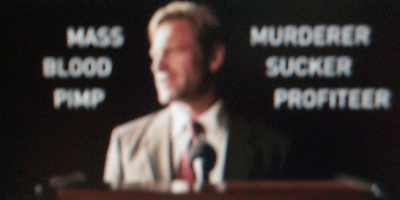
    “Thank You For Smoking”, 2006. Written and directed by Jason Reitman. Starring Aaron Eckhart, Cameron Bright, Maria Bello, Sam Elliot, Adam Brody, Katie Holmes, Rob Lowe, William H. Macy, Robert Duvall, and the underrated J. K. Simmons.

    Now showing at the Uptown Theatre.

    My father is a rabble-rousing, former hippie liberal, my father-in-law an extreme right-winger, a lover of Ann Coulter and Rush Limbaugh. I have no doubt that if I could get these two to shut up for two hours and hauled both of them to see Thank You For Smoking, neither man would be offended at what they saw. Bored, perhaps, but not offended.

    God save us if the best we can do for satire in America is this made-for-tv movie. Without its simpleminded swearing, this thing belongs on Fox with a nod and a wink and a bevy of reviewers claiming it’s the greatest satire since they threw the last shovelful of dirt on Paddy Chayefsky. Is it so much to ask that your irony have some bite to it? Thank You For Smoking, for its heavy lineup of top notch actors, succeeds only in being a tedious string of one liners that were edgy, maybe, in 1996. Note to Director Jason Reitman (and maybe novelist Christopher Buckley): jokes about Birkenstocks were stale in the 80s, for God’s sake.

    Thank You For Smoking features a cast of some of the finest character and supporting actors we’ve got, from William H. Macy, the underrated J. K. Simmons, the underused Maria Bello (obscenely wasted), the perfectly slimy Rob Lowe and relative newcomer Adam Brody, not to mention Sam Elliot and Robert Duvall, for the love of Christ. The movie is ostensibly about spin, which makes me think that it might be fascinating just to see how this damn film got made, and how much of this magical spin was used to convince everyone to hop on board. The barely-beating heart of the film is lobbyist Aaron Eckhart’s relationship with his son, Cameron Bright. This plot, thin as it is, would have been much more powerful if the son were narrating the thing, giving us a clearer view of this conflicted man from a more neutral standpoint. This didn’t happen and the story is an unholy mess, with little subplots that come and go and details that seem to be forgotten. I wonder what the movie would have been like in better hands. Reitman might have promise, though he would have to fall from his father’s tree and roll a good city block–pop Ivan Reitman’s got to be the worst comic director in history if it weren’t for Blake Edwards.

    Sadly, almost every actor has one decent scene to strut his or her stuff, independent of the plot, which makes the movie seem like a very professional high school forensics tournament. Duvall was so good at describing a mint julep I wanted to run out and grab one. J. K. Simmons does his usual bluster, which I love; Sam Elliot is great as a dying Marlboro man; and Rob Lowe and Adam Brody are creepy, doing their high-powered agent schtick, with Lowe an unsleeping powerbroker who wears a giant kimono.

    All of which makes me want to run to the seance table and call Chayefsky back to the old Underwood. It’s not enough for a filmmaker to toss these scenes at us, joke after joke. We need to see how characters respond to these existential laughs. It doesn’t help that Thank You For Smoking’s humor seems ten years old and lacks even the muted guffaws of a poor week at The Onion, but it’s got no characters anyone can relate to. Had old Paddy lived long enough to write Thank You, we might have had something with guts and character, and even quite a few heavy and uncomfortable laughs.
    smokes.gif

  • The Wurlitzer Descends, The Curtain Rises, The Lights Dim…

    ck1.gif

    …but what about the soul
    that grows in darkness, embossed by silvery images…

    –Frank O’Hara, “Ave Maria”

    When I first saw Citizen Kane, at the glorious Temple Theatre in old downtown Saginaw, Michigan, I didn’t quite get the thing. I was twelve years old and not aware that it was the greatest film ever made, that it was overrated to some, that it wrecked its filmmaker’s career, that it was anything but a movie. Kane starred the fat guy from the wine ads, and it was in glorious black & white, which made my imagination rage. “Citizen Kane?” I asked, when told by my pop what we were doing that summer evening (no air conditioning in the theater made it that much more of an experience, the humidity ripening an already thick mildewy aroma). But I was game: thus far, the classics we’d seen, from East of Eden to It Happened One Night to Singin’ in the Rain, had been doozies, films that would have knocked me off my feet had I not been sitting already. Films that had opened my eyes to the great possibility that there was more–much more–than what was playing at the local Cineplex. Looking back, I would argue that Citizen Kane is, in my mind, one of the best films you could ever show a twelve year old. It is The Little Prince of the big screen, an incredible journey through the solar system of adult life.

    We cut to almost twenty five years later. The other day I received my official Movie Reviewer Card in the mail. It’s a little plastic number to go along with a secret decoder ring that allows me to decipher Film Comment and Village Voice critics, a thumb exerciser, a packet of stars and exclamation points, and Gene Shalit’s Pocket Treasury of Accessible Accolades.

    Despite this, and despite the fact that I’ve now read a ton about Kane in particular, and movies in general, I still can’t claim to know anything about the films I’ve seen. Once the darkness envelops us, and the projector begins, we’re all on the same page. Often, I’m as baffled as anyone who’s ever seen a movie; other times a film will so move me that it’s meanings will seem as clear as a glass of gin.

    Each Friday, if all goes as planned, you’ll see an early morning review of a film or films that are opening that weekend. Hopefully, if the Oak Street Cinema ever gets its act together, that might mean I eschew the new Superman for, say Winchester ’73, one of the most remarkable westerns ever made. If not, I’ll write about that gem during the week from my home theater, which isn’t anything more than a 19″ television and a DVD player that buzzes like an old box fan.

    Even better, I want to know what you think of these movies. There’s a comment section: be my guest. I want to hear if you were moved by the menace of Cache, by Thelma Ritter’s weary death scene in Pickup on South Street, by the marine smacking Woodrow Lafayette Pershing Truesmith in Hail the Conquering Hero, one of the most underrated comedies ever, and ripe for a timely remake. Or not. Maybe you think Crash was as dopey a film as I did.

    James Agee began his career as a film critic with: “I would like to use this column about moving pictures as to honor and discriminate the subject through interesting and serving you who are reading it. Whether I am qualified to do this is an open question to which I can give none of the answers.”

    That about sums it up. Like Agee, my columns might just bewilder more than they enlighten. My hope is that when I fall deeply for a movie, when I’m lost for two plus hours in a darkened theater and emerge changed somehow, you’ll be intrigued enough to check it out yourself.

    ck1.gif

  • The Old Married Couple

    Tom Letness could cease his never-ending renovation of the Heights Theatre, in Columbia Heights, and it would remain the finest movie house in the Twin Cities, bar none. Yet he keeps fiddling with it. He knows its history inside and out—from a bombing back in the late twenties at the hands of a disgruntled former projectionist, to its dark days as an ugly second-run theater. As the theater’s current owner, operator, and sometimes beleaguered caretaker, he’s also familiar with all its quirks and charms in its present-day incarnation. Letness didn’t have to dig out the orchestra pit or hire an organist, but he did. He didn’t have to put 152 hand-painted reproduction Edison Mazda bulbs in the chandeliers, but he did. Bringing in the Wurlitzer organ and finding someone to play the thing wasn’t easy, but he did it.

    Letness, who bears a striking resemblance to a young John Malkovich, is often fused to his cell phone, trying to set up appointments with inspectors or scheduling future events, sometimes involving vintage films and even, on occasion, an appearance by an aging star. Letness speaks of the Heights with the weary pride of someone who loves what he’s doing but has long since lost his naiveté. “This is a lot easier to talk about now that most of the renovation’s done and we’re headed in the right direction,” he said with a sigh. He shook his head. “Strangers often come up to me and say they have this dream to open a movie theater and what advice can I give them. I tell them the truth. And the truth is, it’s not easy.”

    Letness typically works twelve-hour days, seven days a week. He lives in a tasteful, relatively sound-proof apartment above the theater that gives him a bird’s-eye view of his renovated Dairy Queen next door. He begins each morning with a quick walk with the dog, then coffee at a local café, often in the company of a publicist, a journalist, or someone else vital to spreading the gospel of the theater. Around 10:00 a.m., he’ll meet with Chuck Merrell, a maintenance man, to go over projects—the old theater requires a tremendous amount of upkeep. Letness also tinkers around the theater himself, climbing scaffolds for ceiling repairs, cleaning up from the previous night’s screenings, in addition to conducting all of the business work—and also scurrying next door to handle the occasional ice cream crisis. He also consolidates the multiple reels of a new film into one giant reel and threads it into the projector, which he maintains. “I handle the pictures with kid gloves, unlike other places,” he scoffed. “You get a quality print at the Heights.” Around 3:00 p.m., he’ll prep for the first show of the night, throw open the doors, sell tickets, and personally start the picture about 5:00 p.m.

    “My employee,” Letness said, stressing the singular as if to drive home his lonely venture, “arrives around 6:00, and I help him get ready for the next show.”

    At times, he can become irritable about some patrons. “Oh, I’ve thrown people out. I look at it like you’re in my house. Don’t talk during the movie. Turn your cell phone off. Pick up your garbage. We have this lovely little announcement beforehand, with a mother telling her kids to be polite, and yet people still are rude. Do I have to go up there myself and ask them to be quiet during the show?”

    For the most part, though, Letness loves his audience and it loves him. “For me, it’s the little things—like when that curtain rises before a film, there’s a wonderful feeling. And I remember one kid before a Harry Potter film seeing those curtains and asking me, ‘Is this the play or the movie?’” Letness rolled his eyes, and despite his obvious pleasure at pleasing the kiddies, the skeptic momentarily displaced the romantic. “Yeah, kid,” he growled sarcastically, “it’s the play.”

    The Heights could screen the typical Cineplex garbage, but instead, Letness insists on bringing in what he believes is quality Hollywood fare and, every now and then, classics like Oklahoma! or White Christmas (this year he has already lined up Bing Crosby’s widow to croon beforehand). And sometimes he’ll indulge his taste for films like It Started With Eve, an old and virtually forgotten Deanna Durbin flick from 1941. “One of my favorites,” he admitted. “That’s one of the joys of the Heights—I know that if I didn’t show that film, no one else would.” —Peter Schilling

  • No one is surly at this brewery…

    Like any budding artisan, Omar Ansari spoke with great pride when he offered a visitor a taste of his creation. “Try that,” he said, pulling a shot of Furious Ale from one of the giant stainless steel tanks. “What do you think?”

    I think the Surly Brewing Company, the Twin Cities’ newest producer of craft beer, is on to something. Its name derives from the notion that one becomes surly when offered a mediocre beer. Furious Ale is a beaut: With each sip your tongue is greeted with a sweet malt flavor that is almost immediately chased by an astringent hoppiness, which lingers like a pleasant daydream. When asked if he thinks there’s a market around here for yet another microbrew, Ansari answered without hesitation: “Oh, we can always use more beer!”

    Thanks in part to his shoulder-length black hair, Ansari has the soft, friendly look of a surfer who’s finally settled down. He often said things like, “Let’s see, Sam was four months old when I had the idea, and two and a half when I bought this place … ”—one of many instances in which he used the age of his children as a timeline. Ansari’s story is essentially the same as many other specialty brewers: He received a homebrew kit as a gift one Christmas and over the next ten years saw his hobby turn into a roaring obsession, which eventually morphed into a business plan. “You know what they say,” Ansari said, “Give a man a beer, he’ll waste an hour. Teach him to brew, he’ll waste a lifetime.”

    The Surly Brewing Company is located in a nondescript little concrete block building in Brooklyn Center. (It is unaffiliated with Surly Bikes, in Bloomington—though they are mutual admirers.) From the outside, the place looks like just another bunker in a beleaguered temp-worker wasteland. The Surly headquarters features a wall of multicolored graffiti, a potholed parking lot, and bland, fading signage for the Ansari family business, Sparky Abrasives, which shares the space with the new brewery. Once inside, however, you’re greeted with what will eventually be the bar and tasting area, where the glow of a neon Surly beer sign shines off the new linoleum tiles in gold and crimson, the brewery’s colors. Back in what used to be a large, long storage room are rows of stainless steel vats, copper piping and big yellow signs warning of the presence of acid. On one wall a shelf of five- and fifteen-gallon kegs rises to the ceiling. Toolboxes and welding equipment are scattered about, along with an old whiskey barrel (for future cask-aged ales) and, languishing in a corner, Ansari’s old homebrewing supplies, a pile of plastic pipes and tubs.

    Ansari negotiated this mess like a seasoned pro as we spoke. As one might expect, starting a brewery wasn’t easy. “The biggest, and most surprising, difficulty was trying to find all this equipment,” Ansari explained, gesturing around the room. Apparently, given the prohibitive expense, few microbrewers can afford to buy their equipment new. Small breweries come and go, however, and when they go, upstarts like Surly can acquire pretty much everything they need—from brew kettles to fermenters—secondhand. One of Ansari’s associates eventually discovered a defunct brewery in the Dominican Republic. Apparently, the machinery was originally sold to the second-richest guy on the island, who tried to set up his son in business. This enterprise failed in short order, and Surly bought the works and hauled it all up to Brooklyn Center.

    Before he could start brewing, Ansari also had to arrange a change in the city’s laws. Since the 1950s an ordinance had been on the books that prohibited brewery operations within the city limits. That made sense sixty years ago, when a brewery typically produced millions of barrels a year, sucked water by the trainload, and belched enough sewage to fill a small lake. In those days, of course, there was no such thing as a microbrewery. After a pleasant meeting with local commissioners—one of whom was a homebrewer himself—the law was changed to accommodate Surly.

    Todd Haug is Ansari’s head brewer. He is a short, taciturn man, with more than a dozen years of brewing experience. When asked where his recipes came from, he shrugged and pointed at his noggin. “Made it up in my head,” he said. Not only is Haug responsible for making sure the beer is of the finest quality, he is also Surly’s mechanical man, and welded and assembled most of the brewery’s machinery. “My hobbies are welding and fabricating,” he mumbled before disappearing behind the pipes and giant silver barrels. Ansari rolled his eyes and said, “I was told that if you ever find a brewer who’s also into welding, never let him go. I’ll never let him go!”

    For now, Surly will brew only two beers, and focus entirely on kegs (bottling would take up a tremendous amount of space). Ansari will use his big red truck to distribute the brew himself. A few restaurants and bars are already serving his beers, but he admits that it takes time to get tavern owners to agree to something they haven’t yet tasted. Without much of a staff besides himself and Haug, Ansari will hit the pavement, meeting tavern owners and plugging his product. “This is the best way to be a salesman,” he adds with a grin. “I’m not selling widgets, you know. I’m selling something people really care about, something I care about. It’s not like before. No one cares about abrasives. But people love beer!”—Peter Schilling

  • Earned Obsolescence

    There’s usually no problem finding a good movie to see in the Twin Cities—between the imperiled Oak Street Cinema, the Heights, Walker Art Center, and Landmark Theatres, there’s plenty to choose from that doesn’t insult one’s intelligence or batter one with sound and C.G.I. Sometimes, though, you get the urge to shut down your brain and settle in with something genuinely awful. For the worst, most bizarre—and by their very nature obscure—movies in history, there is no better local source than Joel D. Stitzel’s Cinema Slop, the eccentric movie program that screens the second Tuesday of every month in the Dinkytowner Cafe.

    “We present rare and unusual movies that aren’t commercially valuable,” Stitzel explains of his free program, now in its fourth year. “It’s questionable as to why people would release these in the first place.” The Cinema Slop curator’s taste for such ephemera was acquired at a young age, thanks largely to local pitchman Mel Jass’ Matinee Movie, a Channel 11 stalwart noteworthy for also forging the Coen brothers’ tastes. Jass was famous for wasting everyone’s Saturday afternoons with such fare as Project Moonbase and other sci-fi drivel. With the arrival of home video, Stitzel, like many film obsessives, began to build his own impressive library. Unlike other buffs, however, his collection is mostly made up of films that could not even properly be categorized as B-grade fare: This is the stuff that even remote gas-station video stores shy away from. Because of this, the pictures featured in Cinema Slop are often difficult to find. With the advent of eBay, the hunt has become somewhat easier but often more expensive, as collectors like Stitzel compete to acquire the strangest and most obscure titles.

    It would be easy to look upon Cinema Slop as a sort of den of cinematic iniquity. Stitzel has, after all, shown such “masterpieces” as the Esperanto-language Incubus, starring William Shatner with his own hair (a novelty unto itself); Toomorrow, in which Olivia Newton-John is kidnapped by aliens because her rock band’s “vibrations” are needed to save their planet; and The Gong Show Movie, which needs no explanation at all. Before each feature (there are at least two each month), audiences are treated to odd shorts, cartoons, and sometimes bits of strange Japanese game shows.

    Cinema Slop does manage to slip in some legitimate gems now and again. When this past year brought impressive DVD reissues of classic works by Robert Bresson and Jacques Demy, Stitzel screened films by the same directors that were left out of boxed sets and film festivals. Slop has also filled its nightly roster with works by Andy Warhol, had Joan-of-Arc themed nights (featuring Dreyer’s silent classic and Besson’s lackluster modern version), freaked out my own Zappa-loving brother with a screening of 200 Motels, and, at times, retreated into the comfort of Stitzel family favorites, like Wings of Desire and Séance for a Wet Afternoon. It is his program, after all.

    But Cinema Slop’s usual fare is the film equivalent of a White Castle hamburger. Its clientele are often shaggy college students and backpack-wielding film fanatics looking for something out of the ordinary to pass the time or fuel their habit. The same rules apply in the Dinkytowner as in most theaters: Talk too loud and the surly crowd will bark its disapproval. Despite the “slop” in its title, you can’t watch a movie and have better food anywhere else in the Twin Cities. To my mind there’s not much more appealing than having a good BLT and a Newcastle Ale while enjoying Harry Nilsson and Ringo Starr in Son of Dracula.

    Primarily, though, there is a genuine pleasure in joining a like-minded crowd and seeing something like Night Train to Terror, a thoroughly misguided horror film that includes, sandwiched between the requisite nudity and gore, an earnest dialogue between God and Satan. The whole proposition leaves a little breathing room for your conscience—the production cost of these films is a tenth of what Jim Carrey makes in a more forgettable movie. Then there’s the pleasure of seeing something truly awful and knowing you couldn’t replicate it if you wanted to. It takes a certain genius to make one of the worst films ever—Ed Wood’s and Russ Meyer’s films, in my mind, are far more entertaining than anything Ron Howard has ever directed. Or consider the Oscar winners of the past. Wouldn’t you rather see the 1968 Japanese transvestite “classic” Black Lizard than Oliver! (the Best Picture winner from that same year)?

    “This is sheer, stupid entertainment,” Stitzel claims with a wicked glee. “You can have the canonical works of Western culture, you can have the pap, but we show the stuff that falls through the cracks. If all you have is a top box office mentality, you aren’t going to get any spice in your life.”—Peter Schilling

  • Mr. Fixit

    If you need guidance in repairing the clutch in your ’57 Ford pickup, quieting your stuttering Edsel, or locating the lubrication specs for that turn-of-the-last-century Stanley Steamer in the garage, here’s a suggestion: Check out the Minneapolis Public Library. The Central Library downtown is the proud possessor of an automotive manual collection that is second in size only to Detroit’s. Considering that the libraries in that city are in dire financial straits, Minneapolis’ Automotive Manual Collection is probably the most accessible and well maintained on the planet.

    Its provenance remains unknown. Suffice it to say, the collection was built slowly at first, in the early decades of the last century, when some librarian with an eye for modernizing decided to obtain both the glove-box manuals and the thicker, more technical repair tomes used by mechanics. The library’s holdings grew as the automobile exerted its presence throughout the country, and ultimately exploded in the car-crazy 1950s. Since then it has been vigilantly maintained. The most recent manuals are about two years old. There is obviously little use for a repair manual for a car under warranty.

    On Saturday mornings an influx of patrons, almost exclusively men, queues up before the library opens in order to peruse volumes from the collection. “These guys are here to get answers for the questions that are taking up their weekends,” said Walt Johnson, a Patent and Trademark librarian who oversees the collection. These repair guides are not your typical Chilton manuals, but the same ones dealers and mechanics use. You could dismantle a car, literally from top to bottom, and rebuild it based on the information between the covers of these books. Because they’re expensive, often running more than a hundred dollars apiece, the library’s policy about adding to the collection is utilitarian: It acquires primers for popular models, such as Fords, GMs, and Hondas, while eschewing Maseratis or Hummers. “Those guys,” said Johnson, referring to owners of such exotic vehicles, “can hire people to fix their cars.” The collection also includes the fascinating Parts and Time Guide, which allows you to determine exactly how long it takes to remove and replace any automobile part, thus keeping time-padding mechanics honest.

    Surprisingly, the manuals are in outstanding shape. They are crisp and clean—nothing like my dad’s old Chiltons, marred by greasy fingerprints, torn pages, and dog-eared corners. They’re also charming to look at, even for someone who can barely change a tire. The old owner’s manuals are delightfully earnest, thanking the buyer for his or her brilliant decision to purchase, say, the “Finer” DeSoto Six. “We have endeavored by illustration and diagram to make these instructions perfectly clear to everyone,” this manual boasts, and then proceeds to baffle with instructions for the simple act of locking the car door. The guide includes instructions for opening the front windshield with a crank, for cleaning the curtains (!) in the rear of the vehicle, and for using hand signals when turning or stopping, which must have been a joy in the winter. Some of the auto manuals are as small and sober as a Bible tract, with minimal information in an art-deco script. Included are advisements to refrain from driving your new automobile at more than forty miles per hour for the first hundred miles, fifty miles per hour over the next hundred, and no more than sixty miles per hour up to five hundred miles. After that, the sky’s the limit. And every manual before 1970 displays the automaker’s generous ninety-day, four-thousand-mile warranty.

    Then there’s the whimsy of the cars themselves: the DeSoto; the Overland Whippet from Toledo; the Hudson Hornet, with its “Weather Eye” climate control system; the Flying Cloud, built by Reo in Lansing, Michigan; the Studebaker, manufactured in the “friendliest factory in the world!”; and my personal favorite, Hupp Motors’ Hupmobile, from the Motor City itself. Paint colors included Juneau gray, Bimini blue, and black. Not Nighthawk Black, like my 2004 Civic, but black. Just black.

    Some of the collection’s most intriguing patrons come in to reference repair manuals for ancient tractors, from Fords to International Harvesters. Johnson has observed that the people who are working on old tractors aren’t just collectors, and they aren’t simply being frugal—they have an intense emotional attachment to these machines. He recalled riding an old Ford on his father’s Christmas tree farm. “This was back in the late sixties, when I was nine and ten years old, before all the land was developed up in the area around Big Lake and Zimmerman. I want to say it was a 1948 model, and we used that tractor nonstop from late spring until early winter. A few years ago I came across an old book in the collection that featured old Ford tractors and I got very nostalgic.”

    The collection is amazing, really: a trip back in time, a tonic for those longing for the days of choke knobs and whitewall tires, a valuable reference tool for people who need more than Car Talk. For now, it is wintering in a basement at the temporary library, waiting for loving hands to shuttle it across the street to the new Central Library. Come May, when the library reopens, no doubt those Saturday-morning lines of do-it-yourself mechanics will be especially long.—Peter Schilling

  • The Jane Addiction

    Every year there’s a ritual in my house: My wife gathers all of her Jane Austen novels from the bookshelf and reads them in chronological order. Once that liturgy is complete, she devours all five hours of the landmark BBC production of Pride and Prejudice, or Bridget Jones’s Diary, the Laurence Olivier Pride, Bride and Prejudice, or one of the many other adaptations of her novels over the course of a long weekend. My wife is either devout or obsessed. I’m still not certain.

    Then there’s my dentist. A real bookworm, she nonetheless loathes Jane Austen. In fact, while visiting London, she took a special trip with her eldest daughter—who shares this bitterness, especially after having to write a college essay on all six novels—to Winchester Cathedral, where Austen is buried. There, they both danced on her grave. And she was delighted to hear that had Mark Twain been alive to join them, he would have dug Austen up and, in his own words, “beat her over the skull with her own shin-bone.”

    Such passions are common when it comes to the bard of Hampshire and her works. While my wife and the legions of Janeites are in heaven, eagerly anticipating the newest film adaptation of Pride and Prejudice, due in theaters this month, my dentist and her daughter (not to mention the spirit of Sam Clemens) must be particularly vexed. For this last decade has seen the cinematic market for Pride and Prejudice explode; with five variations released in the last five years alone, it’s a legitimate phenomenon and one that spans both space and time. If you’re reading an article on Pride then you’ve got to be as familiar with its plot as you are with your morning ablutions. Essentially the story of the mutual misunderstandings betwixt prejudiced Elizabeth Bennet and the prideful Mr. Darcy (or is it vice-versa?), Austen’s 1813 tale reigns as one of the hallmarks of British literature: Its humor and wit make it probably the greatest page-turner from England’s fluffy Regency period. But is that enough to justify so much devotion, and so many different interpretations?

    The first major film production of Pride came at the suggestion of, of all people, Harpo Marx. Harpo—the silent one with the flowing blond curls—enjoyed a lively stage production of Pride in London and immediately wired MGM’s Irving Thalberg, urging him to produce it for the silver screen. Thalberg didn’t live long enough to see the film into reality, but MGM hired Aldous Huxley to write it (along with Jane Murfin), and cast Greer Garson and Lawrence Olivier in the starring roles. The Huxley Pride is my personal favorite: the plot, light and perfectly designed as a box kite, is compressed into a swell little production, with added bon mots that Austen herself could have written. It’s brilliantly scored by Herbert Stothart, whose leitmotif for Mr. Collins is delightful, and acted with verve by all parties involved, but containing two particularly impressive performances—of Lady Catherine and Mr. Collins—by two of the most underrated character actors, Edna Mae Oliver and Melville Cooper, respectively.

    Watching this Pride, we can see exactly why Austen’s story works so well on the big screen and in modern times. Pride boasts some of the most memorable characters ever set to paper: the Bennet girls, from the intelligent older sisters Elizabeth and Jane to the flighty Lydia and Kitty to the brainy Mary, hovered over by the matrimony-mad mother, Mrs. Bennet; Mr. Darcy, the haughty rogue whom female readers (and viewers) hunger for; Mr. Collins, a cousin come to take his pick of one of the girls as his bride, and one of the finest comic creations I’ve ever read; Lady Catherine de Bourgh, Mr. Darcy’s aunt and the dowager who screams to be portrayed by a Dame like Judi Dench (and who does so in the new film); and Mr. Bennet, the father of the clan and the cynical soul of the book whom Martin Amis once called the “the dark backing behind the bright mirror” of Austen’s work. All of these people mill about the cozy confines of Meryton, an idyllic village so far removed from politics and strife it could be heaven itself. But in Pride Austen accomplished in three hundred featherweight pages what it took Tolstoy, in Anna Karenina, nearly a thousand somber ones to do: Pride is not simply about falling madly in love, but about what it means to be married. Her light tone allows the story to shine even in truncated forms. In the space of a two-hour movie, we see not one marriage begin, but four, each one simultaneously a prototype, a warning, and an example. And with Elizabeth Bennet and Fitzwilliam Darcy, Pride and Prejudice captures, in the words of art critic and historian Robert Hughes, “the microcosm of marriage, an Ideal Republic of two.”

    These Republics were on treacherous ground when Huxley set to work adapting the novel in 1940. With the Luftwaffe threatening London, he wrote Pride as a subtle summons to urge American involvement in the war, to show exactly what would be lost without our participation. The story was moved forward in time just a few years, in order to include a reference to the defeat of Napoleon—a victory that would not occur for another twenty years after Pride was written, but England’s last great military victory. Austen’s Meryton, olde England, and marriage itself would soon be lost under Hitler’s bootheel if we Americans did not act.

    Pride fell out of favor for some time after that—there were a few television productions catering to England’s insatiable appetite for dry costume drama, unmemorable versions virtually unwatched today. But in 1995, the BBC took a chance on a Simon Langton and Andrew Davies production that once again reflected current tastes. Their first triumph: casting Colin Firth, who took what is arguably the strongest and most complex male character in all of Austen’s work and shaped him into a vibrant human being. Firth is outstanding: seething throughout most of the film, haughty, and then just right as his arrogance melts away and he falls for Elizabeth Bennet (Olivier’s Darcy is fine, but far from brilliant). Cinematically, Firth made Darcy just as Brando made Stanley Kowalski.

    Langton and Davies’ second triumph: having the selfsame Mr. Firth’s Darcy take a dip in a pond. He emerged dripping wet and climbed into the fantasies of Janeites forever. This Pride was not explicitly sexual, but unabashedly erotic. Thus, it took only fifty-five years (in film time) for Pride to acknowledge that married couples have sex.

    Austen’s examination of the complexities of marriage, weaved into a seemingly effortless plot, makes Pride a story that can be perfectly adapted throughout the ages, even in different countries. Since 1995 we’ve seen Pride in more than a half-dozen adaptations: Furst Impressions, a children’s television show starring Wishbone, a Jack Russell terrier; the two Bridget Jones movies, starring Firth again in the Darcy role, once again dampening his shirt but not his sexuality; a modern-day production by, of all people, the Mormons; an English-Indian Bollywood musical Pride set in latter-day Amristar, India, featuring the sexiest Bennet sisters yet; and, coming full circle, this newest Pride, which is supposedly a “muddier, cloudier” version, in contrast to the sunny ’95 vintage. Mormons embrace it, Indians dance to it, and even dogs wear the roles like gloves. That is quite a ride for an almost two-hundred-year-old novel, and it is unparalleled in movie history. I’m just waiting for the gay Pride.

    Detractors hate Austen in part because of her focus on marriage and the mistaken belief that she is reinforcing the idea of a woman’s dependence on a man. There are also the silly manners and the sunshine and happy-ending world of Meryton. I’d like to think that Twain hated her for the same thing that bugs me the most: Austen’s is a world of the upper classes, where to be destitute is to have “only” a yearly income of a few hundred pounds and but one servant.

    However, if you can cast your eye past these differences, you discover a story unlike any other, one that so richly reflects the possibilities of marriage. The Bennets are not dependent women: Lizzy rejects the wealthy Mr. Darcy because he seems to look down upon her family—though his sentiments match her own more than she would admit. She also refuses to consider his money as a source of happiness. If she fails to marry, we don’t doubt that this Elizabeth Bennet will nevertheless succeed in her life. In the end, it is her strength and intelligence that reunites them. Austen covers the other bases—the relationship between Mr. Collins and Charlotte is one of convenience and economy, and silly Lydia and Wickham’s elopement is an example of the perils of reckless love—but Jane’s and Lizzy’s pairings are the ideals of wedlock.

    I imagine that I used to resemble Mr. Bennet, harrumphing behind my newspaper while my wife swooned over Colin Firth. But we’ve also sat and watched the various Prides together over the years, and I enjoy the story more and more as time goes on. When we’re through watching one of the movies, I like to reflect on our marriage—I can’t think of another story that challenges me on that sometimes delicate subject. My wife and I are older now, and though we like to be inflamed by the likes of Keira Knightly (Elizabeth in the newest adaptation) and Colin Firth, we also know there’s a lot more than just wet shirts and muddy stockings: Like Mr. Darcy and Elizabeth Bennet, we’ve grown to have a profound respect for one another. Over the years, marriages are bound to lose some of the fire you’d find raging throughout Wuthering Heights, but a slow burn over time, a loving endurance—isn’t that what we all hope to find in this type of union?

  • Curtain Call

    Robert Altman didn’t see much of Minnesota. During his month-long stay in St. Paul this summer, he ventured beyond the Fitzgerald Theater and his hotel but once or twice. He came, though, and even if he didn’t see much, it seems as if he was out to conquer. He left for Hollywood with footage for a film in which, reportedly, the Fitzgerald Theater gets demolished, at least one character dies, and, most important, our beloved public radio program ceases to be. Who is this guy? And what does he want with A Prairie Home Companion?

    For Prairie Home is not just the pride of Minnesota, but a refuge from the anxieties of television and a return to the relaxing pace of radio. For me, the show was a Midwestern haven when I was living in the San Francisco area, where people can’t afford lawns and the leaves never change. After work on Saturdays, I would collapse on my bed and listen to Garrison Keillor’s monologue, which was as soothing as a hot bath and a cold beer. So when I first discovered that Robert Altman was going to direct a movie based on Prairie Home—well, at first I didn’t know what to think.

    “No one has ever made a good movie,” Altman has said. “Someday someone will make half a good one.” His own prolific career has certainly yielded some half-good films, such as McCabe & Mrs. Miller, Nashville, and Gosford Park, but I find myself disappointed by most of the others. However, even the worst ones—and Popeye is as awful as anything ever committed to celluloid—trouble me for a long time afterward … and I like to be troubled. Altman has stated repeatedly that he tries to give his audience something to argue about afterward and that he frankly doesn’t care to appease everybody, or even anybody. He also considers his films to be like paintings, which partly explains the distinctively weak plots that irritate many filmgoers, myself included. After producing a litter of small, strange movies—thirty-one in all since 1970’s M.A.S.H.—it’s not as if Altman is suddenly going to change course now. Prairie Home is going to be distinctively a Robert Altman picture, not a Garrison Keillor film (despite his having written the screenplay), and certainly not a Minnesota Public Radio movie.

    Curious fans of Keillor and the radio show can examine Altman’s plotless approach by starting with his last release, The Company (2003). The director threw together professional actors (Neve Campbell and Malcolm McDowell) and non-actors (dancers from Chicago’s Joffrey Ballet); filmed the dancing, the squabbling, the parties, the practices; and then draped all this over a story line that, after an hour, was still not entirely discernable. It had something to do with the stress of being in a dance troupe and Campbell finally becoming the star of the company. Fans of ballet loved it; considering its paltry box-office take, I doubt many others jumped on board. But there were moments in that film that lingered with me later on, like a pleasant aftertaste following a bite of bittersweet chocolate.

    Such as the sound of feet slapping against a stage. This is but one of myriad sound effects in a single scene of The Company, and it was totally surprising—just some brief, sharp thwacks punctuating the music and the dance. In that same scene, which took place during a performance in a Chicago park during a storm, you hear the zip of hands over fabric as a dancer is lifted; the company’s director whispering to a colleague; the rustle of butts shifting on seats; and, of course, the sounds of wind and rain and umbrellas opening. As is often the case in an Altman film, The Company is aurally confounding; the director places microphones on numerous actors at once, whereas the usual practice is to have a boom mike overhead, or to later dub in dialogue, especially if there’s excess noise. But Altman digs excess noise the way Neil Young hungers for feedback. He likes capturing the background hubbub, forcing us to listen hard and try to figure out who (or what) we’re supposed to be listening to.

    With that approach to sound, it’s easy to understand why Altman would be drawn to filming a popular radio show. PHC’s ensemble nature is another attraction. Altman adores the art of acting; he hovers over the shoulder of his performers by utilizing zoom lenses and multiple digital cameras to follow them into every nook and cranny on the set, even if he’s a dozen yards away. This forces actors to remain in character, and in this way Altman captures their spontaneous moments—the gaffes and frustrations and flashes of brilliance, whether accidental or deliberate. In 1992’s The Player, he takes us into a restaurant where Burt Reynolds (playing himself) and a friend chat in the foreground, while the “real” action takes place a good twenty feet behind, at a table with Tim Robbins (playing the fictional Griffin Mill). We can hear and see what’s going on in both places, not to mention the conversations elsewhere in the restaurant.

    Almost all of Altman’s movies baffle with this kind of technical innovation. His painting metaphor—the film as picture—is apt: Watching his films, the feeling is not that this is documentary, or a typical Hollywood dynamic in which good guys and bad struggle toward the inevitable climax, but rather a moment in life, captured in sound and light in the way that a painting can capture a moment in oil and light. When we go to a restaurant or a ballet, we are inundated with sights and sounds, and naturally take away more than just the singular experience of food or dance. The moments Altman captures are often as ugly as they are beautiful, with performers opening up like a flower, singing or dancing before moving backstage and flipping someone off. His gallery is made up of these moments, as portrayed in the old West (McCabe), in seventies Nashville (Nashville), in a thirties jazz club (Kansas City), and, coming up, a contemporary weekly radio show.

    Spatially, Altman’s films eschew large, open settings, retreating instead to the confines of dressing rooms, recording studios, domestic interiors. There are no expansive valleys in McCabe, but rather everything takes place in the cramped saloons, tents, and whorehouses in the town of Presbyterian Church, which is itself wedged into a high mountain gorge. Prairie will be no different, with its cozy set ensconced within the Fitzgerald Theater, both on and off stage.

    In all, the nature and circumstances surrounding Prairie Home seem perfectly suited to Altman’s oeuvre. According to the film’s producer Joshua Astrachan, about three years ago Altman and Keillor met through a mutual lawyer friend, hit it off, and began to discuss the possibility of working together. Altman’s wife Kathryn was a fan of Prairie Home, and after he met the man behind it, the thought of filming this little subculture began to intrigue him. One can see why: As the last of the great radio shows, Prairie Home is a relic and a haven for dreamers, whether they’re performers or listeners. But its dark side suits Altman as well. Though I haven’t read Keillor’s novels (it’s been said that his listeners and his readers are two quite separate audiences), friends have been surprised by the edginess of their prose and the not-so-subtle desire of their author to shake things up in Lake Wobegon. The characters are looking back on wasted lives, dull marriages, probable affairs.

    At first, Keillor was working on a screenplay about Lake Wobegon, but it was Altman who persuaded him to shift the focus from the fictional hamlet to the machinations behind the curtains at the radio show, thus drawing the story into the enclosed setting and focusing on the performers. And perhaps in Keillor’s case, this change—offering a glimpse of fictional characters playing fictional characters, mingling with the actual show’s regulars—allowed him to reveal to his fans the darker side of the show we love.

    Robert Altman is eighty years old, a Midwesterner, and a World War II veteran who would probably cringe at being called one of the Greatest Generation. After a number of minor projects (a James Dean documentary, a sci-fi flick, a twelve-year stint directing TV shows, and a couple features that flopped), he was chosen—and this would be the last time he would ever be chosen—to direct M.A.S.H. The swinging sixties, the anti-war sentiment, and a hunger for things new made M.A.S.H. his most commercially successful film. It gave him the power and the confidence to demand complete control over the content of his work in ways that few other directors can.

    Altman has since become known as one of the last of the Hollywood mavericks. At various times, he has talked openly about his penchants for booze, pot, and gambling; he can be cantankerous with screenwriters and anyone else involved in a film—except for actors, whom he indulges shamelessly; and he seems delighted when his esoteric, utterly personal films alienate audiences and studio heads alike. Actors flock to Altman because he is famous for giving them free rein to interpret their characters, while he watches with few comments or suggestions. This can be heaven for performers used to being treated as meat, but a pain to the viewer who has to watch Lily Tomlin’s brilliance mingle with Keith Carradine’s overcooked ham (in Nashville), Stephen Fry’s juvenile slapstick amongst a well-oiled ensemble machine (in Gosford Park); or Harry Belafonte’s jazzy screed to a vacuous Dermot Mulroney (in Kansas City).

    Keillor, on the other hand, has never tasted such freedom. Usually he is, in his own words, handcuffed by “the restrictions of good taste.” Giving himself over to Altman, Keillor suddenly becomes both a limitless performer and a screenwriter who expects—working with this director—that spontaneity is the rule, damn the written word. Now that the film’s in the can, rumors abound that Keillor might soon draw the curtains permanently on his radio show; it is thirty years old, and the film concerns the last broadcast of a radio show after the same. Considering Keillor’s growing pessimism, as interviews and his own fiction can attest, this could be an ideal occasion. What better swan song than a collaboration with one of the greatest directors in American cinema?

  • Ten Yards, Loss of Down For Clipping

    Jarrett Murphy, in the Village Voice today, complains
    that the media was quick to cover the infamous NBA brawl, and to put it
    into saturation rotation. He enumerates the coverage in newspapers and
    TV broadcasts, inferring that it was as salacious as it was
    unwarranted. (Not “hard news!” Not hard news! Foul! Is anyone
    listening?) He suggests that this is an example of the media adjusting
    to changing times, and taking on a story with heavy “moral” overtones
    and ramifications.

    As a kicker—an afterthought, really—Murphy
    grouses that it would be nice if journalists today would apply the same
    hard questions to more serious moral catastrophes like “the war in
    Iraq, the scenes of mad shoppers on the first day of the Christmas
    shopping season, or other stories not featuring sweaty athletes.” (One
    wonders if he reads his own paper, or values it so little as to not count it in his survey of big media.)

    See,
    this is the type of lazy criticism of “the press” that puts us into a
    lather. Murphy carefully compiles all of the most egregious examples of
    reporting on the Pacers-Pistons brawl, and then expects us to just
    accept his broad generalization that no one anywhere has ever asked
    serious questions about Iraq—or, for that matter, Christmas shopping.
    Our esteemed reporter might argue that you can’t prove a negative—that
    is, it’s hard to enumerate all the articles that have NOT been written.
    But that’s only because he hasn’t tried very hard. In this day and age,
    when anyone bitches that a story has not been adequately written about,
    we have an automatic response: That’s just because you haven’t looked
    very hard. (The more subtle and precise answer is this: That’s just
    because the story hasn’t reached the critical mass where it assaults
    you everywhere you turn—like the NBA brawl story. It’s not that the
    story hasn’t been written. It’s that the reading public has not cared.
    Sad, but true.)

    We’re not crazy about media reporting or media
    criticisim—mostly because we can’t escape the feeling that no one
    really cares, out there in the real world. And then there is the more
    substantive reason: Media criticism is often the most trite,
    navel-gazing, uninteresting, and self-righteous sort of writing a
    person can have the pleasure of not reading.—The Editor in Cheese

  • Scooper & Scooped

    One of the things we miss most about TMFTML was his Monday-morning quarterbacking of the Sunday New York Times. (The critic became the critiqued, and that’s a helluva promotion! We like to believe we beat the Times to the punch bowl, though.)

    TMFTML
    somehow managed to scan and summarize the whole paper—usually in the
    yellow haze of the “worst hangover ever”—from the Magazine to the
    darkest recesses of Travel. He was a sort of pissy, Gen-X ombudsman
    with a rapier wit.

    We are much more piecemeal about the way we
    pick through the Times. This is undoubdtedly a character flaw, but we
    read the Sunday Times for pleasure, not for business. We often notice,
    though, how the Gray Lady’s left hand and right don’t seem to be aware
    of one another. We noted yesterday how the Magazine’s cover story on
    “the overdesigned” life of American children was almost precisely the
    same territory covered by Week In Review’s below-the-fold feature.

    These
    are great articles, of course, but they also have the strong smack of
    trend stories, and speaking as an editor here, we say the fact that
    they crop up in more than one place on one particular Sunday sort of
    confirms this view. I wonder if there are uber-editors somewhere in the
    Times who have steam coming out of their ears—just the way they do when
    the New Yorker, or the Washington Post scoops them. (For the record, we
    preferred the short and snappy Week in Review piece, which got straight
    to the point with solid science and an impressionistic analysis. The
    Magazine’s coverage was multi-faceted, practically the entire issue
    turned over to a relatively simple conceit: Kids are not spending
    enough time being kids anymore, and as a result, neither are they
    growing up to be the adults they ought to be. We begin to understand
    why one of TMFTML’s perennial complaints was just how trailing-edge the
    Times can seem on stories like this.)

    Some
    other high points came in the Book Review—newly redesigned, with a more
    humane display face, the anachronistic return to launching the cover
    story right there on the cover, and the notable shift of contributors’
    notes away from the column footers to the front of the book, much like
    a modern magazine.

    In these spiffy environs, we enjoyed Slate editor Jacob Weisberg’s angle on “Charlotte Simons,” and Tom Frank’s overview

    of four new titles attempting to dismantle the “red-blue” cultural
    divide, although it purported to survey four books, but really only
    focused on the internecine squabble Frank wishes to pick with the
    writers of “The Great Divide” (the “Metro Vs. Retro” folks).

    More
    important, we swelled with pride when we noticed the Times recommended
    David Lebedof’s “The Uncivil War”— and several pages later, a solidly
    positive review of Michael Dregni’s “Django.” Both are local heroes of
    Twin Cities publishing, Lebedof a winner of a 1998 Minnesota Book
    Award, and Dregni the editorial director of Voyageur Books over in
    Stillwater. Nice work, gentlemen.

    It’s not like we need to scan the Times in order to feel good about ourselves—well, maybe it is like that. —The Editor in Cheese