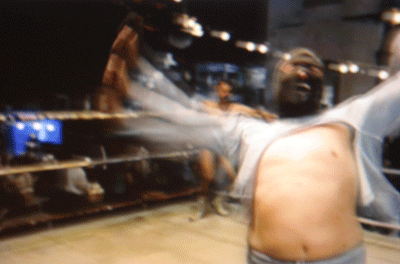
Nacho Libre, 2006. Directed by Jared Hess, written by Jared and Jerusha Hess and Mike White. Starring Jack Black, Hector Jimenez, Ana de la Reguera, and Darius Rose.
Mexicans sure are funny. This was hammered into my cranium about ten minutes into Nacho Libre. Early on, we see Jack Black serving grotesque meals to poor orphans, all the while talking like Speedy Gonzalez, that icon of Hispanic thespianship. Wrapped in sharp cinematography and a smart soundtrack and featuring a cast of bug-eyed, gaping children–all of whom are cute as buttons–Nacho Libre looks good, but could be the worst film I’ve seen this summer (were it not for some tight competition in the guise of Mission: Impossible, Poseidon, and The DaVinci Code). I’m not Hispanic, so I can’t say that this film insults my race; I can say that something this monumentally unfunny and mean-spirited insults me as a person.
Oddly enough, since I endured Nacho last Wednesday, the film has been widely praised as ‘sweet’. This is baffling. Nacho Libre dislikes many of its characters and has an outsider’s view of a culture, lazily researched. It’s ostensibly for kids but without a strong child character, just a selfish man in the character of Nacho and the actor Jack Black, who plays him. The plot is fast and loose, seeming more along the lines of one of those awful Saturday Night Live skit movies (Superstar, Stuart Saves His Family, etc.) and utterly without character. The humor as broad as Jack’s waistband, and I think there might have been ten laughs total in a packed theater.
The facts: Jack plays Nacho, son of a Mexican priest and a Scandinavian missionary, orphaned at a young age. Since losing his parents, he has been in charge of cooking hideous meals for the other orphans, basically green gunk that gives the priests diarrhea (thus begins the first of many unfunny bathroom jokes). Nacho loves the Lucha Libre wrestlers, those masked, caped buffoons who throw each other around in the ring, and who supposedly made some groovy films in the 70s, which this film utterly fails to pay homage to. Anyway, Nacho decides to become a Lucha Libre in order to get some glory and raise money so that the orphans can have something decent to eat.
Admittedly, you don’t need much of a plot to make a good comedy about Lucha Libre wrestling. Perhaps you don’t need a Hispanic playing the lead role, either–after all, Chuck Heston played a Mexican man in Touch of Evil, weakening a tremendous film (in Nacho, I yearned for the talents of the apparently too-thin John Leguizamo, or for side-kick Hector Jimenez to helm the thing).
“I pulled a Meryl Streep,” Black said, explaining his training for the role of Nacho. “I worked hard to perfect my accent. I wanted it to be kick-ass, but it was not easy.” That’s probably because it’s hard to be kick-ass like Streep when you’re a mediocre actor. Black is funny, but his ego demands to be center stage in this film, barely allowing other actors to breathe. And the film has its moments of thinly veiled disgust: Jack’s character is never humiliated to the extent of his pal Esquelito, who has shit smeared in his face, his hair pulled out, and is chased by a tremendously fat woman who has to crawl on all fours through tunnels like a sewer rat. It’s apparently fun to show this woman as being grotesquely fat, whereas Nacho is simply fat and fun, a man of eventual dignity.
Both the Hess’ Napoleon Dynamite and Mike White’s The Good Girl are rife with moments of loathing for characters unlike themselves– Dynamite still bewilders me; I thought it was fun to watch but filled, at times, with moments of unnecessary cruelty. And the girlfriend in White’s School of Rock is the one sour character in an otherwise charming film.
Perhaps I’d ignore much of this if the damn thing had just had a laugh or two. But the comic timing is leaden, and the scatological humor is so thoroughly out of place that the kids in the crowd didn’t even respond to it. Nacho Libre has the appearance of a movie that was fun to make, something that, had I been a member of the cast or crew, I’d have fond memories and a ton of belly laughs. Unfortunately, none of us were on the set, so we’re treated instead to an inside joke that barely registers a smile.
Nacho Libre is mercifully short, and when I emerged from the theater in my grumpy mood, I wondered to myself if white culture has ever had its movie equivalent, of people with goofy accents and a dumb plot with lame, insulting jokes.
Maybe it’s The DaVinci Code.

Leave a Reply