Category: Blog Post

  • Monkeywrench Movie Review. Part One.

    I am a gearhead, or as they say across the pond, a "petrolhead." While this ostensibly disqualifies me from writing a movie review, my British friends think otherwise. Particularly if I am writing about British films.

    The flim you need to watch is called This Sporting Life from 1964. It is a classic of the British New Wave (predated the French) and perhaps the most famous of the "kitchen sink dramas" set in the economically-depressed regions of Nothern England.

    It is directed by the great Lindsay Anderson (his first feature film) who went on to direct the scandalous …If with Malcom McDowell at the end of the decade. It also features the performance of a lifetime by Richard Harris (his first feature flim lead) and Rachel Roberts (nominated for an Oscar, as was, I think, Harris.)

    For a critical appraisal of this classic, simply read the review on the Criterion Flims website (get all your flims–buy and own them— from this website and waste no time with anything else) or check out Strictly Film School.

    For a monkeywrench review, here are my thoughts:

    This is a brutal flim. Many consider it the finest British flim ever made (questionable, but worth considering). It is unflinching and unstinting in its attention to emotional and aesthetic detail.

    What really makes it work for me, however, is Richard Harris’ perfomrnace and that of Ms.Roberts. While it was said at the time that Harris was aping Brando in This Sporting Life, I feel he provides a far more emotionally nuanced performance of an athlete with feelings than "I coulda’ been a contenda" Marlon and his assorted women.

    I wonder if there is even such a thing as a British method actor?

    Leave it to the Americans to coin a buzz phrase. Leave it to the British to mint the finest actors on the planet. (Think Tom Hollywood Hanks in Forrest’s Hump versus Peter Sellers in Being There.)

    Alas, why should you watch this film about sports?

    1) Because it is about sports.

    2) Because it is about women.

    3) Because it has not one, but two classic Bentleys.

    4) Because it shows that apes like you and I can have feelings.

    5) Because it says something about living life over keeping your head in the sand (whether in the suburbs or the skyscraper you inhabit downtown).

    Part Two, including a very greasy plot synopsis, to follow soon. I am too drained from watching. I have feelings.

    (Impatient? There’s always Wikipedia.)

  • Arts Up in Arms: The MIA Attempts to Quell the Rumors this Saturday


    DISCUSSIONS/ART

    MAEP Community Meeting


    Attention artists and art appreciators! As many of you already know, beloved coordinator of The Minnesota Artist’s Exhibition Program, Stewart Turnquist, who held his post for the past 31 years, resigned unexpectedly last week. Many local artists are concerned,
    fearing the future of the artist-run program – which under Turnquist’s
    leadership has successfully maintained a collaboration between the MIA
    and the statewide artist community. Come down to the MIA this Saturday morning for a public forum which will invite those with questions and concerns about the future of MAEP to speak their mind. Our local artists need
    your show of support, so if you appreciate the vibrant arts and culture scene
    that has been so carefully cultivated in our fair city throughout the years, or you are an artist yourself – your input is
    absolutely vital!


    Saturday, 10:30am-Noon, The MIA, Pillsbury Auditorium, 2400 3rd Avenue South, Minneapolis, Free

    ART

    All Buildings Dream in Blueprints


    One of my fave Minneapolis photographers and an all-around talented fellow, Eric William Carroll,
    opens this amazing solo exhibition at Augsburg College’s Christensen
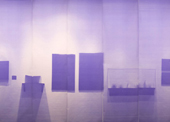
    Center Art Gallery tonight. Using light and blueprint paper, Carroll
    transforms three-dimensional objects and spaces into two-dimensional
    images using an old-timey photography process referred to as diazotype.
    Cool, right? It gets cooler. The installation includes a 2-D,
    large-scale recreation of Augsburg’s annual Student Art Exhibit, which
    was on display in the same gallery this past April. All Buildings Dream in Blueprints
    merges memory with this very moment, creating a visual version of deja
    vu that is as pretty as it is fascinating. Runs through September 5th.


    Friday, Reception 5:30pm-7:30pm, Christensen Center Art Gallery, Augsburg College, 720 22nd Ave. S, Minneapolis, Free


    MUSIC

    Anthony Cox, Phil Hey & Chris Lomheim


    Here’s a gig that lets you strain the brandy or fine single malt over
    your tongue while you swell with pride for living in a place with such
    a vibrant local jazz scene. Cox is an internationally renowned bassist
    who had Billy Higgins and Dewey Redman on his first record and happens
    to call the Twin Cities home. Hey is a protégé of Ed Blackwell and has
    been arguably the top drummer in town for two decades. They’ve formed
    trios with pianist Billy Carrothers and guitarist Dean Magraw, among
    others, but when Cox called Lomheim as well as Hey to fill some
    corporate dates, things took a quieter, albeit very satisfying, turn.
    Lomheim favors the melancholy of Bill Evans and is also a composer of
    some note. Cox, who always admired Evans’ bassist Scott Lafaro, was
    amenable to that approach. The first time they played the AQ a few
    months back was reportedly a luminous affair. Despite their Ornettish
    associations, Cox and Hey are enjoying the hushed, relaxed groove of
    calling out standards-be it Monk or Jerome Kern, with Lomheim always
    bringing at least one original for variety-and spooling out the
    interplay. -Britt Robson


    Friday & Saturday 9pm, Artists Quarter, 408 St. Peter Street, St. Paul, $10


    FESTIVALS

    Highland Fest


    I spent a good chunk of my youth living in St. Paul’s Highland Park
    neighborhood, and the bustling Highland Village was a primo spot for
    within-walking-distance loitering. Each summer for three days, tents,
    moonwalks, food vendors and more come out of the woodwork to turn this
    specialty shop-infested three block stretch into an arts and crafts mecca,
    and the whole neighborhood turns up to spend their hard-earned cash on
    pottery, dreamcatchers and cheese curds. The best part, of course, is
    the beer garden set up near the library, where you can sip (or guzzle)
    3.2 Bud Light while enjoying the musical stylings of such safe-bet acts as Martin Zellar, Yodel A-Go-Go, and tons more. Highland Fest is a fun
    stroll-through, a decent excuse to scarf down some mini donuts, and a
    good way to get some sun! Watch out for off-leash children


    Friday-Sunday, Highland Park, Ford Parkway & Cleveland Ave, St. Paul, Free

    WINE & DINE

    A Culinary "Cue" from Chef Alan Shook

    Meet Chef Alan Shook from Cue at the Guthrie, get recipe tips from the upcoming World Flavors Dinner Party, and pick up ingredients at Whole Foods to make your own gourmet meal! Chef
    Alan will demonstrate cooking techniques, sharing a special
    scallop recipe plus dip and sauce recipes from our upcoming World
    Flavors event. You’ll learn how to transform asparagus, carrots, and
    red peppers into a colorful party mosaic, pretty as a picture and good
    enough to eat too!

    Don’t forget to RSVP for the World Flavors Wine Dinner and Patio Party at Cue
    on July 22nd from 6 to 9pm featuring a multi-course gourmet meal, live
    jazz from Irv Williams and Peter Schimke, and more. Grab a date and
    enjoy this culinary adventure with us! Click HERE for more info and to reserve your spot!


    Saturday, 1-2pm,
    Whole Foods Market, 3060 Excelsior Blvd, Minneapolis, Free


    FESTIVALS

    Chiang Banger


    Who knew a Thai restaurant could rock so hard? This Sunday throw
    caution to the wind and join the crew at delicious Uptown staple Chiang
    Mai Thai for their first (and hopefully annual) block party.
    Spice up the laziest day of the week with yummy food, ice cold beer and
    music from some of the hottest bands in town including local indie
    legends, Polara, sexy electro-dream gods Solid Gold,
    and many other hipster notables such as Ouija Radio, The Mood Swings,
    Shortcuts, Fuck Knights, Frontier, Caroline Smith, Bitch City, and Grey
    Skies – with witty banter thrown in between sets by emcee and comedian
    Chris Maddock. The perfect end to a smashingly good weekend!


    Sunday, 2pm-10pm, Behind Chiang Mai Thai, Lake St. & Girard Ave., Uptown, Free


  • Muja Messiah's Debut Album

    "Don’t wait for the critics to jump on this dude before you start giving it up," says everybody’s favorite Albino rhymer, Brother Ali. He’s speaking about Muja Messiah, the latest local rapper to make a big splash in the national underground hip-hop scene. "Muja is the shit. The man is right with his."

    So this is your last chance to go grab (download…) Muja’s debut album Thee Adventures of a B-Boy D-Boy and enjoy it for yourself, before I ruin it with tempered, analytic praise.

    Ready, go. Now come back. We can have a nice discourse in the comments section below. We will agree with each other, all of us emphasizing each other’s opinions in a positive, supporting manner. Which happens.

    Okay. Let’s start with Bro Ali’s statement that "Muja is the shit." If being ‘the shit’ – and making an album that is also ‘the shit’ – necessitates putting forth an unbroken series of successful songs, then indeed there’s something gorgeous about Muja Messiah. Thee Adventures cycles through a medley of styles. The production ranges from the jazzy slow jam to the upbeat to the downright krunked, the rhymes from egotistical to introspective. And Muja effortlessly navigates from track to track, rapping convincingly over the varied beats – it’s not just like he wrote a rhyme and a producer made a beat and they synced them up and smashed them together; rather his flows seem actually to be linked with the rhythms.

    Overall, his style has a bit more of an edge than most Minnesotan rappers’. Just when I thought the local scene was as saturated as it could possibly be – this is a small city to have as many big names as we do – Muja is able to inject it with something that, if not completely new, is at least new to us.

    Though he expertly tackles the self-conscious and political rhymes that have filled several albums on the Rhymesayers label, Muja Messiah (whose album is put out by Black Corners) is most on point when he’s rapping about his life on the streets of North Minneapolis. (Not to say other rappers here haven’t dabbled in this milieu; it’s just that, to my mind, Muja is so far the most noteworthy.)

    On "What’s This World Coming To" (which features Slug) he’s all like:

    "I was conceived in a mustard green Cutlass Supreme/
    lucky me at the time I was the youngest of three/
    til my big sister drowned in a river/
    years later my brother got gunned down and they never found the killer."

    As this verse shows, he handles his personal history with frankness and even a little bit of humor. It’s his trademark mixture, and proves to be engaging on every track. One gets a sense that Muja is rapping about some important, personal issues, but where applicable he’s able to see the absurdity of his situations. I think that might be called scope.

    What’s maybe most endearing, though, is an inferiority complex that hovers over the album, in regards to street credibility. While Muja Messiah raps about the toughness of his childhood, the murder victims he knows (including his brother), and his absent dad – this is the stuff of Tupac, let’s remember – he still seems to need to validate himself and the city he grew up in.

    On the Lil’ Jon-inspired "Get Fresh," he’s all like:

    "Niggaz backstabbin’ my city
    like it’s all backpackin’ and hippy
    like it ain’t crackin’ in my city
    We don’t be rappin’ about rappin’
    We rap about what be happenin’
    in the streets."

    Likewise, Thee Adventures features guest verses from Black Thought (The Roots), Slug, and I-Self Devine; his beats are produced by guys that have worked with Eminem, Nas, and De La Soul; and yet it seems like Muja’s ego still needs some propping up. It’s sweet, kind of. Coming from the state that labors to make sure everyone knows that Bob Dylan was born here, the self-conscious ego seems a very Minnesotan thing. The overall effect works in Muja’s favor: Because of its insecurities, his thuggish style of rap is accessible even to guys like me.

    At the end of the day, he can’t ignore the fact that Kenwood and Linden Hills are as much a part of his city as any other neighborhood. Seeing as how he’s the wordsmith here, it’s not surprising that he puts it best himself:

    "I’m from a pasture where the grass is greener
    started as a rapper and emerged as a leader…
    I’m down with Black Thought
    I’m down with Black Blondie
    I am the Black Honkie."


    **CD release party Sunday, July 27 at First Avenue**

  • The Naschmarkt: Vienna's Outdoor Market

    "Probieren Sie mal, Herr Professor," says the guy behind the counter at the market stall, as he holds out a freshly fried felafel ball. "Have a taste." (I guess the beard and glasses make me look like a Herr Professor.) A few feet away, another vendor holds out a green olive on a toothpick. Strolling through the Naschmarkt, Vienna’s open air market, is like running a gastronomic gauntlet. The market stretches out for about a mile through the
    heart of the city, with scores of vendors on either side of narrow pedestrian
    walkways.

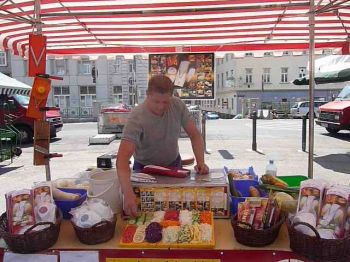
    Naschmarket Vegematic guy

    On loan from the Minnesota State Fair: The Vegematic guy!

    Most of the fruit and vegetable vendors seem to be Turkish, but you
    can also find bakeries, cheese shops, wine merchants, doner kebab vendors,
    Oriental markets, and stalls offering everything from artisan vinegars to fresh
    pasta, fish, meat and sausage. There are also a lot of little cafes in the
    Naschmarkt, offering everything from traditional Austrian Wienerschnitzel and brathaendl (roasted chicken) to palatschinken (crepes) to Thai, Chinese and Vietnamese cuisine.

    **Click here for more pictures from the market and take a look at the video (below).**


  • Vienna: A lot more than just Wienerschnitzel

    Zum Alten Fassl, a typical Viennese tavern-restaurant. Image from Zum Alten Fassl website.

    Greetings from Vienna, one of the great food cities of the
    world. Americans may lump Austrian cuisine together with German cooking, but
    Vienna has its own distinctive cuisine, and it’s a lot better and more
    interesting than German cooking. In part, this might be because the Austrians
    are Catholics, and the Germans – or at
    least the northern Germans – tend to be Protestants. The farther south you go
    in Germany, the more Catholic it is, and the better the cuisine. I have a whole
    theory about this, that I will have to save for another time.

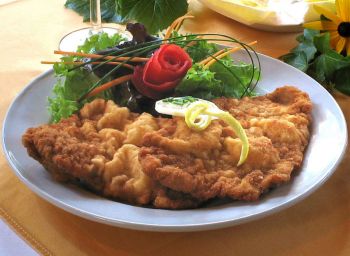
    Wienerschnitzel

    photo by Kobako, used under Creative Commons license.

    At any rate, there’s a lot more to Viennese cuisine than Wienerschnitzel
    and Wiener wurstchen, (hot dogs, not to be confused with wiener dogs.) The classic Wienerschnitzel is made from
    veal, and is actually an adaptation of Italian veal scallopine, but most Wienerschnitzels in Vienna nowadays are made from pork, followed by chicken or
    turkey. A proper Wienerschnitzel is supposed to be pounded very thin, breaded
    in egg, flour and breadcrumbs, and then pan-fried. Done right, a
    Wienerschnitzel should be so un-greasy that you could sit down on it, if you
    were so inclined, and not get grease stains on your pants. Wienerschnitzel is
    about as ubiquitous in Viennese restaurants as hamburgers are on Twin Cities
    menus – even Turkish and Italian restaurants seem to feel the need to offer a
    schnitzel for less adventuresome diners. Another popular variation is the
    schnitzel semmel, a chicken or pork schnitzel on a bun, which has a strong
    resemblance to the classic Minnesota pork tenderloin sandwich.

    Vienna is the former capital of the
    Austro-Hungarian empire, which made it a cultural crossroads for centuries –
    and besides, emperors usually like to eat well, and tend to do a lot of
    high-end entertaining. Today, Vienna is still a crossroads – you can hear
    dozens of languages on the streets, and find restaurants serving practically
    every cuisine in the world. Thanks to an influx of Turkish immigrant "guest
    workers" starting in the 60s, the most popular street food in Vienna is the
    doner kebab, the Turkish cousin of the gyros sandwich, sold on practically
    every street corner for about $5. Pizzerias are nearly as popular.

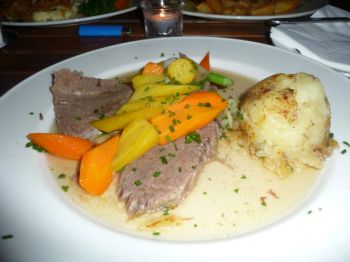
    Tafelspitz

    Last night, I took my son and his girlfriend out to Zum Alten Fassl, a
    typical Viennese beisl (tavern-restaurant), for some traditional Viennese
    cooking – he had Zwiebelrostbraten, roast beef with crispy fried onions, and I ordered one of the classics, Tafelspitz, tender boiled beef in beef broth, served with carrots, parsnips, applesauce and creamy horseradish sauce (it’s a lot better than it sounds), all washed down with local Gosser beer.


  • Beer, Brats, and The Government Inspector

    SPECIAL EVENT
    Beer, Brats and Bribery

    What’s
    better than sitting in the shade of the modern marvel that is the
    Guthrie Theater while enjoying a picturesque view of the mighty
    Mississip, a juicy gourmet brat and an ice cold Summit beer? Not much,
    say I! The last patio party I went to at the Guthrie was a breezy and
    fun experience that I’d happily repeat, and if you’re into tasty food
    and amazing entertainment (and I know you are), then this is your
    ultimate Thursday night destination. For a mere $25 you’ll get not only
    brats and beer, but also tickets to The Government Inspector, a spirited and witty comedy about a case of mistaken identity in a small Russian town, written by Jeffrey Hatcher (The Falls and Tuesdays with Morrie).

    To score this sweet deal call the Guthrie’s box office at 612-377-2224 and quote price code "AV".

    Bonus: Click HERE to reserve your spot for The Rake’s World Flavors Wine Dinner and Patio Party at Cue next week!

    5:30pm Patio Party, 7:30pm Play, The Guthrie, 818 2nd Avenue S, Minneapolis, $25


    READINGS
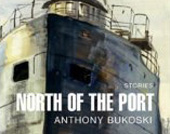
    Anthony Bukoski: North of Port

    While the Twin Cities may be somewhat far removed from the rock-lined shores of Lake Superior,
    we’re still close enough to consider it part of our personal heritage
    as Minnesotans. I know I’ve made many memories that are wrapped around
    the sounds, smells, and experiences I’ve had "up north". Writer Anthony
    Bukoski, while on the Northern Wisconsin side of the shoreline, weaves
    his tales with similar memories in mind. North of the Port
    is a touching collection of twelve short stories dealing with Polish
    immigrant families in the mid-20th century, with most of them set in
    Bukoski’s home town of Superior, Wisconsin. North of the Port is the author’s fifth book, and the most recent in his Superior-based storytelling legacy that dates back to 1974.

    Reading at 7:30pm, Magers & Quinn, 3038 Hennepin Avenue S, Uptown, Free


    MUSIC
    MOVEMent

    North
    Loop hotspot Babalu knows just how to combine contemporary elegance
    with spicy Latin flav to create the perfect ambiance. Now each
    Thursday night you can not only have your tapas, but you can dance
    too! Babalu’s new weekly late night happy hour will feature rotating DJs playing smooth electronica while you sip fancy cocktails and nosh on delectable appetizers on the cheap. Try yummy fare such as the Tostada De Tinga with Chipotle
    chicken, queso fresco and avacado or flash-fried Calamari
    sauteed with garlic and guindilla pepper. Perhaps the Tostones
    Rellenos, which features twice fried plantatians stuffed with shrimp?
    Indulge, then dance it off!

    10pm, Babalu, 800 Washington Avenue North, Minneapolis, Free

  • Nostalgia and the Irregular Lens

    Reclaimed Memory at Rogue Buddha through July 27th and
    Dots and Loops at Midway Contemporary Art through August 2nd

    Outsider art, a concept derived from Jean Dubuffet’s 1948 coinage Art Brut, is the work of artists who live in extreme mental states. Dubuffet thought these states of consciousness placed the artists beyond the reach of official culture. The term emerged in the middle of the last century, (although some of the most famous outsider work comes from before that time). The Art Brut movement was a response to anxiety about the assimilation of Dada by the art establishment, a desperate search for an outside or margin. Today the term "outsider art" is often applied to the work of self-taught and naïve artists. Dots and Loops, at Midway Contemporary Art through August 2nd, is an outsider artist show in the sense of Art Brut’s dedication to outsiders. At another show at northeast’s Rogue Buddha Gallery, Yuri Arajs – who has done much to promote the cause of the other outsider art in Minneapolis – has an exhibition of new work, his farewell to the Minneapolis art world.

    Arajs’ Clever Show

    There is a fundamental trick to Arajs’ Reclaimed Memory. The works – comprised of found photographs that are cropped, treated, and re-framed into evocative scrapbook pages – lure us in with junk-shop mystery, then invite us to experience our own assumptions as discovery. In short, Arajs evokes nostalgia.
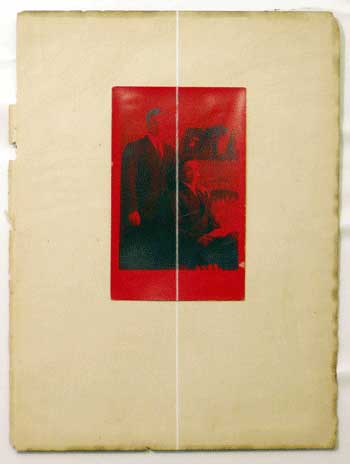
    Yuri Arajs

    Lately, Arajs’ work has circled around organized systems: numberings, language, and repetition. The old photographs at the center of these latest works have such a strong odor of nostalgia that they overpower the rest of Arajs’ familiar motifs. The artist’s modifications become mere clues to the lost worlds of the photographs. It makes for an interesting treasure hunt for the scrapbook sleuth, but as bricoleur, Arajs does little to challenge the viewers’ longing for authority as detective/inventors of the past. To unseat us might contribute dissonance to the music at the center of this exhibition, and what sets Rogue Buddha Gallery apart this month is its ability to transport us into a lyrical mindset. You can almost smell the old books, snow, attic dust, teak and cedar.

    Interact Center Artists at Midway Contemporary Art

    Midway Contemporary Art is currently dedicating its galleries to disabled artists from Minnesota’s Interact Center. The show, Dots and Loops, would attract curiosity even if it weren’t so intellectually engaging and artistically evocative. Just as Arajs’ current exhibition may coax the unwary into indulging mythologies of the past, these artists often point to our own uneasy relationship to the totems of the present – media saturated icons that have become so prevalent as to structure the unconscious idiomatically. Part of the wonder of such a show is that it invites expansive and open-ended interpretation of the work. With that in mind, I will highlight a few of the fifteen artists on display to suggest some of the works’ capacity for meaning without closing off interpretation.

    Take for instance the work of Matthew Zimdars. His drawings derive from the weather maps that have saturated our collective minds. The lurid colors in his Severe Weather series suggest the state of constant emergency that permeates the Bush decade. And yet, abstracted from their functionality, the maps radiate warmth, attaining the totemic quality of religious portraits. The maps are whisperings from an angel, or documents of divine wrath, but even wrath is consideration, and if nothing else, we rely on the interactive weather map to place the viewer reliably at its center.
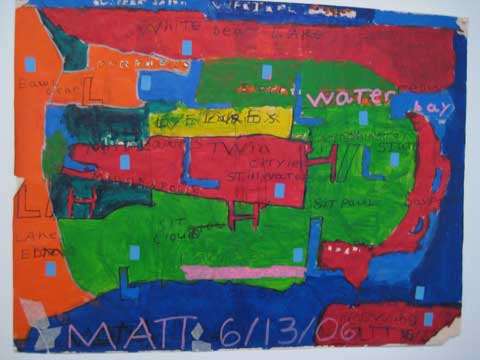
    Matthew Zimdars

    Zimdars’ work suggests the magical quality of the ordinary world – fantasy geographies of the ordinary that scroll by with menace and importance. Zimdars infuses the banal with magical significance. Meanwhile, in the same gallery, Peder Hagen’s work describes a fantasy kingdom with the unflinching eyes of a census taker. His striking portraits and maps from the mythical land of Cressia thoroughly embroider a dream of a utopian culture. His fantasy is unerringly detailed, supported with maps and ledgers until the totality of his dream – its reality – is unmistakable.

    When viewing outsider art, it’s easy to indulge the idea that the art is more sincere, more real and less adulterated. The nihilism of a PBR-swilling art college grad seems like lifestyle art, more so when compared to the cockeyed satire in the work of a painter such as Paul Jagolino. Jagolino’s minuet-in-the-round with the ladies of popular culture strikes a chord at once hopeful and insouciant, expressing an ambivalent relationship to the flickering images of supermodels and film stars. In each portrait, the celebrity sitter is painted coarsely, and each one confesses her love for the painter, a love that is, in its way, reciprocated by the portrait itself.

    Among the most intriguing artists here is Donovan Durham. His work ranges widely – from unusually populated, flattened scenes such as Scenes of Spooks, painted in acrylic, to fascinating line drawings, including a series of portraits of a class of ’64. The former, with their bright childish color schemes, flat perspective and fanciful subject matter, might lead the viewer to the dismiss Durham himself as a case of arrested development, a man with the ideas and concerns of a child.

    But his pencil drawings invite a subversive reading. The portraits seem almost like transliterations from yearbook pages, but the headshots are distorted with a fisheye focus on the lips and nose. The sitters are transformed into half human African-Americans, their noses stretched until they are like armored carapaces across the front of their faces. They might appear like racist caricatures, (Durham himself is black), yet Durham’s portraits are also infused with an unmistakable dignity and honor. Another portrait, with the words "Happy Birthday" written across the top, may refer to the sitter, a curly haired woman, or it may refer to an inscription above her head which reads "The War." The work has stayed in my mind as much as any other I’ve seen this month.

    If it seems naïve to praise the work
    of an outsider artist show in the same terms as that of more conventionally abled artists, momentarily push aside your expectations of art and disability, and recall that disability refers to that narrow set of skills required for work and its related communications in modern society. It has little to do with the various acts of condensation and expression through which an individual’s vision becomes visible through a work of art. The current show at Midway Contemporary Art is a gift of perceptual grace. Brave and lovely, its views through irregular lenses have that power so rare in modern art to transport the viewer to an alternate present. The show should not be missed.

  • All-Star Break Books Edition

    Skol, baby.

    The Twins’ Justin Morneau fairly dominated all-star weekend, first winning the Home Run Derby (even if Josh Hamilton broke the record for most dingers in a single round), and then, in the bottom of the 15th inning of the All-Star Game, he tagged up on a sacrifice fly to right and hustled his buns to score the winning run, and everyone breathed a sigh of relief because they could finally go to bed.

    Skol.

    The duration of the game was four hours, and fifty minutes. The two main developments as the innings grew later were that the New York fans’ resentment against the Red Sox players lessened, and it became increasingly apparent that Joe Buck is a better salesman than play-by-play announcer. ("This National League line-up is brought to you by Taco Bell…Think outside the bun…Up first…")

    If you include the time spent on announcing the All-Stars, the starting line-ups, the hall-of-famers, and the national anthem, the broadcast lasted well over six hours. I thought to myself, ‘I could’ve read a book.’

    Though I suppose that’s not so different from normal. And it’s not necessarily an impulse I act on as often as I might suggest. But in this specific case, it got me thinking about some of the great novels that have been written about baseball.

    I’m pretty sure, actually, that my initial interest in reading may have been helped along by Mark Harris’ quartet of baseball books, narrated by Henry Wiggins, pitcher for the fictional New York Mammoths: Bang the Drum Slowly, The Southpaw, A Ticket for a Seamstitch, and It Looked Like For Ever. I was a fairly prolific baseball card collector, and of course regarded Kirby Puckett and Kent Hrbek as heroes. Harris’ novels were the first glimpses I had into the sort of dirty underside of baseball (pre-steroids, probably). His characters are always stuck in cramped trains or seedy hotel rooms, if I remember correctly. Not surprisingly, I was a lousy ballplayer, and it wasn’t long before I realized that I’d have an easier time accessing the game through prose than through my (lack of) muscles.

    This year, there are a few notable baseball books that have been spawned right here in Minnesota.

    First off, you’ve got Peter Schilling’s The End of Baseball (came out in April), in which a team that ‘almost was’ becomes real. Set in 1944, the wily promoter Bill Veeck hustles his way into owning the Philadelphia Athletics, and in hopes of bringing home the pennant he gets rid of all the team’s white players and recruits the stars of the Negro League. The cast of characters includes Walter Winchell, J. Edgar Hoover, Roy Campenella, and Satchell Paige. From the Baltimore Sun: "To paraphrase George Bernard Shaw, some baseball novels see things as they are and ask why; Peter Schilling Jr.’s brilliantly conceived The End of Baseball sees things that weren’t and imagines what could have been. The best baseball novel so far this century."

    Then, in a couple months, you can check out hometown boy Bill Meissner’s Spirits in the Grass. From the flap: "In Spirits in the Grass we meet Luke Tanner, a thirty-something baseball player helping to build a new baseball field in his beloved hometown of Clearwater, Wisconsin. Luke looks forward to trying out for the local amateur team as soon as possible. His chance discovery of a small bone fragment on the field sets in motion a series of events and discoveries that will involve his neighbors, local politicians, and the nearby Native American reservation." Meissner’s earlier collection, Hitting into the Wind can tide you over until then.

    What else?
    Of course there’s Bernard Malamud’s The Natural (that link goes to a 1952 review of the book), about the prodigious Roy Hobbs whose career is sidetracked first by a crazed fan, and then by disease. I heard a story that when Malamud saw the film version – starring Robert Redford – for the first time, he sat in the theater as the credits rolled, and cried because they’d ruined his book. If you read it, you’ll understand why. (Hobbs is also used as an entity in some Peanuts strips.)

    Then there’s Philip Roth’s The Great American Novel, concerning the Patriot League’s Ruppert Mundys – the only homeless big-league ball team in American history. The players include Gil Gamesh, "the only pitcher who ever literally tried to kill the umpire," and John Baal, the Babe Ruth of the Big House, who never hit a home run while sober.

    Those are the ones that ring my bells. Or something. Here is a more comprehensive list that’s worth checking out. And as always, feel free to add your own favorites below.

    Just for good measure: Skol.