Category: Blog Post

  • Monsters, Maps, and Marginalia

    How is your balance these days? I’m asking only because I’m about to take you out on a limb–and who knows how many of us have learned to walk on a tightrope unafraid, arms spread wide; how to fall without getting hurt; and how to lift off and take flight? (Impossible, you say? But there is flight and flight, lines inevitably running together in a perspective unsuited for parallels and the blind leaps of the imagination, based on nothing but a hunch. I like following those inexplicable urges.) This particular limb is a story: a story that tries to make connections where maybe there are none to begin with. But, you see, I have this hunch. So let me see if I can spin this right and weave the strands together into what may, momentarily, resemble a whole.

    The current McKnight show, on view at MCAD’s gallery, brings together four artists. At first glance, all that connects these artists is the fact that they received a grant that allowed them to pursue the pieces on display. But, as Kristin Makholm puts it in the catalog, these artists also share an interest in "allegory, narrative, symbolism, and story." How appropriate, then, to create a story of my own–not a linear story, but one that proceeds in a seemingly counterintuitive way: from the margin to the center, from the periphery to that elusive pivotal point of convergence.

    As many advocates of such a shift in perspective have argued, what may result from such daring turn-abouts ranges from acute vertigo to a more general unease, anger even, unleashed by the sense of uncertainty and of a profound estrangement from what we thought was ordinary–too ordinary and plainly "normal" to pay much attention to. But looking from the margins toward the center re-arranges what we can see. What’s more, it can lastingly impact how we see, and make us aware of where it is that we see from–speaking socially, culturally, and, also, personally. This realization may jolt us into performing a double take. A triple take. Quadruple–? (Humor me, this once.)

    Four artists, each of them accomplished: Andrea Carlson (whose The Tempest is the header image included above), Megan Vossler, Amy DiGennaro, and Stacey Davidson. Four women. In this election season, with the electorate newly attuned to the lingering legacies of racial and gender trouble, is this a remarkable fact? From what can be gleaned by looking over the list of past grant recipients, it seems this is indeed a first. Does that make four female recipients remarkable, though? I don’t know. What is remarkable, without question, is the work on display.

    Andrea Carlson, Portage, 2008 (mixed media on paper) and The Tempest, 2008 (mixed media on paper), both 92 x 122 inches

    On opening night, Andrea Carlson, whose large scale mixed-media pieces entitled The Tempest (2008) and Portage (2008) occupy the gallery wall furthest from the entrance, mentioned in conversation (and I have her permission to repeat this exchange here) that her friends, upon seeing her new work, asked, "But where are the monsters?" Given Carlson’s previous interest in the mythical monster of Anishinaabe lore, the Windigo, this question is not as odd as it may initially seem. In her Windigo Cycle, inspired, as the artist notes, by her Anishinaabe and European ancestry, Carlson focuses on this "winter cannibal monster" as a character that indiscriminately consumes those unfortunate enough to cross its path. On American Folklore, Schlosser describes the Windigo as "tall as a tree, with a lipless mouth and jagged teeth. Its breath was a strange hiss, its footprints full of blood, and it ate any man, woman or child who ventured into its territory. And those were the lucky ones. Sometimes, the Windigo chose to possess a person instead, and then the luckless individual became a Windigo himself, hunting down those he had once loved and feasting upon their flesh." Carlson relies on the idea of indiscriminate, insatiable consumption, paired with the twin threats of being consumed spiritually–possessed– by the monster and, as a result, of turning to cannibalism, as a powerful metaphor in her exploration of cross-cultural exchanges, including assimilation and acculturation.

    Lauren O’Neill-Butler, analyzing Carlson’s work in her catalog essay, ascribes a "sharp post-colonial critique" to the artist’s work. And, yes, the elements of a post-colonial critique are here: for instance, the very title–The Tempest–alludes to that staple of post-colonial literary analysis, Shakespeare’s comedy set on a wind-swept island, complete with monstrous and enslaved natives. And yet, applying the term "post-colonial" to Native American and U.S. American cultural relations is not uncontested: writers such as Jack D. Forbes (in Columbus and Other Cannibals) and Thomas King (in "Godzilla Vs. Post-Colonial") have argued, with admittedly controversial results, that, strictly speaking, there is no "post" to the colonization of Native land in North America.

    The Tempest is aptly titled, then, to allude to these stormy cross-cultural interactions. Yet the literal storm does not rage at the center of the painting, where white clouds drift serenely over placid water. It is at the periphery, on the margins, where there is unrest, tumult even. Striking black and white geometric patterns, inspired by Anishinaabe blanket patterns, abandon the cozy appeal of the textile and morph into a threatening vortex, complete with rows of jagged teeth. The overlaid patterns evoke a disturbing sensation of motion, as if we are allowed only a brief glimpse of the peaceful vision of a fantastic landscape before the rotating, serrated edges will close on us.

    The act of looking itself, it seems, becomes a dangerous, complicated endeavor here. Where exactly do we stand in relation to this work? Visually, we have to pass through the swirling, vertigo-inducing threshold in order to reach–what? The lure of an idyllic landscape? A promise of authenticity? Neither is ultimately allowed: the paintings themselves are divided into panels that rip the representational space apart and thus deny any illusion of reaching the sanctuary of the land beyond. There is no illusionary wholeness here. All we can see is our own fantasy, framed by the toothy geometry of indigenous imagination.

    So, to return to the initial question raised vis-à-vis Carlson’s work: Where, then, are the monsters here? Who consumes whom in this collision of cultures? Who is at risk of involuntarily turning into the monster and suffering this drastic adjustment of vision through possession by the evil spirit? Given that Carlson’s two paintings are shown next to each other, the experience of looking at their geometrically framed landscapes assumes the uncanny air of peering through two giant eyeholes: There is a storm raging inside the skull we thus come to inhabit, and we, the onlookers, have little control over what we see, since our vision is at the mercy of swirling of peripheral patterns. We, the spectators, turn into the mythical monster. We are the cannibals, indiscriminately consuming whatever comes our way–art, nature, culture (whether our own or somebody else’s), resources. We consume it all, the high-brow along with the low-brow, no-brow. With a storm raging at the periphery of our vision, can we disting
    uish omnivore from cannibal? Clearly, this work articulates a poignant cultural critique–whether it qualifies as post-colonial or not is another question, though.

    Cultural critique, too, acts as a driving force in Megan Vossler‘s work. In her drawings, nameless people scavenge or migrate through rudimentary landscapes that coalesce out of the white paper expanses surrounding these furtive scenes. Vossler withholds any clues to the specific circumstances that may have caused the experience of her characters. These are not the people whose fate makes headlines. These are the survivors, occupying the margins of international media attention, left to fend for themselves. Their experiences move to the center of Vossler’s drawings but nonetheless remain curiously distant, fading in and out of the white space as if not quite in focus, as if caught in the midst of intense fog that only has lifted momentarily.

    Megan Vossler, All of our moments are stolen, 2008 (Graphite on paper), 60 x 73 inches

    Eventually, the whiteness itself emerges as the most suggestive element of Vossler’s work. Whiteness is not just negative space here but seems to bear political meaning. This whiteness engulfs the scenes it surrounds. Like a temporarily suspended blind spot–a blind area, actually–it grants uneasy immunity to perceptive probing. It shields, it erases, it hides the particularities that may help amend the vertiginous vagueness of the scenes depicted. Thus, while Vossler’s work is clearly concerned with re-positioning marginalized and ignored experience at center stage, the seeping, creeping whiteness muffles the margins of the drawings with subtle menace.

    The whiteness materializes in the plaster casts of duffel bags, backpacks, and plastic bags in If you find me, hide me, I don’t know where I’ve been, displayed centrally on the gallery floor. While ostensibly concerned with security regulations, as O’Neill-Butler notes in the catalog, I am, once again, intrigued by the sheer whiteness on display: Is this Peggy McIntosh’s famous invisible knapsack of white privilege literally becoming visible and even tangible at last? Do the privileges most white people have taken for granted for so long finally become recognizable as such at, ironically, the very point in time when they come under increasing attack? And who is uttering the title of the piece–that lost, paranoid, amnesiac phrase?

    Megan Vossler, If you find me, hide me, I don’t know where I’ve been, 2008 (plaster, variable dimensions)

    While Vossler leaves us guessing as to who the people in her drawings are, Amy DiGennaro‘s heavily personal imagery leaves little doubt about the artist’s familiarity with her subjects. Yet this focus on the personal never falls prey to the tired indulgence of self-absorbed work that thrives on narcissism and the audience’s voyeurism; the personal, here, serves a purpose.

    Inspired by the marginalia of medieval books, DiGennaro’s drawings offer clearly structured compositions with an amazing amount of detail. In all of her drawings, center and margins interact and negotiate meanings in multi-layered, recurring motifs. The marginalia illuminate the central figure’s deeds, adding depth, complexity, commentary, and explanation. Simply put, the center only holds because of the margin.


    Amy DiGennaro, Christine the Intrepid, Hours of Bona Sforza, 2008 (graphite on paper, 41 1/2 x 29 1/2 inches)

    It seems entirely possible to get lost in these at times mystifying maps of experience. But while the work validates personal experience, it also transforms the ordinary into something of allegorical significance. This transformation is particularly profound in the case of Christine the Intrepid, Hours of Bona Sforza (2008), a drawing which centers on DiGennaro’s partner weaving nests for their two sons, while at the margins scenes of changing seasons and recurring cycles insist on the naturalness of this non-traditional family. Trees abound in the margins, their roots not only providing shelter for the sleeping figure, surrounded by friends who watch over her, but literally referencing the root, Latin radix, the stem of radicality. (The artist’s likeness, clad in a bird costume, is shown drawing tree branches in the top left corner.) In Marilyn the Sedulous, Hours of Bona Sforza (2008) the tree motif re-surfaces: a woman’s body merges into the heft of a tree trunk. There is rootedness here, and belonging, and the stitching together of homes that do not conform to the narrow traditionalism of the heterosexual family unit. In DiGennaro’s work, the still marginalized, still contested experience of living in Rainbow families is rendered in all its allegorical splendor in a radical reversal of whose experiences should count as potentially universal.

    A similar emphasis on experience that, though ordinary, does not usually take center stage, occurs in Stacey Davidson‘s work–with one crucial difference: her protagonists are dolls, which the artist first fashions three-dimensionally, before portraying them in gouache. Carefully crafted, the dolls effortlessly resist playful platitudes along with the stilted lifelessness of collectors’ treasures. Their irresistible individuality sets them apart from dolls as mass-produced plastic projections of cultural fantasies, but they do share an uncanny affinity with the purposeful dolls used for mastering the unspeakable through playful, diminutive repetition in therapeutic settings.

    When O’Neill-Butler invokes Sigmund Freud’s famous essay, "The Uncanny," in her discussion of Davidson’s work in the catalog, she is clearly on to something: the repressed returns, oddly familiar and strange at the same time, inspiring the proverbial double take and a plunge into intellectual uncertainty. What exactly is it that we are looking at here? A doll? A person? Some sort of fantastic doppelganger or hybrid? More to the point, what is it that returns to haunt us here?


    Stacey Davidson, Salt on pavement, two days after a light snow, 2008 (gouache on paper), 29 x 21 inches

    Ironically, Davidson’s dolls seem to truly come to life once they are rendered in two dimensions: wistful and wise, smeared with lipstick and soot-stained, these dolls have a past that they come to inhabit fully in their portraits. In Fuck what’s hip, Lydia steps out to make a living (2007), we encounter a middle-aged woman in a bathrobe, slightly irked by the necessity of having to step out and take the initiative to tackle her economic plight. In Salt on pavement, two days after a light snow (2008), a girl in a swishy skirt sports a T-shirt that reads "I had an abortion." She calmly meets our gaze, her youth at odds with the patient weariness of her expression. A strange tension persists between the monochromatic gouache backgrounds and the eerie eloquence of the dolls’ faces and poses. As viewers, we are of course compelled to fill in the blanks, to create the story surrounding these snapshots of sorts. The question becomes what exactly we draw on in order to project our own narratives,
    whether strictly personal or cultural, onto these doll portraits.

    What returns to us, then, in the guise of Davidson’s dolls, are culturally coded moments, isolated from their usual context and from the familiar scripts we rely on to make meaning. Despite the visual isolation and emphatic lack of context, we recognize them. What the portraits offer us is a chance not only to fill in the blanks but to pay attention to, and possibly re-assess, just how exactly we go about doing that. Yet this offer is no abstract intellectual inquiry into perception, as the dolls remind us: stubbornly playful, eerie and humorous, they riff on the familiar and make it strange, inviting us to look, and look again. If what we thought we knew becomes a little less certain in the process, so much the better.

    Thus this tale of monsters, maps, and marginalia comes to an end. What the work on view shares, beyond narratives, allegories, and symbolism, is the pronounced effort to disrupt the ordinariness of looking. We may retreat from the unexpected wisdom in the gaze of Davidson’s girl doll, and manage to find a way out of the dazzling mazes of experience DiGennaro maps in her drawings; we may emerge unscathed from the numbingly white surfaces of Vossler’s work, and surface from the depth of vision in Carlson’s paintings; yet, the most central question that arises from this particular story about these four artists insists on being answered: Where do we stand when we look at this work–personally, socially, culturally? At the margin? At the center? Out on a limb?

  • Sad News from the Broder Family

    A press release from the Broder Family:

    Tom Broder, owner and founder of Broders’ Cucina Italiana and Broders’ Pasta Bar, quietly succumbed to a life-long heart condition at his home on Saturday, July 5, 2008. He was fifty-nine. Tom is survived by his wife Molly, sons Thomas (wife Annie), Charlie and Danny.

    Tom, along with his wife and business partner Molly, opened Broders’ Cucina Italiana in 1982 at 50th and Penn Avenue South in Minneapolis. Twelve years later, in 1994, they opened Broders’ Pasta Bar at the same intersection. Tom Broder was instrumental in bringing authentic Italian ingredients to Minneapolis, as well as some of his own childhood favorites: New York style pizza and the South Jersey Hoagie, both of which have become trademarks of Broders’ Cucina Italiana.

    Fresh pasta was also a passion of Tom’s and he brought the first equipment from Italy to Minnesota so fresh pasta could be produced on-site at the deli. When Broders’ Pasta Bar opened in 1994, Tom realized his dream of a full service restaurant producing authentic, house made pasta equal to any pasta served in Italy.

    In 1996, working with local and state leaders, Tom Broder spearheaded a change in state law allowing neighborhood restaurants to serve wine and beer which helped give rise to the proliferation of small, neighborhood eateries that so enrich the Minneapolis dining experience.

    Molly will remain active in the business as CEO, along with their son Thomas who recently joined the business as executive chef of Broders’ Cucina Italiana. Michael Rostance, who has been with Broders’ Pasta Bar since its inception, will continue as chef.

    Tom will be greatly missed by the nearly 100 Broders’ employees and countless loyal customers.

    Born in New Rochelle, NY in 1948, Tom received a BA and MA from St Louis University. Tom’s passion for cooking, especially Italian food, began in his early years in New York and took him to Italy for travel and education.

    Ten years ago, Tom became a recipient of a donor heart and felt truly cared for by the physicians, nurses and staff of Abbott Northwestern Hospital and in particular Station 45.

    Friends may visit at the family home on Tuesday, July 8, 4:00 – 8:00 PM & Wednesday, July 9, 4:00 – 8:00 PM at 4841 Russell Avenue South, Minneapolis.

    The family is grateful to all the health professionals who cared for Tom over the past 14 years. In lieu of flowers the family requests that donations be sent to the Abbott Northwestern Heart Institute Foundation.

  • Le Chapeau du Nord: Free Hats!

    FAMILY

    History HiJinx: The State on a Stick: Sesquicentennial Hat


    Did you know Minnesota is 150 years old this year? Well, it is, and the
    Minnesota History Center has been throwing her (yes, Minnesota is a girl) an epic year-long b-day bash to celebrate. If you’ve not checked out the MN150 exhibit yet, here’s a good excuse that also may appeal to your fashionable side; today through August 22nd, try your creative paw at millinery at this History Center sponsored art activity
    for all ages. The Center will provide you with a hat to embellish with
    assorted Minnesota-themed bric-a-brac such as state symbols, flags,
    stars, and ribbons. So, make a date with the Minnesota History Center
    and celebrate L’Etoile du Nord’s sesquicentennial in style!


    11am-3pm, Minnesota History Center, 345 Kellogg Blvd, St. Paul, Museum admission $10 Adults, $5 Children

    MUSIC

    Jimmy Eat World


    Arizona rockers Jimmy Eat World came onto the underground alternative music scene back in the early nineties – right around the time that the unfortunate "grunge"
    trend was in full effect. By easily garnering the respect of the dirty
    flannel wearing masses, Jimmy Eat World has been able to carve out and
    maintain a huge fan-base to this day with their power punkish static
    riffs and juicy hooks. Tonight’s show will most definitely feature
    plenty of unkempt 30-somethings reminiscing on the days of yore when girls
    wore babydoll dresses with Doc Martins and smelling bad was en vogue.


    5:30pm, All Ages, First Avenue, 701 1st Ave. N, Downtown Minneapolis, $25


    ART

    Genus Elephas


    Just in time for the Republican National Convention, Premier Gallery goes the safe route with an elephant-themed art show. This technically non-politically charged but Republican
    tourist-friendly exhibit features painting, sculpture, and mixed media
    work by local and national artists. Juried by a panel of museum
    specialists, this exhibit will explore "imagery of the elephant and the human fixation with elephant-inspired art".
    While Premier is always quite tame (which makes sense considering their
    primo retail spot downtown Minneapolis), the harmless political twirl
    to this show ought to appeal to everyone, because, lets face it,
    Republican mascot or not, elephants are cute!


    Monday-Friday 8am-5pm, Premier Gallery, 141 S. 7th Street, Downtown Minneapolis, Free


  • Here's to Me, Mrs. Robinson

    A few things.

    1) I am not a woman. And never will be.

    2) Anne Bancroft will remain the hottest baby boomer that ever wore a black bra. (And don’t be fooled by her last name, she was Italian.) 

    3) I am having an affair. 

    She is younger than me. She has a beautiful Italian name (think sunsets at Portofino, without krauts). She has the build of an athlete and the soul of a poet. Best of all, she looks stunning with a black mop. She is so stunningly hot that my body screams like a banshee trapped in the fires of hell.

    Thus my life has become comedy worthy of Dante’. I have told no one of my passion (not even her). I have secretly scouted places to keep her out of sight from my unapproving family–including a somewhat exotic 70’s style love nest in the woods.

    I even have access to a valet at a very fine hotel close to where I work capable of providing the utmost, Buck Henry-style discretion.

    I have become, in effect, Mrs. Robinson.

    Except that I don’t look good in lingere.

    And I have stolen my infernally all-black Alfa Romeo Spider Veloce’ all by myself. 


  • La Poblanita: authentic Mexican

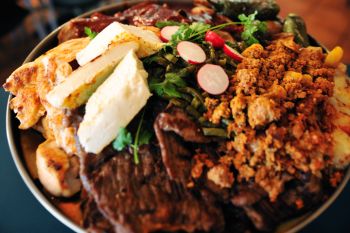
    meat parillada – photo by Denis Jeong

    I’d driven past La Poblanita, 1617-23 E. Lake St., for years,
    but I dined there for the first time a couple of weeks ago, and I’ve been back
    twice since. The two addresses are actually two businesses – a restaurant at
    the corner, and a tortilleria next door, which houses a small tortilla factory,
    meat market, and grocery store.

    They make their own tortillas from scratch, first cooking
    the corn, then grinding it into masa, which may explain why the restaurant menu
    offers so many different kinds of street food based on masa. Some of these are
    familiar – like the tacos and tostadas, but others are more unusual – like the
    tlacoyos, gorditas, and huaraches (“sandals”). These are mostly variations on a
    theme – fat cakes of masa, stuffed or topped with beans or cheese or meat.
    They’re cheap, filling, and very tasty.

    The clientele seems to be almost entirely Latino, which is usually a good sign, and the big screen TV seems to be permanently tuned to Univision, the Spanish language network.

    I’ve sampled about half a dozen menu items so far, including
    the chiles rellenos (poblano peppers stuffed with cheese, battered and
    deep-fried) and the camarones al ajillo (shrimp sautéed with mild dried peppers
    and staggering amounts of garlic) – much milder than it looks, but very tasty.
    The pozole rojo, a hearty pork and hominy soup in a red chile pepper broth was
    spicy but not overpowering, and was served with two tostadas on the side, which
    made it an ample meal.

    I’d like to go back with a bigger group and try some of
    their charolas (platters) that serve three to five people ($36-$38), topped with
    various combinations of chicken, pork chops, quesadillas, rice and beans, or
    else one of the parilladas (table-top grills)
    — either the meat version, with chicken, pork and beef ($24, serves
    three) or the seafood version ($36), piled high with shrimp, tilapia, crab legs,
    and more.

    Best time for a visit might be on a Friday evening, when La Poblanita hosts a karaoke contest, with cash prizes.

    Tortilleria, Taqueria & Carneceria La Poblanita, 1617 – 1623 E. Lake St., Minneapolis, 612-728-0383.

  • Dancing Ganesha: Not Exactly Divine

    I had high hopes for Dancing Ganesha, the new upscale Indian restaurant that replaced Willie’s Wine Bar on Harmon. When I spoke to one of the owners before the restaurant opened, he told me of ambitious plans to make it a "four-star" Indian restaurant with elements of French haute cuisine. I suggested a couple of local food consultants who specialize in south Asian cuisine, but it doesn’t look like anything came of my suggestion.

    The idea of creating an upscale Indian restaurant, with a more stylish ambience, better service and a more sophisticated menu than the usual curry joint really sounds like a great idea – it’s high time that more of our local ethnic eateries break out of the low-end dining ghetto. It may take a while for local diners to get used to the idea that Indian, Chinese or Vietnamese restaurants should be the same prices as Lucia’s or Heidi’s Cafe or Spoonriver, if they provide cuisine, ambience and amenities of comparable quality. But there is no reason why the Twin Cities can’t support the kinds of Indian fine dining restaurants that you can find in New York or San Francisco.

    Unfortunately, while Dancing Ganesha’s prices are considerably higher than any other Indian restaurant in the Twin Cities, they don’t offer the level of ambience, service or gastronomic sophistication that would justify those prices. There are a few unusual dishes on the menu, such as an appetizer of sev batata puri – a puffy chaat-style appetizer of puri topped with potatoes, chickpeas, fresh coriander and tamarind chutney ($8.99), and a Maine lobster Thermidor ($29.99), but for the most part, the menu is made up of the standard currry house fare: tandoori chicken, saag paneer, mostly priced $2-$3 higher than comparable dishes at the nearby Bombay Bistro.

    The ambience seemed to have changed little since the Willie’s era,
    except for the addition of a statue of a dancing Ganesha, the Hindu god
    of success.

    As for the food, my dining experience last night was pretty disappointing. I couldn’t detect anything in Carol’s entree, a mushroom curry, that would justify a price of $18 for a dish that would cost $10-$12 elsewhere. My non-veg thali ($19), was equally ordinary – a lamb curry of dry chunks of meat; an unidentified generic chicken curry, dal (lentils), and a dish of seasoned green beans, plus raita and a very ordinary rice pudding. I am not sure what was in the saffron naan ($3.99), but it didn’t look or taste like saffron.

    But the biggest problem was the service. According to one of the servers, the restaurant has been open for over a month, but service seemed chaotic, and our original server was basically inattentive, clueless, unable to answer basic questions about the menu. A second waiter, who appeared to be from India, was more helpful, but also unable to provide much detail. Neither seemed to have much training in the finer points of service.

    If Dancing Ganesha wants to succeed, they are going to have to either (1) scale back their prices, or (2) make a serious effort to upgrade their service and the sophistication of their menu. Maybe the best approach would be to start with (1) and work on (2).The same company that owns Dancing Ganesha also owns the all-vegetarian Nala Pak in Columbia Heights, which offers a good selection of North and South Indian dishes at more reasonable prices.

    My dining experience was pretty disappointing, but I am going to go back and give Dancing Ganesha another try sometime soon. There were several parties of Indian customers at the restaurant last night, who seemed to have enjoyed their visit – perhaps they ordered more wisely than we did.


  • Melly is actually PROUD that her TEENAGER IS A MOM

    When my daughter asked if she could have a dog of her
    own, Howard and I were very apprehensive. We were finally starting to
    feel like we could make time for each other again, something we’ve had
    very little of since we married at age 21, and had our children. The
    sleeping in on the weekends, the watching TV and hanging out together
    were all the little things that we thought made life so much easier and more comfortable.


    As young parents of teenagers we figured that we were pretty much on
    our way to having the dating life that we never had before our kids came into the picture.
    Wrong, wrong and double wrong! The reality is that our son and daughter
    are, and never will be far from our thoughts and hearts. There is, and
    never will be, a night NOT worrying about their whereabouts and the
    choices they make.


    This last week was no different except in addition to being responsible for two teenagers and two dogs, we are now also responsible for this little love….


    There were months of research (on our daughter’s part) that made us
    convinced that this new addition to our family was meant-to-be in more
    ways than we could imagine. Our new Grandson "Bruno" is teaching our
    whole family once again about how important it is to be responsible and
    loving toward a living creature that you bring into your home.

    I could go on and on about why this story is so wonderful, but I would
    rather turn it over to the two people that have filled our house with love, and helped ensure our newest family member is given security,
    comfort, warmth and unconditional love – even if this little "Morkie"
    puppy isn’t even 2 pounds yet!


    Here are the e-mails that were exchanged between a breeder (with the
    heart of gold) and our daughter who is really excited to be a Mom for
    the first time:


    From Sandy at Tails Wagon on June 12th


    Hello,


    I am not sure yet which one is your boy: it is one of these 2 puppies.
    They are both very nice puppies and almost the same size within 1 to 2
    oz’s. The eyes and ears just opened so if the ears are standing up
    right now it is because they just opened up. They don’t see or ear very
    well yet. They are still nursing off mom 100%. They are starting to try
    to sit and walk – very cute. Adorable boys. The coats will get fuller
    as they grow over the next few weeks.


    Thanks,

    Sandy


    From Maddy on June 30th


    Hi Sandy,


    Bruno is doing great, although he is not eating very much, which
    worries me. He is not crying and has been playing a little bit and
    sleeping a lot.


    I just wanted to make sure I heard you correctly that I have to feed
    him every four hours. Last night I fed him at 5pm, then 8pm then 12am
    then 4am then 9am and so on. He has been enjoying the Karo syrup and
    the Nutri-cal Gel and licks cottage cheese but spit the curds out, but
    that’s it. I am worried about his blood sugar because I sure do not
    want him to get hypoglycemia. I have tried the scrambled eggs too and
    he just licks them but spits them out too. I want him to be as healthy
    as can be, but him not eating makes it quite difficult. Am I doing
    everything alright? Is there any advice you could give me?


    The reason I was curious was because I was reading about small puppies
    like Bruno and they say to just keep food and water available at all
    times and make sure they eat at least three times a day so that made me
    wonder if feeding him every four hours was truly necessary.


    I will send you a picture by the way as soon and I get the chance.
    Thanks so much for everything! Please e-mail back as soon as possible.


    -Maddy


    From Sandy at Tails Wagon on June 30th


    Hello Maddy,


    If you read the information I gave you it said to leave food out for
    him 24 hours a day: dry food, soft and water. Have it available at all
    times just like you read, just like I told you when you picked him up
    and just like all the information I gave you says.


    What I mean by eating every 4 hours is to be sure he is not away from food more than 4 hours at a time. Examples below;


    * like sleeping with him right now, that would make food not available
    * in a crate away from food and water more than every 4 hours.
    * out from the home more than 4 hours without food and water


    Once he is 16 weeks old that is fine, right now he needs food frequently.


    You don’t need to actually feed him yourself. It is not necessary and
    should be avoided, you just need to be sure he has the food and water
    available so that he can eat.


    You should have him in an area at night that he can get to the canned
    puppy food, dry food and water by himself. He does not need to be fed
    – he eats by himself.


    He should not be put in a crate without food (dry & soft) and water for more that 4 hours right now.


    What I mean is don’t sleep with your puppy at this young age, he needs
    food – but you don’t need to get up with him. He needs to be put in a
    safe place where he has access to food (soft & dry) and water.


    CAUTION: Do not give him the Karo syrup and Nutri-cal Gel unless there
    is a problem. That should not be given unless he is not eating.
    Nutri-cal causes diarrhea if over used; don’t use that as a food. Just
    have it on hand if you need it.


    Again, you don’t need to get up with him, he eats on his own: he just needs to have access to the food and water.


    Soft foods can be any of the canned puppy foods on that list I sent.


    As I explained when you were here: the cottage cheese, eggs, hot dogs,
    etc. can be fed if he is not eating the puppy canned food and dry food.


    He was eating the canned puppy food and dry food and water only here before he left.


    You don’t want him to get use to being fed by you. Just be sure he has foods available and he will eat on his own.


    I want to be sure you understand that I was not telling you to hand
    feed him or sit with him when he eats: I just meant be sure he has
    access to the food and water. You really don’t want to be feeding him
    yourself.


    I would give him soft canned puppy foods, dry puppy food and water only.


    The Puppy’s care information:


    The puppy is on free fed: dry food is always available, water is
    always available. Once a day I soak 1/4 cup dry food in warm water
    until very soft until 16 weeks old for tiny breeds. I give the tiny
    breeds powered puppy milk replacer until 16 weeks old (you can purchase
    this at Walmart/Petsmart/Petco) Do not mix milk replacer with food. I
    also feed about 1/4 cup of canned puppy food (See New Puppy Supply List
    for brands) twice a day, be sure the canned food is puppy canned food:
    the tiny breeds need puppy food (Canned & Dry).


    I also give the puppies:


    · Plain yogurt (NOT fat free or NOT low fat or NOT low calorie)

    · Scrambled egg (1) with cheese or an over easy egg diced.

    · Gerber Baby Food hot dogs (in the glass jar)

    · Skinless and Boneless baked chicken cut into small pieces

    · Canned Puppy Food – See New Puppy Supply list for brands


    I always have available dry puppy food, water, soaked puppy food (warm
    water) and one of the other items listed under "I also give the
    puppies", I alternate those items. I have these foods available 24
    hours a day. Put them in bowls that will not dip over (low cat dished
    work great); there is puppy feeding dishes/bowls that are designed not
    to tip over.


    The goal is to have your puppy eating only dry food and water by 16
    weeks old. The puppy should not be carried around away from food for
    hours, they need to eat frequently, they must be in a safe warm place
    with food items and water available 24 hours at day until at least 16
    weeks old, maybe longer depending on size and weight.

    Thanks, Sandy