Tag: sushi

  • The 98 Pound Restaurant: Cheap Sushi and More!

     Header photo by Denis Jeong 

    I’ve been told that the whole Chinese all-you-can-eat buffet phenomenom has run its course, and that the next big trend for Chinese restaurateurs is sushi — the profit margins are better. A lot of Chinese buffets already offer a few varieties of sushi, but the new 98 Pounds Restaurant at 98th and 35W in Bloomington actually combines the concepts.

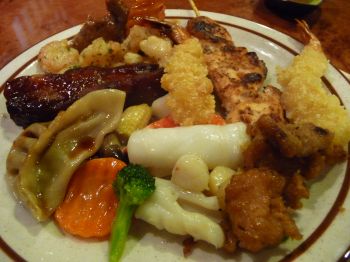
    The steam tables offer a big selection of the usual Chinese buffet
    staples – General Tso’s chicken, shrimp in coconut sauce, stir-fried beef with
    mushrooms, teriyaki chicken, fried rice, egg rolls, potstickers, hot and sour
    soup, tempura shrimp, etc. etc. etc. There’s plenty of fried food, and the
    fried shrimp and tempura shrimp are heavy on breading light on shrimp, but
    overall, I’d rate the hot buffet items as better-than-average.

    But the real novelty here is the cold buffet of
    all-you-can-eat sushi.

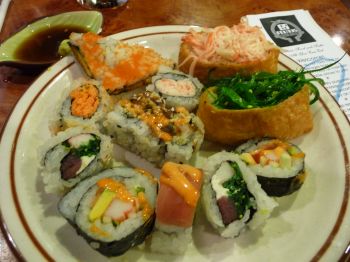
    sushi plate

    There were about 15 different varieties of sushi on offer,
    nearly all of the maki (roll) variety: spicy tuna roll, crab roll, cream cheese
    roll, California roll. Real sushi lovers will not be impressed – there’s very
    little raw fish, or any other costly ingredients, in the sushi, but plenty of
    imitation crab. Still, the sushi actually was tasty, and you can’t beat the
    price – $7.99 for lunch, $11.49 for dinner. I’m told that the dinner buffet
    offers a bigger selection of seafood items, including crab legs and mussels.

    98 Pounds Restaurant, 824 W. 98th St., Bloomington, 952-881-1088.

  • Jade: What's a Critic to Do?

    The question I get asked most often, (after "what’s your
    favorite restaurant?") is "do you get recognized a lot when you review
    restaurants?"

    The answer is, sometimes I do, and sometimes I don’t. When a
    longtime local restaurateur opens a restaurant in downtown Minneapolis, and
    staffs it with servers who have been on the local dining scene for ages, then
    the odds are pretty good that somebody is going to spot me. But if I go to a
    new theme restaurant in the outer burbs, my anonymity is pretty secure — the typical
    hostess is about 19 years old, doesn’t read restaurant reviews, and wouldn’t
    recognize my name if I handed her a business card.

    Ditto most ethnic restaurants.

    I suppose it has gotten a little easier to spot me now that The Rake runs a line drawing of me on this blog (see above), but if you had to
    pick me out of a police lineup, I don’t think the picture would be much help.
    (I’m the guy on the right.)

    I used to think that anonymity is really important, but the
    longer I stay in the restaurant reviewing business, the less convinced I am.
    There is at least a trade-off involved. On the one hand, when I am anonymous, I
    don’t get any special treatment, but on the other hand, when chefs and
    restaurateurs know who I am, I sometimes find out stuff that gives me a better
    sense of what the restaurant has to offer.

    Maybe it’s more than that — often, what’s really the most
    satisfying part of a dining experience is the human element — learning
    something about the people who work at the restaurant, and developing a
    relationship with them — and the detached
    "secret shopper" approach to
    restaurant reviewing misses out on that.

    At any rate, I stopped in last night at a new ethnic eatery — Jade Asian Bar and Restaurant in the Midtown Global Market at Chicago and E. Lake St., and promptly did
    get spotted by owner Carl Wong. Wong is the former owner of the Seafood Palace
    on Nicollet, which I always used to consider one of the best Chinese
    restaurants in the Twin Cities. (I haven’t dined there much since he sold it,
    so I don’t know how good it is these days — if you have dined there, please let
    me know.) Carl’s three-year non-compete agreement expired recently, and he is
    back in the restaurant business.

    Jade — in the space briefly occupied by Chang Bang — turns
    out to be a nicely styled casual dining restaurant with a menu of traditional
    and contemporary Chinese cuisine, plus a sushi bar. The sushi bar is only open at night, and for lunch they offer a buffet (nothing particularly impressive, when I tried it.) The bar part isn’t open
    yet, but the license has been approved, and the restaurant will start serving
    liquor after May 16. Live seafood tanks will also be arriving soon, and will be
    stocked with everything from lobster to abalone.

    Fire and Ice

    At any rate, my wife and I ordered a couple of items off
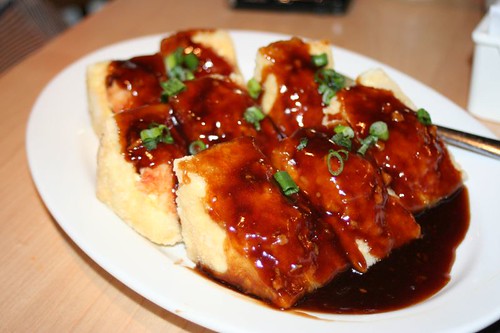
    the menu — the deep-fried stuffed seafood tofu ($9.95) and the salted fish with shredded pork and
    eggplant in casserole (hot pot; $10.95), plus an item on the sushi menu that I had
    never heard of before — "battleship sushi" — gunkan maki sushi. It turns out
    that’s the name for a kind of sushi that I had seen before — the kind that has
    a collar of nori, and a filling of sea urchin, or flying fish roe, or other
    ingredients that need to be held in place. The sushi chef — Tony Sin Tuy — said he would make a
    special order for me. What arrived at our table a few minutes later was a real work of art (or two works of art, to be precise) — each a narrow band of
    nori wrapped around a belt of Atlantic salmon, with a filling of sushi rice topped with chopped tempura fried scallops in a spicy mayo, with tobiko roe and a pineapple soy reduction. Tuy calls it Fire & Ice ($5.50), and it is definitely worth asking for.

    We had barely finished that delight when another dish
    arrived, unordered, at our table — a long snake of a specialty roll — a wild
    caterpillar, we later learned — wrapped in avocado, tuna and ripe mango, filled
    with spicy shrimp, flavored with Thai seasonings ($10.95). This, too was wonderful.

    Then Tuy stopped over and
    introduced himself. He obviously knew who I was, and he told us a little about
    himself — he grew up in Minnesota and California, is of Thai and Chinese ancestry, and
    previously worked at Crave in Edina, where he learned the art of sushi from
    chef Tony Lam. He really tries to make sure that every specialty sushi
    specialty he creates is distinctive, different from who diners might get
    anywhere else, and he works a lof of Thai flavors into his original creations. (Hence, the Thai spices in the wild caterpillar.) I came away
    from the conversation genuinely impressed. This is a nice guy who takes sushi
    seriously. It was a conversation that I probably wouldn’t have had if I had succeeded in remaining anonymous.

    Then comes the other dilemma that goes hand-in-hand with
    being recognized: the bill arrives, and there’s no charge for the sushi. I am a
    little torn by this because on the one hand, I don’t believe in accepting free
    food, and on the other hand, it can get really expensive to pay for a lot of
    food that I didn’t order, and it also can feel rude to refuse food that
    somebody with good intensions sends over.

    So I tell the waiter that I need to pay for everything
    that we ate, and the waiter sends me to Carl, who says that the free sushi is
    from Tony, so I better take it up with him. Tony doesn’t want my money, but
    finally agrees to accept a $10 tip — not quite what the sushi would have cost
    if I had ordered it off the menu, but enough to salve my conscience. And I warn
    him that I can’t come back unless he agrees to let me pay, next time, for
    everything I eat.

    And I do want to go back — the seafood stuffed tofu and the salted fish, pork and eggplant casserole were both delightful, and there is a lot more on the menu that I would like to try, ranging from the whole Dungeness crab ($19.95) to the barbecue pork with oysters in hotpot ($10.95).

  • Sushi: The Naked Truth — Edamame

    Anyone who has tried to make sushi knows it is harder than it looks. But
    when you are plopped at the sushi bar watching the chef make rolls, nigiri, or
    sashimi it looks easy. I, too, thought it was easy when I first watched my
    master show me how to make a roll — until I rolled my fist roll. When I was
    done I didn’t know if he was pissed or if he was going to burst out laughing.

    But that’s the easy part. The key to making sushi — what is critical — is the preparation before you actually make it: fish selection, fish handling,
    rice selection, method of washing and cooking rice, vinegar mixture,
    etc. It’s the pain-staking little things that determine wether the outcome of sushi is
    ok, or an orgasm in your mouth.

    What does this have to do with edamame? It’s the little things.
    Since we opened, I’ve been hearing guest’s commenting on our edamame. I find it odd,
    because its just edamame, steam, then salt. Simple as that. How can our edamame
    differ from anyone else’s?

    Well, my question was answered on Sunday night. In part three of the
    "Sushi: The Naked Truth" I talk about my new guy, who has worked
    at several sushi bars in the Twin Cities. I was in back working with my
    head hot foods chef Alex. While we were waiting for some edamame to
    finish up, the new guy came back and asked, "Why do you do that?"

    "Do what?" we
    both asked.

    "Cook the edamame to order. It’s a pain!"

    "How did
    you do it at other places, especially when its busy?"

    "Pre-cook it, wrap it in the bowl it will be served in, then stick
    it in the microwave when ordered."

    Most sushi bars do not have a kitchen behind the sushi bar, so it is a pain
    when shrimp tempura or soft shell crab tempura is needed for a roll. With
    our open kitchen we just call back an order if needed, and we have a
    Chinese wok range on the line to speed up orders. Part of every Chinese wok
    range is a big stock pot. Since we do not serve up Chinese stir-fries we
    do not use that pot for actual stock but instead we use have boiling water for edamame.
    In and out, in about a minute fresh to order.

    So, again it all comes down to the small things that make the biggest difference.

  • Sushi: The Naked Truth, part three

    Before we opened in January, I had my whole core team working with me, training at the restaurant in Eau Claire. I knew with all of the bad habits and the lack of outside chefs in the twin cities area it would be best not to hire locally and have to correct bad habits. I’m not saying there are not good chefs in the area, but the top chefs are already employed at good establishments — such as Nami’s, Origami’s, and Fujiya — and out of respect of the owners I would not try to steal their chefs.

    However, as business grows and you need to hire it’s tough to train a chef ground up when you are short handed. I buckled and hired a local chef that had experience and could work under me. I knew it would be tough as bad habits are hard to break, but this experience opened my eyes even more to how bad some places in the area are cutting corners. On the second day I had asked him to cut down and trim a hamachi (yellow tail) for me as I was swamped at my station. I watched his knife skills. He did well, and in no time the hamachi was broken down. All was good until he handed the hamachi to me!

    Shocked, I asked him why he hadn’t trimmed the bloodline completely away? His answer was that most of the places in which he had worked in the area had instructed him not to trim it all away because it’s too expensive! Almost speechless, I trimmed away the remaining bloodline, and told him that we do trim all of it away and discard it. Later in the evening, when it slowed down, I was talking to him about the hamachi, and he told me most places cut up the bloodline and add it to the spicy tuna as a filler so they get a larger yield! NASTY!! The bloodline is a part of some fish that is very strong and fishy and should always be trimmed away and discarded.

    He is a good chef, has good knife skills, makes beautiful sushi, but again it all comes down to the dedication and preparation of the establishment. I won’t go into detail on the places that cuts corners, but I assure you that we do not cut corners and some of the places in town like Nami’s, Origami’s, and Fujiya’s also carry on the strict policy of providing only the best.

  • New Group Blog for Foodies: Chef's Table

    In case you haven’t already noticed – we have started a new group
    blog here at the Rake called Chef’s
    Table
    . It isn’t just for chefs, though – it’s for restaurateurs, servers, gourmets,
    gourmands, wine sellers, cheese mongers, etc. – anybody who is an active
    participant in the Twin Cities’ lively food scene.

    It’s a chance for chefs and other foodies to tell diners how to get the most our of their restaurant, or invite them to sign up a special dinner, share photos and stories from their latest gastronomic field trip, weigh in on the latest trends, or sound off on obnoxious customers or pet peeves.

    Anybody can post comments on Chef’s Table, but so far,
    membership is by invitation only. If you would like to participate, drop me a
    line at iggers@rakemag.com, and tell me
    a bit about yourself.

    The most recent post is by Henry Chan, owner of Giapponese Sushi
    in Woodbury – the second installment in a series that gives you the
    down-and-dirty about cheap sushi: "To cut costs, frozen tuna is often used,
    lower in quality with almost no flavor, still safe to eat, at almost half the
    price of good fresh tuna…Tuna, salmon, whitefish, just about every fish is
    now available frozen, trimmed and pre-cut. Hell, I’ve even been approached by
    American fish companies asking if I would be interested in buying pre-made
    frozen ready to eat California and spicy tuna rolls!!
    " To read more, go to the
    blog…

    Niki Stavrou, owner of Victor’s 1959 Café, 3756 Grand Ave. S., Minneapolis, also put up a post recently, to clear up a common misconception about Cuban cuisine: "Cuban culture
    is certainly spicy; the people, the music, the politics, you name it. But when
    it comes to cooking we leave the hot peppers for other cultures…

    Niki also sent
    out an email recently to customers on the café’s email list, suggesting a
    dinner-and-a-movie combination for tonight: "Thought you would like to know that the Walker
    Art Center is showing a Cuban film this Friday night, February 29th at
    7:30pm. It’s called "The Sugar Curtain" and from everything
    I’ve read on it, sounds like it will be a very interesting film.

    "And
    remember, we open at 4:30pm for dinner so why not make it Cuban dinner and a
    Cuban movie? Make your reservations now and mention that you will be
    attending the film – if you arrive by 6:00pm we promise to have you well-fed
    with plenty of time to get to the movie. (I’m even going to try to sneak out so
    I can see it too!)
    ."

    Call the cafe at 612-827-8948 for reservations. To be added to Niki’s email list, send her an email at Cafe1959@aol.com.


  • Sushi: The Naked Truth, part two.

    Bandwagons and gold diggers. Once something’s hot and mainstream it will most likely get exploited. As we all know, sushi is hot, and now it’s come to that stage.

    How can we make it faster, cheaper, and offer more?! This is the general direction for most new sushi bars.

    To cut costs, frozen tuna is often used, lower in quality with almost no flavor, still safe to eat, at almost half the price of good fresh tuna. The grace of a skilled sushi chef with his/her’s knife is also a dying breed. Tuna, salmon, white fish, just about every fish is now available frozen, trimmed, and pre-cut. hell I’ve even been approached by American fish companies asking if I would be interested in buying pre-made frozen ready to eat California and spicy tuna rolls!!

    Sauces, stocks, soups are also offered up in pre-made packaging. When I learned sushi, unagi (eel) sauce was one of the sauces I was taught. It is a pain in the ass to make as it has to be watched and takes up to four days to make, and with one small mistake it would burn and you would have to start over.

    Simple mathematics: all you can eat sushi is not the ideal place you want to go for fresh sushi. Yes, it’s cheap, but so is the quality. Good fresh tuna wholesale is around $15 a pound, plus waste from trimming. So if you go to an all you can eat place and it’s $20 bucks, you are getting cheap frozen fish. Frozen tuna that is safe to eat raw can be found for about $7 to $9 a pound.

    Along with the fish, so many other factors also come in play. The rice. Good sushi restaurants will use a good medium to short grain rice that’s about $30 to $50 for a fifty pound bag — compared to lower end rice that is around $15 to $20 for a fifty pound bag.

    Bottom line, with sushi you get what you pay for..

  • Tuna Tuna

    Ahi tuna: many people know tuna as ahi tuna. However, there isn’t a species named ahi. Ahi means ”tuna” in the Hawaiian language, so if you ask for Ahi tuna, all you are asking for is "tuna" tuna! Sometimes I like to just mess with people when they ask if I have ahi tuna: I ask what kind of tuna? "Ahi," they reply. "Yellow fin, big eye, or blue fin?" I ask. "No, Ahi!"

    Most sushi bars carry three kinds of tuna; yellowfin, albacore, and big eye. The better sushi bars will also carry a fourth named blue fin. So next time you are dining out and you see ahi tuna on the menu, and you are feeling a little snobbish, ask what kind of ahi it is and see if they know… a good chef should know there is no such thing is Ahi tuna.

  • Sushi Bar Etiquette

    Good thing we are not in old school Japan and that most elder Japanese/Japanese-trained chefs in the U.S. have adopted our ways.

    I could care less how you eat your sushi at the bar or at a table, but with some chefs it could get you kicked out!

    Basic sushi bar etiquette:

    Oshibori (hot towel) sushi is finger food, except sashimi; and the hot towel provided is to clean your hands before you eat. Please don’t blow your nose or take a sponge bath with that nice, hot wash cloth.

    Gari (pickled ginger) is provided to cleanse your palette in between different fishes, rolls, or sashimi, so the flavor does not carry over — and to cleanse your mouth when you are finished. Gari is not a salad.

    Fingers: Yes you all have five, so use them. Since sushi is finger food, use your fingers to eat the nigiri or rolls. Some people complain when the rolls are not packed tight enough and the rice falls apart — same goes for nigiri. Good sushi is supposed to melt in your mouth, and a good chef will not pack the rice into a hard ball. Nothing wrong with using chop sticks, but unless you can use them proficiently, the sushi will most likely fall apart.

    Soy sauce: It’s not to be used like ketchup with fries! If you do need soy sauce, dip the nigiri or maki in lightly. If it’s nigiri, turn it around and dip it in fish side down so that you don’t soak all of the soy with the rice. Same goes for rolls: dip the corner of the roll; don’t give it a bath. Light dipping will allow you to enjoy the wonderful flavors of each fish or roll, and one of the biggest reasons sushi falls apart is from the rice getting logged with soy sauce.

    Do not give dirty/empty plates back to the sushi chef. They are dirty; we work with our hands. Put them to the side for your server to clear.

    One bite: Sushi is meant to be eaten in one bite. Please do not cut the nigiri, sashimi, or rolls. By doing so you will lose the intended flavor combination. Yeah, go ahead and stuff your mouth. It’s not rude. Just like slurping noodles, it’s the Asian culture, and shows the chef you are are enjoying the food.

    Watch this funny video if you have not seen it before.

    Oh, and buy your chef a drink. He/she will appreciate it. And if you get them a bit drunk your slices will get bigger!! We don’t want to cut off our fingers as we start to see blurrs!!


  • Sake 101

    Saturday, March 1st at 6:30 p.m. we will be hosting a sake educational tasting, a Sake 101 of sorts. We will have three sakes and possibly a namazaki. The three sakes that will be available have a deep and long history, along with taste. Shichihon yari is Japan’s oldest brewery, founded in 1540 — before Tokyo was even a city! To date, it is still run by the same family members and with only a staff of four producing the sake in small batches.

    Watari Bune is amazing because we shouldn’t even be drinking this sake! The reason for this is that the watari bune rice was grown in 1868-1912 and early showa. Because this rice grows tall it is harvested late, and most of the crops were damaged by typhoons. The war caused it to fall out of use even further due to crop difficulties and food shortages.

    After learning about this extinct rice, Yamauchi-san, the seventh generation director of the Huchu brewery, started his hunt. His hunt for the rice ended when it was discovered that the Ministry of Agriculture had this strand of rice in criovac storage. From there he returned with fourteen grams of rice and went to the old farmers to help him grow the rice. Eventually, the process was perfected and watari bune sake was born!

    Yuki No Bosha was founded in 1903 by Yataro Saito and is now managed by the fifth generation president, Kotaro Saito. Located in the Akita region, rustic and tranquil with harder water than southern Japan, this sake is lively with bold rich aromas balanced by a crisp, white pepper finish.

    Namazake: Nama is a word you should know! Trust me. Nama is just unpasteurized sake. It must be constantly refrigerated, consumed within a day or two of opening and is only available seasonally. The trade off for all this is that nama is known for it’s fresh, young, bombastic taste!! This sake is currently on its way from Japan, and if it makes it here on time we will soon be tasting this rare sake not normally found in the United States.

    This is a free event, so please pass the word!

    Cheers,
    Henry

  • Other Fish in the Sea

    We seem to be in the midst of sushi mania. Two new restaurants—Seven and Musashi—opened recently, barely a block apart on Hennepin Avenue, which means that downtown Minneapolis now boasts at least a dozen sushi outlets. (The others; Koyi, Nami, Origami, Martini Blu, Wasabi, Ichiban, a sushi counter at Macy’s Marketplace, Zen Box, and two Tensuke Sushi locations.)

    Raw fish is making new inroads into the neighborhoods as well, with Bagu at 48th and Chicago, and Obento-ya at 15th and Como. In St. Paul, the Korean restaurant KumGangSan recently added Sushi World to its name and installed a sushi bar and lunch buffet, following the lead of King’s Korean in Fridley. As the central cities get saturated with raw fish, new outposts of sushi open up in far-flung Woodbury, Maple Grove, Apple Valley, and Edina.

    The tidbits of vinegared rice and seafood are everywhere these days—in supermarket delis, Chinese all-you-can-eat buffets, and even on giant party trays at Costco. But as sushi has made the passage from sophisticated and exotic delicacy to mass-market merchandise, something has gotten lost in translation. Most of the local sushi restaurants have little connection to Japan: The owners of Kikugawa, Musashi, Wasabi, and Mount Fuji (the last in Maple Grove) are Chinese; the owners of Koyi Sushi, Bagu, and Zushiya (the last also in Maple Grove) are Thai; and the sushi chefs themselves are from all over (but rarely from Japan). The food may look and taste the same—indeed, most local sushi restaurants serve the same varieties of fish and seafood, purchased from the same suppliers—but the little rituals that are part of the traditional sushi experience are missing.

    So how do you go beyond the ordinary and find something more interesting, and less generic, than the stuff that’s offered on every sushi menu in town? You ask for it. In Japanese, the word is omakase, which translates roughly as “I am putting myself in your hands” or as we might say here, “chef’s choice.”

    My top choice among the new sushi restaurants is Giapponese Sushi in Woodbury. When I asked for omakase, chef-owner Henry Chan immediately understood my request, and proceeded to serve up a delightful series of courses: raw scallop, Tasmanian salmon, halibut rolled in a thin ribbon of cucumber, a whole small mackerel presented as sashimi, and a roll of tempura shrimp and avocado topped with tuna.

    Chan, who grew up in Wisconsin, recently moved here from Eau Claire, where he owns the town’s only sushi bar, the Shanghai Bistro. He clearly has a passion for sushi, and listening to him, he sounds truly committed to bringing in the best quality and most interesting varieties he can find. The selection is still pretty limited, but he says that as his sales volume grows, he will be adding more varieties. He sends an email to customers when he has something unusual to offer, like houbou (blue fin sea robin) from the Tsujiki fish market in Tokyo; to be added to his mailing list, send him an email at twinscroll@gmail.com.

    I’d also return to Giapponese Sushi to try the Kobe beef steaks—a sixteen-ounce, bone-in New York strip and a fourteen-ounce rib eye are each $55. This isn’t the original Kobe beef from Japan, where the cattle are massaged daily and fed rations of beer, but it’s the same breed, Wagyu, reportedly with a lot more marbling than even USDA Prime. Chan gets his beef from a friend who has a herd of Wagyu near Augusta, Wisconsin. While $55 for a steak sounds pretty steep, compared to what other restaurants charge, it’s a bargain. Locally, Cosmos has imported Japanese Kobe beef on its menu for $17 an ounce (which works out to $272 for a sixteen-ounce steak), and even that’s a steal compared to Craftsteak in Las Vegas. There, you’ll pay $105 for a fourteen-ounce American Wagyu rib eye, $184 for an eight-ounce Australian Wagyu rib eye, and $240 for an 8-ounce Japanese Wagyu steak (yes, that’s $480 a pound).

    Next stop, Musashi in downtown Minneapolis. I asked for omakase, and the sushi chef gave me a puzzled look. “Teppanyaki?” he asked—or something that sounded like that. (They have teppanyaki tables in back.)

    “No,” I said. “Omakase.”

    “We don’t have that.”

    Just then, a second sushi chef, Noua, overheard our conversation and stepped in: “I can do that. How many courses do you want? How much do you want to spend? Four courses? Five?”

    We never did agree on a price, but a series of off-the-menu dishes began to arrive, starting with a pair of martini glasses filled with chunks of raw tuna and salmon with thin slices of cucumber in a soy marinade. At the bottom of each glass was a fake ice cube with a little blinking light that changed colors from blue to green. (Actually, mine was stuck on blue.)

    Round two was four pieces of raw salmon wrapped around spears of fresh mango, partially cooked with a blowtorch, served over leaves of aromatic Japanese chrysanthemum. The decorative centerpiece was another light-cube, flashing red, blue, and green, buried under a pile of shredded daikon. Then came a seafood medley covered in a spicy mayonnaise the color of Thousand Island dressing, dappled with orange flying fish roe. The flashing ice cube made its final appearance in round four, alongside four little rice balls wrapped in eel and white tuna. This was, the sushi chef informed us, “French-style sushi.”

    I have never seen anything like it in France, but the phrase rang a bell. French-style sushi is also how the Chinese chefs at Mt. Fuji in Maple Grove described their neon DayGlo fantasies on the theme of sushi, festooned with red, green, orange, and black flying fish roe.

    “Are you all from China?” I asked the Musashi chefs. “We’re from Asia,” sushi chef No. 3 offered, helpfully. “Not me,” shouted Noua, in perfect English. “I’m from St. Paul.”

    Overall, some of the off-the-menu omakase dishes were pretty good, some of it was just okay, and mostly it was kind of weird. I did see a lot of “normal” sushi come out of the sushi bar while we were dining, and it looked the same as it does everywhere else.

    The most stylish of the new entries in the sushi sweepstakes is Seven, on the second floor of the new r.Norman’s steak house at Seventh and Hennepin. The sushi counter is translucent marble, and white-curtained columns throughout the sushi bar and lounge bathe the otherwise dim space in diffuse colored light that cycles through shades of blue, red, and green—sort of like the fake ice cubes at Musashi, but on a grander scale.

    Seven’s menu offers an impressive selection of sakes and a fairly standard assortment of sushi. I wanted to order omakase, but quickly discovered that omakase is already offered on the menu. We chose the sushi-for-two ($40): the chef’s choice of two specialty rolls and ten pieces of “sushi grade” nigiri sushi.

    Omakase is a chance for a sushi chef to show some imagination and creativity, but this time around what we got was generic versions of the most popular sushi available: a tempura roll, a spicy tuna roll, and two pieces each of shrimp, tuna, salmon, yellowtail, and flounder. Our waitress mostly ignored us, as did our sushi chef.

    Last stop: Obento-ya Japanese Bistro, a little storefront with a low-budget décor that suggests the minimalist aesthetic of Japanese interior design. The owners are a young American-born husband and his Japanese-born wife, and the place just feels more Japanese than most of the glitzier places around town. I splurged and ordered the most expensive item on the menu, the deluxe sushi bento ($12.95), which included six pieces of nigiri sushi and a California roll, plus green salad, Japanese potato salad, sautéed burdock, little wedges of Japanese omelet, and miso soup.

    The sushi turned out to be pretty standard, but the rest of the menu is more impressive. First of all, it’s really cheap—most of the basic ben
    to boxes are under $8, and udon and soba noodle soups are $4.95-$6.50. Second, there are a variety of traditional Japanese dishes that you can’t find at most of the other places—not just the variety of bento boxes and the noodle soups, but also a big selection of robata—skewers of meat, fish, or seafood, grilled or deep-fried ($1.50-$4.50 à la carte). The only thing that was missing was wine, beer, or sake, but I am told that should be fixed by the time this story is published.

    Giapponese Sushi, 10060 Citywalk Drive, Woodbury; 651-578-7777;
    www.giapponesesushi.com

    Musashi, 533 Hennepin Ave. S., Minneapolis; 612-332-8772
    Seven Sushi Ultralounge, 700 Hennepin Ave., Minneapolis; 612-238-7777; www.7mpls.com

    Obento-ya Japanese Bistro, 1510 Como Ave. S.E., Minneapolis; 612-331-1432;
    www.obento-ya.com