Year: 2007

  • The Sweet (and Saucy) Transvestite

    In the early 1980s, when I was 16, my friend, Martha, picked me up at 11 p.m. in her father’s enormous Buick, and we drove from our neighborhood in Minnetonka to the Uptown Theater for the midnight showing of The Rocky Horror Picture Show.

    I was brought up on an entertainment diet of The Carpenters, The Waltons, and films like The Goodbye Girl. And Rocky Horror was like nothing I’d ever seen: its black-lipsticked hero, wearing dominatrix garb and wielding an ax; colorfully-dressed Munchkin-like people doing the “Time Warp”; a bizarrely compelling hook-nosed butler who had an unorthodox relationship with his sister, the wild-haired maid.

    Then there was the audience: kids chanting lines along with the characters and throwing things at the screen. Rice, toilet paper, toast. I didn’t remember much about the storyline (in fact, when I saw the film again, recently, I was amazed by its sci-fi ending); what made an impression was the experience. Raucous and sexually-charged, yet strangely wholesome.

    That’s why, when my not-quite-13-year-old daughter came home from a sleepover last summer, proclaiming that she’d watched Rocky Horror twice and it was her new favorite film, I didn’t fret. Despite its themes of party sex, incest, murder, and cultishness, I believed it was pretty harmless. I’d known interesting people over the years who hadn’t fit in anywhere else but found a home in one Rocky troupe or another. I was all for it.

    As an English professor, I realized Rocky Horror was informed by a wide range of classics: it’s a sexually-charged homage to Frankenstein, with a healthy dose of The Fall of the House of Usher, and a little bit of Hansel and Gretel thrown in. This is the story of two naïve kids who fall in love, then travel out into the world and become both wise and jaded. The protagonist, Tim Curry’s Dr. Frank-N-Furter, is sympathetic but deeply flawed — a character that turns from sinister to childlike but appears, in his twisted little heart, simply to want everyone who visits his castle to disrobe, dance, and have a good time. What’s so wrong with that?

    Nothing, I decided. . . .even for my adolescent. And it struck me, too, how remarkable it was that Rocky Horror — which was made when I was seven — remains relevant today. The film has, indeed, time-warped.

    I thought it would be interesting to sit down with an expert to find out why.


    We meet at the Longfellow Grill at 9:30 on a rainy Saturday night. I’m in straight-leg jeans and a purple blouse. She’s wearing a leather corset, fishnet stockings, and four-inch heels. We start by talking about regular life.

    Five days a week, Diana McCleery drives a school bus in the mornings and afternoons, spending the hours in between with her three-and-a-half-year-old, Morgan. She loves being a mom, and she’s grateful for the job that allows her so much time to parent. It’s only on weekends that she leaves her husband home with Morgan and goes to the Riverview Theater in Southeast Minneapolis, where she simulates sex on stage.

    For the past couple years, McCleery has served as the director of Transvestite Soup, a troupe of fifteen local volunteers that puts on a live performance of The Rocky Horror Picture Show while the 1975 cult classic film screens behind them. And she’s well qualified for the job. In addition to holding a psychology degree from the University of Memphis, the forty-one-year-old witch (McCleery is a third-degree leader in the Blue Star tradition of Wicca) has been performing in live renditions of Rocky Horror—here and in Tennessee—since 1990.

    “I went to Rocky every so often in college,” she says. “Then one day my boyfriend and I were like, ‘Let’s dress up and get crazy.’ So I wore my sexiest underwear, and he put a leash on me. I found out I enjoy performing, and I love this movie. In fact, the more I see Rocky, the more I want to get up on stage and show it to people.”

    McCleery points out that there are subtle, heartfelt relationships between the characters, such as Riff-Raff and Dr. Frank-N-Furter, which casual viewers often miss.

    “Frank is beautiful, and Riff-Raff is ugly; Riff-Raff has no one but Magenta, while everyone adores Frank.” She ticks these things off on her long fingers. “And there’s a hint that Riff is in love with Frank-N-Furter. At the end, when he kills Frank, Magenta says, ‘I thought you liked him,’ and Riff answers, ‘But he never liked me.’ If you look closely, he has a little tear in his eye.”

    Her college boyfriend didn’t enjoy their Rocky experience, she admits. As McCleery grew increasingly uninhibited, wearing less clothing for performances and experimenting with different roles, he became uncomfortable. She soon broke up with him and immersed herself fully in the show.

    Luckily, her husband, Rob, an administrative assistant at Wells Fargo whom she met long after starting with Rocky, is a big fan. Before their daughter was born, he attended nearly all her shows.

  • The Original All-American

    ED_reviewDetail.jpg

     
    There is nothing wrong with talented chefs like J.P. Samuelson at jP American Bistro turning out dishes like roast chicken breast with fermented black bean sauce and mango salad and calling it American cuisine. And Doug Flicker has every right to offer duck breast with prune ravioli, asparagus, and portobello mushrooms at Mission American Kitchen. But if you want to taste American cooking the way it was B.C., you have to go to a diner.

    B.C. means Before Child, as in Julia. She swept across the American landscape like a gastronomic tornado, starting in the early ’60s, and almost completely wiped out a venerable dining tradition. Nowadays it’s hard to find a menu that doesn’t offer deep-fried calamari or seared ahi tuna with ginger wasabi dipping sauce, but you’ll have to search far and wide to find a good old-fashioned chicken salad sandwich or Midwestern hotdish.

    Though there are some things that good diners have always done well, like hash browns and pancakes, there is no need to get too nostalgic about this bygone era—the truth is, most American food B.C. wasn’t very good. We were at the height of a convenience-foods craze when Julia burst on the scene, and the signature dish of the American diner in those days was a can of Campbell’s chicken noodle soup. Now the best of the new generation of diners offers an expanded repertoire, often using local ingredients, as well as more imaginative preparations—all without losing sight of the core value of traditional diners: unfussy fare at reasonable prices.

    You can break the contemporary American diner scene down into three basic categories: the true classics, like Mickey’s Diner, the Band Box, Our Kitchen, and the Ideal Diner, which continue to serve exactly the same grub they did two generations ago; the updated diners, like the Modern Café, the Colossal Café, and the Town Talk Diner, where new owners have preserved the historic décor, but offer updated menus (as well as wine and beer, or even a full bar); and, finally, the new retro diners, like the Edina/Longfellow/Highland Grills, which pay homage to the diner tradition with menus that combine old and new.

    The original diners were inspired by railroad dining cars, with a long counter and booth seating, but the concept, and the design, have evolved over the years. The early diners were America’s first fast food restaurants, decades before the Golden Arches arrived on the scene in 1955. With limited seating and tiny kitchens, the short-order cook had to get the food out, well, in short order—and the customers, too. In the ’80s, the Frogtown Diner in St. Paul captured the hurry-up attitude with the motto “Eat It, Then Beat It!”

    If you stretch the definition of a diner a bit, you can include landmarks like Peter’s Grill, which opened in 1914 and is the oldest restaurant still operating in Minneapolis. It has a long curved counter and plenty of booths, but a more extensive menu than the typical diner. Among its specialties are American classics that have largely disappeared, such as the Tuesday specials: a chicken patty with cream sauce and fresh peas, or grilled beef liver with bacon.

    The ultimate classic diner is Mickey’s in downtown St. Paul, built in a factory in New Jersey and shipped by rail to Minnesota. The first Mickey’s Diner opened in 1939 and is listed on the National Register of Historic Places. (There are two other locations in St. Paul, although they have different owners.) You’ll walk out of Mickey’s smelling like a hamburger and French fries, but it’s worth it—this is traditional diner cooking at its best. Their basic cheese omelet is almost as light and airy as a soufflé—maybe because they whip the eggs in a malt blender, and fry them up in what looks like about half a cup of butter. And the hash browns, fried on the griddle, combine crisp and tender in savory perfection.

    BandBoxPic1.jpg

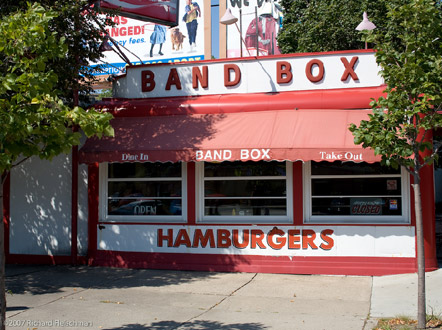
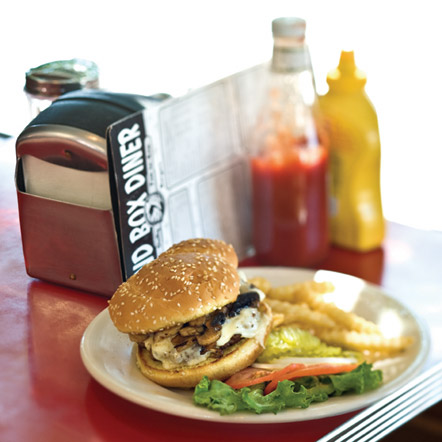
    The Band Box opened that same year just outside downtown Minneapolis, and is enough of a neighborhood institution—and landmark—that its 2003 renovation was supported by Elliot Park neighborhood revitalization funds. It’s got a classic red-and-white color scheme, a standard eggs-pancakes-and-sandwiches menu, and a friendly neighborhood vibe. Although the Band Box Diner’s motto is “Turning Grease Into a Feast For Over 60 Years!” neither my juicy mushroom Swiss burger nor my side of fries was actually very greasy.

    BandBoxPIC3.jpg

    Something about the Ideal Diner brings Lake Wobegon to mind. It’s a place that, to paraphrase Garrison Keillor, “time forgot and the decades cannot improve.” That could almost be its motto, except it already has a better one: “Where Regular People Feel Special, and Special People Feel Regular.” My deep-fried pork tenderloin sandwich was more regular than special, but the accompanying hash browns were terrific. And the daily special, billed as goulash, turned out to be classic Minnesota hotdish: elbow macaroni, ground beef, and tomato sauce, untainted by any detectable spice or seasoning.

  • Men with Baggage

    In the past hundred years, women have successfully appropriated menswear, from slacks and dungarees to business suits—but the exchange hasn’t exactly gone in the other direction. But lookit! Finally it has at least become socially permissible for men of all stripes to carry purses—or satchels, if you will, or just plain old bags. It’s only fair, after all: What guy doesn’t have a BlackBerry to pack, or a bottle of prescription drugs to tuck away until lunchtime? Trailblazing toters may have endured teasing, their attachés being branded with insulting names (“murse”? “man bag”? ugh!), even as their cohorts made do with slovenly JanSports.

    Now, thanks to an assortment of over-the-shoulder carryalls in leather and distressed canvas, the man-with-bag look is as fashionable as it is practical. And not just for lawyerly or Wall Street types. In fact, we wonder whether the proliferation of technological gadgetry didn’t seed this trend among our nation’s youth. In any case, Prince Charming ferries his own car keys these days; he feels naked without that rugged Jack Spade file case (above)—the one with heavy-metal hardware, a pinstriped interior, and enough room for everything he used to shove inside his companion’s purse. Our roaming photographer also met up with handsome heirloom leather bags outfitted with elaborate enclosures and a seductively sleek, bowling bag-inspired duffel by Ben Sherman. To these handy accessories we say: Carry on, fellows.


  • What do you do?

    We are children, and then we work. If we’re fortunate, at any rate, we’re allowed to experience our childhood as children, and able, when the time comes to make our way in the world, to find work. Meaningful work, if we’re truly fortunate.

    The truth, though, is that the introductory icebreaker for youngsters—“How old are you?”—is too quickly replaced by “What do you do?”

    Work occupies a huge territory in both the conscious and unconscious minds of twenty-first-century Americans. We do it, talk about it, take it home with us, dream about it, get obsessed with TV shows about it; many of us allow it to dictate the parameters of our identities and the orbit of our social lives and what we do when we’re not working. The question of meaningful work looms larger all the time.

    Yet chances are that “meaningful work” means radically different things to people, depending on their economic circumstances, ethnic backgrounds, and ambitions. Also built into the notion are such questions as who or what we are when we’re not working. How much of an alternate identity does our work allow us?

    Our first notions of work, of course, take root in childhood, and in our childhood dreams and fantasies, which probably explains the wealth of evidence—first-hand, anecdotal, and statistical—suggesting that kids have largely unrealistic notions of work. Precious few have any real understanding of what their parents do for a living; thus the move, in the past decade or so, toward bring-your-kids-to-work programs. So it’s not particularly surprising that for generations, children, when presented with the inevitable question about what they want “to be” when they grow up, tend to choose highly visible occupations that involve art, public service, spectacle, and the archetypically heroic: ballerinas and painters, doctors and nurses, police officers and firemen, astronauts and professional athletes. In other words, they latch on to dream jobs—clear, simple concepts, really—that can be easily grasped at a time in their lives when they are more purely imaginative and idealistic.

    The real world, such as it is, usually crowds out these early dreams, whether through economic considerations (on both ends of the spectrum: a need to simply make a living or a desire for greater affluence), or the usual, practical process of gradual disillusionment that comes with growing up. For many of us, ambition and dreams inevitably take a backseat at some point, and work becomes a series of contracts and compromises with blunt reality.

    At the same time, we’re constantly bombarded with portraits of affluent achievers and annual reports featuring “executive compensation packages”; but what about all those other people who are still pursuing their dreams, or doing the sort of jobs most of us (with the possible exception of sociologists and economists) take for granted? There’s really no such thing as an “average Joe,” but what about those people who are routinely characterized as such? We went in search of random people doing random, interesting things for a living, most of whom are situated far outside the world of corporate America—a barber, a bartender, and a ballerina, for instance—and asked them not just what they do, but why and how they came to do it, and what sort of pleasures and perils their work offers. And as conscientious job interviewers have done since the beginning of time, we wondered: Where did they see themselves in five years?

    There are always a number of challenges involved in any discussion of work, many of them questions of perception and definition; for instance, how do we view the work we do, especially in relation to the work of our peers? What kind of attitudes and expectations do we bring to our jobs and careers? How does the reality of our work life measure up against those childhood dreams? And what, really, is work, beyond the purely personal nature of what each of us does to make ends meet?

    It’s huge, for one thing. The world is work. It’s everywhere, even if so much of it remains invisible, taken for granted, or situated outside the blinders many of us wear in our day-to-day lives. Work is a chain of connections and interconnections, the endless series of transactions and compacts that make the world run. Break down any fifteen-minute increment of your day and try to recognize all the points at which you are a participant in the ceaseless relay of work. You go to a restaurant, for instance; somebody seats you and takes your order; somebody mixes your drink, numerous other somebodies prepare your meal, somebody clears your table, somebody washes your dishes. Somebody else runs the whole shebang. Somebody owns the place. Another constellation of bodies supplies the restaurant with its meat, its produce, its liquor, its tableware; somebody hauls away its trash. Somebody built the restaurant, and somebody designed the layout and décor; somebody else cleans and maintains it. The signs and awnings are somebody’s livelihood. Somebody sells the proprietor insurance.

    Look at your life. Look at yourself in the mirror. Your shoes, the clothes you’re wearing and the clothing in your closets, the food in your cupboards and refrigerator, the stuff arrayed around your kitchen sink and in your medicine cabinet. All your gadgets and gizmos. Your car. The shit in your garage. Your haircut. All that stuff is the end result of somebody’s labor, and somewhere along the line it has passed through human hands. Trace any of it to its origins and you’d encounter a human being—or several, or dozens, even hundreds—just trying to earn a paycheck, support a family, and make ends meet.

    Again, how you perceive work, and how likely you are to see it all around you, probably depends largely on where and how you were raised. Certainly a kid raised on a farm, or in a family that has spent generations plying one trade or laboring in a particular industry, has a different conception of work than a kid raised in a white-collar bastion of suburbia. Such early ideas about work form the foundation for perceptions of class, and have for centuries.

    The future of work is another question that gets more complex and contentious all the time. Ever since a generation of post-war blue-collar parents sent its children off to college to learn their way out from under their upbringing, there has been an explosion of well-educated, well-trained white-collar professionals. The last few decades have been unprecedented boom times for the upwardly mobile.

    At what cost, though? Somebody still has to do the dirty work, the grunt work, the nuts-and-bolts stuff that keeps our cities (and our economy) afloat. Increasingly, of course, many of these sorts of jobs are filled by immigrant labor—another fact that raises complex and contentious questions. In this sense, it sometimes seems as if we’ve turned back the clock a century or more, to when America’s major cities were teeming with newly arrived workers from all over the globe. Those workers offered insane levels of productivity in return for paltry wages, and the often squalid conditions they worked under, once sufficiently publicized, helped to bring about government protections, as well as the formation of trade unions. They also inspired a wave of realist art and literature that both called attention to their plight and ennobled them and the work they did.

    These days blue-collar work—and work in general—has all but disappeared from popular culture. We’re not likely any time soon to see public art on the scale of Diego Rivera’s Detroit Industry frescos, commissioned in 1932 by Edsel Ford and the subject of almost immediate controversy. White-collar labor, on the other hand, particularly of the drone variety, has become a ripe target for satire, whether in the form of television’s The Office or Joshua Ferris’s alternately hilarious and grim recent novel, Then We Came to the End. There have also been best-selling books along the lines of Barbara Ehrenreich’s Nickel and Dimed: On (Not) Getting by in America, in which the white-collar writer introduced millions of Barnes and Noble customers and frequent fliers to the travails of workers at the lower end of the economic food chain. But what we mostly get today from culture is gauzy, fictionalized treatments of upper-crust lifestyles and careers, most of which are so unrecognizable as to qualify as purely escapist entertainments. Or we’re treated, generally through advertisements, to corporate America’s fantasies of working men and women: labor as soft-focus patriotic propaganda, complete with a soundtrack from Bob Seger or John Mellencamp.

    All of this comes at a time when, according to the U.S. Census Bureau’s 2006 report on income and poverty, the number of uninsured Americans rose to an all-time high of forty-seven million. And when, despite reported economic expansion, the poverty rate among children and working adults is still stalled at recession levels. Americans work longer hours than the Japanese and enjoy less vacation time than Europeans, even as average CEO pay over the past decade has increased by forty-five percent and the CEOs of the largest U.S. companies make more money in a day than the average worker makes in an entire year.

    According to recent data there are roughly 383,000 Minnesotans without insurance, nearly seventy percent of whom are employed. Fifty-six percent of those are self-employed or work for small businesses.

    Those are all just numbers, though, even to the people who are most affected by them. People still go to work, and as we discovered in our interviews, they do what they do for all sorts of reasons. Somewhat to our surprise, many of these folks are doing exactly what they want to. These are people who’ve somehow realized their dreams, or made sacrifices for the sort of freedom and flexibility made possible by what they’ve chosen to do with their lives. Some of them, certainly, have made a kind of peace with what they’re doing. These are people who have come to the crossroads, and chosen.

    All of them have presumably wrestled with the questions familiar to anyone who works for a living. How much insecurity are we willing to accommodate to square the work we do with the lives we want? How much, in a very literal sense, is our work worth? And how much are we willing to pay?

    BAIL AGENT: Janet Radloff

    BALLET DANCER: Penelope Freeh

    BARTENDER: James Flemming

    BOOKSTORE CLERK: Clarence Thrun

    BARBER: Jayson Dallmann

    DOG GROOMER: Bonnie Kane

    FARMER: David Van Eeckhout

    TAILOR: John P. Meegan

    MASSAGE THERAPIST/FLIGHT ATTENDANT: Mary Thomes

    AUTO MECHANIC: Steve Skibbe

    CONSTRUCTION/HOME REMODELING: Aria Williams and Moe Dominguez

    HOUSE CLEANER: Heather Joyner
  • Correction

    A note from the publisher: Due to a breakdown in our crack fact-checking department (which was caused, if you must know, by a complete failure on our part to acknowledge the distraction caused by the failing infrastructure of the American road system, the war on terror, and the recent Twins losses to the Cleveland Indians), we messed up repeatedly last month in a story about St. Paul Public Library Director Melanie Huggins (“A Woman of Action”). (Where’s a reference librarian when you need one? Unfortunately, nowhere in Minneapolis on a Sunday or Monday.) Anyway, to set things straight, here are the true facts, gleaned from the librarian herself: Huggins graduated from college at the ripe old age of twenty-one, instead of seventeen, as was alleged. The story also had Huggins pregnant within the first year of her acquaintance with her husband—but it really took them a leisurely three years. Finally, the author attributed several accomplishments to Huggins: opening Zelda’s Café at the Central Library, offering ESL classes, and opening a satellite branch at a domestic violence center. These amenities pre-date Huggins’s arrival; however, she does fully support them. As for us, if you don’t believe the above excuses, try these: The sun was in our eyes. Our shoes were untied. We thought we heard our mother calling. Yeah, that’s it. That’s why we dropped the ball.

    Tom Bartel

  • Mexico

    Last spring, Michael and Cathy Deering of Eden Prairie fled for Barra de Navidad,
    a country beach town along the Costa Allegre (“Happy Coast”) of western Mexico. There they riffed on the theme of our March issue by engaging in a whole other sort of body count.

    Michael and Cathy Deering

  • Deb Heisick

    Deb Heisick

  • Moving at an Unsafe Speed

    Tom Bartel’s editorial about the bridge collapse, “The Roman Arch: Mixing Metaphors Instead of Concrete,” touched on the dilemma or even the cause of the collapse.

    “ … It’s clear as well that politicians and bureaucrats who answer to politicians have no stomach for inconveniencing drivers …. What representatives of our government’s work receive more irate looks than the guys who put out the orange cones that slow us down?”

    No one was going to or had the power to shut down the busiest bridge in Minnesota. It was reported that when some lanes on the bridge had to be closed for inspections, people would throw objects and verbally assault the inspectors. There was just too much pressure from an insane pedal-to-the-metal society to keep it open, no matter how unsafe it was. Capitalism moving at a rapid pace will always trump an unsafe bridge. The demand to keep things moving at a rapid pace took precedence over the safety of a small handful of motorists traveling over the bridge at any given time.

    The debt we are in, the competitiveness, the greed, all add up to a maxed-out, cannot-stop society. Our non-stop, out-of-control lives are what rule and dictate things around here—not our “leaders.”

    Frank Erickson, Minneapolis

  • A Hole in "News Hole"

    Last month The Rake dedicated an issue to the stories that we missed while we were reading about the bridge collapse (“News Hole”). While we in Minnesota were asleep at the bridge, we didn’t notice that people concerned for a free Tibet traveled to China and hung a banner on the Great Wall. These protesters (one of whom was from the Twin Cities) spent thirty-six hours in detention before being deported. Talk about missing a story. This was news to National Press Canada, The New York Times, Time Magazine, Al Jazeera, CNN, Sydney Herald, Reuters India, Radio Free Asia, The Toronto Star, The Guardian in London, Channel 4 News in the U.K., The Cambridge Evening News in the U.K., The Globe and Mail in Canada, RadioFreeEurope/Radio-Liberty in the Czech Republic, The Age in Australia, CBC’s The Hour in Canada, The London Free Press in Canada, San Diego Union-Tribune, Brisbane Times in Australia, International Herald Tribune in France, Montreal Gazette in Canada, Gulf Times in Qatar, The Economist in the U.K. … You get the idea. Not only did the Minnesota press miss an international story with a local connection, so did The Rake.

    Bill Busse, South St Paul

  • The Toast of Powderhorn

    I jumped for joy to read in Ann Bauer’s conversation piece with Karl and Annamarie Rigelman (“Sweet and Savory,” August) about the croissants made at May Day Café. Without any hesitation May Day offers the best croissant in town, period. I am a true fan of the May Day, and give all the credit to Andy and the others for offering wonderful baked goods day in and day out. And the best part is eating my croissant in Powderhorn, away from the needless hype others might find attractive. Bake on, May Day; let your croissant be my guide.

    Mary O’Donnell, Minneapolis