Month: June 2008

  • Lyre

    There are certain works of art the body wholly understands before the mind kicks in with its distancing powers of disembodied detachment and analysis. In the Twin Cities, there is very little art in the public realm — in what we now call "the commons"– that does this. Most public art, strained through the cheesecloth of three or four bureaucracies, is earnestly mediocre, almost by necessity. Much of what wins competitions is "plop art," dutifully commissioned to meet the tithing requirement for one-percent-for-art public building projects.

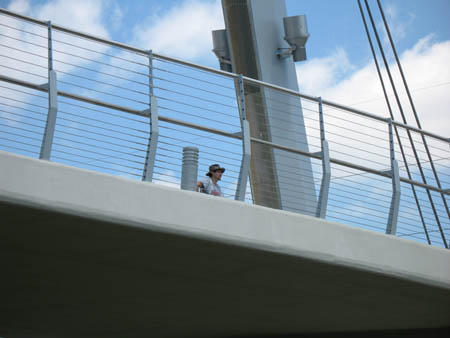
    I can think of a few exceptions –not many– where viscerally beautiful works have come to see the light of day as public art despite the pitfalls of the commissioning process. One of them is the Heilmaier Memorial Bandstand, by the artist and architect James Carpenter, the bandshell with the saddle-shaped roof of glass on Raspberry Island in the river off downtown St. Paul. Another (right nearby, actually) is the powerful "Floodwaters," the roiling torrents of cast bronze flanking the southern gateway to Harriet Island Park, by Jeffrey Kalstrom and Ann Klefstad. Yet another, a work beautiful against all odds, is one that was never primarily intended as sculpture but turned out to be more compelling to the senses than many things currently called that. It is the new Martin Olav Sabo Bike and Pedestrian Bridge that spans Hiawatha Avenue and the light rail tracks adjacent to it, just north of 26th Street in south Minneapolis.

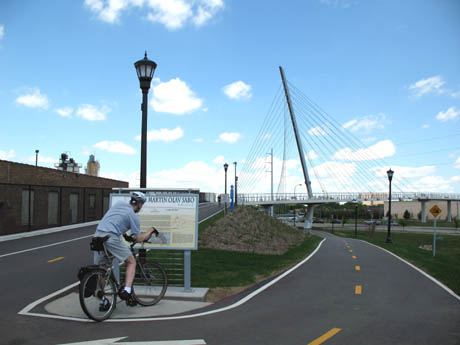
    The Sabo Bridge, named in honor of the congressman who secured federal funding for the project, is of a type known as a "cable-stayed bridge." Although they employ cables, the mechanics of cable-stayed designs are different from those of suspension bridges like the Brooklyn or the Golden Gate. A display panel on the bike path’s western approach to the bridge explains the design principle. From an engineering standpoint, a cable-stayed design presented the most elegant solution to the problem of spanning six lanes of traffic and two sets of light rail tracks without having to resort to intermediate support pillars in the middle of the road. The design wasn’t imposed on the site; it was inspired by the site’s constraints.

    The first time I saw the bridge was when I drove under it one evening at dusk a few months before it was completed. Its structural logic made itself understood on first sight. I felt it right away in my bones, sensing the forces working through and upon it the way people sense the rightness of the lines of a boat. Every one of the elements, the incredible back-bent mast, the deck, the fanned-out cables, the backstays converging onto bulwarks rooted deep in the ground, gave expression to the insight of the biologist D’Arcy Thompson that "structure is a diagram of forces." The bridge’s structure correlates with something internal, with one’s felt understanding of the structural mechanics of one’s own body. The sensation of it being in some way analogous to the way you yourself are put together tempts me to call the bridge a work of figurative sculpture-abstract, but nonetheless a human-figural representation of the forces and counterforces; metaphorically, of a tug-of-war; a stevedore hoisting a pallet aloft with a block and tackle, a puppeteer, a fisherman casting a fly. It is what it is –a bridge– but it triggers a chain of associations. It arouses the imagination in ways that few works of public art seem able to do, inert with virtue as most of them are.

    Call it a bridge or call it a sculpture, the new Sabo bridge is an inspired work, a piece of lyric engineering in the tradition of such masters of structural music as Santiago Calatrava, Pier Luigi Nervi, Eero Saarinen, and Frei Otto. Its elegantly tapered steel mast, backbent at an angle almost equal and opposite to the angle of its massive, similarly tapered concrete footing below the bridge deck, is a form sprung from the soul of Brancusi. The bridge is a stirring sight as you approach and go under the deck by car or light rail, and it doesn’t disappoint up close, when you walk or ride a bike over it. It is lovingly detailed: the workmanship in the steel and concrete is rigorous and clean, the care of the contractors readable in the panoply of the hardware, in the tensioning turnbuckles, tie rods, and railing cables, in the dramatizing spotlights mounted alongside the protective rubber boots on the ends of the bridge cables where they connect to the deck, in the backstay cables as their sinews converge in massive connectors to the concrete footings on the ground below.


    Cyclists in colorful gear flash across the bridge like shuttles of a loom. The balusters of the bridge railings are shaped with a bend like the mast’s. The railings themselves—the thin tension cables that pass through the balusters–are like the lines of a musical staff. They make the balusters read like the bars on a musical score, and a little like the frets on a stringed instrument, which in a way this whole construct is. The bridge is a lyre, a harp strummed by the wind. Reach over the railing and touch one of the cables that hold up the span. You can feel it thrum.

  • Serious Art

    Here’s a truism of modern art: Every new generation of emerging young artists is convinced it will reinvent the culture. And, strangely enough, they all go about this reinvention pretty much in the same way: By making a bunch of meaningless noise. Think of Tristan Tzara here, and his poems that go nowhere. Think of Jackson Pollock’s random splotches and drips. Think of the long and ambling filmic experiments of Warhol’s Factory. It’s not surprising, then, that the upcoming show “Serious Art” at First Amendment Arts of work by young artists Michael Gaughan and the group that calls itself Hardland/Heartland traffics in the realm of the bizarre and incongruous. Even the PR material are in on the act, abecedarianally describing the show as, “absurd, barbaric, concerning, despicable, entertaining, flippant, gregarious, half-baked, intellectual, jarring, knowledgeable, ludicrous, mellifluous, non-sensical, outlandish, perplexing, quadrangular, ridiculous, subversive, typical, urban, verbose, whimsical, xeroxed, yawn, zzzzzzzzzzzzzzzzzzzzzzzzzzz boring.” What this means, likely, is a colorful and head-scratching aggregation of colorful drawings, collages, paintings, installations, hand-made books, music, and fashions.

    The Serious Art opening party, which includes musical performances by Gaughan and members of Hardland/Heartland, takes place on Saturday, July 12, 7 – 10 pm. Admission is free. First Amendment Art is at 1101 Stinson Blvd (in basement rooms A & B) in Northeast Minneapolis.

  • Topless. Chicks. With Sticks.

    Like summer is upon us and will be gone faster than Flo Rida will be hot. With this in mind, I have to make a confession. I love women in convertibles (primarily) who shift their own cars. I want the summer streets filled with them.

    So.

    Here are my top three picks for the best mix of chicks and sticks forever.

    1) Porsche Cayman (not a drop top but hotter than milk chocolate on assphalt). I think this may be the hottest chick car of all time. Calling it Caychick might move even more of them (not that they need it).

    2) Alfa Spider. I dedicate this pick to Janet Car Chick Maximums Grangaard. You go girl.

    3) Porsche Turbo 1987 convertible. The first generation Turbos are some of the wildest, most unpredictable cars of all time. Reminds me of my girlfriend the first year out of college. She could drive cars. She could drive this Porsche. She drove men crazy (primarily) because they could not negotiate its manic, mephistophelean turbo lag.

    The woman was a devil.

    On that note, I generally feel that a chick with a stick will kick a "bad" (superaccentuated air parenthesis) boy with a toy any day of summer.

    Oi.


  • An Insatiable Lover

    We’ve been having some pretty ridiculously great weather lately. If I had a real job (sorry, Mom), I probably would have played hooky last week to go and hang out by one of the lakes. Instead I just read a bit by Calhoun, but without the sense of freedom (or guilt) of having emancipated myself from a necktie.

    Anyway. The poetic equivalent to our early summer comes, I think, in the verses of former U.S. poet laureate Billy Collins. Whenever I finish one of his poems, I just feel so damn pleasant afterwards.

    Maybe here’s why (from an interview with Collins conducted by The Cortland Review):

    Collins: Most of the devices used in poetry-meter and rhyme and assonance and the other kinds of tropes or effects-are really meant to give the ear pleasure in a way that prose does not. Poetry also appeals to the ear because poetry is an interruption of silence. A poem should be preceded by silence and followed by silence. A poem for me displaces silence the way your body displaces water.

    Or maybe here’s why (from an interview with Collins conducted by Terra Incognita):

    Collins: I am extremely reader-conscious, perhaps because I am tired of reading poems that seem to ignore the reader. I feel that I am talking to a reader/listener as I write, so that a good deal of my effort is just to make the poem clear. To get things in the right sequence so that the poem is easy to follow. Not just easy, but easy to follow because the poem is going somewhere, and I want the reader along to share whatever surprises the journey may hold. I try to begin the poem on a common ground, which is a way of assembling a little group around the campfire of the poem. Scoutmaster Collins will then tell some scary stories.

    Or maybe here’s why (from an interview with Collins conducted by Guernica):

    Collins: There’s a great pleasure in-I wouldn’t say ease, but maybe kind of a fascinated ease that accompanies the actual writing of the poem. I find it very difficult to get started. There are just long gaps where I can’t find a point of insertion, I can’t find a good opening line, I can’t find a mood that I want to write into. But once I do, once a line falls out of the air, or I get a little inkling of a subject and I recognize that, it’s like the sense that a game has started. Part of writing is discovering the rules of the game and then deciding whether to follow the rules or to break them. The great thing about the game of poetry is that it’s always your turn-I guess that goes back to my being an only child. So once it’s under way, there is a sense of flow.

    And now one of his poems. This is from his Nine Horses collection. (Click the link to buy it…)

    Aimless Love

    This morning as I walked along the lakeshore,
    I fell in love with a wren
    and later in the day with a mouse
    the cat had dropped under the dining room table.

    In the shadows of an autumn evening,
    I fell for a seamstress
    still at her machine in the tailor’s window,
    and later for a bowl of broth,
    steam rising like smoke from a naval battle.

    This is the best kind of love, I thought,
    without recompense, without gifts,
    or unkind words, without suspicion,
    or silence on the telephone.

    The love of the chestnut,
    the jazz cap and one hand on the wheel.

    No lust, no slam of the door –
    the love of the miniature orange tree,
    the clean white shirt, the hot evening shower,
    the highway that cuts across Florida.

    No waiting, no huffiness, or rancor –
    just a twinge every now and then

    for the wren who had built her nest
    on a low branch overhanging the water
    and for the dead mouse,
    still dressed in its light brown suit.

    But my heart is always propped up
    in a field on its tripod,
    ready for the next arrow.

    After I carried the mouse by the tail
    to a pile of leaves in the woods,
    I found myself standing at the bathroom sink
    gazing down affectionately at the soap,

    so patient and soluble,
    so at home in its pale green soap dish.
    I could feel myself falling again
    as I felt its turning in my wet hands
    and caught the scent of lavender and stone.

  • The Paintings Have Been Drinking (Not Me)

    Travel back with me, if you will for just a moment, to those happy, halcyon days of the year 2001. Oh, what a time to be a young American artist it was!

    The world waited breathlessly for the final bombshell in Matthew Barney’s Cremaster film cycle to drop (spoiler: Gary Gilmore did it!), and your hipper, richer, better-looking friends were cashing in their trust funds and moving en masse to some sort of Italian-speaking suburb of Manhattan called Williamsburg. Fashionable young men were rapidly perfecting the art of ironic facial hair, and their female counterparts had finally harnessed the unstoppable power of the knee-high boots/vintage skirt/wrinkled Mogwai t-shirt combination.

    Oh, what a time to be a young American artist it was!

    Amidst all of this excitement and bustle, your humble correspondent was an apple-cheeked 21-year old BFA candidate in Louisville, Kentucky, learning the twins arts of oil painting and quoting Foucault in the course of casual conversation (the latter being a skill set I still have yet to master). Like the rest of my newly-legal art school peers, I typically spent one or two Friday nights a month out viewing challenging video installations and half-baked performance art in the upstairs loft of a decrepit Clay Street warehouse or a little Frankfort Avenue storefront (the former being a favorite target of the Louisville Metro Police Department for repeatedly violating local noise ordinances).

    What was it that brought me out to those openings, weekend after weekend? Was it the thrill of newness? The excitement of being part of a community? The chance to hobnob with successful young emerging artists? The opportunity to meet prominent local gallery owners eager to display my crappy paintings of cigarette butts?

    Well, sort of. But not entirely. Truthfully, I was there mostly because these spaces usually served free Falls City Beer at their openings. I expect many of my peers were also there for the same reason.

    Now of course this isn’t the only reason I went to art openings in college. I was there to see some art, too. But if you’ve been involved in the art world in any capacity, you know this scenario well. It’s not Louisville, but maybe it’s Northeast Minneapolis, maybe it’s Lowertown St. Paul, maybe it’s Chelsea, maybe it’s whatever the arts quarter of your college town was called; but wherever it is, you know it.

    This is one of the first magical lessons of college: dude, they totally have free beer at art openings.

    If it’s not free beer, it’s free wine. And if you’re lucky, it’s free liquor. If it’s not free, it’s cheap. And if it’s not cheap, your friend working the bar will slip you a cup anyway. The point is, if you have an artsy bent and like to have a few drinks in you, there’s no better place to be than an opening on a Friday night. Openings and alcohol go hand-in-hand, like Gilbert and George, like Andy and Edie, like Jeff Koons and the feeling of wanting to punch Jeff Koons in the face.

    I began thinking about this after some rumblings in a few art blogs last month following the arrest of New York gallery owner Ruth Kalb during an opening at her gallery in the East Hamptons. The charge was violating liquor laws and entertaining without a license. Normally the goings-on of the Long Island art world have little interest to me personally, but this is really a universal theme. How many art openings have I been to that have been shut down by the cops for this very reason? Not a lot, but certainly a notable handful.

    Moreover, how many openings have I been to where someone got a little too drunk on the house wine and wanted to start a fight outside about the relative merits of shooting digital vs. Super-8? Or where the gallery owners had to kick someone out for sloshing their drinks a little too close to the artwork? Or where the aftermath of the night’s festivities was a catastrophic scene of discarded beer bottles, crumpled plastic cups and sticky spots on the floor? More than a few.

    Then again, there have been the many times when I’ve thanked the booze-soaked ghost of Jackson Pollock that I had a little cup of wine to look at the art with. Openings can be awkward, stifling affairs. People go to openings to see art, sure, but they also go for a multitude of non-art related reasons.

    People go to openings to see who else will be there. People are there to impress their friends and confound their rivals.

    People are clustered in unnatural little conversational groups – you’re spending a half-hour talking to that sculptor whose name you never remember, an adjunct professor you once had, your younger brother’s fiancée and that girl that works at the co-op, all at the same time. None of them have met each other. They all expect introductions.

    People are nervous. People want to look good because they may be photographed by The Minneapoline and get their pictures on the Internet. People want to look good because their ex-girlfriends will be there with their new, hotter boyfriends.

    Galleries can be stuffy and overheated in the summer and drafty in the winter, and a lot of the time it’s impossible to even see the art, much less form a coherent opinion about it because people are so crowded around it. If there is music, the music is loud and you have to shout over it. Even worse, the music may quite possibly be "experimental" in nature.

    You often have to seem smarter and/or cleverer than you may actually be.

    Needless to say, a little beer or wine in this context can be a godsend.

    It gives you something to look busy with if you’re by yourself, and gives you a little bit of impetus to talk to people with whom you might not otherwise think of much to talk about. It’s a scientifically-established principle that alcohol makes you smarter, or barring that, at least more confident about seeming smarter. Standing in front of a canvas with a little cup of wine in your hand feels right. It feels natural.

    From the gallery’s perspective, it can be helpful, too. It draws people in, for one. Healthy attendance numbers look good on those grant applications. If it’s a commercial gallery, a little libation gets people in the mood to buy. If the alcohol is donated, the gallery can even cover some additional costs in the process. No huge profit margins, obviously, but enough to make it worthwhile.

    I talked to the directors of a few Minneapolis galleries to get their take on the subject. Was serving alcohol at openings worth it? The general consensus, of course, was a qualified "yes." But within that consensus, there were a range of opinions. Everyone I spoke to wished to stay anonymous, for obvious reasons, so you’ll have to use your imaginations.

    There are some legal issues involved in serving alcohol, of course. Obviously, you can’t sell it without a license. Actually, legally, you can’t really even serve it without an entertainment license (you can read all the statutes yourself to your heart’s delight here on the city’s website). What you can do, though, is suggest a donation, and so this is the way most of the gallery
    owners I spoke to went about things. A lot of it really seems to be semantics – most galleries you’ll go to will have a posted sign asking for donations, and that covers some of the liability, anyway. Everyone was careful to stress that they run a clean house as far as underage boozing, outdoor drinking and slopped-out jerkiness are concerned. Young-looking types get carded, people aren’t permitted to wander around the street outside waving their beer bottles, and troublemakers get the boot. This generally keeps police and city inspectors away. As one owner pointed out, the cost of a license is a piddling little amount compared to attorney’s fees. Another even went so far as to regular hire off-duty cops to keep everything nice and legit for larger, more heavily-attended openings.

    Legal issues aside, there are also the behavioral and trash disposal issues. Most owners here, as well, had specific strategies for making sure people have fun without landing everyone in the drunk tank or the Broken Bottle Fight Injuries Ward at HCMC. Openings occur for a specific and set amount of time, end before the neighbors start complaining, and filter out collectively to neighborhood bars afterwards so people have somewhere to go and finish the conversations they started. Everyone I spoke to recycles bottles and plastic.

    Basically, all gallery heads reported back to me that their crowds, though they do love the beer and wine, are pretty reasonable, intelligent people that aren’t there to bankrupt the gallery, start fistfights or urinate Phillips vodka on the video art set-ups. Mostly they come to see art, meet up with friends, and generally have a good experience. The setbacks are far outweighed by the benefits. An art opening is, in the end, about the art – if it was just about boozing, all of our local gallery runners would be nightclub entrepreneurs instead. This is as it should be. Because let’s face it: Minneapolis, to her eternal credit, has much better galleries than it does nightclubs.

    So enjoy your beer and/or art this weekend, and just make sure the empty bottle makes its way to the recycling bin.

  • Storytime at The Guthrie

    PERFORMANCE

    Studio Stories: Kevin Kling and John McCutcheon


    Engaging storyteller Kevin Kling and award-winning folksinger/musician John McCutcheon
    join forces to bring you an evening of off-the-cuff performance in the
    Guthrie’s Dowling Studio. Kling, perhaps best known for his
    commentaries on NPR’s All Things Considered, and definitely for his
    autobiographical storytelling performances, will enrapture you with
    witty tales that are as amusing as they are eloquent. Accompanied by
    the seven-time Grammy nominated McCutcheon, tonight’s show will
    definitely be a riveting performance that might just warm the cockles
    of your heart. Want to make an evening of it? It wouldn’t be a trip to the Guthrie without at least a pre or post show drink at Cue! Speaking of – hurry to reserve your spot for The Rake’s World Flavors Dinner Party at Cue later this month!


    7:30pm, Guthrie Theater, 818 South 2nd Street, Downtown Minneapolis

    MUSIC
    Orchestra Baobab

    While the elegant Dakota isn’t
    quite as sublime as the outdoor quad in front of Northrop Auditorium-where
    Baobab played under sunny skies and swirling dancers in a beautiful
    evening on their last tour-this amazing 11-piece band does have another
    superb record’s worth of tunes in their arsenal: Made In Dakar,
    released in May, and equal or better than their comeback triumph,
    Specialist In All Styles
    . Barthelemy Attisso’s multifaceted guitar
    lines are the main attraction, but it is hard to discount the vibrant,
    beseeching griot vocals, the Afro-Latin polyrhythms (especially the
    verbose vocabulary of the talking drums) and the snazzy saxophone phrases.
    And like all great bands, the synergy is abundant. – Britt Robson

    7:30 p.m. or 9:30 p.m., Dakota Jazz Club, 1010 Nicollet Mall, Downtown Minneapolis, $40-$50


    MUSIC
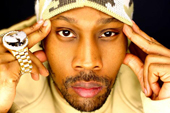
    RZA as Bobby Digital

    Many years ago, I would hold Wu Tang Clan video game
    tournaments at my apartment in St. Paul (yes, I used to live in St.
    Paul, and yes, Wu Tang had a video game). Ever since then, the names of
    the Clan have been burned into my mind, along with probably 3 or 4
    songs from the game’s soundtrack. Members of Wu Tang have come
    a long way since Playstation 1 however, with numerous solo projects, as well
    as clothing lines, film projects – and in RZA’s case, an Internet chess club!
    Tonight’s show features RZA as "Bobby Digital", his solo alter-ego.
    Expect signature dark beats and smooth flow, with a little synth thrown
    in here and there for taste, and maybe even some pointers on your chess
    game.


    8pm, First Avenue, 701 N. 1st Street, Downtown Minneapolis, $18

  • Snacking and Grazing the Mill City Farmers Market

    Yesterday was my first visit of the season to the Mill City Farmers Market, and I was pleasantly surprised by how many new stands there were selling locally produced prepared foods – apparently Brenda Langton, who was one of the founders of the market, and who owns the Spoonriver Restaurant next door, doesn’t mind the competition.

    Black Cat Natural Foods

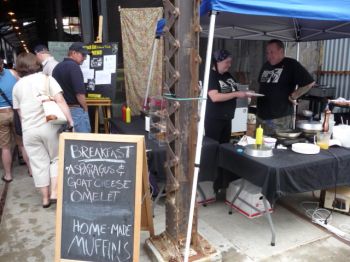
    The Black Cat Natural Foods is back this year – yesterday’s weekly specials included a goat cheese and asparagus omelet, and a pulled pork sandwich ($6; a bit dry, but not bad), made with slow roasted pork from their market neighbors, the Donner family, who operate the MN Valley Organics stand nearby. The Donners were selling their own sandwich, billed as a McDonner: egg, sausage and cheese on an English muffin ($5.25). *Insert joke about Donner Party here.*

    Dim Sum Street

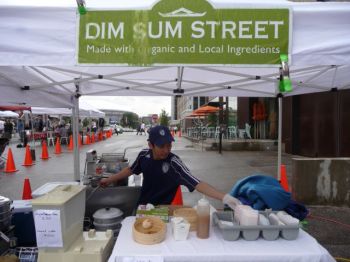
    Among the new stands this year: Dim Sum Street, which offered a combo of steamed chicken bun and three small egg rolls for $5, and Mo:Mo, selling steamed Nepali/Thai dumplings, stuffed with chicken (from the market) or vegetables, topped with a tomato ginger chutney. The veggie dumplings (stuffed with onions, tomato, cabbage, chives, ginger and garlic) kind of fell apart when we ate them, but they were quite tasty.

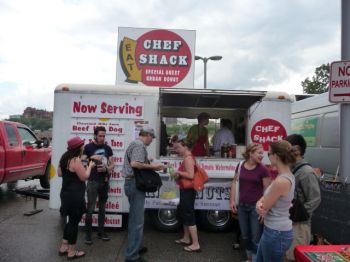
    If I had more room, I would have also sampled the wares at the Chef Shack food truck, where the menu included Thousand Hills beef hot dogs, beef tongue tacos and bison burgers.

    Chef Shack

    Under the market shed, there were several more options, including the Queen of Tarts, selling sweet and savory tarts, Edna’s Caramels, and Shepherd’s Way, offering nibbles of their farmstead cheeses.

    The Mill City Farmers Market, at 2nd St. and Chicago Ave. on the downtown Minneapolis riverfront, (between the Mill City Museum and the new Guthrie Theater), is open Saturdays from 8 a.m. to 1 p.m. through October 18.

  • Breaking Down The Blockbuster Trade With Memphis

    Joe Murphy/NBAE/Getty Images

    Let’s start this with the big fat cavaet that I rarely watch, and am certainly not very well versed about, college basketball. And since two of the key principals in the eight-player swap that the Timberwolves and Grizzlies pulled off in the middle of the night Thursday/Friday are high-caliber college players, I am working with hearsay and inferences rather than my own eyes about how good or appropriate Kevin Love and OJ Mayo will be while plying their now-lucrative trade for their new NBA teams. Maybe when I get a gander at Love and Mayo in action, I’ll have a totally different take. For that matter, maybe my college ignorance is why I seem to be among the minority (and in agreement with ESPN’s Chad Ford, which may be worse) in thinking it is a good trade for Minnesota. So be it. You can only go with what you think you know. I’m not trying to hedge, I’m just honestly laying out the context.

    First of all, the question isn’t whether the Timberwolves helped themselves last night–compare the pre-draft and post-draft rosters and try to tell me they didn’t significantly upgrade–but whether they helped themselves as much as they could. My answer is no, they didn’t, but that’s because they idiotically punted the 34th pick for no discernible reason other than to be pennywise, and we all know the second half of that course of action.

    Let’s cut to the chase. Here are the reasons I really like the Memphis deal.

    1) Mike Miller, who is one of the more underrated players in this league.

    Well, maybe not underrated so much as unknown despite his gaudy accomplishments. If you put out the trivia question: "Which NBA player has been named both Rookie of the Year (in 2000-01) and 6th Man of the Year (2005-06) during his career?" how many guesses would it take before folks came up with Miller? Having turned 28 in February, the guy is in his prime, yet sports the kind of game that isn’t likely to fall off a cliff once he moves past 30. Last season was arguably the best of his career. He sank over half his shots (50.2%), which is made more impressive by the fact that over 40% of them were treys (359 three pointers, out of 824 total FGA), of which he converted 43.2%. Those are career-best numbers but not a huge aberration, as Miller is a career 40.3% shooter from behind the arc after nine NBA seasons. He also led the Grizz in rebounds last year, averaging 6.7 per game, and doled out 3.4 assists. He’s 6-8–a legitimate 3 and a matchup problem for opponents at the 2. He is a floor-spacer par excellence, making it very difficult for teams to double down on Al Jefferson in the low block without getting singed from outside.

    2) Having a plan and sticking to it.

    The most glaring need for the Wolves coming into the draft was gaining size, and picking up personnel that would banish the absurd smallball that had Jefferson at center and Ryan Gomes at power forward many times during the season. Taking OJ Mayo with the third overall pick meant that for the fourth straight year the Wolves were drafting a backcourt swingman (McCants/Foye/Brewer/Mayo). When the team thought Mayo was indeed their pick, I heard Fred Hoiberg tell the Draft Party audience that they could always address the need for a big in free agency. Ah, but when you look at the free agent list, it’s slim pickin’s indeed–the best of the lot are probably Kurt Thomas and Dasagna Diop, both less-than-perfect fits (to put it mildly) who will command inflated salaries on the free market. So, that meant paying through the nose or putting up with another year of Mark Madsen and Chris Richard when you didn’t want to play smallball.

    Now you’ve got Jason Collins, who has fallen off a bit but is still a better complement to Jefferson in the pivot than anyone else previously on the roster. He’s a legit seven-footer who doesn’t need touches on offense and knows his meal ticket is rugged defense. You’ve got Collins for one year and then his $6.2 million comes off the books and you might have to look for another backup center before you can bring over the hot second round pick Nikola Pekovic, who most agree can be a player in the pivot once his rich deal with a team in Greece expires in two years.

    But more importantly, if you’re Kevin McHale, you have eliminated excuses, introduced more direct accountability, and gone out and acquired the person you unequivocally state is "the best big man in the draft." Kevin Love is just a shade under 6-10, has a wide body, is reputed to be a tenacious rebounder, and was named the Player of the Year in the PAC-10 as a freshman, a league that also contained OJ Mayo, Brook Lopez and Russell Westbrook. Many think he is too small to succeed in the NBA paint: McHale is not one of them. The Wolves front office get feisty in pointing out that his combine numbers for size and athleticism compare with Atlanta center Al Horford. They think Jefferson and Love are a legit 4/5, or 5/4, depending on the matchups. I don’t know if they’re right, but I do strongly suspect that Jefferson/Love will play bigger than Jefferson/Gomes, with the 7-footer Collins available to change the mix. More to the point, you don’t have a paucity of big men that enable you to trot out a 3-guard offense as the other side of frontcourt smallball and pretend that’s what you really wanted to do. If you’re McHale, you drafted Randy Foye stating that he can be a combo guard with a primary emphasis on the point, and OJ Mayo is not around to gum up and otherwise complicate that evaluation. The Wolves needed size and they got a better backup than they had last year and the person they believe is the best big man to come out of college this year. If they’re wrong, it will be very easy to notice.

    3) Boil down the legacy and it’s a 2-for-1 swap

    Thank god for salary cap junkies who keep us all honest, and for closet GM types always figuring the roster angles. They will have a field day with this 8-player (count ’em, eight!) deal and all its salary implications and ability to maneuver or not. Well, having watched this Wolves squad for the past four non-playoff seasons, I am well aware of what Marko Jaric, Antoine Walker and Greg Buckner bring to the table. Jaric has been reviled for what he got–a ridiculous contract that will pay him more than $7 million a year through 2010-11–and what he was not–he was not a good complement for Kevin Garnett, not good in the clutch, not capable of making anyone forget he cost not only Sam Cassell but a precious first round pick that has led to tanking by the franchise in order to keep it. Marko can be a spasmodically effective player in a "do all the little things mode." That’s not the definition of a $7 million man, however. Walker would have been bought out last year if he hadn’t greedily wanted more than he was worth to go away. And Buckner spent more time in street clothes than a uniform.

    Minnesota is not exempt in this deal from taking on the Grizzlies’ mistakes. Foremost among them is Brian Cardinal, who will make $6.5 million a year through 2009-10 and is less effective than Jaric. And Collins we’ve already discussed–overpaid at more than $6 million. So there you have it. The players who are truly coveted in this exchange, the ones whose talent really matters and will thus determine the legacy of the deal, amounts to OJ Mayo for Memphis and Mike Miller and Kevin Love for the Wolves. And that’s what will have to be determined: Is OJ Mayo ultimately worth more or less than Love and Miller?

    Those are the three reasons why I currently endorse the trade. But do I perceive there to be any downsides to the deal? Yeah, some potentially serious downsides. This is by no means a slam-dunk bonanza. Here are my primary concerns.

    1) No defense and lots of turnovers

    The Wolves brass seem convinced that Love and Jefferson on the front line is perfectly sufficient–no, even better, part of the
    new vogue–for the long term future of the franchise. But almost all the raving I’ve heard about Love is about his passing, his midrange and long range shooting, his savvy box-outs–not a lot about his defense. On top of that, there are some questions about his physicality in the paint. Now I know Jefferson’s game, and his offense is light years ahead of his defense. So going with a pair of legit power forwards who don’t excel at D sounds like a recipe for disaster in the paint against large lineups. True, large lineups don’t happen even a majority of the time anymore, but, funny, the really good teams seem to be able to defend them, mostly by having one themselves. Not to put too fine a point on it: Minnesota’s interior defense could be in trouble if Jefferson and Love are your frontcourt. Maybe it will be better than Jefferson-Gomes, simply because Love is larger, but let’s not forget that Gomes is pretty big (250 pounds) and smart too.

    What’s more, you no longer have Mayo in the backcourt and by most accounts, Mayo can be very good with perimeter defense. Stopping penetration was one of the team’s biggest bugaboos last year, and Mike Miller doesn’t seem like the answer. In fact a quintet of Jefferson-Love-Gomes-Miller-Foye, as marvelous as it might be on offense, sounds like a disaster on D. The Wolves would win and lose a lot of game by scores like 115-111, and that’s not the way to build a winning culture in the NBA.

    The silver lining in this, perhaps, anyway, is that the NBA showed us this year that defense is more than ever (in this time of zones are okay and hand-checking isn’t) about time synergy more than individual prowess. The Celtics only had two good/great individual defenders in its starting lineup–KG and Rondo–yet played masterfully together, rotating and fluctuating as if everyone was on a string. By contrast, the Nuggets had two defensive studs among its five starters–Marcus Camby and Anthony Carter–and played wretched, dreadful, pathetic team defense. The lesson is emphasis and motivation. Do I think current coach Randy Wittman can emphasize and motivate a subpar defensive team to be appreciably better than their individual collective talents? No, not really, which is why this is a concern.

    The other concern with the new Wolves roster is turnovers. For all of Miller’s strengths, he turns the ball over more 2.6 times per game, which is plentiful. As a rookie, even a precocious one, Love is going to make mistakes that lead to turnovers. Most importantly, Randy Foye is going to have to be your floor general and steady ballhandler. In addition to being a porous defender last season, Foye was hardly Mr. Steady with the handle. In fact I’d say Bassy Telfair is a large beneficiary of this trade, even as Corey Brewer seems penalized by it.

    2) That Mayo is a Superstar about to happen

    On draft night a few years back, everyone was wondering whether Detroit should have taken Carmelo Anthony instead of Darko. Turns out the real choice was Dwyane Wade after LeBron. It happens every year: Some people thought Marcus Williams deserved to go over Chris Paul and Deron Williams and some thought it idiotic. And there was Foye/Roy. Now we’ve got two guys who are consensus stars in Rose and Beasley, and divided opinion on OJ Mayo. Some see him as star who belongs in the conversation with Rose and Beasley, much as Wade did with LeBron and Melo. If those people are right, then this will obviously be a horrible trade for Minnesota. There are some things that could make it much less horrible–the emergence of Randy Foye into a star himself, making Mayo’s stardom redundant to the position; or the overachievement of Kevin Love from very solid pro to Chris Bosh-like invaluability. As I said before, the legacy boils down to Love/Miller for Mayo. And if Mayo is the dominant star who leads his team beyond expectation, bad deal for Minnesota.

    I’ll tell you what I’m not concerned about. I’m not concerned about Mike Miller retarding the development of Corey Brewer and inflating the Wolves to mediocrity so it can’t seize any more stud draft picks. If Brewer develops, he’ll earn minutes–the Wolves desperately a quality defender in their rotation–and the idea that Miller is going to come and go before he can be really important to the franchise underestimates his shelf life value.

    Last but not least, I want to reiterate how dumb it was for Minnesota to fritter away its second second-rounder at #34. I like the blockbuster Memphis trade (with the college cavaet unfortunately attached) and the first second rounder, who seems to be a mixture of draft luck and solid scouting. But this seems like it was a pretty deep draft–at least that’s what the Wolves braintrust itself was telling everyone to get its flock excited about the second rounders. And this did seem to be a draft where there was more-than-usual disagreement about who did and didn’t have first-round potential, meaning that some players regarded by smart, diligent scouts as first-rounders were still there at #34. For the Wolves to let Miami simply take it from them for two future second-rounders and cash feels like a lack of resolve to improve as rapidly as possible and bear relatively small cost for trying.

    More than that, it was stupid public relations. As one of the commenters to his site, Andy G, mentioned last night, there is going to be at least one or two players picked at or beyond #34 that will pan out in this league, opening the Wolves up to the same kind of scorn they received for Josh Howard.

    Worst of all, it may be the pick they handed over to Miami that is the specific example. The Heat chose Mario Chalmers, who the rep of being a steadying influence, a selfless point guard who enabled his more talented teammates at Kansas and then hit the big shot when it mattered to send the championship game into overtime. In other words, Chalmers is calm, seasoned and without a lot of ego. Now he is going to a team that has a pretty dire situation at the point, meaning that Chalmers might be able to work his way into getting quality minutes with a starting unit that includes Wade, Beasley and Shawn Marion. There’s potential for 8-10 assists per game right there, and if Chalmers gets them as a rookie, he’s going to have a very high profile. For all I know, this will be a laughable scenario when we look back on it a year from now. But if so, the Wolves will have dodged a bullet–and one fired from a gun they handed over to their critics.
  • Loud and Proud: Twin Cities Pride Weekend Is Here!

    FESTIVALS
    Pride Weekend Spotlight: LOW LIFE Minneapolis

    As part of the all-city-consuming extravaganza that is this year’s Pride Weekend, hip (and delicious) Loring hot spot Nick and Eddie
    jumps on the bandwagon for their first year open during the Festival.
    Calling in favors from their hipper-than-thou friends in New York to

    rock the alley behind the restaurant, which is definitely one of the
    more charming alleys (really) in the city, you can expect the most
    enticing of stage shows and the most glamorous of costuming. Put on by
    the infamous NYC nightlife pioneers from The Jackie Factory,
    this is one Pride stop that you certainly do not want to miss.
    Hopefully you won’t be so enthralled by the show that you forget to
    stop by the Festival in Loring Park, the Parade on Sunday, or any
    number of other fantastic Pride events going on over the weekend. Not
    sure where to begin? Click HERE.


    Friday from 7pm, Sat-Sun from 2pm, Nick & Eddie, 1612 Harmon Place, Loring Park, Free


    FILM
    My Winnipeg

    Described by Maddin as a "Docu-fantasia," My Winnipeg
    portrays the director’s hometown and his experiences growing up there.
    The film is somewhat of therapy for Maddin, putting down in writing
    and on the big screen many of his remembrances, thoughts, opinions, and
    stories he heard while growing up in Winnipeg, Manitoba, Canada. The
    melding of melo-dramatic silent-film style cinematography with archival
    footage from the past gives the film a real nostalgic feel. – Christopher Kelleher

    Read the full review…HERE

    Opening Friday, Lagoon Cinema, 1320 Lagoon Avenue, Uptown, $8.75

    Pride Bonus: The Walker is screening the Queer Takes film series through the weekend!


    MUSIC
    John Hiatt and The Ageless Beauties

    John Hiatt
    is an ersatz curmudgeon, a faux eccentric, a dilapidated Everyman with
    an undeniably big heart and an equally undeniable knack for songwriting.
    He can jangle a slant-back country blues song or ambush you emotionally
    by confessing for redemption. He’s got elements of a Nashville pro
    and a guy who’s listened to a lot of Dylan. He’s a painstaking lyricist
    who doesn’t try to make it all add up. His latest album, Same Old Man between his 15th and 25th
    release, depending on how you count best-ofs, live recordings, and groups
    like Little Village – may be his most enjoyable
    outing since the sweet spot two-fer of Bring The Family
    and Slow Turning in 1987 and ’88, but it isn’t that much
    better than the ones in-between. –Britt Robson

    Friday, Pantages Theater, 710 Hennepin Ave., Downtown Minneapolis, $47.50

    Pride Bonus: In the mood for something a little more boisterous? Head to nearby Epic Nightclub for the "Big Gay Pride Party"


    ART
    Order, Happiness, and other Fictional Perceptions

    Imaginative curator Emma Berg of mplsart.com
    brings us an interesting body of work featuring photography by Conor
    King, collage by Jaron Childs, drawings by Pam Valfer, and film by Amy

    Pierce – all artists with a connection to Minnesota. This exhibit
    invites the viewer to "look beyond the first layers of assumptions and
    into those that are born from looking into the obscured details." The
    artists were challenged to delve into themselves and examine
    assumptions and perceptions of everyday life – things that too often
    pass us by. Not to mention, The Gallery at Fox Tax,
    always throws killer openings that attract a bevy of up and comers on
    the Minneapolis art scene. Good people watching to be sure! Want to
    make a night of it? Dine at The Red Stag Supper Club, located virtually right next door to the gallery! Runs through July 26th.

    Saturday, 6pm-11pm, The Gallery at Fox Tax, 503 1st Avenue NE, Northeast Minneapolis, Free


    ART
    Umber Studios 1 Year Anniversary

    This
    little-known underground art gallery has been quietly throwing some of
    the best art parties in the Twin Cities for the past year. Umber has
    featured photography, drawing, painting, and installation work by artists
    of all levels and backgrounds which makes for unexpected and
    adventurous exhibits – thanks to the in-the-know artists who run the
    space. Speak of, tonight’s show will focus on work by those very
    people, Umber founders Jessica Helvey, Janelle Vircks, and Phil Behrend.
    All amazing artists in their own right, it’s time for a moment in the
    sun for these scene supporters who have devoted so much of their time
    and energy to up and coming local creatives of all shapes, sizes, and
    mediums!

    Saturday, 8pm, Umber Studios, 3109 E 42nd Ave., South Minneapolis, Free


    FESTIVALS
    GLBT Pride Parade

    There is no question that the annual Pride Parade
    is THE most visually enticing and entertaining parade of them all.
    Forget Miss Cowpatty Minnesota riding in a convertible, or your typical
    off-key highschool marching band – the Pride Parade is what (fabulously gay)
    dreams are made of! Last year about 135,000 people showed up, so I’d
    suggest getting there early to stake your claim on some prime
    parade-viewing real estate. You’d hate to miss the scores of gloriously
    adorned trannies strutting their stuff, the decked out and shimmering
    floats, or the inevitably oiled up, half-naked men that will be out if
    full force. If that last sentence didn’t hook you, well then, I’m not exactly sure what would. The parade starts at 11am on 9th and Hennepin and ends at Loring Park. Pre-Parade show at 9th and Hennepin starting at 9am. For more Pride events click HERE.

    Sunday, 9am pre-show, 11am parade, 9th & Hennepin, Downtown Minneapolis, Free

  • Highlights from Aspen

    Instead of giving you the day-by day-reports of Melly
    in Aspen, here are a few of the highlights.

    Swiller decided that we all should get a little high from
    mother earth, and we did — a super cold, wet, and intense high, care of Blazing Adventures.

    After the 45-minute bus ride, in which we made friends with the
    other adventure seekers, we were dropped off next to a port-a-potty on the side
    of the road next to the Roaring Fork river.

    Brad K — our life line guy if anyone falls
    overboard, and a cutie pie in an adventuresome kind of way — was very specific about the instructions: "Pee now if you have to because it’s two hours in the
    raft, and I don’t want anyone taking a leak in my wetsuits or on my rafts!"

    You really get to know people when you are all taking off your
    clothes, putting on stinky wetsuits (which the Blazing Adventure crew told us were washed the night before, yet still smelled like sour feet), and
    lining up to use the port-a-potty that had one roll of toilet paper for all 30
    of us.

    Being the outdoorsy gal that I am… "Screw the
    instructions; I need some bathroom privacy and a moment to question whether or not I should be
    participating in a whitewater raft when the river is at the highest it’s been in 20 years."

    Well, I sat my crack next to the crack part on the raft (Brad’s
    advice and words, not mine) and took my spot right behind Aimée Sedley (Cleveland Mike’s
    wife) with Bobby Swiller at the helm and Missy and my husband on the right. Brad, the sassy adventure guide, was in charge of steering.

    Every five seconds it was Swiller telling us to row (even though
    Brad said not to) with Aimée snapping at Swiller because she actually knew what she was
    doing and Missy smiling politely while Cleveland Mike was getting soaked and my husband was
    off on Planet Howard.

    After making our way through Barking Dog —
    almost getting decapitated, thanks to the high waves and large tree in the middle of the river — through
    Toothache rapid (the name given by all of the people that have lost half their teeth,
    and I am sure a few Veeners since they’re Aspen people after all), and finally ending up at our destination, all I
    could think of was getting me off the raft. I had three bottles of water that were about to
    explode out of my wet suit if I didn’t get to a bathroom quick.

    As I was squeezing myself to hold it, however, Swiller
    thought it would be funny to have Melly help get the raft and equipment up the hill and over to the
    bus.

    Yes, I made it; and could be wrong about this, but there
    were a lot of people jumping in the river right after we were done… I’m just
    sayin’, I think I know where the bad smell of the wetsuits comes from.

    Taking off the Sleestacks-looking garb in the hot sun felt
    so good that I didn’t even care that my 40-year-old butt was hanging out of my swimsuit
    for all my new adventure friends to see. I did, however, feel bad about the two huge bins full of snacks —particularly the granola bars — being passed over by those who caught a glimpse of my mushy backside.

    "Well, at least I won’t be seeing any
    of these other people again,"
    I thought to myself.

    Yeah, well, on the bus ride back I learned that one of my new
    adventure friends used to live in Minneapolis and was responsible for negotiating one of the
    biggest business deals my father has had in his career. Terrific. It was time for Melly to
    cover up quickly and try to act and look halfway respectable.

    To check out what happened to the group that went out after
    us go to "Fast water leads to river rescue," Aspen Daily News, Saturday, June
    21, 2008.