Category: Blog Post

  • A Chat with the Four Humors

    With their previous entries into the Minnesota Fringe all selling out by the end of their respective festivals, the Four Humors troupe has become something of an August favorite in Minnesota theater. This will be their fourth year participating in the Fringe, and the group is affiliated with three shows that will be playing around town through August 10th.

    The Spaceman Chronicles is something they’ve been carrying in their pockets since 2006; they developed Mortem Capiendum earlier this year, and have been touring it at various festivals throughout North America; and Shift was written in the two months leading up to this summer’s Minnesota Fringe. The assortment of plays represents a solid cross-section of what the troupe has been producing since joining together, showcasing the talent that has prompted critics to say they "offer up such wit and hilarity that audience members will be doubled over in their seats" (Star Tribune). The Rake had a chat with three of the four artistic directors – Nick Ryan, Jason Ballweber, and Brant Miller – to talk a bit about their recent work.

    The Rake: What was it like touring Mortem Capiendum?

    Brant: This is actually Four Humors’ first road show. It was kind of an experiment, just to see what it would be like. I don’t think any of us have ever done a tour before, in any capacity. So this is a first. What was it like touring? It’s a lot of work. In Minneapolis, people actually know us. We know we’re not huge, but in the community we’re known of. In every city you go to, though – Toronto, Winnipeg, Cincinnati – You’ve got to introduce yourself, and get people to come see your show, give you a try. It’s kind of like starting over. It would be like starting in Minneapolis all over again.

    Jason: Except for without the friends and family.

    The Rake: Did you use those festivals as sort of previews to hone the show?

    Jason: Yes. We used Cincinnati very heavily as a preview. We had minimal rehearsal time before we went there, so a lot of Cincinnati was spent working out, you know, the basics of the show. Like whose character’s doing what, and what’s the real big picture that we have going on here. So Cincinnati is what we call our workshop city, and we still had a lot of fun, and had a lot of fun with the show that we put up. And I think that the audiences liked it, but we really used that as a learning experience for what the show was going to become.

    The Rake: Will it change at all from performance to performance?

    Jason: Yes. A lot. It’s a much more open show than what we usually do. We usually include the audience a whole lot, but this one of the first productions where we are directly asking the audience questions, and treating them as if they are an audience that’s sitting before us. The conceit is that it’s a medicine show, and so [the characters] are trying to sell something to the audience. So when we ask questions – we expect an answer back, if we don’t get one that’s fine – but if they do answer, we’re able to talk back. We’ve had a few performances that have really been shaped by how the audience was taking it and what they were giving us. And it’s just the three of us on stage the whole time, and we’re three people who are very comfortable with each other on stage, and we’re able to play a whole lot together. I couldn’t say that any two performances of this show are similar, even.

    Brant: Also, I think we’re going to have done thirty-one performances over the summer? Which is the most we’ve ever done of any show of ours. And we like to keep it fresh for ourselves. It keeps us having fun, and stops it from getting stale.

    The Rake: Was it written collaboratively, and in general, what sort of process do you have for writing together?

    Nick: Well with Mortem Capiendum, it was written collaboratively, and it’s a bit of a change in direction from the shows that Four Humors has been doing. Up to this point, I’ve kind of written the script, and it’s been handed off to Jason, who would direct it, and that was kind of how we’ve done at least our Fringe shows for the last three years. With this one, though, we really wanted it to have been a collaboration between the four artistic directors of Four Humors, and just have us all discussing, and bringing ideas to the table from the beginning, and really have it shaped by the writing table atmosphere.

    Jason: To Nick’s credit, even when he does hand over a script, he’s been very open to our additions, and different actors adding things to what he’s written. So there’s already been a collaborative nature to how we work. This has just been the most unclear roles. We never sat down and said, "You are the writer. I’m the director. You guys are actors." It’s just been, "Let’s do a show."

    Nick: Everybody feels like they own the show in some manner. It wasn’t one person driving it to where it is.

    The Rake: Have there been any bad but preposterously funny reactions to the play as you toured?

    Nick: While Brant and Jason and Matt (Spring — the fourth artistic director) were in Winnipeg and Toronto, I was back here in Minneapolis, and I was checking online for any reviews of Mortem Capiendum. And there was one from the Winnipeg Free Press, and their basic premise was that our show was exactly like There Will Be Blood, in tone if not content, and that Daniel Day-Lewis shouldn’t lose any sleep over our performance. Basically, they were very upset that we weren’t as good as Daniel Day-Lewis.

    Brant: I’d also like to point out that I don’t think Daniel Day-Lewis loses sleep over any Fringe shows that are going on in the world.

    The Rake: Have been any good but preposterously wrong reactions?

    Nick: There was one woman in Cincinnati, who was apparently a mainstay at their Fringe. She was there every single night. And she saw the show. Jason and Matt and Brant play out to the audience a lot, so you can get a very good sense of whether the audience is enjoying it or not. And it was pretty clear that this woman was not enjoying it at all. And she came over to us and spoke to us at the Fringe headquarters. And she kept saying it was too much like the "Three Stooges." And I kept wondering why that was a bad thing. "Three Stooges" are fantastic to me. So we had this conversation, where she was saying it was too much like the "Three Stooges," and I kept saying thank you, and she said, "No, it was too much like the ‘Three Stooges.’" And I kept saying, "Thank you!" So she was upset that we didn’t hold the "Three Stooges" in the low opinion that she did.


    The Rake: Would you talk a bit about how Shift got into the Festival?

    Nick: Because Mortem Capiendum was going to be opened in Cincinnati at the beginning of June, my work as co-writer and outside eye was done by then. So I had a two-month block before the Fringe where I had nothing going on. A friend of mine, Jonas Gaslow, had a Fringe slot, and I approached him about collaborating on a one-man show. For the last few years I’ve been writing fairly exclusively for Four Humors, and I kind of took this opportunity to write something that Four Humors wouldn’t do. To try a show of a slightly different style. And Jonas comes from a very different theater background than I do, and the idea germinated from a numb
    er of conversations that we had together. We just met and talked about what sort of show we wanted to do. It morphed out of a few snippets of writing that I’d done before that, but it really blossomed into the show that it is when the conversation between Jonah and me started.

    The Rake: And how about Spaceman Chronicles?

    Nick: Again, because I knew that Mortem Capiendum was going finished in May, and that I would have this time, before I approached Jonas about Shift I had another slot in the festival lottery, that didn’t get into the general lottery, and I ended up on a waiting list. And I was fairly far down on the list. It wasn’t likely I’d get in. But about a week and a half ago we got a call from the Fringe main office, and they said they had a slot for us, if we wanted. We’ve had this show Spaceman Chronicles for a couple years, and it’s a very fun show, and we just decided let’s do it, let’s put it up as fast as we can, and it’s gotten very good responses so far. All three actors from Mortem Capiendum are involved, as well as myself.

    Jason: And the main confusion there is that you can’t have two shows under one production company name at the Fringe.

    Nick: That’s why we didn’t put the Four Humors name on it.

    The Rake: Have the Minnesota Fringe Festivals helped you to establish yourselves around town?

    Nick: It has really helped get the Four Humors name out. We’ve built a very good audience at the Fringe Festival. Basically all of our write-ups from the major papers in this city are from our Fringe shows. Though right now we’ve found it a bit challenging to take that success that we’ve had in the Fringe, and bridge it over to producing shows outside the festival in the larger Minneapolis community. While the Fringe has been great, we’re still making that leap into selling as well as we do at the Fringe, when we’re not at the Fringe.

    The Rake: Your stuff often deals with sort of higher entities (gods, devils, afterlife, metaphysics) — do you see any continuity in the shows you write from scratch?

    Jason: As a theater company, we like to take older myths and rework them. We’re a bit, um, post-modernist? We have the belief that there’s nothing new, and that you can take an old story and just re-tell it. I think there are, what, twelve stories in the entire world, and it’s just about how you tell them. Also, there’s the old mainstays. Poets keep writing poems about love because no one’s ever been able to explain it. Same with death. We’re interested with grand emotions, as well as the every day. Even if your shoelace breaks, in theater you have to treat it like it’s the end of the world. On stage it’s too mundane if it’s presented any other way. I guess post-modernistic…melodramatic…

    Nick and Brant: Comedy!

    Jason: That would be our main throughway — our interest in the humor of all these grand emotions.

    The Rake: Is there a certain type of show Four Humors likes to put up?

    Brant: We’ve been saying lately that the kind of theater we like to put on is the kind of theater we like to watch. So, that really sums it up. Stuff that engages the audience, and really brings them along, instead of just a fourth wall, feeling disconnected.

    Nick: And we’ve been operating under our mission statement for the last six months or so — we make the beautiful foolish, and the foolish beautiful.

    Jason: Also a little tag on: what we say as artistic directors is, "never treat the audience like idiots."

    Brant: Amen.

    The Rake: What’s harder – putting on a play, or trying to get status as a legitimate Minnesotan business?

    Brant: Well, for us – an assumed-name partnership is officially what we are, with a fiscal agent – just doing the paperwork was a big thing because we’re such artists that the business stuff isn’t right up our alley, we’re not as used to it as we are to creating a new piece of work.

    Jason: Which is not to say that putting up a show is easy.

    Brant: Not at all.

    Nick: We’ve just been honing that skill for a lot longer than we have keeping books and filling out paperwork and meeting deadlines.

    Jason: And just like any business, we’re going to have to consistently put out good shows for people to give us any money to continue putting on good shows. So one will lead into the other.

    See the Minnesota Fringe Festival website for complete listings of remaining showtimes for all the Four Humors’ works.


    To read John Erwin’s Inside the Fringe: Installment One, click here.

    To read Jill Yablonski’s Inside the Fringe: Installment Two, click here.

    To read Andrew Newman’s Inside the Fringe: Installment Three, click here.

    To read Brandon Root’s Inside the Fringe: Installment Four, click here.

  • Chris Adrian's New Collection of Short Stories

    These angels are useless. The heavenly agents that populate Chris Adrian’s new story collection, A Better Angel, sit idly by their hapless wards, disappointed and impotent. Their existence, it seems, is incidental, and at times they are nothing more than a higher order of fuck-ups. Which somehow makes these angels strikingly believable.

    A trinity of woes dictates the nine stories herein — sadness, illness, and death. It’s hard not to view this as the thematic culmination of Adrian’s educational background: he holds and MFA from the Iowa Writers’ Workshops (tantamount to a masters degree in sadness); an MD from the University of Virginia (illness); and is currently a divinity student (mapping out, I assume, the world of death). Thankfully these narratives are not so academic or esoteric as one might fear; Adrian explores his subjects with caution, respect, and most of all, imagination.

    If the angels might be described as inactive, then many of the characters can be called hyperactive. Adrian’s protagonists range from children to the geriatric, but don’t waver in their desire for pain. In this world, it seems that suffering is the most effective means of communication and solidarity. "My father warned me that sadness cleaves to sadness," says the protagonist of "Why Antichrist?" – in which a sixteen-year old lacrosse player discovers that he is the devil incarnate. "And that depressed people go around in hangdog packs." This collection is itself one such hangdog pack.

    The narrator of "Stab" – a seven-year-old boy who is mute except for his narration – wants to die because he knows death will reunite him with his dead brother. Likewise, in "The Changeling," a father mutilates himself because causing himself pain is the only way to bring his son out of his ominously catatonic state. In "The Vision of Peter Damien," the eponymous character wants to be sick, and rubs his skin with hickory root to simulate jaundice, so he can be more like his brothers and sisters. For many of these characters, death and illness are natural as sunlight. All but one of the protagonists has lost a loved one before their story even begins. It’s only natural that their ambitions pertain to more sickness and more death.

    The rules of Adrian’s world are vague enough to be plausible. The semi-magical setting is akin to that of Karen Russell’s recent collection of stories St Lucy’s Home for Girls Raised by Wolves, or any collection that George Saunders has put out in the last decade. Here there are angels, and there are demonic, masochistic children. The prose and dialogue are striking for their plainness (by which I do not mean dullness) – as it’s hard to imagine Dali creating his surrealist designs with ordinary paint. But when Adrian begins to add in elements of the real-real world – Happy Meals and Spiderman, for example – his stories become less convincing. In fiction (and maybe life in general), the balance between real and unreal is always tenuous. Perhaps because so much of Adrian’s world is heavenly, when Earth gets involved it is too obviously mundane.

    In "The Vision of Peter Damien," for example, a Big City Doctor is brought in to help out the community when a sort of epileptic illness spreads from child to child.

    "An upsetment in the blood," said Dr. Herz, summoned all the way from Cleveland by Sara’s father. For her he prescribed opium and antimony and cinchona.

    Both the diagnosis and prescription are, to say the least, archaic. When the reader finds out this story is actually about 9/11, then, it’s shocking – and not in a revelatory sort of way. Sadly, it’s more like the obvious twist in M. Night Shyamalan’s The Village than any sort of meaningful convergence of tragic old world and tragic new. Still, when Adrian delves into the metaphysical parts of this same story, his narrative strength shows through. His prose is heady enough to support Big Statements — he has the rare ability to talk about souls and be sincere, as with Sara’s final revelation:

    The mirror me – the one that is all of this world and all surfaces – is spotted up and bruised and jaundiced and thin, and my hair, as Mother tells me, has lost its spirit. But beyond my body I am a growing giantess, and every time I enter another vision I get a little closer to an end that I know is not death. You are a giant too – I see it no matter how you seek to hide from me. We stand over all the others the way the towers once stood over us, before we became them. Don’t you understand the progression – from frail little person to soaring angel to monolith? What next, except the sky above it all, and a spirit that comprehends everything, and is apart from nothing?

    Thankfully, Adrian plays heavily to his powers. There are stories so thoroughly imagined and expertly written that alone they warrant the price of the entire collection.

    "A Better Angel" succeeds because it contains a character that is keenly aware of his failures, but still does nothing about them. Early in life Carl was granted a sort of guardian angel, a privilege given only to people destined to go on to greatness ("There were fewer than I expected, and as many who were greatly bad as greatly good," he says.) His angel, though, has no power of Carl’s actions, and every time there’s a chance to make a bad decision, he makes it. Upon viewing his 7th-grade classmate’s ‘pooty,’ Carl says he first "understood that I could want – so badly – something the angel thought I shouldn’t." Finally he is summoned to take care of his dying, cancer-ridden father. Armed with Ativan and morphine, he adheres to the one-for-you-one-for-me policy, and spends his last night with his father in a druggy haze. Meanwhile his angel becomes more and more perverted and jealous, unable to guide his hand. "If you were a great man," she tells him, "If you were president – and you could have been president – then I would be a national conscience!" Carl is sympathetic because so many of us are so much like him — he isn’t a bad person, just a little lazy; his angel’s inefficacy grants us an unwanted hint into just world the dying father may be entering.

    "A Child’s Book of Sickness and Death" re-introduces us to some of the characters from Adrian’s recent novel The Children’s Hospital, in which the world is flooded in seven miles of water and the only entity to survive are the NICU and PICU wards of a San Francisco hospital (it’s narrated by angels). Here we focus on Cindy Flemm, who was born with a foot less of small intestine than normal. Sixteen years old, she proudly sports tube tops and hot pants in the antiseptic hallways. One night she develops a crush on Dr. Chandra (also a transplant from the novel), who is something of a tragic fool, severely under-qualified for his job and with pants that inadvertently ride low on his girlish hips. Much to Cindy’s disappointment, Chandra is gay. "How can someone so unattractive, so unavailable, so shlumpy, so low-panted, so pitiable, keep rising up, a giant in my thoughts," she wonders. It emerges that she is attracted to impossibilities, to the allure of cures that will never come (even if the cure is death – death is impossible for her, we find out). The interplay of her desire for health and desire for love, and how she goes about reaching for them, is something wonderful to witness. Finally Cindy submits to her position, which perhaps stands in for the overarching philosophy of the book:

    < blockquote>It seems to me, who should really know better, that all the late, new sadness of the past twenty-four hours ought to count for something, ought to do something, ought to change something, inside of me, or outside in the world. But I don’t know what it is that might change, and I expect that nothing will change – children have died here before, and hapless idiots have come and gone, and always the next day the sick still come to languish and be poked, and they will lie in bed hoping not for healing, a thing which the wise have all long given up on, but for something to make them feel better, just for a little while, and sometimes they get this thing, and often they don’t.

  • An Interview with the Writer and Directors of "Orange"

    I was excited to be able to catch up with Rachel Teagle and Ben Egerman, two friends of mine and veterans of the Carleton College theater scene. As newcomers to the Fringe, they were kind enough to lend some of their perspective, caffeine induced hysteria, and details about their new show, Orange.

    The Rake: How was the play initially conceived? How do the two of you typically collaborate?

    RT: The play was partially inspired by a crazy Joe Orton farce we had both just read, and our desire to make the original cast do bizarre things – like kiss everyone or get eaten. Ben and I typically collaborate pretty well. It’s a bizarre, mystical process even we don’t dare to understand.

    BE: I think another thing that heavily inspired our writing this particular play was our common frustration with a lot of the mania you would see on television regarding various terror levels and threats. When we first wrote it, a few years ago, it seemed like that had reached a fever pitch.

    The Rake: Of all the plays the two of you have written, how did you narrow it down to this one for the Fringe Festival?

    RT: We thought Orange was the best play for the Fringe, because it was political and goofy and had enough substance to it to be more than just a skit. Also it had cannibalism, and that’s really big in the festival this year. Particularly homoerotic cannibalism.

    BE: Also it’s really funny, and we thought audiences would like it. But our decision was mostly due to the cannibalism.

    The Rake: How has the play changed since its first production?

    RT: Well, we’ve added a bunch. We’ve fleshed out Alex the office manager and Harriet the tech girl a bit, and we’ve done some other edits to accommodate the new cast. Also, I think it’s a much darker show now than it was, partially due to the realism of the props. It’s gotten a little gory.

    BE: I’d like to think we’ve matured it a bit. Which is to say, it’s now only mostly sophomoric. But in a good way.

    The Rake: This is your first foray into to the Fringe Festival as writer/directors. What is the experience like as newcomers? Is it what you expected?

    RT: Everyone in the Fringe has been so warm and welcoming. We felt immediately that we were part of a community. The Fringe staff in particular has just been awesome. It’s sort of a crazy week and a half, and it’s hard to evaluate now that we’re smack in the middle of it. It’s really exciting to make connections with local artists and other like-minded creative folk.

    BE: Fringe people are awesome. They’ve been wonderfully helpful and supportive of us as newcomers. A great example is Phillip Low, who’s doing a show called "All Rights Reserved: A Libertarian Rage." We wound up chatting with him after one of the Fringe-For-All preview shows, and he offered us the opportunity to preview our play at two shows he was involved in prior to the Fringe. It’s really amazing to me that just after moving here, and just after getting involved in all this stuff, I can head over to Fringe Central after shows are over and feel like I’m with old friends.

    The Rake: What kind of people do you expect to find in the audience?

    RT: Oh, we expect to find just about everyone in the audience, but the folks I think will most enjoy it are those that embrace absurdity, are looking for a very dark comedy, and anyone who wants to see Quentin Kennedy kiss everyone.

    BE: And anyone who appreciates a good Unabomber joke. After all, who doesn’t?

    Orange is playing at the Mixed Blood Theater on Aug. 6th at 7:00; Aug.8th at 10:00; and Aug. 9th at 5:30.


    To read John Irvin’s "Inside the Fringe: Installment One," click here.

    To read Jill Yablonski’s "Inside the Fringe: Installmant Two," click here.

    To read Andrew Newman’s "Inside the Fringe: Installment Three," click here.

  • The Gallery Grooves at AE and The Fringe Fest Gets Devious

    ART & MUSIC
    Gallery Grooves Jazz & Art Party

    If there’s one thing we’re good for here at The Rake, it’s putting on a fantastic party – and the Twin Cities Pan African Fest is the perfect excuse! Satisfy your art-tooth on multiple levels tonight at Altered Esthetics Gallery, where you’ll be lucky enough to lay eyes on the amazing group exhibition The Revolution Will Not Be Televised;
    an international collection of artwork in response to global and
    socio-political topics PLUS a special one-night-only exhibit in Gallery Q with sculpture and metal work by African artist Rabi Sanfo. Sip delightful South African wines courtesy of our friends at MT Global Wines
    while soaking up the exuberant sounds of Drum & Art Ensemble at 7 pm
    and guitarist John Penny playing jazz-infused world music at 8 pm – all
    thanks to the cool cats at Jazz 88. I’ll personally be there with bells on (ok, with black
    on), so feel free to come down and give me a piece of your mind, a
    high-five or a kiss on the cheek (some restrictions may apply).

    7-9pm, Altered
    Esthetics
    , 1224 Quincy Street NE, Northeast Mpls


    FRINGE FESTIVAL
    Deviants

    Well, I really wanted to go see this show, but Tueday’s performance was canceled "due to injury," so I ended up at Pho Quan on Nicollet with my BFF Stephen
    who insisted that it was "the best," but it was really just one of the
    filthiest places I’ve ever been to – not to mention they totally scrimp
    on the mock duck! Anyhoo, since my schedule won’t allow me to see Deviants in
    time for a personalized recap in this week’s Secrets, you’ll just have
    to take the word of the many reviewers who have been raving about it on
    the Fringe site. Deviants is a foray into debauchery with the always intriguing and abstract Live Action Set.
    Spinning a yarn of unconventional desire and the human psyche, this
    4-pack ensemble brings us an entertaining blend of dance, theater and
    good humor – or bad, depending on your appreciation level for
    depravity. Not to mention, it’s at the Soap Factory, which is the coolest space in the entire city, bar none. Runs daily through Sunday, check HERE for times and tickets!

    7pm tonight, The Soap Factory, 518 2nd St. SE, Minneapolis, $12 (Plus $3 Fringe Button)


    MUSIC

    Brad Senne


    Brad Senne
    is one of those amazing hidden gems you wish you could lock in a
    heart-shaped box and keep all to yourself. Unfortunately for you (and
    for any possible serial killers who may literally
    want to lock him in a box), the sweet sound of Senne is something that
    probably won’t be underwraps forever. So, if you want to be ahead of
    the pack, head down to the Acadia Cafe’s new West Bank digs
    tonight for an intimate performance of perfectly melodic indie-pop from
    this local singer/songwriter, who also just so happens to be the front
    man of the always fun local band Beight. And since you’re already there, you might as well indulge in the Acadia’s new and improved cafe menu
    which includes something called a "West Bank Burger," that, if taken
    literally, could potentially include cigarette butts and hobo sweat. Just kidding
    West Bank, you know I love you!


    8pm, Acadia Cafe, 329 Cedar Avenue S, West Bank Minneapolis, $5 Donation

  • Hippies: The Real All-American Heroes

    Rake photographer Denis Jeong is set loose in Detroit Lakes and tells us all he sees and hears. See the slideshows (Part 1 and Part 2) chronicalling his weekend, nudity and all.

    Boom-bam-bop-tap! Boom-bam-bam-pop-pop-pop! Is this what a drum circle sounds like? Maybe not, but that’s the sound I was hearing as I drifted in and out of sleep that first night. Drums ‘til dawn and a blazing hot sun by nine, not exactly the way I wanted to start my relaxing weekend away from the city. You’d think I’d be pretty grumpy the next day, and I was. Not for long though; who could be when surrounded by ultra friendly hippies and super jamming music.

    After a three and a half hour drive from the Twin Cities, I arrived at a hippie festival straight out of the 70’s. The 70’s with a 21st century twist, that is. There were, of course, the thousands of hippies ranging in age from about to be born–to about to possibly croak. There was the timeless image of long hair, tie dyed Grateful Dead shirts, and the desire to be "sustanic," but this time everyone drove his own car and rallied around their cell phones. It was the appeal of being free from politics and free from the corporate life that gave way for a weekend of dancing, camping, drum circles ‘til dawn, and just letting go. If all this sounds good to you, then there’s a good chance you still got a little hippie in you waiting to free yourself from the world.

    The 10,000 Lakes Festival, or 10KLF as it’s more commonly known, features more than 60 bands, plenty of unique food vendors, clothing, drums, hammocks and so on. The 60+ bands, most of which I had never heard of, were the inspiration for my weekend. Every band I witnessed had a way of embracing the crowd and never providing a dull moment. Whether the band played at noon or two in the morning, they always had people dancing. Even when there wasn’t any music at all, people were still getting down.

    One of the more well known acts was The Flaming Lips. They played Friday night, and started with one of the most elaborate openings I have ever seen. There was a member of the band inside a large ball rolling over the crowd, canons blasting confetti into the crowd, dozens of big colorful balloons beings bounced around the stage and crowd, groups of dancing Teletubbies on either side of the stage. At the start of the third song, a Led Zeppelin cover, front man Wayne Coyne told the crowd that he envisioned thousands of people getting naked for their next song then getting dressed again like nothing had happened. Luckily this did not happen, but a small group of women did end up dancing on stage with him, naked, of course. After that the energy slowed a bit, but it was nice to hear them play many of their classics.

    The Michael Franti and Spearhead performance was straight from the heart and covered many of the world crisis going on now. George Clinton & Parliament Funkadelic were decent, but nothing I would need to see again. EOTO, which are the percussionist and drummer from The String Cheese Incident, were a big hit to close out Friday night. Their style is a breakbeat, trip-hop, house, and drum n’ bass sound that is improvised as they play. It was very creative and fun to dance to. WookieFoot, who have created a sort of local celebrity status, brought their high energy, hippie purist music and tore it up. It’s hard to say who their band members are, as it seems the band is always growing; regardless, it’s a group of people who live for bringing happiness to people through their music.

    It’s hard to say who the headliner was, but I think if you said Phil Lesh and Friends, most people wouldn’t argue. Lesh, bassist for the Grateful Dead, brought to 10KLF what everyone was looking for. Their three and a half hour set was an inspiration to all jam bands, bringing together a oneness that emulated throughout the crowd.

    10KLF was an eye-opening experience for me. It showed there’s more to life than politics and economics. There’s a way of life beyond worrying about gas prices and deciding between fast food joints. The next time you find yourself sitting at a stoplight waiting for the light to turn green, take a cue from the jamming crowd at 10KLF: Turn on some tunes and turn on your life.

  • Pizza Farm

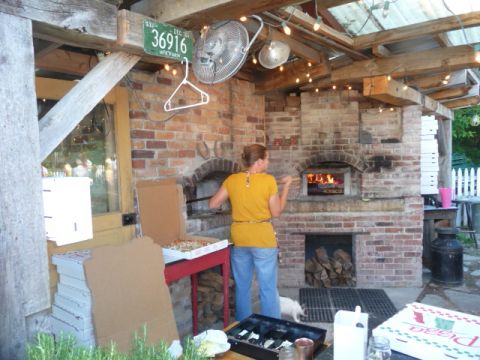
    Pizza Farm ovens

    About 50 years ago, the BBC broadcast an April Fools report
    about the annual spaghetti harvest in Switzerland, and got hundreds of
    inquiries from viewers who wanted to know where they could buy their own
    spaghetti trees.

    Really.

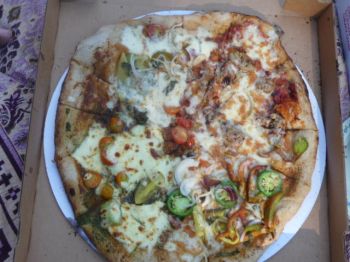
    So just to be clear on this – the pizzas at the Pizza Farm,
    (real name: A to Z Produce & Bakery) just outside Stockholm, Wisconsin, don’t grow on trees. But once a week on Tuesdays, the
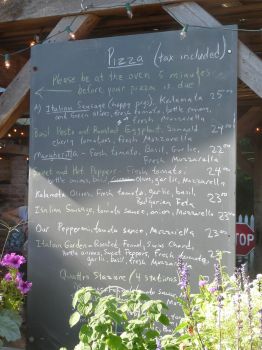
    owners crank up the two big wood-burning ovens, and make delicious pizzas to
    order ($23-$25), generously topped with a variety of fresh vegetables from the farm – everything
    from an Italian Garden pizza with roasted fennel, Swiss chard, bottle onions,
    sweet peppers, fresh tomatoes, basil and mozzarella– to a pie topped with
    Italian sausage (from "happy pigs") tomato sauce, onion and mozzarella.

    pizza

    pizza boardTo get to the Pizza
    Farm, you drive through Stockholm, and then turn on one country
    road, and then another, go past about three cemeteries and a little country
    church, and then there you are, in the middle of nowhere. (For a map, click here.) But it’s not exactly
    a well-kept secret. We arrived early to beat the crowds, and by the time we
    showed up – 5:15 or so – there were more than a dozen guests with tables and
    blankets spread out across the farm yard.
    By the time we left, the place was packed, and there was a long line of
    cars along the road leading to the farm.

    It’s a fun place for kids – out back behind the farm, there
    are a few cows, a couple of goats, and a few sheep, plus a coop with a mother
    hen and a brood of chicks, and a few cats that wander among the picnickers
    scrounging for scraps.

    The pizza farm folks only sell pizza, and loaves of bread,
    so if you want anything else, like wine, beer, cups or glasses, you bring it yourself.

    A to Z Produce & Bakery, N2956 Anker Lane, Stockholm, WI , 715-448-4802. Pizzas on Tuesdays only.

  • Strawberry Fields Overgrow The Fringe

    FRINGE FESTIVAL
    Strawberry Fields Temporarily

    Wear
    your laughing pants (you know, the Zubaz with lightning bolts on them)
    to this uproarious Fringe performance at Interact Center for the Visual
    and Performing Arts. Strawberry Fields Temporarily is a one-man-show written, directed and performed by clever comedian and storyteller Ben San Del, also the brains behind the 2006 Fringe hit Mittens for Fat Kids.

    San Del will weave three true-life tales of "the humiliations
    of stand-up comedy, the consequences of pornography theft, and the
    celebration of life as a long and winding driveway," all of which
    you’ll be able to relate to in one way or another (and no, not just the
    porn part). This show is garnering nothing but praise for its humor,
    sharp delivery and witty, self-deprecating honesty – so make sure to
    mark it on your Fringe itinerary!

    10pm, Interact Center for the Visual and Performing Arts, 212 3rd Ave N #140, Minneapolis, $12 (plus $3 Fringe Button)


    MUSIC
    Habib Koité and Bamada

    Tonight’s kickoff of the Twin Cities Pan African Festival is a doozy! Malian guitarist and singer Habib Koité and his band, Bamada, hit the Cedar Cultural Center
    for an evening of vibrant rhythms and warm, soulful sounds that will
    have you dancing in the aisles. One of Africa’s most admired musicians,
    Koité and his band put a traditional spin on things by using
    instruments such as polyphonic hunters’ horns, a balafón (wooden
    xylophone), and a n’goni (a Malian lute) to compliment his mesmerizing
    guitar playing and rich vocals. Want to make an evening of it? Keep the
    African theme going with din-din at the nearby Red Sea, where you can not only sample the delicious foods of Ethiopia, but you can listen to music and get your drink on too!


    7:30, Cedar Cultural Center, 416 Cedar Ave. S., West Bank, $20


    SPECIAL EVENT

    Lake Hiawatha Neighborhood Festival


    Oh, South Minneapolis circa 1984, how I miss thee. I often reminisce on
    those endless summer months as a child, when being outside from sunrise
    to sundown wouldn’t leave me sun-stroked and cranky. Back when days
    spent swimming, lounging and playing on the beaches of Lake Hiawatha
    or Lake Nokomis would pass in the blink of an eye, and starting my day
    at 7 am didn’t seem unreasonable. Tonight, partake in a bit of summery
    South Minneapolis goodness at the Lake Hiawatha Neighborhood Festival.
    This event is totally family friendly, with all the typical fixin’s
    such as pony rides, face painting, a talent show, a sandcastle building
    contest, and of course, the staple inflatable Moonwalk (most
    likely staffed by a guy with a mullet). And for all you b-ball
    fanatics, the Minnesota Timberwolves will be hosting a basketball
    shooting contest. Summer is fleeting, so get out and work on that sunburn while you still can!


    5pm-8:30pm, Lake Hiawatha Park, 2701 E 44th St, Minneapolis, Free