Month: June 2008

  • Bush Money

    My friend calls it his "Bush money." When I got my own Bush money—six hundred dollars from the Department of the Treasury—I stared at the words. Economic. Stimulus. Package. I’m not one to buy China-made plasma TVs, but I did want to help the American economy by buying something I wouldn’t have otherwise bought. Something fun. Something stimulating. So I decided to trade in my economic package for a different kind of stimulating package. The silicon kind.

    I nervously made my way to the Smitten Kitten, Minneapolis’s progressive sex shop. I had always lacked the guts to go there because, well, I’m a prude. A prude-and-a-half, really. But, as I entered the store and checked out the clientele and merchandise, I told myself I had to help America out. There were plenty of customers amidst the colorful dildos and vibrators, which, had they been in a paint store, would have had names like "mint moonshine" and "silver dawn." I shared company with a woman who I mistook for a honky-tonk man named Cletus, a coiffed blonde who could barely walk on her wedge-heeled sandals, a man bearing striking resemblance to Paul Wolfowitz, and three young girls in trendy leggings.

    I hung back while Jennifer, the seven-month pregnant owner sporting Mary Janes and a pixie haircut, fielded customers’ questions. She made her customers feel comfortable by talking about sex like she was discussing the ins and outs of turning a rotisserie chicken or changing a bike tire. One of the younger girls asked Jennifer in a mousy voice for a book that would shed some light on the personal problems she and her partner were having. Jennifer suggested ditching a book in favor of self-experimentation.

    "Yeah, cool…cool," the girl said, shrugging one shoulder like a junior high student trying to impress a friend while hanging out at the lockers. "Yeah, cool," she said once more like she had never said the word in her life.

    That made me feel better.

    It was my turn to ask Jennifer for help. She would have sensed my discomfort even if I hadn’t let it spill out of me like a broken bag of rice. I started out by bumbling on about how this whole excursion was inspired by Bush, and ended up saying something like, "blah ha ja ha blah." She listened patiently and then told me she’d start with a tour of the store.

    "It’s just like I’m giving a tour of the library," she told me. "You know, here’s the microfiche, and there are the atlases."

    Yeah, cool…cool. Libraries. I know a thing or two about libraries.

    Halfway through our tour we paused at the remote controlled vibrators. One caught my attention because the graphic designer of the "Waterproof Remote Egg Vibrator" had done a bang up job of creating the crappiest cover ever. It donned a busty model looking like someone had accidentally splashed her with a container of day-old popcorn butter. Looking at the cover, I had a hard time understanding how this image really turns people on. For all my mistrust of the Waterproof Remote Egg, though, Jennifer assured me that this was the best one of its kind. I was about to ask her just how she knew, when, reading my mind, she cut me off.

    "We took the remote around the corner," she explained. "You know where Falafel King is?" I was familiar. "Well," she continued, "it still worked even when we turned on the remote all the way from the Falafel King."

    I pictured a staff member with runny cucumber sauce and falafels in one hand and the remote control in another. Then I tried to imagine a lover trying to get his/her partner off from the local falafel store, and still had a hard time understanding just why this whole remote control thing would be necessary. I must have looked dubious because Jennifer told me, "It’s a good product." She stopped and turned over the Waterproof Remote Egg Vibrator, spying a crack down the fuchsia plastic. "Oops, this one’s broken," she said apologetically.

    I assured her I wasn’t going to buy the floor model anyway.

    When we got to the end of the tour it was time to shop. Standing among the multi-textured dildos I felt like I had entered the cereal aisle of a grocery store. Do I want Life, Cinnamon Life, Chocolate Cinnamon Life, or the new Fruity Life? Shoot, I thought, how could there be so many options? It is America, but come on. I mentioned this to Jennifer, who laughed and told me that, yeah, there were a lot of options.

    She paused for a second and added, "and then there’s size." Gulp. She picked up a dildo with the word "Randy" on the side of the box.

    "Randy?" I asked. Randy would be bionic if he were real, like the Incredible Hulk. On steroids.

    "Oh, they all have names in this brand," Jennifer told me, passing me Randy. "Todd, Jim, Spike, Joe."

    Oh, geez. Okay. Yeah. Cool. Randy. I asked her if they had a George, but no such luck.

    Feeling like a teenager in a Judy Bloom novel, I looked at the overwhelming selection as Jennifer left me to size up the situation on my own. Despite my novice attitude, I finally picked a nameless dildo and bought some books on great sex writing. The price tag for everything was $84.14, which meant I could still dump $515.86 into my savings account. This was definitely a shopping trip I wouldn’t have made without the help of the government.

    Fun? Yes. Stimulating? Yes.

    Thanks, Dubbya.

    I have only one regret. Half my purchases were made in Germany.
  • Perverts Park Here

    What’s in a word?

    More specifically what word makes a post zoom up the popular pole faster than others? Of course, there are the easy words like "porn" and "sex." Then there are the more inventive words (for professional writers) and happy accidents (for plebians like me).

    I have come across one recently. I won’t name the golden word, or perhaps the platinum-status proximity of two words. I have become superstitious about this discovery and don’t want to jinx it before I figure out how to hold Tom Bartel over a bigger barrel.

    Yet I must admit it feels delicious to be popular. Or at least it felt that way until my fragile literary ego was popped by a bigger man (in so many ways) and better writer than me.

    "Your post is doing well because of the perverts out there. Why else does it score so high every morning?"

    He is right.

    Get the headlines just right and you’ll increase traffic to your site. With an automotive blog, however, it seems that getting the traffic is far more contigent upon the headline than the vehicles it recommends for venturing into that real everyday madness you find on the street.

    Then again I guess even perverts need a place to park online. Speaking of which, I think its only fair that I credit my good friend Tom for the teaser line on this post (so good I almost can’t ask for money.)

    In fact, I was going to make this the headline for this post unitl my other editor informed me that Prom is now past–and the event is no longer "sticky."

    That was hardly my experience in high school.

    Then again my world, and my words, have long since changed.


  • Cure for the Common Life

    Your job is a prison, gas is expensive, you’re in debt, and both your house and your SUV aren’t worth the money you chuck at them. During times like these, it’s hard to see the merits of the American way of life. If you’re desperate for some escapism, check out Surfwise, the story of a man and his wife who, with nine children in tow, lived a utopian existence, free of material trappings and full of surfing.

    A celebrated doctor and Stanford graduate, Dorian "Doc" Paskowitz upended his life after two devastating divorces and years of anxiety. Vowing to find a new standard of health and to avoid the trappings of wealth, he found his third wife, Juliette, and traveled the country in a 24-foot camper over several decades, surfing with his family. None of their children went to school, they never paid taxes, and they never stayed in one place for very long. The Paskowitz family rode the wave of surfing culture to stardom.

    It’s a fascinating story, but the occasionally lazy film making gets in the way. I really wanted to know the meat of the story; how they made it work financially, the consequences of the unusual lifestyle and how the sons and daughter fare after life in the camper. The film touches on those questions, but it isn’t as satisfying as I was hoping for. Beneath the cacophony of the Paskowitz family wisdom ("Wash your asshole!" "Live like the animals live!" "Don’t be lazy!") there are a few really great moments, but at a lightning fast 93 minutes, I wish Doug Pray did a few more interviews.

    The good news is, despite some problems, the film will leave you wanting to learn more. Desperate to look at life through a different lens? Give it a try, dude.

    Opens Friday, June 20th, at Landmark Lagoon Cinema

  • Jasmine 26: A Second Look

    We had a delightful dinner at Jasmine 26 last night — a
    dramatic improvement over my visits last summer, shortly after the Vietnamese
    bistro at 26th and Nicollet opened its doors. Most of the Vietnamese
    staples are offered, like the spring rolls and egg rolls, and pho, for a dollar
    or two more than you might spent at Quang or Pho Tau Bay, or at the original
    Jasmine Deli, kitty-corner at 2532 Nicollet, but Jasmine 26 has a lot more to
    offer — including a date-worthy Zen atmosphere, a full bar, and a more varied
    menu that ranges from sweet potato shrimp toast and a lively banana blossom
    salad to grilled lemongrass baby back ribs and caramelized catfish served in a
    clay pot ($15).

    The appetizer of sea
    salt and pepper cubed tofu ($6), deep-fried and crispy on the outside, silky on
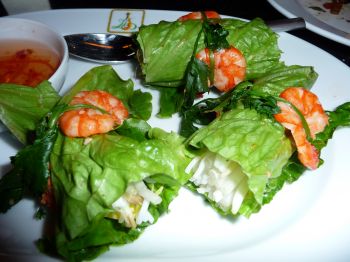
    the inside, is worth the trip all by itself, and the lettuce rolls with shrimp,
    egg, mint and cucumber, tied in a bundle with fresh cilantro are a fresh and
    light variation on the usual spring rolls. The usual noodle stir-fries and
    noodle salads are offered ($10-$12), along with some less familiar options –
    including grilled shrimp tossed with fat udon-style noodles in a very rich and
    savory coconut cream sauce. My bowl of beef stew with carrots and potatoes
    wasn’t quite as lively as the version I had recently at Quang’s, but still good
    enough to be enjoyable. We barely had room for the dessert – tart slices of
    ripe mango in coconut over sticky rice.

    A couple of beers and wines – including Sapporo and Kirin on
    tap, and an Australian cabernet and chardonnay are offered for $3 a glass.After 10 p.m., there’s an expanded list of wine, beer and sake for $3 a glass, plus bargain-priced appetizers, sandwiches and salads (all $4), and noodle dishes and soups ($6).

    Jasmine 26, 26th & Nicollet, 612-870-3800.

  • The Three Pointer: Great Coverage, A Ref Scandal, and, Oh Yeah, A Basketball Game

    NBA Finals, Game #3: Boston 81, Los Angeles 87

    Series to date: Boston 2-1

    1. Superb Coverage

    In all my years of watching NBA basketball, I can’t remember more incisive and illuminating commentary about the game than we got last night from Jeff Van Gundy and his cohorts on ABC and ESPN. The general purpose of these Three Pointers has always been to leave the obvious stuff alone and analyze the matchups and strategic flow of the game in a little more depth. But almost everything I was noticing as the game unfolded–and more–was being identified on the fly by JVG and, to a lesser extent, Mark Jackson and Michael Breen. And what stray pieces remained after that were cleaned up by the postgame interviews with the coaches and the studio analysis of Michael Wilbon and Jon Barry.

    Right out of the gate, the crew highlighted that Phil Jackson had decided to match Kobe up to guard Rajon Rondo, and then correctly surmised that the cross-matchup at the other end–either Rondo having to guard Kobe or Ray Allen having to locate him in transition–was a significant motivation for Jackson’s decision. Similarly, when Rondo went down with a slight ankle sprain and Celtic coach Doc Rivers (finally!) went with Eddie House instead of Sam Cassell, the crew poinhted out that the subsequent Celtic run was due to the better spacing House provided as a lethal long-range shooter, opening up the paint for Kevin Garnett to operate.

    Van Gundy was in a zone. On the Celtics out-of-bounds play under the basket in the final 1.3 seconds of the first period, he said "Usually [in this instance] you want a cutter to the basket and a shooter going to the strong side." Bingo. The Celtics had a man cut hard toward the hoop to draw down the defense, then had a strong side pick to free up three-point shooter James Posey for a trey. Then there was Van Gundy’s explanation of why the pull-up jumper is such a difficult shot, citing Kobe and Ray Allen as on-the-spot examples. Then, as the Lakers began to gather momentum in the 4th period, Van Gundy flatly announced that he would "trap Kobe on every possession." This dramatized Rivers’ failure to do that, not only making JVG look smart and prescient, but alerting even casual viewers about the silliness of leaving Allen hanging out to dry guarding Kobe in single coverage. Finally, Van Gundy understands that he’s a basketball nerd who looks like the guy who always got picked on by the bullies and ignored by the beauties growing up, and plays on that for comic relief. His halftime comment that of all the celebrities at the game, the one he’d most want to meet is Alyssa Milano ("If I was Nick Lachey I’d never let her out of my sight!") was hilarious.

    Mark Jackson necessarily suffers by comparison. Too often he either states the obvious or says something of questionable merit to back up a point he wants to make in the immediate circumstance. Claiming that Kevin Garnett isn’t a very good jump shooter and is far more effective in the low block, for example. Yeah, KG needed to operate down low far more often last night, but not because he can’t stick the midrange jumper–his recent shooting struggles are a significant aberration. Jackson also unleashes groaners like "Jordan Farmar is a starting point guard in this league," which damns Farmar with hyperbolic praise. But Jackson has his moments, like last night when he was the only one to point out that the "effective screens" JVG was praising KG for setting were illegal–a contention borne out by Garnett being called for a moving screen that was almost exactly the same as the one he’d set when Jackson mentioned it.

    Looking at the notes I’d jotted to myself after the game, one of the few things left was that nobody’d mentioned how putting Kobe on Paul Pierce had helped shut Pierce down–and then Phil Jackson mentioned it in the postgame. (The great D by Vujacic on Ray Allen which enabled the Kobe-on-Pierce coverage was about all the slim pickins I had left.) But when studio host Stuart Scott asked Wilbon why Pierce shot so horribly, Wilbon didn’t simply parrot Jackson; he also echoed his colleague Jon Barry’s smart, succinct comments about the difficulty of east to west travel (Jackson also brought up this point but Barry, as a recent player, put more meat on the bone about it) and also added his own analysis that the early foul trouble Pierce found himself in contributed to his woes. It was a great blend of cherrypicking the wisdom of others and adding your own insight makes the slam-dunk case for why Wilbon is way better than the guy he replaced, screamin’ Steve Smith.

    2. The Donaghy Stink Isn’t Going Away 

    As if Van Gundy wasn’t already having a fabulous night, disgraced and crooked referee Tim Donaghy verified his conspiracy theory from 2005. Back then, Van Gundy was fined a whopping $100,000 for claiming that the refs unfairly targeted his center, Yao Ming, for various infractions in response to pressure from Dallas Mavericks owner Mark Cuban. Through his attornies, Donaghy–incensed that the NBA calimed it spent $1 million investigating his unsavory associations, gambling debts, and potential fixing of games, a claim that could lengthen his jail sentence and perhaps compel restitution–essentially backed up JVG’s claims in detail. Interviewed at halftime about the matter, Van Gundy expertly walked the line between covering the NBA’s ass and yelling "I told ya so." He castigated Donaghy for his transgressions and pointed out that they give the ref little credibility, especially as he angles for a lighter sentence. But he also reiterated that the league needs total transparency when it comes to these backroom complaints and, more significantly, how the league decides to respond to them.

    The Van Gundy/Cuban dust-up from 2005 was actually small potatoes compared to Donaghy’s other contention: That two of the three refs (Dick Bavetta, Bob Delaney and Ted Bernhardt) working Game 6 of the 2002 Western Conference Finals were NBA "company men," who, at the direction of the league, went out of their way to officiate the game in a manner that would boost the Lakers over the Sacramento Kings. The officiating in that game was notoriously atrocious, to the point where then-Kings’ coach Rick Adelman bitterly complained about it after the game and many people only half-heartedly wondered if the fix was in.

    I know that Donaghy is not to be trusted, and that if he was going to inaccurately allege that refs beside himself were crooked, that Lakers-Kings game would be a strategically wise one to cite. But Commissioner David Stern cannot wish this one away, or cite previous FBI investigations into the matter. First of all, an entire, separate tribunal similar to the Mitchell Commission regarding steroids in baseball needs to be established, complete with subpeona power, and all doubts and controversies on this subject need to be exposed and examined. The stain and the stink are already out there, and the NBA needs to regain their credibility and good name with scrutiny that should err on the side of overkill. Remember, even as Stern castigates Donaghy for being a criminal trying to save his own skin, the league is also now proven guilty for creating an environment that allowed a compromised Donaghy to operate, and influence, many games, including playoff games. In light of Donaghy’s detailed, shocking charges, how is the NBA any different in trying to save its own skin by simply denigrating him?

    Even as the investigation takes place, Stern (or the person who replaces him) should take Phil Jackson’s advice and divorce itself from any influence over or connection to its officiating crews. That the league office has authority over the refs severely compromises its ability to investigate and judge any allegations made by Donaghy that the league influence referee conduct in the first place.

    3. Leftovers

    A
    fter making a bad coaching mistake subbing Trevor Ariza first off the bench in Game Two, Jackson redeemed himself with the Kobe-Rondo matchup and also by calling plays for troubled Lamar Odom twice in key second-half situations coming out of time-outs last night. Odom hit the first one and had enough penetration to enable Pau Gasol to get the putback on the second one. Jackson knows he’s not going to win this series if both Odom and Gasol remain in a funk. Right now Odom is the more significant problem. He’s resorting to attempted slam dunks on missed shots long after the refs have blown the play dead, cheapskate macho that’s even worse than KG’s, is a pickpocket’s delight every time he puts the ball on the floor, and has become a foul machine because he’s not thinking clearly–"confused," as Jackson put it. Those two plays out of the timeouts were designed to buck him up, and the Gasol putback made it a two-fer on the confidence-rebuilding front.

    I am thoroughly aware of the reasons why the Kobe-Rondo and then the House counter were both relatively effective. But did it really have to happen that way? Mark Jackson seemed to think it would be a terrible thing having Rondo be aggressive with his own shot as Kobe sloughs off him to play center field or double Pierce, claiming Boston doesn’t want to rely on its "fourth or fifth option." But an unguarded Rondo is a decent first or second option. He shot 49.2% during the regular season, and even his playoff accuracy of 41.4% is better than what the team’s other two point guards, Cassell and House, are shooting, and that’s with people guarding them. Which brings up the second point: Why not keep sloughing off the point guard and doubling KG in the low block even with House in the game? He shot 2-8 FG (admittedly, he was 2-3 from beyond the arc), so why not see if you can keep frustrating the Big 3 and make Eddie House beat you? Because guarding House out on the perimeter obviously helped get KG off. It reminds of all the times one coach will go big or small, and rather than seeing which way the deliberate mismatch turns, the opposing coach subs in the corresponding bigs and smalls to match up. If the situation(s) repeats itself in Game Four, hopefully the Celts will allow Rondo to go off, and the Lakers will dare House to beat them.

    Count me among those who think this was a moral victory for the Celts. Their Big 3 was 1-12 FG in the first period and the score was tied. Pierce and Garnett were terrible from start to finish and they still nearly pulled it out. If you’re a Laker fan, you can argue that Gasol and Odom likewise stank up the joint and the Lakers prevailed regardless, but on the basis of the first three games, who is more likely to bounce back to vintage form, Pierce/KG or Gasol/Odom?

    Just moments after Mark Jackson commented that Farmar and Vujacic were in a bit of a tiff over who should be controlling the basketball in the half court, Farmar clanked a long trey off the front iron. It’s the latest in a long line of reasons why I’m not a Farmar fan. But he and Sasha have more guts than brains, and both need to defer to Kobe more often, but when one of them has the hot hand, Laker fans should hope the other has the good sense to nourish it rather than horn in.

    Those who said the refs would call a "makeup" game in favor of the Lakers after the free throw disparity in favor of the Celts had ammunition for their argument after LA traipsed to the line 14 times in the first quarter alone. And yeah, overall I noticed a *slight* bias in the calls in favor of the Lakers, especially early. And as Wilbon pointed out, that may have compounded Pierce’s lack of rhythm, just as quick whistles on Kobe deterred his momentum in Game Two. But my take is that the calls were more even-handed last night than they were in Game Two, and that the refs didn’t decide the outcome of Game Two, let alone Game Three. And I do think Doc Rivers got in a clever dig at Jackson during the postgame last night when he claimed he was happy Jackson didn’t come in whining about the foul disparity this time.

  • A Seemingly Unlikely Marriage

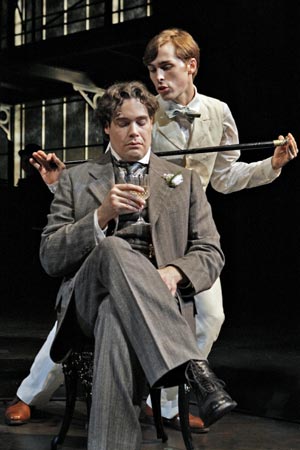
    The widely-discussed flamboyant personality of Irish playwright Oscar
    Wilde
    (1854 – 1900) is such that many often forget that Wilde was
    married and fathered two sons. It is his wife, the comparatively
    uncovered Constance Wilde, that gets the spotlight in Thomas Kilroy’s
    The Secret Fall of Constance Wilde, which opened June 6 at the Guthrie
    Theater’s McGuire Proscenium Stage. Set in a turn-of-the-century
    British train station version of Limbo, the play speculates on the
    Wildes’ relationship, with input from Oscar Wilde’s lover,
    Lord Alfred Douglas. Anchored by a mesmerizing and heartbreaking
    performance by Sarah Agnew (from the Jungle Theater’s The Syringa
    Tree
    ), the complex humanity at the base of the Wildes’ marriage pulls
    the piece through some peculiar theatrics and an unfortunate third
    wheel in the cast.

    The play covers Constance’s marriage to Oscar Wilde in a disjointed,
    stream-of-consciousness manner, starting with an imaginary final
    meeting between the couple after Oscar’s release from prison in 1897, and before Constance’s death the following year. Every major incident in their
    relationship is covered from Constance’s perspective, from his
    relationship with Douglas, to his trial and the unnerving revelations
    that were made there. But to say the unfolding of events lies only with
    Constance would be a gross misstatement. Rather than victimizing
    Constance and turning Oscar into a villain-type, the play depicts the great poet just as terrified and confused as his wife.

    Agnew crafts a brilliant portrayal of Constance, a woman being torn in
    two by her own conflicting feelings and the injury that increasingly
    pains her body and mind. Constantly driven to desperation by a need to
    confess her deepest secrets, Constance is a strong force despite all
    the turmoil she hides inside. And Agnew pours that agony out to the
    audience with every pained step and every choked word. A picture of
    grace under Victorian pressure, Agnew’s Constance pushes herself to
    determined bravery, proving to herself with each new turn exactly what
    their marriage means and what purpose Oscar serves in her life. Her
    quietly conflicted face, always a moment away from tears, never betrays
    itself and glues the entire audience to her whenever visible.

    As the famous poet, Matthew Greer casts a very different light on the
    common conception of Oscar Wilde. All the sharp-tongued wit is there,
    but in a series of increasingly delirious monologues, the more serious
    side of Wilde’s personality is revealed — dark, confused and barely able
    to comprehend the forces surrounding against him. At the close of act
    one, when Wilde is cast into prison, all of his underlying fears are
    terrifyingly ripped into reality. In these moments, the violent and
    nightmarish conditions are vividly brought to life by Greer alone.


    The only misstep in the cast is recent BFA graduate Brandon Weinbrenner
    as Lord Alfred Douglas — affectionately called "Bosie." Weinbrenner
    seems to have believed that it was up to him to provide the comic
    relief in the show, but when one of the lead characters is Oscar Wilde,
    no comedic foil is really required. He plays Douglas as the most
    stereotypical homosexual British aristocrat around — with open-mouthed
    shock, plenty of foot stamps and lots of whiny shouting. With two
    such beautifully nuanced performances from Agnew and Greer,
    Weinbrenner’s subtlety-be-damned approach is even the more jarring. If
    there were a villain of the piece, Douglas would certainly be it. But in
    this case, anyone ignorant enough to be fooled by such a person for so
    long probably deserves at least a little bit of the ridicule and
    torment thrown his way.

    All the other characters in the piece, from Wilde’s jury, to passersby
    on the street, to Constance’s own children, are silent puppets and
    objects manipulated by a quartet of androgynous puppeteers who not only
    manipulate the surroundings but the three players themselves, trapping
    every character into a certain mode of action. They serve as a greater
    force exerting itself on the characters, whether they are fate
    intervening or the strict rules of turn-of-the-century society.
    Director Marcela Lorca stages the action as one large dance piece led
    and manipulated by the puppeteer ensemble; a sensible choice, given her
    extensive choreographic work. Several sequences are staged with an
    almost filmic fluidity — a mixed effect to be sure. While slow-motion
    movement can often be effective, here it seems present only to produce
    a cinematic feeling.

    But the bond between Constance and Oscar is undeniable, even with all
    its contraptions and complexities. Agnew and Greer are at once repulsed
    by each other and irresistibly drawn to each other, making every
    interaction they share undeniably intense and impossible to look away
    from. What would seem to be an unlikely marriage becomes a deep love
    story about two people who could only find completeness in each other
    and the secrets they kept all their lives.


    At the Guthrie through July 31st

  • Ever Drink with the Devil in the Pale Moonlight?

    SPECIAL EVENT

    Drinks with the Devil

    Cock your top hat to the side and jaunt on over to Skyscape Condominiums for this red-hot cocktail party put on by the Minnesota Opera and The Rake. No need for those fancy mini-binoculars
    (aka "Opera Glasses") tonight; you’ll get your up close and personal
    mingle on with Kyle Ketelsen from The Minnesota Opera’s upcoming Faust and many other interesting guests. While you’re at it, introduce yourself to Tempo,
    a membership program geared towards Opera-hipsters ages 21 to 39. This party is on Skyscape’s 6th floor garden patio, which has a
    view you’ve simply got to see — with or without mini-binocs! Click HERE to register.

    5pm-8pm, Skyscape Condominiums, 929 Portland Ave, Downtown Minneapolis, must register to attend.

    FASHION
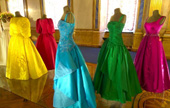
    Fit for a Queen: Nobel Gowns of H.M. Queen Silvia of Sweden

    Speaking of classy, Queen Silvia of Sweden definitely

    embodies the word! Today, the American Swedish Institute kicks off a
    marvelous four-month exhibit of gowns worn to the annual Nobel Prize
    festivities by Silvia Sommerlath since becoming Queen of Sweden in 1976. Each year, exquisite
    and vibrantly-colored creations were commissioned for the Queen, who
    worked closely with well-known designers such as Christian Dior and
    Nina Ricci to make her vision come alive. This dazzling collection of
    eighteen royal gowns, created and worn between 1976 and 2006, is on exhibit
    at the American Swedish Institute today through September 28th. Fancy!

    Noon-8pm, American Swedish Institute, 2600 Park Avenue, Minneapolis, $6 Adults, Kids free.


    MUSIC
    Kanye West


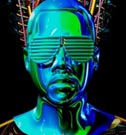
    While Kanye West may not be anything close to a "secret," I still feel tonight’s show is worth a shout out. The "Glow in the Dark" tour has been heralded far and wide as one of the best and most elaborate stage shows in, well, forever. And for all West’s diva-like behavior and cocky remarks, one thing is certain, the kid’s got vision — even P. Diddy agrees!
    Tonight, this hip-hop space odyssey rolls full force into Minneapolis,
    so slip into that silver cat suit you’ve been saving for a rainy day,
    and get dosed with futuristic sonic bombardment a la Kanye West. On a
    side note — I’d recommend checking out West’s kick-ass personal blog, which encompasses fashion, art, music, design — and the occasional babe in a bikini.

    6pm doors, 7pm show, Target Center, 600 1st Avenue N, Downtown Mpls, $38-$128

    MUSIC
    Haley Bonar In-Store Performance


    If you’re in the market for something a bit more low-key, the lovely Miz Haley Bonar has you covered. Her soulful and folksy crooning has a sexy hint of Christina Amphlette (of Divinyls I Touch Myself fame), with a dash of Tori Amos and maybe even a little Cranberries thrown in for flavor. Tonight at the Electric Fetus, get a sneak-listen to Bonar’s hot-off-the-cd-press album Big Star, a collection of sweet melodies and personal stories. Tomorrow night hit the Varsity Theater for the official CD release party!

    7pm, Electric Fetus, 2000 4th Avenue S, Minneapolis, Free

  • The Extraordinary True Life of George Hogg

    It’s easy to understand the
    attraction of putting the extraordinary true life of George Hogg to
    film. An Englishman bearing witness to and working in war-torn
    1930s China, Hogg became the headmaster of a failing school and grew
    to succeed where his predecessors had not. Fearing the Japanese
    army’s advance, Hogg resolved to lead his students on a perilous 700-mile journey
    through the mountains to safety.

    Screenwriter James MacManus
    learned of Hogg’s
    story
    while on
    assignment in China for The Daily Telegraph, overhearing that
    a statue dedicated to Hogg was being erected in a remote town on the
    Mongolian border. Intrigued, MacManus investigated the story. He found and interviewed Rewi Alley, a New Zealander who had known and worked closely with Hogg. MacManus’s story appeared in newspapers
    around the world and compelled film producers to commission a screenplay.

    Director Roger Spottiswoode provides an agreeable old-Hollywood-style
    gloss, and high production values shine throughout. Hogg’s story
    is presented earnestly but not too cloyingly, and the film’s photography
    (shot on location across China) is beautiful, evocative, and easy to
    appreciate on the big screen.

    Less effective are some of
    the performances, saddled with clunky dialogue and the screenplay’s
    need to expedite the passage of time from sequence to sequence, and given
    little room to establish themselves beyond the stock purposes they serve.
    Jonathan Rhys Meyers (George Hogg), great fun to watch as Henry VIII
    on Showtime’s The Tudors, can’t seem to impart the different
    kind of passion this material asks for; and Radha Mitchell (Lee Pearson) is oddly vacant in her role as an
    American nurse Hogg falls in love with. The easy charisma of
    both Chow Yun-Fat (Chen Hansheng, a communist rebel who helps
    Hogg) and Michelle Yeoh, (also in Spottiswoode’s James Bond
    film Tomorrow Never Dies) as a deposed aristocrat, is stark in
    comparison, and they elevate each of their scenes accordingly.

    But for a few moments of startling
    violence, the movie feels content to create and ride a passable after-school-special
    vibe until the very en and through the credits sequence, which hints at the poignancy that is ultimately missing
    from the rest of the film.

     The Children of Huang Shi opens June 13 at Landmark’s
    Edina Cinema
    .


  • Beautiful Resistance

    Remember beauty? The breath-taking, awe-inspiring kind? Take a pause to remember. And remember what followed the initial encounter—the inescapable impulse to share. Did you fumble for your phone or camera to snap a picture for posterity right away? Did you turn to the person next to you, excitedly asking, "did you see…?" or verbally pointing, "look there..!" The urge to share what is beautiful rests deeply within our psyches. Beauty wields the power to humble us, however temporarily, and to re-shuffle our everyday, typically rather self-involved priorities. Rather than secretly stow beauty away, we turn to one another to share it, try to re-create it in order to pass on the experience. In the words of philosopher Elaine Scarry, an encounter with something beautiful leads to a radical de-centering, and grants us a fleeting experience of a dramatically altered relationship to the world around us. Beauty, Simone Weil writes, "requires us to give up our imaginary position at the center."

    If Scarry and Weil are right, the creation and the sharing of beauty are acts of resistance. Why? Because creating the opportunity for "the ethical alchemy of beauty," as Scarry puts it, to run its course, to temporarily dethrone us from the human zenith of significance, means resisting a cultural imperative that tells us, in no uncertain terms, to put ourselves first, to insist on our usurping center stage in the narratives of our own lives and in those of others–other people as well as other creatures.

    Two shows that opened last weekend in Minneapolis take on the lives of those very others: at form + content, Christine Baeumler’s Lost Menagerie invites us to imagine and vicariously experience her encounters with the strange beauty, sentience, and intelligence of creatures dramatically different from us, while Allen Brewer‘s And Then There Were None pays homage to extinct and critically endangered species at gallery 360. Both bodies of work engage with questions raised by the ongoing loss of bio-diversity: Brewer’s paintings with the loss and endangerment of whole species, Baeumler’s installations and two-dimensional pieces with the risk of losing the experience of the seemingly insurmountable otherness and sheer beauty of the non-human world.

    Brewer’s animal portraits are exquisitely rendered. Their at times whimsical and luminescent beauty is paired with somber titles that plainly state either the date and place of extinction–Dodos, Mauritius, 1681; Pink-headed Duck, Calcutta, 1935–or the endangered status of the species depicted. The artist writes about the paintings, hung in ornate but recycled, chipped, and worn-looking frames, as shrines meant to remind us of the "holiness" of these non-human lives lost to carelessness and stupidity of a very human kind. Despite the fact that not all of the creatures in the paintings have already disappeared, that there is some-not much-wiggle room to enact protective measures for some endangered critters, the pieces have an elegiac air. For instance, the Midwest’s black-footed ferret, long thought to be extinct, has recently been returned to the prairies in a Nature Conservancy sponsored re-introduction project. In Brewer’s portrait, though, such hopeful (albeit small) signs of stewardship and caring for all existence are absent: the black-footed ferret gazes out of its portrait under a darkening, sinister, positively ominous sky.

    Darkness, too, plays a role in Christine Baeumler’s Lost Menagerie at form + content. Upon entering the sparsely light gallery space, pupils widen in a visceral response to low light, reminding visitors poignantly of our own branch on the family tree of species, our own evolutionary adaptations and deeply-seated instinctual responses. We may not be so different after all from the creatures Baeumler’s work engages with. As the artist reminds us by quoting Charles Darwin, the difference is one of degree, not kind. But the darkness serves another purpose: it asks us to step out of the conventional script of opening night, to interact in semi-darkness with gouache paintings of underwater creatures whose bulging eyes look back at us, and with video and sound installations that invite us to imaginatively enter into Baeumler’s encounters with various species, ranging from Spinner dolphins to flamingos, to turtles and mighty Galapagos lizards.

    Here, again, is the urge to share what is beautiful in that breath-taking, awe-inspiring way. Rather than mourn the careless extinction of countless species, here is work that asks us to pay attention to what we stand to lose. Yet Baeumler’s explicit concern lies not only with the threatening loss of this strange animal beauty but, more importantly, with the threat of losing the opportunity to experience and encounter that transformative beauty. Loss indeed figures centrally in Lost Menagerie: the loss of our ability to perceive, to slow down, to let "the ethical alchemy of beauty" run its course, to call out to us and transform us in the process.

    Unlike courtly menageries of past centuries, Baeumler’s menagerie does not gather exotic animals together for the sake of displaying wealth and power. And unlike zoos, which grew out of the menageries of old with the added clout of scientific inquiry, this work is not, strictly speaking, concerned with science, despite the prominent invocation of Darwin’s theory of evolution and the appeal to find affinities rather than insurmountable differences in our relationships to the non-human world. (The central piece, Darwin’s Table, includes a video loop of a human eye morphing into a fish eye and back, in a potent allusion to phylogeny). Instead, this body of work addresses experience, the act of beholding, of perception, and, to speak with Scarry one last time, "the creative act that is prompted by one’s being in the presence of what is beautiful." This creative act, driven by the desire to find ways to share encounters that move us beyond words, is the true centerpiece of the show.

    Yet in the process of engaging with these inevitably truncated snippets of profound experience, something odd happens.

    While poring over the glass-jar covered "specimens of experience," as Baeumler calls them, on Darwin’s Table and following the stop-and-go movement of slow motion video footage of a leaping pod of Spinner dolphins in Surfacing, we are conscious of the fact that the act of perception takes effort and time. The kind of beauty on display here resists short attention spans and exhortations to consume, more and faster all the time. There is resistance, too, to the paradigm of scientific objectivity and the putative neutrality of the observer. The thick glass of the jars on Darwin’s Table allows for distortions, reflections, and color variations dependent on the angle of vision. Clearly, there is no detached, objective position here: what we see depends entirely on where we stand, how hard we are willing to look, and how deeply we are ready to immerse ourselves in what we see. Scientific attempts at encapsulating, isolating, and scrutinizing experiences of this kind must ultimately fail.

    These kinds of beautiful resistance–to scientific abstractions, to anthropocentric attitudes, to cultural imperatives to consume and race through life as fast as we humanly can, and even to defeatist laments and cynical inaction–are met with another kind of resistance, though, a resistance that seems to originate from the moving images themselves.

    In Surfacing, for instance, the footage of the surface of the water, shot from a moving ship and projected in slow motion, becomes a plane for dreamlike abstraction: the
    slow-motion induced interruptions of the smooth flow of images conspire to create an effect of great distance. We are free to imagine that we’re looking at snow-covered mountain ranges from outer space, or wispy clouds, or perhaps randomly distributed, purely formalist marks. This contemplative state of aesthetic appreciation, though, is once again interrupted, this time by the graceful ascent of the dolphins. Glistening bodies rise from below the surface, arch out of the water elegantly, before descending smoothly. Their presence and beauty put an end to any associative mental journeys. But more than that, their unequivocally beautiful movement resists the technologically enforced slow-down, resists the very means of capturing and representing this experience.

    The colorful, distorted reflections on the glass jars on Darwin’s Table suggest a similar resistance of the specimens of experience on display. Rather than accept confinement in their isolated bell jars, new images emerge from the semi-darkness, composed in equal parts of video screen and reflection. Simply put, the images refuse to stay put. From certain vantage points in the gallery, the glass covering of the gouache paintings lends itself as a substrate for reflecting the leaping dolphins of Surfacing. Such is the nature of this incorrigible beauty: it resists separation, asserts itself unexpectedly and thus, on a small scale, offers a fragment of that original, mystifying encounter. Yet these feats of resistance accomplish something else still: they re-assert the uniqueness of the original experience, its irreplaceability, and the looming loss of the very possibility of such encounters.

    Ultimately, Baeumler’s work resonates with that alchemical, ethically imperative call of beauty to resist the human position at an illusionary center of the universe. Lost Menagerie invites us to embrace and seek out the radical de-centering that beauty may grant us–before it is too late and the menagerie of experiences and encounters Baeumler shares with us at form + content will truly be lost. This beauty is indeed a wake-up call.


    Acknowledgment: All references and quotations are from Elaine Scarry’s On Beauty and Being Just.

  • POWER: Yes, there is a PRICE YOU PAY

    I used to think that having POWER meant a better night’s rest and less worrying. I was again Wrong.

    In MY life I get to see a lot of things that most people don’t get to see. And there are times when I am so grateful for that window of lights, cameras, action — and other times when I am just at a loss for words.

    Yesterday, I wanted my daughter to see something to which I have been privy much of my life — a dignitary parade of sorts — and get her perspective. Oh, I got it all right, but not what a Mom wants to hear from her teenage child who, like her mom, has seen too much — The Truth.

    As we sat outside, watching town cars round the bend, my daughter fell silent, stunned by the production, by the number of people it takes to transport one dignitary to a private event, and by the way any resident’s needs or comfort falls to the wayside in these circumstances. What happens to a man when he no longer has his caravan? And what of the seemingly wasted man hours? — so many people just standing around.

    I spent many years chasing stories in the same way that everybody else in the media does — trying to make sure I was asking the questions that the viewers wanted answers to. Now that line between asking the wrong and right questions — and taking a story too far — have become even more blurred. This is my life. And I have people to protect, just like the dozens of agents standing around.

    I am a human being, right? And I eat, work, and use the restroom like everyone else, right? So what is the difference between me and, say, the Secret Service, the State Trooper, and the cop who makes a living protecting what the public should know and not know?

    What makes me different from these people is that They, as PUBLIC SERVANTS, pay a hell of a price for their Jobs. Imagine waking up in the morning, saying goodbye to a family that you love and protect, leaving your home, and saying hello to people you are PAID to protect — only, instead of a hug or kiss you get complaint after complaint after complaint.

    Yesterday, the story wasn’t inside, with the dignitaries (where the cameras would be, if only "they" knew), it was just outside, where I was
    standing. It was in the herds of people Paid to Protect.

    As Melinda Jacobs from "Action News" discovered, these people are nothing short of Heroes. Despite having to spend their day in idleness, they were wonderful and kind ALL day, hour after hour. (Only one Female State Trooper gave me "the look" on property that is rightfully mine.) And I could do nothing but be nice back.

    "We finally got some nice weather today."
    "I am going to get some coffee. Would you like some?"
    "Are you hot? Because I would be happy to run and get you some water."

    That is all that I could do with MY Power, but with Their Power they looked me in the eye with a nice smile and gave me that extra feeling of security that comes from being in the hands of people we as taxpayers are LUCKY as HELL to employ. This truly makes me glad that the harder I work, and the more money I make, the more money goes to a workforce of people that Deserve to wear their badges proudly, turn on their sirens, go through stop signs (because they Have to), and put on a uniform that carries the power of life or death.

    If only more of my tax dollars went to the workforce that serves and protects, and less to the ones that abuse freedom… Oh, I would sleep so much better.

    To the Republican Party: I have evidence that I will protect in a safe place.
    To the Democratic Party: I have evidence that I will protect in a safe place.
    To the Independent Party: I have evidence that I will protect in a safe place.
    To those who are undecided: While you fight it out I will be at Dairy Queen having a turtle sundae.

    COPS ARE MY ROCK STARS!